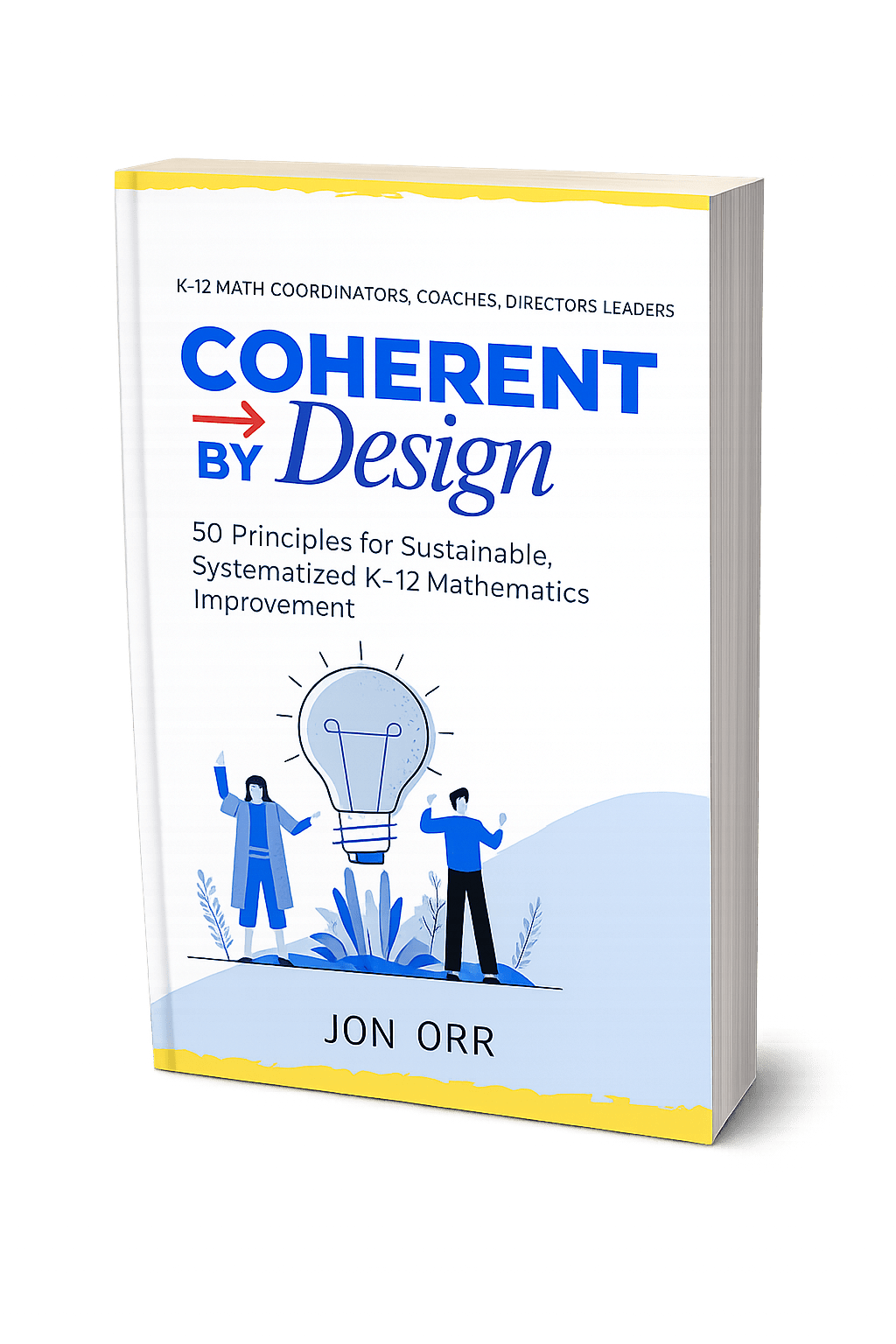

Most math improvement efforts don’t stall because teachers don’t care about mathematics.
They stall because the system supporting math instruction was never designed to hold instructional change over time.
We’ve worked with hundreds of schools and districts across elementary, middle, and secondary mathematics. Different curricula. Different standards. Different pacing guides.
The pattern is always the same.
Strong math vision held by one or two key individuals.
Good people working hard.
Dedicated math leaders.
And yet—math instruction varies wildly from classroom to classroom. Conceptual understanding fades. Procedural shortcuts creep back in. Student confidence erodes.
This book captures the principles we consistently see inside districts that achieve sustained improvement in mathematics instruction—not temporarily, not in pockets, but systemwide.
They are not tools.
They are design truths.
They are system truths.
Our hope is you have at least one epiphany in the area of math improvement planning that ignites a change in your system.
The 50 Principles of Math System Improvement
1. Math Improvement Is a System Design Problem, Not a Teacher Effort Problem
When math outcomes stall, the default response is often to ask more of teachers: more strategies, more fidelity, more urgency. But in every district we’ve supported, effort was never the missing ingredient. Teachers were already working hard.
What was missing was a system intentionally designed to support instructional change in mathematics over time.
Math instruction doesn’t change because teachers attend a workshop. It changes when planning structures, coaching conversations, leadership messaging, and professional learning all point toward the same mathematical goals. When those structures are misaligned—or absent—teachers are left to carry the cognitive and emotional load alone.
Sustainable math improvement begins when leaders stop asking, “How do we get teachers to do this?” and instead ask, “What system would make this the natural outcome?”
2. A Math Vision Without Measurable Instructional Shifts Is Just a Slogan
Many districts have beautifully written math vision statements. They reference conceptual understanding, problem solving, and mathematical reasoning. But too often, those visions stop at aspiration.
A usable math vision makes instructional change observable.
Leaders must be able to answer questions like:
- What will teachers do differently during a math lesson?
- What will students experience more often?
- What evidence would tell us this vision is showing up in classrooms?
Without clear, measurable instructional shifts, a math vision becomes motivational rather than operational. Measurement doesn’t restrict vision—it turns it into a decision-making tool.
3. Fewer Math Priorities Create Deeper Instructional Change
Math improvement plans often try to fix everything at once: reasoning, fluency, discourse, equity, assessment, curriculum alignment. The result is not coherence—it’s fragmentation.
Teachers experience this as overload. Leaders experience it as slow progress.
Districts that see real movement in math instruction make a disciplined choice to focus on a small number of high-leverage priorities and stay with them long enough for practice to mature. Depth—not breadth—is what allows instructional change to transfer across grades and contexts.
In mathematics, less focus almost always produces more learning.
4. Math Alignment Must Happen Before Classroom Implementation
When math improvement starts in classrooms before leaders are aligned, inconsistency is guaranteed.
If district leaders, coaches, and principals hold different interpretations of:
- effective math instruction
- productive struggle
- fluency
- student discourse
teachers receive mixed signals—often unintentionally.
Alignment is not agreement on language alone. It’s shared understanding of what matters most in math instruction and why. When leaders are aligned, coaching becomes coherent, feedback becomes consistent, and teachers experience support rather than contradiction.
Classrooms don’t create coherence. Leadership does.
5. District Math Improvement Moves at the Speed of Leadership Clarity
Clarity is the most underrated lever in math improvement.
When leaders are unclear about what strong math instruction looks like, teachers compensate by reverting to what feels safe—procedures, pacing, and compliance. This isn’t resistance; it’s self-preservation.
Clear leadership answers questions teachers rarely ask out loud:
- What matters most in math right now?
- What can I stop worrying about?
- What will I be supported in learning?
The clearer the message, the faster instructional change can occur.
6. Implementation Dip Needs to Be Planned For Not Abandoned.
Math initiatives often begin with excitement. New resources. New strategies. New language. But by October, enthusiasm fades and old habits return.
This isn’t because the idea was wrong.
It’s because leaders underestimated the implementation dip—the period when teachers are trying to apply new math practices, lessons feel awkward, and student responses don’t immediately improve.
Systems that expect early polish abandon teachers at the exact moment support is most needed. Successful math systems plan for this phase rather than being surprised by it.
7. Math Implementation Moves Through Predictable Stages
Instructional change in mathematics does not happen all at once.
Teachers typically move through stages:
- Awareness of new practices
- Mechanical implementation
- Refinement based on student thinking
- Proficient, flexible use
Each stage requires different supports. Systems that expect proficiency too early create frustration. Systems that design for stages create momentum.
8. Math Coaching Is a Translation Role
The most effective math coaches don’t arrive with checklists. They arrive with curiosity.
Their role is to help teachers translate district math goals into classroom decisions:
- Which task choices matter most?
- What student thinking are we listening for?
- How does today’s lesson connect to the larger mathematical story?
When coaching becomes compliance-focused, coherence breaks down. When coaching acts as translation, alignment spreads naturally across classrooms.
9. Math Teacher Buy-In Follows Instructional Clarity
Districts often delay math improvement efforts while waiting for buy-in. But buy-in rarely comes from persuasion—it comes from understanding.
When teachers see:
- how a math practice supports student thinking
- how it aligns with what they already value
- how they will be supported while learning
resistance softens.
Clarity builds trust. Trust builds engagement. Engagement builds improvement.
10. If Principals Aren’t Aligned on Math Instruction, Classrooms Won’t Be Either
Principals shape instructional reality more than any document or framework.
If principals are unclear about:
- what to look for during math instruction
- how to support teachers during implementation
- how math priorities connect to evaluation
teachers receive mixed messages, even when district intentions are clear.
Math improvement accelerates when principals are positioned as instructional partners—not passive messengers—and are given the time and support to develop their own math understanding.
11. Math PD That Doesn’t Change Lesson Planning Won’t Change Instruction
Professional learning in mathematics often feels productive in the moment—engaging sessions, rich discussions, new ideas. But if those ideas don’t alter what teachers plan tomorrow, classroom instruction remains largely unchanged.
Math instruction lives in planning decisions:
- which tasks are selected
- how representations are used
- what questions are anticipated
- where students are expected to struggle
Effective math PD makes those decisions visible and intentional. When leaders design learning that directly connects to unit planning, lesson launches, and anticipated student thinking, instructional change becomes far more likely to show up consistently.
12. Sustainable Math Systems Reduce Reliance on Exceptional Teachers
Every district has exceptional math teachers—those who naturally design strong tasks, anticipate misconceptions, and facilitate meaningful discourse. But systems that rely on these individuals to carry improvement are fragile.
Sustainable math improvement requires structures that elevate practice for all teachers, not just those who already excel. That means shared planning models, common language around instruction, aligned coaching, and access to high-quality tasks.
When strong math instruction depends on who a student gets as a teacher, equity suffers. Systems—not individuals—must carry the work.
13. Teachers Can’t Teach Conceptual Math They Don’t Understand
Conceptual instruction doesn’t break down because teachers don’t value it. It breaks down when teachers don’t feel mathematically secure enough to teach it.
When content understanding is thin, teachers lean on procedures, rules, and shortcuts—not out of preference, but out of necessity. This often shows up as:
- over-scaffolded tasks
- rushed lessons
- avoidance of student-generated strategies
District math improvement must include intentional support for adult mathematical understanding, not just pedagogy. Confidence in teaching mathematics grows from clarity in the math itself.
14. Mathematical Content Knowledge Is a Leadership Responsibility
Math leaders don’t need to be the strongest mathematicians in the district—but they must understand mathematics deeply enough to recognize strong instruction when they see it.
Without this understanding, leaders unintentionally:
- reward procedural teaching
- misinterpret productive struggle as confusion
- overlook rich student thinking
Leadership clarity in mathematics shapes what is celebrated, supported, and scaled. When leaders grow their own math understanding, they raise the instructional ceiling for the entire system.
15. Math Fluency Develops From Sense-Making, Not Speed
Fluency is often mistaken for speed. In reality, fluency emerges from connected understanding—where students see relationships, reason flexibly, and choose efficient strategies.
Systems that overemphasize speed push instruction toward memorization at the expense of meaning. The result is fragile learning that breaks down in unfamiliar contexts.
Districts that sustain math improvement redefine fluency as flexible, efficient, and accurate thinking—and design instruction accordingly.
16. Math Improvement Requires All Four Components of Adoption
Math initiatives rarely fail because the idea was wrong.
They fail because one or more components of adoption were missing.
Sustainable math improvement requires intentional attention to four interconnected components:
- a clear and shared understanding of the math and the instructional goal
- structures that support teachers in trying new practices
- support during implementation as practice evolves
- and monitoring that reinforces what matters over time
When any one of these components is weak, the entire effort becomes fragile. Teachers are asked to change without being supported while they are changing.
Districts that sustain math improvement design intentionally for all four components at the same time—not sequentially, not hypothetically, but in the daily reality of classrooms. This is how instructional change moves from intention to adoption.
17. One-Day Math Workshops Don’t Produce Long-Term Instructional Change
Single-day workshops can inspire—but they rarely transform instruction on their own.
Math improvement requires cycles of learning, application, reflection, and refinement. Without structured follow-up, even strong ideas fade as teachers return to familiar practices.
Districts that see lasting change design professional learning as a process, not an event—staying with key math practices long enough for teachers to internalize and adapt them.
18. Revisiting Math Practices Builds Instructional Precision
Teachers don’t refine math instruction by constantly chasing what’s new. They refine it by revisiting core practices with increasing precision.
Each revisit allows teachers to:
- notice deeper student thinking
- refine questioning techniques
- adjust representations
- improve task selection
Repetition is not redundancy. In effective math systems, it’s how practice becomes purposeful.
19. Math Improvement Depends on How Time Is Structured
Time is often cited as the biggest barrier to math improvement. In reality, structure—not time—is the constraint.
Leaders control:
- how PD time is used
- what PLCs focus on
- how coaching time is allocated
- which conversations are prioritized
When time structures are aligned to math goals, improvement accelerates. When they aren’t, even the best intentions stall.
20. Math Initiative Overload Fragments Instruction
When multiple math initiatives compete for attention, teachers are forced to choose which ones to ignore.
Initiative overload creates:
- surface-level implementation
- inconsistent messaging
- teacher fatigue
Coherent math systems protect focus by clearly naming what matters most right now—and intentionally setting aside everything else. Focus is not limitation; it’s leadership.
21. Math Test Scores Are Lag Indicators
End-of-year assessments tell an important story—but they tell it too late to guide instruction.
When districts rely primarily on summative math data, leaders miss opportunities to support teachers while change is still forming. By the time results arrive, instructional decisions have already been made hundreds of times.
Effective math systems monitor leading indicators such as:
- task selection
- lesson structure
- student discourse
- use of representations
These indicators provide actionable insight into whether instructional shifts are taking root long before test scores respond.
22. Math Self-Assessment Builds Instructional Ownership
When reflection is positioned as evaluation, teachers protect themselves. When it’s positioned as learning, teachers engage honestly.
Math self-assessment tools allow educators to:
- name where their instruction currently sits
- identify areas of growth
- track progress over time
When leaders model reflection and use self-assessment data to support—not judge—teachers, instructional ownership increases. Improvement becomes something teachers participate in, not something done to them.
23. Progress Monitoring Strengthens Math Teacher Confidence
Teachers are more likely to persist through instructional change when they can see evidence that their efforts matter.
Progress monitoring isn’t about checking boxes—it’s about helping teachers notice:
- improved student reasoning
- richer mathematical conversations
- increased flexibility in strategies
When progress is visible, confidence grows. And confident teachers are more willing to take instructional risks that deepen student learning.
24. What Math Leaders Pay Attention To Shapes Instruction
Instructional priorities are communicated less through documents and more through attention.
When leaders consistently ask about:
- student thinking
- task design
- reasoning and justification
teachers understand what matters. When feedback focuses primarily on pacing or coverage, instruction follows suit.
Math leaders shape classrooms by what they choose to notice, question, and revisit.
25. Instructional Clarity Reduces Math Teacher Resistance
What appears as resistance is often uncertainty.
When teachers are unsure about:
- what high-quality math instruction looks like
- how success will be measured
- whether support will continue
they hesitate.
Clear expectations, aligned messaging, and visible support reduce friction. Clarity gives teachers permission to focus their energy on learning rather than self-protection.
26. Mechanical Math Instruction Is a Necessary Stage of Growth
When teachers first implement rich math tasks, math discourse routines, or new representations, instruction often looks rigid. Questions sound scripted. Lessons feel slower.
This mechanical stage is not a failure—it’s evidence of learning.
The danger occurs when systems interpret mechanical implementation as poor teaching and intervene too early. Teachers then retreat to familiar practices where they feel competent.
Effective math leadership protects this stage and supports teachers through it until practice becomes flexible, responsive, and purposeful.
27. Math Coaching Without a Shared Vision Becomes Inconsistent
When coaches are unclear about district math priorities, support becomes fragmented.
Teachers receive different messages depending on who visits their classroom. Over time, coherence erodes.
A shared math vision anchors coaching conversations, observation feedback, and professional learning. It ensures that support strengthens alignment rather than introducing variability.
28. Math Systems Drift Without Intentional Structures
Even strong math improvement efforts fade without structures that hold them in place.
Drift often shows up as:
- decreased focus over time
- shifting priorities
- loss of shared language
Intentional structures—regular check-ins, aligned PD cycles, coaching rhythms—prevent drift and keep instructional focus visible across the system.
29. Effective Math PD Respects Cognitive Load
Asking teachers to change multiple math practices simultaneously overwhelms working memory and stalls progress.
High-impact math PD focuses on:
- one or two practices at a time
- clear examples
- opportunities to apply and reflect
Respecting cognitive load allows teachers to build confidence and competence gradually—resulting in deeper, more durable instructional change.
30. Math Improvement Must Survive Leadership Transitions
True system improvement in mathematics does not depend on specific individuals.
If progress disappears when a leader leaves, the work was never fully embedded. Sustainable systems document decisions, codify practices, and distribute leadership knowledge.
Districts that design for continuity protect math improvement from turnover and ensure students benefit year after year.
31. Teachers Need Permission to Learn Mathematics Publicly
Instructional growth in mathematics requires vulnerability.
When teachers are expected to appear competent at all times, they avoid risk. They choose safe lessons, predictable procedures, and tightly controlled instruction—even when they know deeper learning is possible.
Districts that sustain math improvement intentionally create spaces where teachers can:
- work through mathematics together
- make sense of student thinking
- ask questions without judgment
Public learning—among teachers and leaders alike—normalizes growth and accelerates instructional change.
32. Confusion About Math Practices Often Looks Like Resistance
Not all resistance is opposition.
When teachers encounter new math practices without sufficient clarity or support, hesitation is a natural response. This confusion often shows up as compliance without commitment—or withdrawal altogether.
Effective math systems respond with clarification, modeling, and time—not pressure. When understanding increases, resistance often disappears.
33. Math Improvement Cannot Be Built on 4.9 Hours
Research suggests that it takes approximately 49 hours of well-designed professional learning to produce measurable changes in instructional practice.
Yet in reality, teachers rarely receive anything close to that in mathematics.
In one large study, teachers reported an average of 20.27 hours of math-related professional learning per year. But when districts examined how much of that time was actually focused on instructional planning, sense-making, and application, the number dropped dramatically. Only about 24% of that time was meaningfully connected to classroom instruction—resulting in roughly 4.9 hours of impactful math learning annually.
This is the hidden gap most math improvement plans ignore.
Districts that sustain math improvement don’t try to squeeze more outcomes out of 4.9 hours. Instead, they design systems that extend and multiply professional learning beyond formal PD—through coaching, collaborative planning, classroom-based support, and intentional follow-up.
When learning lives only in workshops, it disappears quickly.
When learning is embedded into the system, those hours compound.
34. Math Resources Don’t Create Alignment—People Do
High-quality curriculum and resources matter—but they don’t guarantee consistent instruction.
Alignment emerges when leaders, coaches, and teachers share a common understanding of:
- how resources are meant to be used
- what instructional moves matter most
- how lessons connect across grade levels
Without that shared understanding, even strong resources are implemented inconsistently.
35. Coherent Math Instruction Allows for Classroom Variation
Coherence does not mean uniformity.
In strong math systems, teachers make different instructional choices—but for the same underlying reasons. Tasks vary. Representations differ. Student discussions unfold uniquely.
What stays consistent is intent: developing understanding, reasoning, and fluency through meaningful mathematics. Coherence lives in purpose, not scripts.
36. Math Teacher Capacity Is Built Through Support, Not Pressure
Pressure may produce short-term compliance, but it rarely produces lasting instructional growth.
Teachers build capacity when systems provide:
- clear expectations
- sustained coaching
- opportunities to practice and reflect
Support signals belief in teachers’ ability to grow. Over time, supported teachers take ownership of improvement—and carry it forward independently.
37. Monitoring Math Instruction Is About Feedback, Not Compliance
When monitoring is framed as enforcement, teachers retreat.
Effective monitoring focuses on learning:
- What are students doing mathematically?
- What evidence of reasoning is present?
- What instructional moves are supporting or limiting understanding?
Feedback rooted in curiosity and growth sharpens practice while preserving trust.
38. Math Coherence Is Felt Before It’s Measured
Before data reflects change, teachers feel it.
They notice:
- clearer expectations
- more aligned support
- fewer competing priorities
This sense of coherence builds confidence and reduces friction. Leaders who pay attention to these early signals can adjust systems before problems surface in formal data.
39. Math Leaders Set an Instructional Ceiling
What leaders understand about mathematics shapes what they expect—and what they support.
When leaders deepen their own understanding of math instruction, they ask better questions, give more useful feedback, and recognize meaningful growth.
Leadership learning is not optional in math improvement. It defines what’s possible across the system.
40. The Most Fragile Stage of Math Improvement Is the Middle
Early enthusiasm fades quickly. Mastery takes time.
The middle stage—when teachers are trying, adjusting, and questioning—is where most math initiatives collapse. Support often drops just as discomfort peaks.
Sustainable systems intentionally increase support during this phase, ensuring teachers are not left alone when the work gets hardest.
41. Small Instructional Wins Build Math Momentum
Large-scale math improvement is sustained by small, visible wins.
When teachers notice students explaining strategies more clearly, engaging longer in problem-solving, or making fewer procedural errors, confidence grows. These moments reinforce the belief that instructional change is worth the effort.
Leaders who surface and celebrate these wins help sustain momentum—especially during challenging implementation phases.
42. Teachers Trust Math Systems That Stay Consistent
Frequent shifts in math priorities erode trust.
When teachers see initiatives come and go, they learn to wait them out. Sustainable math systems resist the urge to pivot prematurely and instead demonstrate commitment over time.
Consistency communicates belief in the work and respect for the learning process teachers are navigating.
43. Visible Math Leadership Signals Priority
What leaders show up for matters.
When leaders attend math PD, engage in instructional conversations, and reference math priorities regularly, they signal that mathematics is not peripheral—it’s central.
Visibility reinforces alignment and communicates that math improvement is shared work, not delegated work.
44. Structure Protects Focus in Math Improvement
Urgency is a constant in schools.
Without intentional structures—scheduled check-ins, aligned PD cycles, coaching rhythms—urgent matters crowd out important ones. Math improvement becomes optional rather than essential.
Strong structures protect instructional focus and ensure that improvement work survives busy seasons.
45. Deep Math Understanding Transfers Across Grades
Surface-level instructional change rarely transfers.
When teachers deeply understand mathematical ideas and instructional intent, they can adapt practices across grade levels, standards, and contexts. This depth supports vertical coherence and long-term sustainability.
Systems that prioritize understanding over imitation build instructional resilience.
46. Instructional Clarity Frees Math Teacher Creativity
Clear expectations do not constrain teachers—they empower them.
When teachers know what matters most in math instruction, they can innovate within those boundaries. Creativity flourishes when purpose is clear and support is present.
Ambiguity restricts creativity far more than clarity ever does.
47. Math Systems Should Make Strong Instruction Easier
When high-quality math instruction requires extraordinary effort, the system is misaligned.
Effective systems reduce friction by:
- providing access to strong tasks
- aligning planning expectations
- supporting teachers through coaching
The easier it is to do the right work, the more consistently it happens.
48. Math Alignment Is Ongoing Work
Coherence is not a milestone—it’s a practice.
As standards evolve, staff change, and contexts shift, alignment must be revisited. Strong math systems regularly recalibrate expectations, language, and support structures to maintain coherence.
Neglecting alignment invites drift.
49. Sustainable Math Improvement Is Repetitive by Design
Repetition is not stagnation.
Revisiting core math practices, refining instructional moves, and deepening understanding over time is how mastery develops—for both teachers and students.
Districts that embrace purposeful repetition build durable improvement.
50. Math Principles Don’t Implement Themselves
Understanding the principles behind math improvement is necessary—but insufficient.
Implementation requires:
- intentional system design
- aligned leadership
- staged support
- and ongoing monitoring
When systems are built to carry the work, teachers are freed to focus on what matters most: helping students make sense of mathematics.
Truths to Practice
If you recognized your system in these pages, you’re not alone.
Every principle in this post reflects what we consistently see inside districts that sustain high-quality mathematics instruction. But we also know this truth:
Understanding the principles of math improvement is not the same as implementing them.
Principles don’t create alignment on their own.
They don’t schedule the time.
They don’t coordinate support.
And they don’t stay consistent when leadership changes.
Systems do.
Why Most Math Improvement Efforts Stall
Districts rarely struggle with what to do.
They struggle with:
- translating vision into daily instructional decisions
- supporting teachers through the messy middle of implementation
- aligning leaders, coaches, and principals around the same math priorities
- sustaining focus long enough for practice to mature
Without intentional design, even strong math initiatives slowly lose traction.
The Make Math Moments School/District Improvement Program
The Make Math Moments District Improvement Program exists to help districts turn these principles into practice—without adding more initiatives or overwhelming teachers.
Rather than offering one-off PD, we partner with leadership teams to:
- clarify and measure a shared math vision
- design aligned systems of professional learning and coaching
- support implementation through predictable stages
- monitor progress using meaningful instructional indicators
- build structures that sustain math improvement over time
The work is customized.
The process is systematized
And the focus stays on what matters most for mathematics learning.
An Invitation
If you’d like support designing a system that can carry these principles forward in your context, we invite you to learn more about the School / District Improvement Program.
There’s no obligation—just an opportunity to explore whether this approach aligns with your goals.
👉 Learn more about the District Improvement Program
👉 Schedule a conversation with our team
A Final Thought
Sustainable math improvement isn’t about doing more.
It’s about designing systems that make the right work easier, clearer, and more consistent—year after year.
If that’s the work you’re responsible for, we’d be glad to support you.