Every district that has successfully built a sustainable math improvement system shares a common realization: real change doesn’t depend on the brilliance of a few leaders at the top—it depends on coherence in the decisions made by dozens or hundreds of leaders throughout the system.
In most districts, that coherence breaks down long before a new initiative reaches the classroom.
Principals interpret the work differently.
Coaches emphasize different instructional priorities.
Teacher-leaders make site-based decisions that unintentionally pull in competing directions.
Professional learning says one thing while campus structures reward another.
And in that swirl of mixed signals:
- Teachers are left guessing what actually matters.
- Leaders spend more time reacting than improving.
- The Math Improvement Flywheel struggles to gain momentum.
It’s not a people problem. It’s a coherence problem.
Most school systems don’t struggle because educators lack effort, passion, or expertise. They struggle because it is missing a common framework guiding how leaders at every level make decisions, communicate priorities, and carry the work forward.
That’s why we introduce The Math Coherence Compass.
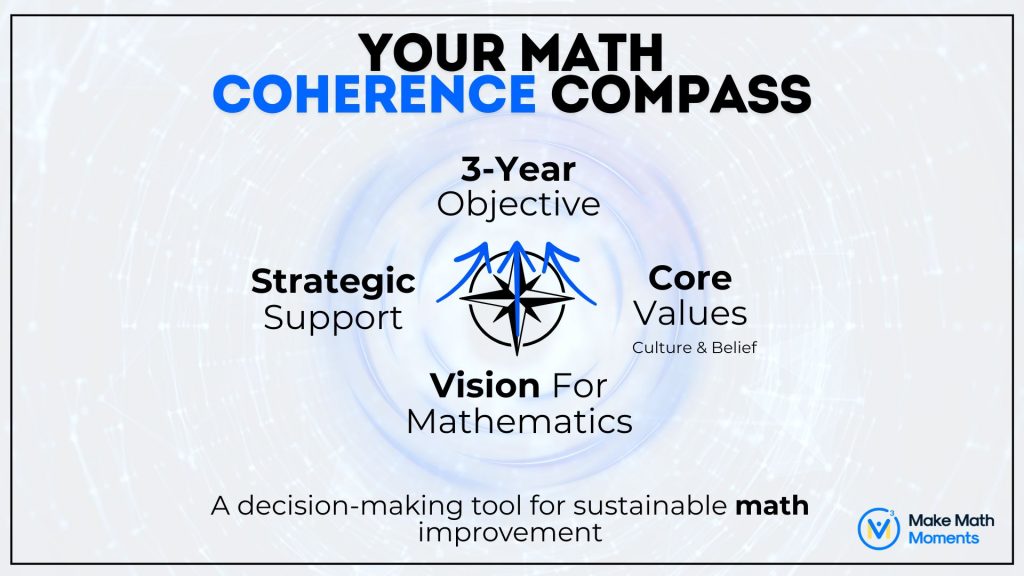
The Coherence Compass is not just a decision-making tool—it’s a distributed leadership framework. It gives every leader in your system—from district office staff to principals to instructional coaches to PLC facilitators—a shared method for determining whether a decision is aligned with:
- the district’s long-term Objective
- the shared Vision for mathematics
- the Core Values and beliefs about teaching and learning
- the Strategic Support Systems designed to drive improvement
With the Coherence Compass, leaders no longer interpret the work through personal preference, past experience, or shifting pressures.
They interpret it through the same lens, grounded in the district’s improvement architecture.
This is the key to sustainable improvement:
Systems improve when the people making the daily decisions share the same mental model.
The Compass is that mental model.
When leaders use it—and when they teach others to use it—decision-making becomes clearer, faster, and more aligned.
Actions reinforce rather than compete.
Support systems strengthen rather than duplicate.
The Math Improvement Flywheel accelerates rather than resets.
Most importantly, the work becomes scalable.
Because when the Compass is shared, leadership becomes distributed.
And when leadership becomes distributed, math improvement becomes sustainable.
Why a Math Coherence Compass?
Walk into any district leadership meeting and you’ll hear familiar words spoken with confidence:
“Fluency.”
“Discourse.”
“Problem-solving.”
“High-quality instruction.”
“Conceptual understanding.”
Everyone nods.
Everyone agrees.
Everyone believes they’re talking about the same thing.
But they aren’t.
And this is the real danger—not that people move in different directions (that’s the symptom), but that leaders think they’re aligned when, in practice, they’re speaking entirely different instructional languages.
The Hidden Misalignment No One Sees—Until It’s Too Late
Let’s take fluency as an example.
Ask a principal what fluency means, and you might hear:
“Being quick and accurate with facts.”
Ask a coach:
“Using efficient strategies grounded in number relationships.”
Ask a teacher:
“Using flash cards and timed tests less often.”
Ask a district math coordinator:
“Flexibility, efficiency, and accuracy developed from conceptual understanding.”
Everyone is using the same word — fluency — but seeing dramatically different images in their minds.
And when people carry different pictures of the same word, here’s what happens:
- Principals observe for speed.
- Coaches model strategy-based routines.
- Teachers teach whatever they’ve always taught.
- PD introduces a new approach no one is prepared to reinforce.
- PLCs plan fluency instruction six different ways in the same building.
The district believes fluency is the priority.
But each layer of the system is implementing its own version.
Not because anyone is resisting.
Not because anyone is disengaged.
But because no one realized they weren’t talking about the same thing.
And the Math Improvement Flywheel stalls silently, invisibly—long before anyone understands why.
This is exactly what emerged in a large district in Texas.
During their summer PD, teachers learned strategies for engagement, problem solving, and number sense. Leaders left energized. Coaches left hopeful. Principals left encouraged.
But by October, implementation had fractured.
It wasn’t because people weren’t trying.
It wasn’t because the PD was weak.
It was because:
- Teachers and coaches held different definitions of “student engagement.”
- Coaches and principals held different definitions of “problem solving.”
- Leaders believed they were aligned—but they were aligned in language, not meaning.
They were united in vocabulary, but fragmented in mental models.
Their director of curriculum said it best:
“We realized everyone was using the same words, but not the same definitions. That’s when we understood why implementation wasn’t sticking.”
This is the trap nearly every district falls into:
We assume shared language equals shared understanding.
It doesn’t.
The same misunderstanding appeared in a rural district in Ontario Canada.
Leadership introduced a “Day 1 / Day 2” math lesson structure. On paper, everyone nodded. Everyone agreed. Everyone understood the model.
Except… they didn’t.
Teachers interpreted Day 1 differently.
Coaches interpreted Day 2 differently.
Principals observed for different indicators of success.
So when coaches were scheduled based on calendars instead of instructional sequences, the problem wasn’t simply logistics—it was misaligned mental models about what “supporting the 2-day structure” meant.
Their math coach reflected:
“We all said we believed in problem-based instruction. But not all of us had the same picture of what it looked like.”
This wasn’t a failure of initiative.
It was a failure of coherence.
When Alignment Finally Clicked
A large school system in Kansas only achieved lift-off when they addressed this exact issue.
Before they defined a districtwide discourse objective—with rubrics, exemplars, and look-fors—teachers, principals, and coaches were each doing their best interpretation of “improve math talk.”
Once they clarified what discourse actually meant and put common tools in everyone’s hands, something remarkable happened:
- Leaders started observing the same things.
- Coaches started modeling the same expectations.
- Teachers started reinforcing the same student moves.
They stopped talking past one another.
They finally spoke the same instructional language.
Their secondary math coordinator later said:
“Once we shared the same picture of discourse, every decision became easier. Everything aligned.”
This is the power of a shared definition.
The Math Coherence Compass: Four Anchors for Clear, Aligned Decisions
Below are four foundational elements that drive systemwide improvement:
North — The 5-Year Objective
Are we getting closer to the long-term instructional outcome we’ve committed to?
South — The Vision for Mathematics
Does this decision reinforce the kind of mathematical experience we want students to have?
East — Our Core Values & Beliefs
Does this align with what we believe about student math learning and how educators grow?
West — Our Support Systems & Strengths
Do we have the infrastructure to sustain this, and does it leverage our existing strengths?
These four points act as the guardrails that keep decisions aligned and grounded—even as staff shift, new challenges arise, or leaders change roles.
Let’s walk through each.
NORTH: The 3-Year Objective — “Is this getting us closer to our long-term aim?”
The North point is your system’s finish line—where your Math Improvement Flywheel is ultimately heading.
Your 3-Year Objective should be:
- ambitious
- measurable
- student-centered
- tightly connected to your vision
When leaders evaluate decisions against the North point, they ask:
- “Will this move us meaningfully toward our Objective?”
- “Does this action accelerate progress or distract from it?”
- “Is this a first-down toward the end zone, or a sideways move?”
The North point keeps the district focused on long-term momentum, not short-term noise.
Example 3 year Objective
Building increased student confidence in math through fluency and number sense.
SOUTH: The Vision for Mathematics — “Does this reinforce the student experience we believe in?”
Your vision describes the math classroom experience you want for every student.
When schools use the Math Coherence Compass, they ask:
- “Will this decision make it more likely or less likely that students experience mathematics this way?”
- “Does this align with what we want instruction to feel like across the system?”
- “Does this solution help us build the classrooms our vision describes?”
Your Vision is the bedrock of coherence.
It keeps the system anchored to instruction, not just compliance.
Example Vision:
XXX School Board prepares students to be creative problem solvers and think like mathematicians by providing teachers the support needed to engage students in cognitively demanding learning experiences.
EAST: Core Values — “Does this align with what we believe about learning and support?”
Core values bring culture into decision-making. They answer:
- “Does this honour how we believe students learn?”
- “Does this align with what we believe teachers need to grow? And how they improve their practice?
- “Does this reflect our commitments—equity, reasoning, collaboration, joy?”
Core values prevent well-intentioned decisions from undermining the culture you’re trying to build. They make sure actions match beliefs.
Example core values:
- All students have access to high levels of mathematics.
- Building mathematical capacity amongst educators is our through line to student achievement.
- We measure what matters: Change.
- Great leaders build leaders.
- We inspire growth.
- We create and highlight bright spots for compounding growth.
WEST: Support Systems & Strategic Strengths — “Do we have the capacity and structures to do this well?”
Here’s where most schools falter.
A decision may align beautifully with the Objective, Vision, and Values—yet still fail—because the system cannot support it.
This part of the Compass is a reality check:
- “Do we have the PLC structure to sustain this?”
- “Do we have coaching capacity to model and support it?”
- “Does this leverage our strengths—or stretch our weaknesses?”
- “Is the curriculum aligned?”
- “Do we have the intervention structure to reinforce it?”
This point ensures leaders choose doable work—not just desirable work.
It keeps the Math Improvement Flywheel moving forward rather than restarting every year.
Example Strategic Strengths for Support:
- Teacher Collaboration (PLCs): How educators work together across grades and buildings to improve instruction.
- Large Group Professional Development: How full staff pull out sessions should be designed, delivered, and sequenced to support lasting teacher growth.
- Coaching Structures: How math coaches are deployed, supported, and aligned to district goals.
- Instructional Materials & Resources: How HQIM and tools are selected and used to create coherence.
- Tiered Intervention Supports (MTSS): How Tier 1, 2, and 3 supports are integrated to serve all learners effectively.
Putting the Compass Into Practice
When school leaders use the Math Coherence Compass, decisions that once felt murky become clear.
For example:
- Should we add a new intervention program?
→ Check the North, South, East, West points.
If it misaligns with your vision, or your system can’t support it sustainably, the answer is “not yet.” - Should we shift PLC focus?
→ Choose the focus that best moves the Objective forward using supports you already have in place. - Should we pilot a new strategy?
→ Only if coaching and PD structures are ready to support it.
Principal teams begin making decisions that are:
- faster
- clearer
- more coherent
- less emotionally reactive
- deeply aligned with district direction
And the district office experiences fewer “shoulder tap” clarifications because the thinking is embedded in the Compass itself.
Why the Compass Matters for the Math Improvement Flywheel
The Math Improvement Flywheel depends on consistent direction and aligned actions.
Without coherence?
- Momentum stalls.
- Teachers feel whiplash.
- Leaders spend energy putting out fires.
- Initiatives fade before they can show impact.
With coherence?
- Every decision pushes the Flywheel forward.
- Long-term objectives stay visible.
- Support structures reinforce one another.
- Schools stop guessing what matters.
- Improvement becomes sustainable.
The Coherence Compass becomes the tool that ensures the Flywheel never resets—it only accelerates.
How to Introduce the Math Coherence Compass to School Leaders
Use it when:
- reviewing campus improvement plans
- evaluating PD agendas
- choosing PLC priorities
- redesigning coaching cycles
- responding to parent or teacher requests
- making budget decisions
- planning new initiatives
Your role?
Help leaders interpret and use the compass with fidelity and integrity at every interaction.
Ask leaders to bring the Compass to every math meeting, PLC, and improvement discussion.
Imagine for a moment. If leaders had true coherence around the math objective(s), the vision, the core values for math success and how to structure their support how powerful your flywheel would turn?
That’s your mission!
Your job isn’t to make every decision for every school. Your job is to build the system that allows leaders to make decisions that strengthen the Flywheel—decisions that advance the Objective, embody the Vision, reflect your Values, and leverage your Supports.
That’s what the Math Coherence Compass does. It turns scattered effort into aligned momentum. It keeps the system rowing in the same direction. And it ensures that improvement doesn’t depend on any single person—but on a shared and sustainable way of thinking.
Want to Learn More?
At Make Math Moments, we help districts build systems for sustainable improvement through our Math Improvement Flywheel—a four-stage process that supports leaders in designing vision, aligning systems, building capacity, and inspiring growth.
If your district is ready to move beyond short-term fixes and ensure the 4 components of adoption are embedded in your system, we’d love to partner with you. 👉 Learn more about the District/School Improvement Program.