Districts across North America have invested heavily in high-quality mathematics curriculum, aligned scope and sequences, and professional learning designed to improve student outcomes in math. And yet, many K–12 math leaders continue to ask the same frustrating question:
Why aren’t we seeing consistent shifts in math instruction across classrooms?
Teachers attend math PD. They explore new routines, tasks, and instructional strategies. They leave energized.
But when leaders observe classrooms weeks or months later, instruction often looks familiar—procedural, teacher-directed, and disconnected from the vision of equitable, conceptually rich mathematics.
This gap between math professional learning and math classroom practice is not a teacher problem. It is a system design problem. And at the center of that system is one of the most misunderstood—and underleveraged—structures in mathematics education: math instructional coaching.
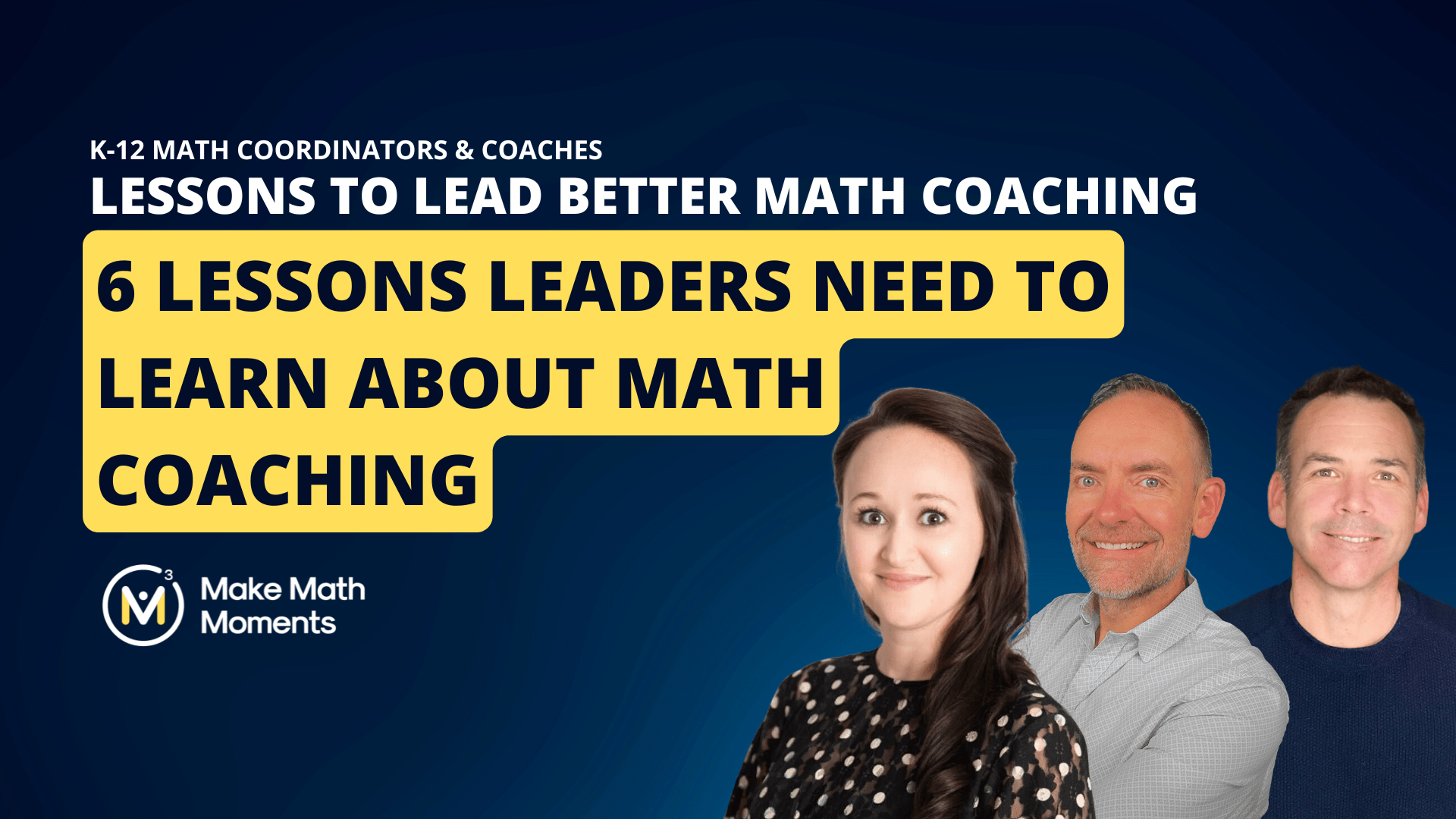
Below are six lessons math leaders must learn if coaching is going to become the engine of sustained improvement in mathematics instruction.
Lesson 1: Math Professional Learning Without Coaching Will Not Change Math Instruction
High-quality math professional learning is essential—but it is not enough.
Research shows that teachers require:
- 30–100 hours of sustained, high-quality learning over 6–12 months to shift instructional practice toward more inquiry-oriented teaching.
- Approximately 49 hours per year to produce measurable gains in teacher practice and student learning (Darling-Hammond et al., 2017).
Yet most districts rely on:
- Summer math workshops
- Occasional PD days focused on strategies or curriculum
- PLC time without instructional follow-through
Lesson 2: Math Coaching Bridges the Gap Between Knowing Math Strategies and Using Them
Math PD often introduces powerful ideas:
- High-cognitive-demand tasks
- Number sense routines
- Multiple representations
- Mathematical discourse and justification
But knowing about these strategies does not mean teachers can implement them successfully with their students.
Math coaching bridges this gap by:
- Modeling lessons that highlight student thinking
- Co-planning tasks aligned to mathematical learning goals
- Supporting teachers in anticipating misconceptions
- Facilitating reflection on student responses and instructional decisions
Joyce and Showers (2002) demonstrated that while workshops alone result in 5–10% implementation, workshops combined with coaching lead to 80–90% implementation.
The leadership lesson:
Math improvement requires more than exposure to strategies—it requires sustained, in-context support that helps teachers navigate the complexity of real math classrooms.
Expecting significant shifts in math instruction—such as increased discourse, stronger conceptual understanding, or more productive struggle—without ongoing support is unrealistic.
The leadership lesson:
If math leaders want lasting change in how mathematics is taught and learned, coaching must be embedded alongside professional learning—not treated as optional follow-up.
Lesson 3: Math Coaching Must Be Centralized and Protected to Stay Instructional
The impact of math coaching depends heavily on how it is designed and deployed.
When math coaches:
- Report primarily to building administrators
- Are assigned to too many schools
- Are pulled into testing coordination, intervention scheduling, or coverage
Their role drifts away from instruction and mathematics-specific growth.
High-impact systems:
- Deploy coaches centrally under district math leadership
- Protect coaching time for instructional work
- Align coaching focus to district math priorities (e.g., fluency, reasoning, discourse)
- Create networks where math coaches learn, calibrate, and grow together
The leadership lesson:
Math coaching succeeds when leaders treat it as a system-level instructional lever—not a flexible support role.
Lesson 4: Ongoing Math-Specific Support Is the Most Fragile Part of Change
Sustained improvement in math instruction requires four components:
- Alignment to a shared math vision
- Opportunities to observe and experience effective math instruction
- Teacher belief in their ability to teach math differently
- Ongoing math-specific coaching and follow-up
Without consistent coaching, districts often experience:
- “Drive-by math PD”
- Inconsistent task implementation
- Teachers reverting to procedural instruction under pressure
- Initiative fatigue
Coaching provides the continuity teachers need to persist through uncertainty, especially when implementing practices like productive struggle or student-led discourse.
The leadership lesson:
Math instructional change does not fail because teachers resist—it fails because systems do not sustain support long enough for change to take hold.
Lesson 5: Equity in Math Coaching Requires Depth Before Breadth
Many math leaders feel torn between equity and impact:
“If we can’t coach every math teacher, is it fair to coach any?”
When leaders spread math coaching thinly across all schools, the result is often minimal impact everywhere.
Districts that see meaningful math improvement:
- Identify early adopters willing to deepen practice
- Focus coaching on priority grade bands or goals (e.g., K–2 number sense, middle school reasoning)
- Allow strong instructional models to emerge and spread
Equity in math instruction is not achieved by equal time allocation—it is achieved when effective practices become visible, replicable, and scalable.
The leadership lesson:
Strategic depth creates the conditions for system-wide equity in mathematics learning. Think “Less teachers but deeper impact” rather than “more teachers and shallow impact”.
Lesson 6: Math Coaching Builds Internal Capacity That Sustains Improvement
Effective math coaching compounds over time.
Teachers who receive deep coaching support often become:
- Instructional leaders in mathematics
- Facilitators of math PLCs
- Mentors for new teachers
- Carriers of district math vision
This builds resilience in the system—especially during curriculum changes, leadership transitions, or staff turnover.
The leadership lesson:
The true return on math coaching is not short-term score gains—it is long-term instructional capacity.
The Bottom Line for Math Leaders
Math coaching is not an add-on to professional learning.
It is the mechanism that makes professional learning work.
Without math coaching:
- Vision remains theoretical
- Strategies remain inconsistent
- Teachers remain isolated
- Improvement stalls
With math coaching:
- Curriculum comes to life
- Student thinking becomes central
- Teachers grow in confidence and skill
- High-quality math instruction becomes the norm
If districts and schools are serious about improving mathematics at scale, coaching must move from the margins to the center of their strategy.
Math coaching isn’t optional. It’s foundational.
👉 Explore our District Support Programs to build sustainable systems for math improvement. Explore our support programs.
Want to Learn More?
At Make Math Moments, we help districts build systems for sustainable improvement through our Math Improvement Flywheel—a four-stage process that supports leaders in designing vision, aligning systems, building capacity, and inspiring growth.
If your district is ready to move beyond short-term fixes and ensure the 4 components of adoption are embedded in your system, we’d love to partner with you. 👉 Learn more about the District/School Improvement Program.