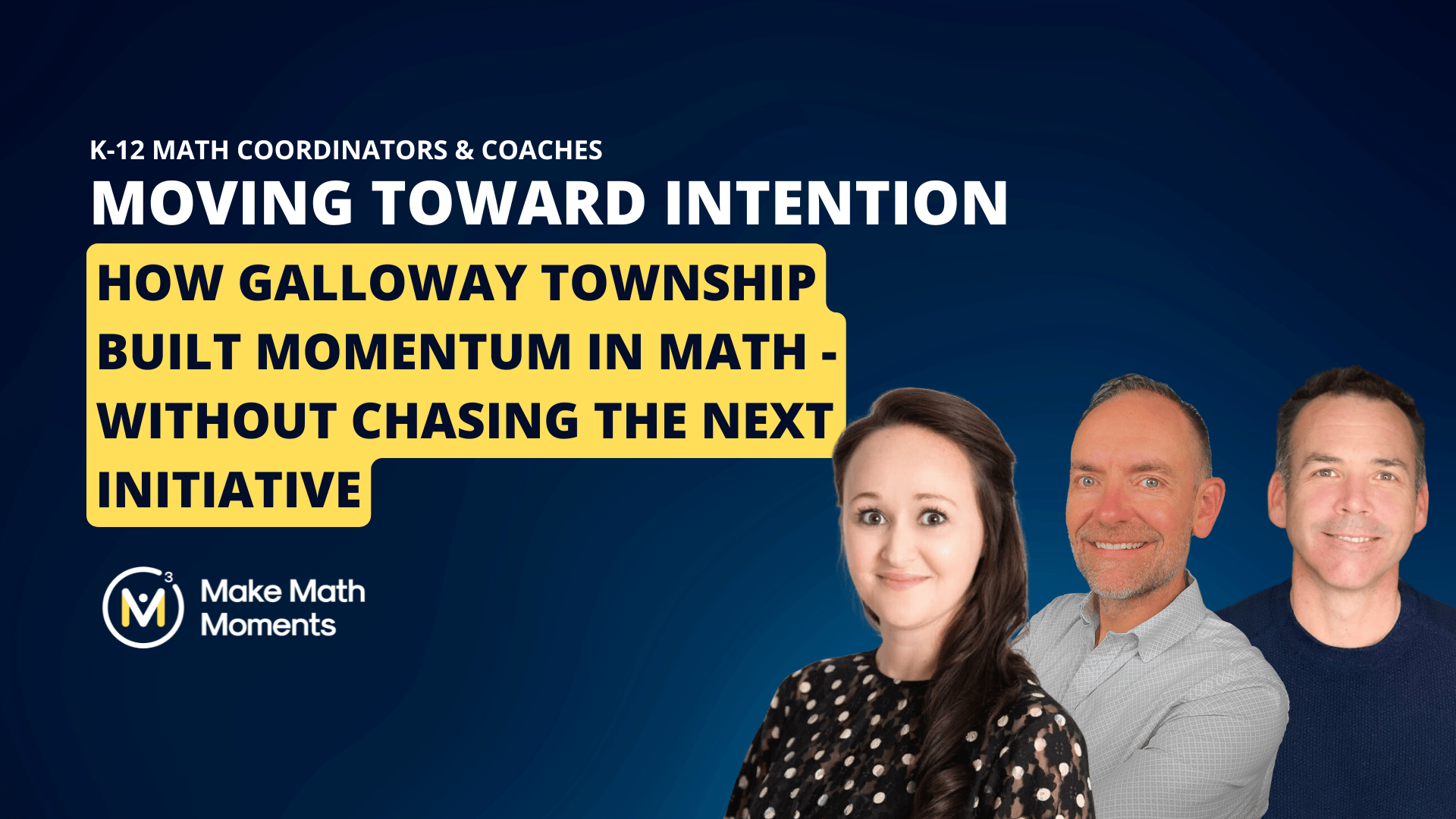
Three years ago, Betty felt like she was carrying math improvement largely on her own.
As Director of Curriculum in a PreK–8 district, leadership wasn’t new to her—but the conditions had changed. Long-standing leaders had exited. Budget constraints quietly erased coaching positions. ESSER funds created urgency without providing direction. And in a system where literacy had long dominated the conversation, Betty often found herself advocating—again and again—for the importance of mathematics.
“I feel like I’m always saying, math is important too.”
To be clear, the district wasn’t lacking effort.
They had invested in fluency kits.
Problem strings had made their way into conversations.
Teachers were using Desmos Classroom.
Running records, intervention blocks, MTSS meetings, and professional development days filled the calendar.
But despite all of that activity, progress felt elusive.
As Betty put it at the time, it felt like spaghetti at the wall.
Goals weren’t consistent across schools. Expectations shifted depending on the room you were in. Teachers were trying things—often earnestly—but nothing stayed in place long enough to understand whether it was working.
The Turning Point: When “Focused” Still Wasn’t Focused Enough
At first, Betty believed they had narrowed the work.
They had identified priorities.
They had named fluency, conceptual understanding, and productive struggle.
They had committed—at least on paper—to improving math instruction.
But over time, a quieter realization emerged.
Even this was still too broad.
Betty recently shared this realization with a group of math coordinators and coaches when reflecting on the journey:
“Don’t give up—but be very specific and intentional.”
That insight didn’t come from a planning template or a framework. It came from lived experience.
What Betty began to notice was this: when leaders say “focus on fluency,” teachers hear very different things. Some hear fact practice. Others think games. Others reach for intervention kits. Everyone believes they’re aligned—and everyone is technically doing what was asked.
The system, however, isn’t.
The result is predictable: strong effort, little coherence, and minimal traction.
The real shift came when Betty and her colleague Kim made a harder decision. They stopped asking only what they were focusing on and started getting precise about how that focus would show up in classrooms.
Precision Created Progress
Many districts have beautifully written mInstead of broadly asking teachers to “work on fluency,” the district aligned around one high-impact instructional move—used consistently, supported deliberately, and observed intentionally.
Problem strings.
Not as a suggestion.
Not as a pilot.
Not as something teachers might try once a month.
As a routine.
Just as importantly, they chose to start where it made the most sense: Grades 3–5.
Problem strings weren’t new to the district. The resources had been there for years. What changed was the level of precision in how they were supported.
Once expectations became clear—what the move was, how often it should be used, and why it mattered—the work started to move.
“We wrote it right on the slide—two times a week. This is what we’re focusing on.”
For the first time, teachers across buildings were hearing the same message. There was no guessing, no reinterpretation, no telephone game.
Support Stayed With Teachers While They Were in the Messy Middle
In the past, professional learning often stopped at exposure. This time, it didn’t.
Betty and Kim intentionally coordinated multiple support systems around this single instructional move. Pull-out professional learning built shared understanding. Coaching cycles supported targeted teachers as they worked through the messy middle of implementation. PLCs became spaces to examine student thinking and refine practice.
Nothing existed in isolation. Every structure reinforced the same expectation.
As Yvette Lehman, a Make Math Moments coach, observed, “They’ve done a great job coordinating PD, coaching, and PLCs around one high-impact move—and they’re seeing the results.”
For Betty, that coordination mattered deeply—because she had lived the alternative.
“Otherwise,” she said plainly, “nothing happens.”
Evidence Showed Up Where It Never Had Before
Over time, something different began to show up.
Teachers weren’t just talking about problem strings anymore. They were actually using them.
As Betty reflected, this was the first time implementation had appeared across nearly every classroom.
Not perfectly.
Not uniformly.
But visibly.
Bright spots began to surface. Momentum built. Teachers started learning from one another rather than waiting for the next initiative to arrive.
Math Leadership Capacity Replaced Dependence
As traction grew in Grades 3–5, Kim began to shift her role intentionally.
Rather than being the sole driver of the work, she focused on building teacher leadership within each site. Teachers stepped up to facilitate PLCs, lead professional learning sessions, and model instruction for colleagues.
This wasn’t accidental. It was strategic.
Sustainable improvement doesn’t scale through one person. Kim’s goal was to build enough capacity at each site that she could eventually expand her focus to other grade bands without losing momentum.
Administrators Joined the Work—Not as Evaluators, but Learners
At the same time, Betty recognized that instructional change wouldn’t last unless administrators were aligned and owned the work alongside teachers.
She began walking classrooms with principals, observing problem strings together and naming what they were seeing in real time. Over time, this helped create a shared understanding of what effective math instruction looks like, sounds like, and feels like during the math block.
Principals weren’t just checking boxes. They were learning what to look for.
“They’re pulling in the same direction.”
That alignment mattered—because teachers can feel when leadership is coherent, and they can feel when it isn’t.
Assessment as a Next Move: Learning, Not Judgment
As the work matured, Betty also began rethinking assessment.
Rather than relying solely on large-scale measures, the district started exploring short, formative fluency assessments used within PLCs. These assessments were grounded in student thinking and directly connected to instructional decisions.
Assessment stopped being something that simply reported learning and became a tool that guided it.
What Galloway Township Sees Now
Betty is quick to say the work isn’t finished.
But she’s equally clear about what has changed.
“I feel like we are starting to move the needle. We still have a long way to go, but I really do see some change that we never would’ve seen if we didn’t make everything more intentional and stick with similar goals time after time.”
This wasn’t about finding the right curriculum, resource, or kit.
It was about learning how precise focus must be for a system to move.
Galloway Township didn’t make progress by doing more. They made progress by doing less—better.
They learned that narrowing once isn’t enough.
That clarity beats enthusiasm.
And that support has to stay present while teachers are changing.
That’s what real traction looks like.
Not immediate.
Not dramatic.
But unmistakable.
Want to Learn More?
At Make Math Moments, we help districts build and implement systems for sustainable improvement through our Math Improvement Flywheel—a four-stage process that supports leaders in designing vision, aligning systems, building capacity, and inspiring growth.
If your district is ready to move beyond short-term fixes and create bridges in mathematics learning, we’d love to partner with you.👉 Learn more about the District Improvement Program.