Most math improvement efforts do not stall because people stop caring. Let’s be clear about that. They stall because your improvement system was never designed to sustain them.
Leaders work hard, teachers give their best, and still, at the end of each year, everyone finds themselves asking the same questions they asked at the start.
This post unpacks five barriers that have consistently kept school systems from gaining lasting traction in mathematics. Understanding these barriers is not just background learning. It is essential preparation for leading math improvement. Because your math improvement flywheel is not going to spin on its own, at least not at first. It will require disciplined, consistent effort in the face of competing demands. Knowing why the barriers exist, and how they operate, is what will keep you from losing focus when the inevitable fires start to appear.
At the end of this post, you will find an action step designed to make these barriers visible in your own system. Keep them somewhere you can see them. They will matter more than you think when the year gets difficult.
Barrier One: Stop Pouring Resources Into the Wrong End of the System
A few years ago, a colleague from the literacy side of our district pulled me aside after one of our monthly support meetings. These were the gatherings where all the subject consultants, programme directors, and curriculum coordinators would update the superintendent on their progress across the various initiatives running throughout the division.
"Do you ever notice that we have it backwards?" she asked.
I asked her what she meant.
"Well, when the superintendent asks us to report on what we are doing, we all describe the tools we are using. The resources. The structures. Nobody talks about what we are trying to achieve for students."
She was right. And it is not just a problem in one district. It is a pattern that shows up everywhere we go.
When we ask math coordinators and coaches across North America "What is going on in your world right now?", the answers almost always sound the same.
We are using Desmos. We are implementing a new curriculum. We are working on number talks. We are trying Building Thinking Classrooms.
These are all tools and structures. They are means to an end. But too often, the means become the end, and the actual goal, improving mathematical understanding and experience for students, disappears from view.
The order has been flipped. Most districts are prioritising in this sequence:
Resources / Structures / Routines → Direction / Goals (if any) → Student Experience / Outcomes
When we should be prioritizing in this order:
Student Experience / Outcomes → Direction / Goals → Resources / Structures / Routines
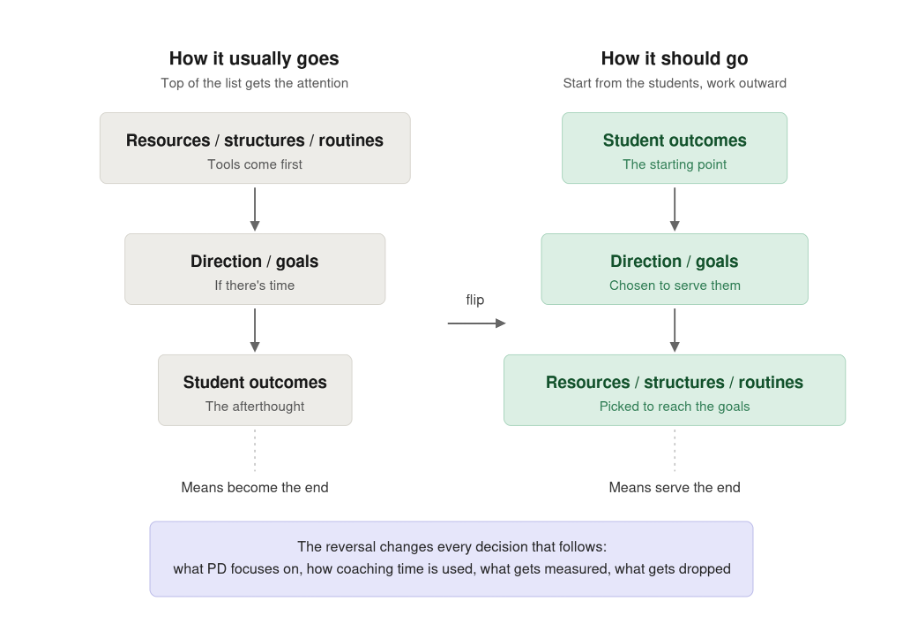
Student experience and outcomes first. Then, the direction and goals that serve those outcomes. Then the resources and structures chosen specifically because they will help achieve those goals.
This reversal is not cosmetic. It changes every decision that follows: what professional development focuses on, how coaching time is used, what gets measured, and what gets dropped. When student outcomes are the starting point rather than the afterthought, the whole system reorients.
Barrier Two: Your Current Math Success Metrics Are Hiding the Real Story
W. Edwards Deming, a quality management expert whose work transformed manufacturing and later influenced education, put it plainly:
"The system you have is perfectly designed to get the results you are getting."
Read that again.
If student achievement is stagnant, your system is producing that outcome. If professional development rarely changes classroom practice, your system is designed that way. If teachers feel overwhelmed by competing initiatives, your system created those conditions.
This is not a criticism of the people in the system. It is an observation about the system itself. And it points to one of the most common and costly mistakes we see across districts: measuring the wrong things.
Most improvement plans are built around student test scores. And while test results matter, they are lagging indicators. They tell you what happened six months ago, in conditions you can no longer change, with information too vague to guide daily decisions. You cannot steer a ship by checking the shoreline once a year.
This creates a damaging cycle. A goal is set around student results. New professional development, tools, or routines are introduced. Everyone waits until the end of the year for test data. The data arrives, inconclusive. A new plan is drafted. The cycle repeats. And every time it repeats, teachers feel the weight of yet another initiative added to an already full plate.
The shift that breaks this cycle is not about working harder. It is about measuring differently.
Instead of asking whether scores went up, ask what specific instructional moves you want to see more of. Ask what classrooms should look, sound, and feel like if the work is taking hold. Ask how you will know whether teachers are actually implementing what was introduced in professional development.
These are leading indicators. They are visible in classrooms every week, not every spring. When you measure them consistently, you stop guessing and start knowing. You can identify what is working, what needs adjustment, and where support is most needed, in real time, not retrospect.
Barrier Three: Systemic Misalignment in Mathematics
Every experienced math leader has heard some version of this: "I just do not have enough time."
It is easy to interpret this as resistance. But most of the time, it is not. It is a signal that something in the system is broken. When teachers say they do not have time, what they are often really saying is: "I cannot see how this connects to what I am already trying to do, and I do not have the capacity to add one more disconnected thing."
That is not a teacher problem. That is a system problem.
When the professional development calendar, the coaching focus, the PLC agenda, and the curriculum are all pointing in different directions, teachers experience the sum of those misalignments as an impossible workload. Everyone is working hard. But they are not working in the same direction.
Deming's observation applies here too. A system perfectly designed for misalignment will produce exactly that. More effort will not fix it. Redesigning the system will.
This is precisely what the Math Improvement Flywheel is designed to address. Not by adding more structures, but by aligning the structures that already exist so that every push reinforces the same motion. When professional development, coaching, PLCs, and curriculum are coordinated around the same focus, the experience for teachers shifts from fragmentation to coherence. And coherence is what makes the work feel possible rather than impossible.
Barrier Four: Mathematics Pedagogy Alone Will Not Create Improvement
If you have ever tried to build teacher buy-in for new instructional approaches, you have probably encountered this frustration: teachers learn the strategy, try it once or twice, and then quietly return to what they have always done. The strategy did not stick. The mindset did not shift.
The reason is almost always the same, and it is one that most improvement systems never address directly.
We have been trying to shift how teachers teach before addressing how deeply they understand the mathematics they are teaching.
Most educators learned mathematics the way their students are currently learning it: through rote procedures and memorised steps. They became fluent at executing algorithms without necessarily understanding why those algorithms work. And now we are asking those same teachers to facilitate rich discussions, respond flexibly to unexpected student thinking, and make in-the-moment instructional decisions that depend on deep conceptual understanding.
Every one of NCTM's eight effective mathematics teaching practices requires teachers to be mathematically flexible in the moment. To adjust. To pivot. To make sense of what students are saying and respond with depth. But if a teacher has never personally experienced the conceptual understanding they are being asked to develop in students, they cannot teach toward it with authenticity or confidence.
This is not a criticism of teachers. It is a description of what happens when improvement systems prioritise pedagogical strategy over mathematical understanding.
When teachers have the opportunity to re-experience mathematics as learners, to notice patterns, wrestle with concepts, and rebuild their own sense-making, something shifts. The pedagogical strategies stop feeling like techniques to perform and start feeling like natural expressions of genuine understanding. Teachers begin to want to use discourse, multiple representations, and reasoning-based approaches, because they have finally experienced what those approaches can do.
That shift is what we call a math epiphany. And it is the starting point for the kind of instructional change that actually lasts.
A flywheel system designed with mathematical understanding at its centre makes those epiphanies possible. Without it, professional development builds on sand. With it, it builds on rock.
Barrier Five: Your Math Improvement Is Resting On The Shoulders Of One or Two Key Educators
Most of us did not get into education to design district-wide improvement systems. We became educators because we wanted to make a difference for students. And many of us stepped into leadership roles because someone noticed what we were doing in the classroom and said: "You should be a coach. You should be a coordinator. You are what this district needs."
So we stepped up. And then came the realization that catches almost every math leader off guard: building a sustainable math programme is not the same as teaching mathematics well. Suddenly you are not just planning lessons. You are navigating politics, pacing calendars, and professional development agendas. You are carrying the coherence of an entire system on your shoulders.
And here is the truth no one tells you at the start: that kind of system is fragile.
Too many math programmes are built on the shoulders of one passionate leader, the person who was tapped on the shoulder. When that person moves on, retires, or burns out, the momentum stops. Teachers feel unmoored. The programme stalls. The next person in line is left to start from scratch, often with no documentation, no process, and no roadmap for what came before.
We have seen it happen in district after district. A single coordinator or coach becomes the heartbeat of math improvement, energising professional development, guiding vision, shaping culture. But when they leave, everything they built begins to fade, not because people stopped caring, but because the work lived in their head, not in the system.
The goal of the flywheel is to change that. Not to remove the importance of talented, committed leaders, but to ensure that what they build is embedded in a process strong enough to outlast any one person. Great math improvement does not endure because of charisma or energy. It endures because it is designed to.
Action Steps: Design a Math Improvement Flywheel System
Before you begin building the flywheel, take a moment to look honestly at the system you already have.
Print or sketch the five barriers and post them somewhere visible, on your wall, your desk, or in your meeting space. Next to each barrier, write one way it shows up in your own system right now.
Where is your team focusing on resources before outcomes? Where are you measuring activity instead of impact? Where do people work hard but not in the same direction? Where is teacher learning focused on strategies before mathematical understanding? And if you stepped away tomorrow, which parts of your math programme would keep moving, and which would stop?
This exercise turns abstract barriers into visible patterns in your own district. Sustainable math improvement starts with clarity, not charisma. When you know your barriers, realign your priorities, and design for process instead of personality, you are no longer spinning your wheels. You are preparing the system to spin for you.
Curious where your system is gaining traction and where it's still spinning? Take our District Math Improvement Assessment — a short screener that gives you a free, customized plan across the six areas that matter most for sustainable math improvement.
And if you want the simple decision-making tool we use with districts across North America to keep everyone aligned, grab the free Math Coherence Compass template.