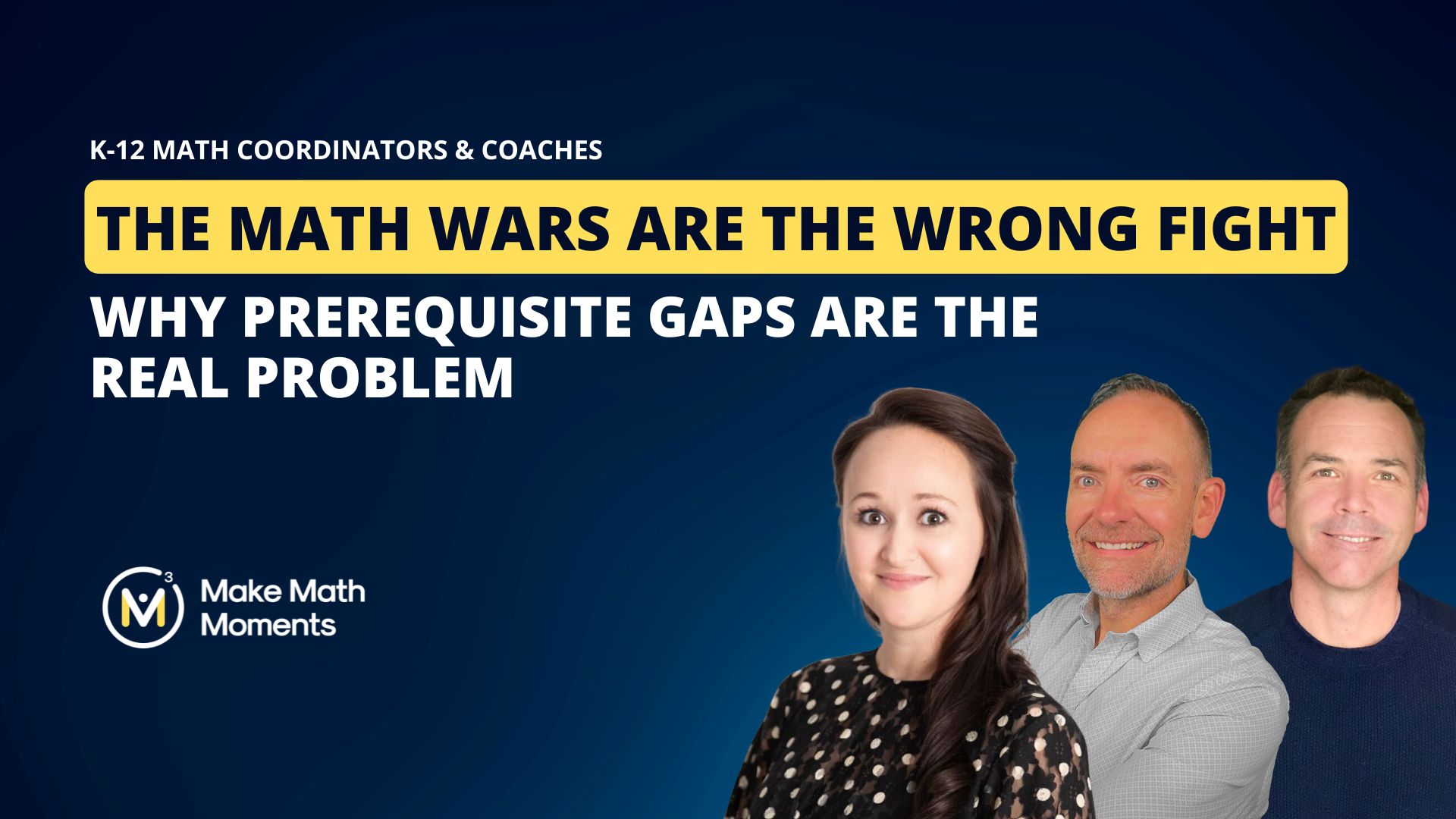
If you’ve sat in enough math meetings, you know the math war arguments by heart. One camp wants more conceptual understanding, richer tasks, students reasoning their way to ideas. The other camp, the science of math, wants the algorithms taught cleanly and practiced until they’re automatic. The conversation gets passionate, sometimes a little tense, and somehow it never quite resolves. You leave the room having relitigated the same philosophical divide for the hundredth time, and Monday’s classrooms look exactly like they did before.
Here’s a reframe worth considering: for a lot of your students, that debate is beside the point. The thing actually blocking them from reasoning through grade-level work isn’t whether their teacher leans conceptual or procedural. It’s the prerequisite skills they walked in the door without. A seventh grader can’t flexibly reason about proportional relationships if they can’t fluently work with the multiplication and division those relationships depend on. No amount of better task selection — and no amount of cleaner algorithm instruction — closes that gap on its own.
When you name the real constraint, a lot of what you’ve been trying to solve for shifts. The question stops being “which philosophy wins” and becomes “which specific foundational gaps are blocking these specific students, and how do we close them inside grade-level work?” That’s a far more answerable question, and it points you toward action instead of toward another round of the same argument.
Why the Math Wars Debate Distracts from Prerequisite Skill Gaps
The conceptual-versus-procedural debate persists partly because it feels like the most important question in the room. It’s identity-level for a lot of educators — it touches what they believe math is and how they were taught to teach it. So it pulls disproportionate energy. Leadership teams spend months adjudicating it, curriculum committees fracture over it, and PD calendars get built around whichever side is currently ascendant.
The irony is that the research community largely settled the false dichotomy years ago. NCTM’s position is unambiguous: procedural fluency is built on a foundation of conceptual understanding, and the two are not opposed but interdependent. Effective teaching “builds fluency with procedures on a foundation of conceptual understanding so that students, over time, become skillful in using procedures flexibly as they solve contextual and mathematical problems” (National Council of Teachers of Mathematics, Procedural Fluency in Mathematics, position statement, 2023). The “rope,” as it’s often described, is stronger because strands are woven together. Picking a side is solving a problem that the field already resolved.
Meanwhile, the problem that actually predicts whether a student can access today’s lesson — do they have the prerequisite skills the lesson assumes — goes underdiscussed precisely because it’s less philosophically interesting. It’s just diagnostic, unglamorous, student-by-student work. But it’s the work that moves the needle.
How to Address Prerequisite Skill Gaps Within Grade-Level Math
The instinct when you discover students have gaps is to pull them back. Stop grade-level instruction, remediate the missing pieces, and only return to on-grade content once the foundation is “fixed.” It feels responsible. It’s also, by the best available evidence, the wrong move.
The most compelling study on this comes from TNTP and Zearn, which directly compared remediation against what they call learning acceleration across elementary math classrooms. Students who experienced acceleration — staying in grade-level content, with prerequisite skills brought in just in time, only as a specific lesson required them — completed 27 percent more grade-level lessons than students who were remediated, and they struggled less with grade-level work, not more (TNTP, Accelerate, Don’t Remediate, 2021). The study also surfaced an equity problem worth naming out loud: students of color and students from low-income backgrounds were far more likely to be routed into remediation, even when they’d already shown success on grade-level content. Pulling kids back doesn’t protect them. It holds them back.
So the practical model is not “find the gaps, then retreat.” It’s “find the gaps, then fill them at the moment of need while keeping students in grade-level reasoning.” That requires you to know, with some precision, which prerequisite skills each upcoming unit actually depends on. Factoring and a fluent grasp of factors and multiples, for instance, are load-bearing for algebraic reasoning — introduced around fourth grade and a persistent struggle through fifth and beyond. If you can name the two or three prerequisites a unit leans on, your teachers can screen for them, address them in the opening minutes of relevant lessons, and keep moving.
This is also where the conceptual-procedural framing finally earns its keep — not as a debate to win, but as a tool. Some prerequisite gaps are genuinely conceptual (a student doesn’t understand what division means), and some are genuinely procedural (a student understands division but isn’t fluent). Diagnosing which kind of gap you’re looking at tells you how to close it. The philosophy becomes diagnostic equipment rather than tribal allegiance.
Closing Foundational Math Gaps During a New Curriculum Rollout
Picture a district adopting a new curriculum and bracing for the usual fight about whether the program is “too conceptual” or “not rigorous enough.” The more useful move is to set that argument down and ask a different question: across our incoming students, what are the recurring prerequisite gaps that will block them from accessing this curriculum’s grade-level tasks?
Answering it means looking at where students actually struggle year over year, cross-referencing what foundational skills the upcoming units assume, and building a short, defensible list of priority prerequisites to screen for and address just in time. That list does more for instruction than another semester of philosophical debate ever could. It gives teachers something concrete to do on Monday, it keeps students in grade-level work, and it sidesteps a fight that was never going to produce a winner.
None of this means belief work is unimportant. How teachers understand mathematics shapes everything downstream. But belief work is most productive when it’s anchored to a real instructional problem — “how do we close this specific gap for these students” — rather than to an abstract referendum on teaching philosophy.
Designing a Math Improvement System Around the Real Constraint
At Make Math Moments, the conviction underneath all of this is simple: most math improvement stalls not because people aren’t working hard, but because the system isn’t designed around the thing that actually limits student growth. The math wars are a perfect example. Enormous effort, real passion, genuine care — all of it pouring into a debate that, for most of your students, isn’t the binding constraint.
The Design & Measure stage of the Math Improvement Flywheel asks you to define what great math teaching looks like and how you’ll know it’s working. When you apply that lens here, prerequisite gaps move from background noise to a measurable, designable priority. You define the foundational skills each unit depends on, you build a way to see them, and you address them inside grade-level instruction. That’s a system designed around the real lever — and a system designed around the real lever is one where effort finally compounds instead of scatters.
The point isn’t to declare a side in the math wars. It’s to notice that the most important fight might be a different one entirely — and to build your improvement work around it.
Your Next Step
If you’re not sure which constraints are actually limiting growth in your system, that’s worth getting clear on before you plan another year of PD. Our free Math Improvement Assessment walks you through the six areas districts need to get right for sustained math improvement, including how foundational skill gaps fit into the bigger picture. It takes a few minutes and gives you a focused report you can bring to your leadership team — a more useful starting point than another round of the same old debate.
References:
National Council of Teachers of Mathematics. (2023). Procedural Fluency in Mathematics (Position Statement). Reston, VA: NCTM. https://www.nctm.org/Standards-and-Positions/Position-Statements/Procedural-Fluency-in-Mathematics/
TNTP. (2021). Accelerate, Don’t Remediate: New Evidence from Elementary Math Classrooms. New York, NY: TNTP. https://tntp.org/publication/accelerate-dont-remediate/