There’s a question we get asked a lot — usually from a math coordinator or a school leader who has some dedicated PD time, a team of teachers who are motivated, and a nagging feeling that all of it isn’t quite adding up to real change in classrooms.
The question sounds like this:
“What would it actually look like if someone came in and helped us do this right?”
That’s a fair question. And it deserves a real answer — not a brochure, not a list of features, but an honest walk-through of the work.
So that’s what this is.
We recently spent three days on-site with a small charter school — one building, grades 7 through 12, four math teachers who were all brand new to the school that year, a principal, a director who’d been running the school for two decades, and a special education teacher. They didn’t have a shared vision for what math should look like. They didn’t have a monitoring system. They had passion, a bit of PLC time, and a real commitment to figuring it out.
Here’s what we did — and more importantly, why we did it.
Why Math Coaching Without a Shared Vision Doesn’t Stick
Here’s something we see all the time.
A district or school decides it wants to invest in math improvement. They know coaching is good. They know PLCs matter. They’ve probably read Building a Better Teacher or seen the research on professional learning. So they reach out and ask: “How do we structure this? What should our coaching cycles look like?”
And our first move is always to slow them down.
Not because those questions are wrong — they’re actually exactly the right questions. But you can’t design the how until you’ve answered the why. If you set up coaching cycles without knowing what you’re coaching toward, you’re essentially designing a delivery system for a package you haven’t decided to send yet.
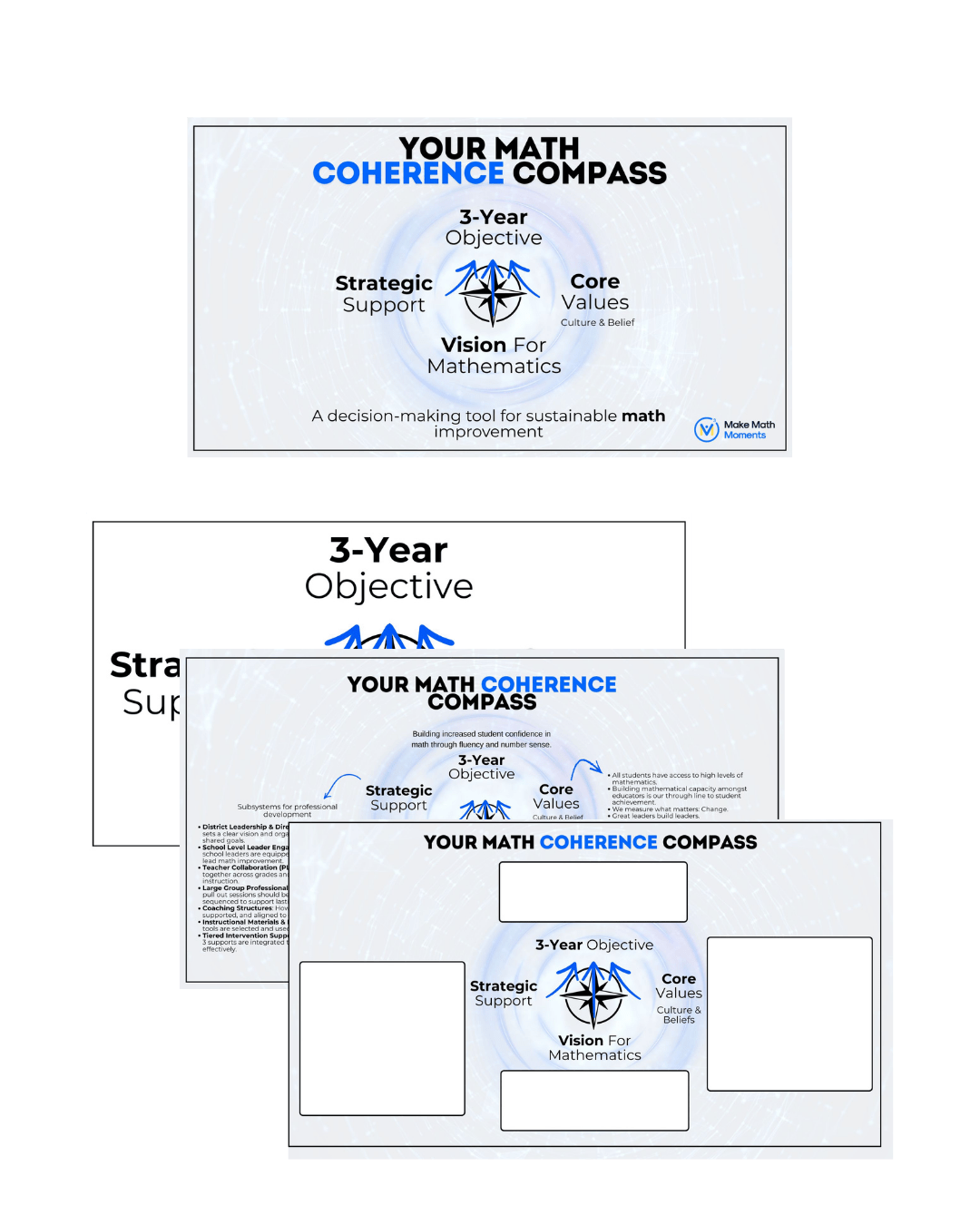
The Math Coherence Compass is the tool we use to answer the why.
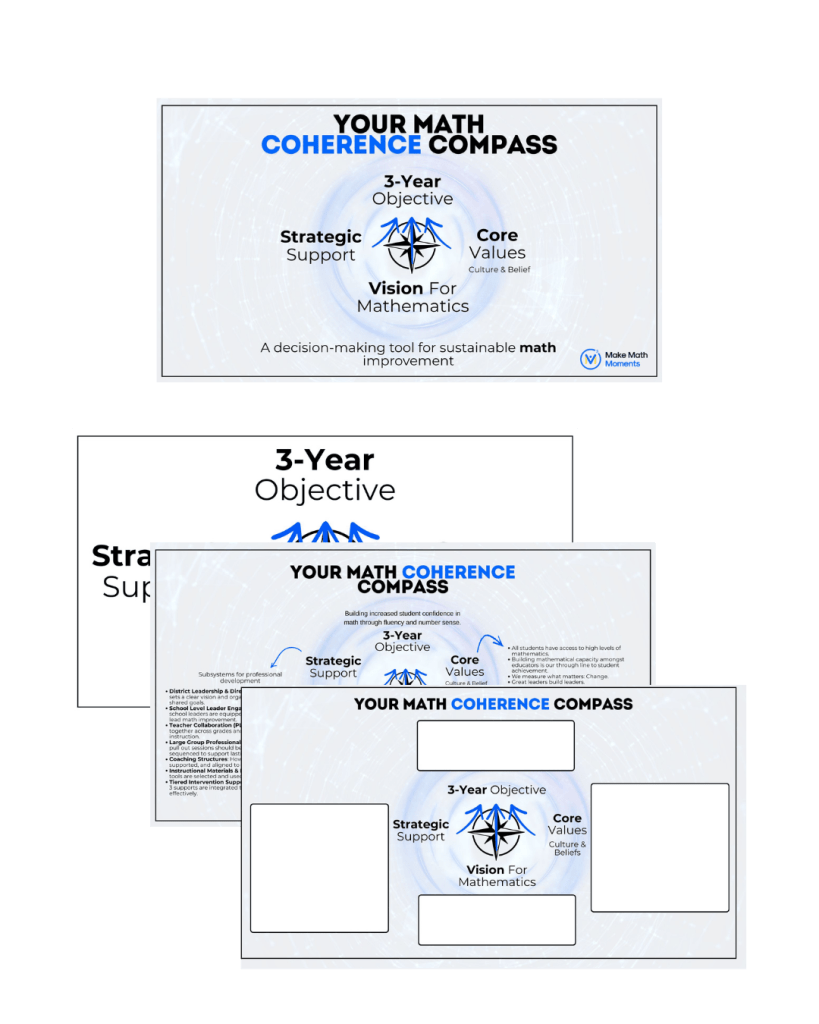
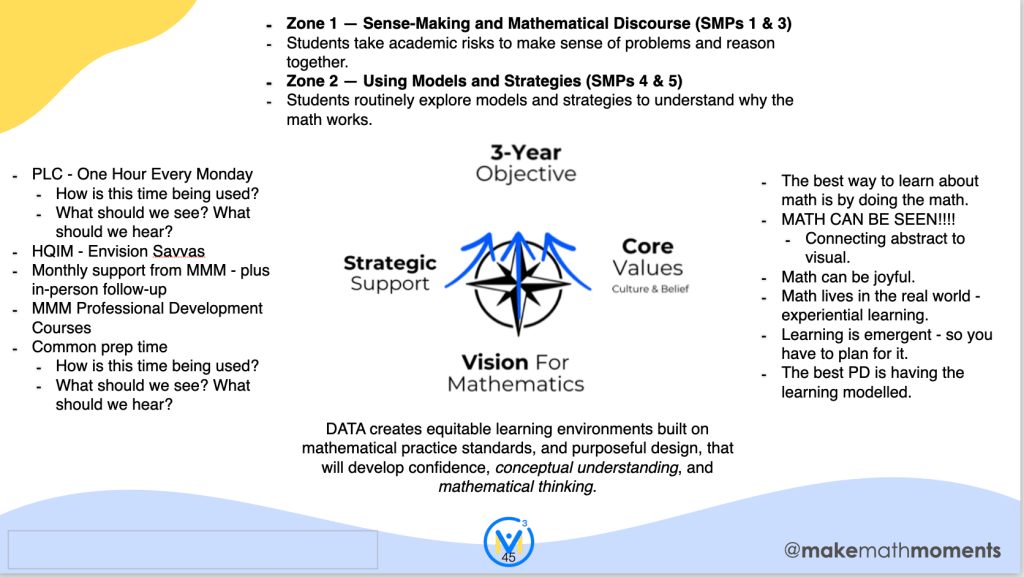
Think of it as the compass that orients every decision — PD design, coaching structure, PLC focus, curriculum selection — toward a shared destination. It has four points: your vision for math teaching and learning, your student learning objectives (what needs to shift now, specifically), your success criteria (what progress actually looks like in classrooms), and your structures (where and when the work happens).
You build it before you build anything else.
Day 1: How to Build a Shared Math Vision With Your School Team
Why Every Math Professional Development Session Should Start With Doing Math
You can’t build a shared vision for math instruction by talking about math instruction. You have to do math.
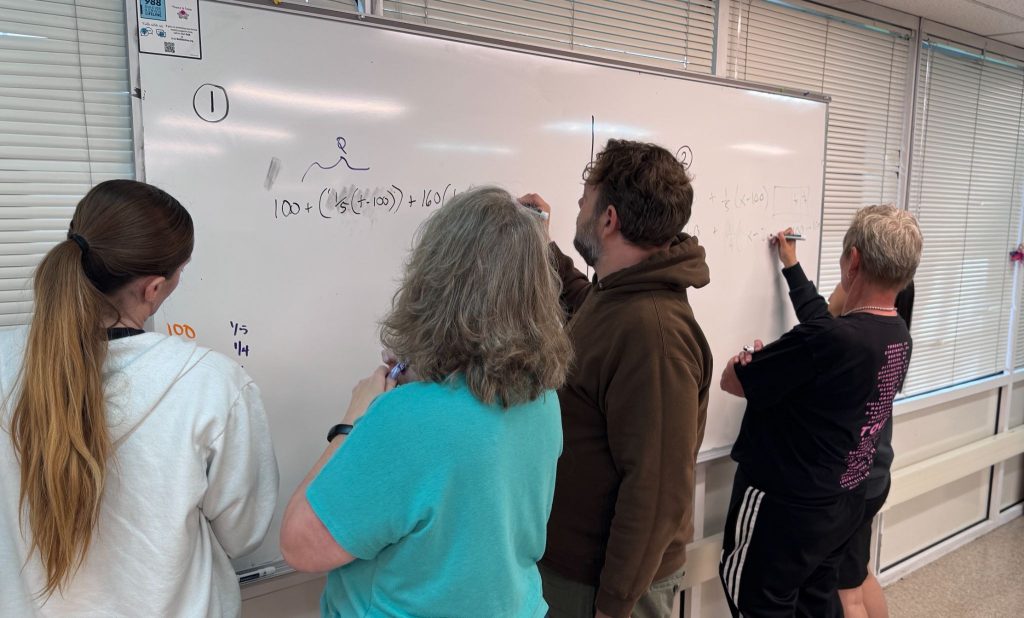
This is a core belief at Make Math Moments, and it shaped every day we spent on-site. Before any whiteboard visioning, before any research framing, before any protocol — we opened the day by engaging the whole team in a carefully selected math task. High cognitive demand. Multiple entry points. A problem worth solving.
We used vertical non-permanent surfaces and visibly random groupings — moves borrowed from Peter Liljedahl’s Building Thinking Classrooms work — which meant teachers were on their feet, working in new configurations, and experiencing firsthand what productive struggle feels like from the learner’s seat.
This isn’t a warm-up. It’s the whole argument. By the time you’re talking about what you want students to experience in math class, everyone in the room has just experienced it. The conversation is grounded in something real, not abstract.
A Protocol for Building Teacher Buy-In Around Math Instructional Goals
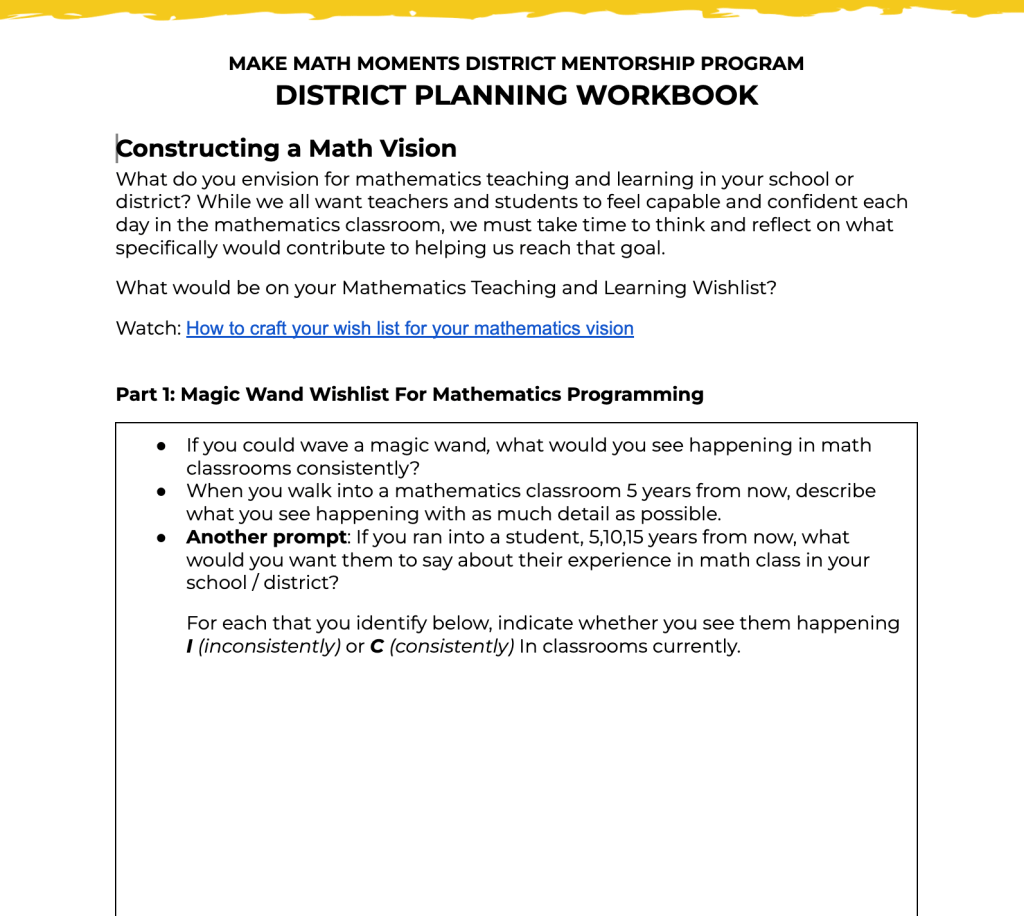
After the math experience, we moved into a protocol that sounds simple but does something powerful: we asked everyone in the room to imagine running into a former student five years after graduation. What would you want that student to say about their experience in your math class?
That reflection was private first — a chance to sit with the question honestly. Then we asked a follow-up: If you could wave a magic wand, what would you see happening consistently across all of your classrooms?
Teachers got up. They wrote on chart paper. They did a gallery walk and starred the ideas that resonated most. What emerged wasn’t a list of policies — it was a picture of aspiration. A room full of people naming what they actually cared about for students.
Then came the research layer.
We didn’t impose it. We invited it. We pulled up NCTM’s eight effective teaching practices. We looked at the mathematical practice standards from their curriculum. We asked: How does this connect to what you just wrote? What you get when you blend teacher fingerprints with research-backed practice isn’t compliance — it’s coherence. It’s people saying, yes, this is what I meant.
How to Write a Math Vision Statement That Teachers Actually Own
By late morning, the team had enough raw material to start drafting.
A vision for math instruction has three parts: What are students doing? How are teachers positioned to support that? And then the so-what — why does this matter? Those three questions aren’t a formula; they’re a forcing function. They make you get specific.
First drafts are always long and messy and ambitious. That’s exactly right. The mess is the material. Teams refine by asking: What’s unclear here? What resonates? What’s missing? And some teams go one step further — crafting a short tagline, a sentence that can travel through a building and actually stick.
By the end of the morning, this team had a shared vision statement that they wrote, argued over, and agreed on together. That matters. When the hard moments come — and they do — teachers don’t abandon a vision they built. They return to it.
How to Choose Your Math Instructional Focus (Without Trying to Fix Everything at Once)
With the vision drafted, the afternoon opened a harder question: If that’s where we’re going, what has to change now?
This is the part where teams want to list everything. Assessment. Discourse. Problem-solving tasks. Intervention. Homework. It all feels urgent.
Our counsel is consistent: pick one. Maybe two.
Not because the rest doesn’t matter — it does. But because when you focus on one thing well, you get gains in one area that naturally spill over into others. When you try to focus on everything, you focus on nothing.
This team landed on two zones: mathematical discourse and sense-making through models and representations. They chose these because they believed — and the research backs them — that if students are talking mathematics to each other and connecting different representations of mathematical ideas, something real is shifting in how they experience the subject.
But here’s where a lot of teams stop — naming the objective and considering it done. The question what does discourse mean? sounds like it has an obvious answer. It doesn’t. Not until you’ve unpacked it together.
What Are Look-Fors in Math Classrooms — and Why Co-Creating Them Changes Everything
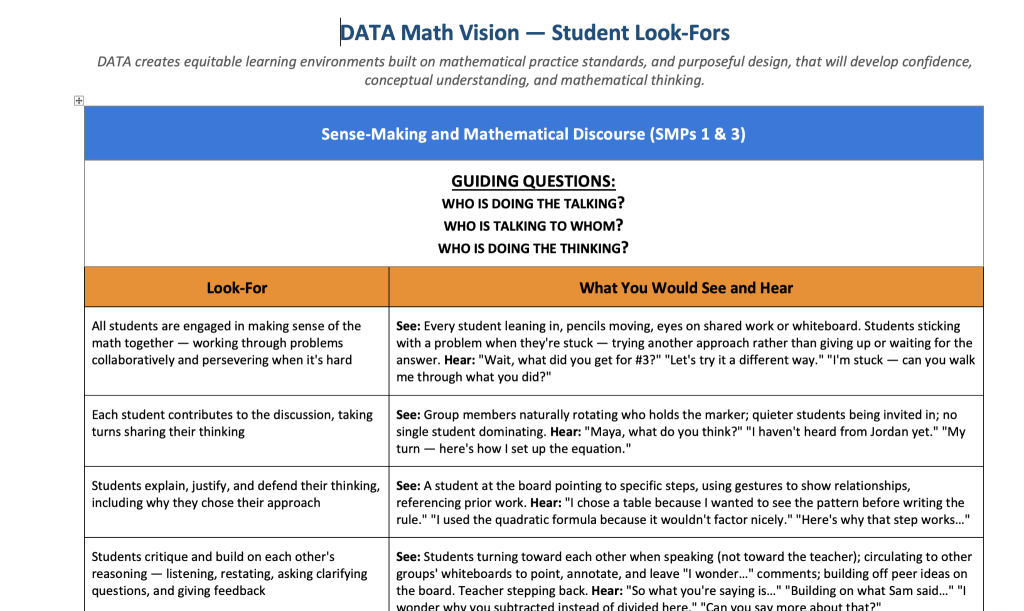
The last major move of Day 1 was co-constructing their success criteria — what we call look-fors.
Not a checklist handed down from above. Not a generic walkthrough rubric. A document built by this team, for this team, describing what progress toward their two objectives actually looks like in classrooms — what you’d see, what you’d hear.
They started by brainstorming their own indicators. Then we layered in language from the mathematical practice standards. When you look at what the standards say a mathematically proficient student does — making conjectures, justifying conclusions, analyzing the reasoning of others — you realize the standards were describing this all along.By end of day, the team had a draft look-fors document. It was rough in places. One indicator said students will work in groups. We let that sit for now. There was important work ahead.
Day 2: Using Classroom Observations to Strengthen Your Math Success Criteria
Day 2 was classroom observation day — but not the kind that makes teachers nervous.
We weren’t there to evaluate teachers. We were there to test the indicators.
We visited every classroom, spending time with each teacher during one period. We collected anecdotal evidence: what we saw students do, what we heard students say. Then we held it up against the look-fors from Day 1 and asked: If we saw this, would it tell us that discourse has been strengthened? That students are making connections between representations?
And that’s when something important happened.
One indicator — students will work in groups — kept checking itself off. Students were turning and talking. Students were at shared whiteboards. Technically, the indicator was satisfied everywhere we looked. But something wasn’t right.
Working in groups isn’t the same as engaging in mathematical discourse. You can have a room full of collaborative-looking activity where no one is justifying their reasoning, no one is building on a peer’s idea, no one is restating or questioning or defending. The indicator was too easy to check. It wasn’t measuring the thing they actually cared about.
So that night, we went back and revised. We moved from students will work in groups to something with more teeth: Each student contributes to the discussion, taking turns sharing their thinking. And then we got even more specific about what that looks like — group members naturally rotating who holds the marker, quieter students being invited in, the specific moves and phrases that mark real participation: “Maya, what do you think?” “Building on what Sam said…” “I haven’t heard from Jordan yet.”
This is the difference between a document that lives in a folder and one that actually guides instruction. The specificity is what makes it usable.
Day 3: Building the Math Instructional Habit That Sustains Improvement All Year
Day 3 opened with presenting the revised look-fors to the team.
Then we did what we always do when something needs to be truly internalized: we did more math.
The team engaged in two more mathematical tasks — this time using the look-fors as a lens in real time. They weren’t just talking about the indicators; they were noticing them, naming them, experiencing what it felt like to be a student when a teacher was deliberately designing for discourse and representation. The look-fors became something you recognize, not just something you read.
By the end of Day 3, something important had happened: everyone in the room could describe, in their own words, what the math team was working on. Not verbatim from the document. In their own language. That’s the test. If the person who holds the marker during the walkthroughs and the teacher at the front of the room and the administrator in the hallway can all give you a coherent answer to what are we working on right now?, you have coherence.
How to Transform Math PLC Time Into a Math Improvement Engine
The west point of the Compass — structures — is where aspiration meets habit.
This team had PLC time on the calendar. Every school does. But like many schools, that time had drifted toward logistics. What’s the next unit? What worksheet do you have? Research on how educators spend collaborative time suggests something uncomfortable: in many buildings, the majority of PLC time gets absorbed by things that could have been an email, leaving only a fraction for instructional work that actually connects to student learning.
The goal is to flip that ratio.
We worked with this team to design a repeatable three-week lesson study cycle anchored to their two objectives. Each cycle rotates through a host teacher who co-constructs a lesson with the team, teaches it, brings back student work, and debriefs. The protocol follows the 5 Practices framework — from setting goals and selecting a cognitively demanding task, to anticipating student responses, to monitoring, selecting, sequencing, and connecting during the lesson itself.
Week 1: Co-construct the lesson together. Work through the task yourselves. Anticipate what students will do — correct strategies, partial strategies, likely misconceptions. Plan assessing and advancing questions for each.
Week 2: The host teacher runs the lesson with teammates playing the role of students. Debrief. Then bring it to real students.
Week 3: Reflect. What went well? What surprised you? Where did you see evidence of your look-fors? Start planning the next cycle.
Rinse and repeat. All year.
The power isn’t in any one cycle. It’s in the accumulation. Think about the flywheel: the first push is the hardest. There’s friction, doubt, the sense that this is a lot of work for a single lesson. But each rotation builds momentum. By the third cycle, the structure feels less like a protocol and more like how we plan. By the sixth cycle, teachers are coming in having already thought about the task, already anticipating student moves. The lift gets lighter.
But only if you protect the time.
This is the part of the advice that feels too simple to say out loud, but it’s the part that makes or breaks the whole thing: you have to put it on the calendar and treat it as non-negotiable. Not some of that time. Not when we can. Blocked, protected, honored. The administrators at this school were in the room for Day 1 through Day 3. They’re planning to be present in PLC sessions. That matters. When leadership treats something as protected time, teachers do too.
It’s the atomic habit principle applied to instructional improvement: the behavior you repeat is the behavior that shapes your practice. One hour a week. Every week. Focused on the same two objectives. Building a portfolio of learning over time.
That’s how change happens.
Sustaining Math Improvement Beyond the Launch: What Ongoing Support Looks Like
We’re planning to support them virtually in monthly coaching PLC coaching sessions. We’ll go back to this school mid-year. We’ll spend time in classrooms looking at student behavior through the lens of their look-fors. We’ll update and refine the plan based on what we see. End of year, we’ll go back again.
The compass they built in April isn’t a finished document. It’s a living one. The look-fors will sharpen as the team uses them. The PLC cycle will get smoother. The guiding questions — Who is doing the talking? Who is talking to whom? Who is doing the thinking? Are students connecting representations? Are students choosing strategies and explaining why? — will become part of how everyone in the building thinks about a math lesson, not just a checklist on an observation form.
Now. A note for the math coordinator reading this who supports more than one school.
This process scales, but it scales fractally. The first school is the hardest. It’s where you figure out what conditions allow this to work. And once you know what success looks like in one building, you can start asking: which other building has similar conditions?
How do I replicate not just the structure, but the environment that made the structure take root?
You can’t shortcut the one school. You have to be able to get to the classroom level — to see the actual shift in student experience — before you can design for it at scale. That’s the go-to-gemba principle: go see the work. Go stand in the room where it’s happening.
If you’re struggling to create the conditions for this in one school, it’s worth sitting with that before designing for twenty.
Your Starting Point for District or School Math Improvement Planning
If you’re reading this and thinking: this is what I want for my school or my schools — the starting point is the compass.
Not the PLC structure. Not the look-fors. The compass first.
Get clear on what you’re trying to strengthen, why, and how you’ll know if it’s working. Everything else — the PD design, the coaching structure, the way you use collaborative time — flows from that.
Grab a blank copy of the Math Coherence Compass here, along with a short video training that walks you through how to build it with your team. It’s free. It’s a starting point. And it might be the most important hour you spend on math improvement planning this year.
The first push on the flywheel is always the heaviest. But you do have to push.