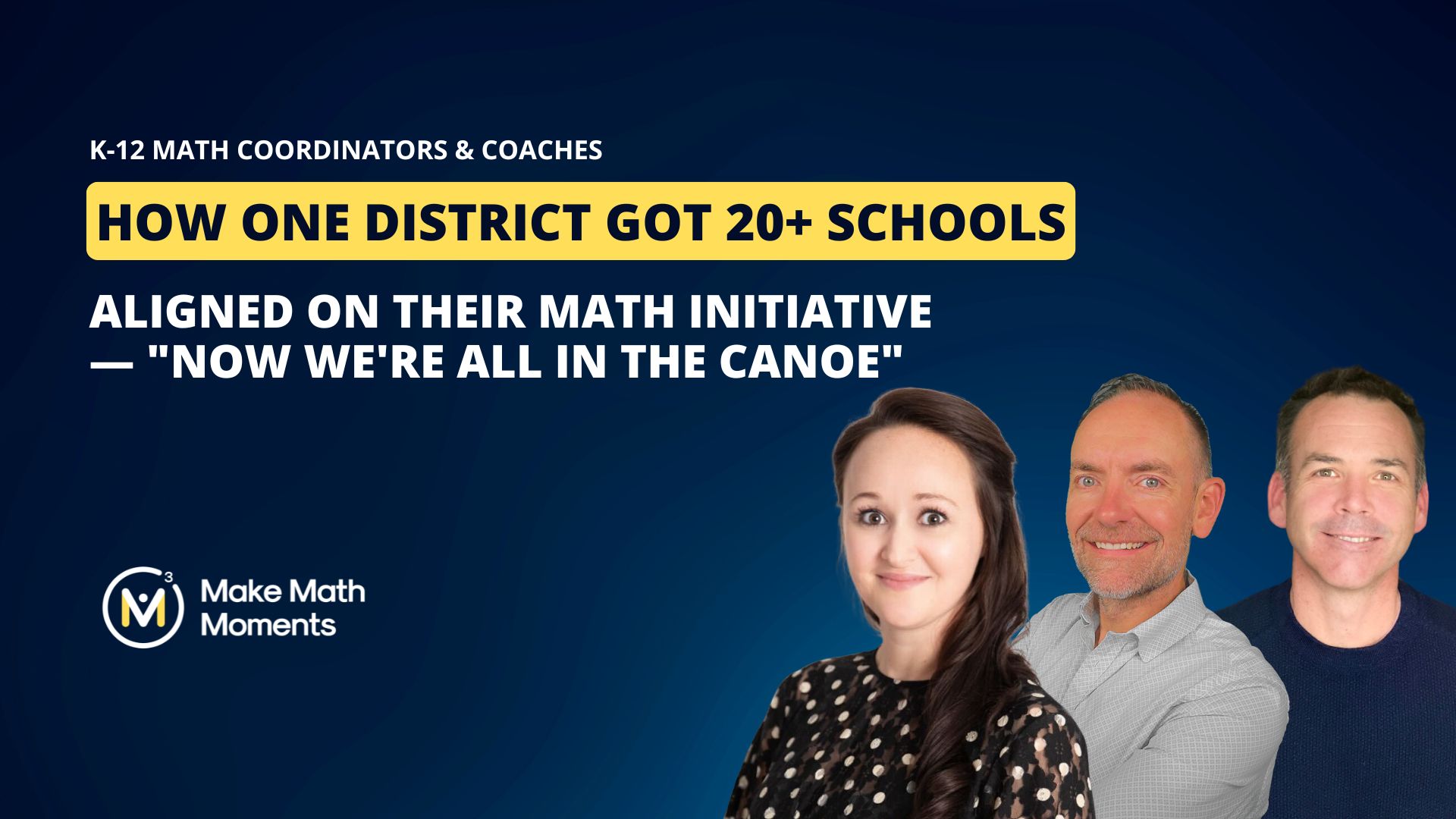
A high-functioning K-12 school district was doing the work everywhere — but only in pockets. Here's the one shift that got 20+ schools paddling in the same direction.
If you'd walked into Dana and Marcus's math work at the start of the year, you'd have seen a lot to admire.
They led a math initiative spanning a district of more than twenty schools. Teachers were running Number Talks. Coaches were trained and in classrooms. There was a genuine, shared belief that fluency and mathematical discourse mattered. By most measures, this was a high-functioning team — one of the stronger districts in their region, and they knew it.
And yet Dana kept bumping into the same frustration. The work was happening everywhere, but it wasn't adding up to anything she could see whole. Some schools were thriving. Others were drifting. It lived, in her words, in "pockets" — and worse, a few of those pockets were quietly working to outdo each other rather than move together.
Here's how she described the starting point, looking back: "In the beginning of the year, there was a lot of gray areas, and I couldn't see how we were going to move forward."
That's a specific kind of stuck, and it's one a lot of district leaders know intimately. Not "my people won't do the work." Something slipperier: everyone is working hard, and none of it is pulling in the same direction.
This is the story of how Dana and Marcus fixed that — and why the fix had almost nothing to do with adding more.
Why Math Initiatives Stall: It's Rarely a Lack of Effort
When a math initiative feels like it's spinning, the reflex is to add. Another PD day. A new resource. A harder push on the schools that lag.
Dana and Marcus didn't have an effort problem, so adding effort wouldn't have helped. What they had was a coherence problem — one of the most common and most invisible barriers a school system faces. Coherence problems don't announce themselves as failure. They show up as a lot of committed people doing a lot of legitimate work that somehow never compounds.
You could see it in the small things. "Number Talks" meant one thing in one building and something subtly different down the road. Schools set their own bars. Teachers, coaches, and principals each had a piece of the picture, but nobody was holding the same whole. When effort is scattered like that, you can double it and still not move the needle — because half of it is canceling the other half out.
The move Dana and Marcus made wasn't to push harder on the paddling. It was to make sure everyone was paddling the same canoe.
The First Shift: Getting Clear on Roles and Ownership
The turning point was less dramatic than a new program and more powerful than one. They got specific about roles.
That sounds almost too simple to matter. It isn't. In most systems, "collective responsibility" is a phrase on a slide that means nobody's responsibility. Dana and Marcus made it concrete. What is the role of the coach in this work? The principal? The math department chair? The teacher? The district team? And — the harder question — does each of those people actually believe it's theirs to carry?
Once those answers stopped being fuzzy, the fog started to lift. Dana could suddenly account for the whole system: how many teachers were trained at each school, where each one sat in their implementation of Number Talks, and what the next refinement move was. The work went from a feeling ("we're doing a lot") to a picture she could stand outside of and read at a glance.
"I can step out of it and be like, okay, we're really clear what we're doing," she said. "Very clear."
That clarity did something the extra PD never could: it gave people a shared direction to align to.
Keeping Teachers Aligned by Anchoring to Why It Matters
Clarity of roles told everyone what they owned. But Dana and her coaches did one more thing that kept the alignment from drifting — they relentlessly tied every routine back to its purpose.
They kept connecting the daily work to effective math teaching practices, and kept returning to the same refrain: this is why we're doing it, this is why it matters, this is how it improves math instruction, this is how it changes learning. Number Talks stopped being a box to check and became a visible container for the math teaching practices they cared about most.
That repetition matters more than it looks. There's a well-known trap in this work called initiative fatigue — the slow exhaustion that sets in when teachers have watched a dozen "priorities" come and go. The antidote isn't a better launch. It's coherence over time: naming why the current work matters, showing what it's producing, and not layering something new on top before the last thing has taken root. By keeping the "why" in front of people, Dana kept the district committed to depth instead of chasing the next new thing.
From Scattered Pockets to a Districtwide Shared Direction
Put those two moves together — clear roles and a relentless why — and the texture of the whole district changed.
The competitiveness eased. Schools stopped trying to out-do one another and started moving as one group. The "pockets" language that had defined the fall gave way to something that sounded, and felt, entirely different. When our coach Yvette asked Dana to name the single factor behind the momentum they'd built this year with our support, Dana didn't hesitate:
"Clarity, for sure. Clarity of everyone's roles and the project itself. And really, the look-fors, the root, everything, all the pieces. I can step out of it and be like, okay, we're really clear what we're doing.
In the beginning of the year, there was a lot of gray areas, and I couldn't see how we were going to move forward. But coming up with how many teachers are trained in this school and that school and across our whole district, what level they're implementing Number Talks now, what's our next move to refine what we're doing — that changed everything.
We keep connecting it to effective teaching practices. I can really see all of the practices in this little routine. We keep hitting home, coming back to: this is why we're doing it. This is why it matters. This is how it's going to improve instruction. This is how it's going to affect learning.
More of our schools are in alignment now. It's not pockets. Everybody's not trying to do something different to outdo somebody else. It's not competitiveness. Now we're in the canoe, and we're all paddling in the same direction. We're not going in different directions."
Now we're in the canoe, and we're all paddling in the same direction.
That's the whole thing in one sentence. Not more paddlers. Not stronger paddlers. The same canoe, and a shared sense of where the shore is.
Why Coherence Is What Makes Math Improvement Last
There's a second payoff to this kind of alignment, and it's the one veteran leaders feel most keenly. Dana and Marcus have both thought about the day they step away — the "before I retire, I hope we're all aligned" worry that sits underneath a lot of long-tenured leadership.
A system held together by two people's judgment is fragile no matter how good that judgment is. But a system where the roles are clear, the purpose is shared, and everyone can see the same picture? That system can keep paddling even when a seat in the canoe changes hands. Coherence isn't just what makes the work effective this year — it's what makes it survivable next year.
The evidence that it's real: other districts have started asking Dana and Marcus how they did it.
Do You Have Pockets Where You Want a Canoe?
Dana and Marcus didn't get here by working harder or by finding a magic strategy. They got here by trading scattered effort for shared direction — clarifying who owns what, anchoring every routine to why it matters, and giving the whole system one picture to align around.
At Make Math Moments, that's the exact shift we help districts and school systems make, just like we did here with Dana and Marcus’ district. Our Math Improvement Support walks leaders through four connected moves — designing a clear vision, aligning systems around it, building capacity in teachers and coaches, and inspiring the growth that keeps the momentum turning — so improvement compounds instead of fragmenting.
If your team is working hard but you're not sure it's all rowing the same way, we'd love to talk about what it would take to get everyone in the canoe.
👉 Learn more about how we support schools and districts in our Improvement Program.