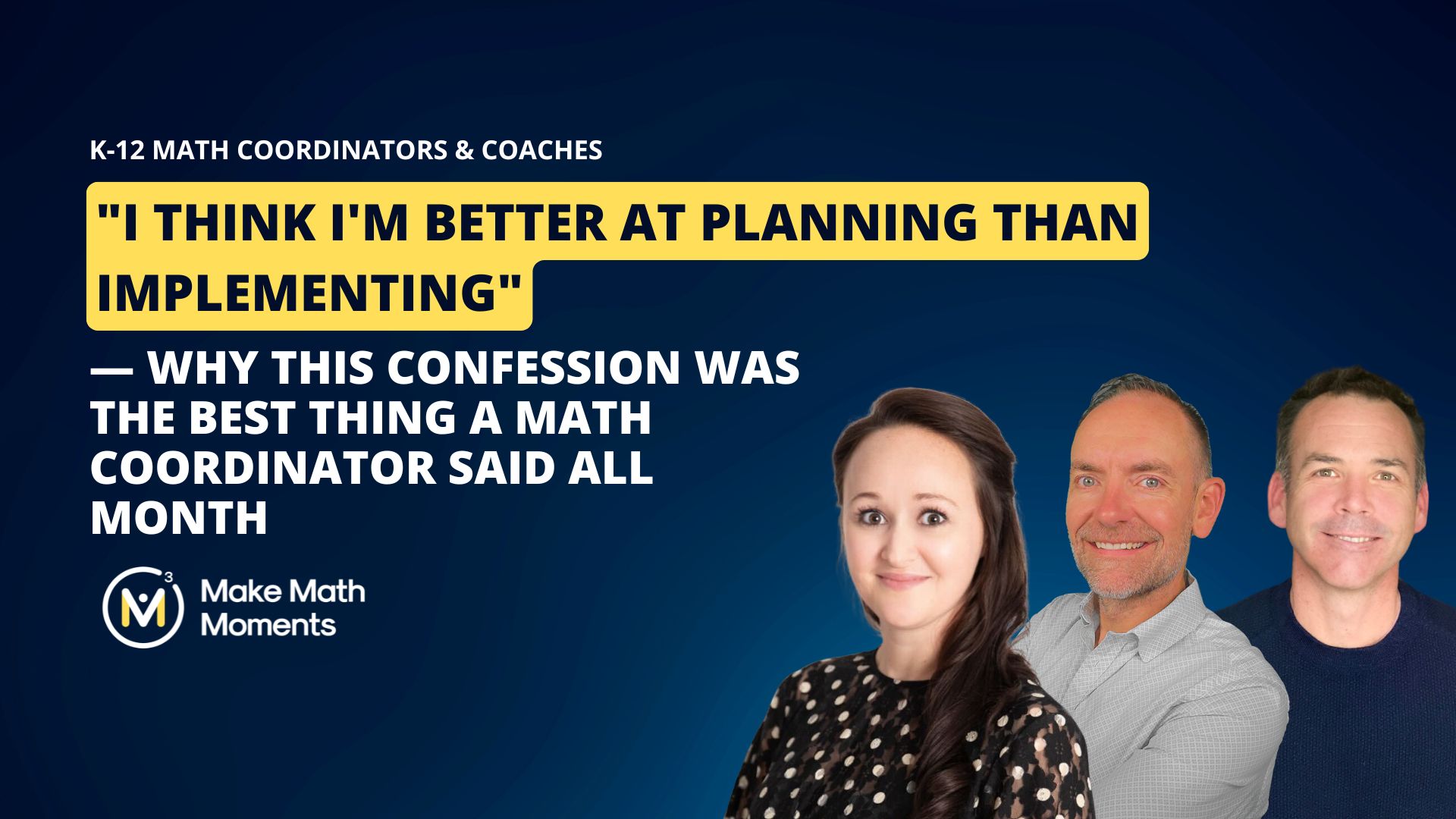
Four weeks. Four coaching calls. And finally a district math coordinator — we'll call her June — said the this part out loud:
"I think I might be better at planning than I am at implementing. So I've got to get better at implementing."
Most math leaders never say that sentence. It feels like admitting failure.
It's not. It's the opposite. That sentence was the moment June’s whole year changed direction.
Here's the story. You may have peeked ahead at the length of this email – it looks lengthy – but we wanted to share this story with you!
Why Busy Math Departments Still Stall: The Hidden Coherence Problem
When we started digging into June’s district, here's what we found: monthly virtual meetings with her focus schools. Weekly newsletters. In-service days on the calendar. Principal rotations every month. New teacher support structures. Quarterly leadership meetings.
Read that list again. That's a lot of touchpoints. Most coordinators would look at that and think, "I'm doing everything right."
And that's exactly the trap.
June had the infrastructure of a strong math improvement system. What she didn't have — yet — was a reason for all of those moments to exist. Each touchpoint was doing a job. None of them were doing the same job. The newsletter talked about one thing, the in-service covered another, the principal meetings drifted toward whatever was urgent that week.
This is what we call the spaghetti at the wall problem, and it's one of the most common (and most invisible) barriers to district math improvement. It doesn't look like failure. It looks like busyness. Everyone is working hard — they're just not pushing in the same direction. And when pushes are scattered, nothing compounds. You end the year tired instead of ahead.
The fix wasn't more activity. It was a north star.
So in one of our coaching sessions we helped June write one sentence that every single touchpoint would serve.
Build teacher capacity to land Eureka Math Squared lessons well — from the leadership layer down to the classroom.
That's it. That's the north star. (In Eureka Math Squared, "landing" a lesson is that final stretch where the learning gets consolidated — the debrief, the synthesis, the exit ticket. It's also the part of the lesson most likely to get squeezed out when time runs short. Which is exactly why it's worth an entire year of focus.)
Writing Math Key Results: Leading Indicators Before Lagging Ones
Then we laddered three key results underneath it, so the focus wasn't just an empty slogan:
Key Result 1
By May 2027, school-level instructional leaders will grow in their capacity to facilitate teacher collaboration, as monitored by the District Math Content Specialist through ongoing coaching conversations, PLC observations, and leadership meeting minutes.
Key Result 2
By May 2027, school-level instructional leaders will use PLC time to lead teachers in studying Eureka Math Squared lessons, with a focus on lesson intent and landing each lesson well, as evidenced by artifacts brought to quarterly leadership meetings.
Key Result 3
By May 2027, more teachers will land Eureka Math Squared lessons according to the Land guidelines, as evidenced by walkthrough data collected using the Land Implementation Support Tool.
Notice the shape of that ladder. It starts with leadership behavior, moves through collaborative structures, and ends in classroom practice. Leading indicators feeding a lagging one. If the first two move, the third will follow — and June will be able to see it moving long before any state assessment tells her so.
Building a Long-Range Plan: 62 Touchpoints, One Job
Here's where the story gets fun. Between two calls, June went away and came back with a long-range plan mapping 62 touchpoints — organized by quarter and by audience — across her three focus schools. Quarterly leadership team meetings, locked in with dates. Monthly virtual meetings with focus schools, scoped to 30 focused minutes during common planning time. Administrator check-ins with a clearly defined role: protect PD time and connect formal observations to the focus.
Sixty-two touchpoints sounds overwhelming. It isn't — because every single one now has the same job. She's not planning 62 different things. She's planning one thing, 62 times, in different rooms.
And she's building it in phases, deliberately, so the plan doesn't collapse under its own weight. One of her smartest moves: instead of dumping all 15 indicators from the walkthrough tool on teachers at once, she's "breadcrumbing" them — a rotating three-week cycle in her weekly newsletter that spirals through the look-fors a few at a time. Small, consistent pushes in the same direction.
If you've spent any time with our work on school and system math improvement, you know exactly what that pattern is. That's a math improvement flywheel starting to turn.
Building Teacher Capacity With a Bright Spot Incubator (Not Outside Experts)
One more move worth stealing. Rather than hiring outside experts to model lessons at back-to-school in-service, June is hand-picking teacher leaders — two per grade level — for a summer lesson study session. Those teachers will co-plan exemplar lessons with a skilled facilitator, then facilitate them at in-service while their colleagues experience the lesson as learners. The debrief happens through the lens of the shared implementation tool, so everyone walks out pointed at the same look-fors.
Bright spots facilitating. Colleagues learning. One shared language for what good looks like. That's capacity-building that doesn't evaporate when the consultant drives away — and it's backed by what we know about professional learning: one-off workshops don't move practice. The research reviewed by the Institute of Education Sciences found that the PD programs showing measurable effects on student achievement involved substantial, sustained contact time — averaging around 49 hours. June’s 62 touchpoints aren't overkill. They're the dosage.
Sustainable Math Improvement: Becoming the Hub, Not the Whole Wheel
So back to that confession. Why do we think it's the best thing June said all month?
Because the leaders who struggle most are the ones who believe implementation is about personal heroics — being in every room, carrying every initiative, being the human battery that powers the whole system. When the battery drains (and it always drains), the system stops.
June named her gap, and then did the only thing that actually closes it: she stopped designing a system that depends on her and started designing one that runs through her. The admin binder. The walkthrough tool. The leadership meeting cadence. The PLC structures. The newsletter cycle. None of it requires her to be in every room.
She's becoming the hub, not the whole wheel.
That's the difference between a math program built on a person and a math program built on a process. People get tired, get promoted, get pulled in new directions. Systems — well-designed ones — keep turning.
Your Next Step: Find Your District's One Sentence
If you saw yourself in the early part of this story — lots of touchpoints, lots of effort, not a lot of compounding — start with one question: If every touchpoint in my system had to serve one sentence, what would that sentence be?
If you can't answer it in under ten seconds, that's not a character flaw. It's a design opportunity. And it's exactly the kind of work we help district math leaders do inside the Math Improvement Flywheel.
Want a clearer picture of where your system stands? Take our district math improvement assessment, or reach out for a conversation. We partner with schools and districts to help them create and support an aligned and sustainable math plan — we'd love to help you find your north star. Your first step is to book a call here.