
Episode #444: MTSS: Fixing the Disconnect Between Tier 1 and Tier 3 Student Support
LISTEN NOW HERE...




WATCH NOW...
Are your Tier 3 supports disconnected from Tier 1 math instruction?
You’re not alone. Many schools implement math intervention with the best intentions—yet students continue to miss critical Tier 1 instruction, feel left behind, and fail to make meaningful gains.
The root issue? Most systems treat Tier 3 like a separate math program instead of a coordinated extension of Tier 1. When intervention is disconnected from core instruction, students don’t just struggle—they get further behind.
This episode digs into the real reasons why tiered support often fails in math classrooms—and what leaders, coaches, and teachers can do to change that. It’s not just about pulling the right small group. It’s about building a system where all students get access to high-quality instruction, every day.
Listeners Will Learn:
- Why Tier 3 often functions in isolation—and why that fails students
- What makes math intervention effective (and what doesn’t)
- Why a shared vision for math is non-negotiable across all tiers
- How to ensure coherence in models, language, and instruction
- The importance of building teacher math content knowledge at all levels
- What math leaders can do to align PLCs, pacing, and professional learning
- Why strong MTSS math systems need more than logistics—they need leadership
If your school or district is struggling to serve students who are far behind in math, this episode is packed with real talk, research-backed recommendations, and hard-won lessons from the field.
Attention District Math Leaders:
Not sure what matters most when designing math improvement plans? Take this assessment and get a free customized report: https://makemathmoments.com/grow/
Ready to design your math improvement plan with guidance, support and using structure? Learn how to follow our 4 stage process. https://growyourmathprogram.com
Looking to supplement your curriculum with problem based lessons and units? Make Math Moments Problem Based Lessons & Units
Be Our Next Podcast Guest!
Join as an Interview Guest or on a Mentoring Moment Call
Apply to be a Featured Interview Guest
It will take less than two (2) minutes to book your Math Mentoring Moment call.
Book a Mentoring Moment Coaching Call
Take two (2) minutes to book your Math Mentoring Moment call and let's work together to shake that math pebble out of your shoe!
Are You an Official Math Moment Maker?
Ensure that you follow, rate and review on Apple Podcasts, Spotify and other platforms to show your support and ensure other math educators can find the show.



FULL TRANSCRIPT
Jon Orr:
All right, here's a question we get asked pretty regularly. And actually I was, I just, I was on a call with a team who asked this, this very question and I had an interesting response that we'll, get into and it will be, I guess that will be this response, but they basically, they said like, how do we design this, this tier one, tier two, tier three relationship in math and supporting students at the tier three level of intervention? And how do we do that so that it's like, we do it by research-backed principles, but also practically for students? How do we help students who need extra support without removing them from the classroom? How do we do that type of structure? And like, tell us, that's what they said. Tell us what to do here. What should this look like? And I basically said, and you guys aren't gonna like this, but I basically said, that's not your problem.
Jon Orr:
There are some other issues that I think were going on and we'll unpack that as one of the solutions. I mean, let's get into this. How do we design tier three intervention without missing tier one instruction or do we, like let's talk about multi-tiered systems of support for math.
Yvette Lehman:
I'm going to predict already John that what you suspect their problem is is teacher content knowledge and like teacher content knowledge beyond just you know like mathematical knowledge for teaching that imagine I had a system in place where all educators teaching math were well positioned to do so they had deep mathematical proficiency they understand it
Jon Orr:
Maybe, maybe.
Yvette Lehman:
They understood math development and they understood student learning profiles. And so in that scenario where all of our teachers who are responsible for teaching math are well positioned to do so, do you think we would have this problem?
Kyle Pearce:
Definitely, I think definitely not as extreme, right? Like, because I think we're still, you know, no matter how amazing and well oiled this machine becomes, right, that we call math education, if we do it really, really well, you know, we're still going to have variances in the students that are coming from different experiences. There's going to be some students that miss time for this reason or that reason. We're going to have those things and a but a well oiled math education machine is going to have the ability for us to put them and support them in ways that essentially tier one, tier two and tier three instruction is really trying to set you up for. I think the challenge we have is that we have, as you had mentioned, there's so much confusion out there around how should I be teaching tier one instruction that when we get all the way to tier three instruction, think of the disconnect that we have in terms of like, what am I doing when I'm working with students who are behind and what am I doing in the classroom? These are two different individuals. And as you mentioned, Yvette, if one or maybe neither of those educators are well positioned to deliver high quality math instruction, then that's obviously going to make it even more challenging and even more difficult. So, I'm gonna turn to Beth here and I wanna get your thoughts on what you've been seeing in classrooms. I know you have quite a bit of experience in the US and the places that you've been working and supporting. Talk to us a little bit about this disconnect between what's going on in the tier one classroom, what's going on in the tier three classroom and how do we essentially do this better?
Beth Curran:
Right, so I think a lot of what I see is tier three instruction functioning in isolation. So it's not in any way connected to the tier one instruction. So, you know, a student might be identified, you know, as three or four grade levels behind. And so that tier three instructor then is working on things like basic addition and subtraction, whereas in your one classroom, they're multiplying fractions. So when those two things happen in isolation like that, the student who's expected to participate in tier one in that classroom is just feeling completely lost. It's a foreign language. There's the Charlie Brown teacher, right? Womp, womp, womp. I'm not understanding anything the teacher is saying because I don't have those situations in place. so a lot of what I see is those two tiers functioning in isolation. And so you know, as a coach or an administrator, someone who supports the tier one and the tier three instructors, you know, I think it's crucial that we get them together as often as we can. Doing math, kind of like Kyle, like you were saying, they need to be experiencing the mathematics. But also talking about what it looks like, you know, a tier three instructor should be sharing with the tier one instructor. You know, here's how this student can access grade level content. And it might be building a model, drawing a picture. And that would be success for the student if they could build a model to multiply two fractions. And likewise, the tier one instructor needs to say, well, here's what we're doing in class. And here are some of the tools and things that I'm teaching students to use. And that tier three instructor needs to be supporting that and working with that, not teaching them something totally different or a different way of approaching the math that's going on in the classroom. So to answer your question, Kyle, typically what I see is those two levels of instruction being taught in isolation.
Jon Orr:
Right. Yeah. And, and you're absolutely right to recommend that Beth, because like when you when you are teaching isolation, this was what perpetuates the well might as well just pull them from that class and and and and have them do this other program over here anyway. And all of sudden now you've you've, you know, you're going against some of the what the research is saying about what you should be doing for for for tier three. So like, that's an important
Beth Curran:
Yeah. And let me just interrupt quickly because something you said there. I think a lot of tier one instructors would welcome the idea to get kids out of this classroom because, and not to, you know, to make it sound like they, you know, they don't enjoy the students. But, you know, it's a struggle to have a wide range of abilities in your math classroom. And so when the idea comes up that, maybe they just shouldn't be participating in tier one, That tier one teacher is probably like, yeah, yeah, get them out. My lesson will go so much more smoothly if I don't have to consider these.
Jon Orr:
Right, they're like, get him out. Well, and if there's no coordination between the two, what you also see is that student just patiently waiting until the lesson's over and then go, I go to my support class now? And they just didn't even participate or think about the lesson that just occurred because there's no coordination or no joint effort between what's happening in these two different educators' choices.
Beth Curran:
Great.
Kyle Pearce:
Right. And it's thinking about it like you really have a lot of times it's like two separate math programs happening, right? Like we have this one at a level where the student is not nearly ready for, and then we have another program. You use the example of like we're multiplying fractions here and over here, we're doing addition and subtraction. There's a complete disconnect, even though addition and subtraction is an important skill for that student to have, and maybe they do need support in that area, but it's nothing that they can bring to the tier one classroom tomorrow and actually feel like they've gotten a little closer to where they need to be, right? And I think that's a really, really difficult piece here. So I love that idea of making sure that those educators are connected, that they are talking, that they do have some sort of connection there so that that student can feel more supported and hopefully start to make some connections to what they're doing in the tier three situation with what's going on in that tier one situation.
Jon Orr:
Yeah. And if you reverse engineer that for a sec, right? And you think about that in a perfect world, coordination is important right there. However, the coordination has to be there, but also the vision for what both educators perceive to be as important instructional moves also have to be in alignment. Otherwise you also get the silo effect happening, the disconnect happening here, because I'm going to be, you know, reinforcing this type of lesson, or these types of moves, maybe we got a teacher who's like, I'm to be showing these strategies over here, but I'm still doing multiplication, and I'm still doing multiplication of fractions. But over in this side over here, we're not doing any of that, you know, and then all of sudden, there's a disconnect there, because we don't share the same common core value of like, what is it we're trying to do here. And we don't have this like vision of like this understanding of like, what math is experience should be here in our building. And so to give you the insight, that's the piece that I said that this team needed to have. you said, you could work, you could come up with a million plans to coordinate the tier one, tier two, tier three plan at your school. But unless you have a vision and what it is, you've defined this clarity of this coherence around what math instruction should look like, it doesn't matter what's gonna happen. It's not gonna be impactful because you're always gonna have this this competing things, even if you get the teachers together, you're a little bit better, but you still have teachers driving at different things when they're acting in silos anyway. So I said, that's your first problem you need to work on. Like you work on that through the multi-tiered systems of support channel, and then that can create coherence across your building, which is really your issue.
Yvette Lehman:
So I think ideally what we're saying is that ideally. If you have two different teachers teaching tier one and tier three, so let's say you have a homeroom teacher or a math teacher and an interventionist, that they are working collaboratively to ultimately say, well, this is the grade level big idea or learning objective that we're striving toward. Okay, this is where this student is entering. How do we get them closer? So if it's we're multiplying fractions by the end of grade eight and we're we're looking at this student who may be entering around a third grade entry point. It's like, well, where are they now? What do they bring to the table? How do we get them closer to the end of grade level expectation and to best point? How are we defining success? And that those two educators are using the same models, the same language, the same structures to support that student when they're in intervention and in the tier one classroom. And we're all on the same page. Okay, now I'm going to tell you the challenges that I hear all the time of why the ideal is hard. The intervention teacher pulls from multiple classes. And so this class is doing multiplying fractions, but this class is working on geometry and this class is doing this. And so this is where I used to be super anti-pacing guides. Like I felt like they really handcuffed educators into, but this is where if you're going to be implementing an MTSS model with tiered intervention, it's not possible for that interventionist to just pull that one student. They don't have the time in their schedule. They're going to have to work with a group of students at the same time to provide that small group and they may be from different classes. So now you're not talking about just coordination between the teacher and the interventionist, you're talking about the grade level team and the interventionist.
Kyle Pearce:
So this is really interesting because, know, in a few episodes ago, we were chatting about some of the challenges of not being able to finish, you know, covering all the content, which some people might be saying, well, wait a second. And one hand we want, you know, flexibility in how we deliver the curriculum. And then on the other hand, we want to have like a successful model where, you know, we're doing tier one, tier two, tier three instruction effectively. We need everyone to kind of be on the same you know, the same page. This is where I might argue that, you know, doing a pacing guide, but doing it in a way that is innate or that that actually brings spiraling or interleaving into the mix right from the get go can be a great place to meet in the middle. So we don't want people veering too far off, but at the same time, we also don't want everyone rolling through just, you know, chapter one, chapter two, all the way through the year because we're gonna run into some problems there as well. So ultimately at the end of the day, we've got to make sure that, you know, as we start looking at, you know, planning our pacing guides, thinking about more than just one problem here, we don't just want everyone on the same page, but we also want to make sure we're considering some of these other factors as well that we've discussed in the past, which is again, making sure that we touch on all of the content, but then, we pick and choose which content do we wanna go to a much deeper depth and spend a more significant amount of time on over or throughout the school year.
Beth Curran:
Yeah, and realistically, depending on the size of the school, Kyle, what that might look like is, if we're asking teachers to maybe now reconsider that common pacing guide, maybe it's more of a conceptual pacing guide. Maybe it's like a big idea. Maybe third grade or eighth grade can agree that over the next two or three weeks, we're going to be kind of focusing on this big idea. that one classroom might be at a different lesson than another classroom, but that's okay because that tier three instructor then knows that here's the big idea and here's where I'm going to help the student build those possible missing foundational skills or that unfinished learning that might be existing there.
Jon Orr:
Right, You know, as we turn to talking to our coaches and our leaders, our principals, people who can make some decisions around structure, this is going to be tough. You know, this is a tough topic to kind of solve for. really what you're trying to do is trying to build capacity of your educators to make appropriate decisions. as long as we have the clarity of where we're all trying to go. So like the moves you can be making are, do we have a common vision for math instruction? Is it clear that we could be moving towards this versus this? Like this is what it looks like in the classroom. This is what it looks like when we have support for those moves. What are we valuing in terms of our essential standards and essentials in our classrooms? Like do we have a clear objective of like this is the important components of of our classroom experience so that we can be coordinated across the support that's happening. How do I make that happen? How do I coordinate support for educators across this? If I'm saying that coordination between tier one and tier three educators is important, especially when I have coaches involved, how do I make sure that we're creating that coordination? Am I dedicating a protecting time for PLCs where we're focusing on Lesson development that spans the multi-tiered system You can be doing that like you can be making sure that you repurpose the PLC time Maybe the PLC time is you know, you know haven't been used in that way in the past and it's really just been a glorified Hey, this is our product, you know our work time, but maybe we can get our grade level teams together to make that a priority all All we what we know if for sure is that when you protect time and you say these are the important components and then you act on those and important components, then shifts start to happen. But you have to say, this is the important part of what we're trying to do. MTSS coordination across our system is important for us. Here's how we're protecting it and here's how we're supporting it. You have to say that at every staff meeting, at every PLC, you have to be making that the major focus of the work that you want.
Beth Curran:
At the district level also, John, feel like oftentimes what I see is that when there are PLCs or professional learning days or hours or whatever the, you know, might be in place, oftentimes as the, the mandate from the district is that all of my interventionists are going to go and do something else. They're, have to do this other thing. And so they're not even allowed or invited into that tier one world. And so, you know, keeping that in mind too, you know, what are the commitments that we're putting on our interventionists? And can we maybe minimize some of those during those times to allow for that collaboration?
Yvette Lehman:
One thing I'm remiss to not share is that I want to really make it clear how hard this work is though for the educator. So I think sometimes it's like we're just at the leadership level saying now go and do. And I don't know that we can even clearly articulate the depth of knowledge that is required to do what we are describing. To be able to take a student who's entering around second, third grade and, and on ramp them to multiplying fractions in grade eight. Like I really don't want anyone to think that we're oversimplifying this or that we are ignoring the mathematical content knowledge required by both the tier one and tier three teacher to do this work effectively. And so if we cannot invest in deeply building the capacity of the educators responsible for teaching math at any tier, like if we can't put 49 hours into their professional development and we can't create opportunities for networking and PLCs because this work is incredibly challenging and thinking particularly for elementary educators who are not content specialists and who may themselves not like when you think about the math knowledge required for teaching you know and I love Debra Ball's graphic they talk about just general math knowledge your own ability to solve the problem. Sometimes elementary teachers are put into a grade level that they aren't even well positioned to solve the problem themselves. Like they're teaching grade six with a grade six math level themselves. And so I think that if we aren't well positioned as a system to really invest in building educator mathematical proficiency and understanding of math development from, you know, K10 to be able to do this work and provide this responsive instruction in a coordinated way, then our ongoing recommendation is to have specialized math teachers who even if I'm working at a sixth grade level currently myself, but all I do is teach math and I can focus all of my energy, all of my podcasts listening, my PD minutes, my networks that I'm a part of, the organizations and conferences that I attend is gonna be completely dedicated to building my mathematical proficiency because I'm not being pulled to also support literacy and social studies and science and music and phys-ed, you're going to have a far stronger system.
Jon Orr:
Right, yeah, well, summarizing, I think that's a great way to kind of leave off this episode. And I guess I'll rewind here to the beginning because I said this conversation came from a very common question that we get asked regularly and specifically we were just asked this. And what I said in the end to this group was that it wasn't just the structure that you needed to worry about. It was about these four big pieces that make up your math improvement flywheel that you really need to focus on and build on and try to work towards. you know, vision and goal setting and coordination and coherence around what math instruction needs to look like has to be it has to be spread across your system. Are you working towards solving that problem? Because it is a problem if you're trying to solve problems like this one. So we said that they needed to work on that and we give them some suggestions. We needed to coordinate the efforts, the PLCs, the pull out PD sessions, the coaching wasn't coordinated. And typically we see that it's not coordinated to strive towards achieving this vision. And so that's a big problem that we all need to be working on. And we need to be making gains to saying like, are they coordinated across the system to work on this vision that we're trying to solve? are we clear on how to make those moves? Are we helping our administrators make those moves in their own schools? you've just hit the nail on the head, Yvette, is that we can't do any of those things or we could do all those things, but it's not really going to move the needle until the third component of that flywheel is moving, which is like, are we spending time developing support and opportunities for teachers to build their own proficiencies for math and be able to build their own competencies toward the mathematics that they're teaching, grade level above, grade level below. Without that, none of this flywheel, like the flywheel halts. And so that's a problem that we need to be working on. It has to be part of your math improvement solution. And then the fourth component is always embedded in all of these things, which is really thinking about how am I creating this to be ongoing? How am I solving this constant fragility problem of math resting on one, two people's shoulders? Like how do we pass the knowledge around so that we're we're working together. And so I said to them, said, yeah, you could work on your math, you know, multi-tiered support system structure, but really you need to be working on these four things so that you had given, you give that thing the hope, you give that thing the, the, the foundation that can actually make it work. And, that's the, the, the recommendations that we made to this team. This is the recommendation we make to most teams that we're on calls with is that we do need to build our math improvement flywheels so that any decisions that we make in our math improvement work has a hope of being successful. If you want to see that math improvement flywheel looks like and what are the pieces involved, you can head on over to makemathmoments.com forward slash grow. There's a quick assessment there you can fill out and then we will send you a report on some of the areas that you can be striving towards. So that was makemathmoments.com forward slash grow.
Your Customized Improvement Plan For Your Math Classroom.
Take the 12 minute assessment and you'll get a free, customized plan to shape and grow the 6 parts of any strong mathematics classroom program.
District leader/math coach? Take the District Assessment
Thanks For Listening
- Book a Math Mentoring Moment
- Apply to be a Featured Interview Guest
- Leave a note in the comment section below.
- Share this show on Twitter, or Facebook.
To help out the show:
- Leave an honest review on iTunes. Your ratings and reviews really help and we read each one.
- Subscribe on iTunes, Google Play, and Spotify.
The Making Math Moments That Matter Podcast with Kyle Pearce & Jon Orr
Weekly interviews, strategy, and advice for building a math classroom that you wish you were in.
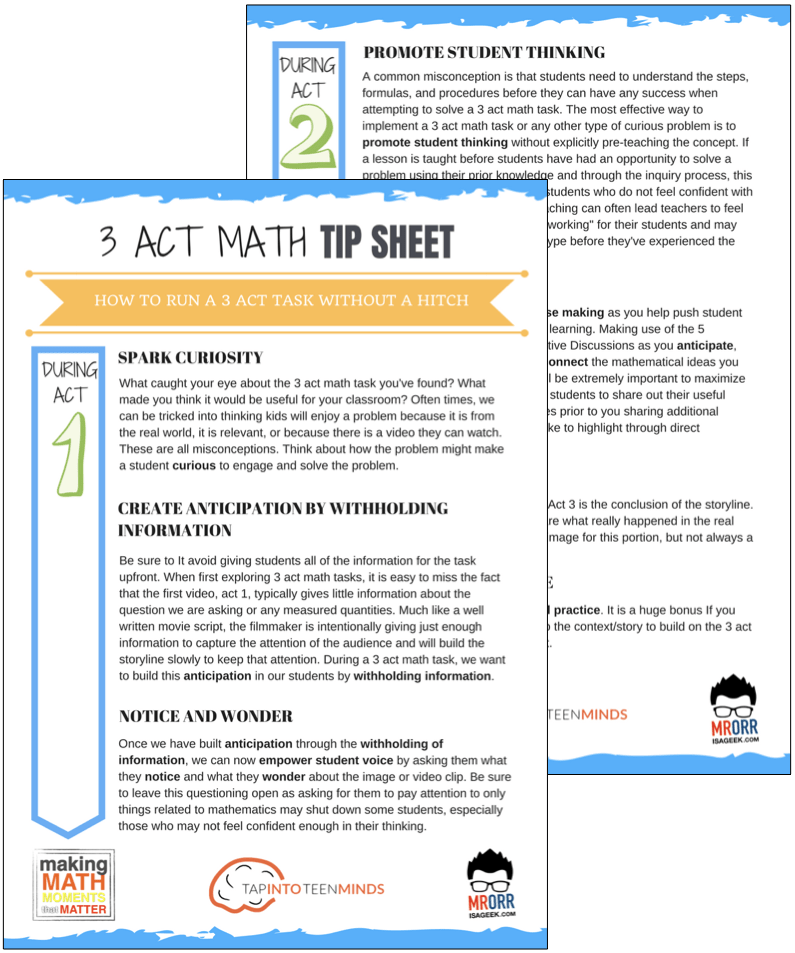
DOWNLOAD THE 3 ACT MATH TASK TIP SHEET SO THEY RUN WITHOUT A HITCH!
Download the 2-page printable 3 Act Math Tip Sheet to ensure that you have the best start to your journey using 3 Act math Tasks to spark curiosity and fuel sense making in your math classroom!
LESSONS TO MAKE MATH MOMENTS
Each lesson consists of:
Each Make Math Moments Problem Based Lesson consists of a Teacher Guide to lead you step-by-step through the planning process to ensure your lesson runs without a hitch!
Each Teacher Guide consists of:
- Intentionality of the lesson;
- A step-by-step walk through of each phase of the lesson;
- Visuals, animations, and videos unpacking big ideas, strategies, and models we intend to emerge during the lesson;
- Sample student approaches to assist in anticipating what your students might do;
- Resources and downloads including Keynote, Powerpoint, Media Files, and Teacher Guide printable PDF; and,
- Much more!
Each Make Math Moments Problem Based Lesson begins with a story, visual, video, or other method to Spark Curiosity through context.
Students will often Notice and Wonder before making an estimate to draw them in and invest in the problem.
After student voice has been heard and acknowledged, we will set students off on a Productive Struggle via a prompt related to the Spark context.
These prompts are given each lesson with the following conditions:
- No calculators are to be used; and,
- Students are to focus on how they can convince their math community that their solution is valid.
Students are left to engage in a productive struggle as the facilitator circulates to observe and engage in conversation as a means of assessing formatively.
The facilitator is instructed through the Teacher Guide on what specific strategies and models could be used to make connections and consolidate the learning from the lesson.
Often times, animations and walk through videos are provided in the Teacher Guide to assist with planning and delivering the consolidation.
A review image, video, or animation is provided as a conclusion to the task from the lesson.
While this might feel like a natural ending to the context students have been exploring, it is just the beginning as we look to leverage this context via extensions and additional lessons to dig deeper.
At the end of each lesson, consolidation prompts and/or extensions are crafted for students to purposefully practice and demonstrate their current understanding.
Facilitators are encouraged to collect these consolidation prompts as a means to engage in the assessment process and inform next moves for instruction.
In multi-day units of study, Math Talks are crafted to help build on the thinking from the previous day and build towards the next step in the developmental progression of the concept(s) we are exploring.
Each Math Talk is constructed as a string of related problems that build with intentionality to emerge specific big ideas, strategies, and mathematical models.
Make Math Moments Problem Based Lessons and Day 1 Teacher Guides are openly available for you to leverage and use with your students without becoming a Make Math Moments Academy Member.
Use our OPEN ACCESS multi-day problem based units!
Make Math Moments Problem Based Lessons and Day 1 Teacher Guides are openly available for you to leverage and use with your students without becoming a Make Math Moments Academy Member.
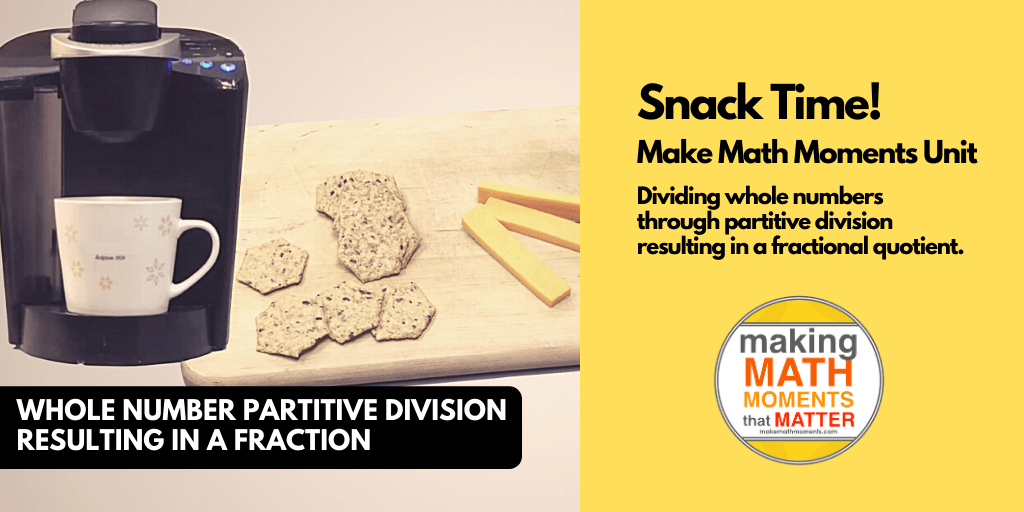
Partitive Division Resulting in a Fraction
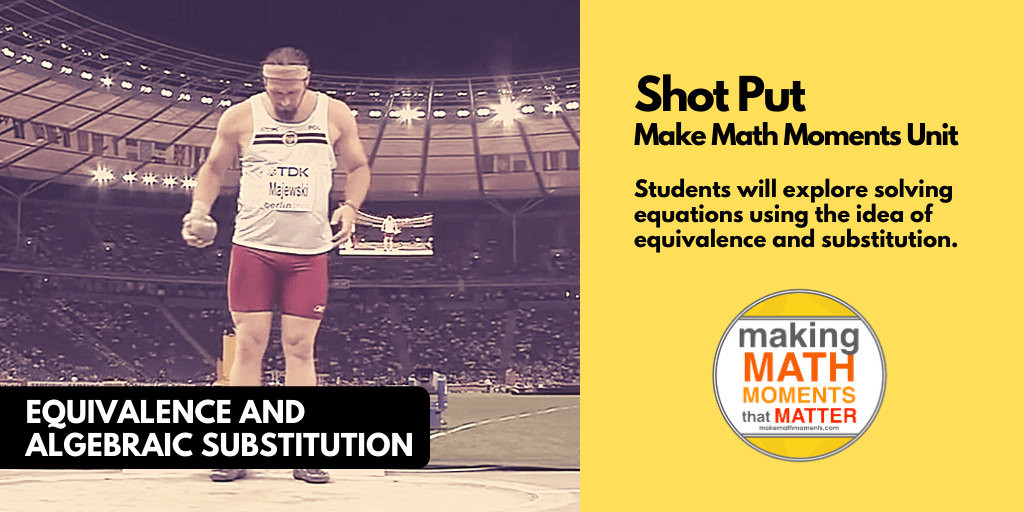
Equivalence and Algebraic Substitution
Represent Categorical Data & Explore Mean
Downloadable resources including blackline masters, handouts, printable Tips Sheets, slide shows, and media files do require a Make Math Moments Academy Membership.
ONLINE WORKSHOP REGISTRATION
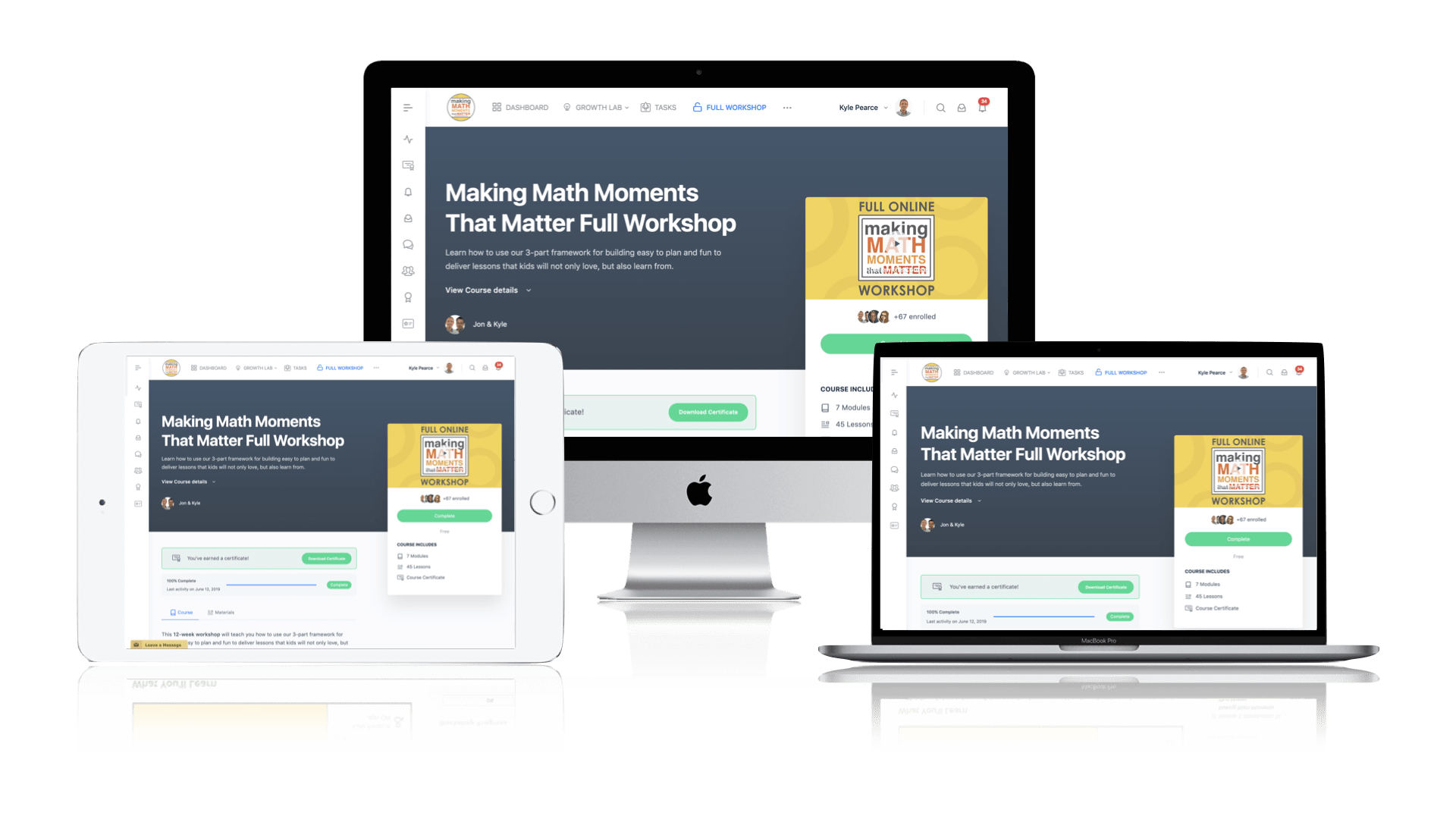
Pedagogically aligned for teachers of K through Grade 12 with content specific examples from Grades 3 through Grade 10.
In our self-paced, 12-week Online Workshop, you'll learn how to craft new and transform your current lessons to Spark Curiosity, Fuel Sense Making, and Ignite Your Teacher Moves to promote resilient problem solvers.
0 Comments