
Episode #445: When Parents Push Back on “New Math”: Building Trust Through Clarity and Confidence
LISTEN NOW HERE...




WATCH NOW...
Have you heard a parent ask, “Why are we making math so complicated?” You're not alone.
Many teachers want to move beyond rote procedures—but hit resistance when families raise concerns about “new math.” From social media posts to parent-teacher conferences, the pressure to revert to traditional instruction is real.
But the issue isn’t just parent perception. Often, teachers aren’t yet confident in conceptual models themselves. And without the right support, it’s easy to retreat back to what feels safe.
Listeners Will Learn:
- Why parents often push back on visual models and multiple strategies
- How teacher confidence impacts the success of math shifts
- What leaders can do to support teachers before inviting parents in
- The importance of teacher epiphanies (and how to create them!)
- How to engage families in the why behind conceptual math
- Ideas for parent communication that build trust, not tension
- What it really means to shift the narrative around math understanding
Whether you're a teacher navigating tough conversations or a coach supporting system-wide change, this episode delivers mindset shifts and practical moves to help you stay the course—even when pushback is loud.
Attention District Math Leaders:
Not sure what matters most when designing math improvement plans? Take this assessment and get a free customized report: https://makemathmoments.com/grow/
Ready to design your math improvement plan with guidance, support and using structure? Learn how to follow our 4 stage process. https://growyourmathprogram.com
Looking to supplement your curriculum with problem based lessons and units? Make Math Moments Problem Based Lessons & Units
Be Our Next Podcast Guest!
Join as an Interview Guest or on a Mentoring Moment Call
Apply to be a Featured Interview Guest
It will take less than two (2) minutes to book your Math Mentoring Moment call.
Book a Mentoring Moment Coaching Call
Take two (2) minutes to book your Math Mentoring Moment call and let's work together to shake that math pebble out of your shoe!
Are You an Official Math Moment Maker?
Ensure that you follow, rate and review on Apple Podcasts, Spotify and other platforms to show your support and ensure other math educators can find the show.




DOWNLOAD OUR HOW TO START THE SCHOOL YEAR OFF RIGHT GUIDE
Start your school year off right by downloading the guide that you can save and print to share with colleagues during your next staff meeting, professional learning community meeting or just for your own reference!
FULL TRANSCRIPT
Kyle Pearce:
All right there, math moment makers. Today we're gonna be digging into a great conversation and I'll be honest, we just hit record after chatting about this for probably a full episode length. So that's how interesting and how complex and how challenging this problem is. And it all stems from a pebble that was in the shoe of a listener. So that listener's probably listening right now and we're gonna do our best to try to help you with this challenge, here it is, word for word. It said, I wanna make changes to instruction. I know that focusing on the algorithm alone is not enough. Notice here, keyword is not enough, meaning we're not ditching algorithms completely, but we're just saying it's not enough. But I'm getting pushback from parents and the community. I see all these Facebook posts about new math and why are we making it so complicated. Help. And I'm sure that some way, or form, all of us can relate to this particular challenge. We've all been there before. Maybe you're dealing with it right now. Friends, what are we thinking? How do we help this individual deal with such, and I'm gonna argue like a common challenge that we experience in math, in the math ed space anyway.
Yvette Lehman:
I wonder if we want to start specifically with the teacher, but then we'll also talk about the system that this teacher works in, you know, because I think those are two important things we need to navigate here. I know what this feels like, right? When you're trying something new and you're questioning yourself and maybe you're not super confident. You're like, well, I was taught a certain way. That was my own classroom experience. All I know is how to use the long division algorithm or maybe I don't even know how to use it really effectively either. But now I'm trying something and it's uncomfortable. I'm trying to use models and I'm trying to make connections and I'm trying to connect the symbolic representation to a visual representation for students or make it more concrete. But I do remember hearing parents being like, why are you making this so complicated? I actually just heard this in a call this morning, Beth, where it's like, you know, we're using the number line and it's, you know, taking a lot of paper or there's a lot of manipulatives and it's taking a long time. And it's like, why don't we just jump to the algorithm? Like, why are you making this so hard? And I know why parents feel that way because they want to help their child and they only had their own experience as well. Right? So it's like I understand why there's a lot of emotional response to maybe this pushback that teachers are feeling. It's like when you start to be questioned about why are we not just jumping to the standard algorithm for subtraction? Why are we asking students to show their thinking on a number line or using, you know, a variety of models? How do we help position this educator to feel comfortable responding and sticking to the change knowing that the change is hard?
Beth Curran:
What I found in my work, because I get this all the time, what I found in my work is that knowledge is power, right? So if you have a group of parents that are pushing back on new math or how math looks different, I think that you have to put some systems in place or some supports in place to teach the parents why this is so important. And once they see the why, they tend to then take that step back. And they allow the teacher to teach in a different way. They allow the school to implement a curriculum that's teaching math in a different way. I think it's all about making sure that every stakeholder and the parents are definitely a big stakeholder in educating their children, that they understand why math is shifting, why it looks a little bit different.
Kyle Pearce:
I love that. It brings me back to, I used to go to a particular school in the district that Yvette and I used to work in. And every year we would do a parents night for math. And every year I would do a math activity and really focus in on the conceptual side of things and really. I would teach it like it might sound silly, but I would literally teach the lesson exactly how I would teach a lesson with kids because every single one of those parents, if they didn't have that experience the same way the kids did, they wouldn't have had the epiphany that they needed in order for us to then have the conversation about like, what is new math? You know, when we talk about quote unquote new math, it's like, it's not new math, it's the math. And it's just never been exposed to many of us along the way. And I think as we take those, like, I like the idea you had said, the system, the structures, like we have to be very specific about this and we can't allow parents to sort of be on the outside looking in and always wondering, right? Because the chances are they're going to wonder incorrectly, or they're going to make some assumptions that really don't exist or didn't happen. And when they have those epiphanies, they start to recognize that, like this isn't trying to just make it complex or complicated. Like that's the big thing that people get at. They're like, it's so complicated. Like I could have come up with the answer so much faster just by doing the algorithm, but in reality, it's like helping them to really gain this insight as to like, what is math class all about? Like it really isn't just about computation anymore, right? Back in the day, that's what was really, really pushed on. Now we're talking about like, we actually want kids to become thinkers, we want them to understand, we want them to know what's going on here, so that when things do get tough, they can actually problem solve their way out. And unfortunately, that's not something that a parent can find on their own, especially if they're number one source for like why math is changing is say a Facebook group where you know there's all these incorrect and oftentimes like misguided you know posts about how their kids are doing math and why they're doing it in a certain
Yvette Lehman:
So I think our advice to this listener that reached out to us with this question or any other teachers who are listening is to open your doors to parents. You know, like I think there needs to be a level of transparency and trust. And that's one thing I always loved about, I worked in our summer learning program within our district and we had parent engagement all the time where it wasn't like come into the school and watch a performance in the gym. It was like coming to the school and actually engage in mathematics learning with your child at the child's desk. And maybe during the day isn't an option for your community or parents aren't available. But as Kyle mentioned, is it an evening? Is it videos, you know, or some type of support just to help people understand? And sometimes, like you said, we just need to have that epiphany, just like educators need to have that epiphany. Some of the ones that we love, right, are subtraction examples where you're saying, you know, 1001 minus 999. And it's like, actually, you know, your algorithm isn't going to be super efficient for that, right? Like that seems really complicated.
Kyle Pearce:
It seems pretty complicated, you know, if you really want to push back on this idea, right? It's like maybe maybe there's more than one way for us to be looking at math and solving problems.
Yvette Lehman:
And we want to build flexibility. We want to build reasoning. We want students to think about what's most efficient. When we have 17 minus eight and people are stacking it and then borrowing the 10 and still having 17 minus eight, these are the types of problems that we're trying to address by equipping our students with a variety of strategies and models. So I think that that's really great advice for the teacher is that Parents also need to have these mathematical epiphanies. They have to see the value in the change because I don't, I, know, parents don't want like bad math for their kids. They're not like, can you please just make it easier for me? I don't think that's what people are looking for. But if they don't, right, right. Like I think that, you know, parents want the best for their child. They want their child to be successful. And so, creating those partnerships with parents, where it's like not me against them. It is a partnership between, you know, the parent or guardian and the school, because we all want our children to be as successful as possible. But we also mentioned this idea. So if you're a teacher listening and you're like, what can I control? Like I can control opening my door to parents or guardians. I can control communication home, maybe a newsletter with some videos. I thinking about the calendar that we created Kyle for greater Essex. was a parent calendar with QR codes with like a little mini math lesson around a big idea or a concept that we are trying to support change in. That's what the parent, the teacher can control. But now I'm thinking about the listeners who are coordinators or coaches or principals. You know, what is their role in supporting this educator to feel confident in the shift that they're making?
Kyle Pearce:
Yeah, you know, it's an incredibly challenging role. So first of all, I don't wanna discount how hard it is for the teacher to try to maintain that line of communication with parents and really trying to build their own conceptual understanding. We talk about content knowledge as being so important. And this is really important for us in leadership roles to understand. It's very, what I find is we wanna see change happen unrealistically fast in our district, right? And one of the challenges that we can face is that if we get too aggressive, let's say, with trying to shift how math instruction is taking place across our system, we may not have all teachers in a position to do it well. And that is to me one of the biggest challenges that we're up against in a leadership role because we certainly all want to see everything. I want to see that change yesterday. I want to see it, you know, I want to see everything happening conceptually if possible. But we also have to be cautious that, you know, sometimes by pushing and maybe even pushing too hard, too fast, that can actually create more of the challenges we're seeing. Like when someone posts in a Facebook group, this new math, complicated math, the whatever, like it's probably based on a situation that they've experienced that either they didn't understand themselves or maybe even the educator wasn't well positioned in order to deliver the content in that way. And therefore the actual experience could have actually been, you know, dare I say it in, you know, worse off than had they gone about it in the way that they were feeling confident. So a word I want to bring up here and put on your mind is like confidence is so important and it's really important for us to be equipping our educators with that confidence. And it's very difficult for confidence to develop until those educators have had the epiphany, have had that shift in belief to go, I wanna see math happening and I wanna see my math classroom shifting from the way I may have done it. And I'll use myself as an example, as a very traditional algorithm first. rush to that algorithm approach, I need to understand the mathematics well enough for me to be able to deliver a content rich experience for those children. Otherwise, I might actually be perpetuating some of these challenges that we're seeing out there, right? Where people are saying, this is just really complicated. My child doesn't understand it, me as the parent, I don't understand it, and heck, maybe the teacher didn't fully understand it themselves. And that's a really, really tough position to be putting everyone in, not saying that we don't do this work. We just have to be very strategic and we have to be very cognizant and aware that this is one of the biggest challenges I see as we as leaders try to shift our districts towards more of a conceptual approach to delivering math curriculum.
Yvette Lehman:
It makes me think though of, go ahead Beth, because I was actually just going to say, it made me think of what you said before the call, which is like the change has to happen to lead to change.
Kyle Pearce:
Real change.
Beth Curran:
Right, It is hard. is hard. And Kyle, I would say that the administrator's role is actually even more important than the role of the teacher communicating with the parent, because what has to be in place first, right? We can't expect a teacher to host a math night with parents if they don't feel well positioned to access the math themselves and to explain it to the parent group. We can't ask them to create videos, content for parents if they don't truly understand the math themselves. So I think the role of the administrator is really important to get this going. We have to provide those supports for teachers. We have to get them doing the math on a regular basis and we have to get them having those epiphanies and seeing why this change is so important.
Yvette Lehman:
It's like, what comes first? know? Like, and what is, because as much as this feels sometimes, like it's not going to happen quickly, the change is going to happen over time. And it may not be, it might be bumpy, right? Like there may be, and I know I felt this, right? Where I've tried to switch my approach to teaching a new concept to something more conceptual. And the lesson, I was confused, they were confused. Everybody was more confused than we had been the day before. but I didn't abandon it. You know, I could have abandoned it. I could have been like, it would have been a lot easier just to teach, keep, change, flip. And I wouldn't have gotten myself all tangled up in this area model today. But.
Kyle Pearce:
Right, right. I would say if you if you've never had that experience, then either you were actually taught from a conceptual understanding approach, which I feel like very few of us here in North America, you know, can confidently say, or we haven't actually, you know, dipped our toe into that world, you know, yet. And and, you know, I think the key piece that I heard you say, Yvette is like, not giving up on doing the work. because I wasn't exactly ready or well positioned yet. And I think it's really easy for us to go, you know, this, I've seen it happen. I've seen it happen with colleagues before where, you know, you're using a certain model or a certain tool and it doesn't go well. And then you sort of get frustrated and sort of think like this, this can't be helpful for the kids. And reality is like, well, maybe it can't be in that exact way, maybe for that exact problem, or maybe for how well positioned I was to actually deliver the content in that way at that time. it's going to, I'm going to say like, don't want pacing might be the right word is like, as we do this work, we have to be cautious. It's like, I love the idea of, know, you jump in cannonball into the pool and like, you're, going to do this work. But if we aren't quite there yet, if we're not ready and well positioned to do that, that cannonball might actually, you know, hinder you from actually getting to the place that you want to get to. Right. So that means like, you're not going to become the perfect, you know, not rushing to the algorithm teacher just overnight. Like it's going to take time and you're going to have to transition your way there. And as you have those epiphanies, you'll be in a better position to help other students have those epiphanies. So if you can expedite those epiphanies for yourself. That means doing the math, spending the time with colleagues or friends or, know, Yvette, I know you do like family math problems with your, you know, your husband and your son. And you guys are doing these things together. Like the more we do those things, the better position we're going to be in order to have success sooner. But I don't want to say it's necessarily going to lead to success immediately. And I think this is one of the maybe hardest things that anyone who's in a leadership role in a school or a district really has to grapple with is like not pushing that cart too aggressively down the path. Otherwise, it could actually lead us to a little bit more chaos than maybe success that we're after.
Yvette Lehman:
think about the conditions to that support change. You know, like when I was in that, when I was trying to change to a more conceptual approach and I was trying to incorporate the use of, you know, models and a variety of strategies, what allowed me not to give up was that I wasn't the only one doing that work. Like it was a district wide, school wide push, you know, for transformation and change. And so I didn't feel alone. And I knew that I would be supported because when I went to, you know, pull out PD sessions with the district, my principal was at the table with me. So when I went back to the school to try something new or try to bring in this new approach, I didn't feel like I wasn't going to be supported because I knew that we were collectively pulling in this direction.
Kyle Pearce:
Right. Like there is that group mentality that we have. It's just part of who we are as humans that if you are the lone ranger out there doing this work and you you feel like your colleagues are all kind of looking at you and sort of, you know, not feeling like the work you're doing is going to be valuable in some ways, it sort of sets you up to go, you know, they're right. Right. And I mean, if if if they if they were a part of that, then you all know like you're there to pick each other up. When you get stuck, you have someone to work with. So this work is really group work and it's really important that you have that group mentality here so that you guys can all work with one another and really develop and position yourself to be a better educator together.
Beth Curran:
I'm going to, I want to leave all of our listeners, whether or not you're a parent, a teacher, an administrator with a thought, something to think about. Oftentimes, when I'm in rooms with adults, I will ask them how they felt about math. Was math their favorite subject when they were going to school? How they feel about themselves as a math person right now? And 90 % of the adults will say, math was confusing to me in school. I didn't feel like I was good at math. Today, I wouldn't say that I'm a math person. We're not a math family. Yet we are so stuck into wanting math to be taught exactly the same way that we learned it. And so that's something to ponder and something to think about. It's like, why are we holding on to a way of mathematics instruction that left us feeling like we weren't good at math and we're not math people? And again, if we want to see change, we have to make some change.
Kyle Pearce:
That is such a strong thought for everyone to take away with them. And I think, you know, my easy answer to why we tend to do those things is that it's all we know. And whatever we know is better than the unknown. And therefore it brings me all the way back to this idea of epiphanies and making sure that we're helping our parents have epiphanies as leaders. We have to help our colleagues, our educators to have those same epiphanies. And then and only then are we going to be able to routinely be able to allow our students to have those epiphanies in math class so that hopefully a generation or two or three who knows how long this will take. But when we get to that place where understanding math, like imagine a world where people say, you know, just like some of these other subject areas that, you know, math I, you know, I was, understood the math. I didn't necessarily love math class because I would prefer to do X, Y, or Zed. But right now we live in a world where a lot of people just feel like math did not make any sense. And in reality, it's one of the things that should make the most sense. Like history doesn't make sense. You know, there's so many things in history. go, how is it possible that that happened? You know, that does not make any sense right there. But in math, everything does make sense. if we take the time, if we're well positioned to actually do that learning. And, you know, we have to do this together. We have to be, you know, we have to be reflective in how fast we try to make this change. Because again, if we go too quick, we might actually be hurting more than helping. we just, patience is probably going to be one of the biggest pieces that we're going to need. So friends, hopefully you found this to be a helpful piece of information. If you're a leader, reach out to us. We'd love to have a conversation with you. If there's something you're pondering as a listener and you know, it's a pebble in your shoe that you want us to sort of tackle here together on the show. We love receiving that feedback from you. We're hoping that we'll see you in one of our future webinars here coming up. I know Yvette's getting geared up for one later this evening and we look forward to chatting with you in our next episode.
Your Customized Improvement Plan For Your Math Classroom.
Take the 12 minute assessment and you'll get a free, customized plan to shape and grow the 6 parts of any strong mathematics classroom program.
District leader/math coach? Take the District Assessment
Thanks For Listening
- Book a Math Mentoring Moment
- Apply to be a Featured Interview Guest
- Leave a note in the comment section below.
- Share this show on Twitter, or Facebook.
To help out the show:
- Leave an honest review on iTunes. Your ratings and reviews really help and we read each one.
- Subscribe on iTunes, Google Play, and Spotify.
The Making Math Moments That Matter Podcast with Kyle Pearce & Jon Orr
Weekly interviews, strategy, and advice for building a math classroom that you wish you were in.
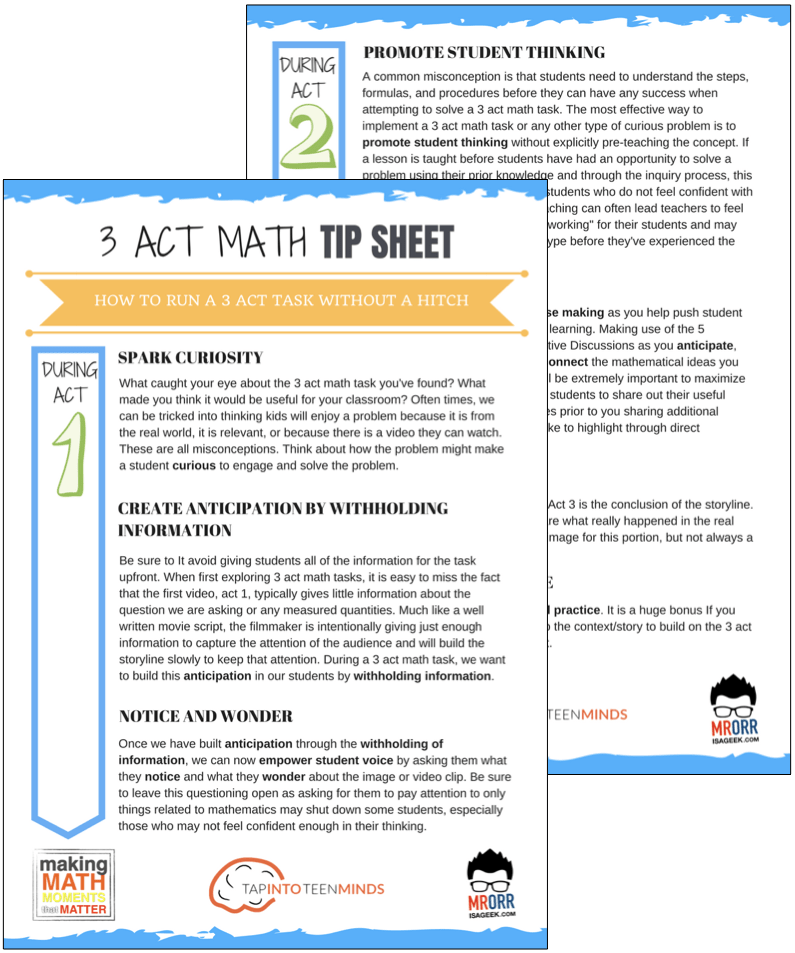
DOWNLOAD THE 3 ACT MATH TASK TIP SHEET SO THEY RUN WITHOUT A HITCH!
Download the 2-page printable 3 Act Math Tip Sheet to ensure that you have the best start to your journey using 3 Act math Tasks to spark curiosity and fuel sense making in your math classroom!
LESSONS TO MAKE MATH MOMENTS
Each lesson consists of:
Each Make Math Moments Problem Based Lesson consists of a Teacher Guide to lead you step-by-step through the planning process to ensure your lesson runs without a hitch!
Each Teacher Guide consists of:
- Intentionality of the lesson;
- A step-by-step walk through of each phase of the lesson;
- Visuals, animations, and videos unpacking big ideas, strategies, and models we intend to emerge during the lesson;
- Sample student approaches to assist in anticipating what your students might do;
- Resources and downloads including Keynote, Powerpoint, Media Files, and Teacher Guide printable PDF; and,
- Much more!
Each Make Math Moments Problem Based Lesson begins with a story, visual, video, or other method to Spark Curiosity through context.
Students will often Notice and Wonder before making an estimate to draw them in and invest in the problem.
After student voice has been heard and acknowledged, we will set students off on a Productive Struggle via a prompt related to the Spark context.
These prompts are given each lesson with the following conditions:
- No calculators are to be used; and,
- Students are to focus on how they can convince their math community that their solution is valid.
Students are left to engage in a productive struggle as the facilitator circulates to observe and engage in conversation as a means of assessing formatively.
The facilitator is instructed through the Teacher Guide on what specific strategies and models could be used to make connections and consolidate the learning from the lesson.
Often times, animations and walk through videos are provided in the Teacher Guide to assist with planning and delivering the consolidation.
A review image, video, or animation is provided as a conclusion to the task from the lesson.
While this might feel like a natural ending to the context students have been exploring, it is just the beginning as we look to leverage this context via extensions and additional lessons to dig deeper.
At the end of each lesson, consolidation prompts and/or extensions are crafted for students to purposefully practice and demonstrate their current understanding.
Facilitators are encouraged to collect these consolidation prompts as a means to engage in the assessment process and inform next moves for instruction.
In multi-day units of study, Math Talks are crafted to help build on the thinking from the previous day and build towards the next step in the developmental progression of the concept(s) we are exploring.
Each Math Talk is constructed as a string of related problems that build with intentionality to emerge specific big ideas, strategies, and mathematical models.
Make Math Moments Problem Based Lessons and Day 1 Teacher Guides are openly available for you to leverage and use with your students without becoming a Make Math Moments Academy Member.
Use our OPEN ACCESS multi-day problem based units!
Make Math Moments Problem Based Lessons and Day 1 Teacher Guides are openly available for you to leverage and use with your students without becoming a Make Math Moments Academy Member.
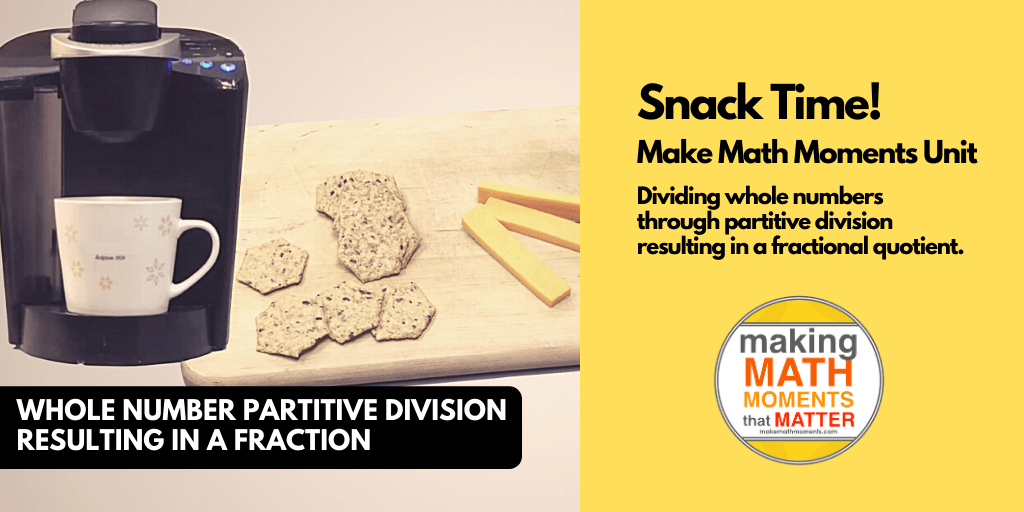
Partitive Division Resulting in a Fraction

Equivalence and Algebraic Substitution
Represent Categorical Data & Explore Mean
Downloadable resources including blackline masters, handouts, printable Tips Sheets, slide shows, and media files do require a Make Math Moments Academy Membership.
ONLINE WORKSHOP REGISTRATION

Pedagogically aligned for teachers of K through Grade 12 with content specific examples from Grades 3 through Grade 10.
In our self-paced, 12-week Online Workshop, you'll learn how to craft new and transform your current lessons to Spark Curiosity, Fuel Sense Making, and Ignite Your Teacher Moves to promote resilient problem solvers.
0 Comments