
Episode #466: What Should Tier 2 Math Intervention Actually Look Like For Maximum Impact?
LISTEN NOW HERE…




WATCH NOW…
You’ve got protected time for Tier 2 math intervention…
…but what are you actually supposed to do during that time?
This is one of the most common questions we hear from teachers and leaders. You know Tier 2 matters—but without a clear vision, it can quickly turn into reteaching the same lesson, louder and slower.
In this episode, we unpack what effective Tier 2 math instruction really looks like, sounds like, and feels like in the classroom.
In This Episode, You’ll Learn
- Why Tier 2 is not just reteaching the same math lesson
- How to structure small groups based on student thinking, not labels
- What purposeful practice should look like for the rest of the class
- How to use formative assessment and self-assessment (red/yellow/green) to form groups
- Why Tier 2 should focus on targeted moves (models, misconceptions, representations)
- How to build a classroom where students support each other, not just rely on the teacher
- The connection between strong Tier 2 and deep understanding of math big ideas
Take a moment and reflect:
If someone walked into your classroom during Tier 2…
Would they clearly see targeted support happening?
If not, start small:
- Identify one learning goal
- Pull one group
- Focus on one specific need
That’s where powerful Tier 2 begins.
Attention District Math Leaders:
Not sure what matters most when designing math improvement plans? Take this assessment and get a free customized report: https://makemathmoments.com/grow/
Ready to design your math improvement plan with guidance, support and using structure? Learn how to follow our 4 stage process. https://growyourmathprogram.com
Looking to supplement your curriculum with problem based lessons and units? Make Math Moments Problem Based Lessons & Units
Be Our Next Podcast Guest!
Join as an Interview Guest or on a Mentoring Moment Call
Apply to be a Featured Interview Guest
Book a Mentoring Moment Coaching Call
Are You an Official Math Moment Maker?



FULL TRANSCRIPT
Yvette Lehman: On the last episode, we talked about indicators of effective tier one or core instruction. And we’re gonna continue that conversation today, but we’re going to look specifically at tier two. We had a teacher reach out recently who said, I actually have protected time for tier two. We have a block of time in our schedule for math intervention. And I’m just not really sure what I should be doing. What does that look like and sound like during that time?
Yvette Lehman: And so for those of you listening, whether you have protected intervention time or your tier two instruction is embedded ideally into your core instruction, we’re going to talk today about do we have a common understanding of the indicators of impactful or effective tier two instruction? What does that look like and sound like?
Jon Orr: Got it. So when you first hear the term tier two, Beth, what’s popping into your mind? Just generally, tier two — what do you think the general understanding of tier two instruction really means?
Beth Curran: What pops into my mind right away is small group instruction, where you’re targeting the students, maybe looking at their entry point into whatever math content you were teaching, and then taking them on a path toward meeting that learning goal for the lesson. So maybe their entry point didn’t quite get them there. So what you might do in tier two is then call that small group over. Small group instruction pops in my head when you say tier two.
Jon Orr: What do the groups look like, Beth, in your mind?
Beth Curran: So in my mind — we talked about this in another episode — in an ideal world, teachers would stop labeling kids as high, medium, and low, and they would think more deeply about how they’re accessing whatever math we’re putting in front of them. So in my mind, those small groups would look like, I have a bunch of students who still need to build a model to access the content. That’s their best point into this grade level content. So I’m going to pull all of them together and try to move them from building the models to maybe now drawing a picture of the model.
Beth Curran: I’ve got my pictorial kids who aren’t quite functioning abstractly, again within that same grade level content toward reaching that learning goal. I’m going to call those over and help them draw those pictures and then connect it to the abstract math. And then my students who are functioning abstractly, I might also call them over to make sure that they can build a model or draw a picture so that they deeply understand the content and again, reach that learning goal. So that’s what my groups would look like in an ideal world.
Jon Orr: I’m remembering my first 10 years of teaching. If you’ve listened to this podcast, you know that my first 10 years of teaching was very traditional. High school teacher, kids sat in rows, I lectured. So when I think about tier one, my tier one was whole group lecture, examples. And then my tier two would have been like, okay, now it’s practice time. And that tier two wasn’t really group work. My tier two was you’re in rows and you now may form your own groups — kids pull their desks together, or they would sit side by side, or lean across the aisle to collaborate with someone. And all they’re doing is the practice questions I assigned them based off the tier one instruction.
Jon Orr: That was my tier two. And then my last 10 years was very much more the five practices mixed in with what became building thinking classrooms, and thinking about like whole group now looked different in tier one. And then they were in groups already, and tier two was really me moving between groups, supporting each group individually. But then our tier one was mixed to be like, let’s pull everyone together for a quick tier one and then go back to groups. Like these are the images I get when I hear tier one versus tier two. And it might be that somebody listening gets a completely different image. And this is the important work — defining what is tier one and what does tier two really mean.
Yvette Lehman: Okay, so if I was in an elementary or middle school classroom and I was told I was walking into the room during tier two, what I would expect to see are students engaged in purposeful practice — and I’m gonna tell you what I mean by purposeful practice in a minute — and the teacher working with a small group. That is what I would expect to see.
Jon Orr: So the teacher’s pulled one small group over here, targeted, and everybody else is doing purposeful practice either on their own or kind of like the way I was describing, leaning across the aisle in their own little groups. I get it, I can see it.
Yvette Lehman: Yes. Maybe in groups, right. And my purposeful practice in my room would have been maybe you are finishing the practice questions from today’s lesson. Maybe you are on KnowledgeHook or Zern or a digital platform engaged in some type of mixed review or practice. Maybe you’re playing a math game because you’re working on fluency. And usually my students had choice for that time because I found the more choice they had, the more engaged they were, the less classroom management issues I had. They still had the same things to complete in the week.
Yvette Lehman: It’s like by the end of the week, you have to finish your practice questions, you have to put in so much time on the digital platform, but you could choose. Maybe that became homework if you didn’t want to use the time in class right now, but these were your choices — a math game, digital platform, or practice questions. And I found choice really helped me because everyone always asks, what is everybody else doing, how do you manage your room? And sometimes kids just didn’t want to do the practice questions right now independently. This wasn’t the right time for them to do that, so I gave them options.
Beth Curran: Let me speak to choice here for a second too, because I can imagine some teachers who are listening are thinking, well, how do I have time to figure that out? How do I know what group I should pull? You’re saying have the same students and not to label them as struggling. So how am I supposed to do that?
Beth Curran: I have seen in classrooms where teachers have said to students, here is your independent work, so that meaningful practice — if you should want some help, I’ll be at the back of the room and come join me. And miraculously, the feedback that I got from teachers who have tried this was that every single student that I would have tapped on the shoulder and said come join me, joined me on their own.
Beth Curran: So again, giving choice — that’s a tier two situation, right? You offered this individualized support to students as they were working through this, but you allowed them to sort of self-select whether or not they felt like they needed that support. Now, there might come a time where a student isn’t self-selecting for whatever reason. That’s when the teacher says, well, hold on — your independent practice has been a little bit off track here. Tomorrow I want you to definitely come and join that small group.
Beth Curran: So providing that student choice can also be helpful because I think it helps build their confidence in who they are as a mathematician. They’re not always the ones in the small group at the back of the table. The teacher is saying, I believe you can do this on your own, but should you need some support, I’m here.
Jon Orr: In my experience with the I’ll be here at the back approach, Beth, the kids that didn’t need it would always come back and talk to me. And therefore, now when I did pull the kids I actually needed to talk to, it looked like, oh, you need this specific support — which means now you’re being targeted against the rest of the group. Or if you ventured back voluntarily, you were centering yourself out.
Jon Orr: I taught high school and middle school, and walking to the back of the room has a lot of social anxiety attached to that move right there. It can be extremely hard for kids — like, I’m gonna make the move to walk across all my fellow students to get extra support. It kind of felt like the same move as, I put the manipulatives at the back of the room. If you need them, then go get them. Like, you’ve almost centered out a kid — that’s only if you need it, you shouldn’t need it, but if you do, go get it.
Jon Orr: And so instead of saying if you need me, I’m here, I think about purposely pulling groups and maybe structuring it so that everybody gets pulled at some point. And therefore you’re not creating groups that feel like the low group or the high group. You’re making it so that everybody eventually gets pulled, and therefore you’re decentralizing this tier two support as something that only some kids need.
Beth Curran: Sure. Yeah, and I just want to make sure that listeners heard what you said there — we need to pull all students. So at some point, all students should be coming back to work with us. Any teacher listening, your classroom and your students are going to be individual and you’re going to have different needs. We’re giving you some ideas of things to try and you’re going to find what works for your students.
Beth Curran: And one of the things that John did say was that you’re calling back not just the kids who appear to be struggling, but also the kids who are in the middle, and also the kids who are functioning abstractly quickly and who need maybe a little more rigor added into the lesson for them. Just making sure that you’re seeing all the students at some point in that small group, because we’ve talked about small group before — it’s so powerful. What Graham Fletcher says, pull up a chair next to students. When you can make that classroom seem a little bit smaller, you’re going to learn so much more about your students and how they think.
Yvette Lehman: Well, I have so much to say on this topic. Just this morning, my son is starting my favorite concept in sixth grade math — top, front, and side views of three-dimensional structures and isometric drawings. I love this concept. So I took five minutes to help him understand what the expectations are, basically to say, you’re going to have a structure and you’re going to either draw the top, front, and side view, or you’re going to build it based on those views, or you’re going to draw it. I basically took five minutes, just one-on-one, to help him get an idea of what the expectations are going to be.
Yvette Lehman: And he will be so much better positioned to engage in this learning today from those five minutes of one-on-one conversation than from 30 minutes talking to a class of 30. Like, there’s so much power to the small group or personalized instruction, and it actually doesn’t take as long as we think sometimes. We were running out the door and I saw on his Edsby — which is his parent communication platform — that they’re introducing this big idea today. So I built one out of Lego and I just quickly showed him, this is what you’re going to be doing today.
Yvette Lehman: I wanted to address the question of pulling everybody and how you pull your groups. I’ve shared this before on the podcast, but it’s been a while so I’m going to share it again. The way that I pulled my small groups or designed my small groups was a two-layer process. So at the end of a three-part math lesson, after the consolidation, we did an exit ticket. And I had them do two types of questions in their exit ticket. One was reflection relative to the learning goal that we’d co-constructed in the success criteria. And one was an application.
Yvette Lehman: So that was one way that I was gathering evidence of understanding relative to the learning goal at the end of the lesson. But then I used John Hattie’s system of red, yellow, green for their self-assessment of their own understanding. And to quickly do that, I had three colours of construction paper and they placed their exit ticket on the paper that reflected how they felt about their learning toward that learning goal.
Yvette Lehman: So sometimes — and typically the students I pulled first, the ones that I grabbed almost immediately, sometimes even for that five-minute conversation at the end of nutrition break or going into the next period — were the ones who had a significant disconnect between what they’d produced and how they self-assessed. So if I had a student who answered the exit ticket correctly and demonstrated strong understanding but put themselves in red, I wanted to see that student right away. If I had a student who was the opposite — who had really misunderstood the learning goal and not demonstrated proficiency on the application but put themselves in green — I also wanted to see that student right away for almost like that quick five-minute conversation to make sure that they had more clarity around their understanding.
Yvette Lehman: But that system really worked for me. And it also brought in that metacognitive process of students owning their learning relative to the outcomes we defined.
Jon Orr: Let’s now talk about what we’re doing in those groups for effective tier two instruction. I know that you mentioned pulling kids, that you are very targeted about who you’re gonna pull and when you’re gonna pull them. But when you pull that group, what are you doing in that group specifically? Give us some of the ideas that you did.
Yvette Lehman: That’s such a difficult question because I feel like it’s so responsive to what you’re seeing and their entry point. And I think there’s a lot of tier two is just this. And if we’re gonna remember — because in the previous episode, if you listen to Monday’s, this is kind of a second parter we’re releasing on a Thursday — one of the big caveats of the thinking around tier one and now tier two is that these are the type of conversations you want to do with your grade level teams, with your schools at a staff meeting or a PD day. To start to help define what are we doing, what does it look like and sound like?
Yvette Lehman: And when I said remember, it’s like, remember — that’s the bigger picture here. Don’t just take this and run. Take the idea that we need to collaborate and hear what other people are doing so that we can come up with a shared understanding of what effective tier two could look like. Because a lot of people just don’t know what it could look like, and then we’re calling it tier two — because that’s the question we’re trying to answer. I have tier two, but what do I do with it?
Yvette Lehman: Right, and I’ve heard you and Kyle say this before — what it’s not is not the same lesson louder and slower. Like, now I’m going to bring you back and I’m gonna reteach the exact same lesson, but I’m just going to talk louder at you or repeat it more times or say it in a different way. So typically, building off of what Beth was saying about this idea of understanding where they are in the CRA model and the development of their understanding of the concept — maybe it’s taking one of the practice questions and working through it concretely.
Yvette Lehman: You know, coming together and saying, okay, we’re going to look at this practice problem in response to the lesson we had today, but you know what, let’s build it. Let’s challenge ourselves. Let’s grab the square tiles, let’s grab the linking cubes, let’s actually build out the context here. Maybe I’d be working with students through that process of unpacking the question through a concrete representation.
Yvette Lehman: Maybe for some students it might be, you know, there’s a misconception — they keep demonstrating the same error over and over again. So I’ve grouped those students because this group keeps demonstrating the same misconception. And so maybe it’s me helping them unpack the misconception or why that can’t be generalized or why that’s not mathematically true, by building a pictorial representation with them and helping them see why it doesn’t make sense to do it the way that they’re currently doing it. It’s really just to build understanding, whether that’s through a concrete, pictorial, or abstract representation. And I think it would be specific — it’s going to be maybe one question that we come to do together.
Jon Orr: Right. And I think you can get into a rut with tier two if you haven’t yet made a significant investment in defining what the learning goals of the lesson are. Because if you could just say the learning goal is that students are going to multiply two-digit by two-digit numbers using this, then when you get to your tier two, you’re like, well, that’s where the louder and slower just comes from. Let’s just do more and I’ll be there to support you. But if you’ve defined a learning goal — and one of the learning goals could be, cause I think every lesson has multiple learning goals — and you always used a great term, what is the everlasting truth or the idea you want to be carried forward?
Jon Orr: It is not just the operation or the curriculum standard that’s very operationally defined, like multiplying 2-digit by 2-digit numbers. Because what Beth was saying is, if you’ve now grouped based off the CRA, you’re also defining that a learning goal is around the CRA and students’ understanding of the concrete and representational and abstract and progressing through that, with this concept as the vehicle to get you towards this everlasting learning that you want to carry forward.
Jon Orr: Because if you haven’t defined that learning goal, then it’s hard to pull that group or to focus the group on that idea. Like, focusing on a misconception is a great grouping strategy and support for that grouping if you’ve clearly articulated the learning goal in a few different ways. And I think that’s an important move to make at the beginning, during the anticipatory stage.
Yvette Lehman: So what I think you’re saying is, in order to really implement strong tier one and tier two instruction, we need to invest in our own understanding of big ideas. Because that’s what the big ideas are — like what Wiggins and McTighe talk about as enduring understanding, or what Cathy Fosnot defines as the big ideas in mathematics. And it’s like, if we don’t really understand the big ideas, those generalizations, those truths about the behaviors of mathematics, it’s hard to know what to highlight or what to bring forward or what to reveal to students and help them generalize and trust moving forward.
Yvette Lehman: So that goes back to our conversation that we’re always having around capacity building. And for elementary math teachers, this is a big ask when you’re talking about somebody who is not a math content specialist and who teaches multiple subjects. And so I’m going to say it again, and we say it all the time — a solution to this problem is content specialist teachers as early as possible, not waiting until sixth, seventh, eighth grade to move to content-specific math teachers.
Yvette Lehman: Like starting this earlier, because even fourth and fifth grade math is quite complex for somebody who is trying to juggle eight other subjects and does not have a math background. Because they would have to really, really invest in building that capacity, and we would have to create the time and structures and supports in place to help them build it. And if we can’t do that — if our system is never going to give them the time that they’re going to need to build up this mathematical proficiency — then maybe we need to pull back the number of subjects people are teaching and allow them to specialize. That’s just my pitch once again for content specialists far sooner than sixth or seventh grade.
Jon Orr: Very true. Okay, so let’s go back to the original question, which is one of our team members said, hey, we’ve got protected time for tier two. It’s not embedded specifically in my tier one instruction; I’ve got extra time scheduled during the day for a tier two. What do we do with it? How do we want to summarize what you do with it?
Yvette Lehman: Yeah, so I think it’s twofold, right? The one thing we talked about is the majority are engaged in purposeful practice — so they are reinforcing the concepts and skills, or doing some cumulative or mixed review. They might be on a digital platform.
Yvette Lehman: One other move that I always did during that time, so that I could focus on my small groups, is if students were doing purposeful practice in response to that unit or mixed review, I would ask the room, I would say, who’s green with this practice today? Meaning they felt very green — and Hattie’s definition is I understand it so well I could teach it to others. So I would say, who’s green today? Put your hands up. And then I’d say, everybody look around the room. These are your green people today. These people understand this well enough that they could teach it to others. Look to them first if you get stuck. And that’s where I go back to those environments where who owns the learning — the teacher is not the only center of knowledge in the room.
Yvette Lehman: They know they can rely on their peers and build their understanding collectively with or without direct support from the teacher. So students are engaged in purposeful, meaningful practice — that could be math games, that could be Zern, KnowledgeHook, Mathify, whatever it happens to be. It might be their practice questions from that unit or from that lesson. And at the same time, the teacher is strategically providing targeted support based on formative assessment.
Yvette Lehman: So these groups are not static — they’re constantly changing in response to the evidence that we’ve collected that day or recently to inform why we’re pulling this group and what we’re going to address in this small mini lesson. And it’s not just a repeat of the lesson that everybody else just did. It’s targeted.
Jon Orr: Right, yeah. Good way to summarize for sure. We would also love to hear other people’s views on what their tier two looks like, or what some of the moves are that they’ve made in their tier two instruction to manage their classroom while that’s happening. You can always reach out to us. If you’re not getting our emails, head on over to makemathmoments.com. You can opt into any of our free trainings over there. We have them pretty regularly — every month we have a free training on building capacity in the capacity building series, where we unpack math key big ideas and how to teach them mostly for ourselves so that we can be prepared for students. You can always opt into that on our main website under the professional development section.
Jon Orr: But also you join our email list. And then if you’re on the email list and you’re getting emails from us, just hit reply. Say, I just listened to the episode on tier two instruction. Here’s what I think, or describe your tier two instruction, or maybe you’ve got some opinions on what we’ve discussed here today. We want to hear about them. So you can do that by hitting reply on any email.
Jon Orr: If you want to explore a little bit further and you haven’t yet taken our assessment on effective mathematics programming — whether you’re a classroom teacher or a district leader — you can head on over to makemathmoments.com forward slash report. We have an assessment on six key areas of effective mathematics programming and you’ll get a free report from us based off your answers on that assessment. So that’s makemathmoments.com forward slash report.
Thanks For Listening
- Book a Math Mentoring Moment
- Apply to be a Featured Interview Guest
- Leave a note in the comment section below.
- Share this show on Twitter, or Facebook.
To help out the show:
- Leave an honest review on iTunes. Your ratings and reviews really help and we read each one.
- Subscribe on iTunes, Google Play, and Spotify.
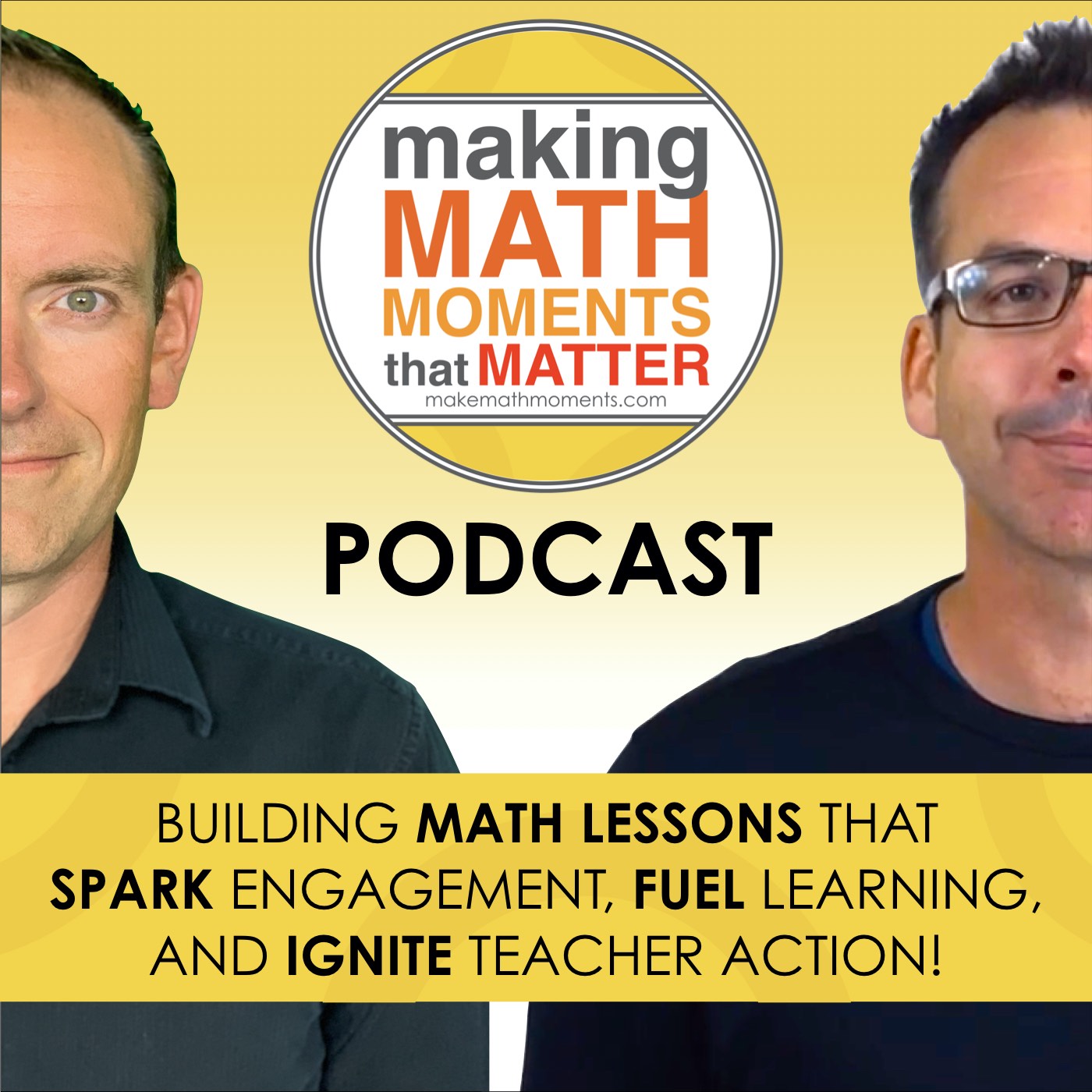
DOWNLOAD THE 3 ACT MATH TASK TIP SHEET SO THEY RUN WITHOUT A HITCH!
Download the 2-page printable 3 Act Math Tip Sheet to ensure that you have the best start to your journey using 3 Act math Tasks to spark curiosity and fuel sense making in your math classroom!
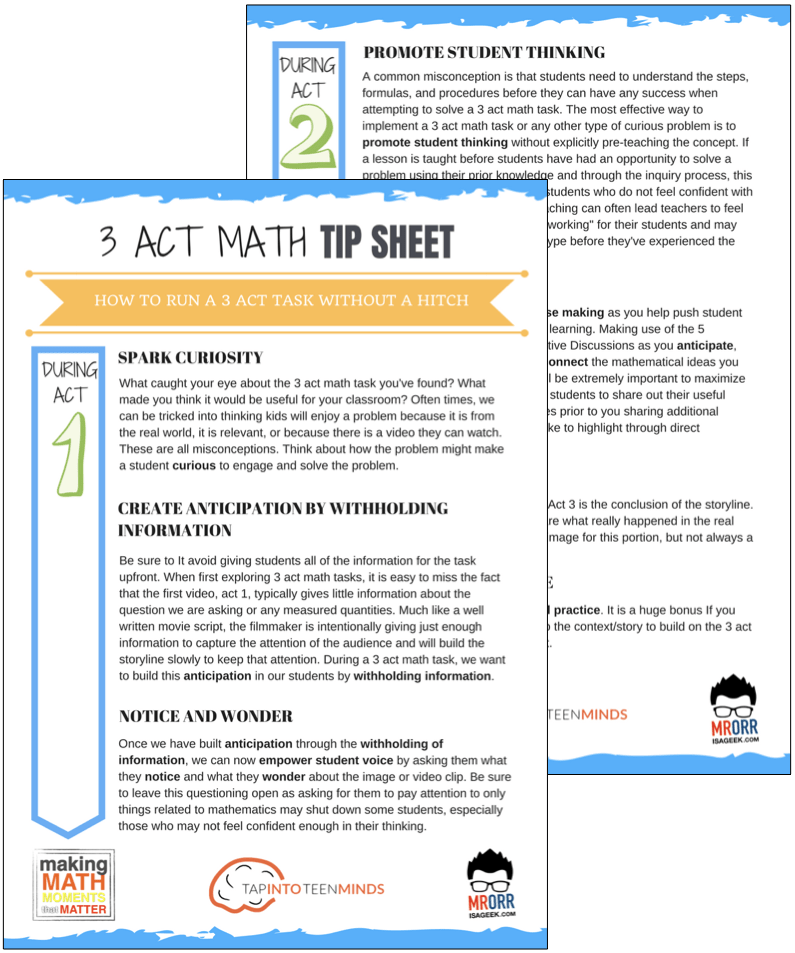
LESSONS TO MAKE MATH MOMENTS
Each lesson consists of:
Each Make Math Moments Problem Based Lesson consists of a Teacher Guide to lead you step-by-step through the planning process to ensure your lesson runs without a hitch!
Each Teacher Guide consists of:
- Intentionality of the lesson;
- A step-by-step walk through of each phase of the lesson;
- Visuals, animations, and videos unpacking big ideas, strategies, and models we intend to emerge during the lesson;
- Sample student approaches to assist in anticipating what your students might do;
- Resources and downloads including Keynote, Powerpoint, Media Files, and Teacher Guide printable PDF; and,
- Much more!
Each Make Math Moments Problem Based Lesson begins with a story, visual, video, or other method to Spark Curiosity through context.
Students will often Notice and Wonder before making an estimate to draw them in and invest in the problem.
After student voice has been heard and acknowledged, we will set students off on a Productive Struggle via a prompt related to the Spark context.
These prompts are given each lesson with the following conditions:
- No calculators are to be used; and,
- Students are to focus on how they can convince their math community that their solution is valid.
Students are left to engage in a productive struggle as the facilitator circulates to observe and engage in conversation as a means of assessing formatively.
The facilitator is instructed through the Teacher Guide on what specific strategies and models could be used to make connections and consolidate the learning from the lesson.
Often times, animations and walk through videos are provided in the Teacher Guide to assist with planning and delivering the consolidation.
A review image, video, or animation is provided as a conclusion to the task from the lesson.
While this might feel like a natural ending to the context students have been exploring, it is just the beginning as we look to leverage this context via extensions and additional lessons to dig deeper.
At the end of each lesson, consolidation prompts and/or extensions are crafted for students to purposefully practice and demonstrate their current understanding.
Facilitators are encouraged to collect these consolidation prompts as a means to engage in the assessment process and inform next moves for instruction.
In multi-day units of study, Math Talks are crafted to help build on the thinking from the previous day and build towards the next step in the developmental progression of the concept(s) we are exploring.
Each Math Talk is constructed as a string of related problems that build with intentionality to emerge specific big ideas, strategies, and mathematical models.
Make Math Moments Problem Based Lessons and Day 1 Teacher Guides are openly available for you to leverage and use with your students without becoming a Make Math Moments Academy Member.
Use our OPEN ACCESS multi-day problem based units!
Make Math Moments Problem Based Lessons and Day 1 Teacher Guides are openly available for you to leverage and use with your students without becoming a Make Math Moments Academy Member.
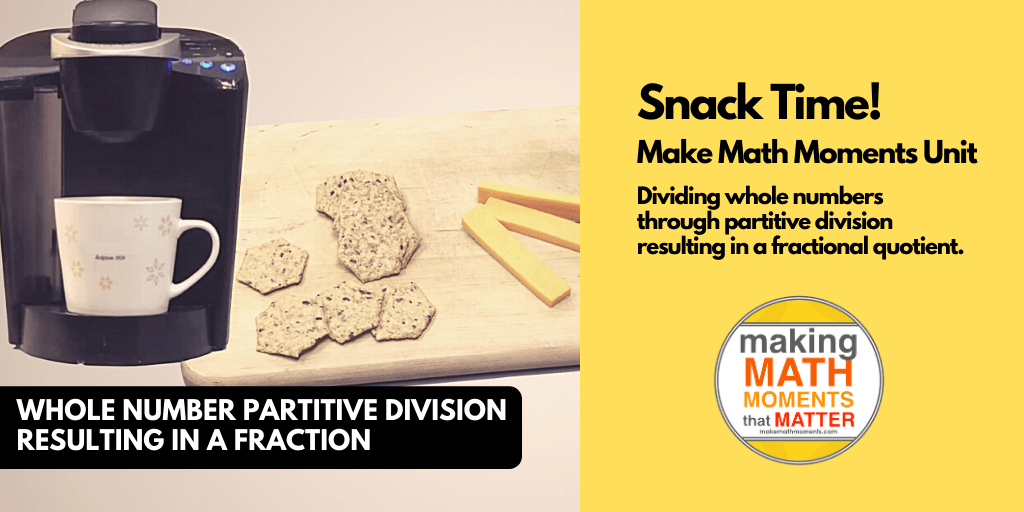
Partitive Division Resulting in a Fraction
Equivalence and Algebraic Substitution
Represent Categorical Data & Explore Mean
Downloadable resources including blackline masters, handouts, printable Tips Sheets, slide shows, and media files do require a Make Math Moments Academy Membership.
ONLINE WORKSHOP REGISTRATION
Pedagogically aligned for teachers of K through Grade 12 with content specific examples from Grades 3 through Grade 10.
In our self-paced, 12-week Online Workshop, you'll learn how to craft new and transform your current lessons to Spark Curiosity, Fuel Sense Making, and Ignite Your Teacher Moves to promote resilient problem solvers.

0 Comments