
Episode #467: The One-Shift Strategy to Improve Your Math Lesson Planning
LISTEN NOW HERE…




WATCH NOW…
We talk about planning all the time in math education. But here’s the question:
How much time should you realistically be spending planning your math lessons each day?
Because the reality is—you’re not just planning math. You’re planning multiple subjects or courses, managing everything else on your plate, and at the same time trying to make sense of a new math curriculum, new models, and new expectations for how math instruction should look in your classroom.
And when that happens, math planning can quickly turn into a daily cycle of planning for tomorrow, feeling behind, and trying to keep up.
Especially when you’re trying to design math lessons that move beyond procedures and actually build student thinking, reasoning, and understanding.
In This Episode, You’ll Learn:
- Why planning math lessons day-by-day leads to burnout
- How to shift to unit-based math planning so you can see the big mathematical ideas
- A simple strategy: focus on one meaningful math experience per day
- How to reduce planning time while still improving the quality of your math instruction
- Why unpacking the math (not just the lesson) matters when using a new curriculum
- How to build repeatable planning routines that make math teaching more manageable
- Ways to improve your math practice without sacrificing your time or well-being
As you think about your next math lesson, consider this:
What if you didn’t try to perfect everything tomorrow?
Instead, choose one moment in your math block to focus on—one opportunity for students to think, reason, or engage more deeply with math.
Start there. Because improving your math instruction isn’t about doing more.
It’s about making small, intentional shifts in your math planning that build over time.
Attention District Math Leaders:
Not sure what matters most when designing math improvement plans? Take this assessment and get a free customized report: https://makemathmoments.com/grow/
Ready to design your math improvement plan with guidance, support and using structure? Learn how to follow our 4 stage process. https://growyourmathprogram.com
Looking to supplement your curriculum with problem based lessons and units? Make Math Moments Problem Based Lessons & Units
Be Our Next Podcast Guest!
Join as an Interview Guest or on a Mentoring Moment Call
Apply to be a Featured Interview Guest
Book a Mentoring Moment Coaching Call
Are You an Official Math Moment Maker?




FULL TRANSCRIPT
Yvette Lehman: Today we’re going to tackle a problem that we hear often from both teachers and leaders. And it’s the idea of how much time should I be spending on planning every day? What is realistic to ask of educators?
Jon Orr: Interesting, interesting. So like I teach all day and I have my one or more minutes of prep time and I need to do a million things during that prep time — and also plan my lessons, make parent phone calls, review IEPs, do duty, so many things. And by the way, I’ve got to teach a new curriculum and adjust everything that I’m doing.
Yvette Lehman: Well, exactly. This is what we hear often from our district partners who are adopting a new curriculum or a new resource or textbook. It’s like, we know this is a heavy lift. We know that in year one or year two of adoption, we have to really deeply understand the material and the why behind it if we want it to be implemented with integrity long term.
Yvette Lehman: But now I need to put myself in the shoes of the teacher, especially from my elementary perspective, where we just have this brand new resource for math that I know I need to learn. I need to study it. I need to internalize the lesson sequence and the big ideas and what we’re ultimately trying to achieve. Maybe it’s a brand new lesson structure or there are new models being used in this curriculum or resource. But I’m also planning for a space unit in science and a French unit and a language unit. I have visual art tomorrow as well that I need to prep all the materials for. And I think where our leaders really struggle is they get it — like, I don’t know that I can ask my teachers to spend hours doing this type of planning. So what’s the answer when we know it’s necessary?
Jon Orr: The answer. Yeah. And I think generally, when you think about wanting to make shifts in your instruction — and this is assuming you do want to make shifts and you want to take some time — yes, you could be like the brand new teacher who stays after school till five or six o’clock at night, and then after dinner going back and doing the planning and doing a little bit of the understanding. And they’re doing that for, like you said, many different subjects.
Jon Orr: This is what you were always told when you started teaching — that was the life you were signing up for. Early on, because you haven’t taught any of this before and your classroom management is non-existent, your planning skills just take time. And therefore, when you shift towards new resources or a new lesson structure, it’s going to be back to that. That’s one way to look at it — when you’re a brand new teacher, you’re like, I wanna do a really good job, this is my career, I’m all in. So you do it. But it feels hard to say I’m gonna do that for just math after I’ve been teaching for 10 or 15 years.
Yvette Lehman: Well, and I mean, I’m going to share my own personal context, which I know is very different from other people’s context. When I was a brand new teacher, I lived at home with my parents. Okay, so my first couple of years of teaching, I was living at home. My mom was making me dinner. That was my job — my only job was to be a great teacher. And I had a support system for sure.
Yvette Lehman: So my personal experience was that when I was a brand new teacher and the lift was very heavy, I was privileged to have a support system that allowed me to really dedicate my time to improving my craft and increasing my understanding. The time that I was able to commit to that type of work after school really changed as I got older and I had life changes. Like I was now the mom of a baby. I could not, without a lot of mom guilt, commit five hours even if I wanted to. My life had changed.
Yvette Lehman: And that’s not just because of having children. It could be you’re prioritizing your health. You could have elderly parents. You could be involved in your community. And I really think that one of the things that we always advocate for is that we do have to respect teachers’ time and their mental health and their balance and all these things.
Yvette Lehman: And so I guess the question that comes back to, we know that this is going to be demanding — to plan for instruction when you have a brand new textbook, you’re at a brand new grade level, you’re a brand new teacher. So if we were coaching these teachers and we were being respectful of the fact that no, it’s not realistic for you to commit three or four hours, what would our advice be to them? Like, what did you do? Because you had three young children at one point and you had to make some shifts to your planning. Let’s talk to the teachers as if we were coaching them.
Jon Orr: Yeah, because I think going back to the beginning teacher — and then your life naturally takes on more responsibility — I think what naturally happened for me was that you got more comfortable teaching lessons and planning lessons and managing the time so that it stayed at school. It didn’t come home. And the marking got pushed to where it needed to go because you balanced. And I think over time, that demand and the heavy lift got less and less.
Jon Orr: But there was a time where I realized that I needed to shift instruction. If you listen to some of the early episodes of this podcast, Kyle and I talk about those moments where we realized that we hated what we were doing at school and we needed to make shifts in our instruction. And so that becomes, all of a sudden mid-career, the heavy lift is back. Because now we know it takes time to plan a lesson where thinking is happening in a more nuanced way.
Jon Orr: You’re not just delivering, as a high school teacher, that 20-minute lecture with three examples and then spending the rest of the lesson sitting down marking or telling kids to come to the back of the room if they need help. The demand shifted in terms of prepping a lesson where you were on your feet the whole time. Because the old me was like, I did a 30-minute lecture, I’ll go sit down. And I would actually plan the next lesson during that lesson because why not? But then when you’re more actively involved in these lessons, you don’t get that time anymore.
Jon Orr: So one of the moves that I remember saying to myself, out loud, was that I was giving myself permission. In a semester school, we had three different preps because we were a small school. So at no time during my school year did I prep the same course twice in a day. I taught ninth grade math, tenth grade applied, and a calculus class. It was always three preps. So I wasn’t prepping a space unit and a history unit and a language arts unit — I was just prepping math, but three different grade levels of math and three different access points for mathematics.
Jon Orr: But I remember telling myself two things. One was that I was going to create a meaningful math experience once in the day — just once. So it wasn’t all three classes. I would look at the day and go, where do I wanna create the epiphany, the moment, the experience, the more thinking, the discourse, the group work around the room type of lesson? The real problem-based lesson where we link all of these ideas and strategies up.
Jon Orr: And I always remembered saying to myself, I’m gonna create one moment that’s a meaningful experience and that’s going to be the moment today. And that’s okay. The rest of the classes, it’s going to be the same as what I used to do, because I can’t handle more than that. Because it took a long time to plan for that moment or that lesson, or maybe it was a 15-minute routine one day and that was it. That was just what I committed to.
Jon Orr: And then I committed even more eventually by saying, I’m going to do that every day. And I took a picture of a moment during that day to say, I’m committed to this. So I had to find that moment or plan for that moment today so that I could take a picture of it. And I did that for an entire year. And by the end of the year, a lot of moments had changed. Then they changed in the tenth grade class, the twelfth grade class, the ninth grade class. But it wasn’t one overall big change, and I wasn’t spending a ton of time on every lesson every day. It was one little thing that I would commit to. What’d you do?
Yvette Lehman: Okay, here’s my advice. And again, this is me — I’m strictly speaking about my experience. Like what Jim Strachan said at our summit last month. He said, what worked for me today on March 31st at two o’clock in the afternoon with this group of students may not work for me tomorrow or next year or with the next group of students. So take this for what it’s worth.
Yvette Lehman: I will tell you what wasn’t working for me. I don’t think planning every day for the next day is sustainable. That was where the problem was for me. It’s like, every day I would teach the lessons for that day and then spend that evening planning the lessons for tomorrow. And I knew I had to get out of that routine because it was no longer a manageable option for me.
Yvette Lehman: And so I started planning in two- to three-week cycles. As an elementary teacher who teaches multiple subjects, I was very fortunate — I had a teaching partner. We would stay every Friday night. That was the only day we stayed late, because our kids had activities. So Friday nights we’d clear the calendar. We would stay every Friday night and we would plan for the entire unit. Not to say we weren’t gonna have to make tweaks and changes in response to the learning, but we would unpack the entire upcoming learning cycle.
Yvette Lehman: But here’s the trick. We never had more than two subjects starting a learning cycle on the same week. So this Friday, we’re planning for math and science for the next three weeks. Next Friday, we’re planning for French and social studies for the next three weeks. The Friday after, we’re planning for history and the arts for the next three weeks.
Yvette Lehman: And getting out of the habit of only being able to see tomorrow not only helped reduce the time, it actually gave me a lot more clarity about teaching. Because I understood where we were going. I hadn’t only turned the page to look at tomorrow’s lesson — I’d actually worked through the entire unit all the way to the summative assessment. We’d map out our daybooks for that unit knowing, of course, we may have to add a day or adjust here, but that adjustment took 30 minutes or 15 minutes as opposed to hours. So that was the thing that was critical for me — getting out of the habit of thinking short term.
Jon Orr: Yeah. Right, right. And if you think about it, when you did that work, it was initial investment work, because you would plan it, but then it got easier in year two, year three, year four.
Yvette Lehman: I always say at the beginning of a learning cycle, there’s a lot of time to invest. And sometimes what would happen is we would stay Friday night and then we’d both have to walk away with more planning to do over the weekend, but clarity on what we had to do. But then that freed us up every other night of the week from Monday to Thursday to be available — whether it was for our own personal health or for whatever it was that we wanted to use our evenings for. It reduced the everyday having to take that time aside.
Jon Orr: Right, right. And I think what I like about what you’ve described is you’ve built — because I always try to think about the micro moves, the habitual moves that are sustainable — what you’ve described is a sustainable move that worked for the two of you on a regular basis. That not only allowed you to reach some goals about lesson planning and unit planning, but building that time in allowed, I’m sure, to also continually strengthen your craft and your practice, because it’s just how you did things.
Jon Orr: And it wasn’t just a, hey, let’s take Friday and map this out, and then all of a sudden we need another Friday because you ran into a roadblock somewhere. It was a habitual move, a micro habitual move that pays off and compounds over time. Like I always try to constantly think about where can we make micro moves like that that compound.
Jon Orr: Because if you’ve read Atomic Habits, James Clear says multiple times in that book that we don’t rise to our goals, we fall to our systems. And so what are the micro moves that we make that allow us to hit our goals but also feel good about the work that we’re doing and not get overwhelmed? And I think that’s what I’m hearing that you decided to do — whether you knew it or not at the time — is an important move. That’s what we want to be doing as teachers, or as leaders helping educators, to figure out what are the micro moves we can sustain and do forever.
Jon Orr: I was talking with a team the other day who was in year two or three of their new curriculum adoption. And they were looking at saying, look, we’ve got it — it’s been year three of this curriculum, we’re not seeing some of the change we thought we would see. We spent some time with teachers in the first year, kind of looking at the preview of the unit, helping them look at the preview, giving them a little bit of a scope and sequence.
Jon Orr: And then I remember unpacking with them — and this is something that, if you’ve listened to this podcast before or if you’re one of our clients who we partner with throughout the school year to do the planning — in order for us to see success in a new curriculum adoption, we need to help teachers and give them time. We’re talking about that here. To unpack the mathematics, to unpack how that connects to the curriculum resource and the standard, what does that look like for students in terms of artifacts. And making it a cycle, making the habit that we can build into our day to continually do that reflection.
Jon Orr: So initially we want to invest time in our PLCs or in our coaching. And I kind of suggested, where did you unpack the math with teachers on a regular basis? And I remember her stepping back and going, well, we didn’t do it like that. We kind of talked more surface level about the structure of the units, the launch and this and that, helping them understand the components. And then she said something interesting. She said, do you think it’s too late to then go and do that work?
Jon Orr: I kind of said, what do you mean too late? That’s what you want to do forever. I think she was looking at this as, well, we already started and gave them the overview. And she thought that the lesson internalization process — which was like an overview of the unit — was never to be done again. And the important aspect is that’s what we want to do forever. Not assuming that we’re gonna get it the first time around or that we understood this math completely. We go deeper and deeper as we do more.
Jon Orr: So like, for example, when you take one Friday and unpack the next three weeks — the next year you’re unpacking those same three weeks again, but you get to go deeper on them. And that’s the micro habit you’re building that really makes sense over time and compounds.
Yvette Lehman: For sure. And that’s if you’re lucky enough to be an elementary teacher who teaches the same grade twice. I was very fortunate that that was my experience, but for many others it’s like, right, now you have a combined grade, you know, this adds to the complexity. That was actually where I wanted to go to wrap up — basically, what is the advice to leaders about creating spaces within our systems for teachers to do this work and for it to be modeled? How do you unpack a unit? How do you unpack a lesson? What does lesson study look like in an efficient way that feels manageable and reasonable, respecting the prep time of educators?
Yvette Lehman: And so we’ve actually been encouraging a lot of our partners that when you’re pulling teachers out for PD or you’re designing PLCs or you’re building time into staff meetings, rather than making the math content learning feel separate from the curriculum or the textbook, leverage the resource as your vehicle for deepening mathematical knowledge for teaching.
Jon Orr: That’s right. 100%.
Jon Orr: Any last thoughts? I know we shared a little bit about what we’ve done to think about — I think — allowing ourselves to be off the hook for having to do A-plus work for everything all the time. Knowing that you’re here for the long range and the long compounding effects can help you sleep better at night around that idea. We helped, I think, the leader think about how to structure some supports, or even just offer that same advice to the teachers they’re supporting when we are trying to create what seems like a heavy lift of teaching a new curriculum with fidelity. So we’ve got some suggestions there. Any last suggestions, Yvette?
Yvette Lehman: I think ultimately remembering burnout — being mindful of people trying to create balance in their lives. So when you are adopting a new resource, or you’re moving teachers’ grades every year, or you have new teachers coming into the profession — really, as you mentioned, how are we creating support systems and how are we also having realistic expectations of them?
Jon Orr: Good, those are definitely important ideas to consider. If you are at any stage in a curriculum adoption process — maybe it’s at the beginning, maybe you’re planning for a new curriculum coming in, maybe you’re in year one, maybe you’re in year two, maybe you’re in the fourth or fifth year of this curriculum implementation and you’re looking for some guidance, some suggestions, some support — that’s what we do with our teams on a regular basis. We help them think about their curriculum and using that to teach to grade level standards and how to shift instruction to allow for more opportunity for higher thinking in mathematics.
Jon Orr: Reach out to us at makemathmoments.com forward slash discovery. We can hop on a quick 30-minute call just to unpack what you have been doing, what you could be doing, what could it look like for next year or for this year. We would gladly discuss those moves with you. And by the end of that call, you’re walking away with some — probably a renewed sense of purpose in what we’re trying to do, but also some practical suggestions to put into place right away. So head on over to makemathmoments.com forward slash discovery. We’ll talk soon.
Thanks For Listening
- Book a Math Mentoring Moment
- Apply to be a Featured Interview Guest
- Leave a note in the comment section below.
- Share this show on Twitter, or Facebook.
To help out the show:
- Leave an honest review on iTunes. Your ratings and reviews really help and we read each one.
- Subscribe on iTunes, Google Play, and Spotify.
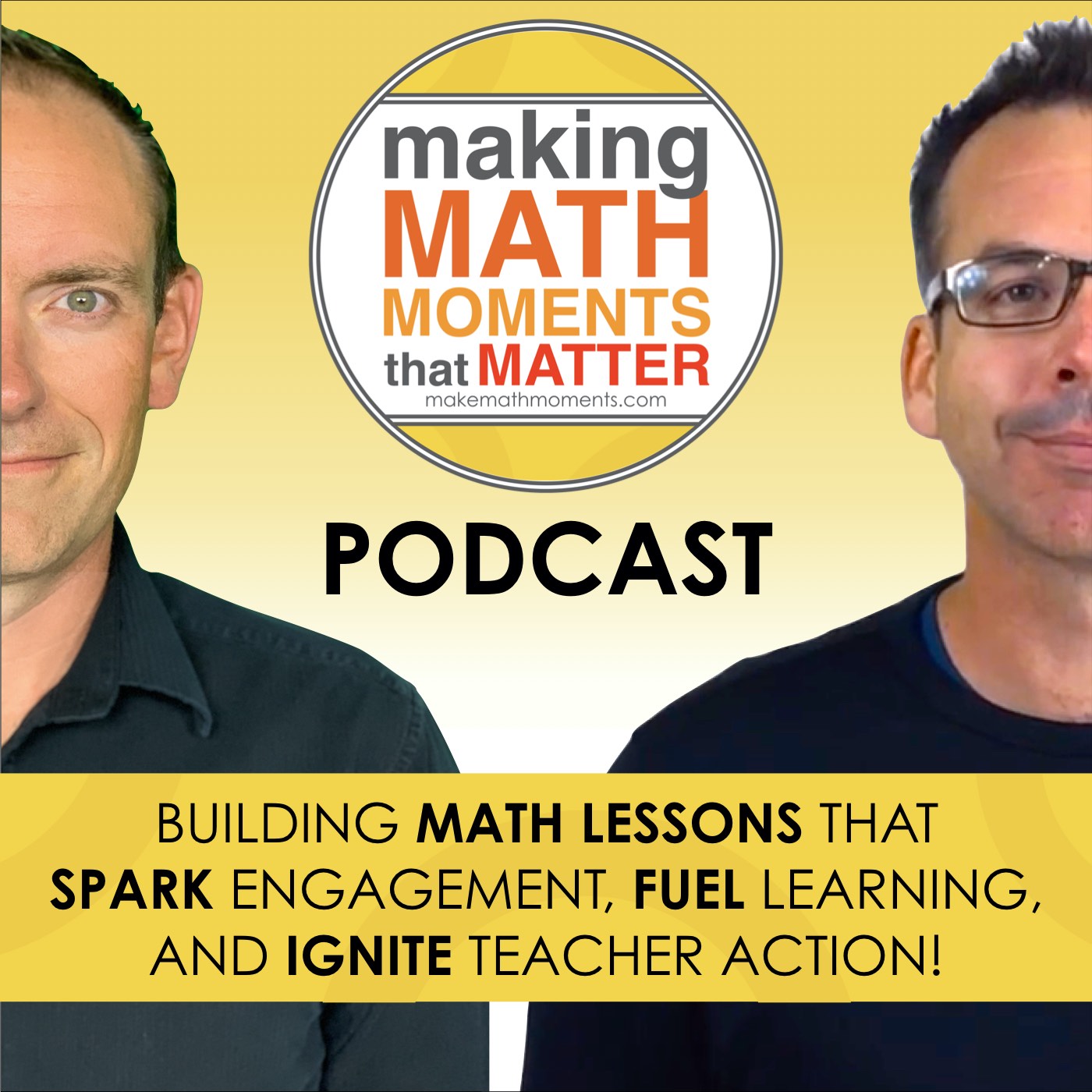
DOWNLOAD THE 3 ACT MATH TASK TIP SHEET SO THEY RUN WITHOUT A HITCH!
Download the 2-page printable 3 Act Math Tip Sheet to ensure that you have the best start to your journey using 3 Act math Tasks to spark curiosity and fuel sense making in your math classroom!
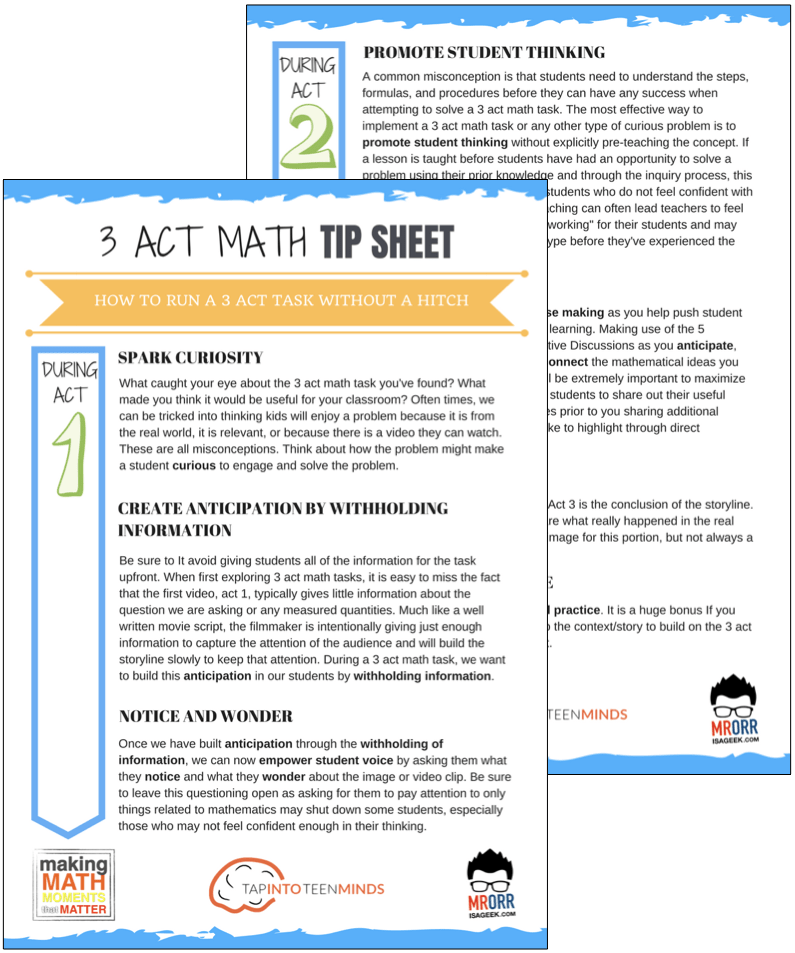
LESSONS TO MAKE MATH MOMENTS
Each lesson consists of:
Each Make Math Moments Problem Based Lesson consists of a Teacher Guide to lead you step-by-step through the planning process to ensure your lesson runs without a hitch!
Each Teacher Guide consists of:
- Intentionality of the lesson;
- A step-by-step walk through of each phase of the lesson;
- Visuals, animations, and videos unpacking big ideas, strategies, and models we intend to emerge during the lesson;
- Sample student approaches to assist in anticipating what your students might do;
- Resources and downloads including Keynote, Powerpoint, Media Files, and Teacher Guide printable PDF; and,
- Much more!
Each Make Math Moments Problem Based Lesson begins with a story, visual, video, or other method to Spark Curiosity through context.
Students will often Notice and Wonder before making an estimate to draw them in and invest in the problem.
After student voice has been heard and acknowledged, we will set students off on a Productive Struggle via a prompt related to the Spark context.
These prompts are given each lesson with the following conditions:
- No calculators are to be used; and,
- Students are to focus on how they can convince their math community that their solution is valid.
Students are left to engage in a productive struggle as the facilitator circulates to observe and engage in conversation as a means of assessing formatively.
The facilitator is instructed through the Teacher Guide on what specific strategies and models could be used to make connections and consolidate the learning from the lesson.
Often times, animations and walk through videos are provided in the Teacher Guide to assist with planning and delivering the consolidation.
A review image, video, or animation is provided as a conclusion to the task from the lesson.
While this might feel like a natural ending to the context students have been exploring, it is just the beginning as we look to leverage this context via extensions and additional lessons to dig deeper.
At the end of each lesson, consolidation prompts and/or extensions are crafted for students to purposefully practice and demonstrate their current understanding.
Facilitators are encouraged to collect these consolidation prompts as a means to engage in the assessment process and inform next moves for instruction.
In multi-day units of study, Math Talks are crafted to help build on the thinking from the previous day and build towards the next step in the developmental progression of the concept(s) we are exploring.
Each Math Talk is constructed as a string of related problems that build with intentionality to emerge specific big ideas, strategies, and mathematical models.
Make Math Moments Problem Based Lessons and Day 1 Teacher Guides are openly available for you to leverage and use with your students without becoming a Make Math Moments Academy Member.
Use our OPEN ACCESS multi-day problem based units!
Make Math Moments Problem Based Lessons and Day 1 Teacher Guides are openly available for you to leverage and use with your students without becoming a Make Math Moments Academy Member.
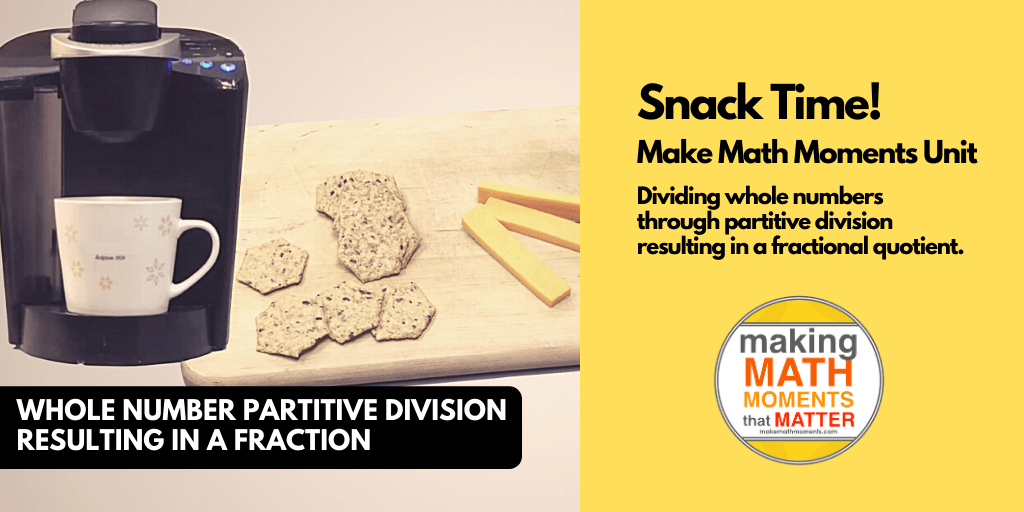
Partitive Division Resulting in a Fraction
Equivalence and Algebraic Substitution
Represent Categorical Data & Explore Mean
Downloadable resources including blackline masters, handouts, printable Tips Sheets, slide shows, and media files do require a Make Math Moments Academy Membership.
ONLINE WORKSHOP REGISTRATION
Pedagogically aligned for teachers of K through Grade 12 with content specific examples from Grades 3 through Grade 10.
In our self-paced, 12-week Online Workshop, you'll learn how to craft new and transform your current lessons to Spark Curiosity, Fuel Sense Making, and Ignite Your Teacher Moves to promote resilient problem solvers.
0 Comments