Episode #468: Conceptual vs Procedural Math: What Effective Math Instruction Looks Like When You Stop Picking Sides
LISTEN NOW HERE…



WATCH NOW…
In this episode, hosts Jon Orr and Yvette Lehman unpack a tension that’s been debated in math education for decades: conceptual understanding vs. procedural fluency.
Yvette shares a powerful realization from her math classroom experience: in striving to teach conceptually, she may have unintentionally neglected opportunities for students to build automaticity and recall. Meanwhile, Jon highlights the importance of helping students move fluidly between visual models, strategies, and algorithms.
Together, they explore:
- Why the “either/or” debate in math instruction is a false dichotomy
- How different learners benefit from different approaches
- What happens when math teaching becomes too rigid in one direction
- The role of tutoring, parents, and community partners in shaping math success
- Why strong math instruction should leverage strengths while building other proficiencies
- How educators can balance reasoning, understanding, and efficiency
This conversation is a reminder that great math teaching isn’t about choosing sides—it’s about creating access, building flexibility, and meeting students where they are.
👉 What if the real goal isn’t picking a side… but helping students move between them?
Attention District Math Leaders:
Not sure what matters most when designing math improvement plans? Take this assessment and get a free customized report: https://makemathmoments.com/grow/
Ready to design your math improvement plan with guidance, support and using structure? Learn how to follow our 4 stage process. https://growyourmathprogram.com
Looking to supplement your curriculum with problem based lessons and units? Make Math Moments Problem Based Lessons & Units
Be Our Next Podcast Guest!
Join as an Interview Guest or on a Mentoring Moment Call
Apply to be a Featured Interview Guest
Book a Mentoring Moment Coaching Call
Are You an Official Math Moment Maker?


FULL TRANSCRIPT
Yvette Lehman: I just got off a call with one of our district partners. And of course I walked away feeling like, did I have too big of an opinion? Sometimes I feel that way. You know what it is? I feel like I’ve been down the road that they’re going down before. And so maybe that’s why the conversation really resonated with me and I’m gonna paint the picture. I’ve been here.
Jon Orr: You got on your soapbox? Right, and you’re warning, you’re like, let me bring some ideas up.
Yvette Lehman: Yeah, so let me just share a different perspective. And so here’s the scenario. I was this teacher. So there was a point in my career where I was so invested in teaching conceptually to almost to the point of rigidity because I had this epiphany myself that that’s what I was missing in my own math experience.
You know, I needed to see it concretely. I needed to see it visually and to connect these representations to the abstract because that was my way of accessing the big ideas and generalizations of the behaviors of math. And because that was the missing piece for me, it’s very personal in my teaching where at one point when I was a classroom teacher, I really felt like anybody who was doing it a different way from me was working against me.
And so the context here is like, my kids in my class are going to tutoring after school. And when they go to tutoring, they’re doing, you know, a lot of rote practice. They’re focusing on the procedure. And I felt like that’s working against me because I’m trying to conceptual procedural from conceptual, but now they’re going off being told, just do it this way.
And I think that kind of where the conversation came today is that back then, I would have felt like we were on opposite sides of this work and that what parents wanted, what the tutors wanted and what I want were at opposite ends of a continuum and we were polarized. And now I feel like I was too rigid in that belief. I think that I was trying to paint my entire class as learners like me.
Jon Orr: can see that. I when I started teaching, I think I thought the same way in terms of saying, like, I know what was successful, therefore I will fill in and repeat what I believe is successful for my students because that’s the way I know where success can lie. And you teach to your strength or teach to your gap and trying to make sure that you’re…
creating students in a way to either be like yourself or to learn it differently like you had said. And I think you’re right. What happens is when we have strong opinions about how we’re supporting our students, it creates these, what has existed for a very long time, the opposite ends of this spectrum, which, or this continuum, which is a very direct instruction end, which I think it’s not even, when I say direct instruction, I’m like, I don’t even want to say it’s at the end of a spectrum.
But I think a lot of people think it is. And that the other end is this very, like you said, this very conceptual understanding of math, which I think a lot of people think this is all free for all, you know? There’s like, there’s nothing really rigorous happening over here is like, let’s just go where the students wanna go.
Like you can imagine that these are these two ends, even though I believe this is a falsehood, but it exists out there when we have conversations and it sparks many, many debates about what we should be doing for math instruction. And I think one of the, I think why we hit record right here is that you had said something really important about trying to think about…
creating more opportunities, we should really think about this in different way, which is creating more opportunities for students to think and experience higher level mathematics. And I was, and I kind of. questioned the idea of what do you mean by like higher level mathematics? Like are you saying like we want everyone to like move towards calculus and then is, if so, is there a cost to there? Back to you.
Yvette Lehman: think when I say that I essentially just mean opportunity. Like should the students choose to continue down a path through secondary through post-secondary that requires mathematics, I want the opportunity to be available to them.
Jon Orr: 100%, me too. Right.
Yvette Lehman: Yeah, so that to me is what I describe as access. It’s like whether they choose that pathway or not should be up to them. They should not have the opportunity because they haven’t had instruction that has positioned them to make that choice.
Jon Orr: course. Of course, of course. And I think when we think about, I think when you automatically start to think about higher level mathematics, you automatically start to think about abstract mathematics, procedural fluency of operation, algorithms. Like you naturally think that way or one might think that way, which is in a way, if we’re going to do higher level mathematics like that, we do have to be really strong in that area, which I think was why the There’s always this kind of natural progression of like what is valued more versus conceptual understanding and certain models towards this algorithmic abstract approach to saying like that’s the goal is we need to get there, so why don’t we just go there?
And I think that drives a lot of this like either or type of thinking when we’re designing math improvement in school systems.
Yvette Lehman: I think the conversation that stemmed from talking about tutoring within one of their schools, it’s like, we’re up against the tutors, we’re up against the parents. And I tried to paint this picture of, you know, just like you described where you were like, well, I taught my students the way that worked for me early in your career.
And I was teaching my students six years ago the way that was working for me. And it’s like, I don’t know that either approach is right, like to be all one or all the other. I think that we have to understand the child and their learning profile and help them access through their strengths and then fill in the other side.
And so this is I’ve given this example before with my son and my best friend’s daughter, who are six months apart. Their brains are just different. And I don’t think that the exact same style of instruction is going to help them both reach their full potential. I think that Mila is an amazing memorizer.
And I think that’s her strength. And do we have to build up her conceptual and her ability to connect to models? Absolutely. But it’s not to say that I don’t think we should lean into her strength of being a great memorizer, really quick recall, really great accuracy.
Jon Orr: rape.
Yvette Lehman: So if she wants to go to Kuman after school and continue to build up that strength, that doesn’t scare me. I don’t see that as being opposite of what I’m trying to achieve with her in my classroom. Where with Leto, his strength is in his spatial skills. He has really high spatial skills. So we lean into his spatial skills and we leverage them and he does a lot of visualization, but his memory isn’t as strong and his recall isn’t as good and he’s not as accurate.
And so I just feel like it’s what we really want for our educators is to be able to create pathways and create learning experiences that leverage students strengths as mathematicians, but then also build up their other proficiencies. And so I guess that’s where my comment came in. Like I don’t see the fact that one of my students is going to extra math after school and receiving instruction from a tutor that might be an approach that’s different from mine.
as necessarily problematic? Do I think that it would be great if we could have conversations and we could work as a community and we could create partners in learning? And I think I have things to learn from their approach and they probably have things to learn from mine, but I don’t want it to feel like we are working against each other or that what they’re doing isn’t in any way benefiting what’s happening in my classroom. I think they would be naive to think that.
Jon Orr: I agree, I agree. I think, I guess when you, because this was a coming off a conversation with a team that was thinking you said that you maybe shared more than your opinion to this team. So what was the, your opinion, I guess in your experience with the team is what was the team battling around where specifically you felt like you’re like, I need to share this.
Yvette Lehman: I think, and again, you know, this is my own bias or based on my own experience. It’s like, in some ways I was like, I’ve been where you are right now. You know, I know that feeling of feeling as though what’s happening outside of school is undermining what I’m trying to achieve through my conceptual approach in the classroom. And I think my, my caution was like not to treat it as being opposing.
Jon Orr: Right, like they were imagining, yeah, like they were imagining like we’ve got this, like we’re trying to do, strengthen this.
Yvette Lehman: It’s how can we find a space, right?
Jon Orr: vision of math or this understanding of how we want to learn mathematics. We feel like we’re being pushed on in a way, feels like an opposing view and we have to battle back. And I think that that’s where they were coming from. And you were saying, let me, let me step in here and give you a little bit of a warning.
Yvette Lehman: I think so. You know, but I am from my coaching hat. I always ask myself, you know, were they looking for that advice? Or did I just, you know, was I advice giving when it wasn’t necessarily being requested of me?
Jon Orr: think, right. Yeah, and I think what happens in our roles when we’re supporting educators and ourselves and thinking about our students is when you, there’s this like natural, I don’t even know if it’s natural, but there’s this, I’m sure this pressure or feeling that we have to create some sort of routine, this system, this boxed solution to this problem.
which, and we say this all the time, is that many people are looking for easy solutions to a complex problem. Because I think when you start to say, we’re trying to do this, and we’re feeling pressure from this view, so instead of embracing to say, let’s work with the, like, let’s understand the connectivity here, because they’re all really important, someone’s trying to go, but I need to tell my teachers one thing, because it needs to be easy.
It needs to be simple to think about it. We need to give them this solution so that it will, you know, instruction will shift. Like we have to tell them this. And if we tell them it’s five things, three things, two things, it’s all of this put together. I think, I think leaders are going that’s way too overwhelming.
And teachers just need or teachers are saying they’re asking for tell me how to do it. Tell me how to do it in an easy way, which is there isn’t one, because you’re absolutely right, is that we want to be thinking about the blend. We want to be thinking about the balance here between strengthening our understanding of mathematics so that we know the why, but then also leaning in towards the efficiency that some of the algorithms can bring to the work that we do as we move up the grades.
There’s… I have always looked at this in the last 15 years of my teaching is that they’re on equal pedestals. And they’re not just two of these things. There’s lots of different ways to think about mathematics and do mathematics. But we have to say honor and try to make sure that students can move between the pedestals in a fluent way and create the equality that, yes, abstract understanding of mathematics, proceduralizing mathematics is an important aspect to doing mathematics and thinking mathematically, but also the conceptual is as well.
And that’s hard to think about because you’re all telling teachers it’s more than just one canned approach to mathematics.
Yvette Lehman: And I’m going to say this, as you know, somebody who is very committed to a conceptual approach. And that’s the way I teach. It’s the way that unlocked mathematical understanding for me. I think that the way that I was teaching conceptually for my last five years in the classroom was not necessarily building automaticity and recall.
Jon Orr: What do mean?
Yvette Lehman: And so I think that what I was doing a good job of was creating access and reasoning skills.
Jon Orr: And.
Yvette Lehman: but I wasn’t really giving enough intentional purposeful practice for students to really consolidate those skills and own them. And so maybe that’s where it’s like, see that, let’s say in this other camp of a focus on fluency, maybe through a more, let’s call it traditional approach where there is more emphasis on.
Jon Orr: Transfer. Got it.
Yvette Lehman: recalling from memory, you know, not necessarily memorizing, but being able to kind of quickly retrieve facts and be able to leverage them for problem solving was a missing part of my instruction. And I think that’s where I, I want to go back to this idea of like, I think we can learn from each other, you know?
there’s aspects of a more traditional approach that I think I needed to weave into my practice. And there are probably models and strategies that would help, let’s say, the tutors that are working with these groups in a more traditional way, create more access for more learners if the procedure isn’t working for them.
Or it’s like they’re not able to access that procedure because they don’t understand the why behind it. And I mean, this is all going back to also, I believe students should look at numbers left to right when they’re reasoning with them. Like I don’t want them treating them as digits. I want them to be able to step back and judge the reasonableness of their answers before they go to any type of procedure, whether traditional or non-traditional.
But I guess it’s, I feel differently than I did 10 years ago where I would have been like, what they’re doing doesn’t help me. I don’t think that’s true. They’re probably giving them the practice that I didn’t have time for in my 60 minutes of math instruction.
Jon Orr: And you were focusing on the reasoning and more on the reasoning skills than say, more of a traditional teacher for sure. Yeah, important ideas to take into account when we’re teaching mathematics and learning mathematics and helping others teach mathematics and learn mathematics. And I think where I have always ended up is trying to create epiphanies around the connection between the models and the strategies that are more visual and the algorithms.
Being a high school teacher, Like I said, you know there’s power there in terms of why these algorithms and why the strategies that are built upon some of these moves in mathematics can allow you to move quicker or quickly in higher level mathematics. And therefore we do need to connect. We do need to look at those.
But I think where the power really needs to lie is making sure that we… take that conceptual and understand where that’s coming from. Why does that work? Why is completing the square, why is it called completing the square? How can we do it without just memorizing this very long procedure, which is very abstract?
There’s a lot of power there, and I think that’s where my last number of years of teaching lie was centered around is, yes, moving towards this proceduralized view or access to this type of mathematics, which was abstract and very algorithmic, but coming at it from the conceptual. I I purposefully wanted to make that connection clear and then structured where the practice really needed to lie in making the connection.
Like my practice lied in the connection between the two. and making sure that students had, say, those loads that achieved the learning goal by the end of the lesson, which was a really important idea. Go ahead.
Yvette Lehman: think the top order for elementary teachers is like automaticity of all the facts that students need to own by the time they leave sixth grade, eighth grade, you know, just to make sure that they can have, you know, we’re reducing the cognitive demand of those higher level tasks because they can quickly, you know, retrieve relationships because they’ve had enough opportunity to interact with them in a meaningful way. So I think the, Basically, my conclusion of this conversation goes back to our belief, which is like strong convictions loosely held.
Like I just, I never want to, and this is maybe was a strong conviction today that, you know, there’s things that we can bet, there’s ways to benefit from, let’s say both approaches, like whether we’re focusing on a conceptual approach versus a more traditional algorithmic procedural approach. think there’s, there’s,
Jon Orr: for sure.
Yvette Lehman: benefits to both for different learners and some learners are going to need a little more of this or more of that. So how do we work with our community partners to create these partnerships in learning that are helping us meet the needs of all students without feeling opposed?
Jon Orr: Exactly. And I think the key epiphany, other than what I’ve shared already, is thinking about what you just said, but then equaling the playing field about the power of these ideas. And they’re not opposing, they’re complimentary, and we want to lean into making sure that there’s equality in there. So like what you were saying, we wanna make sure that One, there’s strength over here in say memorizing, there’s strength in conceptual.
We wanna make sure that the student has access to both and can then make sure that they’re strong, like not necessarily always strong in both, but can be fluid between the two.
Yvette Lehman: And essentially they get what they need to be successful. You know, if our goal is to move every student towards meeting or exceeding the provincial standard or the state standard for their grade level, I don’t think that pathway is going to look the same. So the traditional focus on the procedure isn’t going to work for all. A really conceptual may not work for all either.
Jon Orr: It is not.
Yvette Lehman: So that’s where building up the mathematical proficiency of the educator to be responsive and to really deeply understand learning profiles is where I think we’re ultimately gonna benefit. How do we do that? By working with people who are better at the things that we are not.
Jon Orr: It is not. Right, collaborating with each other and not discounting one view of an educator because you feel like it’s opposing to you, embrace it, learn from each other, important idea, important ideas for sure. We wanna hear from you. What are your thoughts here as you listened to us rattle on here today about some important ideas and how we think about mathematics and how we teach mathematics? What are your…
Yvette Lehman: hehe Mm-hmm.
Jon Orr: What are the things that are influencing your beliefs around teaching and learning mathematics? If you’re not on our email list, you can head on over to makemathmoments.com. You can opt into any of our free resources over there or tasks over there. You’ll be on that email list. That’s how you can contact us.
Hit reply on the email you get after you say, get one of our resources and then hit that, you know, when you hit that reply, let us know, hey, I just listened to the episode where you, You discussed this idea that there’s this fake view of opposing views, and here’s my thoughts on this. Here’s what I think.
Here’s a question I have. We wanna hear from you. Please hit reply on any of the emails. You can get over at makemathmoments.com. We’ll see you in the next episode.
Thanks For Listening
- Book a Math Mentoring Moment
- Apply to be a Featured Interview Guest
- Leave a note in the comment section below.
- Share this show on Twitter, or Facebook.
To help out the show:
- Leave an honest review on iTunes. Your ratings and reviews really help and we read each one.
- Subscribe on iTunes, Google Play, and Spotify.
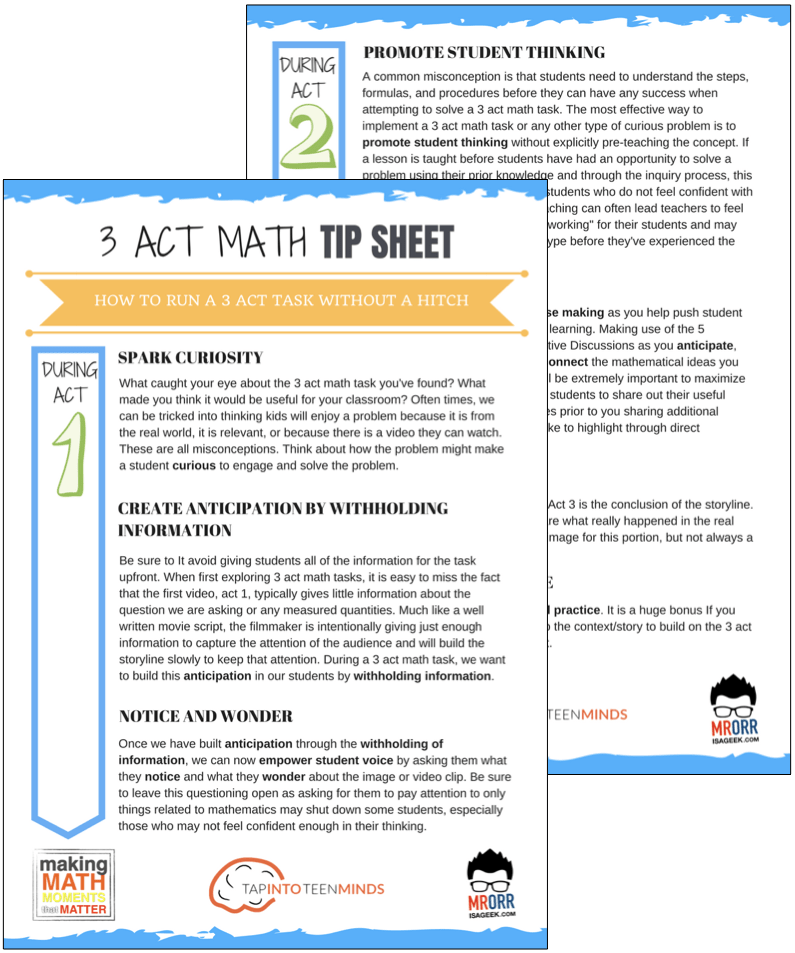
DOWNLOAD THE 3 ACT MATH TASK TIP SHEET SO THEY RUN WITHOUT A HITCH!
Download the 2-page printable 3 Act Math Tip Sheet to ensure that you have the best start to your journey using 3 Act math Tasks to spark curiosity and fuel sense making in your math classroom!
LESSONS TO MAKE MATH MOMENTS
Each lesson consists of:
Each Make Math Moments Problem Based Lesson consists of a Teacher Guide to lead you step-by-step through the planning process to ensure your lesson runs without a hitch!
Each Teacher Guide consists of:
- Intentionality of the lesson;
- A step-by-step walk through of each phase of the lesson;
- Visuals, animations, and videos unpacking big ideas, strategies, and models we intend to emerge during the lesson;
- Sample student approaches to assist in anticipating what your students might do;
- Resources and downloads including Keynote, Powerpoint, Media Files, and Teacher Guide printable PDF; and,
- Much more!
Each Make Math Moments Problem Based Lesson begins with a story, visual, video, or other method to Spark Curiosity through context.
Students will often Notice and Wonder before making an estimate to draw them in and invest in the problem.
After student voice has been heard and acknowledged, we will set students off on a Productive Struggle via a prompt related to the Spark context.
These prompts are given each lesson with the following conditions:
- No calculators are to be used; and,
- Students are to focus on how they can convince their math community that their solution is valid.
Students are left to engage in a productive struggle as the facilitator circulates to observe and engage in conversation as a means of assessing formatively.
The facilitator is instructed through the Teacher Guide on what specific strategies and models could be used to make connections and consolidate the learning from the lesson.
Often times, animations and walk through videos are provided in the Teacher Guide to assist with planning and delivering the consolidation.
A review image, video, or animation is provided as a conclusion to the task from the lesson.
While this might feel like a natural ending to the context students have been exploring, it is just the beginning as we look to leverage this context via extensions and additional lessons to dig deeper.
At the end of each lesson, consolidation prompts and/or extensions are crafted for students to purposefully practice and demonstrate their current understanding.
Facilitators are encouraged to collect these consolidation prompts as a means to engage in the assessment process and inform next moves for instruction.
In multi-day units of study, Math Talks are crafted to help build on the thinking from the previous day and build towards the next step in the developmental progression of the concept(s) we are exploring.
Each Math Talk is constructed as a string of related problems that build with intentionality to emerge specific big ideas, strategies, and mathematical models.
Make Math Moments Problem Based Lessons and Day 1 Teacher Guides are openly available for you to leverage and use with your students without becoming a Make Math Moments Academy Member.
Use our OPEN ACCESS multi-day problem based units!
Make Math Moments Problem Based Lessons and Day 1 Teacher Guides are openly available for you to leverage and use with your students without becoming a Make Math Moments Academy Member.
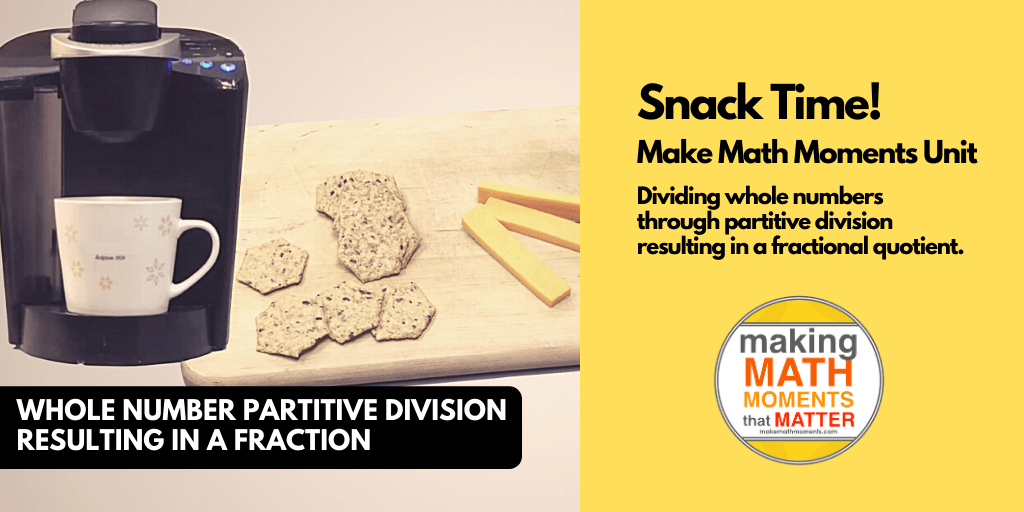
Partitive Division Resulting in a Fraction
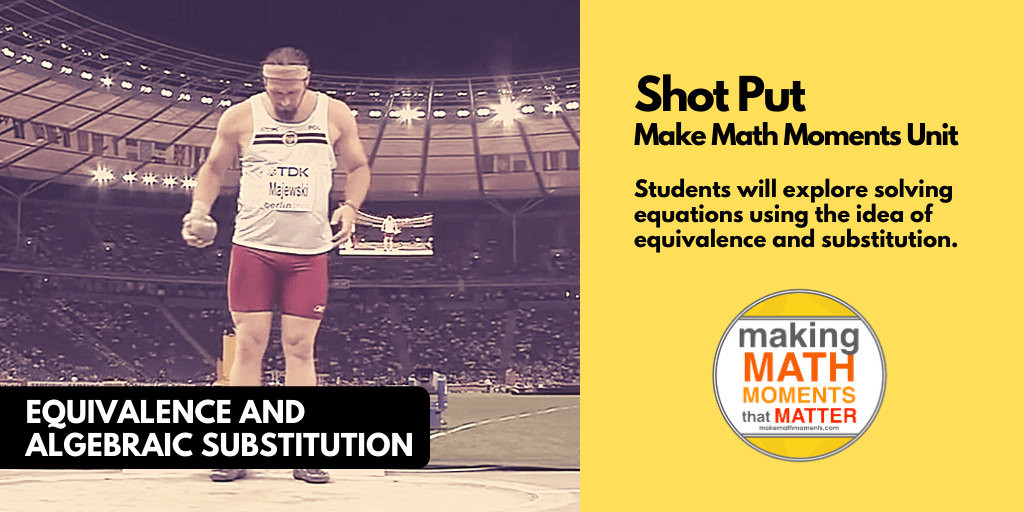
Equivalence and Algebraic Substitution
Represent Categorical Data & Explore Mean
Downloadable resources including blackline masters, handouts, printable Tips Sheets, slide shows, and media files do require a Make Math Moments Academy Membership.
ONLINE WORKSHOP REGISTRATION
Pedagogically aligned for teachers of K through Grade 12 with content specific examples from Grades 3 through Grade 10.
In our self-paced, 12-week Online Workshop, you'll learn how to craft new and transform your current lessons to Spark Curiosity, Fuel Sense Making, and Ignite Your Teacher Moves to promote resilient problem solvers.
0 Comments