Episode #483: The Two-Level Math Training You Haven’t’ Yet Considered To Strengthen An Entire District
LISTEN NOW HERE…



WATCH NOW…
Many school systems want better mathematics outcomes, but few struggle because of a lack of effort. More often, the challenge is figuring out how to create meaningful change at scale—without overwhelming teachers, coaches, and leaders along the way.
After a year of working alongside a large multi-level school system, several important lessons emerged. Sustainable improvement requires more than strong professional development sessions or clear messaging. It requires intentional systems for support, clear priorities, strategic use of coaching resources, and a realistic understanding of how change spreads through an organization. The work isn’t about reaching everyone with the same level of support. It’s about creating coherence through Tier 1 structures while strategically investing Tier 2 support where it can create the greatest long-term impact. Perhaps most importantly, it means designing for the reality that people constantly move through the system—what works today must continue working even as staff, leaders, and teams change over time.
In this episode, you’ll explore:
- Why professional learning should be designed through Tier 1 and Tier 2 support structures
- How to identify high-leverage groups for intensive coaching and support
- The importance of “facilitating the facilitators” in large systems
- Why clarity around the “why” matters more than who sets the goal
- How coaching, PLCs, and instructional leadership can create scalable change
- The role of bright spots, leverage points, and compounding growth
- Why every improvement plan must account for the “Ferris wheel” reality of staff movement
If you’re responsible for leading mathematics improvement in a school, district, or system, this episode will help you think more strategically about where to focus your energy, how to scale your impact, and how to build change that lasts beyond any one individual or initiative.
Attention District Math Leaders:
K-12 Math Leaders: Download our free Math Coherence Compass to help your teammates, system leaders, and educators create aligned instructional practices—without adding another initiative.
Not sure what matters most when designing math improvement plans? Take this assessment and get a free customized report: https://makemathmoments.com/grow/
Ready to design your math improvement plan with guidance, support and using structure? Learn how to follow our 4 stage process. https://growyourmathprogram.com
Looking to supplement your curriculum with problem based lessons and units? Make Math Moments Problem Based Lessons & Units
Be Our Next Podcast Guest!
Join as an Interview Guest or on a Mentoring Moment Call
Apply to be a Featured Interview Guest
Book a Mentoring Moment Coaching Call
Are You an Official Math Moment Maker?


FULL TRANSCRIPT
Yvette Lehman: Today’s episode, Beth, we’re going to talk through some big lessons we’ve learned over the past year with some of our large districts that we support. So this is the work we do, right? We’re trying to create sustainable math improvement within systems by really looking at the roles of individuals within those systems and the structures that they have in place to support change. And we’ve been working with a large tri-level system for the past year. It’s been about a year that we’ve been partnering with this system. And I wanted to dig in today to some of the lessons that we’ve learned through that experience. I agree, which is exciting to reflect on the growth that we’ve even had just as math, you know, consultants and facilitators through that partnership.
Beth Curran: We’ve learned a lot. That’s right. So what’s one big one, Yvette, that jumps at you?
Yvette Lehman: One of my big takeaways from this year is that whether you’re a very large system like the one that we’re describing here today, or even you know, a small district or an individual school, we need to think about our support that we’re able to offer in two levels. Similar to the tiers of instruction in the classroom, but with a slightly different focus, I would say.
Yvette Lehman: What we’ve been trying to support our teams in understanding is that there’s a tier one level of support that we’re able to offer to all. And so examples of that tier one support, if you’re a state team, for example, might be your standards, you know, your actual print documents or your website that disseminates information about the priorities for mathematics, either at state level or large district level. So maybe it’s, you know, a kickoff session or a large pull out PD that everybody’s able to attend or a virtual session. And you know, maybe it’s your standards document with teacher supports embedded or exemplars or, you know, these are things that everybody has access to. That in maybe in a district it’s your high quality instructional material. It’s like everybody has access to, you know, consistent messaging, resources at their fingertips, maybe some large scale professional development for messaging purposes to create awareness around the priorities. And that’s really that tier one that we can blanket with everybody with.
Yvette Lehman: But we also have to get real about what tier one can achieve.
Beth Curran: Right. And I think this is where most schools and school districts get stuck because they feel like that tier one support is what the work is, is that that’s what we have to do. We have to reach everyone. We have to provide opportunities for all. Right. But what ends up happening is that very little then actually gets accomplished. So we’ve dug into this idea that there can also be some tier two supports. So explain some of that a bit.
Yvette Lehman: For sure. Well, and that’s exactly it. I think that tier one only has so much potential. But I do think it’s necessary to keep us grounded. You know, so it becomes our anchor, it becomes our reference point. But it doesn’t necessarily lead to change in the classroom.
Yvette Lehman: And so the tier two support is that intensive, ongoing feedback and collaboration that we know is necessary for shift in practice. But the problem is most systems can’t provide that level of support to everybody. It’s impossible. I’ve yet to meet a system anywhere that’s like absolutely we can provide intensive ongoing support, you know, strong regular facilitation for all teams, all grade levels, all, you know, members within the organization.
Yvette Lehman: So that tier two support is what we can realistically offer in an ongoing intensive way. And the challenge becomes who receives it.
Beth Curran: Right. And I was just gonna say, I can imagine a lot of listeners right now are thinking, but how do we decide? How do we pick? How do we say you guys are gonna get the intensive support this year and you aren’t? Right? So I think that becomes the big challenge. And so I think you and I would agree that you start with maybe not the group that needs the absolute most support. Because what you’re trying to do is you’re trying to establish some systems of support with a smaller intense group that can then easily scale. So you don’t want to pick a group that needs the most work. You kind of want to start with a group that’s in the middle. Right? So think about how you could support some teachers who are already kind of curious and wanting to make change and have bought into the objective or the goals for the school year, so that you can really work on establishing that system that can then be replicated.
Yvette Lehman: We talk all the time, right? It’s not the first time we’re mentioning on the podcast these ideas of bright spots. And I was working with a coach recently who works in a medium-sized district. And there’s only one coach, you know, a single coach for multiple sites and the schools are large. They have multiple teachers at each grade level. And same problem. You know, where does she offer her tier two intensive support?
Yvette Lehman: And what we identified is that the optimization that’s missing is within their PLCs. It’s like they have PLCs, they have access to PLCs routinely within their, you know, structure of their timetabling, but it’s not being optimized. And so that coach is looking at who could be a strong facilitator within that grade band for that particular collaborative team. Okay, how do I build them up? How do I build their capacity? How do I help them model best practices around their fluency targets that they have this year? So that that little PLC team can continue to work and grow and momentum can be sustained long term. And so to your point, it’s like we need to strategically identify who are the levers. Like if we can only dedicate so much time and support in an ongoing and intensive way to an X number of stakeholders within the organization, where’s the leverage point? Like which individuals are best positioned to create momentum and get their own flywheels turning within that, you know, smaller system, maybe it’s a grade level or a department.
Beth Curran: So it’s the who, but I’m hearing you also kind of say it’s the what, right? What should we focus on? So should we focus on PLCs, faculty meetings? You know, what should we focus on? Because we can’t do it all.
Yvette Lehman: Absolutely. What’s another big lesson you think that we’ve learned this year? So we’ve been really focusing on this like two tiers of support. You know, create your awareness, create your foundation, create your reference point, and then where can you dedicate your time and energy as a coaching team?
Beth Curran: Yeah. So I think another big lesson that we’ve learned is that — and this applies I think to our really big system that we’re talking about here — the idea that when we are at maybe one of the higher levels of a multi-tiered system, that our job is to kind of facilitate the facilitation. So it’s like coaching the coaches. It’s not to deliver all the message. We really need to focus on making sure that that level below us, whatever that tier might be below us, that they understand and have that consistent messaging. But that our job then isn’t just to make sure they understand it, but it’s to make sure that they can deliver that message down to the next level. So it’s like coaching coaches. We’re facilitating to facilitate.
Beth Curran: Right. And I think that that’s something that we’ve seen drift. You know, they drift with — this team has drifted away from that idea that we are here to support the group below us, not just to give them information and it stops there. You know, we expect this team below us to then take that information down. And so we’ve had to, I think, several times bring them back to this idea that know your job right now, what is your goal by the end of the year — it’s to make sure that those below you feel comfortable and confident in delivering this message consistently down through the system. And so I think that’s another big idea.
Yvette Lehman: We just — for sure. We describe it right as a fractal model. In this idea of, you know, you’re translating down and you’re bringing information back up. And so that’s that idea that Michael Fullan describes as systemness, where it’s like it’s not just top down. You know, it’s like we’re building capacity below us through collaborative experiences and opportunities to dig into the work and deeply understand and internalize where we’re trying to go and how we’re going to get there. But then those teams are also funneling information back up to the top so that we can continue to provide responsive support. And so I think we’re — you’re right. It’s like we need to re-ground ourselves in that work constantly.
Yvette Lehman: I remember working at the district level and I was in more of a — I was further removed from the classroom. I was in more of a consultant role or a coordinator role. And I really believed at that time that my job was to shift practice in the classroom across 55 sites. When in reality there were a team of coaches that were in classrooms working daily with teachers, you know, making strong relationships with teachers and students. And it’s like really my bigger leverage point would have been to work collaboratively with them and, you know, collectively build and strengthen our coherence and our own capacity as a team and create systems for the information from their classroom experience to funnel back up to the top in a far more intentional way. Cause that’s a bigger impact than me thinking that I have the influence as a single person with fifty-five large schools and hundreds of teachers teaching math, than I’m going to change practice from where I was sitting at the district level.
Beth Curran: Yeah. I mean it would be wonderful if you could, right? Yeah.
Yvette Lehman: I wish, yes. And of you know, and that’s the thing about the tier one. You know, the tier one is going to impact some. Just the messaging alone will be enough to light the spark and the curiosity. And I mean, I’m sure you were that type of teacher, Beth, where it’s like you could attend a one-off session and that one event was enough to pique your curiosity and spark your interest in investigating something.
Beth Curran: Right. Yeah. But for others, it might just be an awareness that this is something we’re working toward. And maybe they’re not in a place where they are ready to take on some change in their classroom, but at least they know. They know that there’s something out there and maybe they can start looking for it and seeing it in their lessons and their structure and in their HQIM that they might be using. So Yvette, you’ve said something else that I found interesting.
Beth Curran: When working with this team and when they’re preparing for a big event where they’re going to bring all of the tier below them together and they’re going to provide them some information. And you kind of correlated it or related it to this idea that, you know, talking to them kind of like in our classroom, right? That sort of listen to me and then I want you to mimic it. But that same idea can be true for this group, right? This team at the higher level of our multi-tiered system. That when they go into an event, they need to think of it as not that I’m just going to talk to these people and ask them to mimic, but that really we’re going to work side by side. We’re going to problem solve. We’re going to figure out how to deliver this message and how to keep it consistent throughout. And so it’s — you related it to just what, you know, good classroom practice would be where we’re asking the right questions. We’re getting them thinking. We’re getting them doing and engaging in whatever it is that we’re trying to solidify in their understanding of what we’re trying to translate down, right?
Yvette Lehman: Man, I — you just made me think of another big idea. But I love what you just said. And it made me think about the dilemma protocol, which is like a collaborative protocol that you can use with a group where you’re trying to plan forward. And so you essentially start with the dilemma. You know, the dilemma is that we haven’t consistently defined fluency across our system.
Beth Curran: Hmm. Tell me that.
Yvette Lehman: Okay, now together let’s co-construct the solution.
Beth Curran: Love it.
Yvette Lehman: Right. And so it kind of positions the team as doing the thinking. Because we obviously, just like in our classroom, we know that the people doing the talking and the people doing the thinking are the ones that are internalizing and will be positioned to translate it to somebody else. You know, because that’s the idea. When you walk out of the room, I find this even when I work with a school team. If at the end of the day I walk out of the room and nobody can paraphrase what we’re doing and why we’re doing it, I feel like I have not achieved my goal for that day.
Beth Curran: Right. And so like you said, getting them engaged in that process and thinking through that, collaborating, right? Co-constructing whatever it is we might need, that’s going to position them well to be able to translate this information down. And this is — yeah, go ahead.
Yvette Lehman: You know what I love too? It also takes the pressure off that I don’t have to walk into the room with all the answers. Which can be intimidating.
Beth Curran: Right. Right. Yep. Now we’ve been talking — absolutely. Absolutely. Now we’ve been talking about big systems, Yvette, but do you see a lot of this applying also to a single school that might have one principal who is in charge of all the instructional support throughout the school?
Yvette Lehman: So this kind of brings me to my next wondering and I’m gonna position it first, then answer your question about a single school or a small system. What I’ve been struggling with all year and we talk about often is like who sets the goal?
Beth Curran: Mm, okay.
Yvette Lehman: Okay, so think about the dilemma protocol. So I walked into the room and I was like, we need to strengthen or create more coherence around fluency. But where did that come from?
Yvette Lehman: And I guess the question that I’m continuously struggling with — systems struggle with and small systems as well — it’s like, is it okay for that goal or objective or the what we’re working toward to be defined by somebody above us? Is that okay, you know, and like it’s like who sets the goal? You know, where does the goal come from? Because I was just working with again, you know, we work with this large system. I worked with a medium sized system recently. And it’s like, you know, the fluency goal emerged from evidence in student data over time, through trend data, through observation and conversation from instructional leaders within the system who essentially identified this lever or this key zone that they wanted to prioritize? And it’s like an if-then statement. You know, if we strengthen, let’s say, fluency, then you know, students will be better positioned to engage with grade level content and you know, successfully meet the standards for their grade level. But where did that zone come from?
Beth Curran: Yeah. How did it emerge? Right. And I think that we all know that top-down decisions that are just mandated, if you will, don’t often land well with teachers, right? So you know, getting their involvement in that decision making seems like the right thing to do. But you and I talked about how much, you know, especially if we’re talking elementary level — elementary teachers are teaching multiple subjects. They are not necessarily specialists in math. And so to ask them to create goals individually or collectively might be a bit of a — it might be a really big ask. And so they might actually want someone to give them some direction. But I think the big piece that often is missing with top-down mandates is the why. Why are we doing this? And if we can back it up with student data. You know, here’s why, because consistently our students are showing deficits in this area. If we can back it up with, you know, information that shows that this new approach is going to work, you know, rather than just saying, for example, we’re all going to implement building thinking classrooms, but why are we doing it? You know, we’re familiar with it, but why do you feel like that’s the right move for our school and our students? And I think that that’s often the piece that’s missing with those mandates.
Beth Curran: And I think that that’s where you can get that collective buy-in, if we all are thinking, okay, let’s dig into this new idea, this objective, whatever it might be. But let’s all figure out the why together. You know, let’s spend some time there. How is this going to affect our students if we decide to focus on fluency this year? Right.
Yvette Lehman: So I guess I wanted to put that on the table before talking about a single school because I’m envisioning I’m a single school, a part of this large system. And we’ve had this objective funneled down to us. And we’re hearing from the organization because we want to create systemness. We all want to pull in the same direction. Like that’s why it’s being shared. Consistently across the system from, let’s say, the top tier is because we’re trying to create coherence, like a system that’s pulling in the same direction. And so imagine I’m a school now and I’ve received this objective, this priority zone, and they’re like, okay, we’re gonna strengthen procedural fluency around the key fluencies at each grade level, you know, as defined by our standards document. So now I’m thinking I’m a principal.
Yvette Lehman: I need to now build this into my school improvement plan for the year. And I think where we left off was like, what is my move now? You know, I’m a teacher. Let’s say I have 12 teachers at the elementary level who are teaching math. How am I creating again these like two tiers of support, making sure that everybody has awareness? So is that through staff meetings? Is that through breadcrumbing emails? Is that through one of our professional development days where we’re exploring the ministry documents and the standards and maybe the vision and the objective and unearthing the why and talking about what it means within our context and whether or not we have evidence to suggest that this is a zone that we need to strengthen. Maybe we’re working in those staff meetings on defining fluency, like getting really clear on what we think it means and what are the indicators of success if a student is fluent with their key fluencies at their grade level.
Yvette Lehman: But then to your point, it’s like, but can I then, if I’m an instructional leader in a building, move everybody and provide ongoing intensive support for all twelve teachers in my system today?
Beth Curran: Yeah. If you’re a sole principal and you’re in charge of everything that happens in that school, my answer would be no, you can’t do it. It’s too much.
Yvette Lehman: Even if you were a principal with an instructional coach, I still think twelve teachers would be too much to take on this year.
Beth Curran: Yeah. Yeah. Because the reality of it is you get pulled in lots of different directions all day long, all week long, all year long, you get pulled in lots of different directions. And so you need to develop that feeling of relentlessness, right? And so if you can prioritize working with a smaller group, tier two, you know, maybe it’s at one grade level, then maybe you can commit to being relentless right there. When, you know, if anything else is gonna get in the way, you’re gonna say, Nope, I have to be in second grade today, because that’s where I’m gonna just clear my schedule for that. But trying to clear your schedule for all grade levels might be just a little bit too much, right?
Yvette Lehman: Yeah. And again, it’s really thinking about a compounding effect. Right? So where can I invest time and energy this year that will be compounded next year? Because those individuals will be positioned as lab classrooms, as bright spots, as instructional teacher leaders within the building. Because I know that year to year I need to grow this work.
Yvette Lehman: And that’s why this is not a one-year plan. Like I love, I share the Bill Gates quote all the time, which is basically a paraphrase like people underestimate what they can achieve in 10 years, but overestimate what they can achieve in one. And so this is a 10-year plan, likely. To strengthen, you know, it is — it’s understanding how am I, who am I going to leverage this year to create that compounding effect next year.
Yvette Lehman: Which brings me to — let’s let’s wrap it up with my last big learning this year that we both shared. And I’ve done — we’ve done a whole other episode on this idea, but I wanna bring it up again today, which is this idea, but it’s also a Ferris wheel. So you’ve invested, let’s say, in this group of educators this year, and two of them are leaving next year or going to, you know, and so knowing that’s the nature of the system that we’re designing for.
Yvette Lehman: I think a way to overcome that, possibly, is to keep the message consistent over many years. Because then it’s not as though, well, you missed that one year when we did that one thing. So too bad, you know? It’s like, you weren’t there, didn’t happen to be here the year that we did that one thing.
Beth Curran: Absolutely. This is sure. Great, right. Sure. Yeah. So this idea, and I’ve heard you say this, is that with this Ferris wheel analogy, the idea is that we don’t just do like session one one year and then move on to session two with different focus, different content, because we’re always gonna need a session one because there’s gonna be people getting off the Ferris wheel and getting back on again. And so this idea that, you know, we’re gonna get better at delivering session one content every single year, but it’s not something that we’re just gonna put on the shelf.
Beth Curran: And that’s where I think this all gets back to, you know, if we can really target who we’re working with and the systems and the structures and we’re building that, we’re strengthening that, that is going to then allow us to be able to spread and to scale and to move into other grade levels. And so you say it’s a 10-year plan, it could — that plan could come to fruition sooner if we can really strengthen those systems and we identify the bright spots and we’re moving teachers, you know, and you know, maybe strategically having them move from grade level to grade level so that they can then work with that team that’s now joining into that tier two support. And so they’re in a good position to then bring their colleagues along with them.
Yvette Lehman: I love what you said though, and I think this is another big lesson we always share is like this work needs to be relentless. But what we’re also doing is we’re not creating initiative fatigue. It’s not this thing happened and then we have no idea what the impact is and we’ve moved on to something else. We’re identifying a high leverage move that is a durable decision that we’re able to commit to for many years. And we’re reiterating the same message each year, but going deeper and scaling farther.
Beth Curran: Right. And if indeed it is a high leverage initiative, it’s going to have impact on other areas as well. So if you strengthen fluency, you’re going to be strengthening your problem solving. If you strengthen fluency, you’re going to be strengthening, you know, so so much kind of branches from that, right?
Yvette Lehman: Absolutely. And and vice versa with things like discourse. It’s like, okay, if we’ve really clearly defined true mathematical discourse and we’re talking about students who are proving, defending, explaining, seeking clarification, comparing, you know, they’re going to have to build up their mathematical proficiency to be able to interact that way when problem solving. And it’s going to hinge on their ability to have automaticity of some facts to have access to the problem. So it’s like it doesn’t really matter where our entry point is. Because when I think about all eight effective teaching practices, they’re going to come into play at some point. But for sure. And just like the proficiencies are interwoven like a braid. But I think the the idea of starting narrow makes it feel more realistic, more manageable and more measurable.
Beth Curran: And I think everybody involved is gonna feel so much more successful. Right?
Yvette Lehman: All right. Those are our big ideas. And I mean, and they’re still evolving every day. Let’s summarize some of them for our listeners. So we’ve talked about a lot here today. So the first one we talked about was design your professional development through a two-tiered structure. What will everybody receive, with knowing the outcome is going to be awareness and consistent messaging and coherence and, you know, an anchor for the work. Who is going to receive that more intensive ongoing tier two support? Where is that leverage point that’s going to create that compounding effect? We talked about: is it okay for someone to decide on the what? And I think our answer was: it’s okay if everybody collectively understands the why.
Yvette Lehman: And lastly, we talked about, you know, making sure we’re very clear on our influence, you know, getting realistic about this fractal approach, identifying who are the bridges. That’s what we call these individuals, these key stakeholders who are instructional leaders at that tier below us who are going to be able to translate this learning down and bring information back up and really prioritizing the capacity building and collaboration with those key individuals within our system.
Beth Curran: Yep. And one more. Plan for the Ferris wheel.
Yvette Lehman: Plan for the Ferris wheel. Yep. Know that this work is going to be ongoing and that there’s constantly going to be people getting on and off and changing seats. All right. Beth, if anybody’s listening and you’re thinking to yourselves, that you know, this sounds like the solution maybe to the problem that we’re having within our system where we are creating initiative fatigue and we are trying to, you know, solve big — have, you know, solutions for mass adoption across a wide system, but we don’t have a plan in place to design that way. Reach out to us. You can go over to makemathmoments.com forward slash discovery and book a call with our team and we’d be happy to talk about your unique context and how we are able to support you. See you on the next episode.
Thanks For Listening
- Book a Math Mentoring Moment
- Apply to be a Featured Interview Guest
- Leave a note in the comment section below.
- Share this show on Twitter, or Facebook.
To help out the show:
- Leave an honest review on iTunes. Your ratings and reviews really help and we read each one.
- Subscribe on iTunes, Google Play, and Spotify.
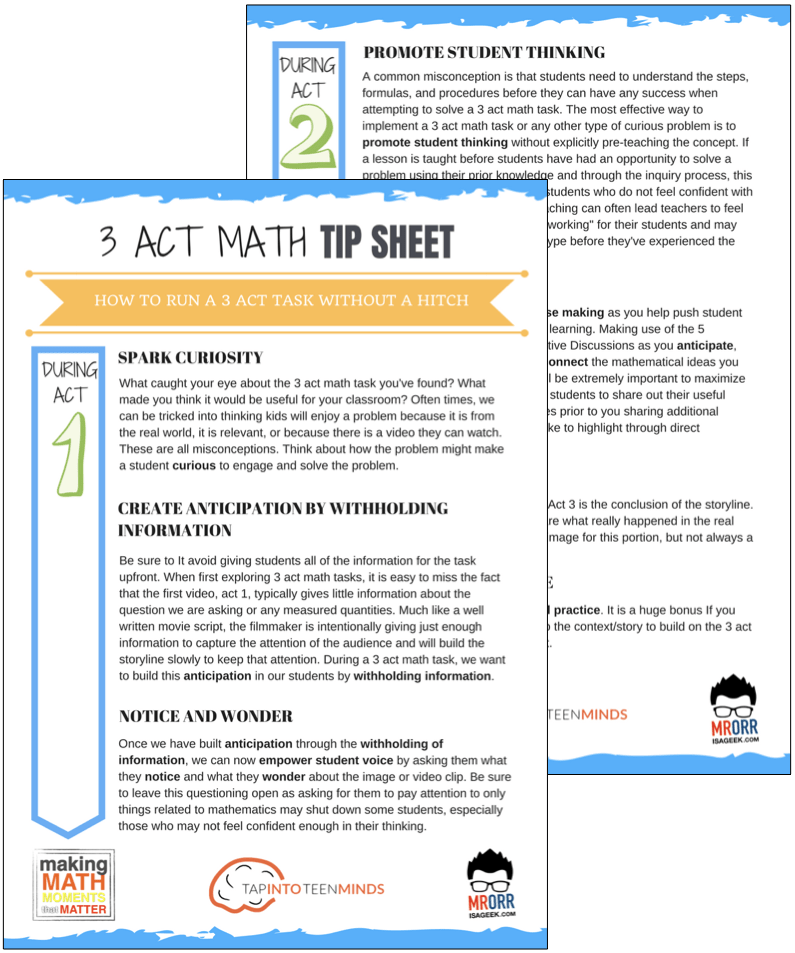
DOWNLOAD THE 3 ACT MATH TASK TIP SHEET SO THEY RUN WITHOUT A HITCH!
Download the 2-page printable 3 Act Math Tip Sheet to ensure that you have the best start to your journey using 3 Act math Tasks to spark curiosity and fuel sense making in your math classroom!
LESSONS TO MAKE MATH MOMENTS
Each lesson consists of:
Each Make Math Moments Problem Based Lesson consists of a Teacher Guide to lead you step-by-step through the planning process to ensure your lesson runs without a hitch!
Each Teacher Guide consists of:
- Intentionality of the lesson;
- A step-by-step walk through of each phase of the lesson;
- Visuals, animations, and videos unpacking big ideas, strategies, and models we intend to emerge during the lesson;
- Sample student approaches to assist in anticipating what your students might do;
- Resources and downloads including Keynote, Powerpoint, Media Files, and Teacher Guide printable PDF; and,
- Much more!
Each Make Math Moments Problem Based Lesson begins with a story, visual, video, or other method to Spark Curiosity through context.
Students will often Notice and Wonder before making an estimate to draw them in and invest in the problem.
After student voice has been heard and acknowledged, we will set students off on a Productive Struggle via a prompt related to the Spark context.
These prompts are given each lesson with the following conditions:
- No calculators are to be used; and,
- Students are to focus on how they can convince their math community that their solution is valid.
Students are left to engage in a productive struggle as the facilitator circulates to observe and engage in conversation as a means of assessing formatively.
The facilitator is instructed through the Teacher Guide on what specific strategies and models could be used to make connections and consolidate the learning from the lesson.
Often times, animations and walk through videos are provided in the Teacher Guide to assist with planning and delivering the consolidation.
A review image, video, or animation is provided as a conclusion to the task from the lesson.
While this might feel like a natural ending to the context students have been exploring, it is just the beginning as we look to leverage this context via extensions and additional lessons to dig deeper.
At the end of each lesson, consolidation prompts and/or extensions are crafted for students to purposefully practice and demonstrate their current understanding.
Facilitators are encouraged to collect these consolidation prompts as a means to engage in the assessment process and inform next moves for instruction.
In multi-day units of study, Math Talks are crafted to help build on the thinking from the previous day and build towards the next step in the developmental progression of the concept(s) we are exploring.
Each Math Talk is constructed as a string of related problems that build with intentionality to emerge specific big ideas, strategies, and mathematical models.
Make Math Moments Problem Based Lessons and Day 1 Teacher Guides are openly available for you to leverage and use with your students without becoming a Make Math Moments Academy Member.
Use our OPEN ACCESS multi-day problem based units!
Make Math Moments Problem Based Lessons and Day 1 Teacher Guides are openly available for you to leverage and use with your students without becoming a Make Math Moments Academy Member.

Partitive Division Resulting in a Fraction

Equivalence and Algebraic Substitution
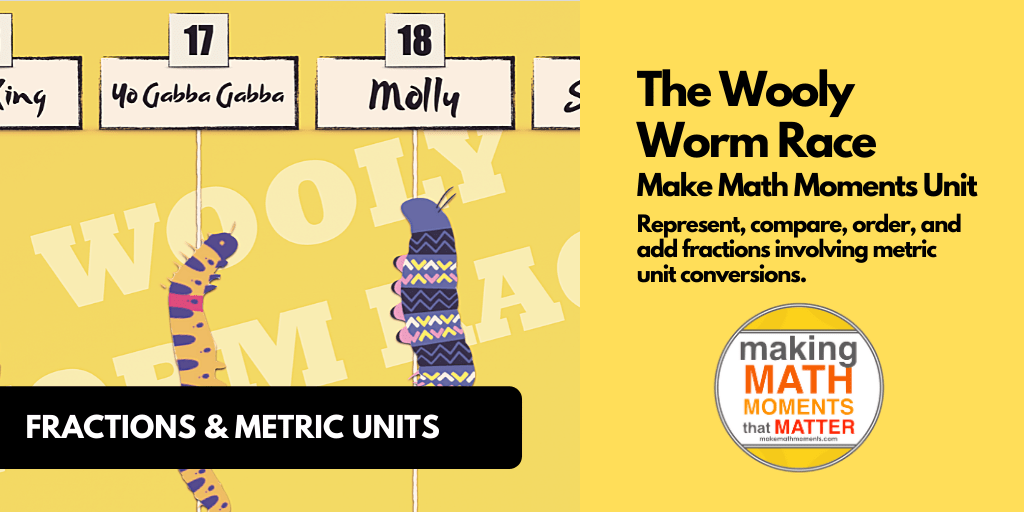
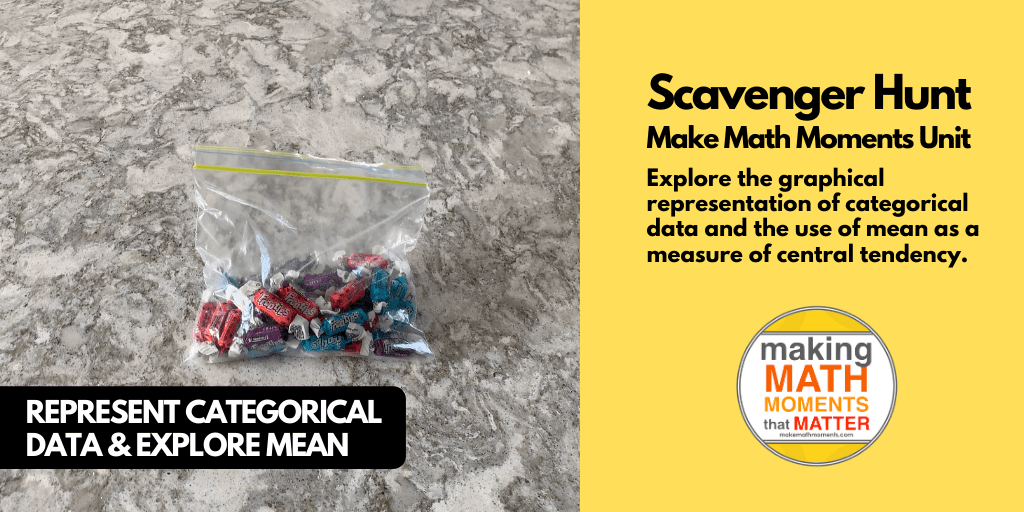
Represent Categorical Data & Explore Mean
Downloadable resources including blackline masters, handouts, printable Tips Sheets, slide shows, and media files do require a Make Math Moments Academy Membership.
ONLINE WORKSHOP REGISTRATION
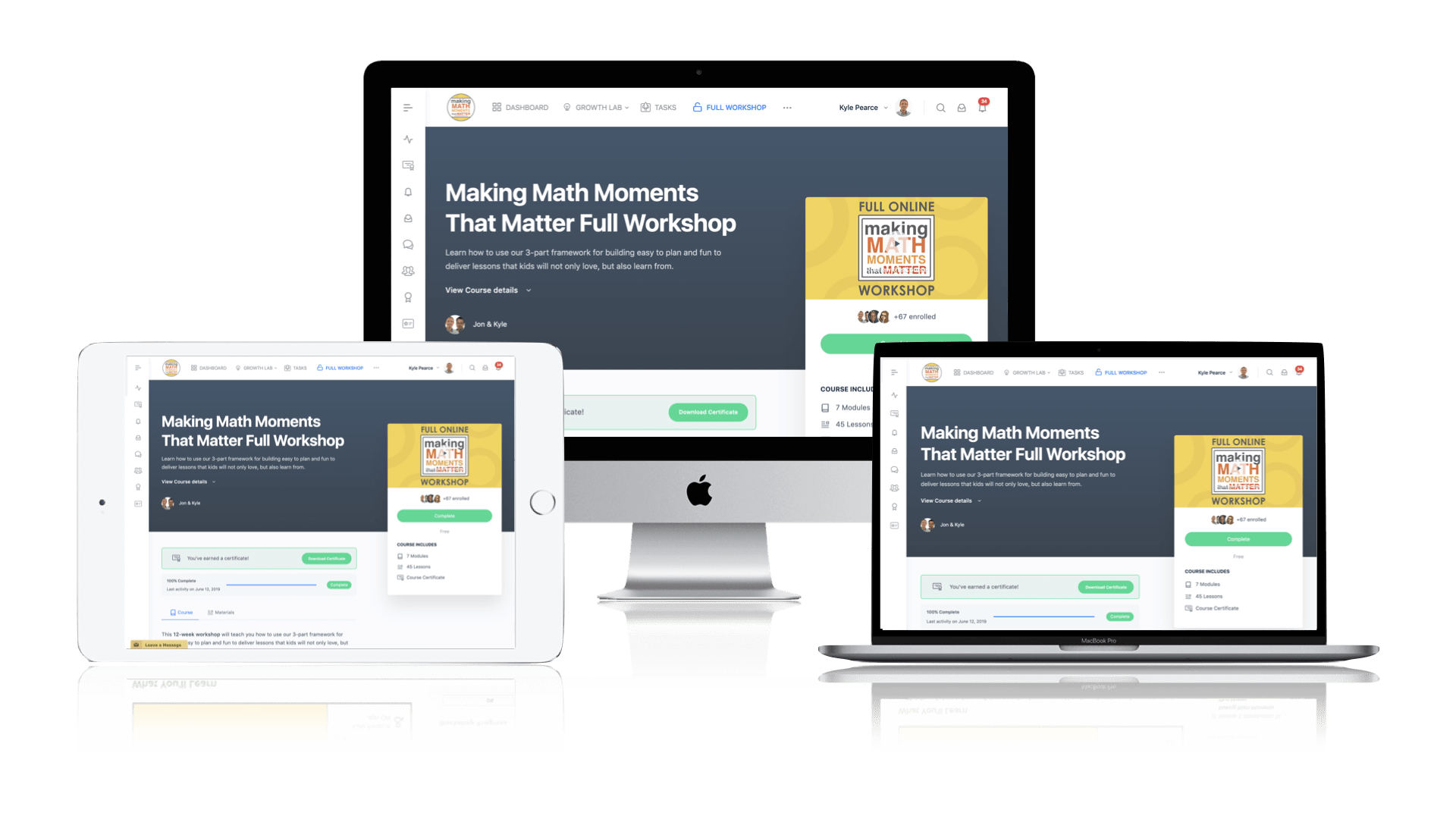
Pedagogically aligned for teachers of K through Grade 12 with content specific examples from Grades 3 through Grade 10.
In our self-paced, 12-week Online Workshop, you'll learn how to craft new and transform your current lessons to Spark Curiosity, Fuel Sense Making, and Ignite Your Teacher Moves to promote resilient problem solvers.
0 Comments