Episode #484: What Should You Grade in Math Class?
LISTEN NOW HERE…



WATCH NOW…
Assessment is one of the most powerful tools teachers have—but it’s also one of the most misunderstood. Too often, every task, activity, or game is expected to produce a grade, making it difficult to distinguish between supporting learning and evaluating it.
What happens when we stop asking, “How do I grade this?” and start asking, “What can I learn from this?” In this episode, we explore the critical difference between formative and summative assessment, and why that distinction changes everything. You’ll hear why games, observations, conversations, and exit tickets are powerful sources of evidence—not because they belong in the gradebook, but because they help teachers make better instructional decisions. We also discuss backward design, student ownership of learning, professional judgment, and the importance of building coherent assessment practices across classrooms and schools.
In this episode, you’ll explore:
- The difference between assessment for, as, and of learning
- Why not every classroom activity should generate a grade
- How formative assessment informs instructional decisions
- The role of backward design in planning meaningful assessment
- Why professional judgment matters more than averaging marks
- How collaborative conversations can strengthen assessment practices across a school or district
- Ways to build a stronger body of evidence for student learning over time
If you’re looking to move beyond grading everything and create assessment practices that truly support student learning, this episode will help you rethink the purpose of assessment and build greater confidence in using evidence to guide instruction.
Attention District Math Leaders:
K-12 Math Leaders: Download our free Math Coherence Compass to help your teammates, system leaders, and educators create aligned instructional practices—without adding another initiative.
Not sure what matters most when designing math improvement plans? Take this assessment and get a free customized report: https://makemathmoments.com/grow/
Ready to design your math improvement plan with guidance, support and using structure? Learn how to follow our 4 stage process. https://growyourmathprogram.com
Looking to supplement your curriculum with problem based lessons and units? Make Math Moments Problem Based Lessons & Units
Be Our Next Podcast Guest!
Join as an Interview Guest or on a Mentoring Moment Call
Apply to be a Featured Interview Guest
Book a Mentoring Moment Coaching Call
Are You an Official Math Moment Maker?


FULL TRANSCRIPT
Yvette Lehman: I was on a call recently with a team. It was an administrator and a teacher. And they’re talking about supporting the implementation of some fluency games in their classrooms. They’re currently doing a book talk around figuring out fluency. And an interesting but not surprising question came back once during their last book talk session from a teacher. They were asked, you know, essentially to take one of the games from the chapter, bring it back to their classroom, and have their students interact with it. And the question the teacher asked was, well, how am I going to assess that?
Jon Orr: The age old question. Well, how do I mark that? What’d you tell me?
Yvette Lehman: Well, so the question that I shared with the administrator was perhaps there’s a bigger question here around consistent understanding of the difference between formative and summative assessment and the purpose of different assessment types. So if a student is interacting with a game to support fluency, I’m not going to use that necessarily as a summative mark in my grading book, but I can gather evidence of student thinking to inform my next steps and to help move that student toward a learning goal. And so I kind of questioned, you know, are we making assumptions that everybody has a consistent understanding of the different forms of assessment and evaluation?
Jon Orr: Because I think yeah, like what you’re describing is — it made me think of that so they’re bringing this back and that almost like if they’re asking that question up front to say, how do I mark this or how do I assess this, they’re thinking about that — everything that they do in the class has to then have some sort of mark or assessment attached to it if I’m gonna ask students to do it. And my old self would have probably agreed with that. It was like, well, if we’re doing — I would have said well, I can’t get the kids to do it if I don’t put a mark on it. And so like, well, I gotta make sure that there’s a mark on it so that they will do it. And I think this is where this teacher is thinking, but then now you’re also thinking that everything goes into the grade book. Everything is in an average at the end of the lesson, which is like not, you know, like you said, you got three different types of assessments that we need to be considering and thinking about, and all of them have different purposes. And we’re confused, and this is true, like a lot of us are confused at this until we know what each form of assessment is for and what’s used for and what we look at how we wanna look at it, but we basically say assessment equals evaluation and they’re all the same until we know differently.
Yvette Lehman: Absolutely. Yeah. And so, you know, once we understand the distinction between assessment for, as, and of, I think it really changes our philosophy about our grade book. And interestingly, the teacher on the call was fully on board. You know, it was somebody who did have this clarity and was just trying to support her colleagues and her peers. But she said, you know, another pushback we come up against is that our administrators expect to see a lot of grades in the grade book as well.
Jon Orr: Right. You’re gonna get called in and flagged if that — you know, if that grade book — we pull up that grade book and there you haven’t evaluated, you know, you haven’t assessed enough yet.
Yvette Lehman: There’s only eight marks. Right, right. And so I think, you know, systemically we need to make sure there’s greater coherence at all levels. Because a teacher is not going to, you say this all the time, have the, you know, safety to make this shift to redefining their understanding of assessment versus evaluation if their principal is not on board.
Jon Orr: Yeah. I remember having a discussion a number of years ago, maybe ten years ago, about assessment and how we were writing it in our grade book and you know, what are the marks we’re putting in here? And, you know, mine was significantly less than what his grade book looked like. And, you know, he had different categories here in Ontario as like, you know, the KICA categories, the knowledge inquiry, and I was looking more about say standardized or standards based learning or outcome based assessment at that time and — he had a hard time understanding or I guess wrapping his mind around it because I think he got the value of it, but he was worried about I think sharing that approach about standards based assessment, basically saying, like, I’m now going to have this grade that represents a collection of skills or a collection of understandings, an assessment that’s like not every grade goes into the grade book, but I’m gonna use different observations, conversations, and product to influence the grade I write in there for that learning goal or that overall expectation or that assessment or that outcome. I think why he got worried was — I can’t — what happens if I share this to teachers? They’re gonna think it’s a free for all all of a sudden. It’s like I don’t have to — like I only have to have six, eight, ten grades for math because those are the overall expectations. And I think some people get worried that we — and this is maybe where the administrators come into play. It’s like I need to see more marks because it’s like I need to see that you did your job, right? Or parents. Like, how do you know? How do you know that that like that mark is — that’s that’s the old way of thinking, right? That’s the old way of thinking is you mark everything and then you’ve justified your grade. I didn’t — I put the grade in the grade book. I averaged them all. Boom. There is no question around where this grade came from because it was all on there, which is like everyone thinks it’s a very objective way to mark. But I mean, like, you also used a lot of subjective thinking in there when you actually made those grades. So you’re kidding yourself in thinking about like — the math made the grade, I didn’t help make the grade — but like you’re a professional that’s paid to help students understand where they are and assess them or evaluate them on these expectations or these overall standards. So it’s a — in a way a weird way to think about it, but it is the old way. It’s kind of like our old way of thinking about grading. It’s still around for sure and it needs to be shifted.
Yvette Lehman: Let’s talk a little bit about if we wanted to make that shift. Or we wanted to support others. So maybe some of our listeners are like, we’re buying what you’re saying. We understand there’s a distinction between assessment evaluation, that there are different types of assessment for as and of, but we want to start supporting ourselves and others to make this change. I feel like the biggest influence I had around understanding assessment and evaluation was Hattie’s work, particularly around assessment as learning, which is the metacognitive part about student ownership of the learning, by clearly showing them where they’re going from the beginning. Like being clear on this is the destination. And every single thing we do and you do to like — we are moving you towards success. But we have clarity around where we’re going. We know what the end result is going to be. And so then in order to actually design that, like, okay, so now I need to figure out — this is the summative, this is the performance task. And now I need to plan the learning experiences and give you ownership around the success criteria through every stage of this journey. I really lean on Grant Wiggins’ work around backwards design and his protocols around, you know, essentially building toward a performance task. And the word task is broad in his interpretation of task. It’s just the way that you’ve identified for students to demonstrate their proficiency of those the cluster of standards or overall expectations.
Jon Orr: Sure. Okay. So what’s the — so what you just described, I think some people are thinking about, yeah, but that’s the same process my calculus teacher or my advanced functions or my algebra two teacher is actually going through because they’ve got their unit test and they’ve got that ready to go. That’s their performance task, and every unit or every lesson leading up to that is getting them ready. Take that test and that test is the thing that goes in the grade book. Like what’s the difference of what I think you’re talking about and that?
Yvette Lehman: Yeah. So you know what is interesting? I’m good with the unit test. Like I am. Like I think some people are like — I’m good with a unit test. So to me, the unit test is summative. It’s a way for students to independently show me mastery of these expectations at their grade level. But I think where my practice shifted is understanding that every step we take toward it, I need to be gathering evidence of student thinking and students need to be self-assessing based on the success criteria, which means it needs to be super clear to all of us. So whatever my learning goal is for that day of that lesson, which is part of this map, you know, it’s like where we’re headed with each piece is building up to the summative. Every time we interact with another learning goal or emerge new success criteria, I need to check in because I’m basically taking every single person in the room and moving them closer. And they’re also accountable for moving themselves closer. So imagine today is one of those days where we’re emerging success criteria that’s going to help us on the summative. I’m observing students during the task itself. And I’m documenting — I have the success criteria for that lesson that day, and I’m probably checking or writing examples of evidence. At the end of that lesson, students are doing some type of consolidation or exit ticket. And then we would have — I’ve shared this on the podcast before where I use Hattie’s red, yellow, green. So students are putting it on the green paper if they’re green that day or on — and so then I note it in their book. Like, were they green? Do I agree that they’re green? Were they green? I actually think that they’re yellow. And then if there was a disconnect between my assessment and their assessment, I would leave feedback in their consolidation journal. And of course, for my red students, follow up with them in small group because I’m basically taking this entire group and we’re all committed to moving as close as we can to successfully demonstrating our understanding on that summative. But the goal has always been clear. Like I would literally show them the summative the first day with the criteria and be like, this is what we’re working toward. Okay, now let’s build all of the pieces we need to get there.
Jon Orr: Right. So go back to the teacher that was like, this is the fluency game and how do I — and they say, how do I assess this? Now thinking about what you’ve just outlined, where does that fit in?
Yvette Lehman: Yeah. Right. So to me, it’s like the fluency that they’re developing through that game is one part of the success criteria for the overall learning that’s happening on an upcoming summative assessment. And so what I’m doing is I’m using evidence of student thinking through observation to say, have the students achieved that criteria? And if not, how am I going to respond?
Jon Orr: Right. That’s a key moment, right? I’m using observations, conversations to influence what my moves are to get them closer to the success criteria, which means I might pivot my plan for tomorrow, or I might, you know, I might pull this small group over here. But because you’re clear on the reverse engineering and where the success criteria is on where you’re trying to go, and you’ve backwards designed, and the key here is designed opportunities for you to witness more of those — that success criteria than maybe the old traditional me would have, which is like, here’s my script, here’s my lesson, sit down, do some marking that I can catch up on. Right. Like you’re designing opportunities to give you information about where everyone is on that trajectory so that you can pivot when needed or get that group to that space in that time period.
Yvette Lehman: And you shared something too as we were heading into this call. It’s like, so now I get to the summative. Okay. And students, you know, it’s a product now at this point. And it’s connected here in Ontario. It should be connected to overall expectations or a cluster of standards if you’re, you know, working with like let’s say common core. But I still need to validate that product. And so what I’m looking for is does the evidence of their learning on this assessment, which is now assessment of, because it’s summative in nature, match what I’ve been seeing this entire unit. And if it’s like, absolutely, I could have anticipated this outcome, they could have anticipated this outcome, this is completely consistent with what I’ve been seeing for the past few weeks. I feel good that this is a good representation of the student’s learning toward the provincial or the state standard.
Jon Orr: Okay. Got it.
Yvette Lehman: But what if it’s not? And it kind of goes back to my exit tickets for every day. Every day I intervened when the student self-assessment didn’t match mine. And so if now I have this product and it’s like everything I’ve seen and gathered so far contradicts what I’m seeing on this summative, I’m gonna follow up. And I might need to have a conversation or I might need to give that student another opportunity or another way of demonstrating what they know, understand, and can do because this product does not match what I’ve been seeing for the last two or three weeks.
Jon Orr: You want the consistency. And that’s what we want to be able to say is like because in when it comes down to it, in the end, your mark should be — here’s in my professional judgment, here’s where this student is demonstrating, or what this student is demonstrating on this collection of standards or expectations. That’s what that mark is supposed to be. And you have to be able to say with confidence that that’s — and with evidence where that number or that mark came from. My old self would have been like the unit test showed me exactly where that — and the one quiz that we had, say two weeks ago, is the mark that would be for that unit. Instead of saying, well, but I hadn’t — in a way, I had no opportunity to actually like collect information because I didn’t design my lessons to be able to collect information to help me assess where students are before I even got there. So I wish in a way the day going into the test, you rarely knew how students would actually do. You know, you knew some kids would do okay because of past experience, because they did well in the last one. They’re gonna do well in this one, right? Or yeah, they came to you for extra help. And you then witnessed, you know, these opportunities. You had more opportunity. And so I think the you know, that we definitely want to be in a position that we walk into that unit test to say we know exactly where every kid’s gonna land there and it validates the work that all happened throughout this. Like for me, I had say a collection of exit tickets or say observational anecdotal evidence that I would collect on a sheet. You know, it’s an easy way to think about it. There was a sheet for a set of expectations for a student and these are the things we looked at throughout this unit, throughout these experiences to see where we are. Hey, did that line up with the expectations or the assessment that happened on that unit test or the summative assessment? Yep. There we go. Consistency and we’ve got a little bit more emphasis on the later marks than not. I feel really good about where this mark is landing. Otherwise, if you’re right, if the mark wasn’t so hot on the say the unit assessment. But I have some great evidence to suggest that the learning was happening. Like, did I blend at that point? I absolutely did. Right? Cause I want that to be an accurate reflection of where they are. Or you pull them aside and you did some re-understanding of where they are. Or maybe you had a retest with that kid or you had a reassessment somewhere down the line a little bit later to help them see where they could make improvements. Because to be honest, when you said the most powerful learning I think you had was from Hattie and Wiggins. And I remember one of the most powerful moments I had about assessment was thinking about — here in Ontario, the curriculum documents, the standards, they say right at the beginning, by the end of this course or by the end of the year, the student will, and then it lists all the current expectations. And I remember thinking, that’s by the end of the year. Like why am I locking things in by September 23rd or October? Like that’s when I’m done teaching, like that unit, maybe. But it doesn’t mean that I can’t help or work with that student to strengthen those things up throughout the year when there’s opportunity. And so it kept the door open to say continually assessing kids all the way through. Would I go back and change a mark on say the fractions or the number sense unit that we did in September when it was January? Absolutely, because we saw growth and we saw consistency on some of the things that we assessed back then. But those are some really important ideas to think about. Like when you think about assessment, it’s like it’s to me, it’s just about collecting information and using it so that when you go to do the evaluation, it’s an accurate representation of what that student knows on that set of expectations.
Yvette Lehman: Well for sure. And you can defend it with artifacts. So if a parent asks or a supervisor asks, you have more than sufficient evidence to tell that student’s learning journey. I love what you just said about by the end of the year, because one thing I would definitely do if and when I’m back in the classroom is make my summative assessments cumulative in nature. Like rather than it’s like I’m assessing your ability to operate with fractions, it’s like that’s the new skill that we’re working on and the new big idea that we’re emerging. But what are the all the things that came before it that I need to test your retention of? Because retention, right, is such a huge issue that we’re trying to overcome in math education, but it’s like if we were continuously, like David Costello says, like continuously engaging in cumulative practice and review through assessment, then we would know by the end of the year whether or not students had demonstrated that they were meeting or exceeding the standard.
Jon Orr: This is why Kyle and I, when we — this is ten years ago — we called these mastery days, or we called them, I think, in the end, portfolio days, where we dedicated one day a week. I thought I remember thinking, we’re gonna run out of time by actually gaining so much time doing this. But basically we dedicated one day a week to looking at all of those overall expectations. So these bigger standards to say, here’s where we all are, like this is where our — say our grade is on each one of these. Each one of those days, each week was dedicated towards students choosing one to work on or choosing a collection of them to work on. When I say work on, was basically saying like strengthen or show evidence of understanding in these ways to say make that better. But really what we were doing is building retention — is that you had to. So it’s like by the end of the year, you didn’t just do number sense in operation back in September. You did it all the way through because you were strengthening it up throughout that time anyway, one day a week. That was an impactful move that I think kept students stronger over the course of a year, because we spiraled, say, those assessments.
Yvette Lehman: If I was going to summarize some of my big takeaways from this conversation, my first one I think is that I don’t think we can assume that in our system, and our system could be as small as our department or our school or our district, that we all have a shared understanding of assessment for as and of and the distinction between formative versus summative assessment and evaluation. We never want to think about, well, we did that. We did that learning. Like and we talked on a recent episode about this idea of the Ferris wheel, that education, our system is a Ferris wheel where people are constantly getting on and off and changing seats. And so the conversations and deep learning around assessment evaluation need to be ongoing and woven into the fabric of our professional development design every year, not as a one off thing that we did that one time. Any other big takeaways, John, from today?
Jon Orr: Well, just to build on that, is I think like when you think about that big takeaway of ensuring that we have a coherence around forms of assessment is — I think the question is, well, how do we do that? Right? Like how do we do more of that? How do we build that coherence around? Is it just a hey, we did that? It was a one day session where we or a half day session where we talked about it and we defined these things. I don’t believe that’s the case to actually create the coherence you’re looking for. It’s — making to me, it’s making use of your collaborative time on a regular basis to pull student artifact, collaboratively look at — what would you give this student? What does that look like? Let’s have a conversation about what those assessment practices are in our classrooms. Are you using exit tickets? Well, how do you record that? Like these conversations, these questions that come up, this is part of what we should be doing in our PLCs. This is what we should be doing with our staff meetings. It’s creating collective understanding. We are all better together. Therefore we can build off each other’s experiences, but then their insights, especially in the form of assessment, because assessment can drive your instruction, right? Like if you’re asking why aren’t teachers shifting practice? You could easily start with looking at assessment practices, and that can be the driver of instructional change in your school or your school system. But you have to do that from this collective effort of like us all looking at what are we doing, but what should we do? What does that mean? Let’s challenge our understanding of assessment and how we use assessment for student learning. So that’s an important move. And I think my takeaway is to continually remember that sometimes if we don’t have that coherence, and we want to make that coherence, but I think helping teachers understand that they have permission to use professional judgment. That’s what they’re paid for. You’re paid to help students teach students in the classroom mathematics, teach them as students, as human beings, and helping them get stronger on the expectations or the standards that you know, sitting in front of you, and also the process standards. So these are the things that we do. Then we should be looking for evidence of helping our students move along and get stronger at those things. But we need sometimes someone to say, it’s okay that you do that and you use your professional judgment to help that student get stronger. And I think the question then becomes, well, how do I record that or how do I defend? You know, I think you just confidence in figuring out your strategies is — like you said, you’ve got a book of exit tickets that actually act as the evidence. That says this is where the student was all unit or all year on this set of expectations. Let’s look at it. Like I’ll gladly change my mark if it’s different than what this is suggesting. Right. Like having the confidence to say that is really important, but you got to build the body of evidence, which means you have to design your instruction to collect it. And I think we need permission to be able to do that. And I think because sometimes we’re just wondering like, I don’t know what those assessment pieces are, but I don’t really know how or I don’t know how to actually do that in the class because I think it has to be locked in this way. And I think that’s a big takeaway for everyone to think about is like how are we giving permission to the teachers we’re supporting or ourselves as teachers to think along these lines of terms of assessment?
Yvette Lehman: What’s our call to action today, John, for our listener? What I heard there for sure is we have to design in two ways. Design for ourselves in the classroom, but also design for opportunities for collaboration and you know this professional journey for growth and coherence across our system.
Jon Orr: Yeah. We’ve put together a comprehensive course inside of our online platform called assessment for growth for mathematics, which is everything that we’ve put into our practices over the, you know, many, many years of teaching mathematics. There’s a full course inside the Make Math Moments Academy that you can get your hands on, plus many of the other courses that we have on fluency strategies or how to teach with the five practices, or content courses specifically on ratios and proportions, proportional reasoning to how to teach math in kindergarten. Like we have a lot of professional development, pedagogical or content courses inside of our academy. Plus, 70 plus units of study are linked in there as well with teacher guides. You can get on over to the academy and register over there at makemathmoments.com forward slash academy or just scroll below and click one of the links down there.
Jon Orr: If you’re a teacher leader or a coach, having access to that academy also can help fuel PLCs. It can help strengthen the processes you’re putting into place. We have a very, very special course inside the academy. If you want access to that, it’s called the roadmap for math improvement. It’s a design course on how to design math improvement at a school or school system. Get access to that course, you got to reach out to us. So there’s a link below. Book a call with us and we can show you how to get access to that course. It’s not part of the original academy or the — that is more for teachers. But if you want that specific course on how to design math improvement for your school system, reach out to us. We’ll set up a call and see if it’s right for you. The link is below.
Thanks For Listening
- Book a Math Mentoring Moment
- Apply to be a Featured Interview Guest
- Leave a note in the comment section below.
- Share this show on Twitter, or Facebook.
To help out the show:
- Leave an honest review on iTunes. Your ratings and reviews really help and we read each one.
- Subscribe on iTunes, Google Play, and Spotify.
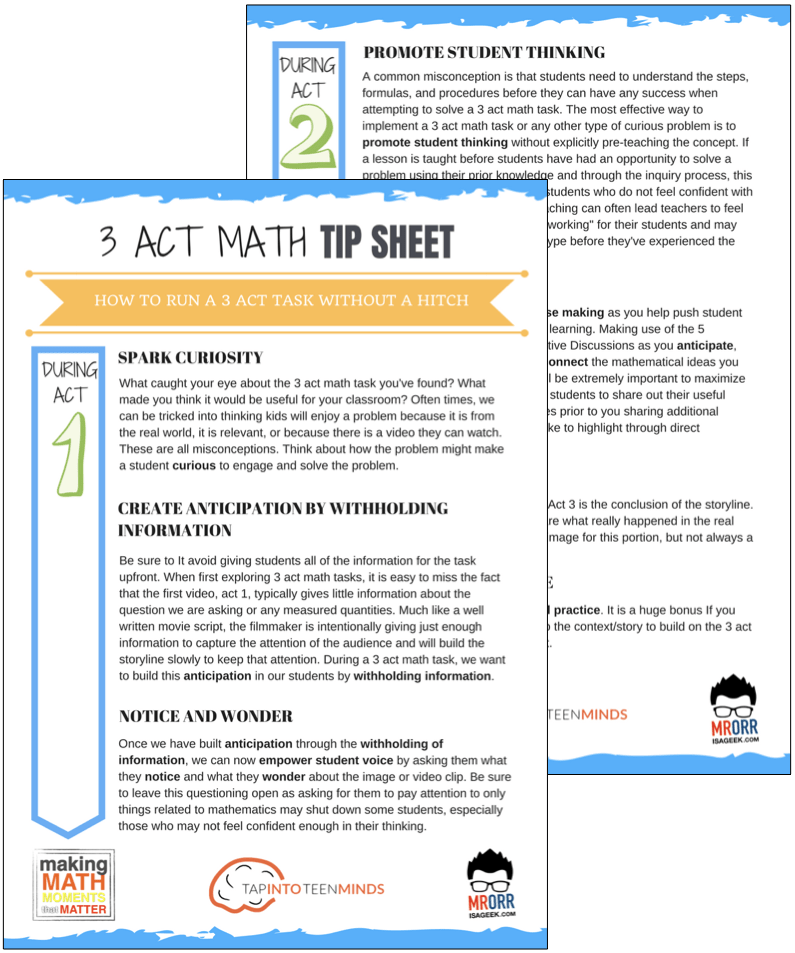
DOWNLOAD THE 3 ACT MATH TASK TIP SHEET SO THEY RUN WITHOUT A HITCH!
Download the 2-page printable 3 Act Math Tip Sheet to ensure that you have the best start to your journey using 3 Act math Tasks to spark curiosity and fuel sense making in your math classroom!
LESSONS TO MAKE MATH MOMENTS
Each lesson consists of:
Each Make Math Moments Problem Based Lesson consists of a Teacher Guide to lead you step-by-step through the planning process to ensure your lesson runs without a hitch!
Each Teacher Guide consists of:
- Intentionality of the lesson;
- A step-by-step walk through of each phase of the lesson;
- Visuals, animations, and videos unpacking big ideas, strategies, and models we intend to emerge during the lesson;
- Sample student approaches to assist in anticipating what your students might do;
- Resources and downloads including Keynote, Powerpoint, Media Files, and Teacher Guide printable PDF; and,
- Much more!
Each Make Math Moments Problem Based Lesson begins with a story, visual, video, or other method to Spark Curiosity through context.
Students will often Notice and Wonder before making an estimate to draw them in and invest in the problem.
After student voice has been heard and acknowledged, we will set students off on a Productive Struggle via a prompt related to the Spark context.
These prompts are given each lesson with the following conditions:
- No calculators are to be used; and,
- Students are to focus on how they can convince their math community that their solution is valid.
Students are left to engage in a productive struggle as the facilitator circulates to observe and engage in conversation as a means of assessing formatively.
The facilitator is instructed through the Teacher Guide on what specific strategies and models could be used to make connections and consolidate the learning from the lesson.
Often times, animations and walk through videos are provided in the Teacher Guide to assist with planning and delivering the consolidation.
A review image, video, or animation is provided as a conclusion to the task from the lesson.
While this might feel like a natural ending to the context students have been exploring, it is just the beginning as we look to leverage this context via extensions and additional lessons to dig deeper.
At the end of each lesson, consolidation prompts and/or extensions are crafted for students to purposefully practice and demonstrate their current understanding.
Facilitators are encouraged to collect these consolidation prompts as a means to engage in the assessment process and inform next moves for instruction.
In multi-day units of study, Math Talks are crafted to help build on the thinking from the previous day and build towards the next step in the developmental progression of the concept(s) we are exploring.
Each Math Talk is constructed as a string of related problems that build with intentionality to emerge specific big ideas, strategies, and mathematical models.
Make Math Moments Problem Based Lessons and Day 1 Teacher Guides are openly available for you to leverage and use with your students without becoming a Make Math Moments Academy Member.
Use our OPEN ACCESS multi-day problem based units!
Make Math Moments Problem Based Lessons and Day 1 Teacher Guides are openly available for you to leverage and use with your students without becoming a Make Math Moments Academy Member.
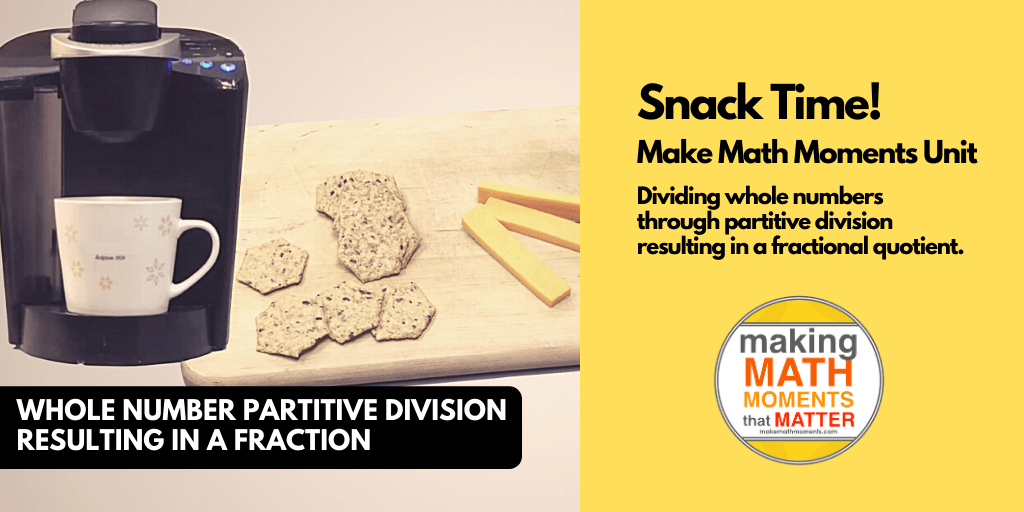
Partitive Division Resulting in a Fraction
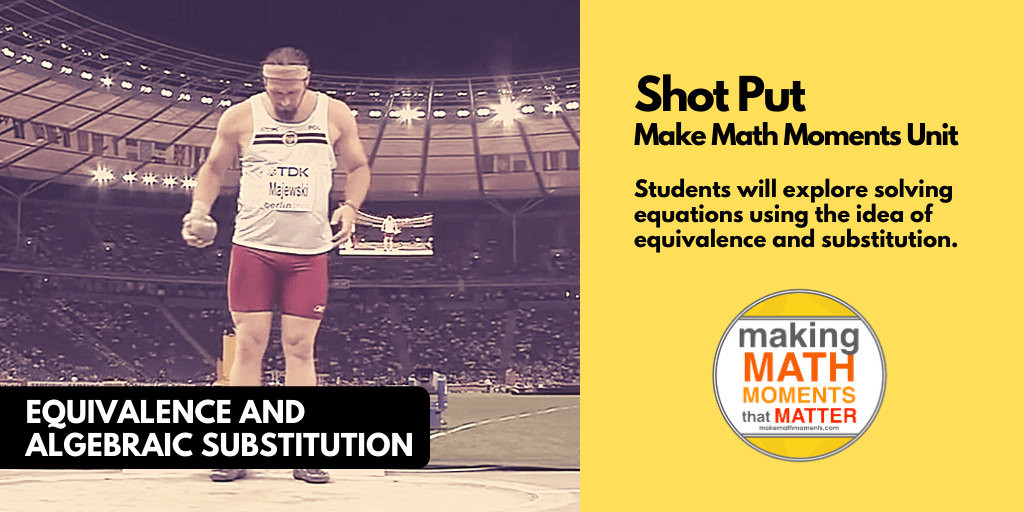
Equivalence and Algebraic Substitution
Represent Categorical Data & Explore Mean
Downloadable resources including blackline masters, handouts, printable Tips Sheets, slide shows, and media files do require a Make Math Moments Academy Membership.
ONLINE WORKSHOP REGISTRATION
Pedagogically aligned for teachers of K through Grade 12 with content specific examples from Grades 3 through Grade 10.
In our self-paced, 12-week Online Workshop, you'll learn how to craft new and transform your current lessons to Spark Curiosity, Fuel Sense Making, and Ignite Your Teacher Moves to promote resilient problem solvers.
0 Comments