
Episode #485: Is Math Intervention Working? Learn to Build A Better Fence
LISTEN NOW HERE…



WATCH NOW…
Every school system wants to improve student achievement in mathematics. Yet when students struggle, the immediate response is almost always the same: more intervention, more support programs, more people working at the bottom of the cliff. While these efforts are essential, they often come at the expense of investing in the work that could prevent students from struggling in the first place.
Using the classic “ambulance at the bottom of the cliff” parable, this episode explores why school systems consistently prioritize rescue over prevention. It’s not because leaders don’t believe in strong Tier 1 instruction—they do. The challenge is that prevention is harder to see, slower to measure, and more difficult to defend. We unpack why intervention feels more urgent, why leading indicators matter more than waiting for test scores, and how systems can make the invisible work of prevention visible through classroom evidence and instructional coherence.
In this episode, you’ll explore:
- Why intervention often receives more attention and funding than prevention
- The “ambulance vs. fence” metaphor and what it means for math improvement
- Why Tier 1 instructional coherence is the foundation of long-term success
- The difference between leading and lagging indicators of improvement
- How to measure instructional shifts before test scores change
- Why sustained professional learning outperforms one-off professional development
- Practical questions leaders can ask to rebalance investment toward prevention
If you’re leading mathematics improvement in a school or district, this episode will challenge you to rethink where your time, resources, and attention are focused—and help you build stronger systems that prevent students from falling behind in the first place.
Attention District Math Leaders:
K-12 Math Leaders: Download our free Math Coherence Compass to help your teammates, system leaders, and educators create aligned instructional practices—without adding another initiative.
Not sure what matters most when designing math improvement plans? Take this assessment and get a free customized report: https://makemathmoments.com/grow/
Ready to design your math improvement plan with guidance, support and using structure? Learn how to follow our 4 stage process. https://growyourmathprogram.com
Looking to supplement your curriculum with problem based lessons and units? Make Math Moments Problem Based Lessons & Units
Be Our Next Podcast Guest!
Join as an Interview Guest or on a Mentoring Moment Call
Apply to be a Featured Interview Guest
Book a Mentoring Moment Coaching Call
Are You an Official Math Moment Maker?


FULL TRANSCRIPT
Jon Orr: John here, and I’m traveling this week. So I’m not in my usual office and I’m not with Yvette to bring you this episode. But this is a topic that’s been on my mind from the various conversations and strategy sessions and the coaching sessions we’ve had over the years. It reminds me of a poem in eighteen ninety-five, a man named Joseph Mallins wrote a little poem that has somehow stayed relevant for a hundred and thirty years. It goes a little like this. A town sits at the top of a beautiful cliff. The view is gorgeous, and people they get close to that cliff and keep falling off the edge. So the townspeople gather to do something about it. Someone eventually proposes building a fence at the top of the cliff. Reasonable. It’s cheap. It would stop the falling. But the conversation drifts the way these conversations do. Someone points out that the people who’ve already fallen need help now, right now. Someone else notes that how good it would feel to have a shiny new ambulance staffed and ready, waiting in the valley below. And at the end of the meeting, the town has voted, as you guessed, overwhelmingly to fund the ambulance at the bottom of the cliff instead of the fence at the top. The poem’s punchline here is that everyone in the room knew that the fence made more sense. They said so out loud, they build the ambulance anyway.
Jon Orr: If you’re a math coordinator, a math coach, administrator, you have lived this poem. You just didn’t know it had a name. Here’s the version that plays out in K-12 Math across North America here. And I bet you can map it onto your own district in about four seconds. Kids are struggling in our classrooms. So you stand up an intervention block, you buy a supplemental program, you hire intervention staff, you pull the strongest teachers off tier one to run small groups, you build a record recovery pathway. Every one of those is an ambulance in the valley. And every one of them is genuinely necessary because there are real kids failing right now and you can’t just let them hit the ground.
Jon Orr: But notice what almost never gets funded with the same urgency: the fence. Coherent tier one instruction, a shared instructional vision for K to eight, teachers deepening their own mathematical understanding so that the foundational concepts actually land the first time, that tier one instruction can be taught flexibly in the way it was designed. The upstream or top of cliff work would mean fewer kids reaching the edge at all. It’s not that everyone disagrees that the fence matters. In every planning meeting I’ve been part of, people nod vigorously when you say we need to fix this at the source. We need to be at the top of the cliff. Then the budget gets allocated to the valley anyway. The ambulance wins.
Jon Orr: Question worth sitting with is why? Because it’s not stupidity and it’s not bad intentions. It’s something just more structural and more fixable than that. The downstream or bottom of cliff fix wins for three reasons, and they’re worth talking about here because you can’t fight a force you haven’t identified.
Jon Orr: One, it’s more visible. An intervention block is a thing you can point to. It shows up on a master schedule. It has a roster. It has a room number. “We strengthen the conceptual coherence of our tier one instruction” just doesn’t fit on the slide the same way “we serve 240 students in intervention this year” does.
Jon Orr: It’s more fundable, is number two. Ambulances attract money. Intervention dollars, grant lines, emergency allocations, student-facing resources. They flow towards the visible crisis, not the quiet prevention. A fence is a one time line item or a continued line item that isn’t as sexy. It’s easy to cut when the budget gets tightened. An ambulance feels like a moral obligation.
Jon Orr: Number three, it’s more politically satisfying. When a board member, a parent or a superintendent asks what are we doing about math? The ambulance is the answer that lands. It signals the action. It signals care. The fence, slow, top of cliff or upstream — it’s invisible for a year or two. Signals nothing in the short term. Even though it’s the thing that actually drains the river. It’s the thing that prevents the cliff. So smart, caring people, working hard, keep choosing the ambulance. Not because they’re wrong about the fence. But because the system rewards the rescue and ignores the prevention.
Jon Orr: Here’s where it gets interesting for math leaders specifically because the ambulance trap is really a measurement trap wearing a budget costume. Think about how most districts measure whether their math work is working. Year end, state, or provincial test scores. That’s a lagging indicator. It arrives months after the instruction happened. It’s shaped by dozens of variables outside of the control of what you’re doing. It shows up far too late to course correct anything. It’s good, don’t get me wrong, it’s good for long term trend data. It’s like trying to improve your diet by stepping on a scale once a year, though. When your only feedback signal is that slow and not noisy, you literally cannot tell whether the fence is working. The fence takes a year or two to show up in test data, and by then you’ve stopped paying attention.
Jon Orr: The ambulance, on the other hand, produces immediate, countable, visible numbers. Students served, sessions run, programs deployed, so you keep funding the thing you can see. The way out is to measure the fence directly. Stop waiting for the lagging scale and start watching leading indicators, street data. The upstream instructional shifts you can actually observe in classrooms next week, not next spring. Is task selection improving? Is mathematical discourse increasing? Are teachers using representations more flexibly? Are kids getting conceptual foundations before procedures? Those are observables. We can build a walkthrough tool, take a baseline in September, return in January, return in May. Suddenly your fence becomes as visible as your ambulance, and it can finally compete for the budget.
Jon Orr: There’s one more reason leaders abandon the fence, and it’s the most human of all, I would say. It’s slow and it feels like failure. The research is sobering here. The work of you and colleagues in a study in the US Department of Education’s Institute of Educational Sciences found that teachers who receive an average of 49 hours of sustained professional development saw their students gain about 21% of points, while a one-off workshop showed no measurable effect. Building the fence is exactly that kind of work. Putting the system into place to support sustained professional development, it’s not sexy or it’s not flashy. It compounds slowly and then dramatically. But the slowly part is where most districts lose their nerve, they climb back down into the valley and start staffing the ambulance again.
Jon Orr: This is the flywheel versus pendulum problem we often talk about. The fence is flywheel work. And the ambulance is what you reach for every time the flywheel feels too slow to be working. It is working. It just doesn’t photograph well in October. You’re just not measuring the right things to tell you it’s working.
Jon Orr: You don’t tear down the ambulance. Let’s be clear about that. That’s not the answer here. There are kids in the valley right now, and pulling them up is non-negotiable. Abandoning intervention to go build a fence is its own kind of malpractice. This is a both and, not an either or.
Jon Orr: But this week you can start tilting the balance to the top of the cliff or upstream. Find one ambulance line in your budget and ask the fence question. For every dollar going into rescue, is there a proportional dollar going to prevention? To tier one coherence, to teacher content knowledge, to shared instructional vision. If the ratio is ninety-five to five, that’s your signal.
Jon Orr: Here’s another one. Make one fence indicator visible. Pick a single top of cliff or upstream instructional shift. Build a way to observe it and start reporting it with the same confidence you report intervention numbers. Give the fence a slide on its own.
Jon Orr: Number three, name the trap out loud in your next planning meeting. Tell the ambulance story. Watch the room nod and then ask the question that breaks the spell. So why does our budget say the opposite?
Jon Orr: The town in the poem never built the fence. Let’s be clear. But you’re not the town. You’re the one person in the meeting who can see the whole cliff. And who knows that the most important math work you’ll do this year is the work that for a while no one will be able to see at all.
Jon Orr: If you want to jump start, you can head down to the links below. We’ve got a few resources to get you started around a math coherence compass. And there’s a link there to book a call with our team to see if you’d like to start thinking about how to build that fence.
Thanks For Listening
- Book a Math Mentoring Moment
- Apply to be a Featured Interview Guest
- Leave a note in the comment section below.
- Share this show on Twitter, or Facebook.
To help out the show:
- Leave an honest review on iTunes. Your ratings and reviews really help and we read each one.
- Subscribe on iTunes, Google Play, and Spotify.
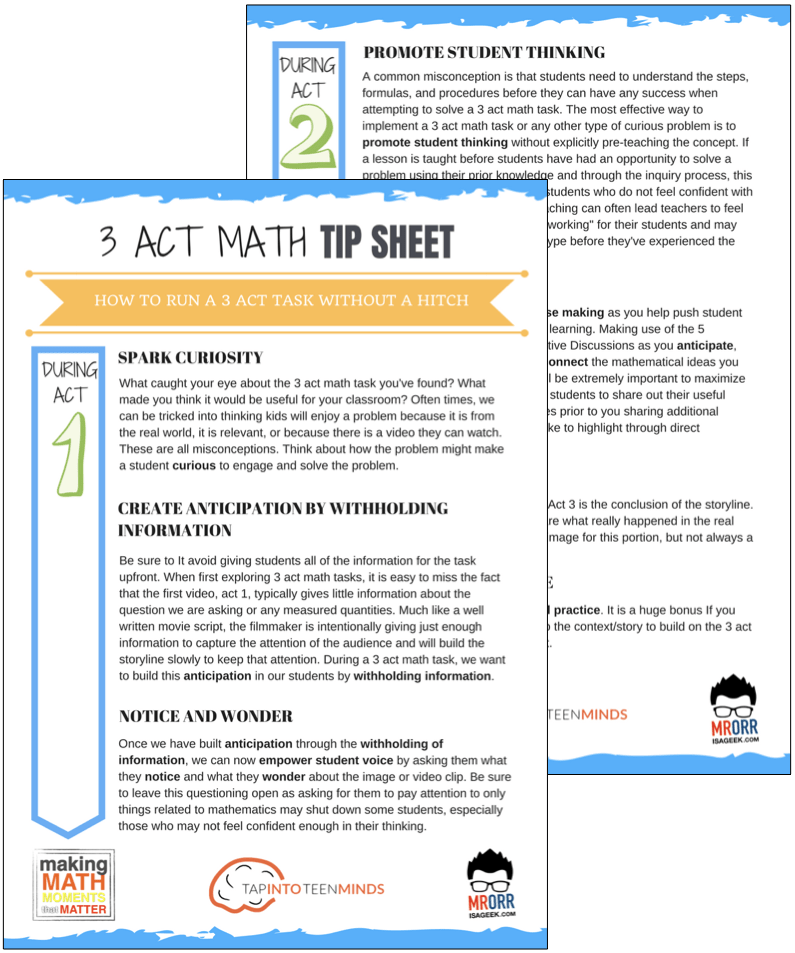
DOWNLOAD THE 3 ACT MATH TASK TIP SHEET SO THEY RUN WITHOUT A HITCH!
Download the 2-page printable 3 Act Math Tip Sheet to ensure that you have the best start to your journey using 3 Act math Tasks to spark curiosity and fuel sense making in your math classroom!
LESSONS TO MAKE MATH MOMENTS
Each lesson consists of:
Each Make Math Moments Problem Based Lesson consists of a Teacher Guide to lead you step-by-step through the planning process to ensure your lesson runs without a hitch!
Each Teacher Guide consists of:
- Intentionality of the lesson;
- A step-by-step walk through of each phase of the lesson;
- Visuals, animations, and videos unpacking big ideas, strategies, and models we intend to emerge during the lesson;
- Sample student approaches to assist in anticipating what your students might do;
- Resources and downloads including Keynote, Powerpoint, Media Files, and Teacher Guide printable PDF; and,
- Much more!
Each Make Math Moments Problem Based Lesson begins with a story, visual, video, or other method to Spark Curiosity through context.
Students will often Notice and Wonder before making an estimate to draw them in and invest in the problem.
After student voice has been heard and acknowledged, we will set students off on a Productive Struggle via a prompt related to the Spark context.
These prompts are given each lesson with the following conditions:
- No calculators are to be used; and,
- Students are to focus on how they can convince their math community that their solution is valid.
Students are left to engage in a productive struggle as the facilitator circulates to observe and engage in conversation as a means of assessing formatively.
The facilitator is instructed through the Teacher Guide on what specific strategies and models could be used to make connections and consolidate the learning from the lesson.
Often times, animations and walk through videos are provided in the Teacher Guide to assist with planning and delivering the consolidation.
A review image, video, or animation is provided as a conclusion to the task from the lesson.
While this might feel like a natural ending to the context students have been exploring, it is just the beginning as we look to leverage this context via extensions and additional lessons to dig deeper.
At the end of each lesson, consolidation prompts and/or extensions are crafted for students to purposefully practice and demonstrate their current understanding.
Facilitators are encouraged to collect these consolidation prompts as a means to engage in the assessment process and inform next moves for instruction.
In multi-day units of study, Math Talks are crafted to help build on the thinking from the previous day and build towards the next step in the developmental progression of the concept(s) we are exploring.
Each Math Talk is constructed as a string of related problems that build with intentionality to emerge specific big ideas, strategies, and mathematical models.
Make Math Moments Problem Based Lessons and Day 1 Teacher Guides are openly available for you to leverage and use with your students without becoming a Make Math Moments Academy Member.
Use our OPEN ACCESS multi-day problem based units!
Make Math Moments Problem Based Lessons and Day 1 Teacher Guides are openly available for you to leverage and use with your students without becoming a Make Math Moments Academy Member.

Partitive Division Resulting in a Fraction
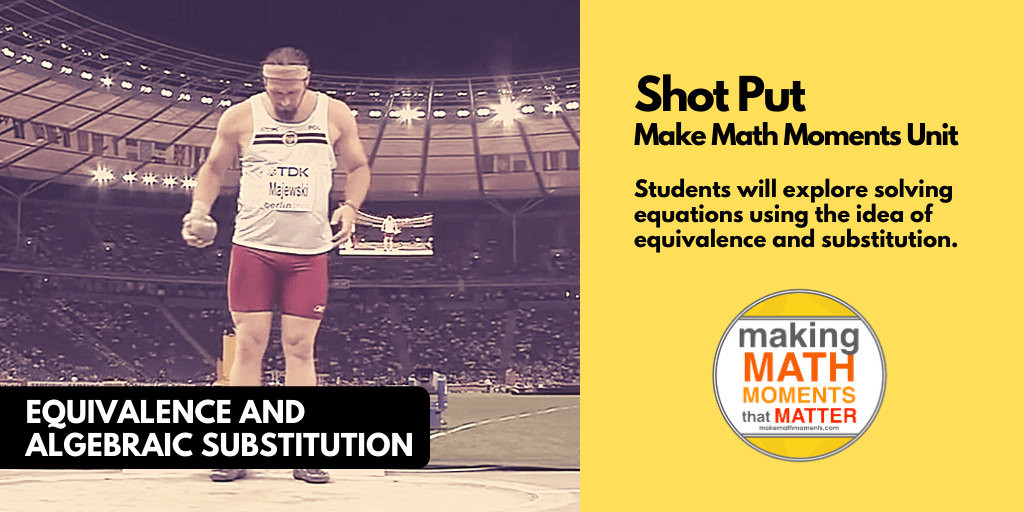
Equivalence and Algebraic Substitution
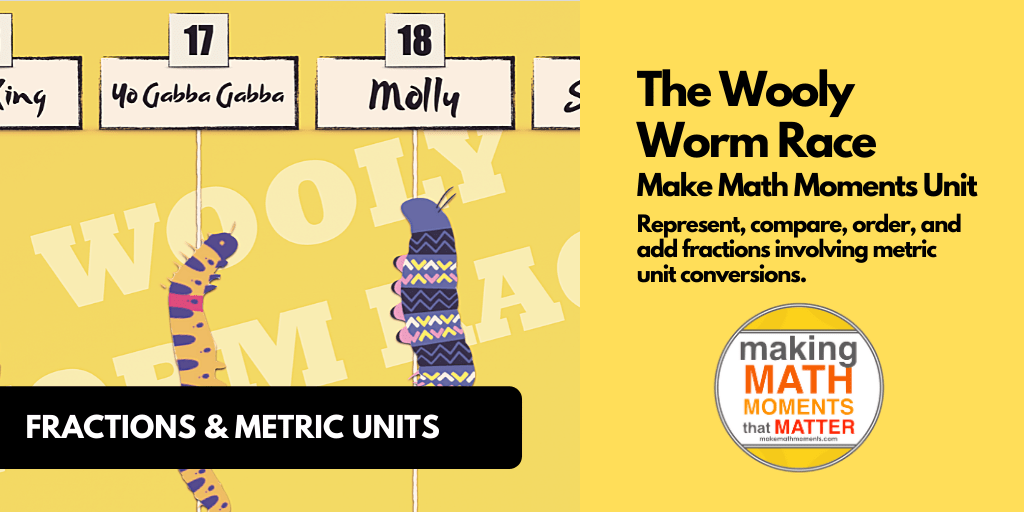
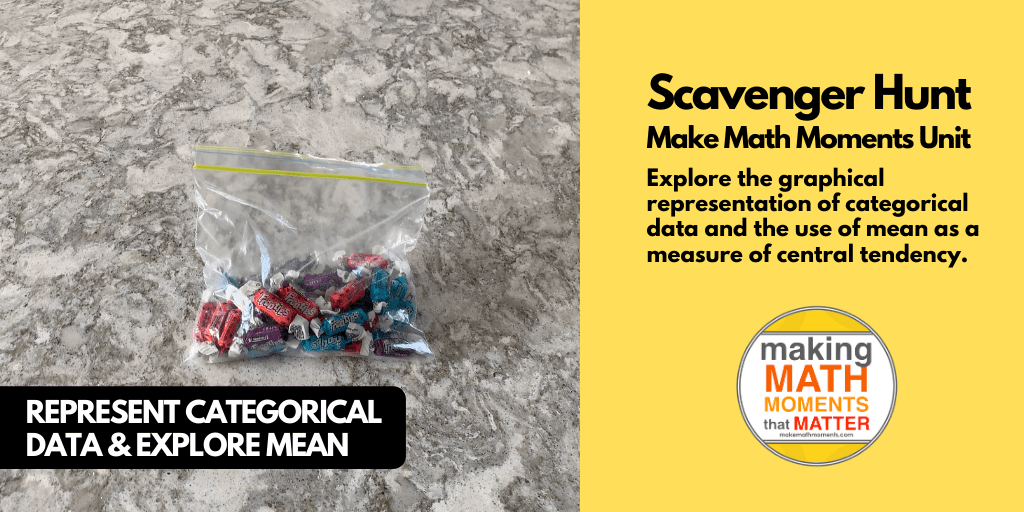
Represent Categorical Data & Explore Mean
Downloadable resources including blackline masters, handouts, printable Tips Sheets, slide shows, and media files do require a Make Math Moments Academy Membership.
ONLINE WORKSHOP REGISTRATION

Pedagogically aligned for teachers of K through Grade 12 with content specific examples from Grades 3 through Grade 10.
In our self-paced, 12-week Online Workshop, you'll learn how to craft new and transform your current lessons to Spark Curiosity, Fuel Sense Making, and Ignite Your Teacher Moves to promote resilient problem solvers.
0 Comments