Episode #486: Math Homework in 2026-2027: What Should It Really Look Like?
LISTEN NOW HERE…




WATCH NOW…
Homework has long been a part of the mathematics classroom, but opinions about its value continue to vary. Should students be completing pages of practice each night, or is there a better way to extend learning beyond the classroom?
Rather than asking whether homework should exist, perhaps the better question is: What purpose should it serve? In this episode, we explore what meaningful math homework could look like if it were designed to reinforce learning instead of creating stress. From fluency games and student choice to strengthening home-school partnerships and building productive routines, we discuss how homework can become a purposeful extension of classroom learning without overwhelming students or families. We also examine why homework shouldn’t be used to evaluate student learning and how teachers can use classroom formative assessment to understand what students know instead.
In this episode, you’ll explore:
- The purpose of homework in mathematics education
- Why less homework can often lead to better learning
- How choice and flexibility can make homework more meaningful
- Ways to strengthen partnerships between home and school through homework
- Why homework shouldn’t be used as evidence for grades
- Alternatives to whole-class homework review that maximize instructional time
- Considerations for school and district homework policies
If you’re rethinking the role homework plays in your mathematics classroom or school, this episode offers practical ideas for creating homework experiences that reinforce learning, engage families, and make better use of valuable instructional time.
Attention District Math Leaders:
K-12 Math Leaders: Download our free Math Coherence Compass to help your teammates, system leaders, and educators create aligned instructional practices—without adding another initiative.
Not sure what matters most when designing math improvement plans? Take this assessment and get a free customized report: https://makemathmoments.com/grow/
Ready to design your math improvement plan with guidance, support and using structure? Learn how to follow our 4 stage process. https://growyourmathprogram.com
Looking to supplement your curriculum with problem based lessons and units? Make Math Moments Problem Based Lessons & Units
Be Our Next Podcast Guest!
Join as an Interview Guest or on a Mentoring Moment Call

Apply to be a Featured Interview Guest
Book a Mentoring Moment Coaching Call
Are You an Official Math Moment Maker?



FULL TRANSCRIPT
Yvette Lehman: On today’s episode, we’re going to talk about homework. And I think what we’re going to do, Beth, is we’re going to share, if we could wave our magic wands, what would homework look like as an extension of the math classroom experience? So I’m going to hand it over to you. What would homework look like for you?
Beth Curran: Gosh, first off, I think it would be minimal. I wouldn’t require a lot of homework in math. I think the days of do the 30 problems, you know, we’re going to practice the same procedure that we learned, we’re going to practice it 30 times until we can recall the procedure from memory — I think those days are gone. So fewer problems, more games, more maybe of a focus on developing fluency, basic fact fluency through games at home because I feel like there’s just not enough time in class for students to develop that fluency. So games, it should be fun. You know, I think that I would give choice on occasion. So if I did want to, if I was going to use homework as some sort of formative assessment, I think I might give choice to students because just the problems that they choose is going to tell me their confidence level with their understanding.
Beth Curran: And I think I would also have maybe opportunities where students could explain what they learned in class to their parents at home. So, you know, I’m not giving like a sort of a one size fits all, do this every week sort of thing or every day, every night, but I’m giving lots of different options. And so I think that’s part of, I think what you’re maybe hearing me say is that homework would be flexible and fluid and based on the students’ needs at the time, and allowing teachers that flexibility and creating homework that benefits our students the best.
Yvette Lehman: I’m gonna answer my magic wand as a parent of an elementary aged child today. So I would agree with you on the — don’t want an hour of homework. I don’t want my own experience as a child where I’m like crying at the kitchen table because I have to sit there until my homework’s done, but I don’t understand it and it’s creating tension in my home. I don’t want that. So volume certainly is not something I’m after.
Yvette Lehman: But I also want homework. And this is why I want homework. Some amount of homework is because I want to be a partner in learning for my child. And I think all children and all parents deserve that opportunity to have that learning extend into their home. So that, you know, as a parent, it’s like, I can check in, I can reinforce, I can support his teacher because there is never enough time in the day to meet the needs of all learners in the classroom. And so I think that I would like there to be a small amount of homework routinely that allows my child to kind of reinforce — to your point, like share what they’re learning, explain to me what they’re learning, give me a highlight, show what you know with maybe a question or two, or they’re bringing home a game, like you said, that they’re going to teach our family because I do want to be a part of my child’s learning experience.
Yvette Lehman: And so, and I think that teachers need that. Like, I just don’t think there are enough instructional minutes in the day to help everybody get to where they need to be by the end of the year to be moving on to the curriculum at the next grade level. With all that being said though, you mentioned — I think that what I would also like is that it’s a little bit predictable. So with my son, who is pretty easy going, he still does better with routine. Right? So like when it’s homework sometimes then not others, or a lot some days and then no homework other days, I feel like that feels more hard for us to navigate as a family. Where if it was more predictable, right? If there were some routines, and then that was his routine where it’s like every day he comes home from school, he knows that he has 20 minutes of homework that he needs to do, or that by the end of the evening he has to get through his choice board or his checklist. I think having more predictability or routine creates less stress at home for families because if you don’t expect it and now all of a sudden today there’s an hour of homework to do but we have a whole evening scheduled, that also creates a lot of stress. So my wish list would be yes to homework, yes to something a little bit routine or predictable, and no to 30 questions to work through independently. That’s not productive time on task — that’s creating a lot of stress and a dislike for the content area.
Beth Curran: Well, and I think both can exist, right? I talked a little bit about flexibility, but that could still be within a structured format. So maybe Monday night’s homework is always X, and Tuesday night homework is always going to be this. And maybe there’s a little piece of fluency or a game that would be played every night. And so I do think that there can be some consistency and some routine built around that flexibility, if that makes sense.
Yvette Lehman: It totally does. Even if it was like, here’s a choice board for the week, you know, and it’s like you have to work through your choice board and every activity is only going to take 10 to 15 minutes. And I imagine teachers are thinking, okay, so now you’re creating more work for me because now I’m planning for not only my math block, but I’m planning for what happens in the evening as well. But I wonder again, like if it was routine, if it was an extension of what you were already doing. So let’s say you introduced a game for your centers for this week, but it’s like you know that that same game is going to be on their choice board that week. Or you know you’re doing some show what you know type questions or some cumulative review questions this week. So you add some of those to their choice board. So it doesn’t need to be anything different from what you’re doing in class. It should just be reinforcing and strengthening what you’ve already planned for the week.
Beth Curran: Right, and most high quality instructional materials are going to include some sort of component that is the practice at home component. Most will also have some sort of parent connection letter or newsletter or something that you can share with parents, keep parents up to date. So yeah, we’re not saying by any means go out and look on the worldwide web and find things to populate some sort of choice board. It’s like use what you have, right? But maybe like you said, maybe one of the choices is today, pick one or two problems and teach them to your parents. And then maybe tomorrow is choose five problems from the resources that go home. And so maybe the choices are using the curricular materials, but just in different, maybe a little bit more flexible ways, and providing sort of that choice for students. Because I think that we can’t discuss homework without addressing this idea of who is the homework actually for. So when we’re thinking about creating homework for students or assigning homework, who is really benefiting from that homework?
Yvette Lehman: Well, it makes me think about this idea of time on task, right? And it’s from the literacy training, but they basically define time on task — it’s like students need to be successful. So if we’re sending homework home and it’s like, well, students could already do it. You know, they’ve already demonstrated mastery of that skill. So now they’re just basically repeating something that they have already demonstrated proficiency at. Or if it’s like they didn’t understand it in class and now they’re taking it home and they’re continuing to perpetuate misconceptions or they’re struggling or they’re feeling frustrated. And so that’s why differentiating the homework to give some choice — and I think that what we would both argue is like, nobody could ever be too fluent. Like fluency is one of those things where it’s like you could keep practicing your fluency forever, right? So I think kind of to answer your question and to extend on it, it’s like we need to be mindful of is the task that we’re sending home meaningful? Is it going to strengthen and reinforce or consolidate learning for students? Is it going to help increase their fluency? Or are we assigning it kind of targeting, let’s say, people who are approaching proficiency and we’re excluding those who are already proficient and those who need intervention in order to access?
Beth Curran: So we kind of landed back on choice again. So maybe providing some choice. And I do think a lot of HQIMs out there do provide some sort of level of choice within those resources that would be used for the homework component of the curriculum. And so looking for that, I guess, would be a recommendation. If you’re listening and you have a high quality instructional material, really start critically looking at what is going home and seeing, you know, is there opportunity in there for some choice? You know, is it sort of differentiated as it’s written? And could you then lean into that? Because I’m going to bring homework back into the classroom then the next day. So with that, you used an example of — we send home some work. You know, maybe we’re attempting to target the middle by sending home some practice. You’ve got some students who flew through their understanding, it’s just rote, they’re not engaging, they already figured out how to do this. And so maybe they’re practicing for fluency, but you know, they can complete it pretty quickly because they firmly grasp the concept. You’ve got the group kind of in the middle that, you know, for the most part they understood it, but maybe as the problems got a little bit complex, that’s where some of their understanding fell apart. And then you might have a group that just didn’t leave class that day from that lesson understanding. And so they’re really struggling, right? Then we bring that back into the classroom.
Beth Curran: And I think a lot of teachers — and this is completely justifiable because we want to help, we want to teach, right? — so the homework comes back. For the most part, you’re looking at the students who maybe that sort of middle ground, or the ones who sort of didn’t quite grasp it, you’re looking to see, okay, how did they do on the homework? You see that it’s just a hot mess. They got a whole bunch of them wrong. So then you take the time, the instructional time to go through all of the problems again. Okay, so keeping in mind now, you do have a group of students who grasp the concept firmly, completed that homework in about five minutes. And now maybe you’ve made the choice to take 20 minutes of your instructional time to go over that homework again. So again, kind of getting back to who is that homework really benefiting and how are we using that then back in the classroom?
Beth Curran: And I would hear teachers pushing back — maybe I can imagine someone listening might push back a bit and say, well, I need to have some sort of a measure of how much they understood in class. And my argument would be that you don’t know how much support they’re getting at home. So is that homework that we’re asking students to do really a good measure? Just completing the page and getting them right — is that a good measure of did they understand what they learned in class that day? Because a student might leave class and go home and have you sit and purposefully go through those problems with them and teach them and support them. And that, you know, then your child goes back to school and everything is right and they’re in a good place because you helped to teach them. You might have a parent who spent hours on the internet trying to figure out how to teach this math and maybe approach it and teach it in a different way. And so now there’s maybe some confusion. And then you have a student who goes home and maybe there just isn’t time to sit down with a caregiver and help them through that. So they’re reinforcing bad behaviors or bad misconceptions, you know, so they’re reinforcing something that they didn’t quite understand. And so it’s — I think a lot of it just gets back to, you know, who’s the homework for, who is it benefiting? Right. And then how are we using our class time moving forward with that? What does that look like in class?
Yvette Lehman: I rarely make bold statements, Beth, definitive ones, but I’m going to do it today.
Beth Curran: Go ahead.
Yvette Lehman: I really struggle with whole class homework take up. Like I just don’t know that it is a good use of instructional minutes for all of the reasons that you just shared. I also have observed what it looks like when this is happening and there’s a lot of disengagement.
Yvette Lehman: And so let’s talk about some alternatives. So if it’s like, if it’s not that, if it’s like not — we’re going to go and assign the same 20 questions to everybody, they’re going to go home, they’re going to work on it with different varying entry points and abilities, and then they’re going to come back the next day and we’re going to carve out 20, 30, sometimes 40 minutes of the next period to take up the homework — if it’s not that, we already talked about what it could be as far as like not the 30 questions. So it’s like we’re sending home a small choice of like, just share your learning, show what you know, work on your fluency. Maybe tonight it’s like, I’m gonna explain to my family this one problem that we worked through. I’m gonna do a few practice questions to strengthen my fluency of a particular — you know, it’s like we’re dividing a whole number by a fraction. I just need a little bit more. Sometimes it’s like I have to do a bunch of them for it to solidify the generalization in my own brain. Maybe it’s a game.
Yvette Lehman: So we’ve already talked about that it’s not the 30 questions that everybody’s bringing back. But what if people are wondering, but what do I do with that homework? Like, are they bringing it back the next day? Am I responsible for checking it? How do I know if they did it or not? And I actually remember I had a parent who was a principal as one of my parents in my classroom. And at the time, I would assign some homework, again just to reinforce. And it was never 30 questions, but it was maybe two or three questions. It’s like, hey, I just want you to spend a little more time. But I didn’t take up the homework. And I actually remember the parent asking me — she was a principal — she’s like, I don’t understand how you know if they got it right. I don’t know if you know if they did it. And I would always — I said to her, I was like, I know if they got it because I’m doing formative assessment every single day in my classroom. So I do formative assessment while they’re working and they’re on task, and I do exit tickets at the end of every single lesson. And I said the homework is not assessment. I am not using homework to assess their understanding. The homework is just for additional reinforcement and for communication to parents and caregivers.
Yvette Lehman: I’m not using it in any way because — to all of the things you shared — I don’t know who did the homework. First of all, like I don’t know how much of the student thinking is in that homework. And so it’s not a good indicator of what they can do independently. So I guess my question is, what do I do to make sure that students are accountable, that they’re completing the homework? Or is that important? Like if I assign the homework, what is the accountability? If I’m saying I don’t want to spend 20 minutes taking it up, I’m not gonna use it as any type of assessment because I’m doing my own formative assessment daily.
Beth Curran: Sure. So I mean, it can take different forms. So if, say, you’ve got two pages in some sort of resource that you’re sending home and you give students choice, then how do you score that? How do the students know whether or not they got it correct? And so one recommendation might be that you come up with some sort of a routine where maybe the first couple of minutes of class, or maybe it’s the end of class, or maybe it’s at a transition point, you project the answers to the homework and students then self-check. They get out a flair pen or a colored pencil or however, whatever, however you wanna manage it in your classroom, and they circle or put a dot next to a problem where their answer didn’t match what they’re seeing projected. And then while students are doing that, you’re walking around and you’re noticing — bunch of circles there. Okay. Maybe I need to make sure that I pull the student aside, offer them some more support, whatever, because they didn’t quite grasp it. You’re noticing students who went above and beyond. And you’re maybe just putting a mark in the book that is complete or not complete. Right. I am going to say an absolute also that I do not believe that homework should be a grade in the grade book other than maybe complete, didn’t attempt it, right?
Yvette Lehman: It could be a learning skill, like right? Like we have in Ontario learning skills, assessment of learning skills. And so for sure, for responsibility, that might be one of the pieces of evidence that I include, but not a math mark.
Beth Curran: Yeah, for sure. So students could be self-checking. You could be monitoring, walking around. If, say, for example, the homework was explain a problem to your parents, then homework review could look like, who heard something interesting from their parents last night that you’d like to share? And again, it could be a quick conversation. Maybe if you’re tracking — are they doing their homework? Because is that a routine that we want them to do, a skill — then maybe some sort of little note or signature from a parent that they explained to me how to do this. So there are ways to track it without taking a ton of time. But I think having students sort of do a self-check.
Beth Curran: So here’s what happened in my class when I started doing that. So in my last position, I was kind of in a unique situation where I was teaching at the elementary level, so lower school level, and I was teaching multiple math classes. So I would work in conjunction with the classroom teacher and I would lead the math lessons. So I had three or four classes that I was responsible for. So three or four times 17 is a whole lot of homework to collect and check. And so pretty quick, I discovered that I’m just going to have the students check it themselves. And here’s what I heard them say. Miss Curran, I made a silly mistake. I must have rushed through this one. I shouldn’t have gotten that one wrong. They started noticing themselves when they were making mistakes or errors that they could have corrected. And so I think that is so — I say this because I think that is so much more powerful than me circling it and writing a note, you made a careless mistake. I don’t think that that student would look back at that and even think twice about redoing that or considering that they had gotten that wrong. But if they noticed it themselves and they had to circle it because they got it wrong because they rushed through, then they were discovering something about themselves. Kind of getting back to what can we do instead — we can have students self-check because I think that there are a lot of benefits to allowing them to do that.
Yvette Lehman: If I was going to summarize our conversation today, I feel like some of the big ideas that we were putting on our wish list was that it wouldn’t be one size fits all. Everybody goes home and does these same practice questions, they come back the next day, we take instructional minutes to take them up. On what it would be though is choice, not super time consuming, but meaningful. It would be for the purpose of bridging partnerships with parents and caregivers that they could support learning at home. It would be to reinforce key understanding or build their fluency. And that when they come back the next day, we’re really looking at learning skills. There’s accountability. We have routines in place for them to be responsible and accountable to that learning. We can do some observation as they’re taking up their own homework — to your point of like, I’m noticing a lot of marks over here that indicate the student may have struggled with some of the questions.
Yvette Lehman: And I guess the challenge with the choice board is like, how do you know which things they’re taking up that day? So that might make that logistically a little bit more complicated. So that’s something for us to think through. And maybe it’s instead of projecting it, it’s like there’s a binder. Actually, I heard a teacher say that the answers would be in a binder with page protectors, and then the day that the student had completed those questions they could go up to that binder and check their answers. So if we have a system for annotating whether they got it correct or not, I could quickly look into their book and see how they did. But again, it’s not for the purpose of assessment or evaluating student learning. It’s to build habits. It’s to bridge partnerships at home. It’s to strengthen because we know that sometimes the instructional minutes are just not enough for all learners to consolidate these key ideas. They need that little reinforcement.
Yvette Lehman: What would we say to leaders before we part today on this episode? Like, what’s our recommendation if you are a principal or a coach or a superintendent and you’re like, well, we have policies, I have to set consistent expectations for all teachers. What would be our advice to them to say, how can we re-imagine homework so that it’s not a cause for anxiety, it’s not adding stress or a dislike for the content area, but it’s truly giving students what they need to be successful and giving parents and caregivers an opportunity to be partners in learning?
Beth Curran: Yeah, so I would say — I heard you say that I have policies, there are policies about homework — but does there have to be? And maybe it’s time that we reevaluate some of those policies and maybe it’s sitting down with teachers and discussing what they’re noticing and how we can maybe change those policies to be a little more accommodating of the things that you said. Why do we do homework? Is it just because it’s a rite of passage that we all have to actually get through? Or is it really to benefit the learners and to bridge that connection between school and home, make sure parents understand what’s going on? And so I think I would challenge leaders out there to reevaluate their homework policies and why they exist and what the goal is. What is the ultimate goal for homework and why are we doing it, why are we engaging in it?
Yvette Lehman: If you’re a leader listening and you’re like, would love to have a think partner, you know, maybe I’m a curriculum coordinator and I’m responsible for math for the entire district, or I’m a principal and I’m an instructional leader at my school and you’re looking to talk this through, think about the system that you support — head on over to makemathmoments.com forward slash discovery and get on a call with us. We’d be happy to talk to you about your particular context and how you can strengthen math teaching and learning within your system. See you on the next episode.
Thanks For Listening
- Book a Math Mentoring Moment
- Apply to be a Featured Interview Guest
- Leave a note in the comment section below.
- Share this show on Twitter, or Facebook.
To help out the show:
- Leave an honest review on iTunes. Your ratings and reviews really help and we read each one.
- Subscribe on iTunes, Google Play, and Spotify.

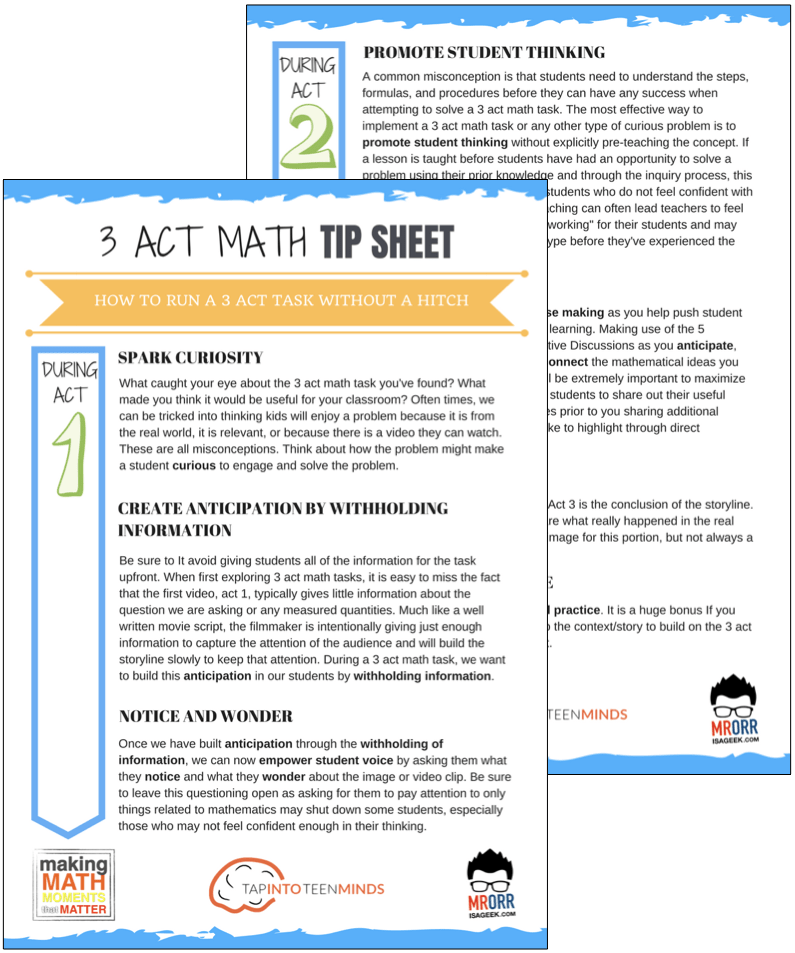
DOWNLOAD THE 3 ACT MATH TASK TIP SHEET SO THEY RUN WITHOUT A HITCH!
Download the 2-page printable 3 Act Math Tip Sheet to ensure that you have the best start to your journey using 3 Act math Tasks to spark curiosity and fuel sense making in your math classroom!
LESSONS TO MAKE MATH MOMENTS
Each lesson consists of:
Each Make Math Moments Problem Based Lesson consists of a Teacher Guide to lead you step-by-step through the planning process to ensure your lesson runs without a hitch!
Each Teacher Guide consists of:
- Intentionality of the lesson;
- A step-by-step walk through of each phase of the lesson;
- Visuals, animations, and videos unpacking big ideas, strategies, and models we intend to emerge during the lesson;
- Sample student approaches to assist in anticipating what your students might do;
- Resources and downloads including Keynote, Powerpoint, Media Files, and Teacher Guide printable PDF; and,
- Much more!
Each Make Math Moments Problem Based Lesson begins with a story, visual, video, or other method to Spark Curiosity through context.
Students will often Notice and Wonder before making an estimate to draw them in and invest in the problem.
After student voice has been heard and acknowledged, we will set students off on a Productive Struggle via a prompt related to the Spark context.
These prompts are given each lesson with the following conditions:
- No calculators are to be used; and,
- Students are to focus on how they can convince their math community that their solution is valid.
Students are left to engage in a productive struggle as the facilitator circulates to observe and engage in conversation as a means of assessing formatively.
The facilitator is instructed through the Teacher Guide on what specific strategies and models could be used to make connections and consolidate the learning from the lesson.
Often times, animations and walk through videos are provided in the Teacher Guide to assist with planning and delivering the consolidation.
A review image, video, or animation is provided as a conclusion to the task from the lesson.
While this might feel like a natural ending to the context students have been exploring, it is just the beginning as we look to leverage this context via extensions and additional lessons to dig deeper.
At the end of each lesson, consolidation prompts and/or extensions are crafted for students to purposefully practice and demonstrate their current understanding.
Facilitators are encouraged to collect these consolidation prompts as a means to engage in the assessment process and inform next moves for instruction.
In multi-day units of study, Math Talks are crafted to help build on the thinking from the previous day and build towards the next step in the developmental progression of the concept(s) we are exploring.
Each Math Talk is constructed as a string of related problems that build with intentionality to emerge specific big ideas, strategies, and mathematical models.
Make Math Moments Problem Based Lessons and Day 1 Teacher Guides are openly available for you to leverage and use with your students without becoming a Make Math Moments Academy Member.
Use our OPEN ACCESS multi-day problem based units!
Make Math Moments Problem Based Lessons and Day 1 Teacher Guides are openly available for you to leverage and use with your students without becoming a Make Math Moments Academy Member.

Partitive Division Resulting in a Fraction
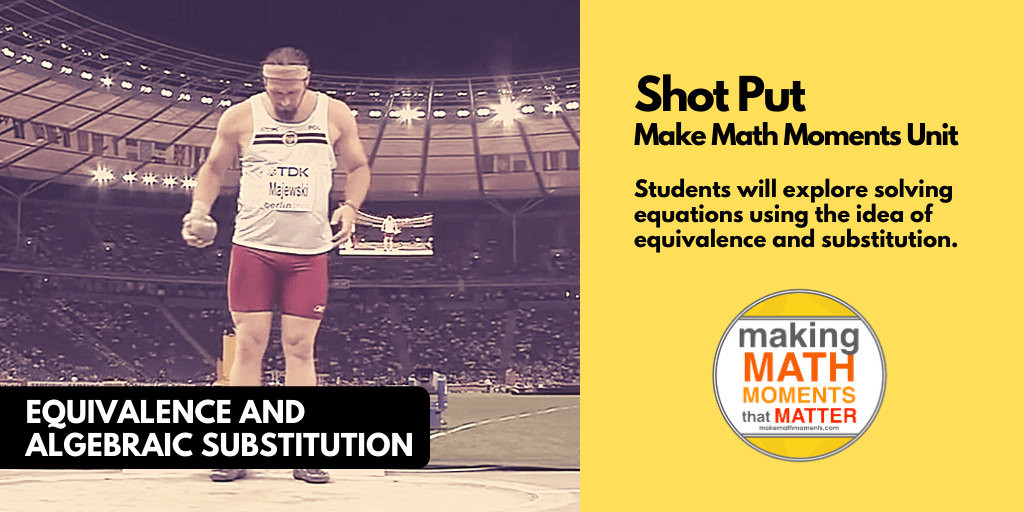
Equivalence and Algebraic Substitution
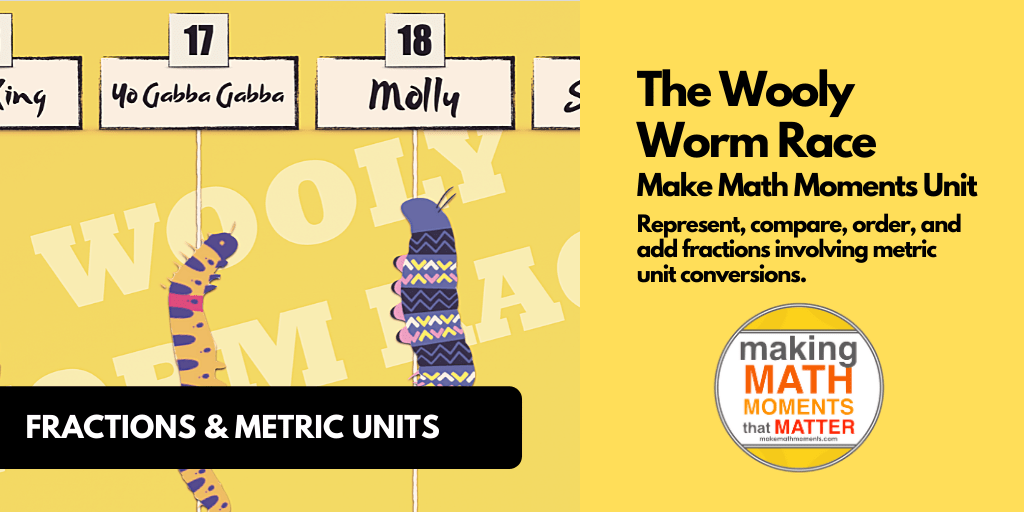
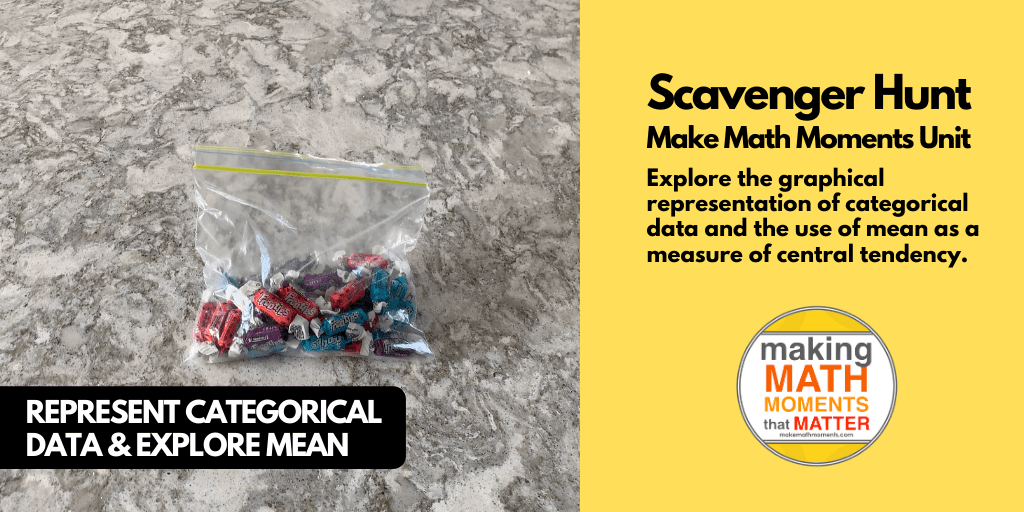
Represent Categorical Data & Explore Mean
Downloadable resources including blackline masters, handouts, printable Tips Sheets, slide shows, and media files do require a Make Math Moments Academy Membership.
ONLINE WORKSHOP REGISTRATION
Pedagogically aligned for teachers of K through Grade 12 with content specific examples from Grades 3 through Grade 10.
In our self-paced, 12-week Online Workshop, you'll learn how to craft new and transform your current lessons to Spark Curiosity, Fuel Sense Making, and Ignite Your Teacher Moves to promote resilient problem solvers.
0 Comments