
Episode #494: How to Spiral Your Math Curriculum: A Better Alternative to Cramming and Reteaching
LISTEN NOW HERE…
WATCH NOW…
Ever reach the end of the semester only to feel like you’re reteaching everything from September? If students learned it once but can’t retrieve it months later, the problem may not be the original lesson. It may be how—and when—they encountered mathematics.
In this episode, Jon Orr breaks down what it actually means to spiral your math curriculum and why spacing and retrieval can support longer-lasting learning. He also shares what didn’t work when he first tried spiraling and offers practical ways to start without rebuilding your entire course.
In this episode, you’ll explore:
- The difference between blocked instruction and spiraling
- Why spacing and retrieval can improve long-term retention
- How blocked units can create an “illusion of understanding”
- Why randomly mixing lessons isn’t the same as thoughtfully spiraling
- How mini-units can balance developmental progression with spaced learning
- Three low-lift ways to begin spiraling without rebuilding your course
- How warm-ups, math talks, and lagged practice can keep previous learning alive
- What leaders can do to create the conditions for spiraling to actually stick
Choose one topic students consistently seem to forget. Instead of teaching it once and hoping it sticks, consider how you could intentionally bring it back three times this term, going a little deeper each time. Start small, build deliberately, and give students repeated opportunities to retrieve and reconnect their learning.
Attention District Math Leaders:
K-12 Math Leaders: Download our free Math Coherence Compass to help your teammates, system leaders, and educators create aligned instructional practices—without adding another initiative.
K-12 Math Leaders: Not sure what matters most when designing math improvement plans? Take this assessment and get a free customized report: https://makemathmoments.com/grow/
K-12 Math Leaders: Ready to design your math improvement plan with guidance, support and using structure? Learn how to partner with us and follow our 4 stage process. https://growyourmathprogram.com
Looking to supplement your curriculum with problem based lessons and units? Make Math Moments Problem Based Lessons & Units
Be Our Next Podcast Guest!
Join as an Interview Guest or on a Mentoring Moment Call
Apply to be a Featured Interview Guest
Book a Mentoring Moment Coaching Call
Are You an Official Math Moment Maker?





FULL TRANSCRIPT
It’s the last week before exams. Let’s imagine you’re already there, even though it’s the beginning of the school year. You’re standing at the front of your room and you’re about to teach or reteach an entire unit you taught back in September. Let’s call it measurement. Remember measurement, everyone? If your students were like mine fifteen years ago, then many probably wouldn’t. You ask that question about surface area and you get those blank stares. The we did that stares?
So you do what most of us did for years. You cram two weeks of review into the calendar. You re-explain everything from scratch. You quietly wonder. You wonder, what did we actually accomplish back in September? If I’m standing up here reteaching it all in June, if that scene feels familiar, sometimes you repeat that unit to unit. This episode’s for you. I’m going to share ideas about spiraling your math curriculum, what it actually is, why the research says it works, how to start doing it without blowing up your entire year or your entire course, and how I attributed it to much of the success my students in my classroom had for years. And I’m gonna leave you with a couple of thoughts near the end of the episode for those of you who lead math out of school or school system and how you can actually make it easier for your teachers instead of harder. But let’s start in the classroom because that’s where it matters most. Let’s get into this.
All right, so let’s define spiraling your math curriculum because you might have heard this called a few different things: spiraling, interleaving, distributing, spacing, they’re all pointing at the same core shift. And we talked about this many times over the years of this podcast. You can scroll back, you can kind of flip up your phone right now and scroll and look at episodes. If you scroll back a while, a number of episodes, you will see many where we talk about spiraling. And this is just to bring this back into the forefront. Because the traditional way most of us were trained to teach math is what researchers call blocked or massed instruction.
You teach a unit, say measurement, for two or three straight weeks, you finish it, you move on to the next unit. Proportions. You finish that, you move to linear relations, and you don’t come back to measurement until it’s review time, months later, right before that final exam. Spiraling breaks that pattern apart. Instead of one long continuous block, you touch a topic, you move on to something else, and then you circle back to it later, a little deeper each time. You’re not teaching measurement once for three weeks. You are teaching it in shorter passes, spread out across the term and layering it more in more complexity each time you return.
Picture the difference this way. Blocked instruction is a t shirt cannon. You load it up one topic, you fire it, it’s over, it’s done, next topic. Spiraling is more like picture a spring, you know, the spring with coils. You keep coming back around the same territory. That spring kind of cycles back onto itself. But each loop you’re a little higher up and you’re a little deeper in. That’s what the difference is.
Now, here’s where this can get slightly interesting because this isn’t just a trendy idea that was shared when we first heard it from Al Overwick here in Ontario. It wasn’t some sort of trending in it that spread across this you know, the system or our province or past past our province. The science behind why spacing beats cramming goes back over a hundred years. A psychologist named Hermann Ebbinghaus ran a series of memory experiments on himself, actually, using lists of made-up meaningless syllables. He’d memorize a list, then test how much of it he could recall after different lengths of time. When he found what he found here became known as the forgetting curve. The moment you learn something, your ability to recall it starts dropping almost immediately. Unless something forces you to retrieve it again.
But here’s the part that matters most for us math teachers. When Ebbinghaus retrieved information after short gaps that gradually got longer, the forgetting curve got less steep each time. In other words, space retrieval, coming back to an idea right around when it starts to fade, builds stronger memory than mass repetition ever does. Researchers Sun and Simon, writing decades later in the Educational Psychology Review, reviewed the evidence across labs and classrooms with adults and kids, and they found the same pattern holds across the board. Spacing consistently leads to better performance than massing.
And then there’s a second concept that I think explains why so many of us don’t feel this problem until it’s very, very late. It’s called the illusion of understanding. When you block a topic into one tight chunk of time, everything feels fresh. Your students can perform. They pass the test. It looks like mastery, but that knowledge is sitting in short-term memory, propped up by recency, not by real retrieval strength. The second you stop reinforcing it, it starts to fade. And by exam time, it was like it was never taught. This is why it feels like those students are sitting in front of you saying, We didn’t even, we didn’t do measurement, we didn’t do that. These ideas that we’re now asking us to recall in June.
This is exactly the idea the author Benedict Carey unpacks in his book, How We Learn. If you have not yet read that, pick it up. Is a fundamental reading, especially for math education. His core argument is that a lot of what we assume about discipline, repetitive, over scheduled studying is actually working against us. And that some of what feels like a distraction to learning can, used the right way, actually support it. His bigger point, though, is the one that I wish you would lean into right now. Learning sticks best when it’s driven by curiosity, not by fear or test or comparison to classmates. And a one-shot block followed by a single test is exactly that structure that’s likely to produce fear-driven learning instead of curiosity-driven learning.
Kyle Pearce, the co-host here, we both started spiraling at the same time many, many years ago. And to be honest, it didn’t start out well. When we first got into this, we basically took our lessons and we we were experimenting. We threw them all into a blender. Think of fifty two pickup. We scattered the cards, we picked them up in whatever order they land, and those cards were like lessons. You know, each lesson was a card and we threw them all over and then we picked them up and then the whatever order we picked them up on is the order we taught that. And there were some real benefits, but we also learned pretty quickly that going that was going too extreme, too fast, creates its own problems. If you scatter concepts with zero developmental logic behind the order, you can leave kids with no chance to actually make connections. And that was an an issue.
What we landed on instead, and what we recommend you aim for is something in between. Group your spiraled content into smaller chunks. Sometimes we call them mini units, four to eight days long, built around a problem-based task. Teach that chunk, move to a different area of the curriculum for a while, and then come back to that first idea later, deliberately, and in layer in deeper than before. That’s the sweet spot. Not one giant block, not total chaos, deliberate return visits, spaced out, builds in and retention.
And one more thing that mattered a lot to us. The how matters as much as the when. If you’re spiraling proceduralized, memorized content, you’ll get some retention benefit, sure. But if you pair spiraling with problem-based lessons, like we did, where students are wrestling with low-floor tasks before you hand them that formula, that’s where the real gains show up. And that’s where our students had the most gains, and we had significant classroom success on achievement results with our students. The students start pulling on prior knowledge naturally because the context of the problem is what triggers the memory, not a worksheet that says unit three, use the formula from page 12.
So here are three low lift entry points for spiraling your math curriculum.
First, reorder your units. You don’t have to rebuild your whole course. Just take the units you already teach and consider switching up the sequence. So you’re touching different strands earlier and coming back to earlier ones later. Do this thoughtfully with developmental progression in mind. Don’t jump into something your students don’t have the prerequisite footing yet for yet.
Second, use warmups and math talks to preview and revisit. A quick warm-up on an idea from three weeks ago or a short preview of something coming up next week is a low stakes way to keep old ideas alive without deciding a whole new block of instructional time. One move I made when I was teaching algebra and specifically looking at factoring, factoring trinomials or factoring quadratic expressions is that we took 15 minutes every day to prior to us starting the unit of quadratics or the unit of factoring. And we made rectangles with algebra tiles. For 15 minutes, we did that by the the visualness, the the writing down the the dimensions of the rectangles, because we made rectangles with certain algebra tiles representing the the different terms of that trinomial. By the time we were ready to do the unit, we had kids had already learned very much on how to factor those expressions. And it was because we did 10 minutes in in a preview ver, you know, preview way prior to the unit. We built in that time over the course of of of spaced practice instead of mass practice.
Okay, third, build lagged practice into what you already assign. If today’s learning goal is fractions, mix in one or two practice questions from a unit you taught a month ago. That’s it. You’re not creating new content. You’re just resequencing when students encounter the content they already have. I used to create homework sets, and the homework sets included different topics from different zones or different units across the course. So every homework set wasn’t exactly today’s learning goal. It was today’s learning goal in last week’s learning goal and last month’s learning goal, but also previews of upcoming learning goals that they were that they were could could handle. That’s an important way to do lagged practice.
Start with just one of these, not all three at once. Some advice we give anyone to trying to change the longstanding habit is small, deliberate shifts that can actually sustain and beat a total overhaul that you probably will abandon by November if you do it that way.
Okay, before we wrap up, I promised a few thoughts for our math coordinators, our coaches, or instructional leaders listening in. Because here’s something. We hear constantly from teachers who do want to try spiraling their curriculum. They get excited about it and then they hit a wall. And the wall isn’t the idea or the philosophy, it’s the system around them. If you’re a leader, one of the most useful things you can do isn’t to mandate spiraling district-wide. It’s to protect the conditions that let teachers spiral well.
That usually comes down to three things:
Give teams shared planning time to actually re-sequence these together. Spiraling well takes real thought about developmental order. It takes understanding of the math curriculum, understanding the math concepts. This is an important idea that you need to build on. That’s a condition that you can set up structures for, like PLCs or like collaborative time. Protect that collaborative time.
Second, watch what you’re layering on layering on top of this type of work. If a team is generally trying to shift towards spiraling, in the same season, you bring three new related initiatives. Don’t be surprised if spiraling falls off the plate. New instructional practices need runway and support, not competition. Give this the room to actually take root before asking teams to absorb something else. Stop throwing spaghetti at the wall and see what sticks. Pick narrowed focuses and support those narrowed focuses.
Third, reinforce this in the structures you already run. If you’re doing coaching cycles, if you’re doing PLCs, if you’re doing classroom visits, build simple recurring check-in questions around the work. Something as small as which ideas came back around this cycle and how’d that go. Keeps the practice visible and keeps you positioned to actually support it instead of finding out six months later that it fizzled out after the first PD day.
That’s really it. Your job as a leader here isn’t to be the expert on every teacher’s spiraling sequences. It’s to build the conditions, the time, the focus, the reinforcement. Let that lets good classroom practice actually stick instead of surviving one semester and quietly disappearing.
So here’s your reflection question for the week. Whether you’re in the classroom or leading from beside it, think about one topic your students consistently seem to forget by the time the test rolls around. What would it look like to touch that idea three times this term instead of once? A little deeper each time, instead of teaching it once and hoping it sticks.
If you want a starting spot. We’ve built a full spiraling guide and course. Again, there’s many episodes that we have that are in this catalog of episodes. We have, you know, all 497 of our episodes you can scroll through. In the description of this episode is there’s a link to that spiraling course. It’s an email course that you can subscribe to and we send you three different videos on how to do this in your classroom.
If you’re a leader and you’re looking to strengthen the supports around your initiatives, there’s links there as well for tools that we use with the teams that we support when implementing initiatives and developing math improvement plans. You can get our math coherence compass. You can get our ebook on 50 principles for math improvement. There are a number of resources there to help you along your journey. Also, there’s a link to book a call with our team so that we can slide in and support you in developing a sustainable math improvement plan.
That’s it for us today. I’m Jon Orr. High fives for us and a high five for you.
Thanks For Listening
- Book a Math Mentoring Moment
- Apply to be a Featured Interview Guest
- Leave a note in the comment section below.
- Share this show on Twitter, or Facebook.
To help out the show:
- Leave an honest review on iTunes. Your ratings and reviews really help and we read each one.
- Subscribe on iTunes, Google Play, and Spotify.
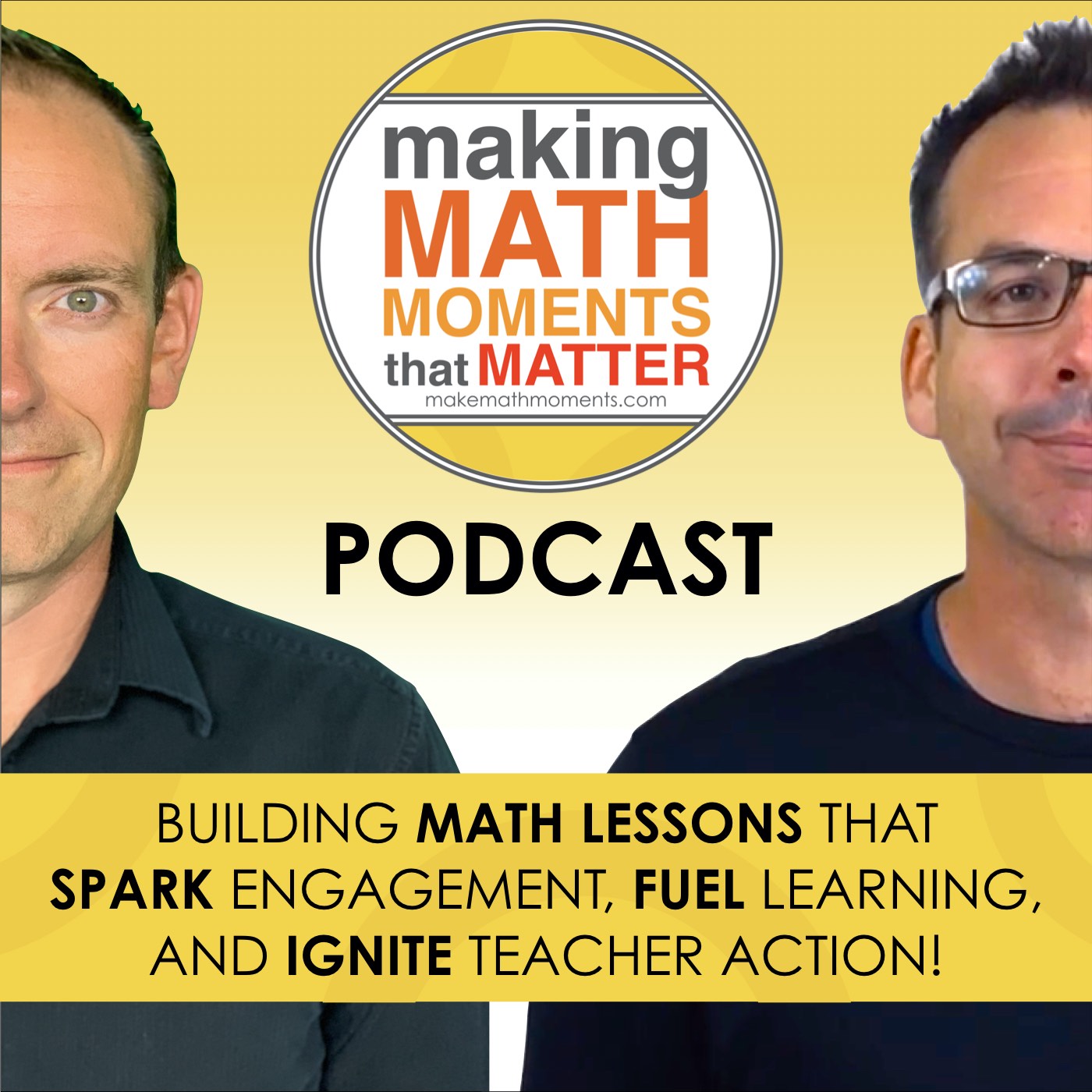
DOWNLOAD THE 3 ACT MATH TASK TIP SHEET SO THEY RUN WITHOUT A HITCH!
Download the 2-page printable 3 Act Math Tip Sheet to ensure that you have the best start to your journey using 3 Act math Tasks to spark curiosity and fuel sense making in your math classroom!
LESSONS TO MAKE MATH MOMENTS
Each lesson consists of:
Each Make Math Moments Problem Based Lesson consists of a Teacher Guide to lead you step-by-step through the planning process to ensure your lesson runs without a hitch!
Each Teacher Guide consists of:
- Intentionality of the lesson;
- A step-by-step walk through of each phase of the lesson;
- Visuals, animations, and videos unpacking big ideas, strategies, and models we intend to emerge during the lesson;
- Sample student approaches to assist in anticipating what your students might do;
- Resources and downloads including Keynote, Powerpoint, Media Files, and Teacher Guide printable PDF; and,
- Much more!
Each Make Math Moments Problem Based Lesson begins with a story, visual, video, or other method to Spark Curiosity through context.
Students will often Notice and Wonder before making an estimate to draw them in and invest in the problem.
After student voice has been heard and acknowledged, we will set students off on a Productive Struggle via a prompt related to the Spark context.
These prompts are given each lesson with the following conditions:
- No calculators are to be used; and,
- Students are to focus on how they can convince their math community that their solution is valid.
Students are left to engage in a productive struggle as the facilitator circulates to observe and engage in conversation as a means of assessing formatively.
The facilitator is instructed through the Teacher Guide on what specific strategies and models could be used to make connections and consolidate the learning from the lesson.
Often times, animations and walk through videos are provided in the Teacher Guide to assist with planning and delivering the consolidation.
A review image, video, or animation is provided as a conclusion to the task from the lesson.
While this might feel like a natural ending to the context students have been exploring, it is just the beginning as we look to leverage this context via extensions and additional lessons to dig deeper.
At the end of each lesson, consolidation prompts and/or extensions are crafted for students to purposefully practice and demonstrate their current understanding.
Facilitators are encouraged to collect these consolidation prompts as a means to engage in the assessment process and inform next moves for instruction.
In multi-day units of study, Math Talks are crafted to help build on the thinking from the previous day and build towards the next step in the developmental progression of the concept(s) we are exploring.
Each Math Talk is constructed as a string of related problems that build with intentionality to emerge specific big ideas, strategies, and mathematical models.
Make Math Moments Problem Based Lessons and Day 1 Teacher Guides are openly available for you to leverage and use with your students without becoming a Make Math Moments Academy Member.
Use our OPEN ACCESS multi-day problem based units!
Make Math Moments Problem Based Lessons and Day 1 Teacher Guides are openly available for you to leverage and use with your students without becoming a Make Math Moments Academy Member.
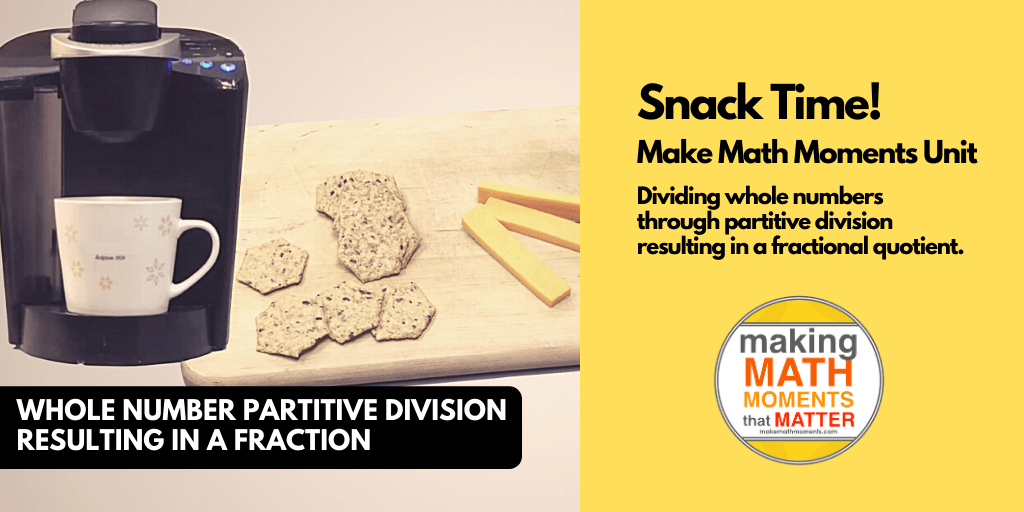
Partitive Division Resulting in a Fraction

Equivalence and Algebraic Substitution
Represent Categorical Data & Explore Mean
Downloadable resources including blackline masters, handouts, printable Tips Sheets, slide shows, and media files do require a Make Math Moments Academy Membership.
ONLINE WORKSHOP REGISTRATION

Pedagogically aligned for teachers of K through Grade 12 with content specific examples from Grades 3 through Grade 10.
In our self-paced, 12-week Online Workshop, you'll learn how to craft new and transform your current lessons to Spark Curiosity, Fuel Sense Making, and Ignite Your Teacher Moves to promote resilient problem solvers.
0 Comments