
Episode #500: Is Productive Struggle One Of Your Math Classroom Pillars? Should It Be?
LISTEN NOW HERE...
WATCH NOW...
What do you fundamentally believe about how students learn mathematics? More importantly, do the everyday experiences in your classroom actually reflect those beliefs?
In this episode, Jon Orr and Yvette Lehman revisit four classroom pillars—growth, curiosity, collaboration, and struggle—and ask whether they still hold up years later. They explore what happens when beliefs become more than words and begin shaping assessment, instruction, expectations, and every interaction students experience.
In this episode, you'll explore:
- Why every math teacher should identify the beliefs they won't waver from
- How classroom pillars connect beliefs to everyday instructional decisions
- Why saying you value growth means your assessment practices should honor growth
- How curiosity, collaboration, and productive struggle shape students' mathematical experiences
- Why classroom pillars shouldn't simply become another checklist
- Whether practice, precision, and mathematical reasoning deserve a place among your core beliefs
- How expectations for rigor can communicate a fundamental belief that students are capable
- How teachers and teams can co-construct their own classroom pillars
At your next team meeting, ask one question: What do we truly believe students should experience and get from mathematics? Identify the few ideas you aren't willing to compromise on, then look at whether your everyday practices actually bring those beliefs to life.
Attention District Math Leaders:
K-12 Math Leaders: Download our free Math Coherence Compass to help your teammates, system leaders, and educators create aligned instructional practices—without adding another initiative.
K-12 Math Leaders: Not sure what matters most when designing math improvement plans? Take this assessment and get a free customized report: https://makemathmoments.com/grow/
K-12 Math Leaders: Ready to design your math improvement plan with guidance, support and using structure? Learn how to partner with us and follow our 4 stage process. https://growyourmathprogram.com
Looking to supplement your curriculum with problem based lessons and units? Make Math Moments Problem Based Lessons & Units
Be Our Next Podcast Guest!
Join as an Interview Guest or on a Mentoring Moment Call
Apply to be a Featured Interview Guest
It will take less than two (2) minutes to book your Math Mentoring Moment call.
Book a Mentoring Moment Coaching Call
Take two (2) minutes to book your Math Mentoring Moment call and let's work together to shake that math pebble out of your shoe!
Are You an Official Math Moment Maker?
Ensure that you follow, rate and review on Apple Podcasts, Spotify and other platforms to show your support and ensure other math educators can find the show.





FULL TRANSCRIPT
Yvette: On today's episode, John, we're gonna go back to some work that dates all the way to your classroom time, which is your four classroom pillars, your core beliefs as a classroom community. And I know that you've shared these pillars on past episodes before. We have a course that provides an overview and support for teachers to implement these pillars. But today, you know, years later, I wanted to revisit them and see maybe if there's anything that we would adjust or change or add.
Jon Orr: For sure, let's do it. Let's do it. So yeah, like I guess where the the pillars idea lives in is it's like if in and you mentioned the academy, because the academy, the Make Math Moments Academy is kind of home base for us individual teachers, or school systems to to kind of look at six key areas for math improvement in ourselves or our system, and we provide resources on improving those six and we've often in on this podcast referred to those six as parts of a tree.
And the first pillar is tends to be like our basically our classroom pillars idea, but really it's just like our beliefs. It's like what do we strongly believe? We have to define that for ourselves and we call that the trunk of the tree. So that like the trunk of the tree, like is the strength of the tree, and it's only and the trunk is what gives the the power of of the branches and the which, you know, can can attribute to our teaching strategies. It can also the limbs, which is kind of like our own professional development that's supported, you know, it supports those branches. And the leaves are like our classroom lessons, what it looks like in our classroom. You see that, right? You see you see leaves of the tree. You have to really look closely to see like the branches and the and the and the and the limbs of the tree. The roots of the tree are are in really our own understanding of mathematics. Because if our root we can only strengthen everything else if our roots are strong. and then the soil of the water and the sunlight is the sixth key area, which is like our our kind of our support systems are around around the tree.
And so when we think about that first one, the trunk of the tree is really defining ourselves of what we are looking at in terms of understanding mathematics and what we're really doing. And so when you understand all these pieces, that that trunk we have to define. And and one of the things I've I always recommend to teachers and to also to help system leaders or coaches help with teachers is help them define what what that trunk looks like. You know, what it what is it that we're doing here in our classroom? What do we value but our classroom? This is why one of the the big activities we do with a sist at the system level is to define their vision and what does that mean about their comp their coherence compass. Like it's all tied to this idea of understanding mathematics and what and not understanding mathematics, understanding what we believe we're doing with mathematics. I think that's all these are tied together.
So going into the classroom is ever the first day. the first day we would talk about why we do what we do. You know, like w what is it that we're trying to do and what does it mean in terms of our classroom and can we co-create pillars in our classroom. Like what is the experiences we've had in mathematics that define our view of math? And how do we shake that up a little bit? So I would design activities, we design thought exercises with kids. So they're up at the walls doing certain activities, they're doing collabor you know, collaborative activities, they're they're getting experience with grappling with with say problem solving. We did a bunch of activities and then we pulled out like what makes like what makes a good mathematician? What makes us strive for, you know, if strive for like pr greatness. And so we we'd talk about and kids would write down after these activities like what is it that Mathematics does for us. Like one of the activities I've shared as well is is completing the phrase math is like. Like math is like dot dot dot dot. Fill that in. That's an activity that we would have kids, you know, complete and we would put them on a card and then we would hold those cards for the year and give them back at the end of the year. sometimes we'd put them up on the walls.
I ought to say math is like this and sometimes they're great, sometimes they're terrible, like terrible. But I mean like mo a lot of like those phrases are like math is like a swamp. Like you'd see that for sure. We want to welcome that. But the pillars themselves, so I haven't even mentioned the pillars yet, but this is what surrounds the idea of like defining pillars. And and why I haven't mentioned the pillars yet is because everyone has to everyone has to define the pillars for themselves. And I think that's what I'm trying to articulate here, is I can tell you my pillars. And I and we're we will share those, but what my pillars are in my math class aren't necessarily what your pillars are, Yvette, and what say another teacher's pillars are. And I think that's the important part is you want to co create pillars for and set the n basically the the norms for what you do, what why you do it answers why you do what you do in your class and what you believe about math teaching and learning.
Yvette: So the four that you've referenced in the past, you know, and that if you were to visit the academy and dig into the course, you know, you highlight these four big ideas around the mathematical experience you're trying to create in your classroom. So you talk about growth, curiosity, collaboration, and struggle as being core components of the mathematics experience. Growth meaning, you know, a fundamental belief that everyone has the ability to learn math given the amount, you know, appropriate amount of time and effort and and opportunity for that growth to happen, although it may not happen at the same pace for everybody, but that everybody is capable.
You know, and I always say to I actually was on a another I was a guest on a podcast recently, and the final thing they asked me was, what's the one thing you would want teachers to hear? And my one thing was that do we fundamentally believe that students are capable? Like do we walk in every day believing students can?
Jon Orr: Yeah. Yeah. And I think I think what what I remember tr what I stressed with students about that pillar, the growth pillar, was was making sure that we the things we do hold or define us. And so if if we actually honor growth in our own learning, what are the policies, the practices what that we're gonna experience this year that actually honor your growth in mathematics. Because you might say, I'm I'm all for your growth, but your assessment policy might not reflect that. And that was a big part of what that pillar represented for us in our class is making sure that students in the high school, when they walk 'cause I taught high school for nineteen years, is that when they walk in that door, that the assessment in the in the evalu you know what we're doing in our class on a regular basis, all of these things that you're going to hear me say and do and why I say what I do and why I do what I do.
It's gonna around assessment, around marking, around assignments, it's going to come back to this. And so then you might disagree with it, but you you probably agree with it today, but we're gonna come back and all I have to say is pillar around growth. And you're gonna now immediately remember that, right, that that growth like growth is important, and he's honoring my growth by doing this move. And so what I mean by that in terms of assessment is that most high school so when they're coming in from let's say they're coming in from the ninth grade to the tenth grade, and they had a possibly a different t like well, they had a different teacher, and maybe that teacher who even though it was in my department had a completely different puzzle that they were building and their pillars were completely different. And this happens in school systems and schools all across North America.
Is and they came in with a hey, the test was on September twenty-third, and the mark I got on that test went in a mark one. test one mark, and that went in the report, the teacher's spreadsheet, and that stayed there forever. And that stayed there until the end of the semester, and the average of all your test marks was a certain weighting, and boom, you calculated your mark based off test scores, quizzes, and any other product you turned in. And so th why I wanted growth. an assessment for growth to be a pillar was that if I said I am cons I I am 100% focused on your growth in math, then I want to honor your growth and I want to show you that the moves I make will honor your growth. And therefore if you grow in terms of your understanding on a standard, then I want to ref that growth to be reflected in the mark. Because everything does end up coming down to a number that goes on a report card that goes out to parents. And the kid will look at that number. So we did we structured it that way. We structured assessment to be always ongoing and stretch structured assessment on standards to be always flexible. we made sure that what I had in say if I demonstrated learning through any sort of combination of observations, conversations, and product on September twenty-third, but I showed improvement or a change in that understanding over the course of a few months or a y you know, the semester, then you got that like that mark that that that say assessment on that standard always reflected your current understanding. And so therefore we had flexible standard marks that showed up throughout the year. And they could always ask and show me and prove to me and prove to themselves that their understanding has shifted. And so I said you might have a test mark on test on September twenty-third, but know that there are avenues for us to continue that growth and to honor the growth that you take on improving your understanding on that standard. Because my goal is for you to have that that mark needs to be accurate. And a lot of times it's it's faulty. Like even if you s lock that mark in, the kid naturally, through the progression of learning math throughout the semester, improved on that. And it's not actually an accurate reflection of their understanding on that standard if you lock it in. So that was why we became a pillar. It became a focus for the policies that we held in the classroom of what that means on when assessment shows up and why we spend time reviewing old learning goals and getting better at old learning goals. And we built that into our timing. So it I wanted kids to be able to have an answer to how do I make this mark better? And we built that.
Yvette: What I think I just heard you say is that so you had these four pillars that were co-constructed and emerged with your students.
Jon Orr: That was just one of them.
Yvette: Yeah, so that was one of the four. but it made me think of the book we recently read, Change the Culture, Change the Game, where they basically talk about, you know, results stem from culture, which is built from every single interaction or experience an individual has within that system. So if you say your pillar is growth, or we could go into the other three, you know, curiosity, collaboration, struggle, but then the moves you make consistently throughout the year don't exemplify that pillar, then it was really just an exercise you did at the beginning of the year that holds absolutely no weight. So I think what we're saying is to your point, John, you know, everybody's pillars might and will be different, but whatever you land on. You have to consider that pillar in every interaction and experience the student has in your classroom because that's what changes results. It's by changing the culture that they where they experience their mathematics learning and they define their identities as mathematicians.
I met with one of our district partners recently who said he had a really successful launch to his year. He had an in-service day in September with all math teachers and they dug into pillars and he, you know, engaged them in some, after working through the course, he engaged them in some, you know, routines and some thought exercises to essentially emerge these pillars. But he said, but I added two more. And that speaks to your idea of like not everybody is going to have the exact same fundamental beliefs around what they prioritize. But I thought the ones he added were interesting.
Jon Orr: Okay.
Yvette: And so I wanted to unpack them a little bit.
Jon Orr: Let's unpack
Yvette: Okay, so he said that when they, you know, engaged in this root these routines as a staff and they had some experiences together and they collectively emerged their pillars or core beliefs around what the math experience should look like, sound like, they had growth, curiosity, collaboration, struggle, the same ones you identified, but they also added practice and precision.
Jon Orr: Mm. Right.
Yvette: So we dug in. Like, why practice and precision, you know?
Jon Orr: Yeah. I yeah, okay. Sure. Yeah.
Yvette: And, you know, this this coach brought up something interesting about how the math classroom experience has evolved over, let's say, the last decade or 15 years, where we've made this, in some cases, a shift. you know, away from some of the more tr in some classrooms, not all, you know, away from a more traditional approach around, you know, rigorous expectations. And this goes beyond just math. It's even in, you know, expectations for students in spelling and printing and organization of their page and their structure. And and what the the coach identified was that in his opinion and his core belief is that there's something about mathematics that requires structure. Because as you move in the discipline, if you aren't organized, if you can't structure your thinking, if you can't communicate your logic on the page in a way that makes sense, you're gonna lose track of what you did. You're gonna fall behind on, you're gonna get confused yourself because you don't have a system in place to organize your thinking. And so he said from a you know, a young age, he wants to teach students that at a certain point math is going to require precision and clarity and logic in sequencing. And his observation in classrooms is that we they've kind of abandoned that in his system. Like it's just a mess. You know, it's like there's thinking all over the place. And but if I was to pick up a student's product, I can't follow it in any type of logical way. And so he's trying to bring that level of precision, structure, organization back to a core component of the math experience. Thoughts.
Jon Orr: Well it's good. I my my thoughts are I'm glad that basically what he's he's saying is that is that we as a s we as a school system are are are recognizing that what we value here across the school, there's a there's a part that either we've lost or we've not we're not putting on the plates for us to say that's important. And it and it and I and I value that process, right? The value of the process of saying, we believe this is a valuable experience to learning mathematics and and practicing mathematics and understanding mathematics. And what we have identified as a as a gap in the support we've maybe provided to to each teachers and ourselves or support we've provided to kids. we've recognized that that's an important component. We all we maybe all agreed that that's important. And we've put it on the plate. We've said that's something we're going to watch and something we're going to strategize around and something that we're going to honor as importance to get support.
Because I'm imagining that yet you're doing this as a he's doing this as a system leader or a school leader or a a district leader with many classrooms and saying, as long as we've he's done this with like collaboratively, we believe this is important and therefore we're gonna support this move, the next move that I would want to know. And is is that what does that mean and and are we are we putting this on the plate because like you said, you can say whatever you want. It's the actions you actually do dictate what that pillar really means and whether it's being honored or not. And so part of that is defining what the pillar really looks like in practice or in application. So if we're saying like practice and precision is really important. But tell me what that means about the day-to-day work we're doing with kids. So that if I'm a teacher going, I believe practice is important and the way I imagine it is different than the way you imagine it, then are we in the same boat? You know, like are are is that is that what we is that okay for one? And is but but to me then all of a sudden you've got seven pillars because we're to me they're different pillars. But again, as long as if the teacher's defining the pillar. And the teacher's saying, this is what I strongly believe, and I'm making moves to honor this in the classroom. And it's rooted in good practice for math, like research-based good practice, for you know, student understanding of math, then I'm all I'm all for it.
So I'm so like saying, like, did I have, hey John, you didn't have a f a pillar on on practice and precision. And partly I probably didn't make it. on practice in prison because it was there. Well, I didn't necess I didn't need to make that the focus because I didn't see that as a whole in what we currently were doing in our classroom. Right. So it's like I've got that under control and I feel like we know that as our school system. That's that's already being enforced across all the classrooms. And I and I make sure that I know what that looks like for me, but it's not a it's not gonna dictate a lot of policy for me. Or do we have homework? Sure. But that homework fell in in the practices and precision technically would would fall in for me into the get challenged part. I'd rather focus on you getting challenged and then and then making sure that you you understand that challenge is going to happen and and challenge is gonna come in many forms. And and I'm gonna put you in positions to challenge your thinking. And then we can talk about how you formulate that thinking or how do you you share that thinking and what does that look like? And what does that look like to to reinforce that thinking. That to me that's all like part of the same thing.
So adding a s a fifth, you know, pillar for me wasn't a a necessary need because I wasn't trying to most of my pillars you could we could argue were causing a a paradigm shift for what the kids were coming in, understanding what math looks like and sounds like versus what they were gonna see in my classroom. And so those pillars helped shift the paradigm. And then still kept some of the old paradigms there. If that makes sense.
Yvette: I think that what we're saying is that this is a good exercise for personal reflection, you know, on what we value and what we are never going to waver from as far as you know, I I think w when I was in the classroom, I would say my two pillars. In the math classroom, my first one, well, collaboration was definitely there as well because I I rooted a lot of my instruction around collaboration. But I would say for sure, you know, I had a slogan which was like easy as a waste of time. I really tried to set the conditions that when you are in this room, the rigor is going to be high, the expectations are high because I believe you are capable. Like and like in everything, you know, every interaction I had was rooted in this belief that like I'm not gonna waste your time. with things that you can already do. I'm gonna constantly be elevating and pushing you because I believe that you can.
And then the other one that's maybe not reflected here yet in your pillars and didn't come up in my conversation with this coach either. And I'm not sure exactly how to articulate it, but for sure in a K-8 context, I would have to have something about math can make sense or math can be re you know, I can reason or I can make sense of the mathematics. I I'm gonna it almost reminds me of you know, the idea around understanding the why. Like I will always help you understand why. Like I no matter I don't care how complex the concept is, if we can't answer why, we will go we will spend as much time I'm on that's what I'm at right now. On the butterfly method. Really need to understand why. I thought I knew why. I don't know why, John. I I did a big deep dive last night about essentially, you know, when you're solving a proportion, why the butterfly method works. And it's basically because you are eliminating the fraction. But the thing that's complex about it is what happens to the units. So I'm in I'm still not I'm c totally confident, but I'm committed. To really deeply understanding when you work through that procedure, what happens to the units in that relationship?
Jon Orr: You've got complex units.
Yvette: You do have complex units, right? Which is
Jon Orr: Right. You've got you've got you're like a rate, you know?
Yvette: yes, but like it's almost like a rate within a rate, you know? Yeah.
Jon Orr: Yep. And that exists. Those are those exist, right? Like you could get into physics and underst you know, understand like, you know, centimeters to centimeters to centimeters. So yeah, no, I ha you know, like I think I think the layering in, like you're saying, the why. But that's like that's what curiosity is, right? Like like designing experiences to be curious, not only not just sparking like you want to learn this, but you have to be curious about why this Right? Like we have to design those experiences for kids to generate curiosity, but also satisfy curiosities that some of us have, but some of us don't have. and and a lot of us have the curiosity of like, why do I have to do it that way? You know, like why does that work? Like that's actually a curious, curious moment in in a mathematics classroom is is to understand the why. And we and we have to take time to honor that curiosity, whether it's my curiosity or your curiosity, but we we need to make sure that we design the experience.
You're going to be this is what we would say to the kids, is like you we need to be in the situations that make us curious. And it's gonna you're gonna experience curiosity in different ways. And that's my job is to put you in these moments where you're like, I wonder about that. And that could be I wonder how many eggshells are scattered across this floor right now and how I could figure out what it looks like if the floor tripled in size. or it's I wonder why, you know, the scale factor here is what it is or why that works when I change the numbers this way.
Yvette: People wanted to dig into their own classroom pillars. Where could they go for anybody listening today to say, I'd like to do this work or I'd like to engage my team in this type of work? What's our recommendation for their next steps?
Jon Orr: Right. Sure. Yeah, like an easy recommendation is at your next department meeting, you know, a ask the question about like what is it that we are truly believe we're doing for math students in mathematics? Like what is if there's one thing that we want students to get out of math class, what is that thing? And like and then have that conversation and then say, Are there other things? And like what what makes what what are the what are the components that make up us and and a great learning experience in mathematics for for many you know for the for the things we value like have those conversations put them on put them up put them in at the forefront of their next department meeting your staff meeting and then encourage people to say what are your pillars for mathematics because that's as easy as it can be we do have as I said the academy is kind of our our our home base for strengthening all six components of effective mathematics classrooms and mathematics l systems. And there is a special course in the academy on how to create and strengthen your math your your classroom pillars. so it if you got access to the academy, you can get access to the academy in a number of ways. You can be, you know, an annual if it is a membership, you can get an annual membership. we have an upcoming task training session that we hold them every single month. And if you attend, Yvette always has a special code for you to to get access for thirty days to jump in there to not only get access to the seventy plus tasks and units of study that we have, but you get access to all the courses as well. So that's a place you can go to kind of dig deeper or learn a little bit more or scroll back in the podcast catalog, you know, like right here in your podcast platform. Scroll back to look at what we talked about with pillars or goals and goal setting. you can listen to us talk about those specific things over the course of the four hundred and eighty episodes that we have in the in the catalog for completely for free. So those are the places there's a link around this podcast wherever or wherever you're listening, to get access to the academy or learn about the academy if that's at the right spot for you.
Your Customized Improvement Plan For Your Math Classroom.
Take the 12 minute assessment and you'll get a free, customized plan to shape and grow the 6 parts of any strong mathematics classroom program.
District leader/math coach? Take the District Assessment
Thanks For Listening
- Book a Math Mentoring Moment
- Apply to be a Featured Interview Guest
- Leave a note in the comment section below.
- Share this show on Twitter, or Facebook.
To help out the show:
- Leave an honest review on iTunes. Your ratings and reviews really help and we read each one.
- Subscribe on iTunes, Google Play, and Spotify.
The Making Math Moments That Matter Podcast with Kyle Pearce & Jon Orr
Weekly interviews, strategy, and advice for building a math classroom that you wish you were in.
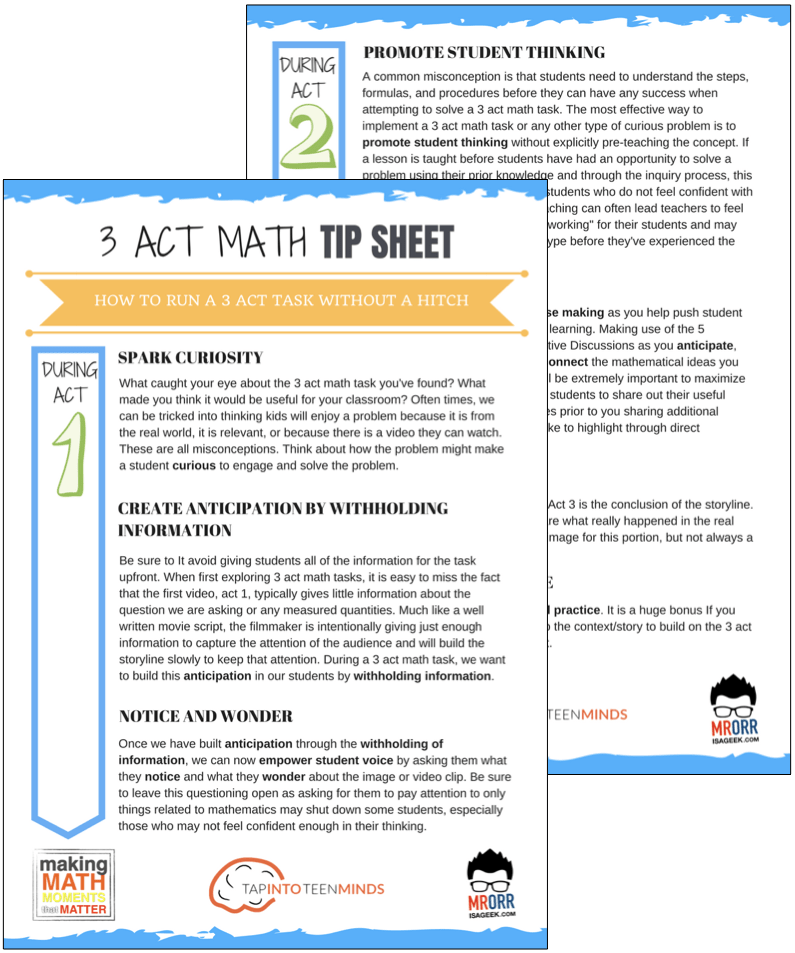
DOWNLOAD THE 3 ACT MATH TASK TIP SHEET SO THEY RUN WITHOUT A HITCH!
Download the 2-page printable 3 Act Math Tip Sheet to ensure that you have the best start to your journey using 3 Act math Tasks to spark curiosity and fuel sense making in your math classroom!
LESSONS TO MAKE MATH MOMENTS
Each lesson consists of:
Each Make Math Moments Problem Based Lesson consists of a Teacher Guide to lead you step-by-step through the planning process to ensure your lesson runs without a hitch!
Each Teacher Guide consists of:
- Intentionality of the lesson;
- A step-by-step walk through of each phase of the lesson;
- Visuals, animations, and videos unpacking big ideas, strategies, and models we intend to emerge during the lesson;
- Sample student approaches to assist in anticipating what your students might do;
- Resources and downloads including Keynote, Powerpoint, Media Files, and Teacher Guide printable PDF; and,
- Much more!
Each Make Math Moments Problem Based Lesson begins with a story, visual, video, or other method to Spark Curiosity through context.
Students will often Notice and Wonder before making an estimate to draw them in and invest in the problem.
After student voice has been heard and acknowledged, we will set students off on a Productive Struggle via a prompt related to the Spark context.
These prompts are given each lesson with the following conditions:
- No calculators are to be used; and,
- Students are to focus on how they can convince their math community that their solution is valid.
Students are left to engage in a productive struggle as the facilitator circulates to observe and engage in conversation as a means of assessing formatively.
The facilitator is instructed through the Teacher Guide on what specific strategies and models could be used to make connections and consolidate the learning from the lesson.
Often times, animations and walk through videos are provided in the Teacher Guide to assist with planning and delivering the consolidation.
A review image, video, or animation is provided as a conclusion to the task from the lesson.
While this might feel like a natural ending to the context students have been exploring, it is just the beginning as we look to leverage this context via extensions and additional lessons to dig deeper.
At the end of each lesson, consolidation prompts and/or extensions are crafted for students to purposefully practice and demonstrate their current understanding.
Facilitators are encouraged to collect these consolidation prompts as a means to engage in the assessment process and inform next moves for instruction.
In multi-day units of study, Math Talks are crafted to help build on the thinking from the previous day and build towards the next step in the developmental progression of the concept(s) we are exploring.
Each Math Talk is constructed as a string of related problems that build with intentionality to emerge specific big ideas, strategies, and mathematical models.
Make Math Moments Problem Based Lessons and Day 1 Teacher Guides are openly available for you to leverage and use with your students without becoming a Make Math Moments Academy Member.
Use our OPEN ACCESS multi-day problem based units!
Make Math Moments Problem Based Lessons and Day 1 Teacher Guides are openly available for you to leverage and use with your students without becoming a Make Math Moments Academy Member.
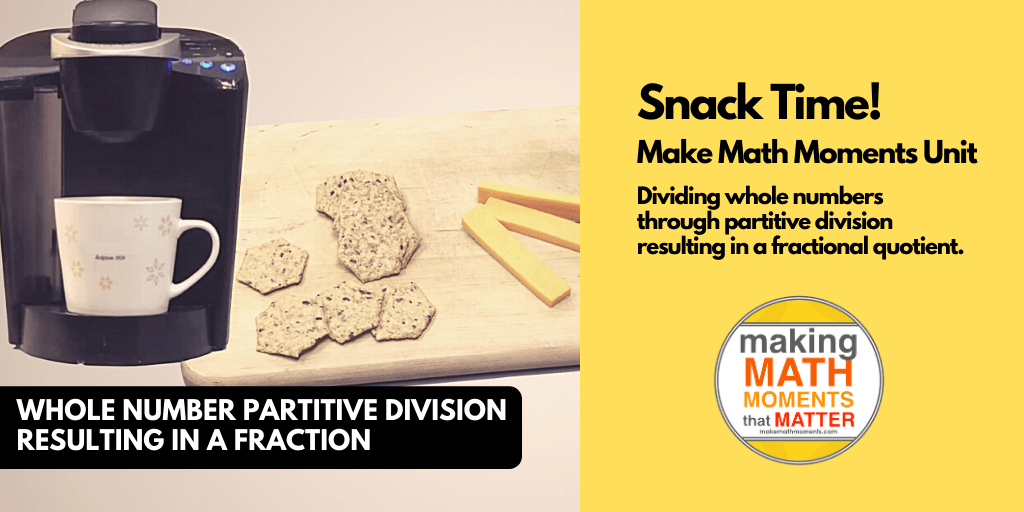
Partitive Division Resulting in a Fraction
Equivalence and Algebraic Substitution
Represent Categorical Data & Explore Mean
Downloadable resources including blackline masters, handouts, printable Tips Sheets, slide shows, and media files do require a Make Math Moments Academy Membership.
ONLINE WORKSHOP REGISTRATION

Pedagogically aligned for teachers of K through Grade 12 with content specific examples from Grades 3 through Grade 10.
In our self-paced, 12-week Online Workshop, you'll learn how to craft new and transform your current lessons to Spark Curiosity, Fuel Sense Making, and Ignite Your Teacher Moves to promote resilient problem solvers.
0 Comments