Episode #502: How to Build Teacher “Buy-In” for Math Improvement
LISTEN NOW HERE...
WATCH NOW...
In this episode, Jon Orr and Yvette Lehman respond to a question they heard three times in a single week: what do you do when your math team pushes back on every new idea? Drawing on Change the Culture, Change the Game by Roger Connors and Tom Smith, they explain why widespread resistance is usually a culture problem rather than a personality problem, and how the Results Pyramid can help leaders design the experiences that shift beliefs and lead to lasting action.
They contrast two teams they support: a 6–12 group that built trust through a co-constructed vision and three years of consistent messaging, and a 9–12 team stepping into the work feeling anxious and skeptical. Along the way, they share practical first steps for listening, building relational trust, and helping more people move above the line.
In this episode, you'll explore:
- Why widespread resistance is a culture problem, not a personality problem
- What “above the line” and “below the line” thinking looks like in math PD and PLCs
- How the Results Pyramid connects experiences, beliefs, actions, and results
- Why math improvement plans that jump straight to actions often stall
- How one district built trust by co-constructing a shared vision and repeating it for three years
- How transparency around observations and data collection builds relational trust
- Why listening to teachers’ fears is the first step toward buy-in
- How trusted informal leaders can help pull a team above the line
- How teams can hold each other accountable without shutting down honest venting
Think about the last time your team pushed back on a new math initiative. What past experiences might have shaped that response? Identify one interaction you lead regularly, such as a PLC, department meeting, or PD session, and ask: What experience am I creating here, and what belief is it reinforcing? Then decide on one change you could make next time to help pull people above the line.
Attention District Math Leaders:
K-12 Math Leaders: Download our free Math Coherence Compass to help your teammates, system leaders, and educators create aligned instructional practices—without adding another initiative.
K-12 Math Leaders: Not sure what matters most when designing math improvement plans? Take this assessment and get a free customized report: https://makemathmoments.com/grow/
K-12 Math Leaders: Ready to design your math improvement plan with guidance, support and using structure? Learn how to partner with us and follow our 4 stage process. https://growyourmathprogram.com
Looking to supplement your curriculum with problem based lessons and units? Make Math Moments Problem Based Lessons & Units
Be Our Next Podcast Guest!
Join as an Interview Guest or on a Mentoring Moment Call
Apply to be a Featured Interview Guest
It will take less than two (2) minutes to book your Math Mentoring Moment call.
Book a Mentoring Moment Coaching Call
Take two (2) minutes to book your Math Mentoring Moment call and let's work together to shake that math pebble out of your shoe!
Are You an Official Math Moment Maker?
Ensure that you follow, rate and review on Apple Podcasts, Spotify and other platforms to show your support and ensure other math educators can find the show.




FULL TRANSCRIPT
Jon Orr: So we just got off a call this week, well just yesterday specifically. But it echoed a common concern and a common question we have, you know, received over the years, but it why we wanted to record this episode, because it's come up three times in the last week. It's it is likely to do with being September and New Year and thinking about the professional development that we're, you know, putting in, you know, supporting our teachers with and thinking about our students and shifting some of our PLCs at the high school level.
So we're talking about nine to twelve and they were saying this is a tough group. And every time we drew something new, I get I get the eye roll or I get the you know the pushback. Well yeah, but but, yeah, but yeah, but and and I and I feel like I I'm spinning my wheels. And that's not the first person this week that we heard them say that. And it's a common kind of question and and strategy that we help teams think about when they they bring that up.
And then we wanted to share some of the thinking that we've been doing for the for a while now around this and some of the strategies that we help these teams employ at their school sites or at their district sites to think about buy in and also think about resistance when we see it in our sessions, our PD sessions, our PLCs, the the one on one coaching that we're experiencing. So that's what we're gonna talk about here today. Yvette, where do we want to begin?
Yvette: I think that in all three calls you're referencing from this past week, right away my mind went to the book that we read over the summer, Change the Culture, Change the Game by Roger Connors and Tom Smith. And what really jumped out at me, I swear I was only probably an hour in. And I kept stopping and grabbing the timestamp and sending it to a bunch of people because I was just so excited to have some language and a framework to describe what many of us are up against.
And so they talk about this idea that, you know, within your organization, if you have a lot of people, and it reminded me of a quote from Jim Knight as well, right? Around resistance being a state, not a trait, right? Like if you have an entire department, an entire school, an entire district of teachers that you would describe as pushing back or resistant to change, it's not personality issue, it's a system systemic problem. And so they talk about, you know, if people in your organization are consistently demonstrating below the line behavior and they talk about yeah.
Jon Orr: Wait, wait, wait. Below the line? Yeah.
Yvette: So and I think that this is, you know, I can't say for sure if this is unique to these two researchers or not, or if they're referencing somebody else. So I apologize if I, you know, don't get that right. But it is referenced in their book, The Oz Principle. That's the title of their first book on this topic. So below the line state is when you're in a state of feeling like a victim, of blaming, of being defensive, you're closed to new learning, you're committed to always being right. And it's a very unproductive state to be in. As opposed to above the line, where you're curious, you're open, you see yourself as an agent of change, you're committed to ongoing learning.
So if you sit back and look around you and you're like, wow, a lot of people within this organization are currently below the line, then you have a culture problem, not a person problem or a personality problem.
Jon Orr: Or or even a strategy problem like a strategy problem. Like for example, like the the PD that you're putting into place could be effective professional development. If if we are not, you know, if if everyone in that room was operating above the line, right?
Yvette: Was above the line.
Jon Orr: Whereas so it makes you think that the the the structure or the the component that the the thing that you're trying to engage people with, like it might be like l more number talks in our classroom or, you know, we're we're we're thinking about you understanding the content and and the the behaviors around division and you're unpacking that. But if not everyone's above the line in that mode, you're gonna you maybe falsely identify that it was the content or the structure of the session that you blame instead of the culture that's surrounding that. And you say buy in is the issue. No one's a no th I how do I how do I motivate these folks to think that this is the right thing to think about or implot you know, start to work into their classroom lessons or or structures or how they think about their own mathematics. The line is is really important. What else like what else is we need to consider about the line?
Yvette: Yeah, so basically they talk about, you know, how to design to shift the I mean that's in the title of the book, right? Change the culture, change the game. So it's like, okay, well, how do we design so that more people within our organization are in that above the line space? You know, they're seeking solutions. They see themselves as part of the the path forward. They wanna be, you know, they talk about this idea, for example, accountability and how sometimes accountability feels like punitive. Like, who's accountable for these low scores? Who's accountable for this? Where it's like, who's accountable for the wins? You know?
Jon Orr: Right. It's always right. It's always the the the downside. It's like we only bring up a c the word accountability when we're blaming someone.
Yvette: Right, where it's like where's the accountability for all the great things that are happening and celebrating the growth? So they they reference a framework that I think is really helpful for any type of improvement planning, but you know, in our space obviously math, which is the results pyramid. So the line, you know, is kind of also replicated in that visual, where at the top, very top of the pyramid, you have results, which is your outcome. So in the book they talk obviously from you know, business perspective that your results might be your profit margin, you know, like or your growth, like whatever that happens to be. And just below results is actions. It's the actions, the things we're going to do or commit to in order to get that result. But that all sits on top of beliefs and experiences, which essentially shape the mindset that your the people of your organization, you know, bring to the table every time they're engaging in this type of work.
So oftentimes, right, we talk about results. We want scores to increase, we want graduation to increase, we talk about actions. So implement this new curriculum, try this new strategy, adopt this new PLC model. But what we don't necessarily design for or plan for is how is the culture being, you know, established through experiences and then ultimately beliefs that people come to the table ready and eager and curious to learn.
Jon Orr: Yeah. Yeah, like seeing beliefs as the the bottom of the pyramid. Or sorry, seeing experiences as the bottom of the pyramid, as the foundation of the pyramid. And I think because you can imagine that you only have beliefs and the way you believe things is through in a way the repeated experiences that you've had that helped you shape those beliefs.
So I I've used this example in in lots of different contexts, probably here on the podcast in in past years, but there was no, there was a time that I was sitting in professional development and I remember the the veteran teacher turning to me and say, Don't you know, don't take this to to like don't don't think this is like the be all end all because they're gonna change it on you next year. And they'll change it on you the year after that. And they're gonna change it. So like just take this with a grain of salt and kind of like roll with whatever you you think is is best in the classroom instead of trying to implement anything that they're saying.
And it was like when you think about it that teacher has had experience after experience after experience after experience in the history of their career to lead them towards that belief about the professional development they're sitting in. And that belief turns into right right. So it's the experiences, then the beliefs, and you can wonder like why we're below the line at that point, because of these beliefs that w were created from experiences, and then it's like what actions are now going to be of available for this person and why the resistance towards any actual action towards any sort of result isn't going to be there because of the past beliefs, but it started with the experience.
And so seeing those experiences, you have to think about, like you said, it's like we start with results when we're doing planning for our upcoming calendar year or school year in terms of what we want to see improved upon throughout the year. What are we going to focus on? We've got PD budget, we got PD time. What do we do? We think about those results that we want, and then what we immediately turn to is because the results will say, well, somebody's gonna say we want scores to go up, but then someone else is gonna say, but that's not the be all end all. Let's make sure that we put more instructional strategies into our classrooms.
But then the rest of it, typically what we're seeing in math improvement planning right now across the board, is we're gonna focus on those actions. And and where you really need to focus on is where have we created the experience and the repeated experience so that we can help people with the beliefs that will actually create the actions to to come out in a in an easier way? Because if we are battling, if we are like butting up our heads against the wall and we're saying we're seeing resistance, we're gonna right away we're gonna ask you, Well, what experiences have you created that show the the a different way to think about this or show that there's value in these things. Like we have to create experiences. A lot of us aren't just and what we're seeing in in pl in planning is that a lot of experiences are not being crafted. We're thinking about here's how to do things, but we didn't create an experience to see why or what it looks like or how I ex I felt during this experience. So that bottom of that pyramid is essential.
Yvette: To contrast two clients that we're currently supporting through the district improvement program. One who's been with us for three years, who supports the 612 space within a larger district. Then we also have a single school that we're currently working with who, you know, is kind of struggling with let's call it the buy-in from their nine to 12 teachers. Because to me, it's not necessarily about like one solution to this problem, it's about conditions.
Jon Orr: Right.
Yvette: Like what are the conditions that are in place to create experiences that leave people feeling above the line, you know, feeling like they're in a space where they can try something new or are curious to seek a solution or want to be a part of the growth.
Okay, so let's talk about the one that's been with us for a few years now. So I think some of the conditions that are in place to create some of this above the line culture is that they have been super clear for the past three years on where they're trying to go collectively. And the key stakeholders and the department chairs and the instructional mentors have all had a hand in crafting it. So they were part of the decision-making process.
So initially, when the coordinator came to the table and said, you know, we want to increase discourse in our six through 12 classrooms, we want to shift the thinking to students. The team came together and really massage those indicators of success. You know, well, what would it look like if students were taking more ownership of the thinking and engaging in more discourse? They co-constructed a matrix. They went on instructional walks and tested it and they gave themselves time to really own it and understand it and unpack it before then asking the department chairs at each high school to bring this into their department meetings and to start taking more ownership at the school level and using these matrixes for formal feedback with their teachers.
And at every single PD session for the past three years, the same vision, the same objective, the same success indicators have been echoed. The, you know, the same it's been like they've been the way that the coordinator described it is like they've been beating the same drum and they're allowing their teachers to trust that this wasn't a fleeting initiative. That came and went, and something, it's like initiative fatigue defined by Douglas Reeves. It's like that thing we did last year is now gone and we're doing something new and nobody knows what happened to it.
The collection of any type of monitoring has been transparent, it's been visible, it's been shared amongst department chairs, instructional mentors, and the coordinator. And so to me, like there's conditions that are in place there, experiences and repeated opportunities to trust that this works is shared, it's meaningful, it's not a top-down initiative. It was co-constructed with really
Jon Orr: Mm-hmm.
Yvette: critical stakeholders having valuable feedback. And there's been consistency in messaging. And that same zone of improvement is being echoed in principal meetings, in department meetings, work with instructional mentors in service days.
Jon Orr: Right. Right. And I think I think the key the key thing here is the consistency of of I I'm gonna say experience. Like you're s you're saying like there's a consistency of messaging that's carried across here, but in order for us to see that on a c to feel the consistency that's really really happened inside this district, they they've they've had repeated experience with that messaging that didn't go away. with what did this look like in the classroom with appropriate modeling so that it cascaded down to the to the classrooms. Not th in through the through the team that that built, you know, this from the ground up, they they focused on supporting them with experience so that those people could then support their classroom teachers with those experiences.
Like like I don't think they s saw it at the time as like we're focusing on creating experiences that that emulate what we really want to see in our classrooms. But it was it was that repeatedness, that consistency of saying, This is where we're trying to go. We're gonna show it every time we come together. that starts to change those beliefs. It starts to change like what that and that starts to change what the actions look like.
Yvette: I think for me another condition for and this is just a maybe bias, a condition for creating a culture where people are above the line is also transparency. You know, making sure that we're clearly communicating how data is being collected, why it's being collected. You know, if there's look fors being used during walkthroughs or observations, who was a part of the team that co-constructed those indicators? Is it feel like it's being done to teachers or with teachers? And then what's happening with those with that documentation or those observations? Is somebody going behind a closed door and talking about it without bringing the right people to the table?
And I think transparency goes a long way for building trust within an organization. And we always say, right, you know, when research backs this, like relational trust is going to be part of the foundation of creating this culture that leads to people taking action and ultimately results.
Jon Orr: Yeah. Yeah. And I think like w th th to tie this back to the the above the line, below the line, I think the the main driver here is is to own that we can play a role in this and that we have to then own that role of saying, every time I inter are exp you know, interacting with anyone, I have to think about what experience I'm actually creating here or or what I'm actually reinforcing. good or bad. by by handling this this way versus that way.
And I think when we think about that, because you can get bogged down for sure to think of like, look, our organization is massive. And if I have to think about every experience across every teacher, that just feels overwhelming. And I don't have that. I can't touch you know, I can't see every teacher. I can't how do I how do I do this across a an entire s district, let alone a entire school? I think it starts with thinking about that mindset of above the line and below the line. Where do you sit? Because if you're saying that I don't know I I don't think I can, you know, I don't think I can create experiences for people, you're you're already kind of below the line thinking.
And you have to kinda say, like, I own a piece of this and I have to then do my part and then I I interact with this many people on a regular basis. And I have to decide what kind of experience am I creating and are I part of? And what can I say, reach into and mold or shift so that the culture will change down the line anytime I'm interacting with people? And that might be a department level, it might be at a school level, it might be at the district level and you're you're working with a bunch of TOSs or coaches. We have to think about those experiences if you have any hope of shifting, even though there's an entire district behind you know in front of you, you you do have to say, I have to own a piece of this. And it's okay that I can't affect everyone, but I own this piece. In this piece is where I'm gonna start to make shifts.
Yvette: Let's contrast that now with our new district or a new client. So it's a K-12 school, and they were trying to find a path forward with their 912 teachers who are stepping into the learning space feeling very anxious, feeling very just not like they're not trusting the process. They're like, why are we here? Why is this the work? What why us and not other departments? So why was the math team selected for this an additional sub level of support while others were not? You know, it's like, why us? Why now? What do you want from us now? You've already thrown a bunch of initiatives our way. We haven't like it just we're already stepping into the space, not trusting that this is going to be a valuable journey together.
So we've been trying to as a team, you know, with the leadership in our team for Make Math Moments, like find a path forward that's productive. Like what's our best path forward to get, you know, I there's a visual if you look at, you know, above the line versus below the line. One of the graphics I really like, you know, they're reaching down and they're pulling people up above the line. It's like, how do we make decisions moving forward to bring more people on this 912 team above the line so that they see themselves as curious, open, committed to learning, wanting and willing to take new actions and bring them back to their classroom? And so the first thing we really started to do was just to listen.
Jon Orr: Mm-hmm.
Yvette: You know, what what and you often say this sometimes on our calls, Jon, which is like, what's your fear? You know, like what's your fear around this new opportunity or this new you know, structure that we're implementing? Like, what's the fear? And we need to really listen to people because what you're probably going to learn is all of the experiences that they've had so far in your organization that have shaped their current belief.
Jon Orr: That's what you're gonna hear. Cause it you could imagine
Yvette: Mm-hmm.
Jon Orr: me saying, I'm a I'm a 'cause I've sat in many nine grade nine to twelve math team meetings and PD and it's like, I fear you're gonna waste my time.
Yvette: Right. And so then we actually had that conversation with one of the teachers who is an informal lead amongst the team, you know. and we had to figure out like what what why is that a waste of your time? You know, tell us more about that. And if it wasn't a waste of your time, what would it look like instead? And like really leaning into the experience that they're th that they are seeking, you know, so that we can try to create that experience for them.
And another thing that we thought about as we plan for our next touch point with this team is, you know, I mentioned, you know, who do they trust? Like if they don't trust me, I I'm just establishing a relationship with them as an outside consultant. If they don't trust their current coach, if they don't trust the curriculum coordinator. Who do they trust? You know, how can we leverage that individual to try to bring them to the inside so that we know, again, a picture that visual of like we're pulling people above the line, we're trying to create psychological safety, we're trying to empower and motivate people. And so we have to start by listening. We have to start by leveraging where do they feel safe? Where do they feel open? What are the conditions that have been successful in the past for creating productive conversations and an eagerness for learn. Okay, how can we leverage those past successes and replicate those conditions that were there on those successful bright spot times and bring them into this conversation that we're having with the team.
Jon Orr: Yeah. Yeah. And I was I was I was reminded of the the you know, the third call we had this week, which was the one I started with t in this episode with us was the one I had yesterday. And this, you know, this individual said the the same type of thing. And one of the things I remember patting like and this was somebody who was brand new to us, like we just had a we just had a strategy call. It wasn't it wasn't a team that we are committed to work with throughout the year and support and help plan their their math improvement plan. It was just a just a str kind of a a call to talk about what they've had some successes on and what they could be, you know, improving upon.
And one of the things I said I think you did really well on, is that it was a second year in the position. And he said the first year, all I did was build and try to build relational trust with everyone. Because I came from this, you know, area. I moved into this area and math wasn't my my strong suit, but he is working with say K to twelve. and then said, I just got into classrooms and I just lend a hand wherever I was going. Like if it was it was doing small group, I did small group. And if it was pulling a kid out here to to do a little bit of one on one, I did it I did that. If I if I needed to run a photocopy, I did that. It's like I did that for a year, knowing that I need to build any like a relational trust here. If I have any hope of crafting the right experiences to influence the right beliefs over consistency. So that we can actually move actions to get results.
So I said, I I know you need I know you're looking for a plan on how to do all the other stuff, but you did really great in ensuring that you understanding relational trust is a priority for you to before you can even begin to build what your math improvement plan could be.
Yvette: If we have leaders listening right now, I want to offer maybe one first step or a little bit of advice that might help begin this process. I was talking to a vice principal last week, and she was saying that her elementary team had actually done a lot of learning around above the line versus below-the-line mindset. And so awareness was really important, you know, to start to identify those behaviors in ourselves and to figure out what are the experiences that are contributing to that belief so that I can communicate them and I can be transparent.
But she said that her team did such a good job with this work that they would actually like notice for each other. Like they became almost accountability partners that if they were in a professional development session or a PLC and somebody was demonstrating below the line, they would actually they were comfortable enough and they'd created enough safety to say like, so right now what I'm hearing is below the line thinking. Can you talk to me about why you're feeling that way and what can we do to pull you above the line? And they actually use this as a a way to be accountable to each other and to keep their PLCs in a productive space.
Jon Orr: Hm.
Yvette: And I know that, you know, one thing I appreciated about listening to the book was they said, like, that doesn't mean we can never vent. Like venting is normal. And like I do this
Jon Orr: Right. Yeah.
Yvette: to you sometimes, Jon, like I need you to hear why I'm frustrated about this, but also know that it's not gonna stop me from finding a solution to it.
Jon Orr: Right.
Yvette: Like I believe I am capable of seeking the solution. I'm just currently frustrated by the obstacle. And so I l I appreciate that they said it doesn't mean that we can't ever find ourselves in a space where we want to vent or complain. Like that's not the idea, but it's what we do in response to that.
Jon Orr: Absolutely. Absolutely. That was good, you know, that's a good kind of next step here. And I think one of the big next steps is to to really take the framework and think about what kind of experiences are we interacting or or creating, whether indirect like whether consciously or not or unconsciously. and how do we think about above the line and below the line and the work that we're currently doing and how to pull people above that line through experience.
That's one of the frameworks that we're we're using to help teams create their math improvement plans from start to start to finish. Like I said, the the w how we started talking about this, I had a call with someone yesterday just to talk about s the strategy that they're currently using and think about what it looks like next year and the year after. I gladly hop on those calls on a regular basis if you believe you need someone to have a look at where we are on the line. Are we above the line? Are we thinking about above the line? Where are we doing this? W you know, w w how do I structure experiences? Let's have a conversation. You can click the link below this video in the the the the description area, book a call with our team. We could be having a strategy session to talk about what your math improvement plans look like when it we talk about the results pyramid. But thanks for ever listening for everyone. We'll see in the next episode.
Your Customized Improvement Plan For Your Math Classroom.
Take the 12 minute assessment and you'll get a free, customized plan to shape and grow the 6 parts of any strong mathematics classroom program.
District leader/math coach? Take the District Assessment
Thanks For Listening
- Book a Math Mentoring Moment
- Apply to be a Featured Interview Guest
- Leave a note in the comment section below.
- Share this show on Twitter, or Facebook.
To help out the show:
- Leave an honest review on iTunes. Your ratings and reviews really help and we read each one.
- Subscribe on iTunes, Google Play, and Spotify.
The Making Math Moments That Matter Podcast with Kyle Pearce & Jon Orr
Weekly interviews, strategy, and advice for building a math classroom that you wish you were in.
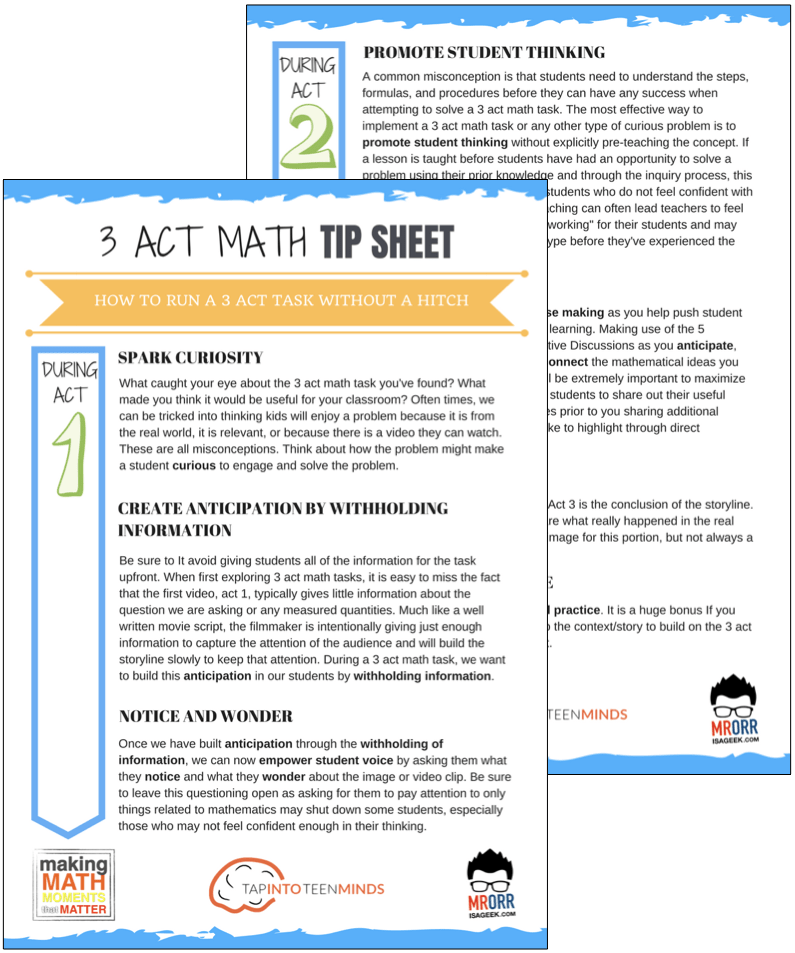
DOWNLOAD THE 3 ACT MATH TASK TIP SHEET SO THEY RUN WITHOUT A HITCH!
Download the 2-page printable 3 Act Math Tip Sheet to ensure that you have the best start to your journey using 3 Act math Tasks to spark curiosity and fuel sense making in your math classroom!
LESSONS TO MAKE MATH MOMENTS
Each lesson consists of:
Each Make Math Moments Problem Based Lesson consists of a Teacher Guide to lead you step-by-step through the planning process to ensure your lesson runs without a hitch!
Each Teacher Guide consists of:
- Intentionality of the lesson;
- A step-by-step walk through of each phase of the lesson;
- Visuals, animations, and videos unpacking big ideas, strategies, and models we intend to emerge during the lesson;
- Sample student approaches to assist in anticipating what your students might do;
- Resources and downloads including Keynote, Powerpoint, Media Files, and Teacher Guide printable PDF; and,
- Much more!
Each Make Math Moments Problem Based Lesson begins with a story, visual, video, or other method to Spark Curiosity through context.
Students will often Notice and Wonder before making an estimate to draw them in and invest in the problem.
After student voice has been heard and acknowledged, we will set students off on a Productive Struggle via a prompt related to the Spark context.
These prompts are given each lesson with the following conditions:
- No calculators are to be used; and,
- Students are to focus on how they can convince their math community that their solution is valid.
Students are left to engage in a productive struggle as the facilitator circulates to observe and engage in conversation as a means of assessing formatively.
The facilitator is instructed through the Teacher Guide on what specific strategies and models could be used to make connections and consolidate the learning from the lesson.
Often times, animations and walk through videos are provided in the Teacher Guide to assist with planning and delivering the consolidation.
A review image, video, or animation is provided as a conclusion to the task from the lesson.
While this might feel like a natural ending to the context students have been exploring, it is just the beginning as we look to leverage this context via extensions and additional lessons to dig deeper.
At the end of each lesson, consolidation prompts and/or extensions are crafted for students to purposefully practice and demonstrate their current understanding.
Facilitators are encouraged to collect these consolidation prompts as a means to engage in the assessment process and inform next moves for instruction.
In multi-day units of study, Math Talks are crafted to help build on the thinking from the previous day and build towards the next step in the developmental progression of the concept(s) we are exploring.
Each Math Talk is constructed as a string of related problems that build with intentionality to emerge specific big ideas, strategies, and mathematical models.
Make Math Moments Problem Based Lessons and Day 1 Teacher Guides are openly available for you to leverage and use with your students without becoming a Make Math Moments Academy Member.
Use our OPEN ACCESS multi-day problem based units!
Make Math Moments Problem Based Lessons and Day 1 Teacher Guides are openly available for you to leverage and use with your students without becoming a Make Math Moments Academy Member.
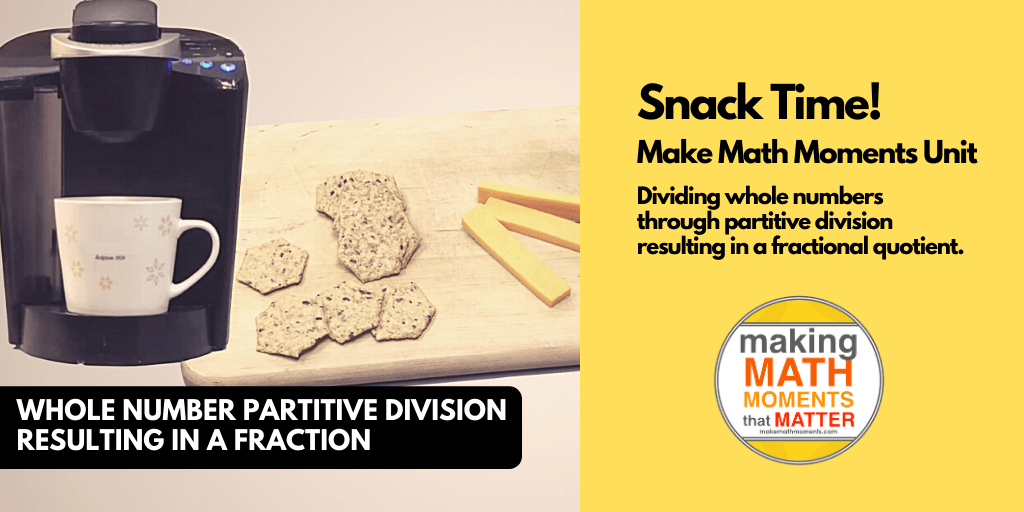
Partitive Division Resulting in a Fraction
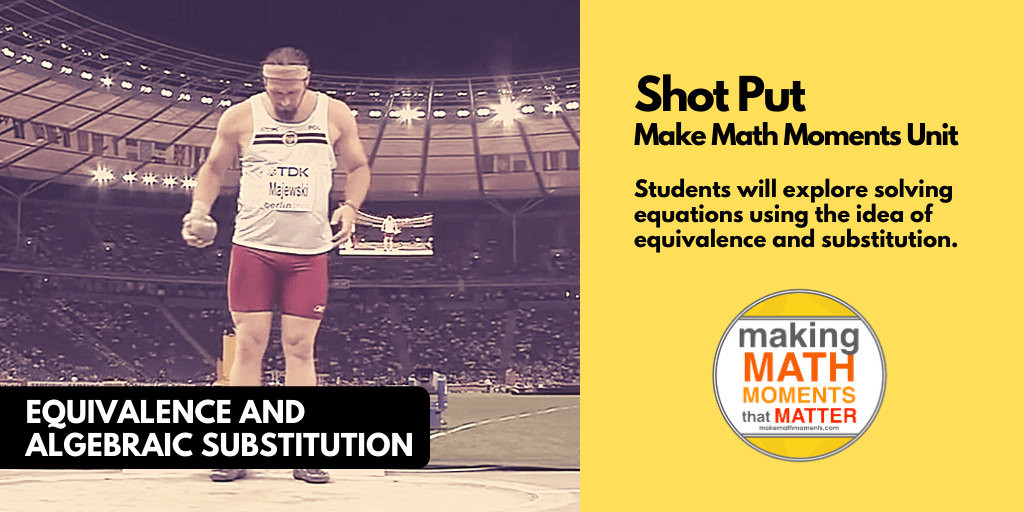
Equivalence and Algebraic Substitution
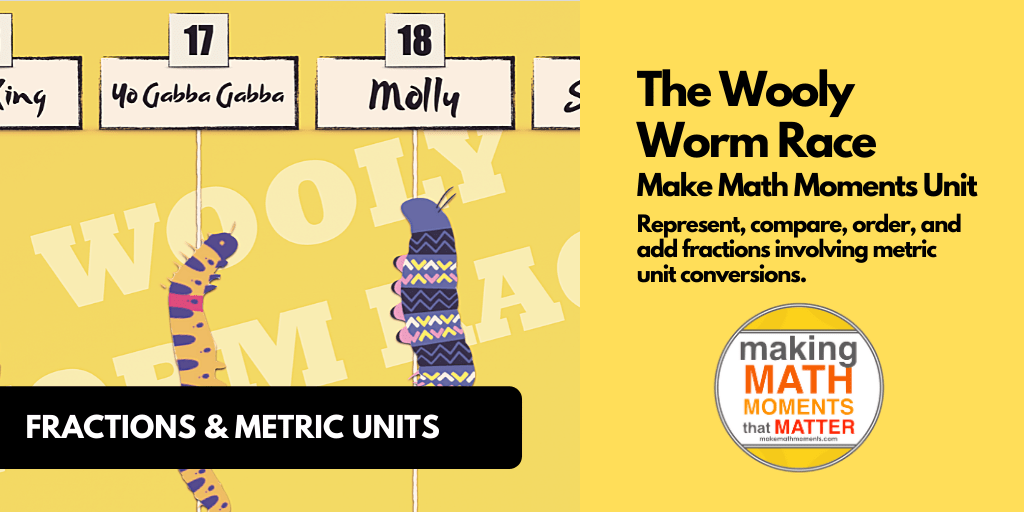
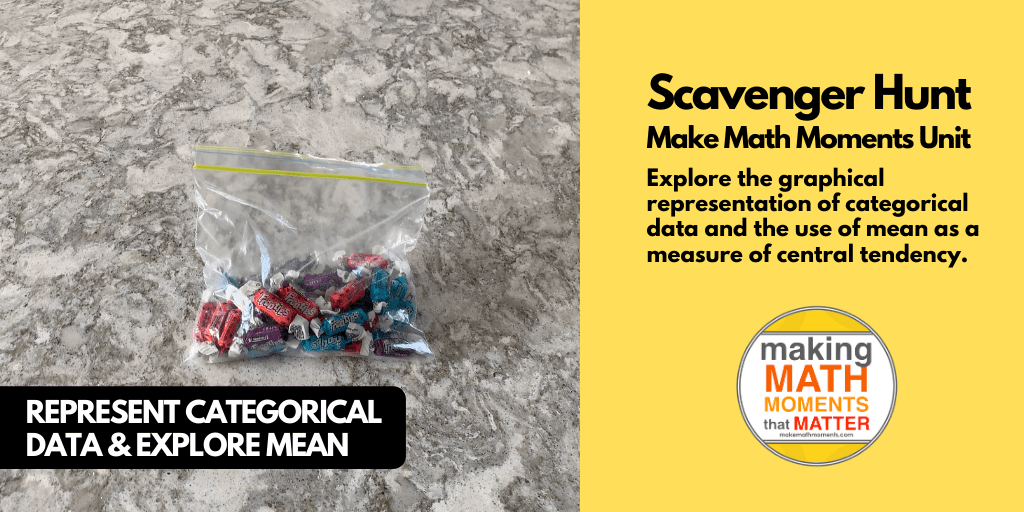
Represent Categorical Data & Explore Mean
Downloadable resources including blackline masters, handouts, printable Tips Sheets, slide shows, and media files do require a Make Math Moments Academy Membership.
ONLINE WORKSHOP REGISTRATION
Pedagogically aligned for teachers of K through Grade 12 with content specific examples from Grades 3 through Grade 10.
In our self-paced, 12-week Online Workshop, you'll learn how to craft new and transform your current lessons to Spark Curiosity, Fuel Sense Making, and Ignite Your Teacher Moves to promote resilient problem solvers.
0 Comments