Episode #506: Building Math Professional Development Teachers Want
LISTEN NOW HERE...
WATCH NOW...
In this episode, Jon Orr talks with Hilary Larvis, Mallory Messinger, and Courtney Fain, elementary math coaches in Dublin City Schools near Columbus, Ohio. As part of a team of eight math coaches serving 15 elementary schools, they noticed their math professional development felt disjointed, especially while much of the district’s attention was on literacy.
They share how the team used the Make Math Moments District Program Assessment to align, narrowed a detailed district vision to two priorities, and chose teacher content knowledge as their focus. They describe the eight-session, for-credit course they built where teachers do the math first and bring back student work, and how monthly and weekly team meetings, content leads, and coaching cycles keep their work connected and sustainable.
In this episode, you'll explore:
- What a team of elementary math coaches learned about planning and meeting teachers where they are
- How the Make Math Moments District Program Assessment helped eight coaches find common ground
- How the team distilled a detailed district vision into student discourse and problem solving
- Why building teacher content knowledge became the highest-leverage focus
- How an eight-session, for-credit course gave teachers time to do the math themselves
- How teachers brought student work back to reflect on what they tried in their classrooms
- What participant feedback revealed about teachers’ appetite for math PD
- How a month-by-month coaching plan supported the rollout of a new curriculum
- How content leads, opt-in coaching cycles, and administrator partnerships extend the team’s reach
- Why shared decision making helps math improvement survive turnover
Look at the math professional development your team offered last year and ask: Was it connected by a clear focus, or was it a collection of one-off sessions? Choose one priority that matters across all of your schools, map out how teacher learning could build toward it over the year, and decide how you’ll gather feedback from the teachers doing the work in classrooms.
Attention District Math Leaders:
K-12 Math Leaders: Download our free Math Coherence Compass to help your teammates, system leaders, and educators create aligned instructional practices—without adding another initiative.
K-12 Math Leaders: Not sure what matters most when designing math improvement plans? Take this assessment and get a free customized report: https://makemathmoments.com/grow/
K-12 Math Leaders: Ready to design your math improvement plan with guidance, support and using structure? Learn how to partner with us and follow our 4 stage process. https://growyourmathprogram.com
Looking to supplement your curriculum with problem based lessons and units? Make Math Moments Problem Based Lessons & Units
Be Our Next Podcast Guest!
Join as an Interview Guest or on a Mentoring Moment Call
Apply to be a Featured Interview Guest
It will take less than two (2) minutes to book your Math Mentoring Moment call.
Book a Mentoring Moment Coaching Call
Take two (2) minutes to book your Math Mentoring Moment call and let's work together to shake that math pebble out of your shoe!
Are You an Official Math Moment Maker?
Ensure that you follow, rate and review on Apple Podcasts, Spotify and other platforms to show your support and ensure other math educators can find the show.



FULL TRANSCRIPT
Jon Orr: Hey there, Mallory, Hillary, and Courtney. Welcome to the Making Math Moments That Matter podcast. It's exciting to have this conversation. And I'm looking forward to hearing your journey and your story on the math improvement practices you're putting into play. Let me know. Like introduce yourselves, like tell me your roles. Tell me like what does this look like? Don't tell me your titles. Tell me what do you do, you know? Who wants to go first?
Hillary: Yes, I can. My name's Hillary Larvis. I am one of the instructional coaches focused on numeracy for our district, elementary specifically. And I'm part of a larger team, or we all are, of sixteen coaches, eight of whom are math focused. And I get to serve two different buildings, so it's close to geez, a hundred educators in total, once we include all of the related services as well. And so I get to, along with these two ladies with me, we get to have lots of amazing conversations with teachers, with administrators, and we have the privilege of being able to see really what our educational system looks like beyond the classroom and both beyond just one school. So it's been a very interesting journey to be able to see that.
Mallory: Yes, I'm Mallory Messinger. We work in Dublin City Schools near Columbus, Ohio, and it's a very large suburban district, 15 elementary schools, and so we each have two different elementary schools, K-5, that we serve. And we get the chance to coach within classrooms, within PD and in our building, and many different ways that we provide support in our two buildings.
Courtney: And my name is Courtney Fain. Similarly, I also have two buildings. And I have really enjoyed the opportunity to coach, being able to work with not only teachers but students as well and thinking about how they're solving math problems and how we can help them continue to learn and grow as mathematicians.
Jon Orr: Awesome. Awesome. Now, you know, like us here at Make Math Moments, you know, you've gone from classroom teacher to coach, and that's, you know, every coach goes from classroom teacher to coach. Or every coach has gone from classroom teacher to coach, let's say it that way. What would you say is something that you tried as a coach that you would never try again?
Hillary: Man. Jon starts to ask the hard questions right away.
Jon Orr: That was early. I've just said no warm up time there at all.
Hillary: The one thing that comes to mind, I remember it was one my very first days coaching. Somebody who had formerly been a coach and wasn't anymore, she connected me with one of the teachers in our building who was brand new, brand new to math, brand new to the building, brand new to all the things. And she's like, hey, go help her set up her manipulatives. And I like, okay, let's go. And so going in with very little planning is not something that I would have done as a teacher. And definitely not something I do anymore as a coach. And I think learning the hard way and feeling like I was fumbling through would have been a something we don't repeat often unless we absolutely have to.
Jon Orr: Right. Right. Makes sense.
Mallory: I think always grounding ourselves too in remembering what it was like to be a classroom teacher and making sure that whatever we're asking or modeling is something that feels relevant and achievable is something that I try to keep in mind in my coaching work.
Jon Orr: Right, right. Makes sense.
Courtney: I think one thing that I've learned, this is my third year of coaching and in the beginning I felt like everybody would be feeling that same excitement about math that I was feeling and that was not necessarily the case. So knowing that everyone is at different places when it comes to math instruction or instruction in general, and keeping that in mind when I'm making decisions, when I'm asking questions, and when I'm offering suggestions.
Jon Orr: Awesome. Awesome. Now, we want this episode to tell your story and your story with the district and the teachers that you're serving and the coaches that you're working with, you know, the eight coaches, like you said, big part of a part of a big team. And I know that we want to kind of look at what has happened over the last year to see where you were to where you feel like you are now and looking forward to see the strengths that you're gonna be kind of building on into the future.
But like I know from say our emails back and forth specifically that you folks joined our we host a webinar pretty regularly about how to strengthen math improvement. And you folks joined that over a year ago and you know were engaged and you know took some of those pieces. But tell me like what did like when you attended that webinar, what were you hoping to really walk away with? Because there's sometimes you have epiphanies about things, but like what was the thing that when you before you actually went into the webinar, well, what were you like, I'm hoping to get blank?
Hillary: It's a really good question. And we actually tracked back our timeline and realized that this all actually started back in 2024. A couple of us attended one of your summit sessions at the time. And then I think it was one of the there's just kind of percolating ideas in the back of our brain, but we had all talked about some observations we had with professional development and the way things were going in our district and feeling like there was some disjointedness primarily because things were so focused on literacy. And not really sure how we could best meet the needs of our teachers, our building, and really feel like things were cohesive.
So after attending the session, we were really hoping to have some type of next step forward so that we'd be able to not only align ourselves as a coaching team, but also then take some feedback or even ideas just back to the district as a whole, knowing that there wasn't we wouldn't be able to control a district this large, but at least have some influence. And we wanted to make sure that we were grounded and what made sense and what some best practices were along that. So I think just having next steps and a general plan.
Jon Orr: Yeah. Yeah. What would you say for some of those next steps you got?
Hillary: So one of the pieces that we took from the session was the Make Math Moments District Program Assessment. So all of the eight coaches took the assessment and we were aligned kind of in the two areas of leadership and teacher content knowledge. And we wanted to take ownership of that leadership of we have the power to help design our PD structures, our plans. We also knew we were going into year one of a new resource this current school year. So we wanted to make sure our coaching team was well aligned in our vision and objectives.
So then we moved into those pieces and parts together, and it helped us to see we really are kind of on the same page. We have the same hopes for our classrooms and for our students. And it helped us level set prior to this new implementation this year. And while that might get looked different in different buildings, we knew that there were structures in place that if we had a common goal, we'd be able to still share those goals with each other and with our own buildings, even though it might not look the same.
Jon Orr: Right. Right. Now that assessment sometimes can be eye opening, and a little bit of ooh, was there anything that kind of shocked you when you took that, especially all eight together?
Mallory: I don't know if it was shocking, but I think it was helpful to see the connection between the parts of the tree and how everything is kind of relying on each other and knowing and helping us to focus in on what maybe we need to tackle first and that systematic way of building a PD plan that could be more than just a one-and-done opportunity. So seeing all those pieces and the connections were very helpful.
Jon Orr: Yeah. And you mentioned, you know, having the vision was important. Like did you have a vision before this process? Did you have like a clarity around what math instruction needed to look like across the district at the time, or is this a process that you, you know, tweaked at, you know, and provided tweaks over the course of the last two years?
Courtney: As part of our curriculum review process, there's a year of visioning. And so there had just become a new vision, very similar to our previous math vision, and it's very detailed about the things that we hope for our classrooms. And so we tried to distill that vision down into maybe two key areas that we wanted our coaching work to focus on. And so when we went through and we looked at the mathematical practices and the effective math teaching strategies and things like that, we were able to distill it down into student discourse. We want the kids to be the ones doing the talking and problem solving. We want them to be able to solve novel tasks, persevere, and work through that. So somehow we all kind of came to the same consensus even though we all were, you know, talking separately and coming up with conversations. So that was cool to see.
Jon Orr: Yeah. Narrowing the focus can be tough. To try to say I'm only going to work on these zones of improvement. How did that go with the all eight coaches sitting around a table together and trying to, you know, because I think the hard part is to say when you say yes, I'm gonna narrow my focus, you're literally saying no to other things. And that can be hard to battle, knowing we're educators and we're trying to like do the best and the most good for the most people all the time. But tell me about the narrowing process of saying, hey, we've got a vision, but we knew we had to kind of narrow our priority if we're gonna make any dent here.
Mallory: I think that it was really interesting when we did the assessment, we said we all were very aligned and kind of where we knew our focus much broader needed to be. But like Mallory said on distilling it down, that you're absolutely correct. That was a very lengthy conversation that I think we all needed to keep in mind that our experiences in our individual buildings were very different because we have very different demographics across our district and different needs. So it really allowed us to think about what the most impactful piece of professional development would be for all.
So with over, you know, 400 elementary educators in our district, that's a lot of different needs and that we were really focusing on. So it led to some really detailed and rich conversations around what we truly believe to be the most impactful bang for your buck, so to speak, in terms of math development, professional development. And one of the things that some of the leaders in our district had already been focusing on was really developing content knowledge. So that we can truly put the art of teaching back into whatever resource we had and be able to use our professional knowledge to then move kids forward. But we can't do that without that deep content knowledge.
Jon Orr: Yeah. What did that look like? What did that look like on a daily basis to say I'm gonna we're gonna narrow on developing teachers' content knowledge. And what were some of the this, you know, the barriers in the way to help you kind of get into it?
Hillary: I think it starts too with our own learning and knowledge of the progression of standards. So we did a lot of work with making sure we understood the K-5 progression in Ohio and making sure that we had other resources to pull from. So the five practices for orchestrating productive mathematics discussions was one that we wanted to embed within our PD to make sure there was a systematic way of having these conversations where student work was at the forefront, but there was a very intentional way of introducing the work and connecting the work. So leaning on these math experts that have already created resources that we can then use to have a foundation to then coach around.
And we also had the opportunity, our coaching team, to work with our content leads. So we had a coaches corner for monthly professional development for our content leads, and then those content leads would take it back to the building as well and share what they've learned. So we focused on progressions in that area as well. So I feel like starting small and having multiple voices sharing was very helpful.
Jon Orr: The sessions themselves, like was were you folks kind of organizing saying like we have groups of teachers together, we've got, you know, we're doing this in PLCs or we're doing this in one-on-one coaching or we're doing this after school or before school? Paint us the picture of like what does the what does the structures look like here and how did you use those structures to accomplish this important goal of building content knowledge?
Mallory: The answer is yes, all of those structures you just said.
Jon Orr: Excellent. Yeah.
Mallory: And I think that was one of the things that through our ongoing conversations starting back two years ago when we first found your work, it was realizing we have a lot of different professional development avenues and outlets of where we can reach our many teachers, but it was feeling like there was a lot of one-off conversations or small focuses based on teacher interest as opposed to maybe what the overarching need of the district was or just the math ed climate in general, which we know has been shifting quite a bit over the past few years.
So once we've kind of found our narrowed focus, we thought, okay, well, if we want to make sure that we're doing content knowledge, what would that progression look like? We basically thought about a progression for ourselves and how we would want to distill that out for teachers and to share it. And then once we knew that, we thought about okay, well what are our channels? How could we do that? And then how can we make sure that we're embedding this experience into teachers' everyday work so that it doesn't have to feel like one more thing. We that's the complaint we hear all the time. And how can we make it meaningful and purposeful?
So, with that in mind, we all brainstormed, okay. Like you said, we have PLCs, we have meetings before school, we have professional development opportunities, and then after school, based on the start of our school day, was really the time for dedicated ongoing PD that obviously would be voluntary. And so at that point we realized okay, teachers really like to get credit for things. They like to have college credit, they like to have continuing education credit, to make it worth their time, especially if they're taking themselves away from their families and their other activities that they do after school. So we've created an eight session, yes, eight session, over the course of the year.
Jon Orr: a course like almost like hey this this is the learning goal that we're trying to achieve let's actually spend time to develop this this this like you're you the word you've been using progression from here to there to accomplish that that learning goal and which is so important and and I applaud you for for structuring it that way. how did you know like what what were you looking at when you design that to go okay it because in in my when I you know when you teach math lessons we go here's my six, like you whether you're writing this down or not, you're still going, what does my success criteria look like to achieve the learning goal? And then I'll develop the lesson or use a lesson to get there. But but the success criteria are like, this is how we know we made a difference. And this is how we know we've achieved the learning goal. Tell me, like, what did that look like for you folks? Like, where does the where's that? Hey, I got to the end of the the eight sessions and we know we made a difference because blank.
Mallory: One of the things we were trying to be intentional about was this is a time for them to collaborate with colleagues from across the district, different, you know, grade levels even or same grade level but different buildings. And so we tried to have each session actually two together, the same topic, so that we used Pam Harris's reasoning in the different, you know, counting, additive, multiplicative, proportional reasoning as our four areas of focus throughout the year. And we used tasks from our resource that teachers would then be the ones doing the task prior to then using it with their students.
So we wanted teachers to feel have that opportunity to do the math as well. We were inspired by Mike Flynn and his colleagues with the math playdates and wanting to get that feeling of we're the ones doing the math as well. And if we can anticipate and think through the math of this task prior to launching it with students, we're going to be better able to use our questioning and conferencing with students to get them to the learning goal. So that, and then the success criteria then is as they implemented it, being able to talk about what did they look for in their students, how did they help move their students thinking forward and being able to reflect with them after the fact of how it went with their students.
Our teachers would bring student work samples from the tasks that they applied in their classroom. And then that second session, we would be able to reflect and share collaboratively on what they learned and how what we talked about in our first session applied to their teaching in the classroom.
Jon Orr: Awesome. And what did you find? Like what was what with the eight sessions? Like what did you find as a say the result? You know, in a way that when I say result, I also compare that back to like what you had done prior to organizing your professional development and streamlining it this way. What's the big change that you saw between the old way and this new way?
Mallory: Well, I think one is that we actually had participants who remained with us through the course, which for eight different sessions we thought was impressive. Being in year two now of this course, we've had some repeat participants as well as new. But I think it was really the feedback that we were receiving from teachers both throughout the series but and also at the ends. Statements like, Wow, I didn't know this prior about math reasoning, I saw this help in exact as we talked about with XYZ student, or because of this work, I was able to go back and support with this type of thinking I didn't have before.
But then more than that, the feedback that we received at the end of the course was really encouraging. Do you want to share about that, Bernie? Yeah, so we knew that 94% of our participants chose to join because they were excited to learn more about math. So, in that way, that showed us that for a while literacy had been the focus, and by offering a year-long PD opportunity, that was something that our teachers were craving. And it was nice to be able to see after the fact that they felt that it was impactful in their classrooms. We also knew that 75% of the participants joined because they wanted to be able to collaborate with other educators, which is not something that was always an opportunity in previous professional development.
Jon Orr: Awesome. Awesome. You mentioned you know that the district itself had say vision like prior established visions and and kind say goals and and yeah, in a way a lot of times this is part of the process is how do I try to merge what we're doing in math that's then also related to say the district wide goals that are not necessarily just math. They are say all subjects. Like how did how did you kind of battle the or or or blend or merge say your priority for math and choosing that priority with with say larger priorities across the district?
Courtney: For year one, I think we knew that we wanted to definitely focus on some sort of building that content knowledge of either how the standards progress or how kids' reasoning progresses because we knew that would apply to anything, and that's just something that we wanted to focus on. But we also each have building goals that were responsible for helping support with our principles. And so trying to help align ourselves to then trickle down into the building level, any sort of PD that's offered at the building level as well is another reason why we found your work to be inspiring of trying to find those couple through lines that teachers will hear over and over again so that they they understand this isn't going away. This is something that we're going to continue to focus on no matter what curriculum we decide to go with. And so that was kind of our reason for doing it that way.
Jon Orr: Right. Now you had mentioned earlier too that you wanted to almost get organized before that curricula, that new curriculum showed up. And how did that organization help that new curriculum show it up in w well, share a couple of examples there.
Hillary: Well, I think that when we brought our team together last spring and we went through implementation starting really I would say June with training this past summer, it allowed us to find those main priorities that we really wanted to focus on, which then became kind of the lens that we would look through as we were thinking about okay, how are we going to go forward in launching this and or implementing this program and resource throughout the district. And so that's kind of been one of the things we've had in our focus as we moved forward.
Additionally, with that, it gave us an opportunity as a team to be aligned and not have individual coaches, you know, doing the best they can for the buildings that we are serving and then go in different directions. We all have a shared plan. So as part of that, we also mapped out what our ideal as coaches professional development plan might look like that would then be implemented at the building level. But we did it by month and we had overarching topics that align with our district goals. And then we have kind of what does it look like in practice and how we then provide professional development that is supportive of implementing the resource. So we're really trying to focus on not just here's the resource, here's how you teach it, but what is what are best practices in math looking like? And what is it, how can we embed some of those just great pedagogical skills so that we can then make sure that it isn't going to change this PD and not be relevant when we may switch resources in the future.
Jon Orr: Right, right. So important. So important. Tell me, tell me about the coaches themselves, you know, the group themselves. Like a lot of times we when we have key individuals doing, you know, providing support to teachers. Some districts you're saying, hey, we've got we got a set of coaches, we have meetings with those coaches, but then those coaches go out to schools, and then sometimes they're attached to a school, and therefore the system, the network of coaches is disjointed sometimes. It sounds like you folks are working very collaboratively as coaches, but tell me what does the cadence look like there? What is the ongoing support for coaches look like on a regular basis to keep this flywheel turning so that we get stronger each year?
Mallory: So we have a coordinator of mathematics that leads our group. So monthly we have meetings together where we're able to make sure we're in alignment, we have opportunities to plan upcoming PDs together, make sure that we're all kind of on the same page with what this rollout looks like. So we're lucky to have that structure in place. What else? We have daily communication with the other coaches. So it's so great because we can talk about com conversations we've had with teachers at second grade for this standard this is coming up and then we're able to, you know, gather ideas that we can then share with our second grade teachers at the other buildings. So we have that kind of like immediate feedback with each other that we can then use to support our own buildings.
And then something that we implemented this year was adding weekly meetings. So we meet every Tuesday just to check in, make sure that we are all on the same page. Is there anything that we need to talk about or that we can share with each other that could go back to all of our buildings? So it's been really cool to see the collaboration from our entire team sharing one common professional development plan and one common message, even if it looks different in different spaces. And how lucky are we to work with people that all love math too. We're so lucky.
Jon Orr: Of course. Of course. One of the the hard, I think, things that many districts and school systems battle against is the idea of narrowing their not just necessarily their focus, but sometimes narrowing the support to teachers. And because sometimes you just you can't get in every single classroom. And sometimes you can. Like you've got eight coaches, two, you know, a coach covering two different schools. Is that an issue with, you know, your the number of coaches you have or getting into classrooms and trying to make the, you know, the impact you have been? Or have you say try to narrow some of that and say, look, I'm gonna try to create bright spots out of this group, knowing that we're strengthening these areas up with the hope of years down the road at trickling down into that effect. Tell me about like what that process looks like of saying like if I are narrowing, who gets the who gets the coaching and how do we how do we kind of navigate that world?
Courtney: We have a few different structures to help narrow it down. So one of those is like Courtney mentioned, our content lead group. So every building has a K-2 and a 3-5 math content lead. And they're in charge of attending meetings, helping to disseminate information at the building level as well. And so we're kind of building capacity and teacher leadership that way. And many times they're kind of like the early adopters or the rooms that we're welcome to go into very readily.
And then from there, we also advertise coaching cycles. And so we utilize the work of Diane Sweeney and having a structure in place in terms of like let's work on a student learning goal. But within that, we can layer in some of the student discourse and how are we going to have our discussions structured and things like that. And so having a structure within our coaching cycles is another way that we can focus in on a teacher or a team for more of an extended period of time. Like you said, honing in on those bright spots and letting it spread from there.
Our coaching model in our district is an opt-in model as well, which is different than what some coaching models look like across school districts. So with that being said, as you mentioned, the bright spots or the early adopters, people who are excited and interested in collaborating, we definitely gravitate towards them. We enjoy being thinking partners alongside them. But as you said, we only have a limited amount of time. We are human. And so PLCs are one of the structures that some of our buildings are utilizing in partnership with coaches and as an avenue for our continued professional development goals, along with collaborating with our building administrators.
That I've found recently having conversations specifically with the implementation of our new resource, but also just helping them build their own content knowledge. I'm finding that over the years now, as our administrators are you know doing observations and asking for feedback around well, what should this look like, or what could it look like if you know, whatever the math concept might be, or how might we embed more collaboration for our students, or making sure we get to the teaching point since it's more of a problem based learning structure? It's been really helpful for them to have the same kind of growth mindset and wanting to learn what this looks like so that they also can be coaches for our teachers as the instructional leaders in our buildings.
Jon Orr: Yeah, absolutely. Absolutely. Yeah, making sure we identify who the who are the key players and and and oftentimes I remember I always try to borrow a phrase from Keith Ferrazzi who wrote a book called How to Lead Without Authority. And one of the pieces that always sticks with me is he's like, you gotta identify who's on your team. And the team isn't necessarily like there's a collection of people we all sit around a table. Your team is people that sometimes don't even know they're on your team. And it's the team is who are the people that can make the goal become easier? And how do I partner with them to help them with their goals so that they can help me with my goals? Because if I can help that person over there achieve and strengthen that part of the work up, then therefore the overall priority gets a little bit easier, it gets a little bit stronger.
And you know, sometimes districts and coaches shy away from partnering with administrators. But when we know that they're part of the team, they have to be part of the team to see this work be done well at a school site. Which you know, when we think about team and we think about, it also makes me think about sustainability. And we and oftentimes we always talk about a fly the flywheel effect here at Make Math Moments, which is how do we keep the flywheel stronger year to year to year to year and spinning? Because and then a lot of times I'll meet with teams and I can see that they're fragile, the wheel won't spin.
And so when they're fragile is typically when the math work lives with one or two key people. The decision making is done there. The, you know, the this is the priority that was chosen, is one or two people, or the there's one or two coaches. But when we have distributed leadership, when we have leaders that are, there's more transparency in how we make decisions, we have more group collaboration. We've got like a math council. We've got a team. Like you've got eight coaches that come together pretty regularly with the math coordinator. I'm imagining that this team is going to be less fragile so that any one of you steps away for another role, your machine doesn't come crashing down. Is that right? Or tell me about how you're protecting the future of math improvement.
Hillary: You're absolutely right. And this is something that I think we've really worked hard as a team to reinforce and to build over time. I think our district leadership recognizing the importance of that has been absolutely essential. And there's a number of people from our central office staff who've made that happen and listen to the feedback of our coaching team for the importance of it.
We have had some turnover over the years. We typically have at least one or two team members that for different reasons either go back to the classroom or have a different role. And I've found this is my sixth year on the team. Mallory, it's your we say eighth, I think. We've seen a lot of shifts over the years, and I think there's been less of a kind of a turmoil in this turnover when we have new team members as a result of these shared conversations. And I do feel like that if somebody were to leave for whatever reason, or even if our leadership were to change, I think we now have enough of a back kind of a backbone or we foundation is the wrong word, foundation I guess. That we could then lean on to carry us forward in a meaningful way.
Jon Orr: Yeah. Awesome.
Hillary: Something else that we added on this year with year two of our year-long optional after school PD series is a second credit hour can be obtained with job embedded work. And so teachers can get credit for attending meetings, reflecting on lessons, like in the moment of like, okay, if we're really focused on student discourse for these two sessions as you're teaching this lesson and at the end, do a quick reflection on how that conversation went. What questions were impactful there. And then we also have a project that involves collaboration with a coach. And so there's built-in coaching within receiving a second credit hour this year that is helping spread kind of the wealth of the coaching across our district through that course as well.
Jon Orr: Awesome. Awesome. Great moves. Great moves. If there was one big message you could leave with a coach or a coordinator who's listening right now, what would be your message to leave with them?
Courtney: Listen to the feedback of the people who are actually doing the work in the classroom. Seek the feedback from all parties involved. I think that it's when that real connection to what's happening is lost, probably not by choice, just by all the things that happen. I think that's when the meaningful PD that teachers want to be part of and the direction forward tends to become very watered down.
Jon Orr: So true. So true.
Mallory: I would add like continue to find the joy in mathematics, the patterns and the connections we can make. The more we understand how the math builds, the better we can support students in seeing those connections and not thinking of math as these isolated concepts we have to learn, but really the connection how it's building over time. That's kind of something that I would pass along as a focus.
Jon Orr: Amazing. Amazing. Well, I know we're recording this mid to late October, and you're about to head out to Denver, Colorado, and present at the NCTM conference. Sounds like for the first time. So that's pretty exciting. And you're going to present the work that you've been doing to strengthen math improvement in your school district. So congrats to you folks for doing that. So I know people listening to this will already be passed, and therefore they won't get a chance to say, join you because they listen to this, but maybe they'll see you there and go, these are the folks that I listened to or I watched at NCTM. Is there any other place that you would point folks to to either learn more about the work you're doing or recommend a move to make to get started on the work you're doing?
Hillary: We would love to share our contact information in the show notes if anyone wants to reach out and collaborate because that we always learn best with in community with others. So yeah. And then I would also say too, I'm gonna turn it right back to the work that you've done. I truly don't think we would have been in the same place if we hadn't utilized your district program assessment, the planning workbook, and then obviously had the opportunity to spend time as colleagues really understanding what our needs were and really figuring out what the best path forward would be, just starting one small step at a time.
Jon Orr: Yeah, you guys are doing fabulous and important work. And I think, you know, even though you kind of tossed it back our way, we share the best practices that, you know, we're using with teams across North America. And all we do is kind of reflect that back to the podcast and reflect that out into the world. And the real work is when we take action on those things and say, let's actually put this into place. Let's be systematic about the work we're doing, let's get narrow, let's start to organize and structure around that narrowed focus and optimize the channels that we have to make sure that we create the dent. Let's measure the change that we're trying to make. Like you've done the work here and it's paying off. So congratulations. That's important work that you're doing right now.
Hillary: Yeah, thank you.
Jon Orr: Thanks for joining us here today in your busy schedules of coaching and taking time out with the students that you're working with.
Hillary: Thanks for having us. Absolutely. Thank you.
Jon Orr: Of course. Of course.
Your Customized Improvement Plan For Your Math Classroom.
Take the 12 minute assessment and you'll get a free, customized plan to shape and grow the 6 parts of any strong mathematics classroom program.
District leader/math coach? Take the District Assessment
Thanks For Listening
- Book a Math Mentoring Moment
- Apply to be a Featured Interview Guest
- Leave a note in the comment section below.
- Share this show on Twitter, or Facebook.
To help out the show:
- Leave an honest review on iTunes. Your ratings and reviews really help and we read each one.
- Subscribe on iTunes, Google Play, and Spotify.
The Making Math Moments That Matter Podcast with Kyle Pearce & Jon Orr
Weekly interviews, strategy, and advice for building a math classroom that you wish you were in.
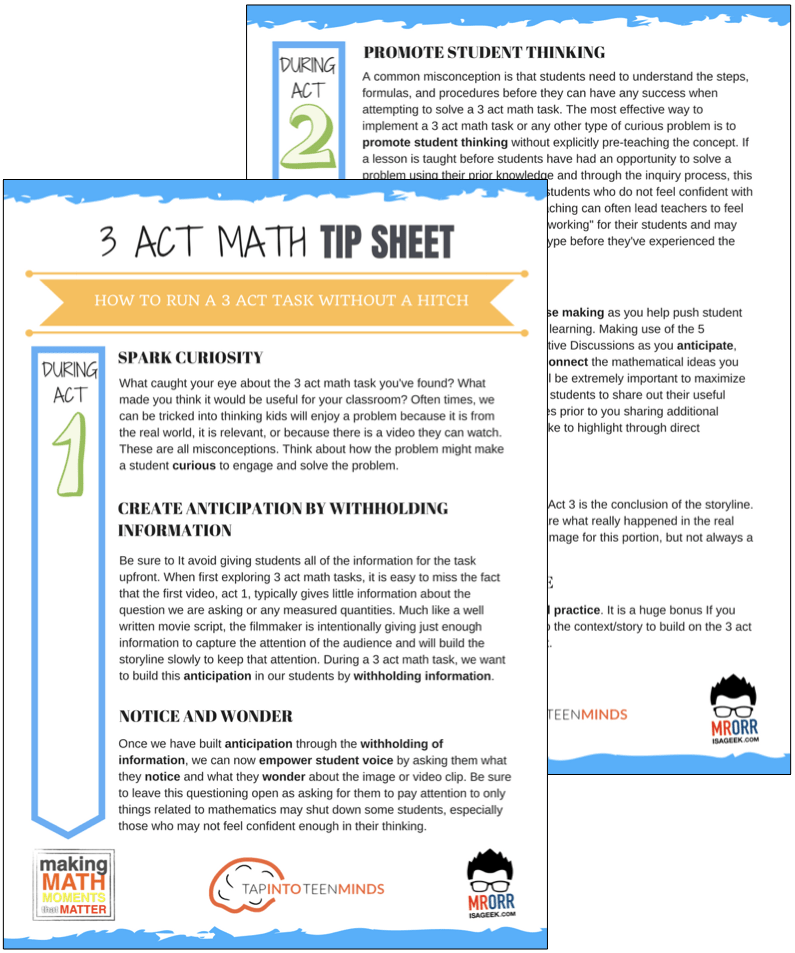
DOWNLOAD THE 3 ACT MATH TASK TIP SHEET SO THEY RUN WITHOUT A HITCH!
Download the 2-page printable 3 Act Math Tip Sheet to ensure that you have the best start to your journey using 3 Act math Tasks to spark curiosity and fuel sense making in your math classroom!
LESSONS TO MAKE MATH MOMENTS
Each lesson consists of:
Each Make Math Moments Problem Based Lesson consists of a Teacher Guide to lead you step-by-step through the planning process to ensure your lesson runs without a hitch!
Each Teacher Guide consists of:
- Intentionality of the lesson;
- A step-by-step walk through of each phase of the lesson;
- Visuals, animations, and videos unpacking big ideas, strategies, and models we intend to emerge during the lesson;
- Sample student approaches to assist in anticipating what your students might do;
- Resources and downloads including Keynote, Powerpoint, Media Files, and Teacher Guide printable PDF; and,
- Much more!
Each Make Math Moments Problem Based Lesson begins with a story, visual, video, or other method to Spark Curiosity through context.
Students will often Notice and Wonder before making an estimate to draw them in and invest in the problem.
After student voice has been heard and acknowledged, we will set students off on a Productive Struggle via a prompt related to the Spark context.
These prompts are given each lesson with the following conditions:
- No calculators are to be used; and,
- Students are to focus on how they can convince their math community that their solution is valid.
Students are left to engage in a productive struggle as the facilitator circulates to observe and engage in conversation as a means of assessing formatively.
The facilitator is instructed through the Teacher Guide on what specific strategies and models could be used to make connections and consolidate the learning from the lesson.
Often times, animations and walk through videos are provided in the Teacher Guide to assist with planning and delivering the consolidation.
A review image, video, or animation is provided as a conclusion to the task from the lesson.
While this might feel like a natural ending to the context students have been exploring, it is just the beginning as we look to leverage this context via extensions and additional lessons to dig deeper.
At the end of each lesson, consolidation prompts and/or extensions are crafted for students to purposefully practice and demonstrate their current understanding.
Facilitators are encouraged to collect these consolidation prompts as a means to engage in the assessment process and inform next moves for instruction.
In multi-day units of study, Math Talks are crafted to help build on the thinking from the previous day and build towards the next step in the developmental progression of the concept(s) we are exploring.
Each Math Talk is constructed as a string of related problems that build with intentionality to emerge specific big ideas, strategies, and mathematical models.
Make Math Moments Problem Based Lessons and Day 1 Teacher Guides are openly available for you to leverage and use with your students without becoming a Make Math Moments Academy Member.
Use our OPEN ACCESS multi-day problem based units!
Make Math Moments Problem Based Lessons and Day 1 Teacher Guides are openly available for you to leverage and use with your students without becoming a Make Math Moments Academy Member.
Partitive Division Resulting in a Fraction
Equivalence and Algebraic Substitution
Represent Categorical Data & Explore Mean
Downloadable resources including blackline masters, handouts, printable Tips Sheets, slide shows, and media files do require a Make Math Moments Academy Membership.
ONLINE WORKSHOP REGISTRATION
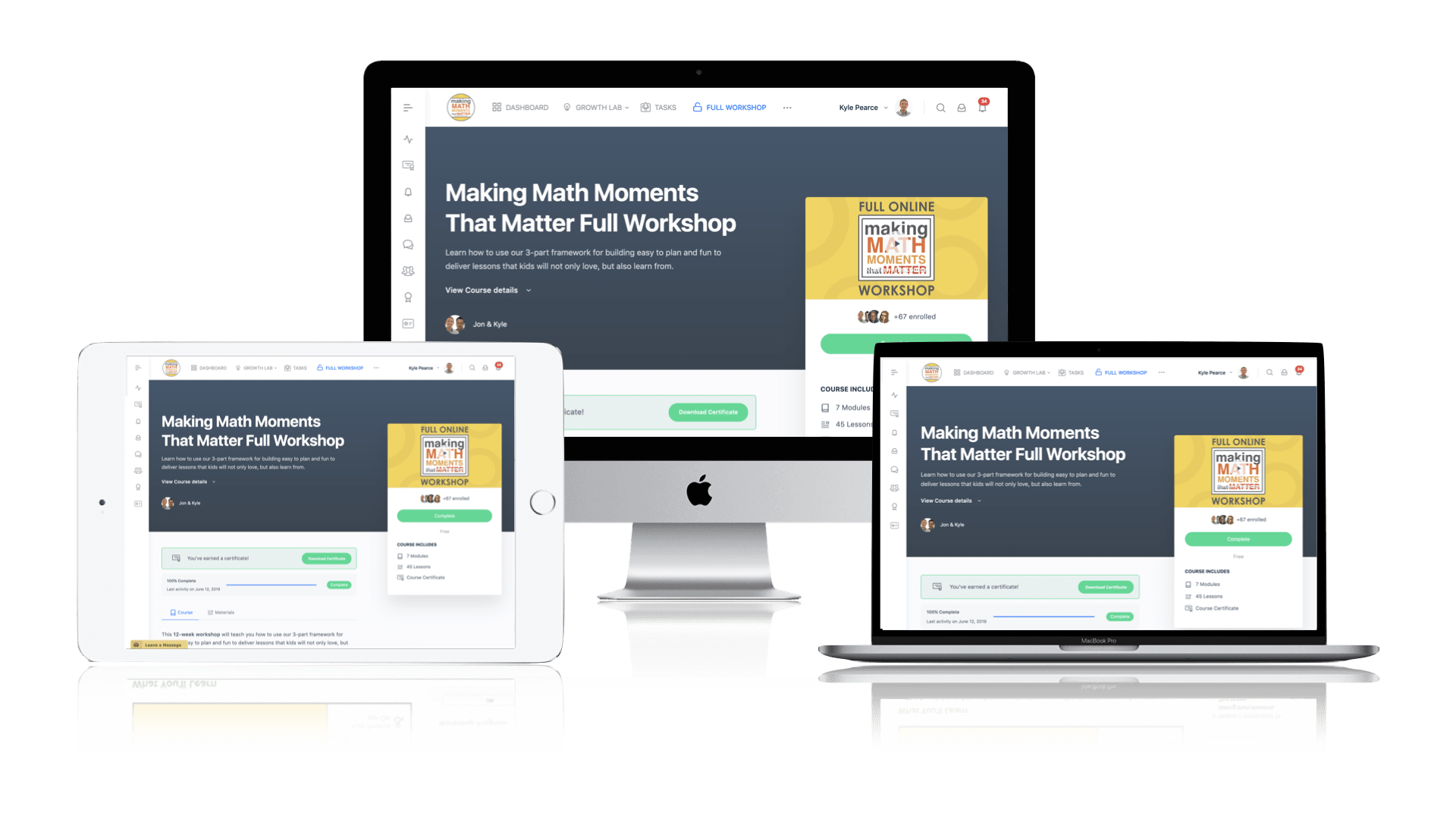
Pedagogically aligned for teachers of K through Grade 12 with content specific examples from Grades 3 through Grade 10.
In our self-paced, 12-week Online Workshop, you'll learn how to craft new and transform your current lessons to Spark Curiosity, Fuel Sense Making, and Ignite Your Teacher Moves to promote resilient problem solvers.
0 Comments