Episode #508: Grace Kelemanik and Amy Lucenta – Making Math Discourse Visible
LISTEN NOW HERE...
WATCH NOW...
In this episode, Jon Orr talks with Grace Kelemanik and Amy Lucenta about their upcoming session at the 2026 Make Math Moments Virtual Summit, Annotation: Making Discourse Visible. They explain why so many math discussions happen only out loud, and how that can leave behind students who don’t process information best by listening.
Grace and Amy describe teacher annotation as highlighting and connecting student ideas in real time, using purposeful color, as students speak. They share why annotation is high leverage, why it looks different from class to class, and the lessons they’ve learned about anticipating student thinking. They also offer practical strategies for moments when you’re not sure how to annotate an idea.
In this episode, you'll explore:
- Why Grace hopes students leave with questions they can ask themselves to get started
- How asking “What’s the job of this number?” helps students make sense of problems
- Why being believed in shapes students’ and teachers’ mathematical confidence
- What teacher annotation is, and how it differs from scribing or reteaching
- How purposeful color and lasting visual residue help students connect ideas
- Why the same task can lead to very different annotations in different classrooms
- What a Lady Gaga story teaches about planning ahead and staying responsive
- Why annotation supports working memory, language, and visual-spatial strengths
- How annotation can transfer to students through co-annotation and turn and talks
- Practical tips, like annotating on the rephrase and layering annotation over time
Think about your last whole-class math discussion. How much of the thinking stayed visible after students finished talking? Before your next discussion, anticipate two or three ways students might approach the task and decide which colors you could use to connect their ideas. Then try annotating on the rephrase, giving yourself and your students a second chance to hear the idea before it goes on the board.
Attention District Math Leaders:
K-12 Math Leaders: Download our free Math Coherence Compass to help your teammates, system leaders, and educators create aligned instructional practices—without adding another initiative.
K-12 Math Leaders: Not sure what matters most when designing math improvement plans? Take this assessment and get a free customized report: https://makemathmoments.com/grow/
K-12 Math Leaders: Ready to design your math improvement plan with guidance, support and using structure? Learn how to partner with us and follow our 4 stage process. https://growyourmathprogram.com
Looking to supplement your curriculum with problem based lessons and units? Make Math Moments Problem Based Lessons & Units
Be Our Next Podcast Guest!
Join as an Interview Guest or on a Mentoring Moment Call
Apply to be a Featured Interview Guest
It will take less than two (2) minutes to book your Math Mentoring Moment call.
Book a Mentoring Moment Coaching Call
Take two (2) minutes to book your Math Mentoring Moment call and let's work together to shake that math pebble out of your shoe!
Are You an Official Math Moment Maker?
Ensure that you follow, rate and review on Apple Podcasts, Spotify and other platforms to show your support and ensure other math educators can find the show.


FULL TRANSCRIPT
Jon Orr: Hey there, Amy and Grace. Welcome to the Make Math Moments That Matter podcast. I'm excited. I'm excited for this one because we have not, you know, officially met many, many times. And Yvette Lehman, who is our chief academic officer, co-host of the podcast, was like, we gotta have Amy and Grace present at the summit this year. We gotta have them. It was like, I was like, let's do it. Let's do it. And so we're here to talk about your summit session. You're both presenting at the 2026 Make Math Moments Virtual Summit. So we're glad. But first, you know, where are we coming from? Like where are you guys coming from? What's going on in your neck of the woods?
Amy Lucenta: Well, we're actually coming from very similar spaces geographically and experience-wise. So we're both here in Natick, Massachusetts, and we come from a long line of very practice-connected work. By that, we've both taught middle school, high school. I've coached elementary. Grace has done a bunch of more system work and we've been working together for probably too many years. Probably too many for Grace. Yeah. Yeah. And working with pre-service
Jon Orr: Too many. We don't need to say the number. We don't need to say the number.
Grace Kelemanik: A long time. A long time. A long time.
Amy Lucenta: teachers and always trying to connect our work to classrooms and the realities of education in today's day and age. So and we have fun with it. Would I leave out Grace?
Grace Kelemanik: Yeah. I don't think you left anything out. I mean, we except maybe that we love being in classrooms and we get to do that quite frequently, working in schools with teachers and sometimes we even get to teach, which is amazing. So we're still in it and see a wide variety of classrooms and students and teachers, so practice based. Yeah.
Jon Orr: Yeah, love it, love it. So important, you know, so important because it can be quickly, you can feel the effects of quickly when you step out of that classroom for the first time and how quickly you feel disconnected from that classroom, even one year, two years later, if you're at the district office or the coaching office even, how, you know, getting back into classrooms, teaching lessons is how we stay grounded in the work that we all do.
The question we've been asking everybody in this series is thinking about their future math moment. So I don't know who wants to kind of tackle this one first, but the prompt here to think about is instead of a math moment that's defined you from the past and shaped, you know, who you've become as an educator and what you remember from your own mathematical experiences, let's project to the future with a student and a student's mathematical experiences. So imagine you met a student years after they've graduated, they've been long past the care that you had them in your class or your system or in your care. And you ask them, hey, what was your big takeaway from having, you know, been in my care for mathematics? Like what do you want that student to say? Like what do we want them to say about their moment?
Grace Kelemanik: I well, the first thing that came to mind for me is that I'm a big believer in the power of ask yourself questions, like questions that you ask yourself to get started and restarted and thinking mathematically. And so not questions that teachers ask students, but questions that teachers help students to learn to ask themselves so that they can work on their own and look to themselves. And so I think if I met a former student and they came back to me and they said that's what they carried with them, they had these, you know, two or three questions that they knew they could depend on to get started and work through things they had never seen before and problems they had never seen before. I think I'd be thrilled. Yeah.
Jon Orr: Right. Like that metacognition, that thinking about our own thinking and like pushing ourselves for what. Grace, what would be those like what is one of those questions, by the way? 'Cause I think that's for a lot of listeners that might be like a new thing to like put in our pockets.
Grace Kelemanik: Sure. So well, we were just actually working with some educators last night, yesterday out in Iowa. And a question that I think is really powerful for students to ask themselves when they're looking at a mathematics problem and they're looking at the numbers is to ask themselves kind of like, well, what's the job of this number? 'Cause in mathematics, numbers have two different jobs, right? Numbers either tell you something about a quantity, it tells you there's a value for a quantity in the situation or context, or it describes a relationship. It's comparing two quantities and talking about how one is bigger or smaller than the other. And those are two very different jobs that numbers have in mathematics. And it's a really good starting point for kids to kind of wrap their heads around situations.
Jon Orr: Absolutely. Absolutely. And just even phrasing it that way makes you think about the possibilities of helping students kind of think about that question and what does that number mean to them in this scenario? And I think that's I'm gonna put that in my pocket right now for a little later. But Amy, to you.
Amy Lucenta: Yeah, so my, that I like that one, Grace. That's pretty cool. I might have to steal it, but when you first pose the question, of course it was rooted in our own math moments and thinking about what we would want future students to say. And it's kind of one in the same for me. And it has to do with the people that believe in you. And those are the people that define my math moment. And if I were to see students, past students down the road or future students down the road or teachers or leaders, I think it would be most gratifying if they said, you believed in me, and I knew I could think mathematically, or I knew I could teach in different ways, or I knew how to stand side by side with teachers as a leader. And that belief in themselves. I think that if I could bring that out in people, that would be amazing. That I would be very, very happy. And it connects back to my own math moment and people that believed in me. So it's kind of full circle there.
Jon Orr: For sure, for sure. And doesn't it just in a way, like when I hear you say that, because everyone's nodding, like absolutely we all want that for our kids. But to me, it feels like that it just melts away some of the other things that surround the work that we do, you know, and it's like it all really comes down to that, like an important part, like not all, but I mean that's a core element of what I think what we're trying to do in mathematics primarily. Yes, we've got content standards. Yes, we have strategies and routines to like layer in and to help our students with their own confidence in math. But it comes down to that part right there. And I think it melts away some of these other things that like we all start to go like, well, what about that? Nah, nah, nah. Like this is what matters.
Amy Lucenta: Yeah, believing our belief system can sometimes hold us back. And so yes, we can go through the motions of the mechanics that you were describing, but if we authentically believe that all students can think and reason mathematically and all teachers can work to make that happen, the work becomes much more authentic.
Jon Orr: Absolutely. Absolutely. Let's pivot here and talk about your session coming up in the summit in November. Your title is Annotation, Making Discourse Visible. And you know, you both have spent years on reasoning routines and thinking routines, thinking practices. Like how did annotation surface as the thing dedicating a whole session to this year?
Amy Lucenta: Well, it had me way back, the question had me way back when we were first unpacking the math practices. And we began articulating annotation as a practice and making thinking visible and having something for teachers to grab onto to make that thinking visible. And for us, I think it uncovered what a rich practice it was and how useful it was. But that's like I just went way back, Grace. So you should bring it more current.
Grace Kelemanik: Way back. And then full circle, right? It went from it started there and it turned into we, Jon, in our second book, Teaching for Thinking, we talked about like five essential teaching strategies. And we always talked about annotation as the sexy one, like the one that, you know, people like to practice and do and was fun. And then fast forward to where we are now with, you know, the new work, micro routines, maximizing engagement. I think annotation speaks to offering another modality in a math classroom. So often when we're discussing content, you know, having a full group discussion around somebody's solution or strategy and we're looking at it, that discussion often is all in the air, right? We talk about it. And if you're strong taking in information auditorily and making sense of it, you're golden. But if you
Jon Orr: Yeah, that's not me.
Grace Kelemanik: If you aren't strong in that regard, or memory is an issue for you, or let's flip the switch and talk about student strengths, you're a visual learner. Then having someone, the teacher, while students are talking, basically making their thinking visible, highlighting the aspects of what is being talked about as a student is talking about it, so that there's a residue and it stays there and you're using color purposefully so you're able to connect ideas to the color and kids stay in the conversation longer. They have something to look at, to reflect on, to think about. It just adds that other means of accessing the ideas and processing them.
Amy Lucenta: And I think to pick up from there, one of the reasons we're focusing a session on it is because while Grace describes it as sexy, it's not easy. And so when you see someone annotate effectively, they capture the essence of what a student said. They use, as she described, use color to make the idea really well organized and connected, and leave it there. And it looks just elegantly done. But it's not that easy to listen to student thinking and respond in the moment and grab the right marker and have the covers off and capture that in the moment, responsive to student thinking. So it's really helpful for teachers to have a space to learn it, practice it, get some tips, and be ready to put it into action.
Jon Orr: Yeah, no, I'm literally looking forward to it. Would either of you be able to like define annotation the way that you're imagining this and not imagining this, like the work that you've done around this? But I think like what I say imagine, because I think there's a lot of people listening going, what do they really mean here? Like what does that look like? And then what is it not, you know, in math class specifically?
Grace Kelemanik: Yeah. It's funny that we're doing this and it's all like auditory, right? Because we're talking about something that's visual. No one's
Jon Orr: Yeah. No one's, no one, yeah, exactly.
Grace Kelemanik: Yeah. I'm trying to decide if I'm to go the route of describing what it looks like and what it's not or using an analogy. And I think I'll start with describing it and maybe we'll pull a Lady Gaga analogy in. And now you're all wondering what Lady Gaga has to do with annotation. Now we're curious.
Jon Orr: Yes, now you have, we have the curiosity here, yeah.
Grace Kelemanik: So here's the deal. I think a lot of times teachers are writing on, well, back in the day, the chalkboard, the whiteboard, the smart board, right? We're putting something up for students to look at. A lot of times we're recording, you know, completely what students are saying when they're saying it, and that's all good. A lot of times we've planned really carefully how to show something, and we're writing and we're using color intentionally, and all of those things have a place in the classroom.
When Amy and I talk about teacher annotation, we talk about something that happens as students are speaking. So I am listening to you, Jon, describe how you are seeing, I don't know, rise over run in a graph. Like you're talking about slope and you're connecting it to a context, you know, but I don't know, whatever the context is. And as I'm listening to you describe that, the teacher is literally like highlighting, and maybe it's underlining a part of the graph or circling the part of a graph in blue, and then over where the words that are connected to it in the problem statement, she's underlining those words in blue. As we're saying, you know, the student ran to the store and we're talking about that spot on the graph. And then later on in the graph, maybe the student then walked home. And we're now, as the students saying that, we're underlining in red student walked home and circling that part on the graph in red.
So that it's literally kind of capturing the big idea, connecting ideas in real time as they're happening, versus scribing everything the student is saying. Or the student says something and then we step in as versus stepping in as a teacher and saying, So what Jon was saying was, and then like show. It is literally adding in a visual element as the student is speaking. Does that help? Amy, can you do a better job of that?
Amy Lucenta: Well, no, I thought that was great, especially in the air, which is annotation is really designed to not have conversations in the air. But one hallmark of really effective annotation is that you could have a discussion in a classroom. Say you're doing a number talk with a visual image, like a dot pattern, and students describe how they're counting the total number of dots. And then another student rephrases it. And when a student rephrases it, the teacher annotates, circles these three in red and connects it to a red three, or you know, like Grace was describing. But then in another classroom, you're looking at the same task, but the annotation looks vastly different. And that's because the focus of the discussion took a different turn. So it's that responsive. It could be the same teacher, the same task, and a different group of students in front of them and the annotation will look different because the student thinking was different.
Grace Kelemanik: And now we get to Lady Gaga. I think.
Jon Orr: Right. Okay. Hit me with it.
Amy Lucenta: Mm-hmm.
Grace Kelemanik: Hit me with your best shot here.
Jon Orr: Yeah.
Grace Kelemanik: So that's Pat Benatar. I'm not gonna sing. I am not singing.
Amy Lucenta: That's Pat Benatar.
Jon Orr: Yeah, yeah. That's a different generation.
Grace Kelemanik: So the movie Star is Born, Lady Gaga and Bradley Cooper. Right. I was listening to Lady Gaga talk about being in that movie, and she's talking about one of the things she learned working with Bradley Cooper. Because, you know, she's the singer, he's the actor. And they both had to do both those things in the movie. And she was saying, what I learned from him about acting was we would rehearse and I would have the scene played out in my mind exactly how I wanted to do it. And we would kind of like rehearse it together and I'd have it all set. But then what I learned from him is when the director says action, you have to leave that planning behind and focus completely on the other person in the scene. And be responsive to what they're giving you in the moment. And so what ended up happening on tape when the tape was rolling was often different than what was practiced.
And I think that that, I don't think, I know that happens in annotation because when you're preparing to go into a lesson and you're imagining the different ways students might think about something, you practice what you might want to annotate, what you might want to hold up in their thinking. And then as Amy says, you get into a class. And the strategy is different or the way it's communicated is different or the order in which it's communicated is different. And you have to be responsive in the moment. But all that kind of rehearsal and practice on the back end helps you be in the moment to truly listen.
Jon Orr: Right. I was gonna say that. It almost speaks to the importance to the anticipation stage of like what's going to happen in that lesson. Right. Like there's a quote from Tom Schimmer, a Canadian who's done a lot of work in assessment and he always, and I remember seeing him speak at an event and he said, We have to plan with precision so we can proceed with flexibility. And we have to think, you know, plan with precision so we can proceed with flexibility. And I always remember that. It's like the gives the power to saying, like, yes, annotation is an important element here that we're going to be put to use today. And you can plan for, you know, you can think that you're gonna do that. But the planning part is absolutely essential so that you can be flexible while you're dealing with it. And that comes also with practice, I assume.
Grace Kelemanik: And even then you get into situations where you're stuck. Like something's happening, you're like, I don't know how to annotate this in the moment. I don't know what to do. Like that does happen.
Jon Orr: Yeah. Yeah. What makes this like high leverage? You know, like is it the multimodal aspect here? Is it the, like you said, the visualness paired with the auditory and we're really giving a visualness to something that normally we're just hearing and we're just capturing it on the board or wherever we're capturing it? Like what makes this high leverage for kids?
Amy Lucenta: That really captures a lot of the essence of why it's high leverage. It integrates multiple modalities. We're talking a lot these days about areas of cognition and visual spatial processing organization. It helps organize ideas. The residue, the fact that it stays up there supports memory, working memory as we're working with the ideas, longer-term memory as it stays up there, and we refer to it later as the discussion ensues and there's lasting residue of the conversation. So it supports auditory processing. And it builds language because you're actually seeing ideas while it's connected to the spoken word. And oftentimes annotation includes some recording of language. So it just does all that in this small moment. And we think that's super, super powerful.
And we particularly like when we can think about how annotation can build from not just support students, but build from their strengths. So a lot of kids these days are strong visual spatial processors. And so why don't we build from that and re-represent these ideas through annotation and build from that strength? Yeah.
Jon Orr: Right. Where does this, I guess, where does this like go when like we have students practice, like if you're modeling, like in a way what you're doing is if you're practicing annotation in the classroom and you're annotating students thinking whole class, or even in small group, but when you're modeling that, you're really showing students what they could also be doing. Like where does this live with student to student discourse in the classroom?
Amy Lucenta: So we've, it's funny, we've only been talking about teacher-led annotation. There is a transfer, right? It's valuable as a teacher-led practice, and it's super valuable for students to learn to annotate to represent their own thinking. Annotation is a really efficient way to represent your thinking. And some of our microroutines actually have students co-annotating, sharing a workspace and annotating a common representation or annotating their thinking to help support that communication. I think the teacher-led annotation implicitly models it and the intention is to transfer it to students, but you now have me thinking, whenever Grace and I land in that space, we should probably be explicit about that. And to give a process for teaching annotation to students. It's not just osmosis, right? It's not just modelling.
Grace Kelemanik: Yeah, yeah. Yeah. And sometimes you give kids opportunities to annotate by default, like when I'm stuck. So if I'm working with the class and we've been having lots of conversations and I've been annotating, there will be times where a student will share something, it will get rephrased and it will give me pause. Like I'm not, wait, I'm not sure how to annotate it. And one of the strategies I lean into in that case is I look at the class and I'm like, huh. I wonder how I could best annotate that idea. Turn and talk to your partner. What would be the best way to annotate it? And have the kids talk about it. And then I listen in for good ideas, like what are they saying? And then we pull back and I, you know, ask a student to share out. And as they're sharing out, I'm annotating what they're saying. So there's like a way to kind of turnkey it. I do that when I need help. I look to the students 'cause
Jon Orr: Right. Absolutely. Love it. Yeah. One of the things that for new, especially new practices, or other routines that I want to put into my classroom and use with my students, I, you know, over the years of doing that, I often have looked back and said, gee, I wish I didn't do it that way when I did it, you know, two years ago, three years ago. I wish I had done it more like this, which makes me go like, well, what are those early mistakes I wish I could have avoided when I tried something new? And therefore, if I'm going to annotate in my classroom on Monday with my students, what is that well-intentioned mistake? Like it was well intentioned. I was gonna try this, but it was a, hey, I wish someone had told me about that before I tried it so that I knew about it. Otherwise I would have learned it. What's that there?
Amy Lucenta: I think some of the tips, yeah, some of the mistakes we've made that we wish we didn't make were in not fully anticipating student thinking. So that, you know, it doesn't make sense to you in the moment when it's when you haven't anticipated it enough to be flexible in the moment. If you haven't planned precisely enough for that flexibility. I think there are really like practical considerations. And some strategies we've learned, like the one Grace just shared.
But one strategy we often use is when a student shares an idea, it's helpful for us to hear it again before we annotate. It's also helpful for all the students to hear it again because it's new to them, also. So we typically annotate now on the rephrase because that just gives a little more time and space to process the idea. And then when the initial idea is being shared, we can visualize, think about the annotation, uncap the markers, and that's no joke because you're using two to three colors and you're trying to annotate swiftly enough that when the student's done talking, you're pretty much done annotating. And if I continue to stand there and annotate when the conversation's over, I'm positioning the students for a lot of disengagement. So you want to be pretty adept at it.
And so we've kind of developed some, I don't know, like SOS strategies to help us when we're in a jam. And I think this is a worry for a lot of teachers. You don't know what's about to come at you. And to be responsive in the moment is sometimes difficult. But to have some back pocket strategies like have students turn and talk and share how they would say the same idea and give yourself that moment or to anticipate how they would annotate it or ask for another rephrase or annotate just a little bit and then have a turn and talk and then build the annotation, layer it in over time. It doesn't have to be perfect the first time out. It's really rough draft and you're building into it. So I think those are the lessons we've learned over time and some of the tools we keep in our back pocket to help us.
Jon Orr: Grace, anything to add there or she got it all?
Grace Kelemanik: I think she had it all. Maybe one thing I would add is sometimes you really want a particular idea to get out there to annotate. It's critical to the lesson goal. And it may not be in what students have shared, or maybe it was initially what they shared, but not in the rephrase. And so there's something left that you wanna bring out. And then as Amy alluded to, it's a great time to just have a turn and talk around that idea and then when students share out, layer it in. Like not feel as though you have to get everything out all at once immediately.
Jon Orr: Right. Right. If there was, you know, thinking about your session that you're gonna hold in November, if there's one, like if it's like don't miss this session because this is the most important thing that you're gonna take away from that session, what will be that most important thing that we should take away?
Amy Lucenta: I would think that you'll leave ready to annotate and to represent student thinking in a variety of contexts and really see what we're saying in this conversation and to see all the different elements of it and be able to put it into practice. You'll see it in practice and leave ready to put it into practice, which I think is super helpful. When you're learning something new, it's small enough, the grain size is small enough that you can turnkey it, which is really helpful for educators today.
Grace Kelemanik: Folks who are coming to the session, make sure you've got some paper and a four color pen or a bunch of colors alongside you during the session 'cause you're gonna be annotating. So it's interactive even though we're, you know, live.
Jon Orr: Perfect. Love it.
Grace Kelemanik: Virtually live. Yep.
Jon Orr: Thank you. Thanks you two for taking some time out of your busy schedules to chat with us here at the Make Math Moments community. We look forward to that session, November fourteenth, twenty twenty six. It's a one day live event with a number of pre-recorded sessions and also live sessions. So looking forward to that. Registration is open right now. You can go and register for this session. You just head on over to the link in the description below and get yourself registered. It's completely free to participate in the weekend. So thanks again, Amy, Grace, and look forward to seeing you. Should see you probably maybe in Denver soon, maybe. Yes. Okay. All right. Thanks so much.
Amy Lucenta: Thanks for having us. Yes, for sure. For sure. All right.
Grace Kelemanik: Yeah, thank you, Jon. Yeah, yeah, for sure. Yeah, yeah.
Amy Lucenta: Thanks, Jon.
Grace Kelemanik: You bet. Take care.
Your Customized Improvement Plan For Your Math Classroom.
Take the 12 minute assessment and you'll get a free, customized plan to shape and grow the 6 parts of any strong mathematics classroom program.
District leader/math coach? Take the District Assessment
Thanks For Listening
- Book a Math Mentoring Moment
- Apply to be a Featured Interview Guest
- Leave a note in the comment section below.
- Share this show on Twitter, or Facebook.
To help out the show:
- Leave an honest review on iTunes. Your ratings and reviews really help and we read each one.
- Subscribe on iTunes, Google Play, and Spotify.
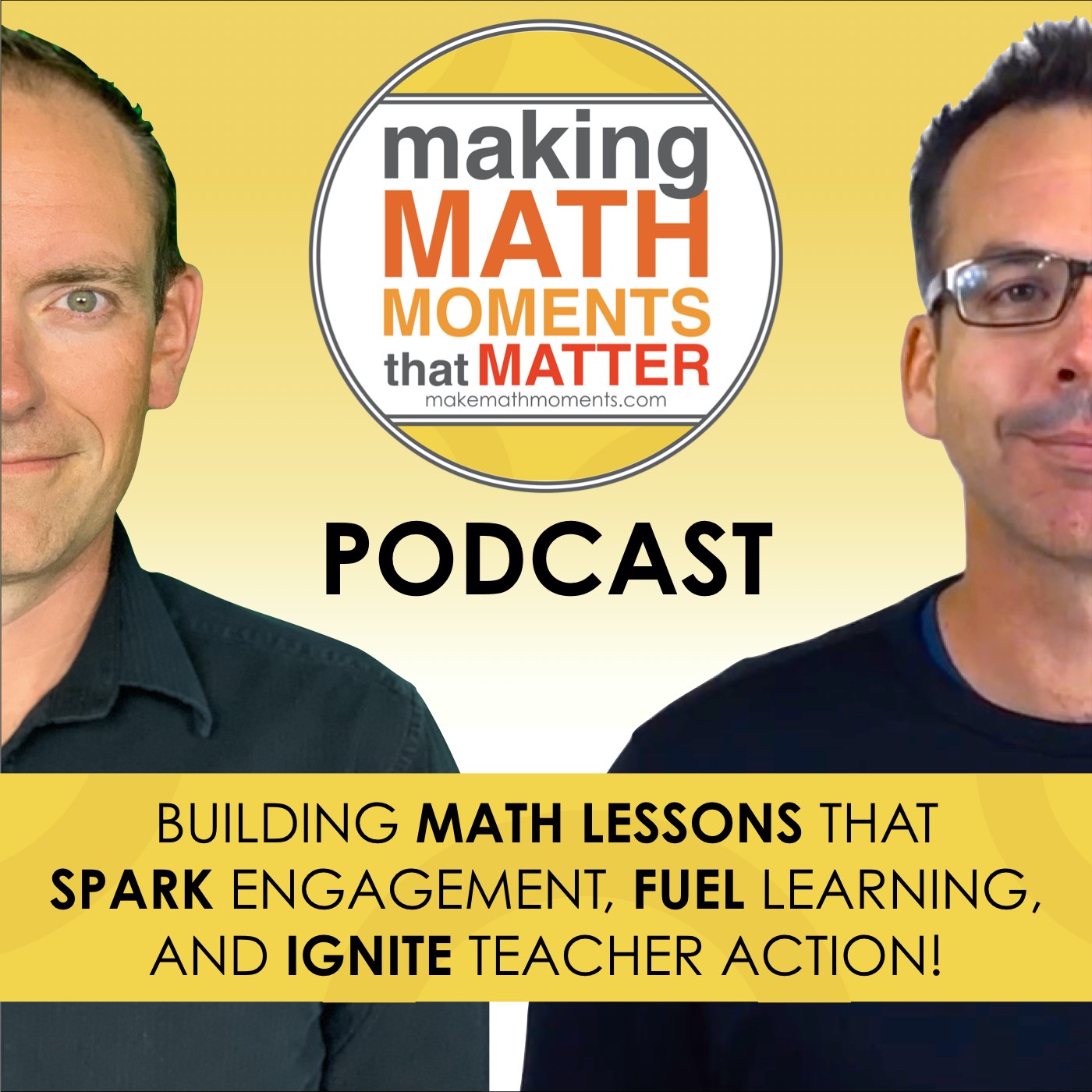
The Making Math Moments That Matter Podcast with Kyle Pearce & Jon Orr
Weekly interviews, strategy, and advice for building a math classroom that you wish you were in.
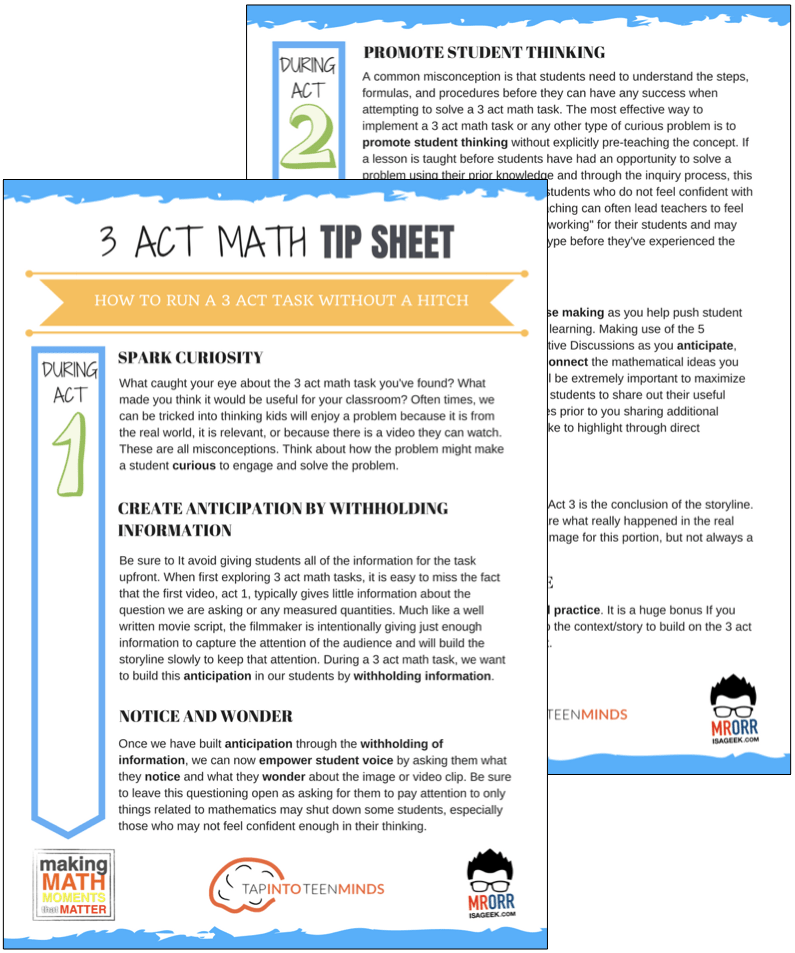
DOWNLOAD THE 3 ACT MATH TASK TIP SHEET SO THEY RUN WITHOUT A HITCH!
Download the 2-page printable 3 Act Math Tip Sheet to ensure that you have the best start to your journey using 3 Act math Tasks to spark curiosity and fuel sense making in your math classroom!
LESSONS TO MAKE MATH MOMENTS
Each lesson consists of:
Each Make Math Moments Problem Based Lesson consists of a Teacher Guide to lead you step-by-step through the planning process to ensure your lesson runs without a hitch!
Each Teacher Guide consists of:
- Intentionality of the lesson;
- A step-by-step walk through of each phase of the lesson;
- Visuals, animations, and videos unpacking big ideas, strategies, and models we intend to emerge during the lesson;
- Sample student approaches to assist in anticipating what your students might do;
- Resources and downloads including Keynote, Powerpoint, Media Files, and Teacher Guide printable PDF; and,
- Much more!
Each Make Math Moments Problem Based Lesson begins with a story, visual, video, or other method to Spark Curiosity through context.
Students will often Notice and Wonder before making an estimate to draw them in and invest in the problem.
After student voice has been heard and acknowledged, we will set students off on a Productive Struggle via a prompt related to the Spark context.
These prompts are given each lesson with the following conditions:
- No calculators are to be used; and,
- Students are to focus on how they can convince their math community that their solution is valid.
Students are left to engage in a productive struggle as the facilitator circulates to observe and engage in conversation as a means of assessing formatively.
The facilitator is instructed through the Teacher Guide on what specific strategies and models could be used to make connections and consolidate the learning from the lesson.
Often times, animations and walk through videos are provided in the Teacher Guide to assist with planning and delivering the consolidation.
A review image, video, or animation is provided as a conclusion to the task from the lesson.
While this might feel like a natural ending to the context students have been exploring, it is just the beginning as we look to leverage this context via extensions and additional lessons to dig deeper.
At the end of each lesson, consolidation prompts and/or extensions are crafted for students to purposefully practice and demonstrate their current understanding.
Facilitators are encouraged to collect these consolidation prompts as a means to engage in the assessment process and inform next moves for instruction.
In multi-day units of study, Math Talks are crafted to help build on the thinking from the previous day and build towards the next step in the developmental progression of the concept(s) we are exploring.
Each Math Talk is constructed as a string of related problems that build with intentionality to emerge specific big ideas, strategies, and mathematical models.
Make Math Moments Problem Based Lessons and Day 1 Teacher Guides are openly available for you to leverage and use with your students without becoming a Make Math Moments Academy Member.
Use our OPEN ACCESS multi-day problem based units!
Make Math Moments Problem Based Lessons and Day 1 Teacher Guides are openly available for you to leverage and use with your students without becoming a Make Math Moments Academy Member.
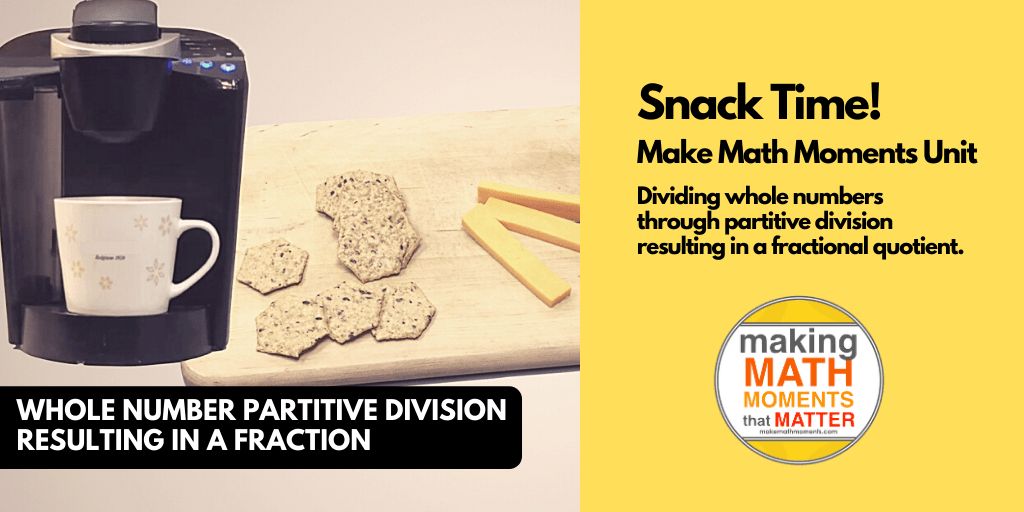
Partitive Division Resulting in a Fraction
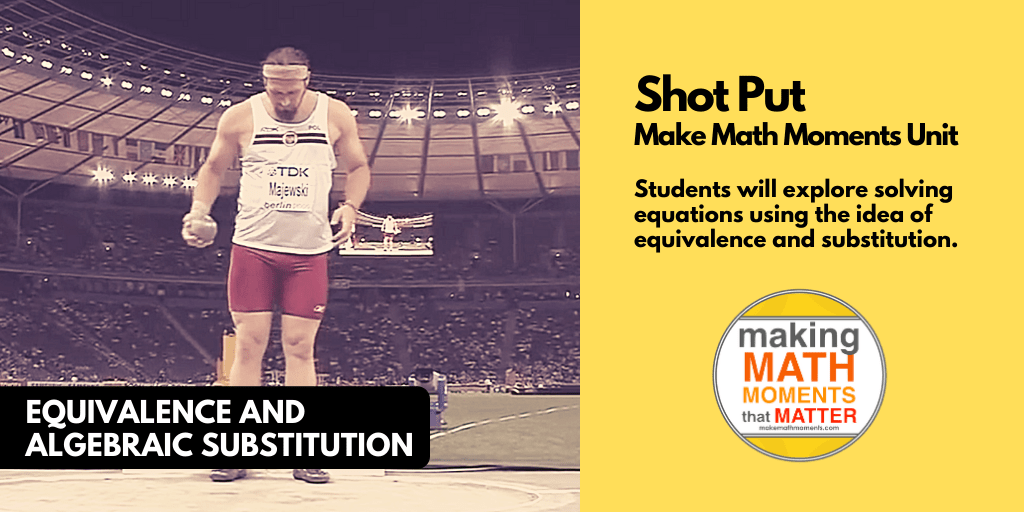
Equivalence and Algebraic Substitution
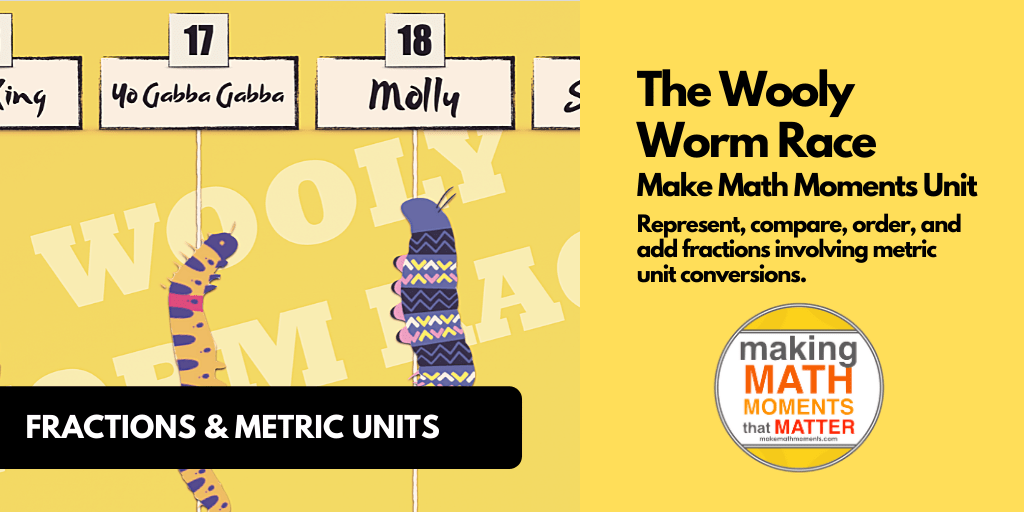
Represent Categorical Data & Explore Mean
Downloadable resources including blackline masters, handouts, printable Tips Sheets, slide shows, and media files do require a Make Math Moments Academy Membership.
ONLINE WORKSHOP REGISTRATION
Pedagogically aligned for teachers of K through Grade 12 with content specific examples from Grades 3 through Grade 10.
In our self-paced, 12-week Online Workshop, you'll learn how to craft new and transform your current lessons to Spark Curiosity, Fuel Sense Making, and Ignite Your Teacher Moves to promote resilient problem solvers.
0 Comments