
Episode #512: Why You May Feel Like You Are Failing at Teaching Math
LISTEN NOW HERE...
WATCH NOW...
In this episode, Jon Orr and Yvette Lehman reflect on a letter from an anonymous Ontario teacher describing moral injury: the shame and guilt teachers feel when they can’t do their job the way they know they should. Yvette shares how a highly skilled teacher friend feels this daily, and Jon reflects on two points in his own career when he left class feeling defeated.
They connect the conversation to a recent half-day PD session for ninth-grade math teachers, where wish lists focused heavily on classroom conditions rather than student outcomes. Jon and Yvette don’t claim to have all the answers, but they share two big takeaways for anyone planning professional development: address the elephant, not just the rider, and design experiences that can shift beliefs.
In this episode, you'll explore:
- What moral injury is, and why so many teachers may be experiencing it
- How behavior, interruptions, and a packed curriculum pull teachers away from their best lessons
- Why skilled teachers feel defeated when they know what students need but lack the capacity to provide it
- Whether today’s classroom conditions are new, or whether expectations for teachers have changed
- Whether teachers may need new skill sets to teach in today’s classrooms
- Why protecting learning has to be a priority from the top of the system to the classroom
- How one half-day PD session invited teachers to choose their own small move
- Why teachers’ wish lists focused on conditions like cell phones, support staff, and split classes
- How the elephant and rider framework from Switch applies to planning PD
- How the Results Pyramid and above-the-line thinking connect to teacher beliefs
Think about the next professional learning session you’re planning and ask: Have I planned for the elephant, or only the rider? Before presenting data or new practices, consider how you’ll acknowledge what teachers are experiencing in their classrooms right now. Then look for one way to give teachers a shared, positive experience and a voice in choosing the small move they’ll commit to next.
Attention District Math Leaders:
K-12 Math Leaders: Download our free Math Coherence Compass to help your teammates, system leaders, and educators create aligned instructional practices—without adding another initiative.
K-12 Math Leaders: Not sure what matters most when designing math improvement plans? Take this assessment and get a free customized report: https://makemathmoments.com/grow/
K-12 Math Leaders: Ready to design your math improvement plan with guidance, support and using structure? Learn how to partner with us and follow our 4 stage process. https://growyourmathprogram.com
Looking to supplement your curriculum with problem based lessons and units? Make Math Moments Problem Based Lessons & Units
Be Our Next Podcast Guest!
Join as an Interview Guest or on a Mentoring Moment Call
Apply to be a Featured Interview Guest
It will take less than two (2) minutes to book your Math Mentoring Moment call.
Book a Mentoring Moment Coaching Call
Take two (2) minutes to book your Math Mentoring Moment call and let's work together to shake that math pebble out of your shoe!
Are You an Official Math Moment Maker?
Ensure that you follow, rate and review on Apple Podcasts, Spotify and other platforms to show your support and ensure other math educators can find the show.



FULL TRANSCRIPT
Yvette: I recently came across a letter, I saw it on Facebook, it was written by an anonymous Ontario teacher, and it was talking about this idea of moral injury, which is a term that I hadn't heard before. But, you know, and I don't wanna speak on behalf of this teacher, but the way that I interpreted the message was that essentially many teachers are experiencing moral injury over and over again, particularly in the past five years, let's say since, you know, COVID and coming back from COVID.
Jon Orr: Hmm, sure.
Yvette: Because they feel shame and guilt for not being able to do their job. Not being able to do their job the way that they want to, or like that that they have that expectation they have for themselves. And I actually hear this from my good friend who I'm in contact with regularly. She's a homeroom teacher, elementary teacher, and I think one of the most phenomenal teachers I've ever had the privilege of working with. And almost every time I interact with her, she's just absolutely burnt out and sad. Like she says she's like very teary almost every single day because she can't do what she knows her kids need. It's like she sees the needs in the room and she knows the type of learning she wants to create, but the conditions in the classroom just don't give her the opportunity to teach that way.
Jon Orr: So what is she doing instead?
Yvette: I think the problem is a lot of her energy gets pulled to some of the big needs, big behaviors, big distractions in the room. And so when you think about I have 60 minutes to teach this lesson, and the curriculum is aggressively cumulative and loaded with expectations in a calendar year, and you're already fighting other interruptions and distractions, and then big parts of your day are monopolized by putting out big fires and managing behavior and de-escalating. And then you walk at you get to the end of the day and you feel defeated because you had this beautiful lesson plan prepared and you just couldn't get to it. And this happens day after day after day after day. And it just it it it takes a toll on you.
Jon Orr: It reminds me of like, I guess, two scenarios that I experienced and I guess I had two different or maybe a same reflection afterwards. So the first, I guess the first scenario, and I guess hold this kind of noodle on this, is that the first scenario was that when I first started teaching and I taught the applied level math classes here in Ontario, which are the classes that streamed when back then in... sure it was streamed when you kids showed up to grade nine. So this is not the stream that students are going to, you know, head to post-secondary education for like a four-year program. This is for kids that are either going to the workforce or going to a community college type program. It's usually kids that come in that have been told that they've been terrible at math for years and for that system.
And I think that the scenario is that when I first started teaching, I taught very traditionally. And so then when I came in, I had the same image of like, this is the lesson I want to teach. This is what I would feel proud teaching. And then when it didn't go that way, I would also feel shame or failure that I didn't do it the right way. And I did that for years. And so there was like that scenario, because I think that's that's what I'm hearing you say from this teacher. I don't know if I would call it moral injury to me back then. Maybe, I don't know. But I think I was very rigid in what I was doing.
Now, the second scenario is one of my, I think probably one of the last years that I was in the classroom, which was only a couple of years ago. And I had a classroom full of I think what you just described, know, students dealing with say some mental health issues, uh students that had, that were say in the third stream that struggled to be in classroom environments. Often these students, and I only had 12 of them, had to be removed because of physical issues in the room. I experienced the same, in a way, not the same thing, because I also had shifted the way I taught over, say, my first years to my later years in a very much way that I was very proud of. But I couldn't do that in that classroom either.
You like I couldn't teach the way that I wanted to in that room, providing, you know, thoughtful experiences for students to engage in mathematics for them to grapple with math, get more thinking from this group than like I had done for successfully for many years leading up to this point. But I would walk away from that class going, I failed again. In a way, if you compare the teaching styles I wanted to do in each room, they are completely different. But I still walked away from both of those scenarios, feeling defeated on a continual basis. And it sounds like that's what this teacher is feeling. But why I bring up the two scenarios is I feel like I don't know how to make sense of both of those scenarios in comparison to this moral injury that this teacher is maybe feeling.
Yvette: And actually I actually think it's a different scenario. So let's throw this one out there. I think for the teacher who penned this letter and my friend who I'm referring to, I think she's a very skilled educator. And she knows the individual pathways the students in her classroom require. She can do that really good assessment of the room and be like, this group of students is ready for this learning. And this group of students requires this type of intervention, but it's not physically possible for her to dedicate the time that's necessary to grow the skills of all the learners.
So imagine you're a fifth grade teacher, you have kids who are on a gifted pathway who have already consolidated the fifth grade math curriculum. And let's just talk about math because this teacher also teaches all content areas. But let's say you have a fifth grade group where you do the, you know, diagnostic at the beginning of the unit and they've already demonstrated that they they've consolidated the expectations at the grade level. But then you have three or four others who are about three grade levels below grade level, who need an intensive like remediation of two to three years of opportunity gaps or learning gaps requires really intensive remediation and support and really careful scaffolding. And then you have maybe students who are working toward or just about at grade level who still need really solid instruction. And it's all about this like getting every child what they need when they need it to be most successful.
So imagine the complexity of that as well. So, like you're looking across your room and you've done a scan and you're like, I understand it's like that learning on the horizon that Deborah Ball talks about. It's like I've done a good audit of my room and I understand what every group needs to push them along the developmental continuum. But now I have to make all of that fit within my 50 to 60 minutes of dedicated math time. And on top of that, I'm dealing with big issues, de-escalating behaviors, interruptions. And I think it's like she knows what they need. She doesn't feel as though she has the capacity, time to provide it. And so it's just, it's disheartening, you know, because she knows that by the end of the year, she's gonna look back on her impact and be like, I wish that I could have done what I needed for every learner in my room, and I just couldn't. And this happens every day.
Jon Orr: Do you think this is a new issue or something that every teacher has faced since the dawn of teaching?
Yvette: You know, it's interesting that you say that because we obviously have teachers who have been in this profession for twenty plus years. And in in certain populations, for sure I can't speak globally or I can't speak, you know, on all geographical areas or socioeconomic dynamics, but it certainly seems to be a common feeling amongst educators that there's been a shift in the past five years to the conditions in many classrooms.
And I don't know I I can't imagine because we're hearing it so consistently across a lot of different educator groups that it's not true. Like that there's not something unique possibly to the conditions that are currently existing in classrooms, or maybe it's just that we're more aware of wanting to meet students where they are, where before I guess we would have been okay with, well, I taught the lesson, they got it or they didn't, and we moved on. Where now I think the expectation for teachers is that we meet the needs of all learners and that it's like success for all, no child left behind. And so we're no longer okay with this idea of, well, I taught it and I guess they didn't get it. So therefore they failed, and that's not my fault, and we're moving on.
Now I think people teachers are taking, you know, really personally the of course, as they should, the success of their learners. So then when the conditions aren't in place for them to ensure success for all, it's defeating and exhausting.
Jon Orr: Right. Do you think this is a, again, a situation of like, because I would say that the two scenarios I presented was like, I didn't have the skillset in the first scenario to teach the way I needed to teach down what I shifted over the course of 19 years of teaching in classrooms to be able to teach consistently to that group and not feel like I felt in that first scenario. Because the first scenario, I was saying like, I can't reach this group of kids. But then I learned how to do that, right? Over the course of many years of practice and teaching that skill, you know, the skill set for that group specifically, or the varying students that walked in my door over the course of that time. Like I learned the skill.
Like, do you think that this is a situation where it's like, okay, we've got... In a way, we're dealing with, think what you're saying here is that the structures around us feels like they shifted and therefore maybe the supports aren't in the classroom that used to be before, say COVID, let's say. And is it possible? We just don't have the skillset yet. It's like one of those like, can't see what I don't, you know, there's like the unknown unknowns. Like I don't know yet what the skillset is to teach the way that we're being asked to teach or we want to teach because we're being asked to reach every student in the timeframes that we have when we then have a, sounds like a bigger variety of skills of say learning styles coming into my room and maybe behaviors. Is it possible we just don't have the skill set yet to like teach the way that we want to? And we're just lamenting on the old way that we did it.
Yvette: I don't have the answer to that, truthfully. Like well and I also, you know, um I'm not
Jon Orr: I know we don't have the answers. So if you're listening to this being like, I want to get, like, I hope they tell me the answer. I'm like, spoiler, we don't have the answer. We're just, we're chatting.
Yvette: Well, and I would you know, I would love to see examples. You know, like please, like, reach out to us if you feel like you figured this out and you're like, you know what, I've I found myself in this situation at one point where I wasn't sure how to optimize the learning experience in my classroom and meet the needs of so many diverse learners. But I figured it out. Like I've unlocked it and every day now I feel, you know, like I'm I'm having the impact. Not even every day. I think that's unrealistic, but generally it's like the there's a I I feel impactful and joy there's joy in the work that I'm doing. And and it's because, like John's saying I just didn't realize this was the missing skill set or this was the missing approach or this was the missing mindset that I needed to bring to the the the job. I would love to see it. Like I'm I'm still seeking this answer.
And because obviously you and I aren't currently in the classroom today, in today's context, you know, like I I don't ever want to speak to um my past experience because I don't think it reflects today's experience. I think a society is constantly evolving. Um, we have a generation of tech children who there's higher levels of attention deficit disorder. There's a lot of it takes a lot more, from my impression, from educators to keep kids engaged.
Jon Orr: Yeah. That's what, yeah, I was just gonna say, like, that's, I guess that's the thinking that I'm trying to struggle with too. Is it like, are we always in education trying to play catch up um to an ever-changing world? And I think maybe that's just the reality that we have to sit in. And I don't know if that's true. Like for example, it's, when we talk with math coaches and coordinators, they're constantly saying that I'm trying to shift the instructional practices of a group of teachers that are stuck in the old ways, you know, and they're resistant to shifting instruction. We present them with evidence. We present them with research. We present them with ways to do this, but they still aren't shifting.
And it's because that group of educators are saying like, well, this is the way we can do this here, but it's not serving the groups that we currently have. It may have served maybe probably unlikely, but we would say, it's served a group from years ago. For some reason we think, hey, it worked back then, it should work now. And it's like, are we those people, are we gonna be those people that 20 years from now, math coaches and coordinators are talking about Jon and Yvette who couldn't figure this out. Like they're stuck in their old ways, not being able to evolve to teach to a vast diverse group of kids sitting in front of
Yvette: So here's a another perspective that I will bring to this conversation where we don't necessarily have all the answers. One of the opportunities that we have, which is a privilege, is we do get to visit a lot of systems and spend time in a lot of classrooms. So, which is, you know, obviously a huge privilege. And and I have recently seen some really, really and like, you know, great examples of um just like classroom culture and classroom environments, you know, and and whether or not those teachers would say, Yes, I'm meeting the needs of all learners, and yes, I go home every day feeling as though the system that I'm a part of is is meeting the needs of students and that I'm supported in my role and not sure, like I'm gonna have to follow up and ask.
But I it's like I do believe that there are conditions systemically that start all the way from the top, all the way to the classroom around like culture of high expectations and protection of learning that is essential. Like, are we doing everything we possibly can as a system to protect learning? That learning is the number one reason that kids come to school. And if that is not the priority of your system, if learning is not the the reason you are there, the fuel behind every decision you make, then I think it's really hard for learning to happen. And it starts at the top.
Jon Orr: Let's go to a specific case here and kind of think about this. I wanna stay with this lens though. Are we prioritizing learning and what are we doing specifically to help the system support that and also the moves that we could be making to support that. You just got back from visiting a team here in Ontario and they did a one-off PD session for teachers of their... There are high school teachers, but specifically, I think focusing on our D-streamed ninth grade stream and teachers of teaching that course. So D-streamed, this is not tracking. If you're using the word tracking or streaming, kids who are coming into ninth grade here in Ontario are somewhat streamed, not streamed. We had three streams, now we have two streams. One is a locally developed. The other one was our, say we had a, we called it academic stream and applied level stream are now one stream in grade nine. And that's a change since COVID-ish time that we made to that shift. I think 2021 might've been the year.
So you came in coming off say that PD session of say their math coordinators leading, I guess some ideas of how we can address the gap we're seeing in students achievement in the locally or the D-stream ninth grade class. Like, give us a snapshot. What did this look like? What did it sound like? Fill us in on the details here with this particular group and I guess the hard parts of helping teachers think about how to teach the diverse kids that are coming into their system.
Yvette: So one of the things that we considered when we were planning for this, it was a half day of professional development, was that we didn't want to come into the space downloading more solutions. Like it's like we don't want to come into the space and be like, hey, everybody, try this new instructional practice or use this new tool or resource. It was like we really wanted to create a space for the educators to be part of the team seeking solutions.
And so we took essentially the accountability framework as our reference from Change the Culture, Change the Game, which is like we need to see our current reality. We need to own, you know, the problem and the opportunity. We need to seek solutions and then do it. And what we really wanted to do was position the educators in the room to be a part of that process and to have some autonomy over where they wanted to target their professional development focus for the remainder of the year.
And so we designed the morning to really be about creating shared experiences, which goes back to also, you know, the work on the Oz principle, which is like focus on experiences in order to shift beliefs, which will lead to actions and ultimately results. So we engaged in some math together. We did the magic wand wish list together. And ultimately the end of the session was really about self-assessing where they were currently relative to their ideal experience that they're trying to create for learners in their classroom and defining one small move that they could take as a department to try to strengthen math teaching and learning and improve outcomes for students. But it was like they got to choose that instructional practice. They got to choose that one small move that they were going to collectively commit to as a team.
Jon Orr: Right, was the agenda.
Yvette: Yes.
Jon Orr: Were there any barriers when you went to get this going in that session?
Yvette: So when we facilitate the Magic Wand Wishlist protocol, we really try to make sure that we're defining the intended or desired outcome for students. So imagine if all conditions were ideal, what would you see students doing? What would you hear them saying? But this particular group really struggled to look beyond the conditions that were in their opinion preventing that from happening. So like one thing, for example, was cell phones. Cell phones came up on almost every single wish list, which is interesting because we have a ban. Right, right. Yes, yes, like we have a ban on cell phones in schools.
Jon Orr: even though they're banned here in Ontario. We laugh at this.
Yvette: Yet that was one of the most recurring wish list items was no cell phones.
Jon Orr: Who else was on that list?
Yvette: More EA support was on that list. Smaller class sizes, no splits. This is a there are a lot of rural schools. So they have I was in a class, I didn't tell you this, Jon.
Jon Orr: splits here.
Yvette: It was a three grade, it was a three course split. She taught three courses.
Jon Orr: My kids have sat in three courses. We live in a very rural town. There's only 200 kids in my high school. My kid's high school, right? So that's no new thing in our world. They've sat in a three split physics class in the 11th grade. They taught grade 12 physics, grade 12 college physics, and grade 11 academic university level physics. But go ahead. Sorry, I cut you off.
Yvette: So these were some of the can yeah, so those were some of the things that kept showing up on wish lists that were not focusing on the ideal outcomes for students, but it was like we can't see past.
Jon Orr: Right. And it's like, do you believe, like you imagine, like we started this with the teacher who wrote the moral injury letter. don't you believe that if I also felt morally injured with how the system feels like it shifted over the years, I also couldn't get past those things and therefore I would have a hard time labeling, like what it is I want students to experience in mathematics while they're in my room. But if I'm saying, if I keep thinking that the system has changed and these are the conditions right now dealing with, we need to fix those. Right? So it's like, I can't do these things that I want maybe to do, but the system's preventing me. So even though you're trying to shift instructional practices, this group sounds like they wrote that letter.
Yvette: The connection that I had entirely when I reflected on just the the feel and the dynamic in the room, and then I read this letter over the weekend. I wish I had read it.
Jon Orr: Yeah, so like you walked away probably from that session just I think saying like, there's such a like a resistant group, you know, like that didn't want to like think about the, well thinking about the Oz principle and the results pyramid, the experiences, the beliefs, the actions, like there's a line that says like when we get to beliefs, above it is actions and results.
But the authors talk about the above the line thinking versus below the line thinking. And above the line thinking means I'm part of the problem and I need to take an active role in what I could do. Below the line thinking is like, not my problem. It's someone else's problem. And so you've got this group that's going like, I'm resistant to you coming away from this initially going like, I'm resistant to whatever's happening here. Probably we're thinking below the line. But I'm thinking below the line because I feel like I've been morally injured for years.
Yvette: You nailed it. Like that was 100% the connection that I made was that I'm trying to, you know, and again, like I'm I don't have relational trust with this team. I was there kind of as a guide on the side to support their leadership team and engaging in this learning on that day. And you know, we're focusing on things like standardized test scores and why test scores aren't improving and I think people are probably feeling if they're feeling the way that the person who penned the letter is feeling, and they're feeling the way that my friend, who's an absolutely dynamic educator, is feeling, it's like until we address the things that are failing our students and failing the system, I can't give you more. Like I'm already fragile, I'm already feeling defeated and emotionally exhausted, and you're telling me.
And I and and I think that we were absolutely cautious. And again, not coming in and telling them, you will do blank. Like that was a an intentional design, but I don't know that it was maybe enough to address, like you would say, like the elephant in the room. Again, like that's like the elephant and the rider analogy. Like the emotional state of the educators perhaps wasn't handled with as much care as I would have had I had this lens.
Jon Orr: Right, like I think while we don't have answers to how do we shift our classroom instruction to handle the systems that we are sitting inside, there's no one right answer anyway. But I think that the big idea I think we want you to take away today is if you are planning professional development, are you considering the elephant? And are you considering the results pyramid? Like those are the two, think, big takeaways for me anyway, when we think about planning professional development.
And so the elephant, if it's new to you, it's from the books, which actually I got the books sitting right here. I picked it up at Taliz the other day for a dollar. I saw it there. I was like, anytime I see my, this is a huge tangent right now. Anytime I see like books that I would give to people at, this is what I do. My wife will go into these, what do you call them? Thrift stores. So you go into a thrift store and then secondhand stuff, they've always got a book section. I just go there. And I just look for books that are like, I picked that up because it's a dollar, because I'm gonna hand it to someone.
But anyway, ah so the framework that I often recommend to individuals who are planning professional developments is the framework from the book switch, which is the elephant, the rider and the pathway. And it really, think really it comes from thinking about the two sides of our brains that Daniel Kahneman explored in thinking fast and slow. And the one side is our slow methodical side, which is our reason side. This is the part that actually responds to reason. That's your writer. The elephant is the quick thinking part of your brain. This is like the animalistic part of our brain. This responds quickly to things. It keeps us alive in a lot of situations. That's the elephant. But the elephant often responds to motion.
The rider often responds to logic. And a lot of times when we're planning professional development or going into motivating educators or anyone individually, a lot of times what we see in education is that you plan for the rider and you don't plan for the elephant. You plan for the logic. I got to present them with data. I'm going to present them with reasons. I'm going to start the PD day showing that your standardized test results are not where they're supposed to be. Awesome, thanks. You just piled on a bunch of stuff for me to like worry about because my my elephant is worried about stuff, but the rider is going, well, tell me the logic. Like we do too much rider, not enough elephant is, I guess, what I'm saying.
And the elephant is the emotional side, the worries, the fears that we all have. That side will dominate when you're trying to go down a pathway. The elephant will just go wherever it wants. And the rider who's sitting on top of the elephant wants to go down that pathway. It's not going down there if the elephant's afraid to go down there. So we need to address more elephant when we think about these things.
So the moral injury is like, do we step, we have to step back and go. Do we know what teachers are really going through? Like, have we heard it? Have we felt it? Do we understand it? And are we going to figure out how to address and bring that to light? Say we've not, we've not not considered these things as a primary component of any work you're doing, especially for educators who are feeling like they've been morally injured. I think that's a huge recommendation because now it turned to the results pyramid.
Because the results pyramid would say like, your recommendation is like, is maybe group of educators over years just haven't had the experiences that they needed to shift some of the beliefs to be more above the line thinking. More of, can own some of this or I could feel like I have a handle or a say in what I could do, even though my system isn't designed to help me much. Because a lot of times what happens is when we aren't thinking about the elephant, and we aren't designing experiences for us, for educators to experience shifts, then we definitely have below the line thinking it's like, there's nothing else I can do. I've been beaten down by the system. I'm morally injured.
Those are the two, think, recommendations we need to consider any time you're kind of walking through professional development or any sort of interactions with educators. If you've had anything to add.
Yvette: No, I just think that this is the work, you know. We are in the business of supporting systems and doing professional development. And I think we're always reflecting and refining and trying to have, you know, create the best experiences. Like nobody wants to facilitate a session and feel as though it's not a positive and joyful space for educators to feel empowered and supported. And so I think that this is just our continued work to to create those experiences that do shift beliefs and ultimately lead to results without ignoring the current conditions and the way the system may or may not be supporting both teachers and students.
Jon Orr: Right. And just also just to know that when you are designing this, you're not alone. know, like there are people who are trying to just like us, we're trying to figure out as every system or every thing you plan for is different and different. It's just like every classroom you've taught in your career is that you've got a different group in front of you and you've got to think about the frameworks and the systems and the instructional practices to help the learning happen.
This is what we do. And if you need a second set of eyes or a listening partner, feel free to click the link below. We have certain spots available during the week to have calls with leaders like yourself, just to hear what practices you're putting into play. And we can steer you one way or the other. We can have a kind of a coaching call to help you think about the moves you're trying to make. So click that link below, book a call with our team and we can be talking soon. If not, that's thought for you. Then we'll see you in the next episode.
Your Customized Improvement Plan For Your Math Classroom.
Take the 12 minute assessment and you'll get a free, customized plan to shape and grow the 6 parts of any strong mathematics classroom program.
District leader/math coach? Take the District Assessment
Thanks For Listening
- Book a Math Mentoring Moment
- Apply to be a Featured Interview Guest
- Leave a note in the comment section below.
- Share this show on Twitter, or Facebook.
To help out the show:
- Leave an honest review on iTunes. Your ratings and reviews really help and we read each one.
- Subscribe on iTunes, Google Play, and Spotify.
The Making Math Moments That Matter Podcast with Kyle Pearce & Jon Orr
Weekly interviews, strategy, and advice for building a math classroom that you wish you were in.
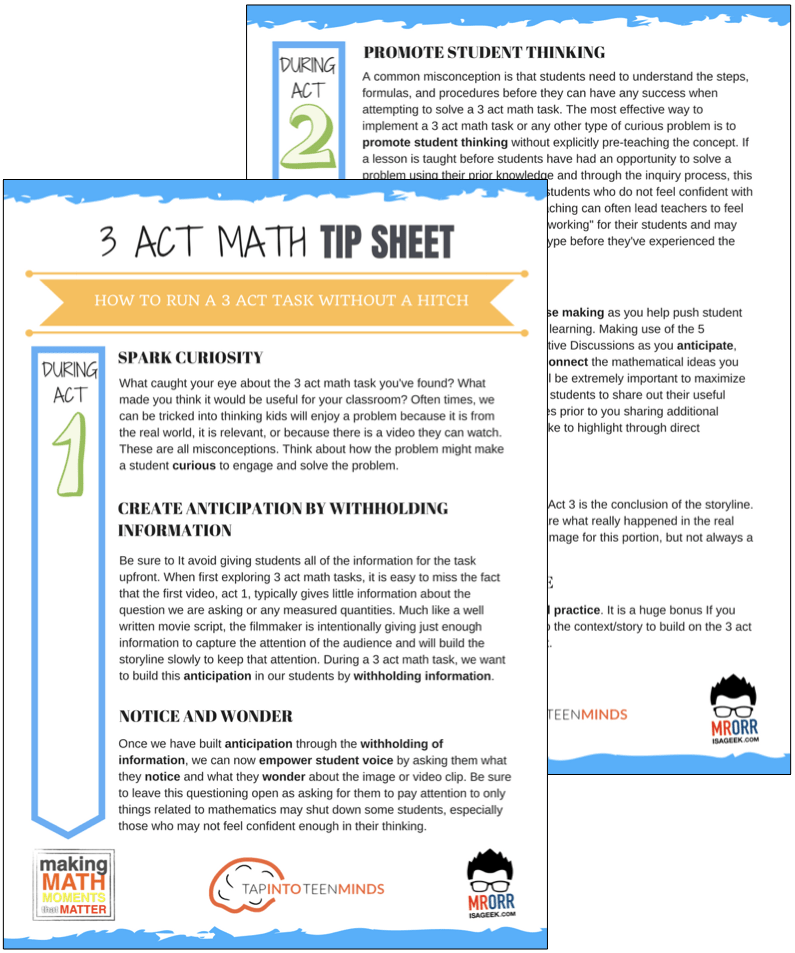
DOWNLOAD THE 3 ACT MATH TASK TIP SHEET SO THEY RUN WITHOUT A HITCH!
Download the 2-page printable 3 Act Math Tip Sheet to ensure that you have the best start to your journey using 3 Act math Tasks to spark curiosity and fuel sense making in your math classroom!
LESSONS TO MAKE MATH MOMENTS
Each lesson consists of:
Each Make Math Moments Problem Based Lesson consists of a Teacher Guide to lead you step-by-step through the planning process to ensure your lesson runs without a hitch!
Each Teacher Guide consists of:
- Intentionality of the lesson;
- A step-by-step walk through of each phase of the lesson;
- Visuals, animations, and videos unpacking big ideas, strategies, and models we intend to emerge during the lesson;
- Sample student approaches to assist in anticipating what your students might do;
- Resources and downloads including Keynote, Powerpoint, Media Files, and Teacher Guide printable PDF; and,
- Much more!
Each Make Math Moments Problem Based Lesson begins with a story, visual, video, or other method to Spark Curiosity through context.
Students will often Notice and Wonder before making an estimate to draw them in and invest in the problem.
After student voice has been heard and acknowledged, we will set students off on a Productive Struggle via a prompt related to the Spark context.
These prompts are given each lesson with the following conditions:
- No calculators are to be used; and,
- Students are to focus on how they can convince their math community that their solution is valid.
Students are left to engage in a productive struggle as the facilitator circulates to observe and engage in conversation as a means of assessing formatively.
The facilitator is instructed through the Teacher Guide on what specific strategies and models could be used to make connections and consolidate the learning from the lesson.
Often times, animations and walk through videos are provided in the Teacher Guide to assist with planning and delivering the consolidation.
A review image, video, or animation is provided as a conclusion to the task from the lesson.
While this might feel like a natural ending to the context students have been exploring, it is just the beginning as we look to leverage this context via extensions and additional lessons to dig deeper.
At the end of each lesson, consolidation prompts and/or extensions are crafted for students to purposefully practice and demonstrate their current understanding.
Facilitators are encouraged to collect these consolidation prompts as a means to engage in the assessment process and inform next moves for instruction.
In multi-day units of study, Math Talks are crafted to help build on the thinking from the previous day and build towards the next step in the developmental progression of the concept(s) we are exploring.
Each Math Talk is constructed as a string of related problems that build with intentionality to emerge specific big ideas, strategies, and mathematical models.
Make Math Moments Problem Based Lessons and Day 1 Teacher Guides are openly available for you to leverage and use with your students without becoming a Make Math Moments Academy Member.
Use our OPEN ACCESS multi-day problem based units!
Make Math Moments Problem Based Lessons and Day 1 Teacher Guides are openly available for you to leverage and use with your students without becoming a Make Math Moments Academy Member.

Partitive Division Resulting in a Fraction
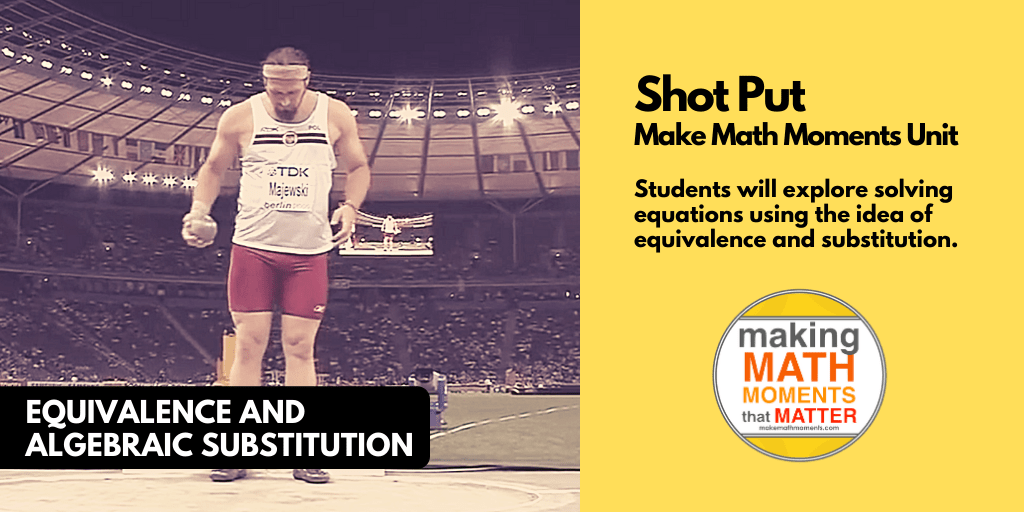
Equivalence and Algebraic Substitution
Represent Categorical Data & Explore Mean
Downloadable resources including blackline masters, handouts, printable Tips Sheets, slide shows, and media files do require a Make Math Moments Academy Membership.
ONLINE WORKSHOP REGISTRATION
Pedagogically aligned for teachers of K through Grade 12 with content specific examples from Grades 3 through Grade 10.
In our self-paced, 12-week Online Workshop, you'll learn how to craft new and transform your current lessons to Spark Curiosity, Fuel Sense Making, and Ignite Your Teacher Moves to promote resilient problem solvers.
0 Comments