
Episode #513: Math Improvement Is Fragile When It Rests ONLY on Your Shoulders. Here’s How to Strengthen It!
LISTEN NOW HERE...
WATCH NOW...
In this episode, Jon Orr and Yvette Lehman unpack a full-day session with a charter school system they’ve partnered with for about 18 months. After a year of building school-level math improvement plans, the team noticed a common roadblock: accountability rested almost entirely on principals, which created fragility in a system with frequent staff movement.
This year, each school brought a math champion to work alongside its principal or coach. Jon and Yvette walk through how the day unfolded, from defining the champion’s role and sharpening student learning objectives to building simple monitoring tools and committing to dated, short-term action steps. They also explain why doing math together and focusing on the process, not a perfect plan, matter so much.
In this episode, you'll explore:
- Why placing sole accountability for math improvement on principals can create fragility
- How identifying math champions widens ownership across a school
- Why each champion team included someone with decision-making authority
- How the coxswain analogy defines the role of a math champion
- Why having champions explain why they were chosen builds confidence in the role
- How revisiting a vision and student learning objective can reduce interpretation drift
- How a shared experience can build a common understanding of terms like conceptual understanding
- How a simple look-for scale helps teams monitor change over time
- Why short-term milestones and specific dates make action plans realistic
- Why the process of reflecting and refining matters more than a perfect plan on paper
Look at your school or district’s math improvement plan and ask: Who owns this work, and who is relentless about it? Identify one or two people beyond the principal or coach who could help champion it. Then choose one action step for the next few months, open your calendar, and put a specific date on it.
Attention District Math Leaders:
K-12 Math Leaders: Download our free Math Coherence Compass to help your teammates, system leaders, and educators create aligned instructional practices—without adding another initiative.
K-12 Math Leaders: Not sure what matters most when designing math improvement plans? Take this assessment and get a free customized report: https://makemathmoments.com/grow/
K-12 Math Leaders: Ready to design your math improvement plan with guidance, support and using structure? Learn how to partner with us and follow our 4 stage process. https://growyourmathprogram.com
Looking to supplement your curriculum with problem based lessons and units? Make Math Moments Problem Based Lessons & Units
Be Our Next Podcast Guest!
Join as an Interview Guest or on a Mentoring Moment Call
Apply to be a Featured Interview Guest
It will take less than two (2) minutes to book your Math Mentoring Moment call.
Book a Mentoring Moment Coaching Call
Take two (2) minutes to book your Math Mentoring Moment call and let's work together to shake that math pebble out of your shoe!
Are You an Official Math Moment Maker?
Ensure that you follow, rate and review on Apple Podcasts, Spotify and other platforms to show your support and ensure other math educators can find the show.



FULL TRANSCRIPT
Jon Orr: All right, let's get into this. We just got back from a travel week and we had spent half the week with a charter school system that we've partnered with for the last eighteen months or so. And honestly, a little longer than that from some of the work that we had done before the official partnership eventually began.
But in this specific trip, what we had done was gone to a meeting of principals from the charter school system itself. And what we had them do is bring along what we called a math champion. And that math champion and the principal together were working on elements of strengthening their math improvement plan. And today what we want to do is really unpack like what we did, how we did it, why we did it. But before we get into the specifics about that day, Yvette, do want to kind of set the stage of like what we did last year?
Yvette: Yeah, so as you mentioned, we've been with this team for about 18 months and where we were trying to target was essentially strengthening their school level improvement plans. You know, most schools have a math goal. They have some type of indicator or target, right? To strengthen and it's typically around math achievement. So, you know, typically we see these math improvement plans set around increasing achievement scores.
And so when we started this partnership, it was like, how do we support administrators who are responsible for creating these plans? Do so in a way that actually leads to change and is sustainable. And one of the things that's unique about this particular system is they do have a lot of movement within the organization. So teachers coming and going, principals in and out, move in between sites. And so they're constantly trying to build something that lasts and that matters because and really they're up against the fragility of the people in particular positions.
So last year we spent some time building up the capacity of their administrators, their leadership teams, on what it looks like to build a school-level improvement plan that's going to lead to sustainable change and actually change the experience for students in their classrooms. But what we've learned last year is that our target on principles was important because we always talk about how important it is for the principles to support this work and to champion this work and to be intimately involved in the decision-making around improvement planning.
But we often talk about the fact that conditions are not the same everywhere. And in every site is the principal the right person to champion this work. And it's just not always true. Like maybe the principal's brand new and they're trying to keep their head above water. Maybe the principal sits on a variety of other committees or has other content areas that they're prioritizing right now. Um, there's just a lot of reasons why maybe the principal is not always, although that we always say they need to be intimately involved in the process, maybe they're not ready right now today to champion this work and actually leaning on them is creating more fragility.
Jon Orr: Yeah. Yeah. Like last year it was to and just to to make sure we're we're very, very clear for clear that the work that we did with them last year wasn't just principals. There was teams of people sitting around a table with the administration was a principal, maybe a assistant principal, their math coach. Every every single building had an instructional coach or a math coach, all sitting at that table, brainstorming what what it is that we want to be, you know, looking for in in math math classrooms.
They went back to schools, had conversations with their staff, their teachers. And then and then I think the the champion was like came up with the the question of like I think we see this a lot in schools is to say, okay, we wrote a plan last year. It lived on paper, but where did that translate into the classroom? And how and how who is going to be the this is why the term champion came out because as a principal, we can we can help our our staff rally behind a goal or or or include them in the process of creating goals and action items and in focus zones of of of improvement.
But who's going to be the relentless? And this is a word that came up over the course of the the the that half week we spent last week. Who's going to be the relentless one to ensure that we we don't let up our foot up off the gas? Or or we're gonna, we're gonna hit these targets, or we're gonna work on these, these, these strengthening moves inside of our PLCs, or wherever we're gonna, we're gonna hold some of this work.
So we needed to widen the circle, right? We had to widen that circle to say it's not just the men and the math coach and and the people that sat at that table last year. And this is where the fragility comes in, is that sometimes that happens, is that people in this small circle hold the the math success rests on their shoulders. And what we wanted to do this year was widen that circle a little bit and ensure that we're bringing in the classroom, uh, the classroom focus into that circle. And because I think last year it's like they could have chosen people to come to that table that had were teachers, but they didn't. We said, let's make sure that the classroom champion is included in this today so that we can widen the circle a little bit to ensure that the relentlessness is there. held held accountable to the team.
Yvette: Well, and I guess I should rephrase that. Although you're right, you know, other people were at the table, who owned the work? Like who was responsible for ensuring that the school improvement goals were met? And to me, it's like that often in most systems falls on the shoulders of the principal. Although other people were part of the construction or the design, you know, there was um stakeholder input. At the end of the day, it's like who's held accountable?
From a higher level, right? Like from a supervisor position, when the supervisor comes through, or in this case, a CEO comes through or a director comes through, they're looking to the principal to say, like, did you do what you said you're going to do? Did you meet the goals you're going to meet? And what we found is that putting that on the shoulders of the principal alone, the accountability part, was not necessarily the most impactful road to go down.
Which is what most schools do. Like if you ask most schools who owns the school improvement plan, who's accountable to it, who has to speak to it, who gets questioned about it, who is asked whether or not it's the principal. Right? Like from a supervisor position. It's like who owns this work, who's responsible for this work, even if it's co-constructed, even if it's developed in a collaborative way, it's like the the responsibility kind of lands on the shoulders of the principal.
And I think what we recognize is that we talk about this all the time, like we need distributive responsibility, ownership, accountability, decision making, authority. And so when we met with their regional team to reflect on the work last year, like we basically sat down and said, you know, what worked and where were the roadblocks? And the roadblock that the regional team identified was the fragility of putting this pressure or this responsibility on the shoulders of the principal for different reasons, for different conditions at every site.
And it's like hi to your point, like how do we widen the ownership? How do we widen the accountability and the responsibility? And so when we asked the teams to identify their math champions, we kind of had a criteria, which was basically, you know, if we don't want the sole responsibility or accountability to land on the shoulders of the principal, who is ready to step up? Like who would want to step in, fill this role, and who would want to step up and take this on, you know, and be really committed and be relentless, like you said, and be open to the accountability and to being like, I'm gonna take my team.
And we're gonna do what we said we were gonna do, and we're gonna hit those targets because they matter. And so we really left it open to every site to identify those individuals. But we did specify that one person on the team had to have decision-making authority. So there needed to be somebody who could make decisions around how PLC time was spent, how staff meeting minutes were used, how resources were allocated. And so when we came together last week, we had kind of a mix. Like some teams were a principal and a classroom teacher. Some teams were a coach, an instructional coach, and a classroom teacher. Some were in an I don't think we had any that were two teachers.
And with most of our teams, if the principal was not on the team, they weren't the two identified champions, they attended for either the whole day or at least a portion of the day. So again, it's not to say, you know, principals, you're kind of like, off the hook, which is maybe not the right way of putting it. It's like, no, principals, you need to be a part of this work, but this isn't all on you. You're not the only one who is going to, you know, the CEO comes in, the director comes in, and it's like, well, tell me about your school improvement goal.
Jon Orr: Exactly. And in general yeah. Yeah. And generally when you when you say take it out of this context and you take it to other schools, yes, uh school principals typically are responsible for school improvement plans, but the larger your system gets, the the more than that uh gets put on say the the math coordinator's shoulders or the math coach's shoulders. So like if you zoom out to say it's not just a school anymore. Even maybe it's a large school and you have a math coach in the building, then all of a sudden the the the accountability shifts to that one person.
If you go out to say I'm I'm I'm looking at multiple schools in a region or district, then it's like, okay, schools have math improvement goals, but then math success is now district wide on the math coordinator's shoulders. And that same kind of uh pressure exists there to say, like all of like my our math success rests here. But then we have to ask ourselves the same question generally is to say, where's the distributed leadership happening? And are you shouldering this accountability yourself? And where can you bring in relentless others to shoulder this with you?
Because uh the fragility of your system will rest on your shoulders. When you step away, then the maths the math plan or the math process of for that planning is is now going with you, unless unless you've built say that successful team aspect. Uh many systems have a math task force to battle against this, or a math like uh um council, we've heard it been called. But and this is one of the recommendations we make with larger systems is where is this team that makes decisions and supports and carries out the support across the the system.
So that's kind of what it looks like system-wide. Okay, let's go back into this context in this system. Um, what let's describe I think some of the activities that this group did because their goal by the end of this one full day session is to basically as a team widen that circle uh and make sure that we there's clarity and coherence around what is it that we want uh to be our priority here inside the building. And then specifically, what are we gonna do about it? You know, like we could put it on paper. We can put our math vision on paper. We can put our three-year or one-year target on paper, but what are we going to do about it? And how are we going to know that we made improvement? And that was the main goal of the day. And that team can can can generate that together, but give them time and space to ensure that they could answer those questions by the end of the day moving forward. So what are some of the activities that we kind of help them navigate so that if I'm listening to this and I'm looking at uh supporting schools or maybe it's just within my school, what I should be doing with my staff to uh also get very clear on what it is we should be improving on this year and how how it would look.
Yvette: One of the things we started by doing was really defining the role of the champion and trying to be super clear that it doesn't mean because you're here in this room today, now all of the work is yours, all of the decisions are yours, all you know, this is now your plan. You're the we always give this, you know, and I use the rowing analogy that day. Sometimes I use the canoe, but that day we were rowing. And I'm like, you're I did. I watched Kurt. Exactly.
Jon Orr: That's because you just watched a teen drama show or something.
Yvette: Highly recommend. But you know, I was describing it's a rowing team and maybe you're the coxswain of that rowing team. And it doesn't mean that nobody else is paddling. It just means like you're helping the team keep building momentum and you're helping them set the course and you're helping guide and give direction, but it doesn't mean that, you know, you're the only one rowing. So your goal is really to get more people rowing in the same direction.
Jon Orr: But understand the direction and be clear on the direction.
Yvette: Right. And so that was really important for us to establish for these champions, like what your role is, and it's not to come to this space outside of your building and to make all the decisions. It's to think about, you know, how are we going to go back to our site and create experiences to get more people rowing in the same direction at the same speed. And so that that was important, and also really thinking about, you know, why you were selected, what qualities you bring to this role. You know, clearly somebody tapped you on the shoulder and said, We want you to be our math champion. So why?
Jon Orr: Right. Right. I found it particularly impactful but also uh inspiring when the prompt that you had everyone uh kind of share was defending why they may have been chosen. Uh they had to come up with reasons themselves to say like why would I have been chosen uh to be the math champion? But now I have to do a stand up, hand up, pair up protocol where I go and I meet with a person I don't know across the room. Um, and tell them why I would make a good champion. I think it's that activity, I think when you have to say it out loud, sometimes you say it to yourself when you might believe these things, but now saying it to someone else, you truly believe it. And I think that's helpful for them to like establish why they're on the team and reaffirm they're the right person on the team.
Yvette: So once we'd kind of established, you know, tried to build some clarity around the role itself and in empowered individuals in the room to be, you know, to own what they bring to the table and the qualities that they have. Keeping in mind this is not the first time we've worked with these teams. So last year, every site had done some work around their vision and their student learning objective.
And so we always describe that process of, you know, creating a shared vision and identifying your target zone through a learning objective as iterative work. That's why the flywheel represents like these continuous cycles of improvement. And so we ask the teams, you know, come back to the table, revisit the vision and the objective that your school established last year, and you know, see if there's room for improvement. And what we often find in this work is that the first time teams write a vision or a student learning objective, they're usually ambiguous and open to a lot of different interpretations. And so what we try to do in our second or third pass-through is like say what you mean and paint a really clear picture so that you can reduce the interpretation drift.
Jon Orr: Yeah. Like you you had very specific prompts to to and showcase like here's here's a a student uh learning objective, here's one that's a a little clearer and less ambiguous. Now go and write yours so that it or modify yours so that it's very it's less ambiguous in the in the conversations at the tables where people asking themselves, like if I use this term and you use this term, would we see the same picture and and would we say the same things? And what would I s if I asked teacher to explain that term, would they explain it the same way I did? And if not, then two things have to happen. Either we need to explain this in our objective so that we're clear on what we're trying to do, or that automatically, and this is something that we helped the teams with, is automatically became one of their important key action items as their next steps, which basically saying, like, if we if if I can't be certain that if I use the term fluency or if I use the term productive struggle, if I use the term resiliency and what that looks like in the classroom, then we need to add this to our action items to say when we go back to our classrooms for the for the probably the rest of the year, we need to make sure that when we get to the end of the year, we get to maybe it's only 90 days from now, that if I ask the question again, we are all clearer. We are all a little bit clearer, we're all a little closer.
In the description we give when we use these terms, which means now I have to like layer in where is my where is my professional development? Is it in my staff meetings? It is in my PLCs. Like, how do I create the experiences for teachers to shorten that gap or close that gap in in the ambiguity around these terms? Because I could I can write whatever you want on a piece of paper, right? Like you can write anything you want about a goal or a vision statement. But if no one if everyone is interpreting it in different ways, it doesn't matter because you're nothing's going to be achieved anyway, and in there anywhere towards your goal, because we haven't created that clarity. We haven't painted what or or you know shown everyone what the box needs to look like. So it becomes the experiences have to become the rallying behind that. And and it once you are convinced that you all have clarity around the vision, then then now start to like create more opportunities for experiences to strengthen the instructional practices around that in the classroom. And I think that's an important thing that this the all of these teams had to grapple with while they sat at tables together uh because there was a lot of conversations around like ensuring that we understand what this word means. And there was a lot of rewrites happening at that table.
Yvette: Yeah, and I was gonna say, like, to me, it's not even like we can rewrite, and that's great. But I think what's most important is what you just described is how do I go back to my site and create an experience so that when we all see the word, we have a more coherent vision or picture in our mind of what we're talking about. So an example I'll share is we had one of our sites build their student learning objective around basically the practice of building procedural fluency from conceptual understanding. But the principal and the teacher on that team were debating what conceptual understanding meant.
And I mean, we've had this debate on the podcast, right? Where it's like, well, what is it well defined? Are we all interpreting it the same way? And so one of my recommendations was I had attended James O'Neill Jr.'s session from the summit last year. And you know, his whole platform is around like make it make sense. Like unpacking procedures and and not ignoring the why. You know, when a student says, Well, why does it work, or how does it work, or does it always work, to lean into that question and to really understand? And so my recommendation was like, why don't you at an upcoming staff meeting watch that session together? Create some dialogue and some discourse and connect it back to your student learning objective around conceptual understanding. And that's what we're what we mean by like an experience, like rather than coming in with all the answers or having rewritten the student learning objective and now just presenting it to the staff, let's do that rewrite together after we've had a shared experience.
Jon Orr: Where did we go from there? Because we spent most of the time giving time and space for these teams to grapple with these ideas and and and share practices and write write these and rewrite and think about the processes. How did we end the day?
Yvette: Well, I guess we we need to go to the middle first. So the the middle of the day was one piece that we thought teams needed to strengthen, which is how are they going to know that they were making improvement toward their student learning objective? So let's say their student learning objective was around, you know, um, students will make sense of and persevere through problems, uh, students will build procedural whatever it was, how will they know? six months, twelve months, eighteen months from now, that their effort and their actions are leading to an increased outcome for students in that zone.
And so that's one thing that a lot of our school level teams, you know, are striving to define is what does what does success look like? And the great thing about that process is when you have to define how you would know, you essentially elicit some success criteria, which also helps you clarify your student learning objective. So it's kind of a uh multi-purpose process. It's like, yes, we need to monitor change over time. But the way we go about monitoring change is going to help us strengthen our understanding of what we're trying to achieve.
Jon Orr: Can you describe what what some of the examples we showed them look like?
Yvette: Yeah, so I think I've talked about this example on the podcast before from one of our other sites that we're supporting right now intensively. And essentially, you know, they created a look for document that was co-constructed. So with their task force, they came up with, you know, I will see, I will hear kind of indicators of success. We used that to go in and do some observations. And then eventually they were like, well, how are we capturing evidence? You know, like what does it look like? Is it tally marks? Is it annotated comments? Like what is it?
And so that team decided and they they decided this. It was like their task force, which is made up of principals, teachers, coaches. They were like, it would be okay if we kind of put it on a scale, like a Likert scale, an open number line. And they chose the qualifiers of none, meaning like no students are demonstrating this behavior or the this these types of behaviors to like most or all. And so that was one of the examples that we shared of just like, can we ki quickly kind of capture through a temperature check how consistently are we observing students demonstrate these ideal or desired behaviors when we walk through a classroom and we observe?
And the powerful thing about I think that particular tool is that when teachers self-assess their, you know, like they look at the success criteria as examples of these behaviors we're looking for. They're not gonna say all of my students are demonstrating these skills, like or the these competencies, because otherwise it wouldn't be a good learning objective. If we already had most of our students demonstrating these behaviors, then we're not targeting the right zone. We've selected a zone that we know there's room for improvement. Therefore, maybe our dots right now are leaning toward, you know, few or some. And the idea is that over time can we move that dot closer to most? Like we're just trying to move down that continuum so that more students are more consistently demonstrating these behaviors that we've defined as success.
Jon Orr: Yeah. Yeah. That was a good it was good good part of the the day to to make you know make sure we we touch on this point because you know, many school systems, what we're really doing is they're saying, like, we want school improvement or we want math and to improve, we want structural practices to improve. And so what we actually rely on is we go and we look at st you know, achievement scores from standardized test results, or we look at pass rates, but we or or we just go by gut. I think we've had some improvement.
But what these teams are doing is is actually collecting baseline data. They're collecting the the you know, they're they're they're finding the look for us, but then they're putting that into use to see in real time. I'll say real time, but it's like they'll see in in a short time period, not waiting for a year to pass before they see any sort of uh cloudy results that they can actually attribute back to the success. They'll see real success of like what they're actually looking for.
One of the, you know, I think the core beliefs we have at Make Math Moments is just basically say if you you need to measure the change you want to see. And and if you are looking for a change in say a teacher's understanding or teacher's practice, we get we've got to be measuring that. We got to be we got to be looking at how will we know um and and developing that tool. And these these teams were developing these these tools to help them answer that instead of relying on these these cloudy metrics, which are great for long term range data, but not great for determining whether we've made improvements on the tools and the strategies and the processes you put into play. Um, which is, you know, something that we believe that every team who's serious about the process of continual math improvement to make. So which means that you have short-term measures to see where are we making success so we can make corrections right away instead of waiting for the end of the year.
Yvette: Now I can talk about the end of the day. I'd like to want to skip the middle part. At the end of the day, teams worked on their action tracking sheets, which is essentially describing in detail what are they going to commit to doing between now and a short-term deadline. So we talked about this on another episode where we said, you know, key results, we used to think about these milestones as, you know, at the end of the year or by May 2027. But what we're finding is that in order to be relentless, we need to have short-term targets that we can hit and then keep the momentum going. And so we talked about things like, you know, by the end of December, by the end of the first semester. What goal do you want to hit? What milestone do you want to achieve? And what can you commit to? What action steps are you going to take? Are you going to run a staff meeting? Are you going to put a particular protocol into PLCs? Are you gonna do a survey? Are you gonna do a walkthrough? Like, what are you actually going to act on?
And we always encourage teams as well to be really like put the date down. Right? It's like open up your calendars now. And if you're saying one of our action steps is to, you know, build coherence through a shared experience at a staff meeting, what staff meeting? On what day? At what time? Like because otherwise we just know. That you and Kyle used to describe this when we worked together at the district level, he'd say, like, people would leave RPD and they'd get back on the hamster wheel of doing all the other things that they have to do. And so if we don't really lock it in when we have the the space, you know, it's a privilege to come out of your building into this space, right? Where there's time to think and there's time to be really intentional. So that's
Jon Orr: Right. And I I think what the date well, I think what the date does too is it helps teams and it helped these teams get realistic about what they actually could commit to. Because when you're forced, like when you're walking around, when you're rocking around that that those tables and saying, like, what date are you gonna put that on? Like when when are you gonna do that? And they they start to reflect and like, Well, I don't really have a lot of time. And exactly. So it's like w but where then? Like which means like either you're so you're relentless about school improvement in mathematics, or you're not. And it's okay if there is no time to do it because you're just saying there are other priorities. But what you have to then be okay with is the results that will come by 180 days later. Like you can't look back and go like, I just wish it was better. Like because you didn't allocate any time to make it better, which is something we all have to live with. when we when we're in this world, which means like, but but you're when you're forced to put the date down down, you're you're basically saying, like, I actually could commit this time and the this space to do this because now I actually because the dates force me to think about what's required that will go into that. I have, I can block off this time. I can, I can schedule this here. I could put I could schedule this session. I have time with principals here. I have time with you know my my staff here. Like you're now forced to kind of like look at all the mechanics and the logistics to make these things come true. And without that time measurement, you you won't do it. Like you'll just say that's an important thing for us to do, but not actually schedule it. You have to reverse engineer the the pieces to actually achieve the goal. And and time helps you do that.
Yvette: And that's also where the regional team can support and create some accountability as well. So if we have access to this tracking sheet for every site, and it's like, I see that this particular site has a staff meeting coming up where they're going to be doing you know, a shared experience around their student learning objective and creating their walkthrough tool, well, we reach out ahead of time and we see what support they need and we see, you know, any how would it clear the path for that team, for those champions. And then we follow up after. And we ask how did it go? What were the outcomes? And that's what helps to keep this work going and it helps us all remain relentless is having that accountability partner as well as, you know, a tool that helps keep us on track. And that's what we were trying to create for all of our teams.
Jon Orr: Mm-hmm. Right. Yeah. So most teams were either the and and to be honest, and to be to be clear, this these teams didn't have completed tracking sheets when they walked out the door. They they had started started working on on them. The other thing I think we didn't mention here specifically um yet is that during the day we took three different instances to do math together, which is one of our core beliefs. Around any sort of professional development is that when we bring adults together, we do a math activity for the sake of doing a math activity and strengthening our own understanding and capacity building for mathematics.
So we kicked the day off with an activity. We did one right uh after our first break, and then we did one right after lunch. And that was it sets the tone, it creates, you know, the culture, it showcases some some pieces that you know creates a little bit of coherence around some of the the the words that you tend to use when we were describing math math uh experiences in class. So we that's something that we always do when we bring people together. And we're trying to replicate that because that's uh a message we want teams to put into play at their own school sites is that when you bring people together, you also should be focusing on this because building our own math capacity is say the gatekeeper for us to acting flexibly in the classroom with any sort of curriculum or any sort of resources that we have. Like we have to we have to strengthen our own capacity to do that and be to be able to uh uh to to move flexibly in the class.
Yvette: The last thing I wanna share with uh, you know, anybody who's listening who's stuck around for this whole episode today. Yeah.
Jon Orr: There's a couple people. There's a couple.
Yvette: It's great. Thanks for being here. I one thing I always want to caution people as well is that at this point in the process for these schools that we're supporting, whether they have a perfect vision or a perfect student learning objective or a perfect monitoring tool or a perfect tracking sheet is not how we measure success. Like I would never expect somebody who's early in this process or on their, you know, first or second iteration of this refinement to, you know, have this completely figured out.
And maybe, you know, they do. Like it's like, imagine that's like, oh wow, everything checks all the boxes and this looks great, but it sits on the page and it never lives within the system. And there's no nobody seeking feedback and seeking opportunities to refine and constantly questioning, you know. Are we making the impact we wanted to make and how do we know? And really to us, that's the indicator of success of a school that's really building the conditions for true change, is if they're constantly trying and adapting and reflecting and refining and asking, how do we clear the path? How do we find more solutions to the problems that we're encountering? And if they're doing that collectively and collaboratively, and there's a culture of learning in their building. and they're keeping that target clear and the the coxswain has them all rowing in the same direction, it doesn't matter if it looks perfect on paper.
We sometimes get hung up on the language or, you know, does it say it in exactly the perfect way that we would want? And it's like that to me is not
Jon Orr: Right. The product.
Yvette: yeah.
Jon Orr: Yeah, it's the process, not the product. That's the important part to remember. If one of the other things that we use or we referenced in this session was uh a tool that we use with many of our teams, which is called the Math Coherence Compass, which is a a f decision making framework tool that helps create coherence across a system like a like a large system like this, and or even in a school, uh for from the principal down into the you know the teachers in the classroom.
The math coherence compass, you can click a link below to get a copy of a blank compass, but also a video training that goes with that compass. You can see how we've built them and how we use them with Teams. Um, that's in the link below. Uh and if you are looking to uh you know build your math improvement plan but need a second set of eyes, you need a uh an accountability partner, you need a team that has done this with many other teams. We have some slots still open. for us helping coming in and helping you build that math improvement plan. You can click a link below there as well to book a discovery call with our team to see if we're the right fit to help you build a math improvement plan. Until then, we'll see you in the next episode.
Your Customized Improvement Plan For Your Math Classroom.
Take the 12 minute assessment and you'll get a free, customized plan to shape and grow the 6 parts of any strong mathematics classroom program.
District leader/math coach? Take the District Assessment
Thanks For Listening
- Book a Math Mentoring Moment
- Apply to be a Featured Interview Guest
- Leave a note in the comment section below.
- Share this show on Twitter, or Facebook.
To help out the show:
- Leave an honest review on iTunes. Your ratings and reviews really help and we read each one.
- Subscribe on iTunes, Google Play, and Spotify.
The Making Math Moments That Matter Podcast with Kyle Pearce & Jon Orr
Weekly interviews, strategy, and advice for building a math classroom that you wish you were in.
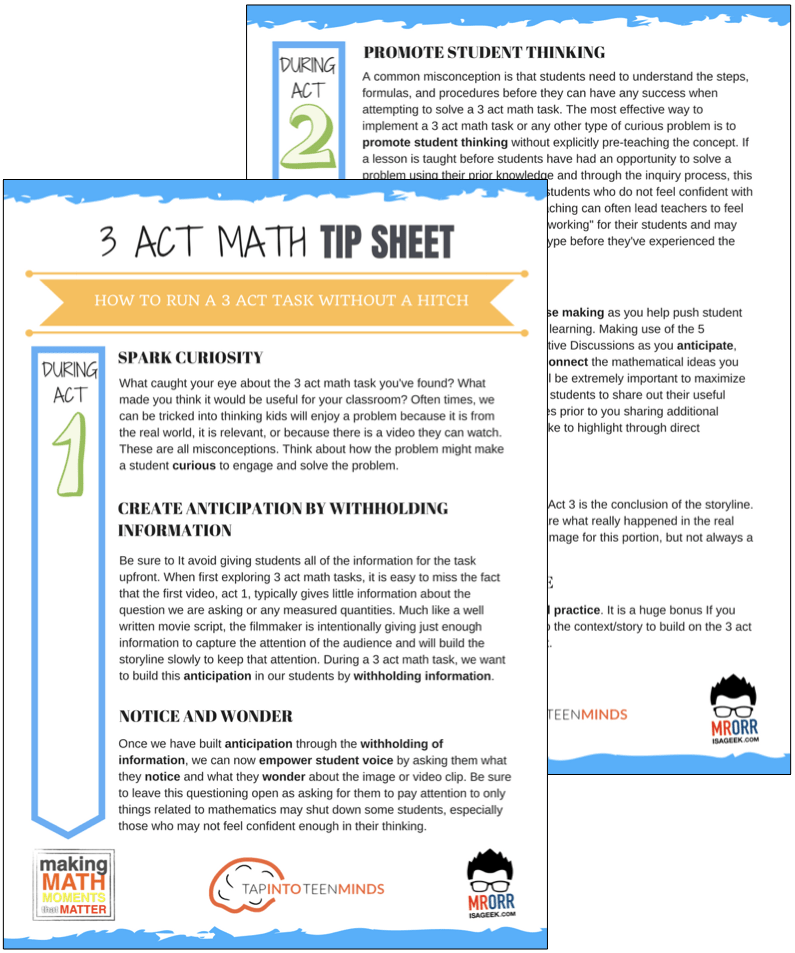
DOWNLOAD THE 3 ACT MATH TASK TIP SHEET SO THEY RUN WITHOUT A HITCH!
Download the 2-page printable 3 Act Math Tip Sheet to ensure that you have the best start to your journey using 3 Act math Tasks to spark curiosity and fuel sense making in your math classroom!
LESSONS TO MAKE MATH MOMENTS
Each lesson consists of:
Each Make Math Moments Problem Based Lesson consists of a Teacher Guide to lead you step-by-step through the planning process to ensure your lesson runs without a hitch!
Each Teacher Guide consists of:
- Intentionality of the lesson;
- A step-by-step walk through of each phase of the lesson;
- Visuals, animations, and videos unpacking big ideas, strategies, and models we intend to emerge during the lesson;
- Sample student approaches to assist in anticipating what your students might do;
- Resources and downloads including Keynote, Powerpoint, Media Files, and Teacher Guide printable PDF; and,
- Much more!
Each Make Math Moments Problem Based Lesson begins with a story, visual, video, or other method to Spark Curiosity through context.
Students will often Notice and Wonder before making an estimate to draw them in and invest in the problem.
After student voice has been heard and acknowledged, we will set students off on a Productive Struggle via a prompt related to the Spark context.
These prompts are given each lesson with the following conditions:
- No calculators are to be used; and,
- Students are to focus on how they can convince their math community that their solution is valid.
Students are left to engage in a productive struggle as the facilitator circulates to observe and engage in conversation as a means of assessing formatively.
The facilitator is instructed through the Teacher Guide on what specific strategies and models could be used to make connections and consolidate the learning from the lesson.
Often times, animations and walk through videos are provided in the Teacher Guide to assist with planning and delivering the consolidation.
A review image, video, or animation is provided as a conclusion to the task from the lesson.
While this might feel like a natural ending to the context students have been exploring, it is just the beginning as we look to leverage this context via extensions and additional lessons to dig deeper.
At the end of each lesson, consolidation prompts and/or extensions are crafted for students to purposefully practice and demonstrate their current understanding.
Facilitators are encouraged to collect these consolidation prompts as a means to engage in the assessment process and inform next moves for instruction.
In multi-day units of study, Math Talks are crafted to help build on the thinking from the previous day and build towards the next step in the developmental progression of the concept(s) we are exploring.
Each Math Talk is constructed as a string of related problems that build with intentionality to emerge specific big ideas, strategies, and mathematical models.
Make Math Moments Problem Based Lessons and Day 1 Teacher Guides are openly available for you to leverage and use with your students without becoming a Make Math Moments Academy Member.
Use our OPEN ACCESS multi-day problem based units!
Make Math Moments Problem Based Lessons and Day 1 Teacher Guides are openly available for you to leverage and use with your students without becoming a Make Math Moments Academy Member.

Partitive Division Resulting in a Fraction
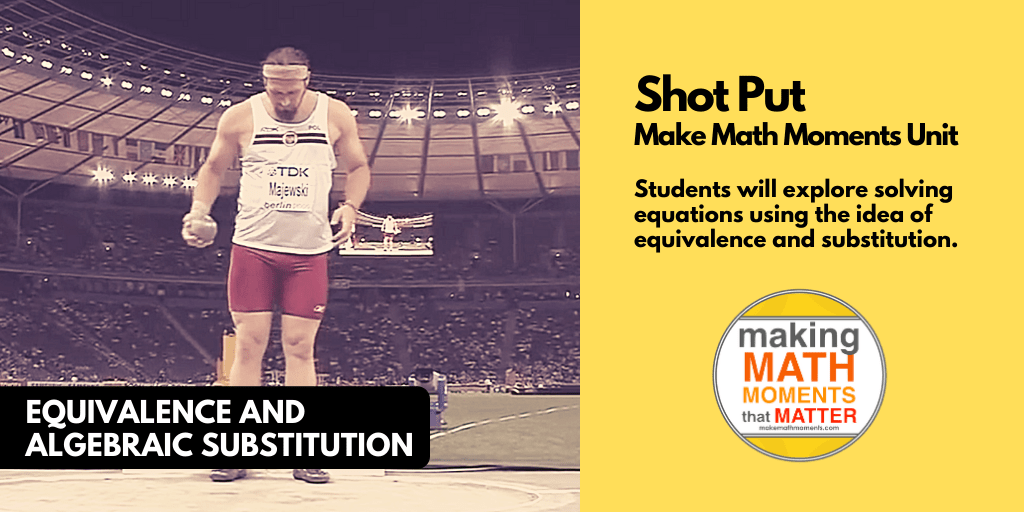
Equivalence and Algebraic Substitution
Represent Categorical Data & Explore Mean
Downloadable resources including blackline masters, handouts, printable Tips Sheets, slide shows, and media files do require a Make Math Moments Academy Membership.
ONLINE WORKSHOP REGISTRATION
Pedagogically aligned for teachers of K through Grade 12 with content specific examples from Grades 3 through Grade 10.
In our self-paced, 12-week Online Workshop, you'll learn how to craft new and transform your current lessons to Spark Curiosity, Fuel Sense Making, and Ignite Your Teacher Moves to promote resilient problem solvers.
0 Comments