Episode #451: Your Math Results Are Stagnant: Why Improvement Keeps Stalling
LISTEN NOW HERE…



WATCH NOW…
Every year, schools and districts roll out a new math improvement plan. The language sounds right: teacher voice, coherence, sustainability, research-based practice. But the results don’t change. New curriculum is dropped with little support. Big goals are set without the conditions to meet them. Top-down decisions are labeled collaboration. In this episode, Jon Orr and Yvette Lehman name the uncomfortable truth behind stalled improvement: when what leaders say doesn’t match what their system is designed to do, trust erodes—and progress stops.
In This Episode, You’ll Learn:
- Why most math improvement plans are recycled versions of old ones
- How the say–do gap undermines trust and implementation
- Why curriculum adoption alone doesn’t move the needle
- The conditions that actually support meaningful math change
- Why ambition without system capacity leads to failure narratives
- How doing less—strategically—creates more impact
- How the Math Coherence Compass helps leaders align beliefs and decisions
If you’re ready to stop repeating the same math improvement cycle and start designing systems that reflect what you truly believe about teaching and learning, this episode will help you get real—and lead differently.
Attention District Math Leaders:
Not sure what matters most when designing math improvement plans? Take this assessment and get a free customized report: https://makemathmoments.com/grow/
Ready to design your math improvement plan with guidance, support and using structure? Learn how to follow our 4 stage process. https://growyourmathprogram.com
Looking to supplement your curriculum with problem based lessons and units? Make Math Moments Problem Based Lessons & Units
Be Our Next Podcast Guest!
Join as an Interview Guest or on a Mentoring Moment Call
Apply to be a Featured Interview Guest
Book a Mentoring Moment Coaching Call
Are You an Official Math Moment Maker?



FULL TRANSCRIPT
Jon Orr: Okay, let’s get into, I think, something that is very much top of mind for us as we mostly come out of the meetings that we support our teams with, any new teams that are saying, hey, we’ve got some space, know, because we do have some space open for going into next year for supporting schools, school districts in math improvement and math improvement plans.
But we come out of some of these early meetings and we, you know, when you feel like you’re like, there’s something that’s just not sitting right yet. There’s a, and that’s really what we’re talking about here, which is really around this idea of, I guess, I guess we’re going to frame it as fundamental beliefs and fundamental core, core beliefs about what we’re, what we say and what we do.
And I think maybe that’s the better way to say it, Yvette, is that we come out of the, and this is where we’re, you know, we just hit record because this is top of mind and we’re gonna be very passionate. You’re gonna hear Yvette get passionate in just a sec.
So, you know, it’s kind of like, what do we say is important in math improvement and math here at our school or school district? And what do we do? Are often what we’re seeing, two completely different things.
And, when we close the gap there is when we start to see improvement. So let’s talk about how wide the gap is when we think about like what we say is important and then what we’re doing to about it. All right, I’m gonna let the reins go.
Yvette Lehman: I guess it also comes back to this question that we’re constantly striving to answer with our district and school level partners is what’s different about this plan than every other plan before?
Right, so we’re not new to improvement planning at the state district school level. This is the work that we do that’s ongoing. So why is this plan going to be more impactful, more effective, more sustainable than every other iteration in the past where it just hasn’t yielded the results and we’re in this doom cycle of try and then toss and try and then toss.
And one of the things I’ve been wondering lately is kind of to your intro, which is when we say things like, we believe that teachers need to have a voice in the process. We believe that teachers need to be the ones doing the thinking and doing the work and coming to the table and digging in and they need some autonomy over the how and what it’s going to look like.
And we believe that creating space for that and networks is important. If we believe that, like if that is a fundamental belief that we’re like, with change is gonna happen, you know.
Jon Orr: Wait, what?
Now you’re saying we, you’re talking about, hey, I’m at the district office or I’m at the school, you know, office. I’m supporting teachers or I’m planning professional development. I’m in charge of curriculum, all of these things. I’m not a classroom teacher.
I make decisions around the direction of where we want to go in a year for improvement planning purposes. We say these things are important. Give us the example.
Yvette Lehman: Well, and I guess it’s like, if that’s something we fundamentally believe, that we’re like, change is going to happen when, like we’re talking about ultimately change getting to the student desk, you know, transformation in student learning outcomes, student dispositions, student attitudes, you know, student confidence.
Like we want the change at the student desk in the student experience. And if we fundamentally believe that a critical part of that work is that teachers are, you know, in it, they’re invested, they’re open to the change, they want to be a part of the transformation, they’re looking for the solution, then everything we do to design professional development should honour that belief.
But sometimes it’s like because of time or because of, you know, constraints, we do. And I guess my, so then what’s different?
Jon Orr: We sacrifice our beliefs. And then up.
Exactly. You just come back to the same old same old. You know, we have often said like, got to change the change. Like you got to change what you’re trying to change about what the way you go about improvement planning.
And because, we get on calls and we say, well, what do want to, you know, what do want to focus? What do want your, your one objective to be by the end of the next year?
Like we’re going have a, you know, we’re going to have a like you just said, we’re going to have a, we’re going to make sure that we create coherence across the system and we’re going to get voice.
But it’s like, but the rollout of that is going to be like, well, we’ve already predetermined what the objective is going to be. And then now we’re going to tell everybody how to do it. Like, is that really what you’ve just done?
Like you have to decide what are like, and we see this a lot is that you, haven’t really defined what we truly believe about some really core issues around education.
We maybe haven’t talked about it with our leadership partners or our teachers or we have to sometimes have these tough conversations like what do we truly believe about how to motivate individuals because that’s kind of what you’re that this is kind of like why we say what we say about especially teacher voice is like we want teacher buy in.
We want everyone to be on board with what we’re trying to do. We’ve got an idea. We know it’s rooted in research practices like this is important stuff. Not everybody knows what we know, but we need everyone to be like rally behind this.
And so we want to build in voice. But then we say we want to build in voice, but we still know this is the right way to do it.
Like, that’s still a tough thing to do. It’s a tough conversation to have, but you still have to decide what is it that you truly believe about how to motivate individuals and get by.
If getting teacher voice is part of that process, you have to, you’re right, you have to design all the professional development that you’re trying to do, let alone decide on what the vision for math instruction is going to be with teacher voice in mind.
How do you really do that? We have to fundamentally, we have to list, describe, what are our fundamental core beliefs around the improvement here in education?
What do we truly believe about how to motivate? What do we truly believe about how students learn mathematics? What do we truly believe about how educators learn math, like how educators learn how to perfect their craft? What do we truly believe about the student experience? Like these are things we have to answer because they guide decision making.
Yvette Lehman: And I think the problem is when we say we believe something, but then our actions don’t reflect that belief, we lose trust.
And this is the continuous cycle we sometimes find ourselves in because of constraints and because of things that are out of our control often, but it still doesn’t change the impact.
Another example that’s come up, you know, in our research lately and our conversations has been like, do we believe that buying a new curriculum or new resource and downloading it into the system is going to move the needle?
So we’re like, you know, now we’ve bought it, we’ve put all the money into it and here it is. It’s going to show up at your classroom door the first day of September. Go ahead.
Like, do we believe that that is going to empower teachers, build teacher confidence, impact student achievement, and does the research say that that’s true?
And like, if the answer is no, you’re like, of course not, you know, dropping a resource on teachers with no networks in place for support or capacity building, and we always go back to, and it’s not five hours or 14 hours of pull-out PD, it’s sustained, ongoing, you know, intensive support that’s offered to support implementation with integrity, if that’s what’s actually necessary to move the needle or build teacher confidence, impact student achievement, then we believe that.
We have these conversations at the district level, of course, but that we continue to drop resources.
Jon Orr: Right. Like I think what was more reality is that everyone says yes to your question. I true like that’s I think that’s what you’re meaning.
It’s like, yes, we believe that a core resource is essential to math learning in our schools. And it’s like gives us a floor to build from it’s an important component of the work we’re trying to do.
But, you know, so but my actual actions are to drop like what you’re saying to drop it in on you because you think that’s actually going to solve the problem.
Because I think yes, we need it, but also yes, it’s not the only thing that’s gonna actually move the needle here.
Yvette Lehman: Well, it’s like, we know that the resource alone, you know, without sustained support and understanding of implementation and, you know, feedback from administrators on board, right?
Like without all of those things in place, it’s like, we just, you know that the impact isn’t going to be significant and that it’s only in many cases, especially in elementary where teachers are teaching multiple subjects, it creates overwhelm, it creates frustration, creates distrust in the system.
Jon Orr: Yeah, I think what happens is you’re right, people are saying no, I know it’s not the only thing that matters, and so then they drop it still.
We say one thing, we do another, but I think the third or the other way people are looking at it is going, but what else can I do?
And that’s what perpetuates the cycle of like, okay, I’m just gonna drop it because I’ve got no other better ideas. It works somewhat last time. This is supposed to fix it a little bit more. Let’s drop it.
Then if you did ask them to reflect on, well, how are you gonna support it? How are you gonna roll out the actual required amount of professional development that you’ve now understand is is required to get you the results that you want is to have, you know, consistent adoption, consistent use of the, you know, by integrity and, and all those all of the above that you are imagining that this is going to solve is and going like, Okay, I’m gonna, I’m gonna do this.
But now, I can’t, I don’t have the funds to do all of that. Like that would take this, that would take this week, like, but we have we bought it.
So then it’s like, we’ll just keep doing what we do. Right.
And then it gets, it gets overwhelming because you feel like you’re in an unsolvable situation.
Yvette Lehman: Mm-hmm. Well.
I think that we’re trying to stop the doom cycle, you know, stop this constant, we need to start again, we need to buy something new, we need to put in a new initiative because what we’ve been doing hasn’t been working.
We really need to focus on strengthening the system we have and how it’s built to support and sustain change. And that system’s going to be held up by what you fundamentally believe.
It’s going to take or what are the conditions? Like what are the conditions for change? Like thinking about human behavior and how people respond and feel empowered.
It’s like, what are the conditions that are gonna support meaningful and authentic change and reflection and refinement and, you know, people asking questions and digging in.
And it’s like, if we can identify the conditions and we can commit to them and not waiver from them, even if it means doing less, or only committing to so many places or pulling back on the ambitious goals maybe that we had for this year because we need to get real about what we said the conditions were for building sustainable systems that allow change to happen, and sticking to it.
Jon Orr: Yeah. Yeah. And I think it’s just we just don’t know what sometimes what those conditions are until you know what those conditions are, you have a hard time making the decision of like, how do I support it in this way?
Like, like, how do I structure, the subsystems of support that I have the PLC is the coaching the large scale pullout sessions that I have, how do I, how do I create coherence across my school or my school system to rally behind this idea or if it is about in supporting the installation or the adoption of this curriculum is how can I create those conditions and can I create them first at a small scale to know what actually is needed?
It’s like if I fundamentally know that it takes 49 professional development hours, well, how do I do that at a small scale to show that that curriculum in that grade level, in that school, with that leader?
With the support on the leadership side, the support on the facilitator side, the support on the coaches side, the support on the intervention teacher side, all of those pieces matter.
And when we create coherence with all of those individuals and all those pieces around this one thing, hey, we’re seeing traction in that first year of adoption because we created the conditions that matter, because we had control over a small subset of our people.
And now we can make the decision if we have support to go farther or the next grade level or we move the support to another grade level, or we open it up because we’re now seeing the success of the conditions that we created.
Like we’d rather see teams do that type of work than just go like rolling out K to 8, drop it. We know we can’t support it, but we’re just hoping.
Yvette Lehman: Right, and I mean, we can continue to do that, but it’s not going to result in any significant difference at the student desk. That’s just the reality we have to be okay with.
So it’s like if we don’t want things to be different than the last five iterations of this plan, then we’re gonna keep doing what we’re doing.
Jon Orr: Right. Yeah.
Exactly. It’s like, just, you’re right. You have to just, and I think sometimes you just don’t know that that’s what it’s going to be.
You, you, a lot of times we have these epiphanies when we have these types of conversations with the teams we’re supporting is, is we’re providing you this information around the conditions that matter.
And we still are, have unique constraints that we’re under that we can’t solve. But now that you know it, will adjust your outcomes and your expectations.
And that actually is really important for what you can decide to commit to because you might just understand like, this is what is required.
I can’t do any of that, or I can’t do half of that, or I can’t do a third of that.
But you just now go, okay, so that changes the reality of where I think we were gonna end up at the end of year.
And that’s, am I okay with that? I just have to ask myself, if I’m not okay with that, then what am I doing to adjust those expectations knowing that I’ve got these conditions in place.
Which condition do I want to change to create the outcome that I want? Or if I am realizing that I’m happy with that based off my current constraints, then great.
That’s good for you knowing that what you know to maybe you can make adjustments into the next year.
But I think knowing helps you sleep better at night.
Yvette Lehman: For sure.
I think that’s actually, I think we have a session this Friday with some of our school teams with a larger organization that we work with.
And I think the title is like, let’s time to get real. You know, like it’s like, we can be as ambitious as we want to be. We can set these goals, but the problem is when we never actually achieved them because they were unrealistic based on the conditions we have in place or the strength of our system to sustain change.
Then we end up feeling defeated, deflated, like it was a failure and we throw it all out.
We scrap it rather than just saying, you know what, we just didn’t actually match our outcome with the reality of the system that we have to support change.
Going back to this idea, just to kind of summarize for our listeners today, I think it’s important to really not just think about the thing or the innovation.
Whatever it is, it’s like, I want to adopt this new curriculum with integrity. I want to support the implementation of these high impact practices. I want to, you know, change achievement around fractions, whatever it is.
I think part of your compass, if you’re a leader of change, is to decide what you fundamentally believe about conditions that even you as a teacher, when you think about your experience and when you were best positioned to engage in meaningful learning, when you had an open learning stance, when you felt empowered and motivated and inspired to do the digging in, it’s like, what were those conditions?
What do we fundamentally believe is going to, I mean, we say this all the time.
We can have the best plan in place, but if nobody wants to come to the table, if nobody wants to be there, it actually doesn’t matter.
If they come to the session and walk out the door and say, sure, that was great, but I’m not doing anything different tomorrow, then I feel like it’s a lot of energy and time spent on something with little impact.
And so, as part of your, we did a session or a podcast recently on like your compass, like these, this lens through which you make decisions about how funds are gonna be allocated, how PD time is going to be used.
You have to ask yourself, like, does this choice honor what we believe about conditions that support change?
And if the answer is no, it actually contradicts our beliefs. It goes against what we know to be, you know, best practice or research based, then we have to really ask ourselves why we’re doing it.
Jon Orr: Totally.
You mentioned the compass. The compass is a tool that we help our teams understand because the East Point is understanding what is our fundamental beliefs around these important ideas.
We have we have we listed them? Have we communicated them? Have we tried to create coherence around them?
The compass we call the math coherence compass because coherence is really the job of improvement planning is to create coherence across the system.
What is it that we’re trying to do and what does it look like?
The north part is is your like three year, five year mission.
Like what is it that you’re trying to achieve in five years? Like what’s that one thing, that one objective? You have to know what that is.
The south point on your compass is your vision statement for mathematics.
Like what is the student experience that we’re ultimately striving for long term, past five years, 10 years? Like can we describe that in clear language so that everyone can understand what that looks like and sounds like?
We have to like use it as a decision making compass, like if I have these decisions, does it pass the student experience?
Like does this thing help us do that better or clearer or more? Yes. Okay. Great. Pass that checkpoint.
The West side is our, is kind of like where sometimes things get mucky or slower. And this is our subsistence of support.
Where are our strengths? Like where are our technical strengths? Like our, our, our system strengths, like what can support this decision? Or this move, you know, this is our coaching supporters programs are, you know, do we have access to, to, you know, professional development days throughout the year? Like, what are the strengths that what are the moves, the, the, the, the channels that we have access to, to actually create this coherence?
You have to decide like sometimes these, these moves, like, like a lot of times when we were just talking about what the high quality instructional material adoption is like, that’s the great move.
Let’s go look at the west side of the compass. Can we support it? Yes or no.
Now we have to get really real about what this move actually looks like.
So the compass is a tool that you want to put into place because it helps leadership at all levels and teachers understand where we’re all trying to go and how to make appropriate decisions.
You can get a copy of that. You can see the training around that over at our website. Go to makemathmoments.com forward slash coherence.
You can download your own coherence compass. It’s a template. You can fill it in. There’s a training that’ll show you how to fill it in and how to go about doing that with your school or your school district.
We talked about the compass here today, really around the East Point, the fundamental values, the fundamental beliefs around what we’re trying to do to help you make better decisions.
So you can head to makemathmoments.com forward slash coherence. Otherwise, we’ll see you soon in the next episode.
Thanks For Listening
- Book a Math Mentoring Moment
- Apply to be a Featured Interview Guest
- Leave a note in the comment section below.
- Share this show on Twitter, or Facebook.
To help out the show:
- Leave an honest review on iTunes. Your ratings and reviews really help and we read each one.
- Subscribe on iTunes, Google Play, and Spotify.
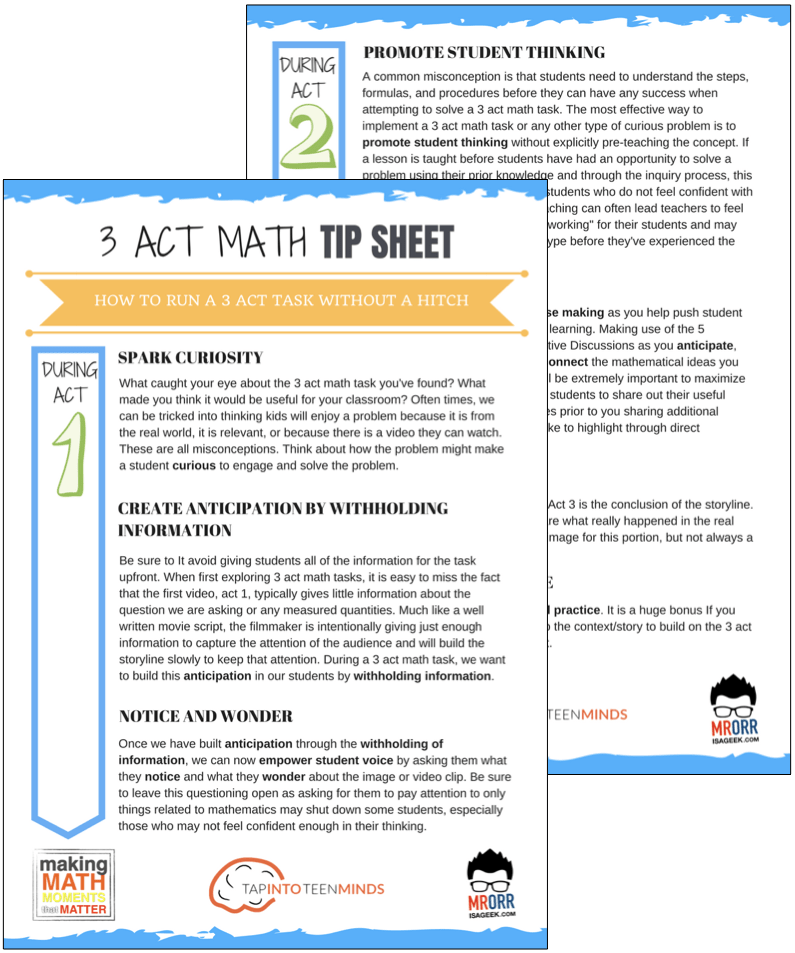
DOWNLOAD THE 3 ACT MATH TASK TIP SHEET SO THEY RUN WITHOUT A HITCH!
Download the 2-page printable 3 Act Math Tip Sheet to ensure that you have the best start to your journey using 3 Act math Tasks to spark curiosity and fuel sense making in your math classroom!
LESSONS TO MAKE MATH MOMENTS
Each lesson consists of:
Each Make Math Moments Problem Based Lesson consists of a Teacher Guide to lead you step-by-step through the planning process to ensure your lesson runs without a hitch!
Each Teacher Guide consists of:
- Intentionality of the lesson;
- A step-by-step walk through of each phase of the lesson;
- Visuals, animations, and videos unpacking big ideas, strategies, and models we intend to emerge during the lesson;
- Sample student approaches to assist in anticipating what your students might do;
- Resources and downloads including Keynote, Powerpoint, Media Files, and Teacher Guide printable PDF; and,
- Much more!
Each Make Math Moments Problem Based Lesson begins with a story, visual, video, or other method to Spark Curiosity through context.
Students will often Notice and Wonder before making an estimate to draw them in and invest in the problem.
After student voice has been heard and acknowledged, we will set students off on a Productive Struggle via a prompt related to the Spark context.
These prompts are given each lesson with the following conditions:
- No calculators are to be used; and,
- Students are to focus on how they can convince their math community that their solution is valid.
Students are left to engage in a productive struggle as the facilitator circulates to observe and engage in conversation as a means of assessing formatively.
The facilitator is instructed through the Teacher Guide on what specific strategies and models could be used to make connections and consolidate the learning from the lesson.
Often times, animations and walk through videos are provided in the Teacher Guide to assist with planning and delivering the consolidation.
A review image, video, or animation is provided as a conclusion to the task from the lesson.
While this might feel like a natural ending to the context students have been exploring, it is just the beginning as we look to leverage this context via extensions and additional lessons to dig deeper.
At the end of each lesson, consolidation prompts and/or extensions are crafted for students to purposefully practice and demonstrate their current understanding.
Facilitators are encouraged to collect these consolidation prompts as a means to engage in the assessment process and inform next moves for instruction.
In multi-day units of study, Math Talks are crafted to help build on the thinking from the previous day and build towards the next step in the developmental progression of the concept(s) we are exploring.
Each Math Talk is constructed as a string of related problems that build with intentionality to emerge specific big ideas, strategies, and mathematical models.
Make Math Moments Problem Based Lessons and Day 1 Teacher Guides are openly available for you to leverage and use with your students without becoming a Make Math Moments Academy Member.
Use our OPEN ACCESS multi-day problem based units!
Make Math Moments Problem Based Lessons and Day 1 Teacher Guides are openly available for you to leverage and use with your students without becoming a Make Math Moments Academy Member.
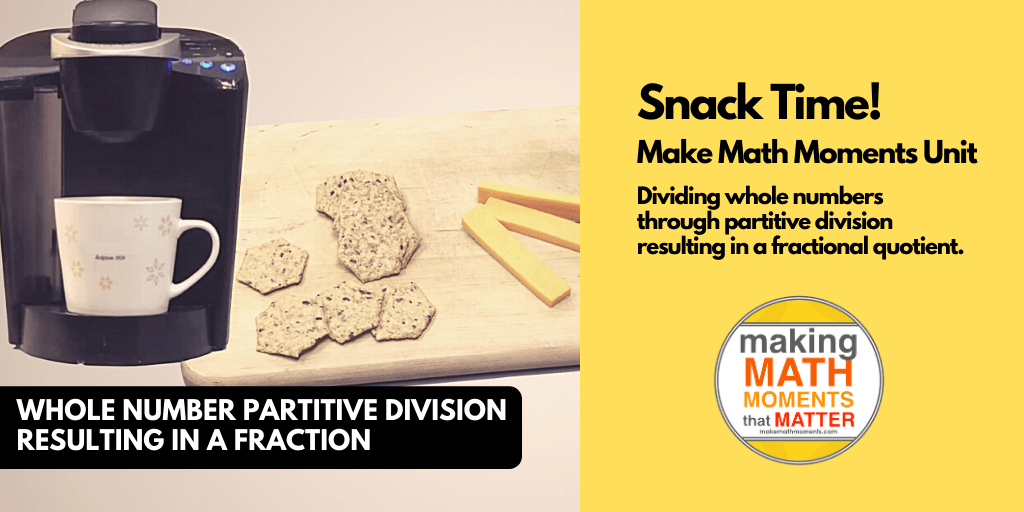
Partitive Division Resulting in a Fraction
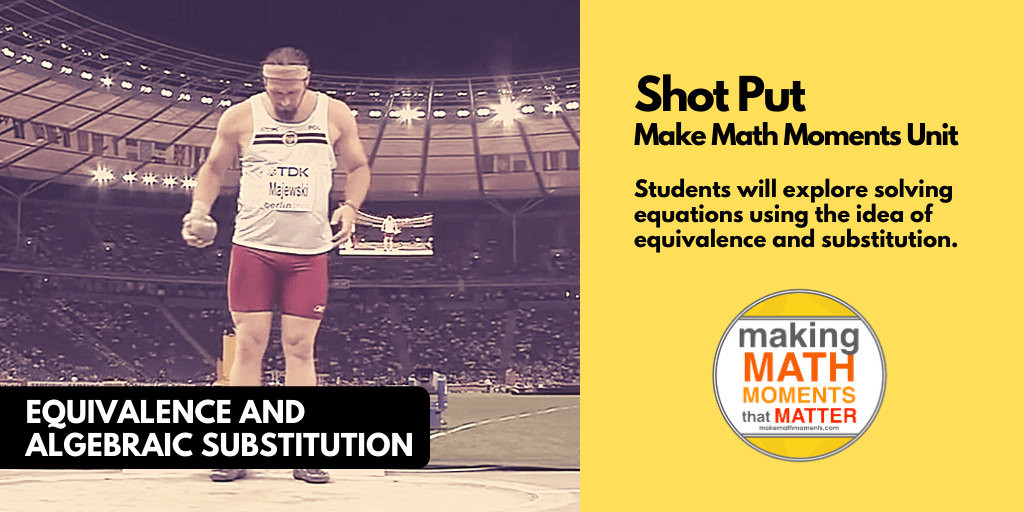
Equivalence and Algebraic Substitution
Represent Categorical Data & Explore Mean
Downloadable resources including blackline masters, handouts, printable Tips Sheets, slide shows, and media files do require a Make Math Moments Academy Membership.
ONLINE WORKSHOP REGISTRATION
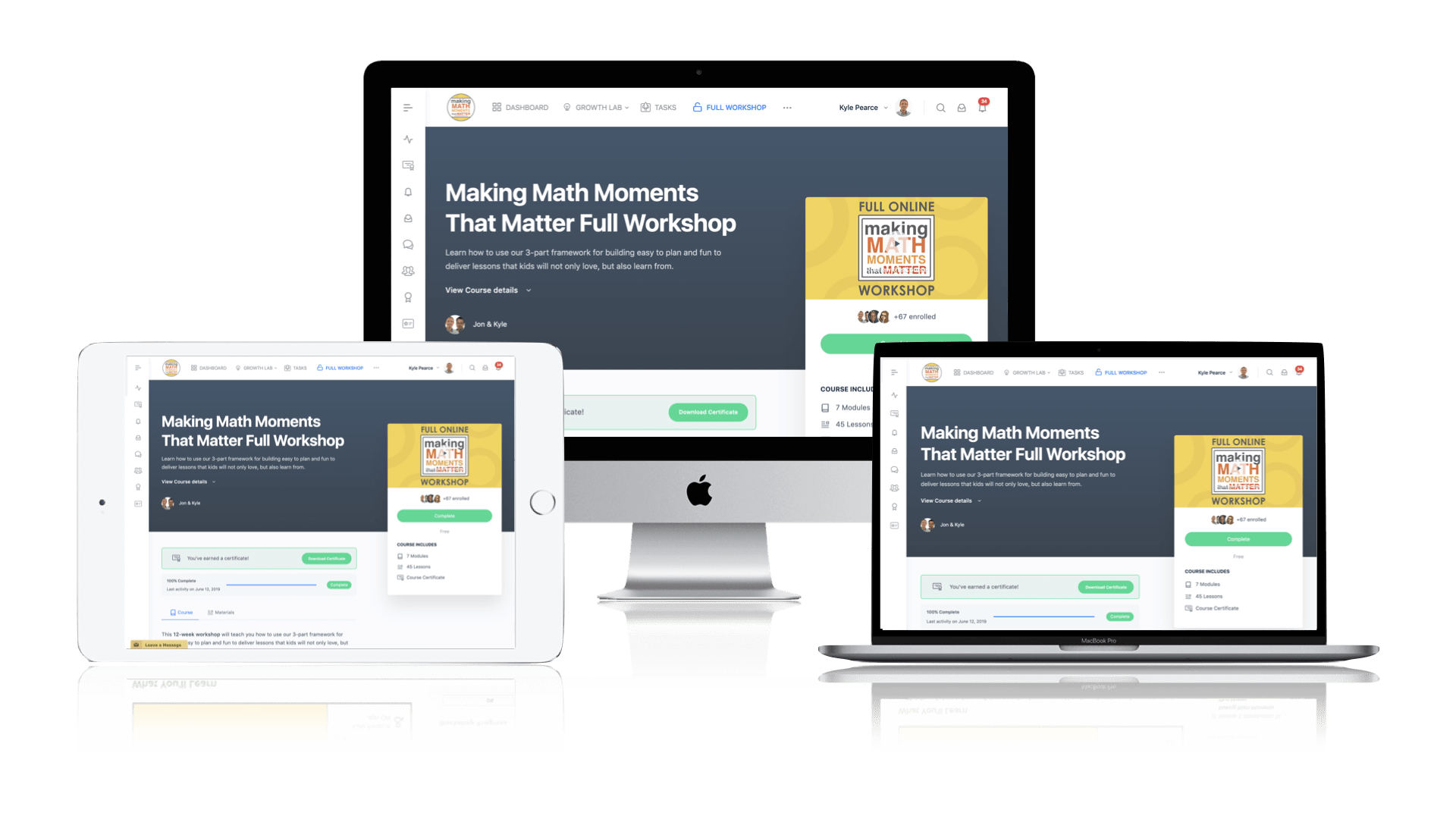
Pedagogically aligned for teachers of K through Grade 12 with content specific examples from Grades 3 through Grade 10.
In our self-paced, 12-week Online Workshop, you'll learn how to craft new and transform your current lessons to Spark Curiosity, Fuel Sense Making, and Ignite Your Teacher Moves to promote resilient problem solvers.
0 Comments