
Episode #463: Math Testing Season and Anxiety: How Teachers Can Build Confidence Without Adding Pressure
LISTEN NOW HERE…
WATCH NOW…
As math testing season approaches, many teachers and leaders feel the tension. We want students to succeed. We know they’re capable. But too often, that message turns into stress, anxiety, and even math avoidance.
So how do we walk the line between pushing for excellence in math and protecting student confidence?
In this episode, we unpack the difference between high expectations and pressure in math classrooms—and why they’re not the same thing.
In This Episode, You’ll Learn:
- The critical difference between math expectations and math pressure
- Why focusing on math outcomes (scores) can increase anxiety
- How shifting to process-based goals in math reduces stress
- What it looks like to build a math classroom culture of confidence and capability
- How to use leading indicators (like persistence and engagement) instead of just test scores
- Why student math identity and disposition matter just as much as achievement
- Practical ways to support students during math testing season without lowering expectations
If you’re heading into math testing season and want your students to feel confident—not overwhelmed—this episode will help you rethink how to maintain high expectations in math while minimizing pressure.
Attention District Math Leaders:
Not sure what matters most when designing math improvement plans? Take this assessment and get a free customized report: https://makemathmoments.com/grow/
Ready to design your math improvement plan with guidance, support and using structure? Learn how to follow our 4 stage process. https://growyourmathprogram.com
Looking to supplement your curriculum with problem based lessons and units? Make Math Moments Problem Based Lessons & Units
Be Our Next Podcast Guest!
Join as an Interview Guest or on a Mentoring Moment Call

Apply to be a Featured Interview Guest
Book a Mentoring Moment Coaching Call
Are You an Official Math Moment Maker?





FULL TRANSCRIPT
Yvette Lehman: Alright, on today’s episode we’re going to talk about walking the tightrope between pressure and having high expectations. This was top of mind for me this week from a parenting perspective. You know, we’re all parents on this podcast and this is the tightrope we walk with our own children at home, but also as testing season approaches. So here in Canada, particularly in Ontario, and I know in many parts of the US, we’re heading into that time of the year where standardized testing is around the corner. It can sometimes — or maybe just end of year finals even for our middle school and high school students — create real pressure. And the question that I asked myself yesterday was, is it possible to create a culture of high expectations but minimize the negative impact of pressure?
Jon Orr: Tell me more about what you mean about negative impact of pressure and the difference here, because I think let’s make sure we clarify this difference between high expectations and negative pressure.
Yvette Lehman: I’m gonna use my son as the example. So this is where, of course, I was being reflective after our call yesterday about, am I doing this well or not with my own child? I have high expectations for him because I know that he’s capable. And I believe that if he puts the effort in, if he puts the time in, if he engages in deep thinking, that he is capable. So I’ll give the example of math — I expect him to do his best. And I believe he’s capable of exceeding the provincial standard in math.
Yvette Lehman: He had a chess tournament last week and it’s like, I believe that he is capable of performing well in a chess tournament. I think he has all the skills necessary. And so going into it, of course, it’s like, I expect you to do your best. I expect you to put in a lot of effort. I believe you’re capable. I know that you’re ready for this. I know you have all the skills that you need to be successful.
Yvette Lehman: But what I don’t want is him having a stomach ache going into that math test because he’s worried that if he doesn’t do well, there’s going to be some type of negative consequence. Not even like a physical punishment, but there’s just something — if I don’t do well at this chess tournament, if I don’t get a level four or an A on the math test, it somehow is going to have an emotional impact on him where he’s either going to be nervous going into it, or having a breakdown after, or shutting down completely because the stress is just too high. And this is the line.
Jon Orr: Right. Like you don’t want both self-induced or self-imposed pressure — so he doesn’t have a stomach ache maybe from his own expectations or his own pressure — and also external pressure from others, from yourself.
Yvette Lehman: Exactly. So my question that I asked myself is, can I do both? Can I have a culture of high expectation for him because I believe he’s capable, without him feeling like, well, if he doesn’t, that somehow impacts his worth? Or it means that he’s not a good mathematician because he didn’t do well on this test, or not a good chess player because he had a bad day at this tournament.
Jon Orr: Right. Beth, can you relate?
Beth Curran: I can totally relate. One thing that I think might help distinguish the two — the pressure and the expectation — is how we define success. So is it, I’m sure you’re not Yvette, but are you saying to your son, I expect you to get a four or higher? Or are you saying, I expect you to try your hardest on this? And then following that up with the conversation of, say he does score a three, rather than saying I’m disappointed because you didn’t score a four or higher, it’s more like, how did you feel as you were taking it? Were you putting in your best effort? What was going on?
Beth Curran: And so I think it’s kind of establishing what is the outcome that we want. And it’s a fine line, I think. As a parent, for sure, we walk that line all the time because we don’t want to create that pressure. We don’t want to say you have to get an A, because if we do and the student scores a B, they feel like I’m bad at math. We want to celebrate their effort.
Jon Orr: Yeah, how I relate to this right now too as a parent is that I have a teenage daughter who I think is putting a lot of pressure on herself — whether it’s self-induced or through us or through other parties — around her involvement in the game of basketball and performing at a high level. She plays on a travel basketball team that travels from city to city and competes in tournaments. It’s a high level game. And there’s a lot of pressure to perform at a high level on that team, from the coach, from the other players. And there’s a lot of stress involved in that.
Jon Orr: And right now that’s coming through. You can see it emotionally on her — it’s affecting how she perceives the game and how she perceives herself, from the pressure she’s feeling in high intensity situations. When she doesn’t make a shot or make five shots in a row, what does that mean? There’s a lot of negative pressure there. So yes, good topic to keep talking about here. Back to you, Yvette.
Yvette Lehman: Well, and then I thought, of course, I’m always thinking about this as a parent. And I think we all are — we’re navigating, this is my first time at it, I only have one son, so I’m just trying to figure this out. But then I thought about the complexity of navigating this with 30 students. I’m just trying to figure out with this one child that I know very well. But then I put myself back in the classroom and I taught sixth grade for eight years here in Ontario, which is a testing grade for us.
Yvette Lehman: And all year, because we only test in grades 3, 6, and 9, this is a testing year. This year counts in some way in a different way than the previous two. And so there’s this underlying pressure all year long. And as we lead up to that testing window, I think the pressure increases. And so I think we have a few different options of how we navigate that pressure.
Yvette Lehman: One way — which is not the way that I would approach this — is to minimize the assessment. You know, to basically say, don’t worry, this isn’t a big deal, it doesn’t count for anything, just do your best and we’ll move on and we won’t even worry about it.
Jon Orr: And like, you’re saying in the grand scheme of things, this doesn’t really matter. It’s not a big deal. It’s like the chess game — the chess game doesn’t really matter. You’re going to look back on this and you’re not even going to remember that you either won or lost that game. It doesn’t really matter in the big picture. The basketball game doesn’t really matter. That’s what you’re saying is one strategy — to constantly share this message that these experiences, these events don’t really matter, and therefore minimizing it is a strategy to reduce the stress that may be self-imposed around expectations.
Yvette Lehman: Right. I think that approach reduces pressure, but it also lowers our culture of high expectation. And what I’m looking for is high expectation, low pressure. And so the way that I always approached it when I taught sixth grade was this idea of, I believe you’re capable. I believe you have all the tools that you need to be successful. I think that you can reason through these problems and you’re going to do the best that you possibly can and you’re going to try really hard and that’s going to be great whatever the outcome is.
Yvette Lehman: But then even though that’s how I went about it, I always told them this is a chance for you to show off all the things you’ve learned this year. You know, this is a chance for us to shine. And it doesn’t matter for your report card, but it does reflect on our class and it reflects on our school and we want to demonstrate to those who care that there’s some great learning happening here, because you are capable and confident young mathematicians. Like I tried to boost them up and I didn’t ever say this doesn’t matter.
Yvette Lehman: But I did have some tears. Like the test would come around and there were definitely students who, in spite of trying to approach it through effort, trying to approach it through I believe that you’re capable, do the best you can — it still manifested into some breakdowns, some stomach aches.
Jon Orr: Yeah. And I can imagine because it’s like saying that about the chess game or the basketball as well — it’s still saying the outcome here is really important to me and the outcome should be really important to you. And so what I hear you saying is that you’re still putting a high expectation on the actual outcome of this event. And my question I guess is, is that where you want to place the emphasis?
Yvette Lehman: Right. And I think that goes back to what Beth was saying. Is the emphasis on the outcome or is the emphasis on the effort?
Beth Curran: Right. And I just wanted to add to this that your students, while in class, you were saying, you all are well prepared, you have the tools, I think you can do it, I want you to believe in yourself. You’re sending that message, but we can’t control the other messages that they might be hearing from parents, from peers, from just internal competition, this desire to be perfect.
Beth Curran: So I was thinking, how could we support a school or what could coaches or leaders do at a school to help shift this from, we want all of our students to score at a certain level, to valuing the effort that we put in?
Jon Orr: Yeah, I think what we’re really talking about is outcome-driven goals versus process-driven goals. Because when you think about it — let’s go back to the chess game — it’s like, am I only playing chess and competing in chess because I’m concerned about the outcome? Or do I just love competing in chess?
Jon Orr: Because those are different, right? Like, I’m here to win and I’m putting 100% emphasis on the outcome here, and then my value is actually determined by the outcome of these events, instead of the value being determined by the process that leads up to this event, or the process of just becoming a good chess player.
Jon Orr: Those are different emphases, different priorities, different expectations. And you can achieve high expectation because you’re saying you’re going to choose the behaviors that lead to the process and enjoying the process of playing chess at a high level. Same with basketball — do you just enjoy playing basketball at a high level, in practices, with teammates, working with people, learning leadership skills? Fall in love with the process, make the expectation about the behaviors of the process.
Jon Orr: And less about the actual outcomes — that’s the move we do wanna make. Same with school. To your point, Beth, about leadership, but also in the classroom — if I’m working with my sixth grade students, I’m working with my ninth grade students, we have to continually discuss the culture of what we’re really doing here. And it’s not the outcome. Yes, this is an important component of what we’re doing. We have high expectations because we are so adamant about the process of problem solving, the process of the moves and the behaviors of the mathematics that we’ve been learning all year. This is what we need to fall in love with. And the outcome is just a byproduct of the work that we do to strive for excellence in the behaviors of learning mathematics.
Jon Orr: That’s where the emphasis lies in all of these components. And so if I’m working with teachers and supporting teachers, it’s the same thing. We have to help everyone fall in love with the process of professional learning and professional development and getting better at mathematics and understanding what that translates into in the classroom for students. So you can translate those same beliefs, which means take the emphasis off the outcomes.
Jon Orr: How many times have we worked with teammates to say, your key result in your work this year isn’t to score 3% higher on your standardized test results? That’s not a key result. That’s a lagging indicator of work. What are the behaviors that we wanna measure throughout the year to strengthen falling in love with the process? That’s how you build your math improvement flywheel — you build on processes rather than outcomes.
Jon Orr: And so yes, you’re gonna have maybe a school goal. Yes, the district is gonna be looking at that data. Yes, parents are gonna be looking at that data. But what other measures are we putting in place to hold ourselves to high expectations on what we believe is important for learning mathematics and teaching mathematics? We have to decide on those, and those are the key results we tend to help teams set. Because you don’t want to get to the end of the year and say, we had high expectations for ourselves and we hit them and we feel proud about it. Now all of a sudden we’ve de-emphasized the outcome of a high intense moment because a standardized test was there.
Beth Curran: Well, I think both of the examples that you, John, and Yvette brought up about a chess tournament or a basketball tournament — there is kind of an inherent goal, right? You want to win. The coach is maybe pressuring you because the team wants to move on to the next level, or you want that award or that ribbon. So there is this idea that we’re competing to win.
Beth Curran: And I think that in the classroom, when we’re talking about standardized tests, there’s maybe not as much of that sort of inherent goal. It’s not like you’re trying to score better than the student sitting next to you. Hopefully there’s not that competition, or our class should score higher than the class across the hall. Unfortunately in the United States there is a little bit of that school-to-school comparison. Hopefully that doesn’t make it down to the students, and it’s more about, you’re just trying to do the best you can, you’ve learned all year.
Jon Orr: But that’s where the importance of coming up with what is the goal other than that comes in, right? Like yes, it’s going to be there. Yes, there is an outcome of a basketball game and a chess game. But what is the goal that you’re setting to help mitigate this negative pressure that will come along so that we can steer around it towards these other wins — pressures that are more emphasis on the behaviors and the expectations that we really want?
Jon Orr: Because we still want those high expectations, but we don’t want this negative pressure. One of the things we’ve talked about as parents to our students is goal setting. Is it your goal to be at the high excellence level of a basketball player? If it’s not, then the pressures might not be there anymore. I remember talking with Kyle about this. He’s saying, is he capable of performing at a high level in chess? And you’re saying yes, I know he’s capable. In a way, it’s like, we’re capable of anything we really want, right?
Jon Orr: Kyle used to say, could I be a marathon runner? Could I go and run a marathon? He’s like, I’m sure I’m capable of it. Other people do it, therefore I could do it. But do I want to fall in love with that process? Because I’m going to have to, if I want that goal. Like, what is the goal that I set for myself? And do I want to live that lifestyle or the lead up to achieve that goal? That’s an important decision-making process.
Jon Orr: So if I want to play at a high level of basketball, is that a goal for myself? Do I want to go down that pathway? Because that will lead to the pressure or not. And it’ll lead to the behaviors that lead up to that. Goal setting is a really important move. And going back to supporting teachers in the classroom — what is the goal that we can set for ourselves? Then we can determine the behaviors that help us achieve that goal. Because we’re all capable of things. We just have to decide what are the moves to get to the goals we want. And do we want to make those moves?
Yvette Lehman: Let’s talk specifically about some moves for either teachers or leaders. So I’m a teacher. It’s April. We’re heading into that testing season. I’m feeling the pressure. My students are feeling the pressure. What’s one move I could make to establish this balance between high expectations and minimizing the impact of negative pressure? Let’s give a really concrete, actionable recommendation for a teacher in a classroom who’s feeling the pressure right now listening to this episode.
Beth Curran: If I had to say one thing, I would say think about the way that you have engaged with your students all year long. Just because it’s testing season and we’re prepping for a test, we’re not gonna throw out all of that. I would venture to say that the majority of teachers out there do encourage effort. They do look for growth, that growth mindset — if you put your mind to it and you practice, you’ll figure this out. But then testing comes around and we all get panicked.
Beth Curran: And so I would say stay the course. If you’ve been focusing all year long on developing a growth mindset in your classroom around mathematics, continue that. Even when you’re doing your sample questions, bring that in and let the students see that this is not a separate thing. It’s just what we do.
Yvette Lehman: A colleague of mine who is a ninth grade teacher said to me between last year and this year, he said, I don’t know that my scores went up, but I do know my students spent twice as long on the assessment. And again, that goes back to the goal setting idea. That’s an indicator of growth that may not translate into increased achievement levels, but there has been a behavioral shift in his students that was observable, and that was his win. They were willing to stick with it a little bit longer, persevere through some of the higher questions, and spend just more time thinking deeply about the questions than the previous year.
Jon Orr: In a way, those are leading indicators, right? Because you can look for that throughout the year, and you know that leading indicators should, with strength, turn into lagging indicators. Like if we did look at studies to say the longer kids stay with testing, does that mean they will perform better overall? It’s hard to say with one group of students on one test, but generally that’s why it’s a leading indicator — because it generally will be true. If kids are not packing up the test in five minutes, they have a better shot at scoring at an increased achievement level.
Jon Orr: So deciding on what some of those leading indicators can be is really important. And it’s like, coming into the end of the year, if I’m feeling unsure, one of the things that you may want to be putting on your back burner is to say, how do I not feel like this next year? Have I looked at what leading indicators can help me see where our wins are throughout the year? That’s what I’m going to want to decide on. Not to say that I’m abandoning the end of this year — that is not what I’m recommending at all going into testing season or review time — but that might be just something to think about.
Jon Orr: Because that’s what I used to think about all the time. If I’m feeling unsure about something, now I have to say, how do I do this again next year? Because this is what we are — we’re in a business where we get to try again with a different group of kids the next year. So how do I not feel like this next year? What could be the moves to make? I would encourage everyone to think that if I’m feeling pressure going into a testing season, what could I be doing to actually alleviate that?
Yvette Lehman: Yeah, I’m thinking about a leader and I wonder if the leader’s pressure is in some ways higher than everybody’s, because you’re thinking about how these test scores are linked to enrollment, and enrollment numbers are linked to funding and staffing. And you’re saying to yourself, well, we want to have good results because we want to show that our school is a desirable place to be. And so how do you as a leader establish high expectations, reinforce that this test does matter in some way and is a good indicator of the health of our system, without then putting negative pressure on teachers and negative pressure on students? What would be our advice to a school administrator, for example?
Beth Curran: That’s kind of a loaded question, I think. Well, the advice would be model what you want your teachers to do in the classroom. So if you’re helping your teachers set goals for what they want to achieve, the goal shouldn’t be tied to an increase in student scores, for example. And so model that as much as you can. Be careful what you tie those results to. And maybe some of that is outside of even the principal’s control — it maybe goes up to a district level decision or even a state level decision. How are those scores used? So it’s kind of a loaded question.
Yvette Lehman: I think you made some really good points there, Beth, and I was thinking about maybe some other indicators of success. So things like, maybe we’re looking at how confident students felt walking away from the test. That was always my indicator. My indicator was always, did my students walk away from it feeling like, you know what, I could work my way through that? There was nothing on that assessment that was out of my grasp. Doesn’t mean they got everything right, but they felt as though they had access and they could interact with the content.
Yvette Lehman: And so maybe student disposition towards the assessment and how they felt after is the goal, as opposed to how did it translate into scores. I think to John’s point, let’s look at some other indicators as opposed to just looking at what was the number of students that met the standard.
Jon Orr: And normalizing those indicators, right? So communicating those indicators to make this like, yes, we’re looking at this data point over here, but we’re also going to be looking at these when we go to annually review or when we present this to the staff at a staff meeting. Like this is where we have to consistently build that into your system to say it’s these things that matter.
Jon Orr: And hey, we did okay here, we did okay here. We need to do a little bit better moving forward on this metric over here, which was maybe one of your leading metrics. And then that can translate into the lagging metric down the road. And that’s the process you wanna be building as a leader in a system, whether you’re at the district level or the school level — that’s how you consistently can get better, by looking at how to shift leading indicators, which will then turn into lagging indicators.
Jon Orr: Is it possible we can have high expectations and reduce negative pressure?
Yvette Lehman: I think it is. And in my conversation with Leto the other day, I feel like we’re doing a pretty good job with him so far, but I think we need to continue to talk about it and check in with him. Because I did ask him, I said, you know, do you feel pressure when you go to write a math test, or when you were at the chess tournament, or heading into a musical theater performance, do you ever feel anxious or like you have a stomach ache or you’re worried about how the outcome is going to impact you? And he was like, nope.
Yvette Lehman: So I think he’s doing okay so far, but it’s something that I am trying to be mindful of as a parent. But I’m also talking about one child with one personality. So now I think about, I have one child amongst 29 others who have different backgrounds, different experiences, different personalities. And so now I’m not only thinking about the impact of my high expectations on this one child, I’m thinking about it on 30. Which is what makes teaching very complex.
Beth Curran: We just had a discussion with a client recently where they had gotten back some results from student surveys. And I think that’s a great example of defining what those indicators are. Because some of the questions were, do you feel like you’re a problem solver? Do you enjoy math class? Do you look forward to math? Do you feel like you’re a math person? Questions like that.
Beth Curran: And I think that’s really what leadership could consider doing — because that’s telling the teachers that we value more than just a high test score. We value things like, are we developing students who love math, who feel like they’re problem solvers, who feel capable of launching into a challenging problem on their own? Defining those indicators and figuring out a way to measure those. And then, John, like you said, do we know that that’s going to ultimately lead to higher test scores? We don’t yet. But if we continue to monitor these things over time, we might see a correlation.
Jon Orr: For sure. As always, we’ve got some ideas here for you, but not always full solutions. This is the art of teaching, the art of leading teachers, the art of leading students and teaching students. So we welcome your thoughts. We welcome your wonders on this idea of high expectation and negative pressure and the balance of achieving one and not the other, and trying to do that in your classroom and doing that to support the teachers that you’re supporting as a leader in the building or a leader in a district.
Jon Orr: This is one of the big zones of improvement that we all have to think about — how do we help people learn, and how do we help with battling different cultures or different belief systems when we think about our classroom tree or district level tree? We often reference that here on the podcast where we talk about the soil, the water, the sunlight that influences what’s happening in the classroom. This is really one of those things — it’s about pressure from external sources or pressure from internal sources and how do we help navigate those.
Jon Orr: If you want to learn about those six key areas of the tree, head on over to makemathmoments.com forward slash report. There’s an assessment you fill out about the six areas and we’ll give you suggestions on all six areas on how to strengthen those in your classroom or your district or your school. It’s customized to you as you’re filling that out, so makemathmoments.com forward slash report.
Thanks For Listening
- Book a Math Mentoring Moment
- Apply to be a Featured Interview Guest
- Leave a note in the comment section below.
- Share this show on Twitter, or Facebook.
To help out the show:
- Leave an honest review on iTunes. Your ratings and reviews really help and we read each one.
- Subscribe on iTunes, Google Play, and Spotify.

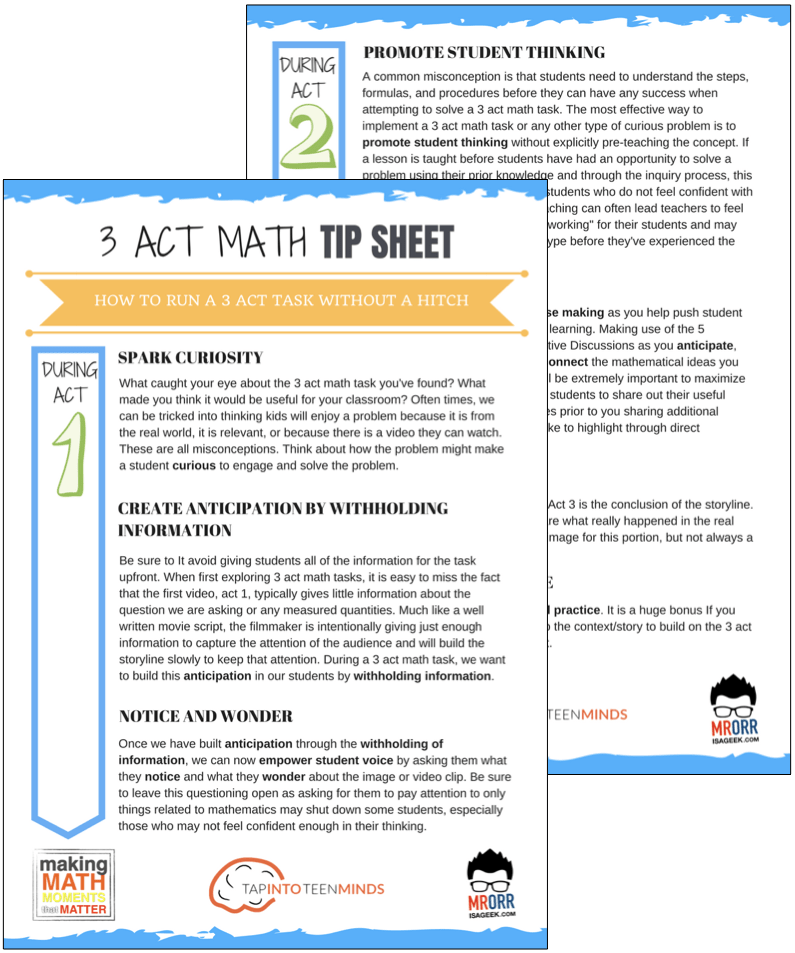
DOWNLOAD THE 3 ACT MATH TASK TIP SHEET SO THEY RUN WITHOUT A HITCH!
Download the 2-page printable 3 Act Math Tip Sheet to ensure that you have the best start to your journey using 3 Act math Tasks to spark curiosity and fuel sense making in your math classroom!
LESSONS TO MAKE MATH MOMENTS
Each lesson consists of:
Each Make Math Moments Problem Based Lesson consists of a Teacher Guide to lead you step-by-step through the planning process to ensure your lesson runs without a hitch!
Each Teacher Guide consists of:
- Intentionality of the lesson;
- A step-by-step walk through of each phase of the lesson;
- Visuals, animations, and videos unpacking big ideas, strategies, and models we intend to emerge during the lesson;
- Sample student approaches to assist in anticipating what your students might do;
- Resources and downloads including Keynote, Powerpoint, Media Files, and Teacher Guide printable PDF; and,
- Much more!
Each Make Math Moments Problem Based Lesson begins with a story, visual, video, or other method to Spark Curiosity through context.
Students will often Notice and Wonder before making an estimate to draw them in and invest in the problem.
After student voice has been heard and acknowledged, we will set students off on a Productive Struggle via a prompt related to the Spark context.
These prompts are given each lesson with the following conditions:
- No calculators are to be used; and,
- Students are to focus on how they can convince their math community that their solution is valid.
Students are left to engage in a productive struggle as the facilitator circulates to observe and engage in conversation as a means of assessing formatively.
The facilitator is instructed through the Teacher Guide on what specific strategies and models could be used to make connections and consolidate the learning from the lesson.
Often times, animations and walk through videos are provided in the Teacher Guide to assist with planning and delivering the consolidation.
A review image, video, or animation is provided as a conclusion to the task from the lesson.
While this might feel like a natural ending to the context students have been exploring, it is just the beginning as we look to leverage this context via extensions and additional lessons to dig deeper.
At the end of each lesson, consolidation prompts and/or extensions are crafted for students to purposefully practice and demonstrate their current understanding.
Facilitators are encouraged to collect these consolidation prompts as a means to engage in the assessment process and inform next moves for instruction.
In multi-day units of study, Math Talks are crafted to help build on the thinking from the previous day and build towards the next step in the developmental progression of the concept(s) we are exploring.
Each Math Talk is constructed as a string of related problems that build with intentionality to emerge specific big ideas, strategies, and mathematical models.
Make Math Moments Problem Based Lessons and Day 1 Teacher Guides are openly available for you to leverage and use with your students without becoming a Make Math Moments Academy Member.
Use our OPEN ACCESS multi-day problem based units!
Make Math Moments Problem Based Lessons and Day 1 Teacher Guides are openly available for you to leverage and use with your students without becoming a Make Math Moments Academy Member.
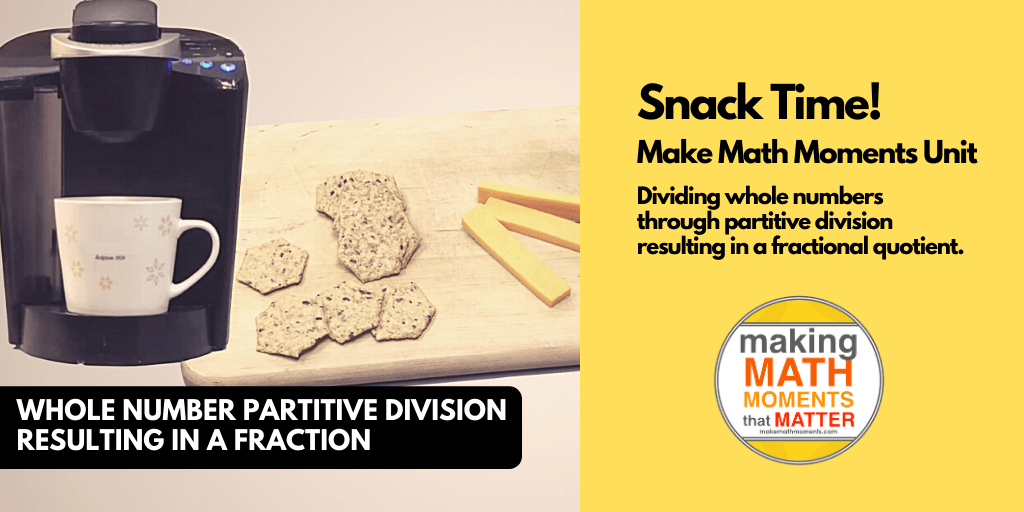
Partitive Division Resulting in a Fraction

Equivalence and Algebraic Substitution
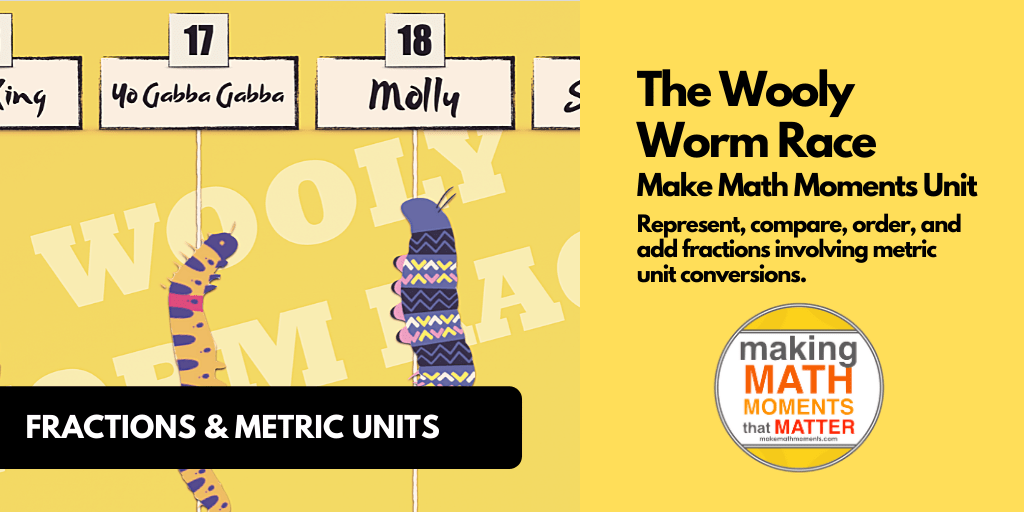

Represent Categorical Data & Explore Mean
Downloadable resources including blackline masters, handouts, printable Tips Sheets, slide shows, and media files do require a Make Math Moments Academy Membership.
ONLINE WORKSHOP REGISTRATION

Pedagogically aligned for teachers of K through Grade 12 with content specific examples from Grades 3 through Grade 10.
In our self-paced, 12-week Online Workshop, you'll learn how to craft new and transform your current lessons to Spark Curiosity, Fuel Sense Making, and Ignite Your Teacher Moves to promote resilient problem solvers.

0 Comments