
Episode #459: Tier 2 Math Intervention: How Coaches and Teachers Can Use Small Groups More Effectively
LISTEN NOW HERE…




WATCH NOW…
You’re teaching math to 34 students. You slow math pacing to support the middle, but you can feel yourself losing students who are ready to move.
A listener emailed us after our episode on rigorous Tier 1 math instruction: they don’t want to create opportunity gaps by slowing math down—but they also don’t know how to actually run small group math instruction after the main lesson. We also connect this to a real conversation with a district math team wrestling with Tier 2 math and Tier 3 math supports.
In This Episode, You’ll Learn
- Why “high/middle/low” labels get in the way of effective math small grouping
- How CRA math (concrete–pictorial/representational–abstract) can guide flexible math groups after the lesson
- Why CRA in math is not a ladder—and why abstract math isn’t automatically the “top group”
- How to use formative math assessment (including exit tickets) to identify what students need next in math
- How to structure math class so random groups drive discourse, then targeted math groups drive practice and support
- A coaching/leadership math move: “live the math work” in a classroom for a full unit before scaling the strategy
- Why sustained math coaching support (not one-off math PD) builds coherence in math instruction across a system
If you’re a math leader or math coach, ask: What’s one unit where we can co-teach, gather formative math assessment daily, and build CRA-informed math small groups—so we can scale what actually works in real math classrooms?
Attention District Math Leaders:
Not sure what matters most when designing math improvement plans? Take this assessment and get a free customized report: https://makemathmoments.com/grow/
Ready to design your math improvement plan with guidance, support and using structure? Learn how to follow our 4 stage process. https://growyourmathprogram.com
Looking to supplement your curriculum with problem based lessons and units? Make Math Moments Problem Based Lessons & Units
Be Our Next Podcast Guest!
Join as an Interview Guest or on a Mentoring Moment Call
Apply to be a Featured Interview Guest
Book a Mentoring Moment Coaching Call
Are You an Official Math Moment Maker?




FULL TRANSCRIPT
Yvette Lehman: We got an email this week from one of our listeners responding to an episode we did recently about pacing and rigorous tier one instruction. And I think our pitch in that episode was that we don’t want to sacrifice the integrity of the standards or the curriculum at that grade level and create opportunity gaps by slowing the pace, reducing the cognitive load in order to meet kind of the middle or low group.
Yvette Lehman: And so the teacher, I’ll read verbatim the response we got, which was, I have 34 students. I feel obligated to pace to the middle, but I can see I’m losing other students. I don’t know how to actually split into small groups after the main lesson based on their needs. So that’s what we’re going to unpack here today.
Jon Orr: Let’s unpack, let’s unpack. And I think you also had a discussion with one of our teams around the same idea.
Yvette Lehman: Yes, I love when this happens. We recently met with one of our district partners and our entire pebble that we were trying to help, you know, unrattle from their shoe was this idea of how do we ensure greater success or achievement for all learners, in particular learners with a special education profile that was a group they were hoping to prioritize. And the question that came up was, what does tier two look like? What does tier three look like? How are we actually identifying who is working in what group for what purpose?
Jon Orr: Let’s jump in here. Do you want to start there? Like what does tier two look like? You just want to start with the comment or the question we got asked from the listener.
Beth Curran: So I’d like to address the comment. This teacher clearly is feeling like they’re just not meeting the needs of all students in the classroom. And so that’s their big pebble, I think. And I think teachers do tend to default to the middle or the middle low group because they feel like I can’t move ahead because I’m going to lose this whole group of students.
Beth Curran: And then what happens is the students who did grasp the concept fairly quickly are now sitting and waiting while the teacher is essentially doing small group instruction, whole group. So the question here, I think, there’s a few things that I could say to sort of address this. First off, I would love for teachers to stop labeling students as high, medium, and low within the general classroom.
Beth Curran: I know we were specifically talking with a special ed situation. I think that’s a little bit different. But if we’re just talking your general ed students, I think that we can really lean heavily into this idea of this CRA or the CPA model. So this concrete to pictorial to abstract progression. And instead of labeling students high, medium and low based on a skill, what if we instead thought, okay, we’re going to provide access concretely, pictorially or abstractly to the concept that we’re teaching.
Beth Curran: And then we’re going to evaluate the students based on those phases of learning. So we’re gonna pay attention to which students still need to build models to access the content. We’re gonna pay attention to those students who can now move to a pictorial representation and those who can quickly abstractly answer. And we’re going to differentiate or target the needs of the students in our tier two instruction based on that phase of learning. Okay, so that’s my first big thought. So I’ll pause there.
Jon Orr: Okay, yeah, pause there, because I actually had some wonders there. I’m literally curious about your responses between, my wonder here, which is like, okay, so imagine that we do start to look at trying to regroup students based off the CRA or the CPA model and go, okay, who is at, say, the pictorial or who’s at the abstract?
Jon Orr: My hesitation here, and I do feel like I have a hesitation here, but I want that to be freed up, so it’s not a hesitation for me, is because I think there’s a valuable channel here to explore, is that are we still risking the abstract is the top tier. And I feel like we’ve been speaking a lot about this over the years to say like, I remember talking with Joe Bowler about this a couple of years ago, specifically by saying like, we need to create the equity between all three of those pieces, like the abstract, the pictorial, the concrete, like all of them have value. And even though it’s an order from left to right, I think we need to take that away and say like, it should be more circular.
Jon Orr: You know, it’s more about like, let’s make sure, like if I am abstract, how do I know the student has a strong understanding of the concrete, of the pictorial around this idea? Because then it’s like, do they always end up in the abstract group? And then therefore, are they being, you know, taught or are they strengthening the other forms of the other groups? That’s my hesitation right now and my worry if this is the move that we try to make. We wanna make sure we clear that up, I think, for the listener too, is like, let’s make sure we’re clearly separating this idea of the groupings.
Yvette Lehman: I think that it was important what you shared, which is essentially with every single new concept, it’s like you have to go back through the three stages to really solidify your procedural fluency from conceptual understanding. I find even as an adult learner, sometimes when I’m trying to convince myself that something’s true or make a generalization, I have to go back to the pictorial or back to the concrete, even if I’m at the abstract phase. But okay, I think this is the way that I think about it.
Yvette Lehman: You know, Jennifer Bay Williams nested circles of fluency, right? Where it’s basically like they’re not separate from each other, they’re nested within. And so below the abstract level, we also have to have the pictorial and the concrete. It’s like that builds us up to that abstract. So interestingly, when we were talking with our district partner, they were saying that Illustrative is the curriculum that they’re currently using. And it’s like every unit, everybody starts concrete. But the problem is, what about the students who aren’t ready to leave concrete? And now it’s like all of a sudden we’ve jumped off to the pictorial and now we’ve left behind this entire group that’s not ready to move on.
Beth Curran: Yeah, so I’m going to jump in here again. So John, I love your concern. And what I actually thought you were going to say is, you know, as a middle school, high school math teacher, everybody needs to get to the abstract, right? So that’s what I thought you were going to say. And so, you know, to address this though, I mean, I think you’re right. It does have to be kind of fluid. And so what does your differentiation look like when you have that abstract group with you? Just like Yvette just said, we need to encourage them to go back and build a model or draw a picture of their abstract understanding.
Beth Curran: Because there are some really good memorizers out there. I was one of them. Show me how to do something. I can memorize the algorithm and I can function abstractly, but I didn’t quite understand what I was doing. So had a teacher said to me, why does this algorithm work? Why does this abstract math? How come we can keep change flip? I don’t think I could have explained it because I didn’t understand it deeply enough.
Beth Curran: So differentiation isn’t just for your students who, air quotes here, struggle. It’s also to make sure that the students who are functioning abstractly deeply understand the math that they’re learning.
Jon Orr: Okay, so I think what we’ve so far, you know, to address this teacher’s question about grouping is we’ve looked at a way to think about structuring those groups after the lesson, thinking about the lesson, now, okay, so let’s go down that path. Like, let’s say we do that. Like, there’s still now probably more questions that are now coming up going like, okay, so if I’m gonna do that, like before I could just randomize groups, that was easier, but now it’s like, I’ve got to group by concrete representational and abstract, what am I looking for? What are the moves that I need to make? Like how do I start reassessing every time I have a lesson?
Beth Curran: So let me address something that you just said — the randomized groups. Randomized groups are what you start your lesson with. So that’s to encourage collaborative thinking. It’s to encourage communication. It’s all the things that we learn about. So what we want is to reserve that sort of distinction between grouping by phase of learning, phase of understanding, to reserve that for the differentiated practice.
Beth Curran: So when we get to the practice phase, we might have our randomized groups where they discovered a pictorial representation or a concrete model or abstract math. And now we’re digging into that a little bit deeper so that we can provide individualized support, meet the students where they are. If you’re a concrete learner, you came off the task, the consolidation, still at a concrete level of understanding, then the teacher’s job during the practice is to take them from concrete maybe to pictorial, maybe to abstract, depending on the student and their readiness.
Beth Curran: So I do want to clarify that. So it’s not that we’re saying now we should always put our kids into these concrete pictorial abstract groups. We’re still saying maybe you want to start off with that task in those randomized groups. But then when you get to the practice where you’re making sure everyone understands it, then you’re going to maybe think about putting them into groups by their level of understanding.
Yvette Lehman: The question I had when we were talking with the district partner about creating these groups was I used to do obviously an exit ticket. So there was two forms of formative assessment during my lesson, my three-part math lesson. I was doing my anecdotal observation and documentation while students were interacting with the task. But then I would also have them do an independent exit ticket. And essentially what I would do is I would go through their exit tickets and I would be like, who has it, who doesn’t?
Yvette Lehman: Like who has solidified this concept? Who needs additional follow-up support, feedback, a little bit to make sure that everybody is now ready for the next lesson, for tomorrow’s lesson. But I don’t know that that one exit ticket would have given me enough evidence. I would have just had basically two groups or maybe three groups, like, you know, has it consolidated? Almost there, you know, minor misconception, or like really needs remediation when we’re not close or no access.
Yvette Lehman: But I don’t know that my exit ticket would have helped me understand. I probably would have taken all of those groups and started them concretely and then moved them through in my small group instruction to basically say, do I have evidence that this student can access this task concretely? Do I have evidence that they can access it pictorially? So I guess I think that assessment, right? Formative assessment is going to be really critical to targeting the right big ideas.
Jon Orr: For sure. And it has to come down to you recognizing what are you really looking for? What is the assessment that I’m actually after on this idea? What does that look like for concrete, representational, for abstract in this concept with this group and in being articulated?
Jon Orr: We talk a lot about intentionality and sometimes if you are pivoting this way, you have to have the clear intention of what is it that you’re looking for while you’re in this lesson so that you can do the regrouping. You’re right, like a standard exit ticket is not gonna tell you what you want. You have to purposely design the assessment to tell you what you wanna know so that you can take that next step. Beth?
Beth Curran: I’m gonna push back just a little bit on that because I do think that your typical formative assessment exit ticket could let you gather that information if you make it normal in the classroom to draw a picture to model your thinking, right? If it’s normalized in class that we’re just looking for an answer or we’re just looking for the abstract math, then the students, yeah, then you might not know. You’ll just know that they got it right or wrong. You might not know their phase of learning.
Beth Curran: So if you normalized, we could draw a picture and we’ve practiced drawing pictures in class to access the math. Then you give that exit ticket and you say to the students, you can draw a picture. You can use the algorithms, whatever we’ve been learning that day to solve this. But I need you to somehow explain how you got your answer. So we don’t just want an answer. So yeah, you have to set it up a little bit, but I think you could use the same exit ticket because a student who can’t draw a picture, who can’t do it abstractly, what are they telling you? They’re still concrete.
Beth Curran: Right? They haven’t conceptualized whatever it is that we’re trying to teach them. The student who draws the picture gets it right, or draws a picture and gets it wrong, is also giving you a lot of information. And then a student who can say, well, I solved it using this particular algorithm, is again giving you that information to be able to put those students into those groups, maybe in days moving forward.
Beth Curran: I’m kind of hesitant to say, let’s start everyone at concrete and then everyone moves to pictorial and then everyone moves to abstract because I think you’re gonna find that students spend different amounts of time in that. And so again, it’s kind of more normalizing — you can build a model throughout math class, the entire class today. You could build a model if that’s how you’re gonna access this. You could draw a picture, you could solve it abstractly, but not this idea that we’re moving distinctly through those phases.
Beth Curran: So kind of getting back to what you said first, John, how they have to be sort of fluid and the students kind of moving through and back and forth and showing their conceptual understanding, but also understanding the math.
Jon Orr: Right. Yvette, how you were working with the math coordinator with this district, thinking about the leadership, because as leaders, we are always in a position to support our educators who are asking these questions, you know, and battling these ideas, especially when we have, say, curriculums we’re trying to follow and we’re trying to say, how do I teach this rigorous curriculum? How do I stay on course and not try to design my lessons for the middle, and I’m using air quotes here folks, to the lower and how do I create this dynamic that we’re after.
Jon Orr: So I guess thinking leadership, what did you and the team come up with as a support structure or support ideas to support teachers around this kind of idea when you’re working with teachers?
Yvette Lehman: The next step that they identified, so this district has two coaches, because they have a new curriculum that they’re currently adopting, was that they were both going to partner up with one teacher and work through an entire unit with that teacher side by side, strategically gathering formative assessment and creating targeted small groups. And the idea was they needed to live it and experience it and connect it to the pacing of that particular curriculum before they scaled it.
Yvette Lehman: Before they started kind of dropping recommendations to all teachers, you know, do your small groups this way, or this is one way that you could do your small groups. They wanted to really experience it in the classroom with students, team teaching, so that they could deeply understand how this fits within, because does the curriculum itself, are the exit tickets giving the right information? Are there supplements within the curriculum to target purposeful practice or small group instruction?
Yvette Lehman: So in order to deeply understand how this type of small group strategy works within the curriculum that they’re currently adopting, that was their next step — they needed to live it and not, we’ve talked about this before, John, like not show up once a week and then come back a week later. It’s like actually be there every day to understand how does one day of the lesson turn into the next and how do we keep everybody moving as close as we possibly can to the learning outcome for that unit or module.
Jon Orr: And that fits in line with the research behind effective professional development because there’s, you know, we can link up some of the research that we’ve been heavily relying on — one really important element of professional learning is sustained ongoing support. And I think when we think about PL, we think about supporting teachers, a lot of times we do the one big PD thing and we think we’ve given everyone awareness, therefore now they can go off and try it.
Jon Orr: And hopefully that some of those people it’ll trickle, or maybe the curriculum that we’re adopting we’re gonna spread through our coaches to hit teachers every week or every two weeks in a cycle. But in reality that is not the sustained support that actually can drive instruction. So when you think about the moves that you were making with this team, now you’ve got teams that are saying we’re doing sustained support not only to strengthen these one or two individual teachers, but now what we’re doing is we’re creating and discovering the conditions that we can scale past where we are.
Jon Orr: What does it look like if I’m gonna do this with another teacher? I know the moves to make so that we can then build upon those moves. The other idea of why that move fits with some of the research is that you’re building the bridge, you’re building the coherence around what this can look like in the classroom. And now you’ve got a model that you could heavily rely on to share what that looks like with other teachers in the school or across schools.
Jon Orr: That’s an important idea because one of the biggest things that we’ve seen across school districts is that when you say one thing and you say that this is the instruction we’re looking for for the curriculum, the words sometimes are the same, but they’re completely different experiences. And so if that’s an important idea that we need to create — it’s coherence. We have to create coherence across the system. And what better way to do it in a narrowed approach, an intense approach with a teacher, so that you can create the conditions to spread across the district after that.
Yvette Lehman: If we wanted to summarize the big ideas from this episode. So for our listeners who are, you know, maybe driving on their way to work and they’re like, okay, I just heard a lot of information, but what did they actually say? I’m going to take a stab at it and then I’ll have you guys reinforce any ideas that I miss.
Yvette Lehman: But I think what we tried to do is answer the question: how do you create your small groups in response to the lesson? So I’ve just done the lesson in the curriculum, whole group, or students working in small groups, and now we’re basically asking the question, how are we going to group our students? And one of the ways that we recommended today is to deeply understand where the students are on their stages of understanding from concrete to abstract, not prioritizing one over the other, but gathering evidence to suggest like this student is currently working at a concrete phase, therefore I’m going to intervene based on where they are.
Yvette Lehman: And so formative assessment is going to be a really important part of gathering that information to target that really responsive instruction. We also talked about, what if we are a coach and we want to support teachers in doing this work? And I think that where maybe the team we met with is, there’s an assumption that this is the right way to go to support tier two, but they’re not willing to just broadly make that recommendation to their teachers until they’ve lived it with the curriculum the teachers have in their hands.
Yvette Lehman: And I think that’s really good advice to our coaches and our coordinators, you know, to go to the work, to live the work, experience the work, make sense of the work alongside another teacher who’s gonna benefit from having you as a team teacher for that unit. But before we broadly make recommendations at a system PD or put out messaging that, you know, make your small groups this way, they’re going to actually see how it makes sense in the classroom with their students, with the curriculum teachers have in their hands first before scaling.
Jon Orr: Now we started this episode because a listener like yourself reached out with a question. They heard us talk about an idea and they hit reply on the emails that they got and they said, hey, I’ve got a question about this from what I’ve heard. We wanna hear those questions. We read every single one. Like when you hit reply on your emails, we’re reading them. So we wanna read those emails.
Jon Orr: We wanna address your wonders, your questions — whether you’re a classroom teacher battling with some of these ideas, those pebbles in your shoe, or a leader trying to support around these ideas, we wanna hear those as well. So hit reply in those emails, ask us those questions. We’re here to be able to do that.
Jon Orr: If you wanna take further steps and you’re thinking about your math program that you’re putting in your own classroom or the math program that you’re supporting in your school or school district, we have an assessment we’d love for you to fill out. It’s going to ask you some questions about six key areas of effective mathematics programming in the classroom or at the school or district level, and it’s going to give you a report based on those six and actually recommend some moves on one of those.
Jon Orr: One of those six is a high priority move for you. You can fill that report out over at makemathmoments.com forward slash report. That’s makemathmoments.com forward slash report. And you can be digging into some of those next steps for you right now, as soon as you do that. But take care, we’ll see you in the next episode.
Thanks For Listening
- Book a Math Mentoring Moment
- Apply to be a Featured Interview Guest
- Leave a note in the comment section below.
- Share this show on Twitter, or Facebook.
To help out the show:
- Leave an honest review on iTunes. Your ratings and reviews really help and we read each one.
- Subscribe on iTunes, Google Play, and Spotify.
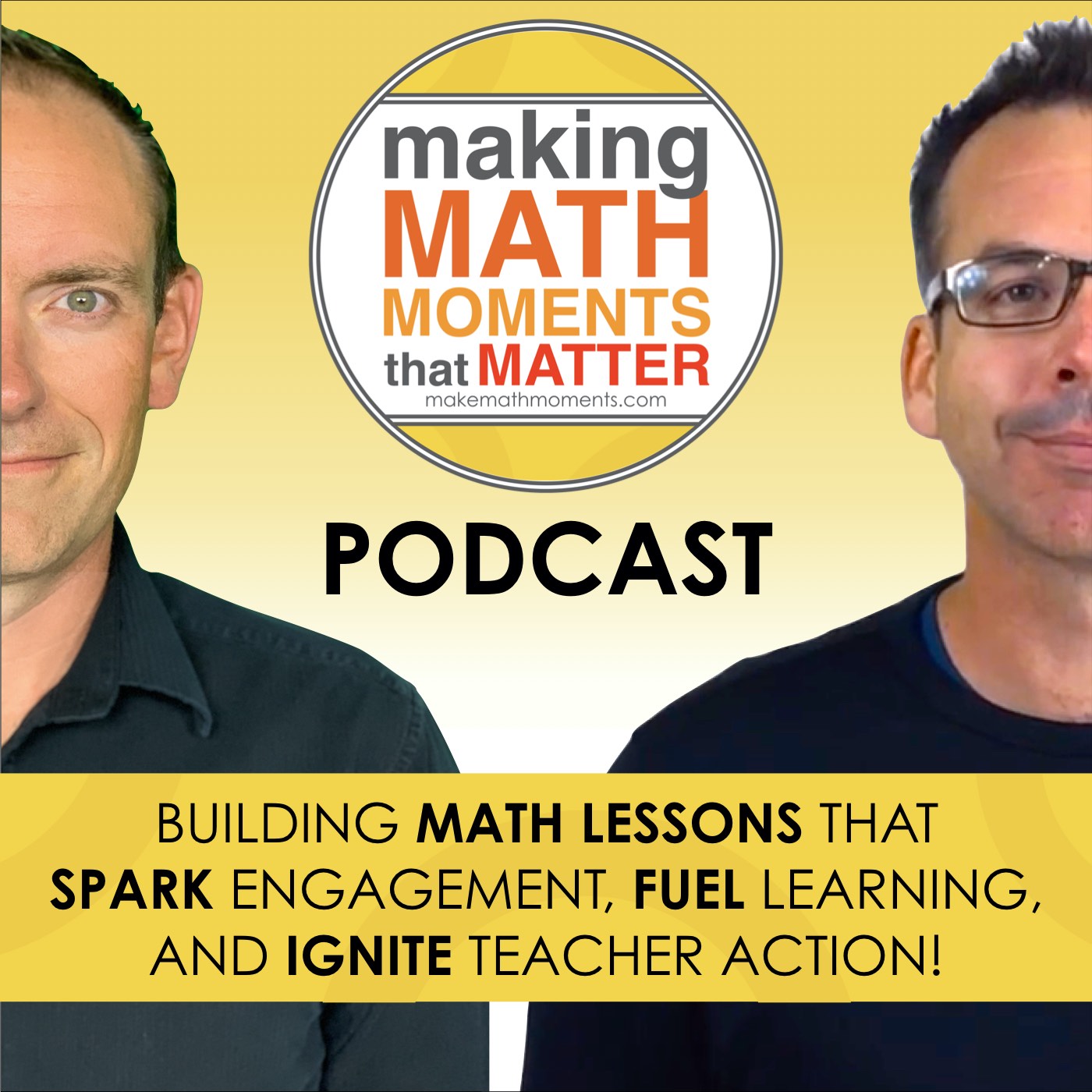
DOWNLOAD THE 3 ACT MATH TASK TIP SHEET SO THEY RUN WITHOUT A HITCH!
Download the 2-page printable 3 Act Math Tip Sheet to ensure that you have the best start to your journey using 3 Act math Tasks to spark curiosity and fuel sense making in your math classroom!
LESSONS TO MAKE MATH MOMENTS
Each lesson consists of:
Each Make Math Moments Problem Based Lesson consists of a Teacher Guide to lead you step-by-step through the planning process to ensure your lesson runs without a hitch!
Each Teacher Guide consists of:
- Intentionality of the lesson;
- A step-by-step walk through of each phase of the lesson;
- Visuals, animations, and videos unpacking big ideas, strategies, and models we intend to emerge during the lesson;
- Sample student approaches to assist in anticipating what your students might do;
- Resources and downloads including Keynote, Powerpoint, Media Files, and Teacher Guide printable PDF; and,
- Much more!
Each Make Math Moments Problem Based Lesson begins with a story, visual, video, or other method to Spark Curiosity through context.
Students will often Notice and Wonder before making an estimate to draw them in and invest in the problem.
After student voice has been heard and acknowledged, we will set students off on a Productive Struggle via a prompt related to the Spark context.
These prompts are given each lesson with the following conditions:
- No calculators are to be used; and,
- Students are to focus on how they can convince their math community that their solution is valid.
Students are left to engage in a productive struggle as the facilitator circulates to observe and engage in conversation as a means of assessing formatively.
The facilitator is instructed through the Teacher Guide on what specific strategies and models could be used to make connections and consolidate the learning from the lesson.
Often times, animations and walk through videos are provided in the Teacher Guide to assist with planning and delivering the consolidation.
A review image, video, or animation is provided as a conclusion to the task from the lesson.
While this might feel like a natural ending to the context students have been exploring, it is just the beginning as we look to leverage this context via extensions and additional lessons to dig deeper.
At the end of each lesson, consolidation prompts and/or extensions are crafted for students to purposefully practice and demonstrate their current understanding.
Facilitators are encouraged to collect these consolidation prompts as a means to engage in the assessment process and inform next moves for instruction.
In multi-day units of study, Math Talks are crafted to help build on the thinking from the previous day and build towards the next step in the developmental progression of the concept(s) we are exploring.
Each Math Talk is constructed as a string of related problems that build with intentionality to emerge specific big ideas, strategies, and mathematical models.
Make Math Moments Problem Based Lessons and Day 1 Teacher Guides are openly available for you to leverage and use with your students without becoming a Make Math Moments Academy Member.
Use our OPEN ACCESS multi-day problem based units!
Make Math Moments Problem Based Lessons and Day 1 Teacher Guides are openly available for you to leverage and use with your students without becoming a Make Math Moments Academy Member.

Partitive Division Resulting in a Fraction

Equivalence and Algebraic Substitution
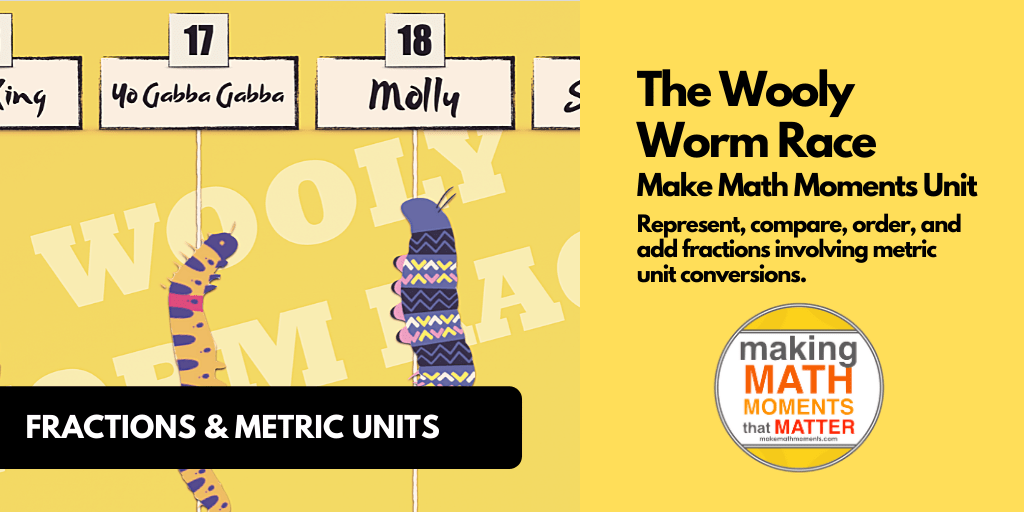
Represent Categorical Data & Explore Mean
Downloadable resources including blackline masters, handouts, printable Tips Sheets, slide shows, and media files do require a Make Math Moments Academy Membership.
ONLINE WORKSHOP REGISTRATION

Pedagogically aligned for teachers of K through Grade 12 with content specific examples from Grades 3 through Grade 10.
In our self-paced, 12-week Online Workshop, you'll learn how to craft new and transform your current lessons to Spark Curiosity, Fuel Sense Making, and Ignite Your Teacher Moves to promote resilient problem solvers.

0 Comments