Episode #464: End-of-Year Math Strategies: Finishing the School Year Strong Without Cramming
LISTEN NOW HERE…
WATCH NOW…
It’s April, and in math class the countdown is on.
There is limited time left before standardized math testing or the end of the school year—and many math teachers are feeling the pressure to either rush through remaining math content or coast to the finish.
This time of year creates a real tension in math instruction. Teachers want to maximize the time that’s left, but they also know that flying through math units won’t lead to retention or confidence. At the same time, no one wants to lower expectations or lose momentum in the final stretch.
So what does strong end-of-year math instruction actually look like?
In This Episode, You’ll Learn
- Why rushing through math content at the end of the year often undermines lasting math understanding
- How to identify priority math standards and focus your remaining math time wisely
- Why end-of-year math units like measurement, geometry, probability, or data can be powerful opportunities for applying prior math learning
- How rich math tasks and cognitively demanding math problems can consolidate a year’s worth of math learning
- What math coaches and math leaders can do to support teachers in making end-of-year math decisions
- How spiraling math instruction can reduce end-of-year math pressure altogether
If you’re feeling the pressure of end-of-year math instruction, take a step back and ask:
What math learning is most important for students to carry forward from this year?
Let that answer guide how you finish strong in math.
Attention District Math Leaders:
Not sure what matters most when designing math improvement plans? Take this assessment and get a free customized report: https://makemathmoments.com/grow/
Ready to design your math improvement plan with guidance, support and using structure? Learn how to follow our 4 stage process. https://growyourmathprogram.com
Looking to supplement your curriculum with problem based lessons and units? Make Math Moments Problem Based Lessons & Units
Be Our Next Podcast Guest!
Join as an Interview Guest or on a Mentoring Moment Call
Apply to be a Featured Interview Guest
Book a Mentoring Moment Coaching Call
Are You an Official Math Moment Maker?





FULL TRANSCRIPT
Yvette Lehman: episode’s coming out in April and I feel like collectively in education here in North America we’re feeling like it’s crunch time. There’s almost this kind of ticking clock that’s going in the background and it’s leading us into either our standardized testing or just the end of the year. I know some of our partner districts in the US they’re done mid-May and some of them even have a spring break mixed in there.
We were with a group yesterday and they were counting down the weeks and it’s like five weeks till testing and then six weeks after that till the end of the year. And they’re trying to think about how do we maximize the time? We don’t want to coast through the end. We don’t want to think that we’re already done.
Therefore we go into, you know, taking our foot off the gas, but also we don’t want to get into a panic mode where it’s like, we have so much content to cover. We’re just gonna fly through everything that’s left.
Jon Orr: What did you think? Well, like when you were teaching, like when you’re this time of year, like which one were you in where you were like, I’m, was I the fly through at the end? Was I some, you know, something, how did I think about the end of the year going into the, you know, that, you know, a chunk of that time is, is we got to review, we’ve got to review the test where the exam is coming.
And, and like, how did you feel during that time knowing that like, you were also probably not tossing in the towel, you know, you were. You were saying, we’re just gonna watch movies for the rest of the time, but you were making sure that you were maximizing your time. How did it make you feel at the end of the year?
Yvette Lehman: I don’t want to lead in too much because I feel like Beth is going to have some things to say about this, but I feel like I used the end of the year to really dig in to cognitively demanding tasks and experiential learning. Like it was almost like the culmination of all of the learning that we had done throughout the year and it’s like now you’re going to take all of those skills and all of that understanding that you’ve developed throughout the year And now you’re ready to really dig in.
so we did, especially because the weather would get nice in June. So we would do like big Fermi problems, or we would just like really dig into some really interesting and complex mathematics in a way that consolidated everything that had led up to that point. And that was my way of reviewing, was to really say, okay, now that we’ve built all of this knowledge and understanding throughout the year, let’s apply it. in some really interesting and creative ways to solidify our understanding.
Beth Curran: And for those listeners who are following a curriculum, I would say that I would ask you to look at your curricula, what you have left and see if you see those opportunities for that consolidation of learning for the culminating content, if you will. Oftentimes, I think that curricula tends to, you know, focus on the meat of calculation, working with four operations of whole numbers and fractions and decimals and then The content that often we feel crunched to cover are things like measurement and geometry, really, truly, usually those units are application of all the content that we’ve used.
And so I would challenge anyone who is following a curriculum to kind of look ahead and see where does this live within the content that I still have to cover rather than feeling like, now I have something else to do. I have to practice for a test and I have to go out and find these rich tasks. So I would challenge them to really dig into the curriculum and look at that.
Jon Orr: How do I battle the need and the pull to speed up and say, a minute, there’s only this much time, but I haven’t covered this, this, this, and this. We need to do better job here, here, here, here, here, here, here, here, here, here, here, and here with only this much time. How do I battle that as a teacher?
Because I think what you’re saying is like, both of you are saying slow down and kind of think big picture.
Yvette Lehman: I think that we have to ask ourselves, what is the impact of rushing through content? Like, is there evidence to suggest that if I speed through or speed up the pace and I rush through and I just deliver everything that’s left, that it’s gonna result in retention and lasting understanding for students?
Jon Orr: Well, isn’t that why the word cramming exists?
Beth Curran: But did you hear Yvette’s word there? She said lasting understanding, right? So that’s the difference. And I think what we know now is that we need to develop opportunities for students to experience that lasting understanding. And so by rushing through things, you know, when teachers rush through mathematics, I think they tend to go back to more procedural steps, you know, things like that.
It’s more of a procedural quick cram, if you will, than it is to really, I think what goes out the window is that conceptual understanding. You we tend to focus more on just, gotta get them, I gotta tell them how to do it now because we’re running out of time.
Jon Orr: And if I’m like, let’s say I’m leading a school or a school right now and I’m listening to this episode or I’m a coach and I’m like, I’m not going to play this for my teachers because now they’re gonna get the idea that they should just cut and not do blank because the end of the year is here and they’re saying that they have permission to not cover everything. And that is worrisome to me as an administrator of a building.
Beth Curran: Now, I’m not saying that they have permission to not cover everything. What we’re saying is they don’t need to try to cover everything before the state test. Typically after the state test, most schools still have another three, four, five weeks of instruction. So that instruction could still happen later on, setting the students up for that lasting understanding that’s going to carry them into the next school year. Yvette, go ahead.
Yvette Lehman: think this is also, we talk a lot about priority standards. And I think that if we got to this point in the year, and I was a coach and I was working with a teacher who’s looking at all of the units that they have left, and they’re like, okay, well, I have four units to cover, but I only have eight weeks to do it.
And the pacing suggests this is going to take twice as long. I think that’s where having conversations around priority standards and what is really, what, What do we absolutely have to solidify by the end of this year because it is critical learning that’s going to lead them into the next year along their developmental trajectory is really important.
And I think to Beth’s point as well, it’s like looking for those opportunities where maybe, let’s say we have a measurement unit and a fraction unit. It’s like, okay, how can those two units maybe work in tandem in some way so that we can strengthen our fraction understanding through the measurement unit and we don’t have to treat them as too isolated?
Jon Orr: How do I make that call though? Like how do I, is it me that makes that call as a classroom teacher? Is it, have to wait for my administrator? Do I approach my administrator to have these discussions? Like I think there’s a lot of hesitation. It depends on district, it depends on classroom, it depends on teacher.
But I think there’s, I’ve heard a lot of hesitation around modification. And I’m not sure, therefore I just have to like keep going the way it is. And when I get to what I get to is sometimes I think the course of action, because I don’t know, I don’t know if I’m allowed to combine or, or, do this type of thing.
If I have a set curriculum, I have to follow in a set pacing guide because I’m trying to match this teacher over here across the hall or down, down the hall.
Beth Curran: Whew, these are big ideas here, John, thanks. So who does that fall on? Well, I think that’s partly, we’re speaking to coaches, right, as well as leaders. so talking to coaches, I think what we would encourage them to do is to help the teachers to see where things can be combined. What are those major? content strands that we need to make sure that we cover.
What are the major clusters within our standards that we need to make sure that we’re covering? And so I think it becomes a group effort. Maybe slightly shifting, right, this time of year, what our long-term goals were and kind of focusing now on maybe even defining some new key results over the next five weeks or so.
At the end of the five weeks as we’re getting prepared, students are going to be taking the test tomorrow. what would success look like? know, backwards designing that and coaches roles may be shifting to support teachers and helping them get through that.
Yvette Lehman: think what you’re describing, John, is what we would say is an ideal system where there is coherence, networking, and collaboration happening so this doesn’t fall on one individual teacher to make this call. As a division, as a grade level team with support from their administrator and their coach, they’re coming to some, they’re coming up with a plan. They’re looking at the content that’s left for the rest of the year.
Jon Orr: this collaboration.
Yvette Lehman: and they’re asking themselves, where are we going to spend our time? What are we going to prioritize? What does finishing strong with this group of students look like, sound like, feel like? And I agree with you because to put the onus on an individual teacher to decide what’s important and what to cut or not cut or how much time to spend on the remaining content is probably not only unfair, but also there’s going to be a ton of variability from classroom to classroom if we leave it up to every individual teacher to figure this out.
Jon Orr: for sure. And it’s like, it just goes back to the importance of putting those moves in place as a culture and a system early on so that, you know, you’re doing that through the year. You’re doing that on a continual basis as part of the way that you decide on, you know, the goals that you’ve set for the beginning of the year, but through the year so that you’re like, we’re not getting to this point in the year going like, wonder what we should do or wonder how we treat the end of the year.
This should be part of how you continually improve the work you’re doing. year to year to year to year. And it takes time. there’s no question about it. Be like, wait a minute, but who, how, how do we work that in? you don’t want to be in this situation, you have to then say, is this a priority for us to say that we have a consistent meeting time place that says like, we come together, we look at where we are, we look at the pacing, we look at the expectations, we have priority standards, we set those up at some of our previous meetings so that when we’re here, you’re right, Yvette, like, There is no question anymore.
that’s typically the work that we want to do with teams is to help them establish that type of environment. And so that you’re not wondering what happens at the end of the year. These are important moves that successful school teams make so that they have say continuity and coherence and around the work that they’re trying to do with the resources they currently have.
Yvette Lehman: It made me think of one of our partners in Louisiana, and they’re actually going to be engaging in some work coming up in March. They’re bringing their teachers together and the way that they designed the day was very teacher driven. It’s an opportunity for them to come together as grade level teams and figure out where they are and where they’re going collectively.
And although the day is going to be facilitated by instructional leaders, the thinking is being put on the educators and the collective expertise of the room to kind of stop and reflect on where they are currently in the year and what does the next eight weeks look like for them? What does Finishing Strong look like?
Looking at the modules that they have on the horizon and deciding what they’re going to prioritize moving forward. So that I think is a great example of how they have a PD day. they had to determine how they were going to use that PD day. They were like, we’re pulling all of our middle school math teachers together.
What does that time look like? And the time is really anchored around creating networks, creating collaborative structures that they can collectively determine the best course of action moving forward.
Jon Orr: Any tips that you want to share with teachers right now? So going into the end of the year, we are at this place because we talked a lot about like how to structure a system at a school or a school district and, and spirit as coaches to support teachers. But any tips that we want to share with the teacher who’s listening right now saying it’s the end of the year.
I don’t want to speak. I don’t want to rush. What could I be looking at? And let’s say I don’t have the system that supports me right now that tells me and helps me understand what those priority standards are.
Beth Curran: Yeah, we were talking with a client recently who they’re trying to figure out what to do for the last five weeks before the testing. you know, the teachers are stressed that they have to do, you know, fit in time. They have to create time now to do practice questions. And so we kind of talked through that that scenario with them.
And one thing I think that that we’ve said kind of consistently here is. finding the practice questions that support what they’re currently teaching. So rather than having it be just a random practice question that we’ll work through that deals with something different, really looking at if we’re about to launch into a chapter or unit on measurement, then let’s find the practice questions that are around measurement, but maybe also bring in some of the other major cluster standards around calculating the four operations of whole numbers and fractions and everything else.
And so finding connections and so helping, you know, if you’re a teacher, you might look at the practice, the set of practice questions that you’ve been given and try to tie those into what you’re teaching. We also talked about an emphasis on getting students to really look at a problem. And while it might look unfamiliar, recognizing that, you know, what in here do I know, you know, and actually being intentional on teaching maybe problem solving strategies to students this time of year, rather than my gosh, they have to know the answer to this question.
It’s more like, well, teach them how to attack a problem. You know, thinking about what do I know? Could I draw a picture? Will I use my scratch paper? You know, could I draw a quick sketch of the situation or the scenario? So really working on building up the students, reminding the students that they have been working toward developing these problem-solving skills.
And maybe the focus is less on I have to cover all this content. And it’s more on, my students well-prepared to persevere when they’re posed with a question that might look slightly different, which is probably a scenario they’re going to end up, the situation they’re going to end up in when they take that standardized test.
Yvette Lehman: I want to give advice, but I’m also cautious because I understand that everybody’s context is different, right? And sometimes teachers don’t have autonomy to make decisions about pacing or to make decisions about altering curricula. So I want to be mindful of that in this recommendation that I’m going to make.
But I also am going to say, I just don’t know that rushing through concepts they haven’t seen at all this year. and giving them like a quick, let’s see it quickly and move on is going to lead to much learning. Right? Especially if I get like to your point, Beth, it’s like, we haven’t even seen these concepts, but they’ve been left for the end of the year.
And now it’s like, I’m going to quickly show it to you and we’re going to move on. I just don’t know what the retention rate is for that approach. So if that’s your only option, it’s like, well, I have three units left, but I only have two weeks to do it. So I’m just going to fly through these. I just don’t know that even like that I could ever recommend that as being the best solution.
Jon Orr: What did you do instead?
Yvette Lehman: Can I answer as if I have autonomy? know, like I, yeah. So I think that what I would personally do is I, cause again, typically at the end of the year, you’re going to have your application units, not always, but it’s like now we have application units. looking at probability. We’re looking at, you know, maybe measurement or data. And I think exactly to best point,
Jon Orr: Yeah, you’re a teacher in a classroom.
Yvette Lehman: I would probably pull the cognitively demanding task from that unit. And I would help students connect to the prior knowledge, but maybe using, you know, experiential multimodal approaches that they can access it through context, they can act it out, they can, there’s visuals to support them. It’s like, I want us to help them see that the learning that they’ve done previously can be applied through these contexts.
And I mean, I would still have to do my formative assessment. I’d still have to pull my small groups. It’s not as though I’m not still doing my best practice for tier one and tier two instruction that I’ve done throughout the entire year. But I think that I would treat it as more of a consolidation of prior learning through rich tasks, through problem solving.
Beth Curran: was gonna say if you have less autonomy and you’re told that you’re gonna spend the next three weeks, five weeks, four weeks, whatever, doing practice questions, I think again, I would encourage teachers to look for those high cognitive questions from that practice set, something that looks unfamiliar, not, you know, don’t always go to the ones that you know they’re going to get right and use those questions then to, just like Yvette said, to work through you know, the, do we approach something like this? Could we lean into our concrete, our representational, our abstract?
What could we do? And so if you don’t have as much autonomy and you are told you’re going to spend this time doing practice questions, then thinking about how you use that set of practice materials.
Jon Orr: If you go back to the autonomy side, you know, and this is, you know, one of the, feel like, you know, a huge benefit here in Ontario, most teachers have almost full autonomy of like what’s happening in their classrooms. And, you know, I lived in that system and taught 19 years in that, in that system before I, you know, pivoted to coach teams and schools and school districts on math improvement.
But Now, this is the more advanced move and historical listeners of the podcast will know the advanced move was the spiraling approach that both Kyle and I developed, know, number of, not developed, but, but, you know, applied a number of years ago into our classrooms to teach the way that Yvette was talking about, from the beginning. So we’re not waiting until the end to kind of do that type of work is to teach through problem solving, teach through bigger kind of problems, but then spiral it so that we touched upon all concepts before the midterm.
And so there was no worry at the end of the year, whether we touched upon everything and there was any sort of major idea left off at the end of the year, because we would begin and we would go teach through problems that introduced these ideas throughout the year, but not go as in depth as you would in a unit style approach. You would leave that for the next spiral and then the next spiral and slowly over time you would get deeper.
And so you’re jumping between units or strands. But you’re also say going deeper and deeper and deeper as you go. And so there was never a worry when you got to the end of the year, whether you’ve covered everything because you touched upon everything and then you, you know, you’re getting deeper and deeper.
So that was my move. That’s an advanced move. That was a move that because we had high autonomy, we also had high capability of building that type of program for our students in our, in our grades, but something to consider.
Yvette Lehman: So as we wrap up this episode today, thinking about it’s crunch time. I’m a teacher, I’m a coach. I’m trying to figure out how do I maximize the remaining five weeks, six weeks, eight weeks. How do I finish strong? How do I finish the year in a way that helps students really consolidate their understanding and feel confident in their ability to, as Beth described, tackle novel problems, tackle unfamiliar situations, leveraging the knowledge, understanding, and skills they’ve developed throughout the year? So if we had one call to action for teachers listening, what would it be?
Jon Orr: Well, think what it would be is that we’ve given some suggestions, right? So we have to answer this for ourselves, right? It’s just to step back and go, like, where do I want to place the value? Like, what do I want the everlasting learning to go beyond this year? Do I want to make sure that I strengthen the existing priority standards that I currently have?
Maybe there’s a couple that I can identify, even if I have to do it on my own going into the end of the year. I am listening to a podcast on my own, so I might be that teacher who can take that opportunity. I think we just have to take that step and go, I have to take some deep breaths going into the end of the year and decide how do I want to treat this knowing that I want everlasting learning to maintain and that I don’t want to, and we’re trying to convince you to not rush and cover everything on a speed basis just to say you covered it.
So that’s the personal decision you’re going to have to make in your own classroom is how do you use that information? and some of the suggestions here that we talked about to go into the end of the year. And if you do want to take that step in that advanced step that I mentioned, we do have a full course on spiraling your math class.
You can head on over to makemathmoments.com for spiraling. There is a, it’s free to register and there is a three part series that can guide you through why spiraling makes a big difference, how to start it and how to maintain it throughout the school year.
Thanks For Listening
- Book a Math Mentoring Moment
- Apply to be a Featured Interview Guest
- Leave a note in the comment section below.
- Share this show on Twitter, or Facebook.
To help out the show:
- Leave an honest review on iTunes. Your ratings and reviews really help and we read each one.
- Subscribe on iTunes, Google Play, and Spotify.
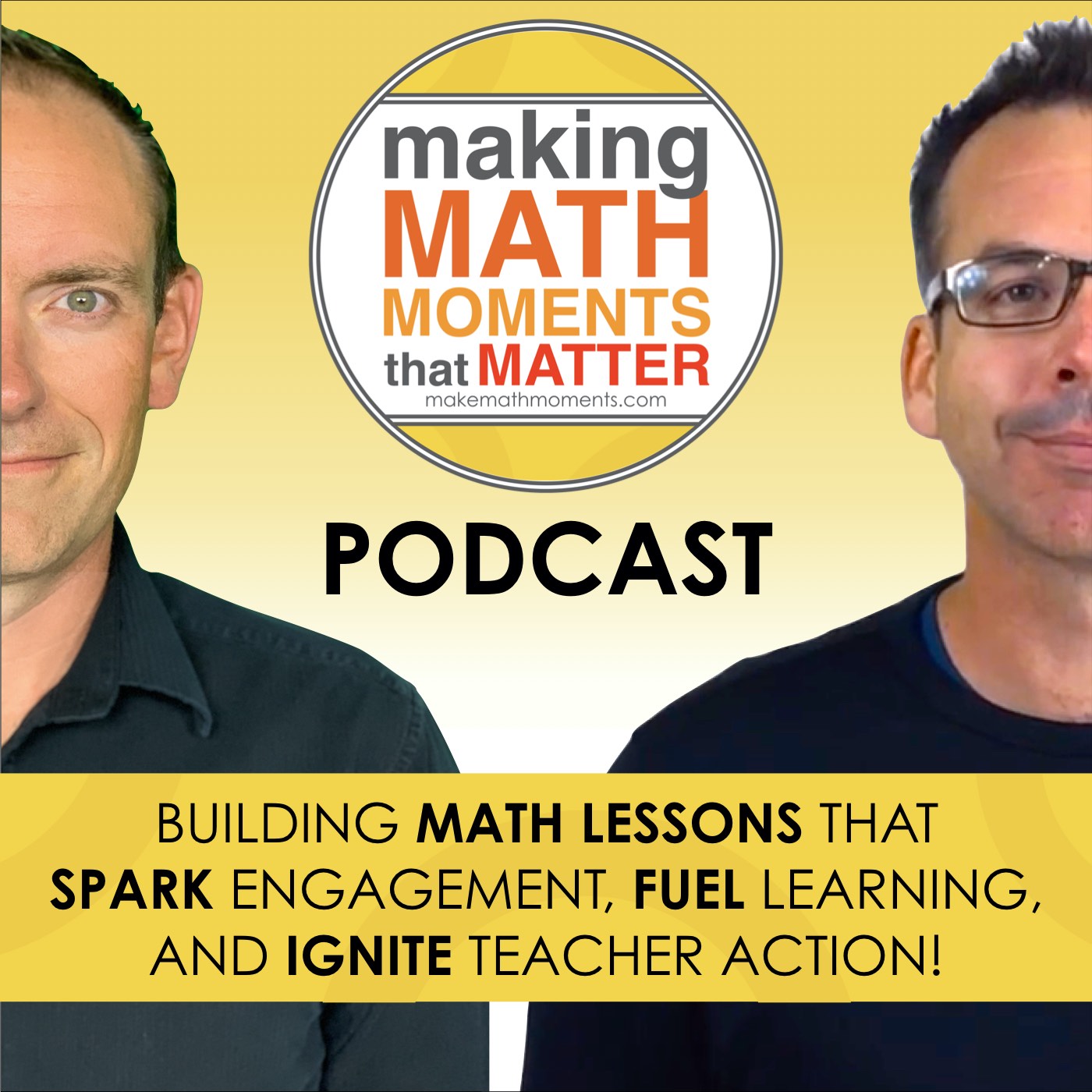
DOWNLOAD THE 3 ACT MATH TASK TIP SHEET SO THEY RUN WITHOUT A HITCH!
Download the 2-page printable 3 Act Math Tip Sheet to ensure that you have the best start to your journey using 3 Act math Tasks to spark curiosity and fuel sense making in your math classroom!
LESSONS TO MAKE MATH MOMENTS
Each lesson consists of:
Each Make Math Moments Problem Based Lesson consists of a Teacher Guide to lead you step-by-step through the planning process to ensure your lesson runs without a hitch!
Each Teacher Guide consists of:
- Intentionality of the lesson;
- A step-by-step walk through of each phase of the lesson;
- Visuals, animations, and videos unpacking big ideas, strategies, and models we intend to emerge during the lesson;
- Sample student approaches to assist in anticipating what your students might do;
- Resources and downloads including Keynote, Powerpoint, Media Files, and Teacher Guide printable PDF; and,
- Much more!
Each Make Math Moments Problem Based Lesson begins with a story, visual, video, or other method to Spark Curiosity through context.
Students will often Notice and Wonder before making an estimate to draw them in and invest in the problem.
After student voice has been heard and acknowledged, we will set students off on a Productive Struggle via a prompt related to the Spark context.
These prompts are given each lesson with the following conditions:
- No calculators are to be used; and,
- Students are to focus on how they can convince their math community that their solution is valid.
Students are left to engage in a productive struggle as the facilitator circulates to observe and engage in conversation as a means of assessing formatively.
The facilitator is instructed through the Teacher Guide on what specific strategies and models could be used to make connections and consolidate the learning from the lesson.
Often times, animations and walk through videos are provided in the Teacher Guide to assist with planning and delivering the consolidation.
A review image, video, or animation is provided as a conclusion to the task from the lesson.
While this might feel like a natural ending to the context students have been exploring, it is just the beginning as we look to leverage this context via extensions and additional lessons to dig deeper.
At the end of each lesson, consolidation prompts and/or extensions are crafted for students to purposefully practice and demonstrate their current understanding.
Facilitators are encouraged to collect these consolidation prompts as a means to engage in the assessment process and inform next moves for instruction.
In multi-day units of study, Math Talks are crafted to help build on the thinking from the previous day and build towards the next step in the developmental progression of the concept(s) we are exploring.
Each Math Talk is constructed as a string of related problems that build with intentionality to emerge specific big ideas, strategies, and mathematical models.
Make Math Moments Problem Based Lessons and Day 1 Teacher Guides are openly available for you to leverage and use with your students without becoming a Make Math Moments Academy Member.
Use our OPEN ACCESS multi-day problem based units!
Make Math Moments Problem Based Lessons and Day 1 Teacher Guides are openly available for you to leverage and use with your students without becoming a Make Math Moments Academy Member.

Partitive Division Resulting in a Fraction
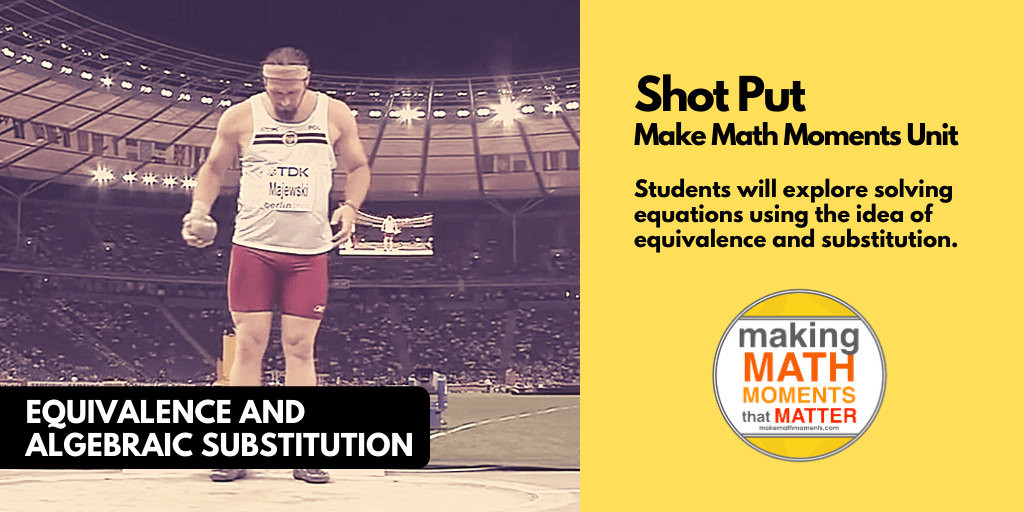
Equivalence and Algebraic Substitution
Represent Categorical Data & Explore Mean
Downloadable resources including blackline masters, handouts, printable Tips Sheets, slide shows, and media files do require a Make Math Moments Academy Membership.
ONLINE WORKSHOP REGISTRATION
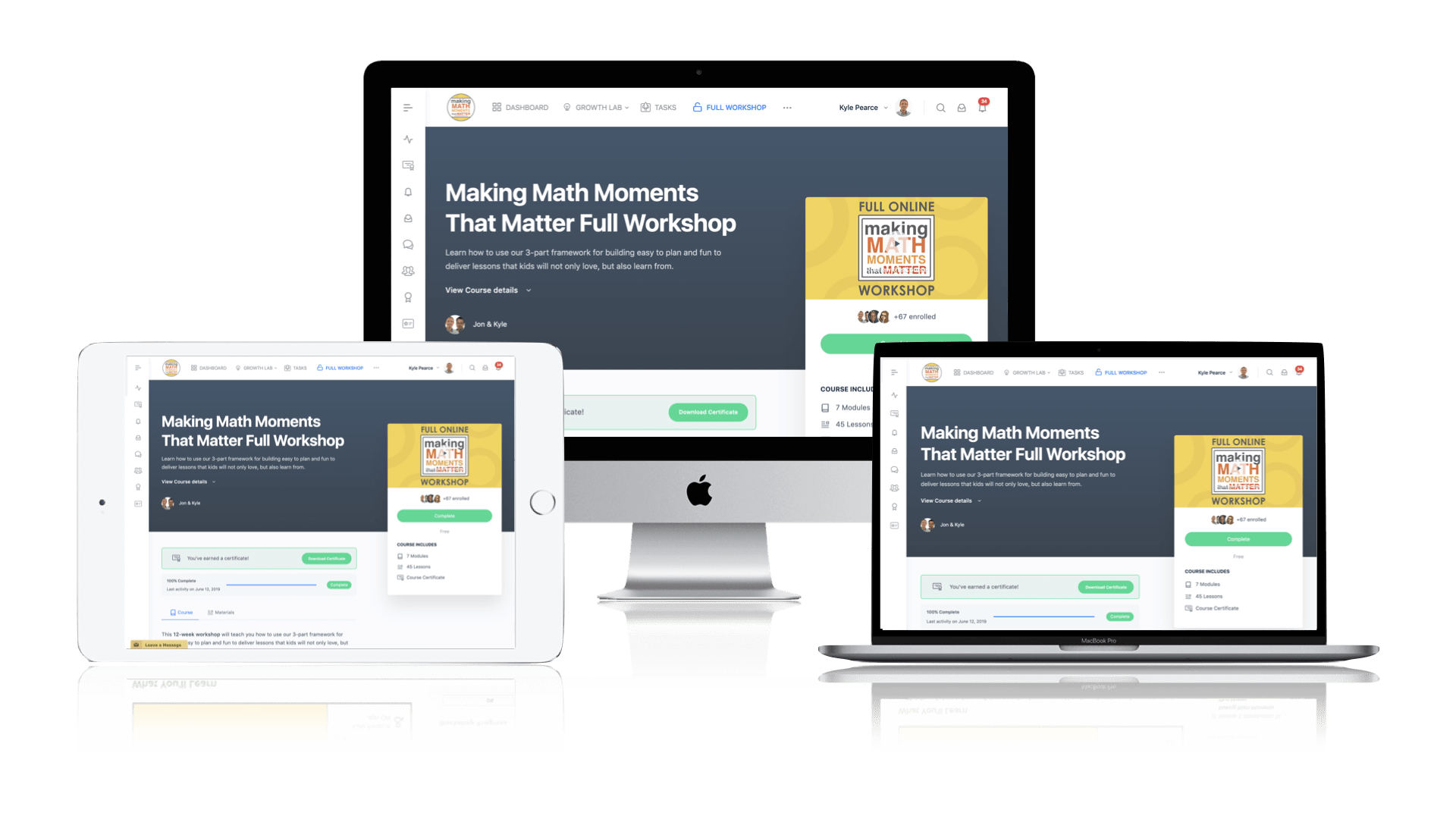
Pedagogically aligned for teachers of K through Grade 12 with content specific examples from Grades 3 through Grade 10.
In our self-paced, 12-week Online Workshop, you'll learn how to craft new and transform your current lessons to Spark Curiosity, Fuel Sense Making, and Ignite Your Teacher Moves to promote resilient problem solvers.
0 Comments