
Episode #469: How To Protect Instructional Time in Math Class in a World of Disruptions
LISTEN NOW HERE...




WATCH NOW...
In math classrooms, what is the most common frustration that keeps showing up? Not enough time. Interrupted lessons. Lost instructional minutes. The constant feeling of trying to cover more math than the time allows. It’s not just about lost time. It’s about lost momentum. Lost focus. Lost thinking. At the same time, schools are balancing another priority—community and culture. Assemblies. Events. Activities that matter.
So the question becomes:
Is it possible to protect instructional time and still build a strong school culture? Or does it have to be one or the other?
In this episode, you’ll explore:
- Why lost instructional minutes impact more than just pacing
- What happens to student thinking when lessons are constantly interrupted
- Why strong beginnings and endings matter more than we think
- How predictable routines can help reclaim lost time
- What teachers can do to maximize instructional minutes on a typical day
- How school leaders can create more predictable, protected instructional time
If you’ve ever felt like you’re constantly behind—or like your math block disappears before it even starts—this episode will help you rethink how to protect and make the most of every instructional minute.
Attention District Math Leaders:
Not sure what matters most when designing math improvement plans? Take this assessment and get a free customized report: https://makemathmoments.com/grow/
Ready to design your math improvement plan with guidance, support and using structure? Learn how to follow our 4 stage process. https://growyourmathprogram.com
Looking to supplement your curriculum with problem based lessons and units? Make Math Moments Problem Based Lessons & Units
Be Our Next Podcast Guest!
Join as an Interview Guest or on a Mentoring Moment Call
Apply to be a Featured Interview Guest
It will take less than two (2) minutes to book your Math Mentoring Moment call.
Book a Mentoring Moment Coaching Call
Take two (2) minutes to book your Math Mentoring Moment call and let's work together to shake that math pebble out of your shoe!
Are You an Official Math Moment Maker?
Ensure that you follow, rate and review on Apple Podcasts, Spotify and other platforms to show your support and ensure other math educators can find the show.




DOWNLOAD OUR HOW TO START THE SCHOOL YEAR OFF RIGHT GUIDE
Start your school year off right by downloading the guide that you can save and print to share with colleagues during your next staff meeting, professional learning community meeting or just for your own reference!
FULL TRANSCRIPT
Yvette Lehman: I was on a call with a teacher last week and he was sharing a struggle that many teachers experience, I think, which is this pressure of not feeling like you have enough time. So we talk about this all the time, right? You're trying to keep up with your pacing. You're trying to ensure good outcomes for all learners. You're looking ahead and you're thinking there's just more content here to cover than the instructional minutes that I have.
Yvette Lehman: But the frustration this teacher was explaining was that they got into the classroom at the beginning of the period and they wanted to get students into the launch and off to work right away, as the curriculum is designed to do. But it took 15 minutes to get there because of all of the disruptions and interruptions. The phone was ringing in the classroom. There were announcements. There was somebody stopping by from another room to grab some iPads. A student comes in late, and there were just so many things that ate up time within the period. And when we think about all of the things that are cutting into our instructional minutes daily or weekly, that seems to be a frustration that we hear from both teachers and leaders.
Jon Orr: I echo that frustration. And I guess this is the part where you know that this doesn't happen every single day. But there are days where you're feeling like you're getting started and then something just steps in and reduces or stops that start. It's like you said — a student is late and knocks on the door, or all of a sudden someone's buzzing into your room to say your attendance isn't finished, or there's an announcement, or hey, it's picture day and three kids have to leave the classroom during this time, and then three kids have to leave the next hour. It's like you know you're just getting going and then it stops.
Jon Orr: I remember just saying to the kids on those days, I don't know if we have any more disruptions here to get going, folks. So yeah, I 100% echo that frustration. Now, I'll admit that doesn't happen every day. It doesn't happen all the time. But when it does happen, it really disrupts the flow and it really disrupts, I think, your mental ability to keep the flow actually happening once you're interrupted. It's hard. And I think you step back and go, what are we doing here? Are we teaching math, or are there other things here that matter the most?
Yvette Lehman: I feel like the other competing priorities — and this is where I guess we wanna go today — is this idea that we want to create strong communities within our schools. We want to establish a joyful, inclusive space and great culture. And so when you have things like picture day coming up, and now the track team's coming down to get their jerseys and this group is leaving for this and that, it does erode some of that time on task or our focus on academic excellence.
Yvette Lehman: And I think what I wanted to debate with you here today is, is it possible to establish a culture of high academic excellence where instructional minutes are prioritized and protected, and still offer all of those other additional extracurricular community-building activities within your school? Is it an either-or?
Jon Orr: Right. Because I guess we all hope it's a blend for sure. What you're saying is, on one hand, if we say math time or any instructional time isn't protected, we should be protecting it. This is why we don't make interruptions here. This is — we're here to learn, we're here to engage our thinking, we're here to stretch our brains and communicate with each other about our ideas and work towards strengthening our understanding on the learning goals and the standards that we're trying to get better at.
Jon Orr: On the flip side, school is a place of community and culture and there's more to learning math than just the math. We need to say we have a place where students feel like there is more than just academics, more than just being in a math class. We want to make sure that we showcase that. We want to honor that community, that culture we're building in our building. And I think you're saying we don't want to look at it as either-or. Or you're asking, can we create that so that it doesn't become an either-or situation?
Beth Curran: Yeah, so I think one thing to think about is if we do know going into the academic year that there are going to be interruptions — there are going to be practices for plays and drama and musical things that the school is putting on, and there are going to be times when sports teams have to leave early — we do know that those things are going to happen, and those things are important in developing a good strong culture. Then what we need to make sure of is that when things are normal and there aren't interruptions, we are using our instructional time as best as we possibly can.
Yvette Lehman: I think what you're saying, Beth, is we have to maximize the minutes that we have on a daily basis, knowing that there are going to be assemblies and events throughout the year that are going to erode some of that time because of all of these other priorities. So then I wonder if that means, on a typical day when there are no disruptions, looking for recommendations for both the teacher and the school leader.
Yvette Lehman: If we have a teacher listening right now, what does it mean to protect the time, to maximize the time, to leverage instructional minutes on a typical day? And how can principals create more typical days? Let's talk about the first one. If we recognize that there are going to be disruptions and that's part of being part of a larger school community — which means we need to plan for them and optimize the time we do have — what would be some ways teachers could do that?
Beth Curran: I think prioritizing instructional time — we need to launch our task within the first five minutes. We need to get students thinking, get their brains engaged in learning whatever new concept it is. I think it's really easy for teachers to get caught up in checking homework and doing a warmup or something that's not necessarily related to the content that they're going to be working through that day. And then it just kind of snowballs.
Beth Curran: Because you spend 20 minutes going over homework, then you've lost that 20 minutes of instructional time and you don't get through the instruction you intended. So then you assign homework and the students don't do well. So then you spend 20 or 30 minutes the next day and it just starts to snowball. And so your meaningful instructional time starts to shrink. So really protecting that time and being aware — do a little time audit. Have somebody come in and watch you with a timer and just let you know how long you're spending on these things. Because I think it's easy to get caught up in that and not realize how much time might actually be going to other things rather than time on task, instructional time, learning time.
Jon Orr: Yeah. And something I think we all want to remember is from the book Power of Moments by Chip and Dan Heath. A big part of why certain moments have more impact on our lives and our memory than others is that you remember the beginnings and the ends more often than the middle. And therefore, when you think about creating powerful moments in our lessons, we wanna pay careful attention to how we're beginning the lesson and how we're ending the lesson. Because those are some really important — yes, the middle's important as well, but the beginnings and the ends are the most impactful moments to create the memorable component.
Jon Orr: Establishing routines at the beginnings of every lesson can establish this is when learning is happening, this is what we always do, this is the way we get started. And then we structure that to be a powerful moment. So maybe this is where we're making sure that we're all prepared and we've got our thinking activity, our launch activity. And then tying it up with the bow at the end and making sure that we have a moment at the end.
Jon Orr: Because sometimes it's like, how do we design both of these knowing that there are going to be disruptions? When is the time in my routine that we do those other things? Like kids are going to be asking to leave the classroom or do this. Can we structure some of that time? And part of it is — I hesitated to have that at the beginning, because you want to get into it right away. But at the end is when a lot of people's schedule kind of winds down — it's like the last 15 minutes is when everyone's standing by the door or the block of time is basically all wrapped up.
Jon Orr: But that's actually another really powerful time. And I never wanted those last moments to be the do-whatever-you-need-to-do time. Like that's the impactful time to bring us back together. This is when your exit slip goes out or when you tie up the big learning goal at the end, even though maybe there was some lag time in the middle of your lesson. Keeping in mind that when we are planning our lessons and trying to minimize disruptions — when we do have control — powerful moments at the beginning, powerful moments at the end can be really impactful for student learning.
Yvette Lehman: I heard two things from both of you. And the one I wanted to jump into is this idea of routine. Like, we have to create predictable structures and habits within our blocks so we can get to the work. You also talked, John, about consolidating the lesson or landing the lesson. That's a pertinent one. How many coaches tell us that the teachers they're supporting never get to it? It's like they've run out of time because they're not launching right away. So every single day we're leaving the learning unfinished, kind of without that memorable moment at the end.
Yvette Lehman: And so this is our call to action to educators — creating that memorable moment at the beginning and the end of our lesson, and also establishing routines so that it's predictable for students. So that they know what to expect and there's less time lost on transitions or giving instructions. That's one thing I learned from my teaching partner — the more predictable your routine is, the less time you lose in explaining what you need to do now. Because students know what to do. The expectations have been clearly established and we do the same things routinely. So then you actually make up time by gaining time from those transitions.
Yvette Lehman: That also made me think about recommendations we have for school principals. I wonder how principals can also help with routine and being more predictable. What I mean by that is, sometimes there's no pattern to the disruptions or the announcements or when things are happening in the building. They're more reactive — like, we forgot to collect the money, someone's coming around now; recycling needs to be picked up today, we're going to do that in the middle of period five. And so I wonder if we think from the bigger picture of the school, how can the leadership also lean into this idea of routine or predictable patterns so that people can plan around them and anticipate for them?
Yvette Lehman: It will help teachers be more intentional about protecting their time because they can predict when those interruptions might be. Thoughts on that? Like, what is a principal sending this message look like?
Jon Orr: Well, I think it's exactly that — sending the message and communicating it on a consistent basis. Like, when we're in class, we want community to exist in our building, but we're going to say have set times where we structure that time, whether it is between this block and this block where we can all agree to plan around, knowing that those types of activities happen and therefore you can all plan around that time.
Jon Orr: But really what I was saying is that the principal values these principles as well and then communicates those on a regular basis — when we have the time with our students, we wanna be maximizing that time in terms of instructional time. We've got set times to do these other things, but when we're in class, we're doing the thinking, that type of work with our kids. And then we're gonna honor this other type in these other places as well. But what I'm saying is consistently bringing that into the staff meetings to just continually talk about it.
Jon Orr: It's a message that's echoed throughout all the decisions that are being made in the building and not just a one-time hey, we've got this time or an all-of-a-sudden choice that goes against some of the things you said before. It has to be — if we say that's what we want to do, we have to then live it, breathe it, and honor that that's the choices we make and stick to those choices. Because when you see the constant interruptions, it's someone who just hasn't valued that that's an important part of what we're doing in our building.
Beth Curran: And I hear both of you talk all the time about how you have to really think about what the system can take on, right? And so as administrators and leaders of schools are thinking about scheduling for the upcoming school year, just being realistic — if you are committed to making meaningful mathematics improvements in your classrooms, then you have to protect that time for mathematics and maybe even give teachers a little more time for mathematics than has been in the schedule over the past few years. Because the system can only take on so much. So if we're taking away from instructional time that teachers are being given because we've taken on this new initiative, then that's obviously going to affect those outcomes.
Yvette Lehman: I feel like the advantage of being in a coaching role is that you get to visit so many different sites. And I think to your point, it's like, when you walk into a building or walk into a classroom, it's sometimes almost palpable what the tone has been set in that building. I can actually picture buildings where I was amazed one time because during instructional time there was minimal movement in the hallways. It wasn't noise and chaos and people coming and going up and down all over the place. It's like, no, this is instructional time. The halls are quiet. You have the few students walking to the washroom and that's it.
Yvette Lehman: And then during the nutrition break or recess, it was buzzing and things were happening and they were taking care of what needs to be taken care of. Okay, the bell rings — now it's quiet again, it's calm, the hallways are clear. Where other buildings, it felt like come and go all day long. There was constant movement and disruption and it just didn't feel like the instructional minutes mattered. The tone had been set that this is learning time. And the expectation is that you are in your classroom engaged in meaningful learning because we value these instructional minutes.
Yvette Lehman: So I think that's kind of our big message here in this episode today — to help people feel heard. It seems like a very common frustration that teachers share with us, which is basically you're asking me to cover more than 10 months of curriculum in a 10-month period, but I'm continuously losing minutes and feeling like I'm constantly playing catch up. And so what can the teacher do to get some of those minutes back or make the minutes meaningful? And what can the leadership of the building do to set the tone for prioritizing instructional time and protecting it?
Jon Orr: I think we had some good nuggets to think about moving forward. And when we think about effective mathematics classrooms and mathematics programs, we often reference the six components of a tree. And thinking specifically today, when we talk about protecting instructional time, my thoughts immediately went to the sun, the soil, and the water of the tree — the surrounding elements of what's happening in our classrooms. And how do we structure, say, to make our tree grow stronger?
Jon Orr: The water, the sunlight, and the soil are the culture — those surrounding components — and strengthening that up is always something we need to reflect on and get stronger on. Just like the roots of the tree, which are our mathematical capabilities and mathematical understanding of what we're doing mathematically with our students and ourselves — that's an important element of an effective mathematics classroom. So having that element and considering the choices around the soil, the water, the sunlight is an important component, just like the other components as well.
Jon Orr: If you want to learn more about the six components of effective mathematics classrooms or effective mathematics programming and support, you can always head on over to makemathmoments.com forward slash report. Fill out our assessment there about what your mathematics classroom looks like and sounds like, what your school's program looks like and sounds like, and we'll send you a custom report that outlines the six components and some next steps on strengthening those components. So that's at makemathmoments.com forward slash report.
Your Customized Improvement Plan For Your Math Classroom.
Take the 12 minute assessment and you'll get a free, customized plan to shape and grow the 6 parts of any strong mathematics classroom program.
District leader/math coach? Take the District Assessment
Thanks For Listening
- Book a Math Mentoring Moment
- Apply to be a Featured Interview Guest
- Leave a note in the comment section below.
- Share this show on Twitter, or Facebook.
To help out the show:
- Leave an honest review on iTunes. Your ratings and reviews really help and we read each one.
- Subscribe on iTunes, Google Play, and Spotify.
The Making Math Moments That Matter Podcast with Kyle Pearce & Jon Orr
Weekly interviews, strategy, and advice for building a math classroom that you wish you were in.
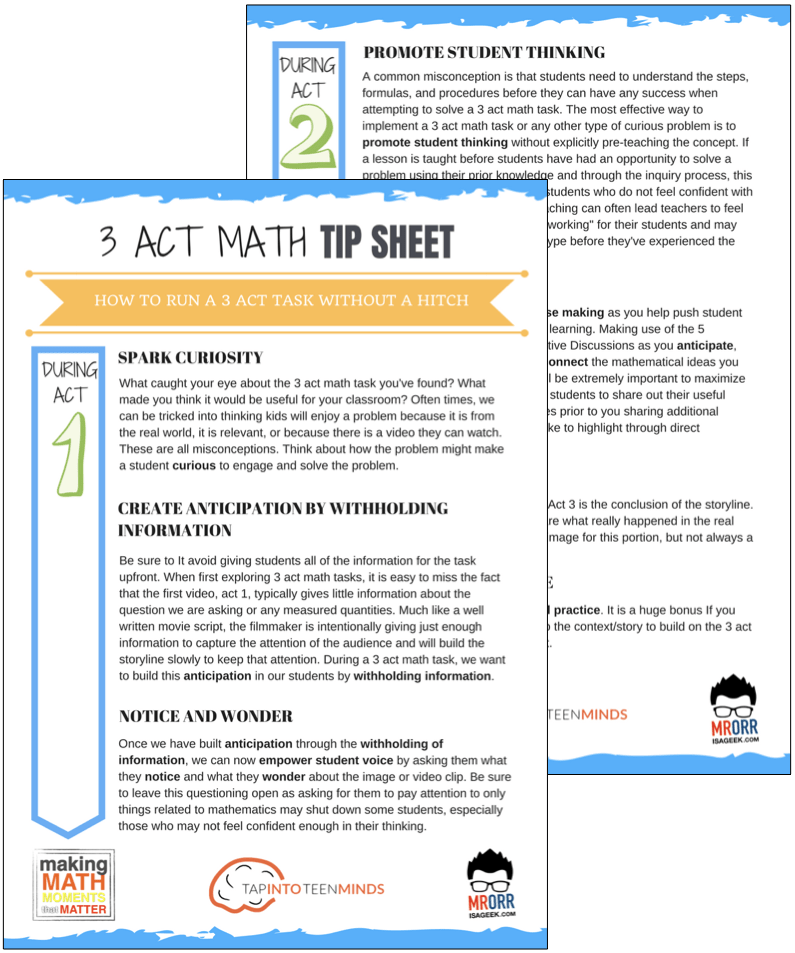
DOWNLOAD THE 3 ACT MATH TASK TIP SHEET SO THEY RUN WITHOUT A HITCH!
Download the 2-page printable 3 Act Math Tip Sheet to ensure that you have the best start to your journey using 3 Act math Tasks to spark curiosity and fuel sense making in your math classroom!
LESSONS TO MAKE MATH MOMENTS
Each lesson consists of:
Each Make Math Moments Problem Based Lesson consists of a Teacher Guide to lead you step-by-step through the planning process to ensure your lesson runs without a hitch!
Each Teacher Guide consists of:
- Intentionality of the lesson;
- A step-by-step walk through of each phase of the lesson;
- Visuals, animations, and videos unpacking big ideas, strategies, and models we intend to emerge during the lesson;
- Sample student approaches to assist in anticipating what your students might do;
- Resources and downloads including Keynote, Powerpoint, Media Files, and Teacher Guide printable PDF; and,
- Much more!
Each Make Math Moments Problem Based Lesson begins with a story, visual, video, or other method to Spark Curiosity through context.
Students will often Notice and Wonder before making an estimate to draw them in and invest in the problem.
After student voice has been heard and acknowledged, we will set students off on a Productive Struggle via a prompt related to the Spark context.
These prompts are given each lesson with the following conditions:
- No calculators are to be used; and,
- Students are to focus on how they can convince their math community that their solution is valid.
Students are left to engage in a productive struggle as the facilitator circulates to observe and engage in conversation as a means of assessing formatively.
The facilitator is instructed through the Teacher Guide on what specific strategies and models could be used to make connections and consolidate the learning from the lesson.
Often times, animations and walk through videos are provided in the Teacher Guide to assist with planning and delivering the consolidation.
A review image, video, or animation is provided as a conclusion to the task from the lesson.
While this might feel like a natural ending to the context students have been exploring, it is just the beginning as we look to leverage this context via extensions and additional lessons to dig deeper.
At the end of each lesson, consolidation prompts and/or extensions are crafted for students to purposefully practice and demonstrate their current understanding.
Facilitators are encouraged to collect these consolidation prompts as a means to engage in the assessment process and inform next moves for instruction.
In multi-day units of study, Math Talks are crafted to help build on the thinking from the previous day and build towards the next step in the developmental progression of the concept(s) we are exploring.
Each Math Talk is constructed as a string of related problems that build with intentionality to emerge specific big ideas, strategies, and mathematical models.
Make Math Moments Problem Based Lessons and Day 1 Teacher Guides are openly available for you to leverage and use with your students without becoming a Make Math Moments Academy Member.
Use our OPEN ACCESS multi-day problem based units!
Make Math Moments Problem Based Lessons and Day 1 Teacher Guides are openly available for you to leverage and use with your students without becoming a Make Math Moments Academy Member.

Partitive Division Resulting in a Fraction
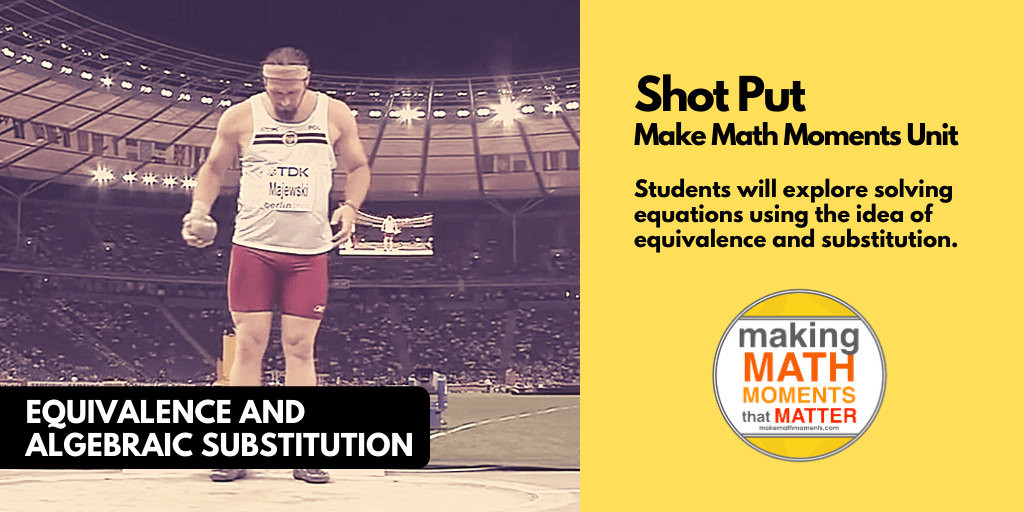
Equivalence and Algebraic Substitution
Represent Categorical Data & Explore Mean
Downloadable resources including blackline masters, handouts, printable Tips Sheets, slide shows, and media files do require a Make Math Moments Academy Membership.
ONLINE WORKSHOP REGISTRATION

Pedagogically aligned for teachers of K through Grade 12 with content specific examples from Grades 3 through Grade 10.
In our self-paced, 12-week Online Workshop, you'll learn how to craft new and transform your current lessons to Spark Curiosity, Fuel Sense Making, and Ignite Your Teacher Moves to promote resilient problem solvers.
0 Comments