Episode #480: How One School Designs Math PLC Time That Actually Shifts Instruction
LISTEN NOW HERE…




WATCH NOW…
Many schools want to improve math instruction, but few have a clear process for deciding what to focus on, how to measure progress, and how to align professional learning around a shared vision. Without that clarity, improvement efforts can quickly become fragmented and difficult to sustain.
What does it actually look like to bring an entire math team together and build a plan for improvement from the ground up? In this episode, we unpack a real three-day process used with a middle and high school math department to co-create a vision for mathematics, identify priority areas for growth, define success criteria, and establish structures for ongoing professional learning. Rather than starting with programs or initiatives, the work began with a shared understanding of the student experience they wanted to create—and the specific shifts needed to move toward that vision.
In this episode, you’ll explore:
- What a Math Coherence Compass is and why it matters
- How to co-create a vision for ambitious mathematics teaching and learning
- Why engaging in mathematics together is a critical part of professional learning
- How to identify high-leverage instructional priorities for improvement
- What effective classroom look-fors can reveal about progress
- How PLCs and collaborative structures can be redesigned to support instructional change
- Why coherence and shared language are essential for sustainable improvement
If you’re planning for next school year and wondering how to align professional learning, coaching, PLCs, and classroom practice around a common goal, this episode offers a practical roadmap for building clarity, coherence, and momentum across your math team.
Attention District Math Leaders:
K-12 Math Leaders: Download our free Math Coherence Compass to help your teammates, system leaders, and educators create aligned instructional practices—without adding another initiative. https://makemathmoments.com/compass/
Not sure what matters most when designing math improvement plans? Take this assessment and get a free customized report: https://makemathmoments.com/grow/
Ready to design your math improvement plan with guidance, support and using structure? Learn how to follow our 4 stage process. https://growyourmathprogram.com
Looking to supplement your curriculum with problem based lessons and units? Make Math Moments Problem Based Lessons & Units
Be Our Next Podcast Guest!
Join as an Interview Guest or on a Mentoring Moment Call
Apply to be a Featured Interview Guest
Book a Mentoring Moment Coaching Call
Are You an Official Math Moment Maker?



FULL TRANSCRIPT
Jon Orr: We just got back from an in-person visit with one of our school partners — a three-day engagement. This is the beginning of their work, and what we want to do today is unpack what we did with this school, step by step: what the activities were, who was involved, and what it all looked like — so that you have a better picture of how you could design and build a math coherence compass for next year, think about supporting teachers through professional development, and strengthen math instruction in your building.
Yvette Lehman: Let’s describe the context. This was a middle school-high school, and we had the opportunity to meet with all of the math teachers, the principal, and the director. Together, that made up the core team we were collaborating with over the three days. You mentioned the compass, and we’ve done a previous episode specifically on the math coherence compass — it’s a tool we help both districts and schools develop as a lens through which all decision-making is filtered. We designed our three days with the ultimate goal of walking away with their compass built. We were going to fill in the North, South, East, and West, and have all of that information as a guiding source for decisions around professional development, curriculum selection, and everything else. Everything gets looked at through the lens of this co-constructed compass.
Jon Orr: Just to touch on what the compass does specifically: it answers a few key questions. What are we trying to strengthen? Why are we trying to strengthen it? And how are we going to do it? It’s the filter for decisions around coaching frameworks, PLC design, and support cycles. I just got off a call with a team yesterday who said they were starting coaching next year and wanted to know how to structure it — what do the cycles look like? My response was: we have to take a step back first. Before we design the cycles, we need to know what we’re looking to shift and how we know a shift is even needed. You build the compass first, so it gives you the beacon. That’s what we did with this team.
Jon Orr: We designed day one to produce two core components of the compass. First: what is the vision for math instruction and student experience at this school? Second: what is the one non-negotiable shift that needs to happen immediately to move closer to that vision? The vision is aspirational — it describes what math experiences should look like for students, guided by research and input from teachers. It’s not going to be achieved in one or two years. But the objective — the one zone, the one non-negotiable shift — is where we focus our immediate effort. That was the mission for day one.
Jon Orr: In terms of who was in the room: this was the entire math department of a middle school-high school — about nine people including the spec ed teacher and the administrators. That’s the right group to have at the table when you’re building your compass: administration, teachers, spec ed, coaches. They had dedicated the entire day for this work, and the goal was to leave with those two compass components drafted.
Yvette Lehman: To begin building the vision, we used two protocols. The first: we did math. One of our core beliefs at Make Math Moments is that we can’t just talk about math — we have to do it. We have to put ourselves in the shoes of a learner. So we carefully selected a task with high cognitive demand but within the zone of proximal development. It had to be curious, allow for multiple solutions, and position people to productively struggle. We applied some Building Thinking Classrooms practices — vertical non-permanent spaces, visibly random groupings — and teachers got to experience what it’s like to think and problem solve and persevere through something worth solving.
Yvette Lehman: The second protocol: we asked them to reflect independently on a question — what would you want your graduate to say five years after leaving your classroom, if you ran into them at the store? What would you want them to share about their experience as a math learner? Then we had them get up and do a magic wand wishlist activity — describing what they’d want to see consistently across all classrooms, recording ideas on chart paper, doing a gallery walk, and highlighting the ideas that resonated most. Through that process, we started to build agreement around what matters, what our aspiration really is, and what we all want to commit to.
Jon Orr: And the vision that emerges is a blend — their fingerprints, but also research-backed practices. After the reflection and sharing, we layered in the eight effective teaching practices and pulled up the math practice standards for their jurisdiction. We asked them to discuss each one and describe to each other what it actually looks like in practice. What does productive struggle mean in a real classroom? What does reasoning and proving look like? What you’re doing is creating coherence around those ideas, and that’s the big power of the compass.
Jon Orr: After they shared, they blended that thinking together and spent the rest of the morning building a first draft of their vision statement. It has three components we always recommend: what do you want students to be doing? How do we position educators to support that? And why — the so what. If you can answer those three things, you can build a vision of math instruction. That was the morning.
Yvette Lehman: The afternoon, we came back together to do more math. We really want to establish a habit — that doing math together is a routine. That’s actually on the East point of the compass, which is about core beliefs. And I love that by the end of day one, one of their core beliefs that emerged was: the best way to learn about math is by doing math — not talking about math, but actually experiencing it. So we did another mathematical task in the afternoon and used it to unpack their own vision. You mentioned conceptual understanding in your vision — where do we see that in this task? You mentioned mathematical thinking — what does that mean in the context of what we just did? That’s how we use the shared experience to deepen understanding of the vision.
Yvette Lehman: Then we asked: if that’s where you want to go, what needs to change now? What zones do we need to strengthen to get closer to that vision? From that conversation, they identified two areas. The first zone was mathematical discourse. The second was sense-making through models and a variety of strategies. They said: if we can commit to creating more opportunities for students to engage in meaningful discourse and connect mathematical representations — all five highlighted in the effective teaching practices — that’s going to move our classrooms toward the vision we’ve defined.
Jon Orr: This is a core belief we hold at Make Math Moments: when you ask what has to shift now, a million things come to mind. Assessment, culture, everything. It’s hard to narrow down. But we always encourage teams to pick one or two, because they don’t act in isolation. When you focus on one thing, gains spill over into many other areas. By focusing on everything, you end up focusing on nothing. This team picked two, but they really ended up with one dominant priority that blended the second naturally.
Jon Orr: And I want to be clear — picking these zones isn’t quick. There’s brainstorming, back and forth, questions about what we really mean. When you say discourse, what does that look like? When you say models and representations, do we understand what we’re committing to? That’s where the math activities came in throughout the day. And then at the end of day one, the team co-created a set of look-fors — a continuum or rubric of what discourse and sense-making look like and sound like in a mathematics classroom. That’s the measurement tool, the feedback tool, the guiding document. They built it — we guided the process. They left day one with a draft of that document in hand.
Yvette Lehman: I want to add one thing about the look-fors: we tied them to the Standards for Mathematical Practice, specifically Math Practice Number Three around constructing viable arguments and critiquing the reasoning of others. So it was a combination of the team’s own brainstorming rooted in their curriculum and the language of the standards. By the end of day one, they had a draft and they were saying: this is our success criteria. This is what we want to see happening consistently if we’re strengthening these two zones.
Yvette Lehman: Day two, we took their look-fors and went into classrooms. We spent the day visiting each teacher during one period — not to observe the teacher or evaluate them, but to evaluate their indicators of success through observation of student behavior. We were essentially doing a student work-study — creating anecdotal documentation of everything we saw and heard students do, then holding it up against their indicators to ask: are these the right indicators? If we see these things happening, does that actually tell us the zones are being strengthened?
Jon Orr: And one of the epiphanies from that day: one of their indicators was “students will work in groups.” We saw students working in groups everywhere. Collaboration was happening. But we asked: is that really what we mean? Because that’s easy to check off but doesn’t actually capture the change they’re after. When you go back to the standards and think about how students are interacting, the language they’re using, the actions they’re taking — that indicator didn’t really capture it.
Jon Orr: So we went back and stress-tested the look-fors. We refined them into a version two, then a version three, and presented those back to the team on day three. For discourse specifically, we landed on much more granular descriptors: each student contributes to the discussion, students take turns sharing thinking, quieter students are being invited in, no single student is dominating. Things like: “Maya, what do you think?” “I haven’t heard from Jordan yet.” “Here’s how I set up the equation.” We got that specific so they knew exactly what they were looking for — and so did everyone in the room, from teachers to administrators to spec ed teachers to interventionists.
Jon Orr: That coherence is the whole point. When everyone says they’re working on discourse but “discourse” means different things to different people, nothing really shifts. Having this document — and going through the process of building it together — creates a shared language and a shared target. That’s what’s going to create coherence across classrooms.
Yvette Lehman: On day three, we leveraged the refined look-fors as they engaged in more math. They had the chance to interact with the look-fors as learners this time. We did a task, and they used the document to ask: did this task set students up for these indicators? Where did we see them? They were noticing and naming the look-fors through their own mathematical experience. We did that with two tasks — really wanting to internalize the indicators, commit to them, and agree on them together.
Yvette Lehman: One of my personal goals for the three days was that by the end, everyone in the room could paraphrase what we were working toward — not necessarily verbatim, but in their own words. If you walked up to anyone and asked what the math team is working on right now, they could tell you. That internal ownership is critical.
Jon Orr: And they believed it was the right work. They believed they could make a difference. When we think about the four components of teachers adopting new practices, the middle two are seeing it in action — which we were providing through modeling — and believing that you can do it yourself. The way we built the compass with this team was designed to create that confidence. Because they built it, they own it. Because they’ve experienced some of the shifts through the look-for document, they feel the confidence to go do it.
Yvette Lehman: Throughout the days, we also walked away with five guiding questions that everyone owned — repeatable anchors anyone could carry into any classroom. Who is doing the talking? Who is talking to whom? Who is doing the thinking? Do students have an opportunity to explore concepts through a variety of representations? Do students have the opportunity to choose an appropriate strategy? Everyone internalized those five questions in their own words. That’s critical — when everyone can describe in their own words what we’re collectively trying to achieve, the work has traction.
Yvette Lehman: Once we had the look-for document drafted and internalized, we moved to the West point of the compass: structures. Where and when does the work happen? What supports are in place — the time, the resources, the knowledgeable others who will help the team build capacity to make these changes a reality?
Jon Orr: We settled with this team on strengthening an existing structure they had but weren’t using to its full potential — their collaborative PLC time. In a lot of schools, PLC time is time together on paper, but in practice it’s spent on logistics, what’s happening next week, which worksheet someone has. Research supports this — surveys suggest about 75% of PLC time goes to logistics that could have been an email, and only 25% goes to actionable classroom practice. Our goal with every team is to flip that ratio.
Jon Orr: What they chose to commit to was using that collaborative time to design lessons together — through the lens of the look-for document, focused on the two zones. Every single week: come together, spend an hour co-building a lesson, unpack standards, look at curriculum documents, have conversations about what grade level looks like, strengthen their math practice, co-create, deliver the lesson, bring back student artifacts to analyze, and ask: did we get closer? Then do it again. Strengthen again and again.
Jon Orr: The West side of the compass is really about your structures — PLCs, coaching cycles, professional development days, staff meetings — and asking honestly: how are we using these to support the other sides of the compass? This team committed to doing this every week for the entire year, and administrators are in those sessions. The time is protected. Because if you say “we’ll use some of that time” without protecting it on the calendar, it disappears. An emergency happens, a meeting runs over, and suddenly that hour is gone. Putting your shoes out the night before so you actually run in the morning — that’s the atomic habit principle. One hour a week, every week, consistently for a year, will move the needle on those two zones. But only if you protect the time.
Yvette Lehman: And just like the flywheel analogy — the first rotation is going to feel heavy. There will be questions, doubt. But momentum builds. The next time through the protocol it gets easier, and eventually this becomes part of how we plan, how we carefully design for instruction and mathematical experiences. We touched base with them again this week and they’re already seeing it. The next time through, the lift is lighter if they just stay committed.
Jon Orr: This is one school. One school committing the resources, the time, the effort to making math instruction a priority. If you’re a math coordinator across a larger system — five schools, twenty, or even across a state — this can feel overwhelming. But we think about it as a fractal process. Get clear on your vision, identify the shifts, determine what conditions created success at this one school, and then look for other schools with similar conditions where you can replicate it. You can’t design well for twenty schools if you can’t get it working with one. Start with one, understand the conditions for success, then build from there.
Jon Orr: What we wanted to share today is a picture of what supporting one school looks like in practice — so that you can start planning what this could look like across your context. If you want a starting point, scroll down in the show notes and grab a free copy of the math coherence compass template, along with a video training that accompanies it. We’ll also include some examples so you can see what we described today. And if you want us to take a deeper dive into your specific situation, there’s also a link to book a call with our team. We’d love to talk about how we can support this kind of work with you.
Yvette Lehman: I’m just excited to see where this team goes. Coming back mid-year to do observations, test the look-fors, and see the actual shift in students’ mathematical experience — that’s the gift of this work. Going to Gemba, spending time in classrooms, seeing the impact — we’re really grateful for this opportunity and for getting to share it with our listeners today.
Jon Orr: Don’t forget — scroll down and grab your copy of the compass.
Thanks For Listening
- Book a Math Mentoring Moment
- Apply to be a Featured Interview Guest
- Leave a note in the comment section below.
- Share this show on Twitter, or Facebook.
To help out the show:
- Leave an honest review on iTunes. Your ratings and reviews really help and we read each one.
- Subscribe on iTunes, Google Play, and Spotify.
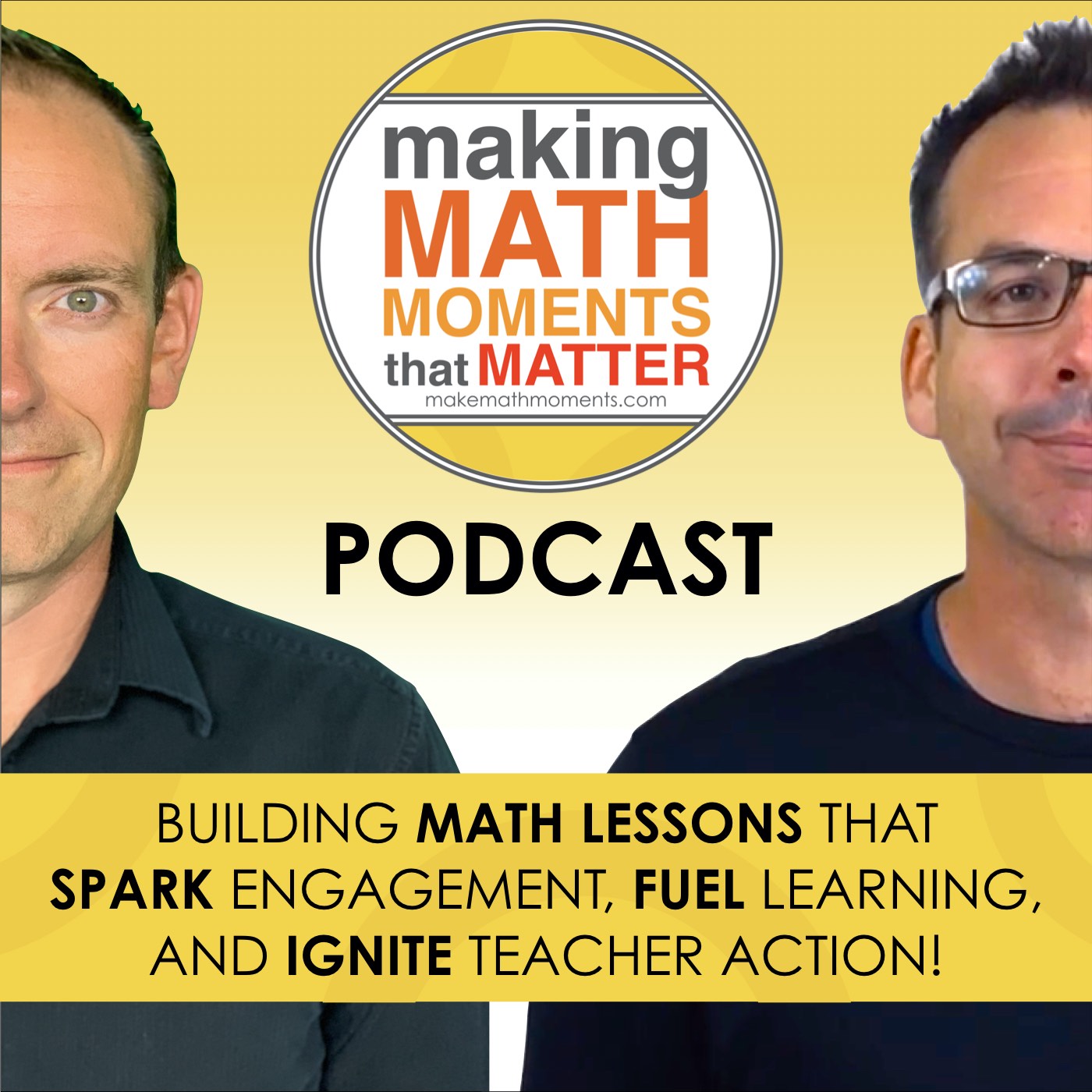
DOWNLOAD THE 3 ACT MATH TASK TIP SHEET SO THEY RUN WITHOUT A HITCH!
Download the 2-page printable 3 Act Math Tip Sheet to ensure that you have the best start to your journey using 3 Act math Tasks to spark curiosity and fuel sense making in your math classroom!
LESSONS TO MAKE MATH MOMENTS
Each lesson consists of:
Each Make Math Moments Problem Based Lesson consists of a Teacher Guide to lead you step-by-step through the planning process to ensure your lesson runs without a hitch!
Each Teacher Guide consists of:
- Intentionality of the lesson;
- A step-by-step walk through of each phase of the lesson;
- Visuals, animations, and videos unpacking big ideas, strategies, and models we intend to emerge during the lesson;
- Sample student approaches to assist in anticipating what your students might do;
- Resources and downloads including Keynote, Powerpoint, Media Files, and Teacher Guide printable PDF; and,
- Much more!
Each Make Math Moments Problem Based Lesson begins with a story, visual, video, or other method to Spark Curiosity through context.
Students will often Notice and Wonder before making an estimate to draw them in and invest in the problem.
After student voice has been heard and acknowledged, we will set students off on a Productive Struggle via a prompt related to the Spark context.
These prompts are given each lesson with the following conditions:
- No calculators are to be used; and,
- Students are to focus on how they can convince their math community that their solution is valid.
Students are left to engage in a productive struggle as the facilitator circulates to observe and engage in conversation as a means of assessing formatively.
The facilitator is instructed through the Teacher Guide on what specific strategies and models could be used to make connections and consolidate the learning from the lesson.
Often times, animations and walk through videos are provided in the Teacher Guide to assist with planning and delivering the consolidation.
A review image, video, or animation is provided as a conclusion to the task from the lesson.
While this might feel like a natural ending to the context students have been exploring, it is just the beginning as we look to leverage this context via extensions and additional lessons to dig deeper.
At the end of each lesson, consolidation prompts and/or extensions are crafted for students to purposefully practice and demonstrate their current understanding.
Facilitators are encouraged to collect these consolidation prompts as a means to engage in the assessment process and inform next moves for instruction.
In multi-day units of study, Math Talks are crafted to help build on the thinking from the previous day and build towards the next step in the developmental progression of the concept(s) we are exploring.
Each Math Talk is constructed as a string of related problems that build with intentionality to emerge specific big ideas, strategies, and mathematical models.
Make Math Moments Problem Based Lessons and Day 1 Teacher Guides are openly available for you to leverage and use with your students without becoming a Make Math Moments Academy Member.
Use our OPEN ACCESS multi-day problem based units!
Make Math Moments Problem Based Lessons and Day 1 Teacher Guides are openly available for you to leverage and use with your students without becoming a Make Math Moments Academy Member.
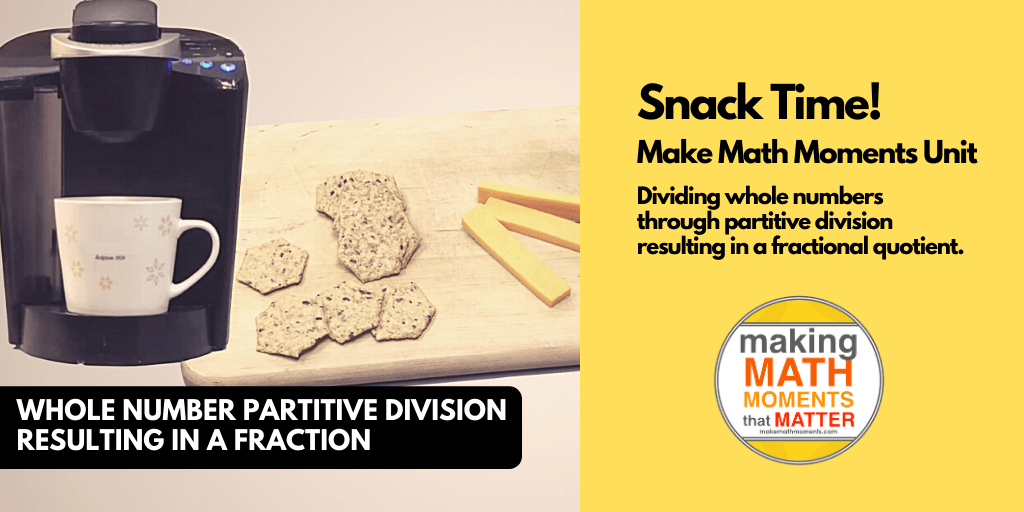
Partitive Division Resulting in a Fraction
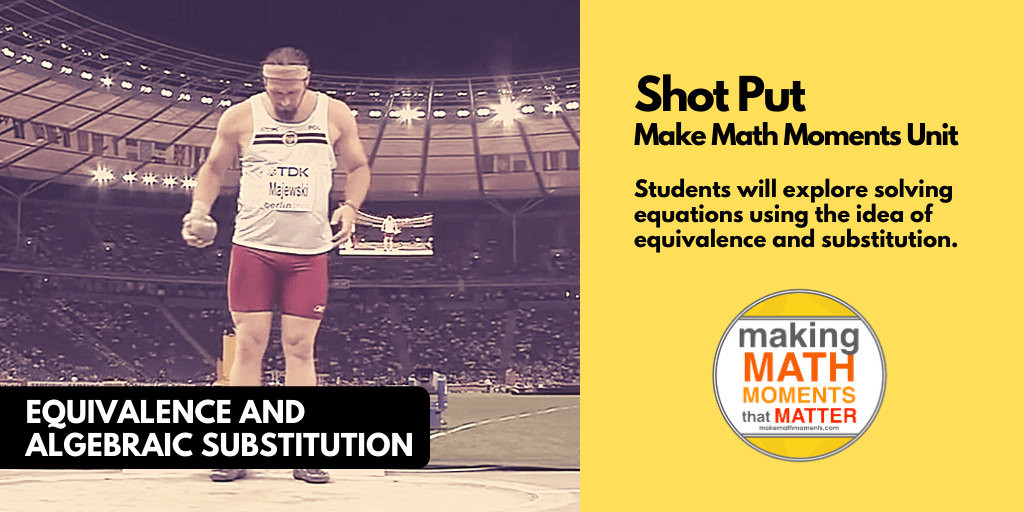
Equivalence and Algebraic Substitution
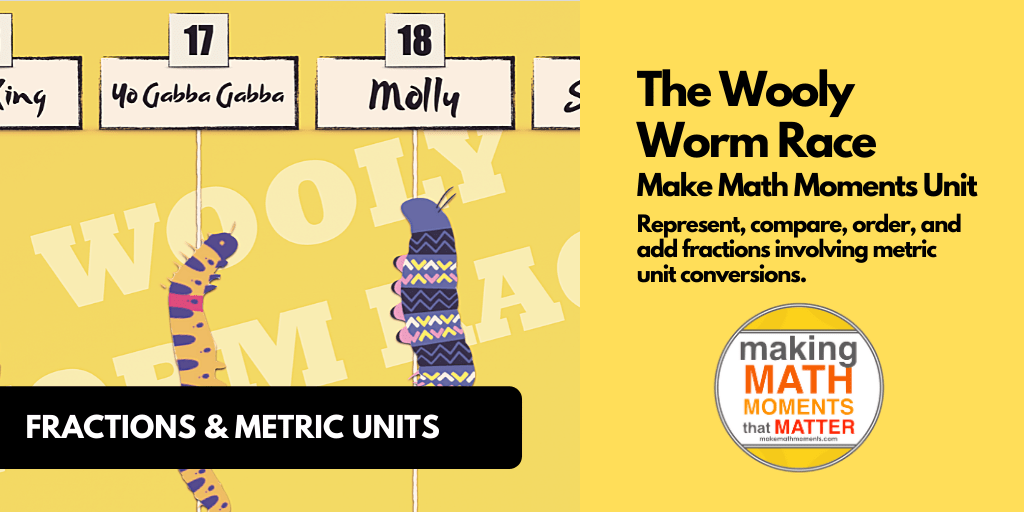
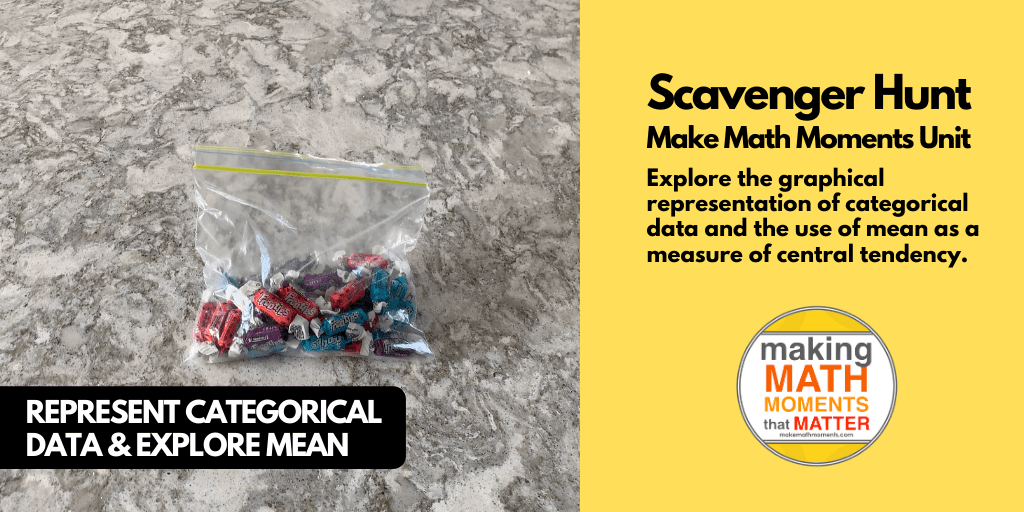
Represent Categorical Data & Explore Mean
Downloadable resources including blackline masters, handouts, printable Tips Sheets, slide shows, and media files do require a Make Math Moments Academy Membership.
ONLINE WORKSHOP REGISTRATION
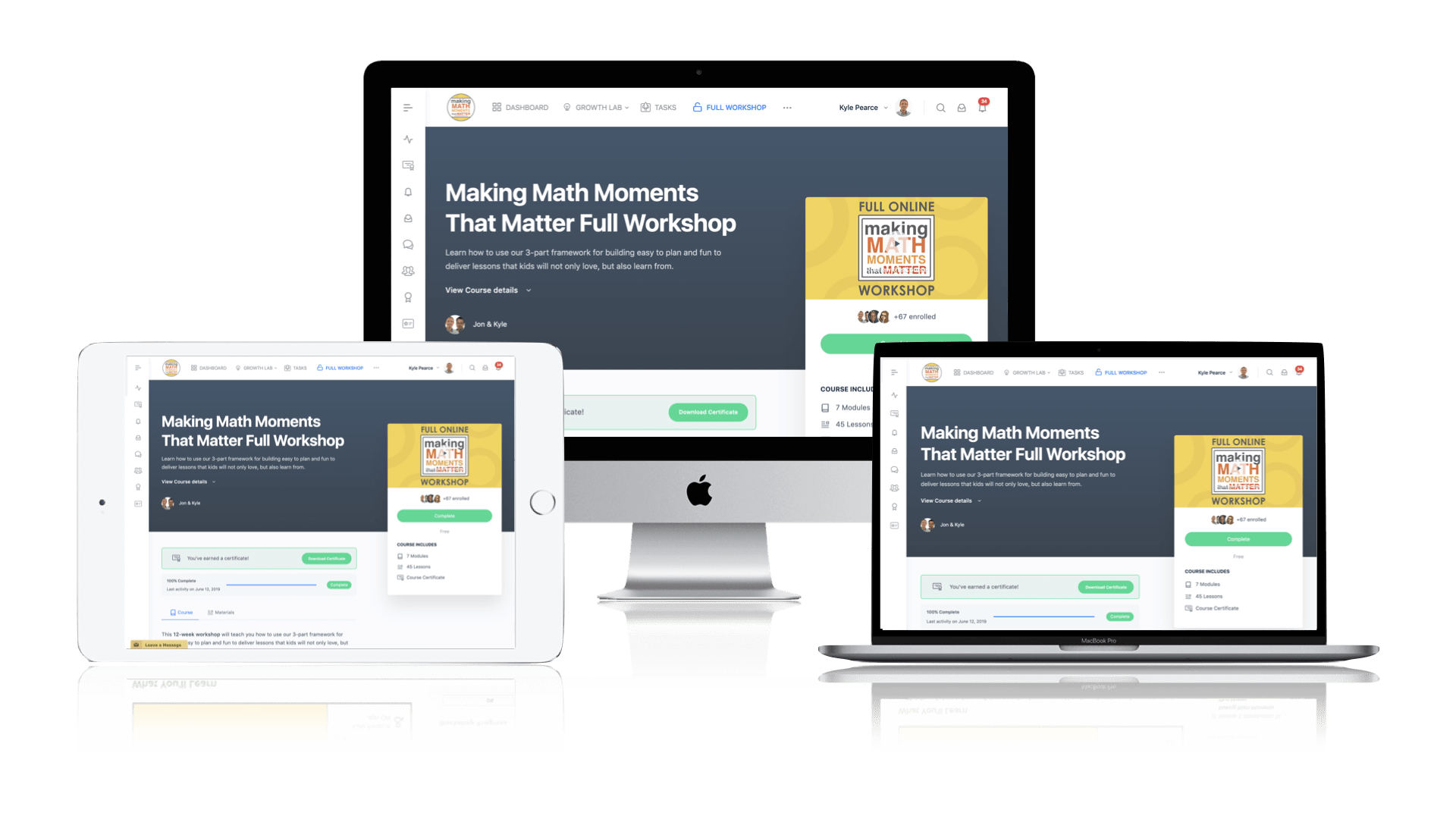
Pedagogically aligned for teachers of K through Grade 12 with content specific examples from Grades 3 through Grade 10.
In our self-paced, 12-week Online Workshop, you'll learn how to craft new and transform your current lessons to Spark Curiosity, Fuel Sense Making, and Ignite Your Teacher Moves to promote resilient problem solvers.
0 Comments