Episode #501: Dr. Nicki Newton: Rethinking Math Fact Fluency.
LISTEN NOW HERE...




WATCH NOW...
What does fact fluency actually mean in your school? If you asked five teachers, would you get five different answers?
In this episode, Jon Orr and Dr. Nicki Newton explore why fact fluency is bigger than a classroom strategy. They unpack what fluency really means, why timing matters, and what changes when schools treat fact fluency as a coherent, long-term system priority.
In this episode, you'll explore:
- What efficiency, flexibility, and accuracy with understanding really mean for fact fluency
- Why instant recall can be a goal without making timed tests the starting point
- Why fact fluency needs to be approached as a system-wide priority
- How differentiated practice can better meet students where they are
- Why public displays of students' math fact performance can do more harm than good
- How data conversations can shift from identifying what's “wrong” with students to examining instruction
- Why schools need to interrogate the practices they've inherited around math facts
- How leaders, coaches, teachers, students, and families can contribute to a coherent fluency approach
Start by uncovering your school's current fluency story. What do you believe about fact fluency? What practices have become routine, and why? Then ask whether those practices are actually producing the outcomes you want for students.
Attention District Math Leaders:
K-12 Math Leaders: Download our free Math Coherence Compass to help your teammates, system leaders, and educators create aligned instructional practices—without adding another initiative.
K-12 Math Leaders: Not sure what matters most when designing math improvement plans? Take this assessment and get a free customized report: https://makemathmoments.com/grow/
K-12 Math Leaders: Ready to design your math improvement plan with guidance, support and using structure? Learn how to partner with us and follow our 4 stage process. https://growyourmathprogram.com
Looking to supplement your curriculum with problem based lessons and units? Make Math Moments Problem Based Lessons & Units
Be Our Next Podcast Guest!
Join as an Interview Guest or on a Mentoring Moment Call
Apply to be a Featured Interview Guest
It will take less than two (2) minutes to book your Math Mentoring Moment call.
Book a Mentoring Moment Coaching Call
Take two (2) minutes to book your Math Mentoring Moment call and let's work together to shake that math pebble out of your shoe!
Are You an Official Math Moment Maker?
Ensure that you follow, rate and review on Apple Podcasts, Spotify and other platforms to show your support and ensure other math educators can find the show.



FULL TRANSCRIPT
Jon Orr: Welcome back to the Make Math Moments That Matter podcast, Dr. Nikki. I just looked this up. This is gonna be your fourth or fifth episode. You know, when I reviewed and I looked back in the history of us having conversations here on the podcast. The first one was episode sixty-two, which was a number of years ago. Then we bumped up to then there was a long gap. We had 317. Then last year we did 409 where you talked about AI. And this year it's gonna be 503. So welcome back. How are things going over there?
Dr. Nicki Newton: They're going, they're going well.
Jon Orr: Awesome. Awesome. Love it. Glad to hear it. Glad to hear it. One of the things we've been asking all of our guests, especially in this series, so most of our guests in past years, and you would have answered this when you were on the show before, which would we think about a math moment. And so these moments that stick with us are what we define as a math moment and something that we carry with us. So when we first probably interviewed you, we probably asked you back then, but I want to take this a little further and say, let's look to the future. Let's look to like what moments would be in the future and what are kids going to say about those moments?
So here's the kind of the thought exercise. So imagine you meet a student ten years after they leave the school system or leave your care. And you said, Hey, what was your biggest takeaway from you being in my care or my class or my system or my school? And the kid answers you. And so then the prompt that I think we want to reflect on here is, what do you want them to say?
Dr. Nicki Newton: I want them to say it was so fun and I felt like I could do it. I learned that I could do math and it was fun. That's why I always say happy mapping because I really believe that it should be a happy space. It should be a happy experience. I'll give you an example. I was in Colorado Springs. This was years ago and all day long everybody was excited that the math lady was there and there was a little second grader who kept asking his teacher. When is that math lady coming? When is the math lady? She said, she'll be here, she'll be here. So finally I got to their class and I played a bunch of games. And then I left and the little boy went up to his teacher and said, that was so fun. Now when is that math lady coming?
Jon Orr: That is awesome. That's like the that's like the best, you know, that's the best compliment you can hear, right? Yeah.
Dr. Nicki Newton: Yes! So that is what I kids to feel like. We didn't even know we were learning that. We're having fun and playing games and thinking, right?
Jon Orr: Yeah. I used to get kids mad at that. You know, like I remember a whole week going by in the first week of class because we would do activities, we would do, you know, activities we're at the walls, we're doing activities where we're using our brains and doing thinking and it's completely different than what they were used to coming into that class. And this is high school. And so I remember at the end of the first week you got a kid who's like a you know, who strives for, you know, A plus plus plus, right? So they come up to me at the end and they just said, When, Mr. Orr, are we going to get to the math? Like, you've been doing it already. You just, you just have been you've been thinking about it differently. Yeah, yeah, yeah. So we wanted you to we wanted to have a conversation here today because you're going to, again, I think you are, and I've shared this before with you last year, I think, is that I think you were the only presenter in the history of the eight Make Math Moments Virtual Summits, because this will be the eighth that has done every single one. And we we want to thank you for your commitment to math education and your commitment to the the Make Math Moments community. So well done there and we're honored to have you back.
Dr. Nicki Newton: Well, it's an honor. It's an honor. It's an honor.
Jon Orr: And your session this year is called Fact Fluency Unlocked. Ten moves that make sure every kid in your school learns their math facts. So we're gonna talk about that here today, but tell me this, tell me this. Like when you say fact fluency, what do you mean? Because I think we there's a lot of things floating around when we say fact fluency. So tell me what you mean about fact fluency. Yeah, yeah. Tell me.
Dr. Nicki Newton: Yes, I am specifically speaking about efficiency, flexibility, and accuracy with understanding. Because Linda Gojek says, you can be accurate and not be able to explain what you did. So accuracy with understanding. That is specifically what I am talking about. And it is still highly contentious, even though there's a really good study that just came out in 2026, shot off the presses about fact fluency. And it really brings it all together and says, you know, one of the things that it really says, but VanDuel said this a long time ago, that there is a place for time tests. I don't know that I necessarily even still agree with that, but he said, but I do believe in instant recall.
Right? There is a place where we want and we can all agree that we want kids to get to hands on recall. And what the study said is that it's not so much about either this or that. It's about when. So, yes, we want kids to get hands on recall, but you don't start there. That's not where you start. After kids have learned their facts, after they have conceptual understanding, after they really know what they're doing, then there is a place to practice for that, you know, instantly, that instantly, right?
Jon Orr: Right. Yeah. It's like we're it's like we're all trying to and this is I think something common across mathematics, stretching into the upper grades, is we try we're trying to jump. You know, we're trying to get right to this this efficiency and we and we I'm using air quotes here, right? Like it's like we're getting to this efficiency this efficient technique without going through the mud, you know, and the mud is the is the is the meat and the potatoes. I don't know, I'm I'm using a lot of metaphors here, but I mean
Dr. Nicki Newton: Yeah, you are, but I'm following them.
Jon Orr: Ha okay. It's like we we jump, we jump ship, you know. There's another metaphor.
Dr. Nicki Newton: I love Mudd. I've loved Mudd since I was a kid. So, I love that. I love that research. I love what it's saying. I love that it ties back to Vanduil because I love everything that Vanduil said. He's one of the godfathers. But this idea that there is, because even Vanduil said there's a place for drill. It's not at the beginning, but after kids have really learned and they're just practicing and working on instant recall, there is a place to, to drill a little bit, right? But I think drill can be fun. It can be a game, right? You can still drill within a game. And I think you could do like elements of time by having, you know, Bay Williams and Cling talk about the just, just know it tests. And I write about those too, where you, where you give the kids the facts and you say circle the ones you just know. And now in a different color, you know, do the rest. So the child is saying, these are the ones I just know. I don't know all the other ones instantaneously, but I do know these, right? So I think there's ways to work on instant recall without terrorizing children. I believe that.
Jon Orr: Without terrorizing children, yeah. Like like we've all had those s round the worlds and you know, math fact speed, what do you c ma I forget the name of it, it's on the tip of my tongue, but yeah, like I think I think you're right, like terrorizing terrorizing kids with and I think what I think what's happening and w is this is why I asked the question, is because we're all we all think we're doing fact fluency. Right. That's and this is what we see with schools when we're working with when we go into a school to support them and we sit down at a table and we say, you know, like write down three words that describe fact fluency for you. Everyone's got different words. And that's one of the the big stumbling blocks as a system right now. That's that's I think that's a barrier up against because in your description you say fact fluency is a system problem. and it's it's right. Yeah. Right.
Dr. Nicki Newton: I believe that, that's what the book is about. That's what the book is about. Because it's a system problem. Because you can have all the greatest energizers in the world, but this goes back to leadership, right? One of the things I'm writing about in the book that I'm writing on leadership is I look at the upgrade five, it's about AI and leadership and how AI can help us. But upgrade five is that you can have a lot of great initiatives and have no coherence.
Right? So, you know, the walkthroughs are, it's phenomenal. They're looking at classroom environment and the PLCs are doing an excellent job with language tips and the coaches are really looking at student discourse, but there's no through line. There are all these like individual, you know, there's research. can't remember the name of the research right now. They call it the Christmas tree effect. They say because it's bright and it's schools that have bright, shiny dangling things, lots of them. And they called them Christmas tree schools because they said they have bright, shiny things with nothing's really leading to anything. Right. You got some popcorn and some cranberries, little red birds. But what does it all mean? Right. So I, I really think that back fluency is a human right. And I think it's a systems issue. And I think until we really get it and approach it from a systems perspective, we are not going to get all of our kids fluent. Because
Jon Orr: What does that mean, a systems perspective?
Dr. Nicki Newton: I mean that from the principal down to the custodian, everybody is on board with what it looks like, right? That the principal, that there's a through line that we're saying we believe in back fluency. What does that mean for homework? What is it differentiated? Because if you really believe in fact fluency, then the homework doesn't look the same. Because Johnny's not working on nines, he's working on threes. Susie's working on her foundation facts. Miguel knows his multiplication facts. Why are we making him do the same thing as the one that doesn't know the facts? So it's a systems problem that the principal needs to say, what does differentiated homework look like for fluency? And I'm not saying teachers need more work. because they don't. But I am saying we need systems in place that say, this is the road, right? It goes back to learning trajectories. This is the road to learning your multiplication facts. These are the stages of learning your multiplication facts. Where are your kids and having pockets and buckets of those things? So we know these guys are working on foundational facts. Their homework looks like foundational facts. These guys are working on making connections. Their homework looks like that.
And it's not homework for the night. I don't believe in American homework. I think it just is bad for everybody.
Jon Orr: What about Canadian homework?
Dr. Nicki Newton: I like Finnish homework. Because they're like, my friend was teaching in Finland and they were like, she was doing all this stuff. They're like, hold on. We don't do that like that here. All that stuff you guys do in America. We don't do that here.
Jon Orr: What do they do?
Dr. Nicki Newton: We believe children should have lives outside of school. We don't bog them down with a whole bunch of stuff that we want them to learn in school. And so I believe that homework should be intentional and short. I think you can give, you say, John's working on doubles, give him a doubles game, give him some double splash cards and send him home for a week to practice that with his parents or his guardians and then come back. I don't think it has to be every night. I don't think it should, I think it should be a game. because parents will play a game and kids want to play it. And then John's going to learn his doubles and he's focused. Right. But we don't have systems that even look that far ahead. It's systems in that if you really believe in fluency, what is your coach doing? What are you looking for on your walkthrough? What are you a system that says this is our pride? This is one of our priorities. And that's a leadership issue. Right.
Jon Orr: Absolutely.
Dr. Nicki Newton: That's a leap because because the coach can't do that on their own. Right? The coach is part of that team, but the coach can't do that on their own. And so even if your grade level is really good at it, it's not going to improve. It's not a school improvement initiative if it's just Mrs. John in third grade.
Jon Orr: Right. You need the blend. You need what we always say this here is like you need the blend of the of the leadership team to to have the right mix of support and pressure.
Dr. Nicki Newton: Yes.
Jon Orr: You need the pressure part to say this is a school-wide priority. therefore, you know, the buck stops there. It's saying that this is this is what we're all working towards. But then you need the support to s to carry that forward. And and if you can't have one with the other, right? So it's like I can't make I can't have the pressure and then no support and I can't have support without the actual teeth on the pressure, right? So it's like we can we can be coaching all day long, but when when it's not being supported in the pressure part, at say staff meetings, at PLCs, like everywhere through the like you said, the through line, then then it doesn't go anywhere anyway. So having the blend is really important.
Dr. Nicki Newton: And what is the long game? Are we playing it for the long game? Because one of the things that come up in this book that I'm working on is Initiative Fatigue. There's a researcher that writes specifically, I mean there's a lot of researchers that write about initiative fatigue, but there's one person that coined it and I can't remember their name off the top of my head, but it's called initiative fatigue. The teachers are just so sick and tired of all the initiatives. It drains them mentally, emotionally, and physically, and then there's no carry through. The initiative is gone and we stack another one on top. So teachers have initiative fatigue. They're like, we're working on back fluency at least for the next six weeks. Move on to something else. So that is a systems issue. If you're going to say we believe in math back fluency, that's a long game. Right? And what does that look like?
Jon Orr: Absolutely. Yeah.
Dr. Nicki Newton: and how do you plan for it? And do you have a fluency vision? Do you have a fluency statement, right? Mission statement. Does everybody in your school know what you mean by fluency? Or if I interview five teachers, do I get five different responses? Do the parents, parent communication is another thing I talk about heavily in my book. I'm talking about AI and all these things and how AI can make it better. But do parents know what fluency means to the school? What's the school values? And are parents supported in supporting their kids? That's why it's fact fluency unlocked, right? Because there are components. And yeah,
Jon Orr: Yeah, clearing the way, you know.
Dr. Nicki Newton: and you've got to know what all of those components are. I argue there's 10. And one of those is families, right? One of those is teachers, and one of those is coaches. Part of that is leadership. Part of that is kids. Like, do kids know where they are? And I've said this for years and I'll say it again, because I try to say it every chance I get. I don't believe in publicly shaming children around their math facts. So people need to stop putting up those boards that say, John knows 15 math facts and Nikki knows two. Who is that helping? That is embarrassing and publicly shaming children. We need to stop doing it. Teachers say, no, it motivated them. No, it doesn't. And I always give the example. Let's, you think that's motivating? Then let's collect all of our credit scores and write, be sure to write your name really big, write your credit score. We're going to line them up from low to high. And then the people with the low ones can look at the high ones and say, I wish I was there. Now I'm more motivated. Nobody would ever agree to that. Then why are we doing that to kids? We're taking private information about their knowledge base and putting it on blast. I'm so against that. And I used to like nicely say, you know, maybe you should, now I just say, take it down. Take it down. It does not belong up on the wall. Take it down. And so that's where I'm at.
Jon Orr: Now, one of the you said one of the one of the ten, 'cause you're gonna talk about ten in this session. And we're not gonna, you know, we're not gonna go through all ten here today. We don't have that kind of time, but we know one of the ten was teachers. So now one of the things I think we, you know, and hardworking teachers, we teachers sometimes we just don't know what we don't know, right? And and what would you say from the work, you know, your your year you know, your years of experience strengthening fluency across grade levels, like what is the most common thing w us well meaning teachers do that actually undermines fact fluency without actually realizing it. So like I think we talked about like we think speed is we might think that that's that's a well meaning move, but what else? Like what else other than speed are we doing
Dr. Nicki Newton: Yes, we rush children. We rush children. We rush children. We put their data up publicly. And I think one of the things that we don't do. Okay, so today, just today, I tweeted out something about what happens with data, right? This is what I think teachers get wrong with data. And there's research. I can't remember the date or the person, but it's in my tweets today. What the research shows is teachers get data, they look at the data, they locate the problem with the data inside of the child, and then they designate small groups. They never look at the instruction that led to that. It's always the kids' fault or their parents. It's never, what did I do? So now you've got teaching that did not help. only in a smaller group. The teacher never changed his teaching. They just made the group smaller, sorted the kids by the data, made the group smaller, and then repeated the cycle. So I think one of the things that teachers don't do, and it's no fault of their own, is we don't look at data critically from our perspective. What am I doing that they're missing it? We look at what they don't know and what did Mrs. Susie do last year and how their parents are. We locate the problem everywhere but within our own pedagogy. So one of the things I say is, I think you could really ask ChatGBT to help you here. Ask chat GPT to look, anonymize your data and ask it to look at your data. So say we give a fluency test, ask it to look at the fluency test. Tell chat GPT what your pedagogical moves were and ask it to critique and suggest what you could do differently to help kids learn their multiplication facts. Now, John, know, that's an interesting conversation and it could be quite uncomfortable.
Jon Orr: Yeah, for sure.
Dr. Nicki Newton: because people don't want to look at that. Well, I couldn't possibly be doing anything wrong. Well, I'm doing what the book said. This cannot be wrong. There's no error here. The error is outside of me, right? So I think as staffs, we have to start looking at what are we doing to contribute to the problem? And how do we do something different? And how do we have those conversations? Right.
Jon Orr: Right. And then and then that's where it leads back to the I think I think partly a system the system part problem, which is like w if if I'm the active classroom teacher taking that role and and introspectively looking at what I'm doing and I and I have that thought, then I have to also say, Well, how can I get support? Knowing because I only know what I know, and therefore like where does that support live? And woo I I have to teach eight subjects a day. and then How do I continually learn and where do I do that? And and what do I lean on? If the curriculum is what it is, where do I get that? And and I'm what I and I think what I'm leaning here is, and this is what we've kind of uncovered over years, is is it's not the necessarily the pedagogy. And we talked about this in the right before we hit record, is is that a lot of times it's it's like we just didn't know that the the math at the deeper level we needed to to act flexibly in the moment with the pedagogy or with the curriculum.
Dr. Nicki Newton: Absolutely. It's dynamic. It's yes. Yes. Yes. Yes.
Jon Orr: And that part is is also murky to get into because it's like, I have to accept that I don't know math as deeply as I could have, but I didn't know there was a different way. And that's where the systemness has to go. We're committed to strengthening that.
Dr. Nicki Newton: And in my book, because I'm deep in the research, that's what I keep talking about, because I'm reading the research and saying, one of the things the research says is this about leadership, that principles have got to have protocols, equity protocols around data that push staff into the difficult conversation. And that if we don't have those protocols, people tend to locate the problem outside of themselves. So again, it's systems. What systems do we have in place so that we can ensure that every child is learning? And if they aren't learning, how do we look introspectively? Because this is what I don't get. Tell me what you think about this. You go to school and you hear it every year. these kids don't know their math facts. That is a common phrase, especially now because the school's starting. I don't know what they did last year because these kids don't know their math facts. OK. My question is, OK, they don't know their math facts. What is happening differently this year knowing that what we did last year didn't work?
Jon Orr: There's a there's a phrase that we've been sharing in our webinars and and in our in also our upcoming book, which is it it hits home, which is from W dem like W. Edwards Deming, which basically says the system you have is perfectly designed to get you the results you're getting.
Dr. Nicki Newton: Yes, I love that. Yes.
Jon Orr: Right. And it's and and that's what happens year to year is that we don't change anything, but we just w it it it's the it's a f a nice way of saying, you know, the definition of insanity, right? Like which is like you just keep doing what you're doing. If you if you think that's gonna all of a sudden magically shift, then you you've got you've gotta think about it again.
Dr. Nicki Newton: I love that. It's so true. Your system is designed to get exactly what you are getting.
Jon Orr: Ex exactly.
Dr. Nicki Newton: well, one of the things that I have been tweeting out was like, and I think people need to take this more seriously. Your school has a fluency story. Every school has a fluency story. And most teachers at that school were not involved in creating that story. They don't even know why they're doing half the things that they're doing that are a part of that story. So if we really want to change the fluency story at schools, we need to get serious about interrogating. What is our fluency story? we do time tests. Why? Who started it? I started teaching in 1988. I was at a school just the other day and having flashbacks because they were doing time tests. I'm like, this is a, I remember as a first year teacher, the pinks, the blues, the greens, you're working on the pink, you're working on the, all those time tests and different colors, depending where they, that's what I was doing in 1988. Have we learned nothing? It is almost 40 years later. Have we learned nothing? Right? Think about all of the math research that people have done since then. And we're still giving green and yellow and red and blue paper out to children and giving them one minute. I just, don't understand it. I don't get it. It doesn't make sense to me. And people are very locked in. You know, they're locked in.
So this is the 10th anniversary of math running records. People use it around the world. And I'm writing an anniversary edition of math running records at some point, but This is what I want to say about that. I love writing records. I love math writing records. I think it'll change your life. Some people aren't ready for it yet. They're stuck. I mean, they are holding tightly. If you say, don't don't do, don't do this, those are fighting words. It's very emotional. So I have been more and more telling people, well, I think you really need to get to like, you know, math, running records, but, on your way, if you're not ready to make the jump, I think what you should do is a two color test at least. And I think I'm getting some headway there and I get schools to do a two color test. It's a test where you give the kids two colors and you give them 10 problems for addition and 10 problems for subtraction. You give them 30 seconds, you know, three seconds and you say, okay, starting green. Okay. And then you never say any time thing. You just say, I need you to switch now. And then the kids switch. And then you do that for addition and subtraction. And then I give them a, I want to see if they can model. So I give them some questions where they have to model problems. And then I want to see if they know algebraic thinking, like at the kinder first grade level. So I give them, you know, equations, but like nine equals blank plus four. You know what I mean? that. and I want to tell you something. I just did this with one of my schools and then we put it in chat GPT. to get it, we anonymized everything, put it in JAT.TB to get the results. And of course we had to look at it and know, chat's not perfect, it's gonna do some stuff wrong. But it gave us amazing data and it said, you get out of that so much more. If you're so worried about speed, you get that element of it. You get to see, but you get so much more. Like the analysis was blowing people away because the analysis is like, 92% of your kids know their facts. but only 50% of them are automatic. you had 90% of the kids were correct and they knew their facts. They just didn't know them within the 30. You see, you never know that on a time test. But in this test, you know it and you can see like where kids are. You can see kids that go back and change the colors and you can see, we also got to see like everybody sucked at algebraic thinking. They're like, the class has taken a very deep die from basic back recall to and because that's a first grade standard three plus four equals blank plus you know that's a first grade standard that is fair and we only gave this test to second and third graders and they all all did horribly like the highest scores were 50 percent. So my point is this, every school has a fluency story that people are just adopting lock, stock and barrel. We have to start to interrogate the stories that we are living by around fluency in our schools. And we have to start interrogating our own practices around what we're doing. If what we're doing isn't working, why do we continue to do that? And then keep situating the problem with the kids.
Right? So this is about having hard, honest conversations. It's not a blame game. I'm not trying to find any blame. I'm trying to find out what do we fix to make schooling and learning your math facts, because that's the anchor to everything else, better for all children? And how do we have honest conversations about that? And how do we let go of stuff that's not serving us? Heidi A's Jacobs always said, years are good for cheese and wine. You would never go to a doctor that said, I've been practicing medicine since 1930 and I never adopted any of the new stuff. That would not be your cardiologist. So why are we doing it in schools? I've been teaching since 1960 and I, they were good those tests in 1960 and they're still good. Why are we doing this? I've worked up a sweat dog in the back.
Jon Orr: This is why we gotta we gotta tell that story, right? Like you gotta we gotta rewrite that story. Like you to use your your metaphor is that we have we want, you know, we gotta write that story at our own school. And and I know that the session that you're you're planning to to give at the summit, ten moves that make sure every kid in in your school learns their math facts. Right now, right now it registration is open for the summit right now, and it's the number one session that people have registered for. It is the has the highest registrations right now. So yeah.
Dr. Nicki Newton: because I think everybody's really trying to, I mean, don't you, I mean, you guys are in this deep. Everybody's trying to figure it out. But John, it is not an enigma.
Jon Orr: It's clear.
Dr. Nicki Newton: We're not, why it's not a conundrum. We don't have to be like, have no idea how to approach this. It's there in the research.
Jon Orr: Yeah.
Dr. Nicki Newton: It laid out very plainly.
Jon Orr: Yeah.
Dr. Nicki Newton: I think we've got to get out of our own way to make this happen.
Jon Orr: It sometimes and and I think again to go back to the to the systemness and I think and the leadership part because I think what's happening, this is my prediction is is that the really the bystander effect is taking taking over here, is that I didn't create this. I didn't I didn't make what we do in mathematics, but also but also pff I don't who am I to sh to to completely change everything we do in terms of what what we're doing in our math classes. And so then no one takes ownership of it. And therefore, and what we need is schools to write their own stories and say it's a priority. And we're gonna own not any one person owns it, but we as a team will own it. And that's an important move I think schools need to make. We could take we you know, I know that we could keep talking I and I honestly I can always keep talking to you all day long. And and I'm gonna l we're we're gonna let everybody get on with with their their days. But the Fact Fluency Unlocked, the session at the summit coming up November fourteenth on it's a Saturday. It's a live session. Registration is open. Go register for it right now. There's a link somewhere around this video or or podcast episode you're listening to. Go go register if you haven't already. Tickets are free. and you will be talking with Dr. Nikki on her session.
Dr. Nicki Newton: And I just want to say this as a bonus, just so people can get excited about it. I'm going to be giving out lots of templates that I've been working on.
Jon Orr: Alright. Awesome. Can't wait. Can't wait. one last thing. If there is one thing that everyone wouldn't want to miss, what is it? Other than the templates. And the ten and the ten moves.
Dr. Nicki Newton: Well, I am also going to be giving out like a prompt list for how you prompt. It's going to be like a prompting AI for fact fluency. How to analyze data, how to get it to make tasks, how to get it to make game boards, how to get it to make visual flashcards, not just regular flashcards, but visual thinking, math, talk flashcards. So I'm going to be giving that out. People are going to want that.
Jon Orr: Love it. Love it. Doctor Nikki, always a pleasure speaking with you. Thanks again for joining us here today.
Dr. Nicki Newton: Always an honor. Thank you for inviting me. I am humbled and honored to be invited.
Your Customized Improvement Plan For Your Math Classroom.
Take the 12 minute assessment and you'll get a free, customized plan to shape and grow the 6 parts of any strong mathematics classroom program.
District leader/math coach? Take the District Assessment
Thanks For Listening
- Book a Math Mentoring Moment
- Apply to be a Featured Interview Guest
- Leave a note in the comment section below.
- Share this show on Twitter, or Facebook.
To help out the show:
- Leave an honest review on iTunes. Your ratings and reviews really help and we read each one.
- Subscribe on iTunes, Google Play, and Spotify.
The Making Math Moments That Matter Podcast with Kyle Pearce & Jon Orr
Weekly interviews, strategy, and advice for building a math classroom that you wish you were in.
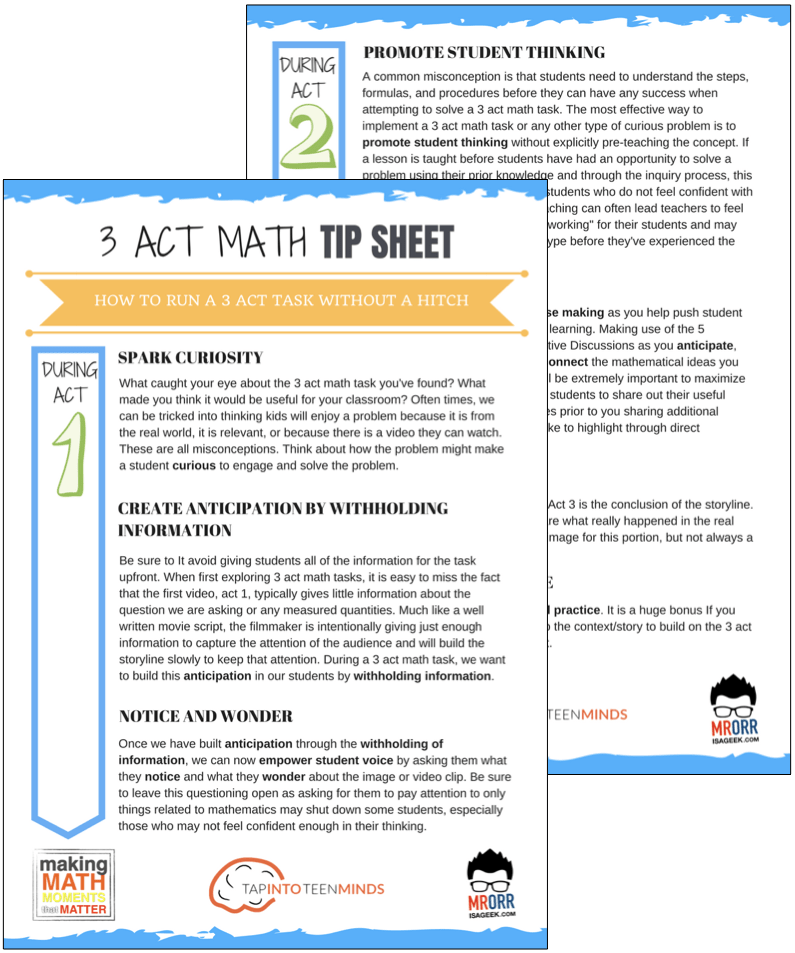
DOWNLOAD THE 3 ACT MATH TASK TIP SHEET SO THEY RUN WITHOUT A HITCH!
Download the 2-page printable 3 Act Math Tip Sheet to ensure that you have the best start to your journey using 3 Act math Tasks to spark curiosity and fuel sense making in your math classroom!
LESSONS TO MAKE MATH MOMENTS
Each lesson consists of:
Each Make Math Moments Problem Based Lesson consists of a Teacher Guide to lead you step-by-step through the planning process to ensure your lesson runs without a hitch!
Each Teacher Guide consists of:
- Intentionality of the lesson;
- A step-by-step walk through of each phase of the lesson;
- Visuals, animations, and videos unpacking big ideas, strategies, and models we intend to emerge during the lesson;
- Sample student approaches to assist in anticipating what your students might do;
- Resources and downloads including Keynote, Powerpoint, Media Files, and Teacher Guide printable PDF; and,
- Much more!
Each Make Math Moments Problem Based Lesson begins with a story, visual, video, or other method to Spark Curiosity through context.
Students will often Notice and Wonder before making an estimate to draw them in and invest in the problem.
After student voice has been heard and acknowledged, we will set students off on a Productive Struggle via a prompt related to the Spark context.
These prompts are given each lesson with the following conditions:
- No calculators are to be used; and,
- Students are to focus on how they can convince their math community that their solution is valid.
Students are left to engage in a productive struggle as the facilitator circulates to observe and engage in conversation as a means of assessing formatively.
The facilitator is instructed through the Teacher Guide on what specific strategies and models could be used to make connections and consolidate the learning from the lesson.
Often times, animations and walk through videos are provided in the Teacher Guide to assist with planning and delivering the consolidation.
A review image, video, or animation is provided as a conclusion to the task from the lesson.
While this might feel like a natural ending to the context students have been exploring, it is just the beginning as we look to leverage this context via extensions and additional lessons to dig deeper.
At the end of each lesson, consolidation prompts and/or extensions are crafted for students to purposefully practice and demonstrate their current understanding.
Facilitators are encouraged to collect these consolidation prompts as a means to engage in the assessment process and inform next moves for instruction.
In multi-day units of study, Math Talks are crafted to help build on the thinking from the previous day and build towards the next step in the developmental progression of the concept(s) we are exploring.
Each Math Talk is constructed as a string of related problems that build with intentionality to emerge specific big ideas, strategies, and mathematical models.
Make Math Moments Problem Based Lessons and Day 1 Teacher Guides are openly available for you to leverage and use with your students without becoming a Make Math Moments Academy Member.
Use our OPEN ACCESS multi-day problem based units!
Make Math Moments Problem Based Lessons and Day 1 Teacher Guides are openly available for you to leverage and use with your students without becoming a Make Math Moments Academy Member.
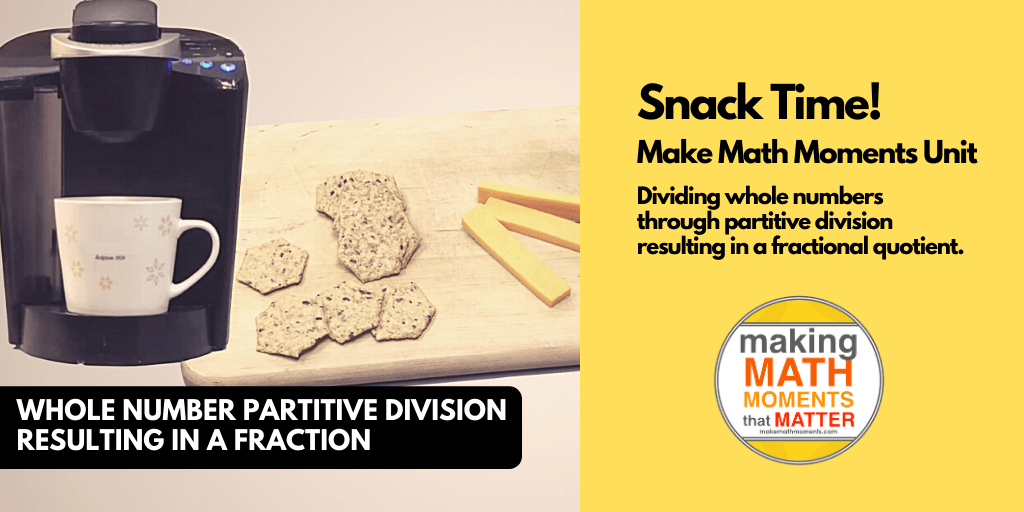
Partitive Division Resulting in a Fraction
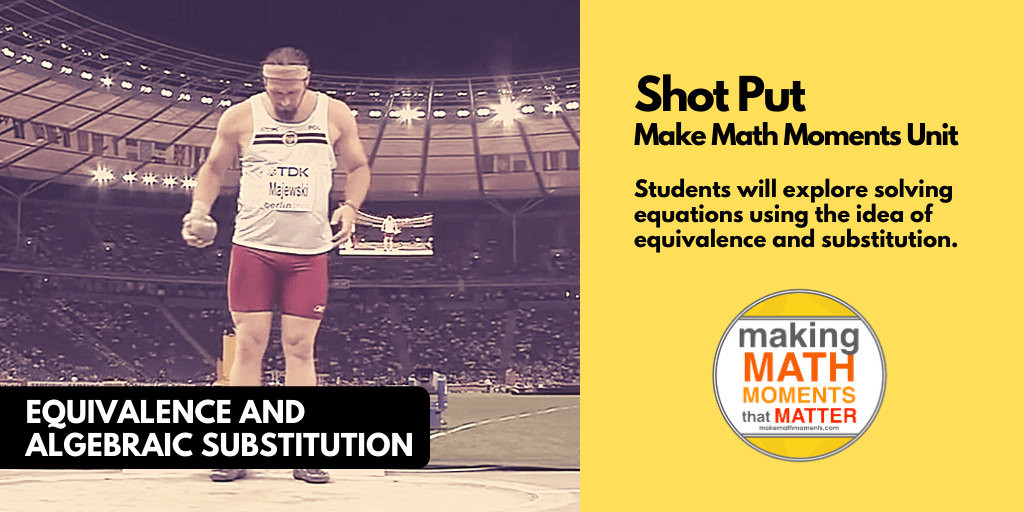
Equivalence and Algebraic Substitution
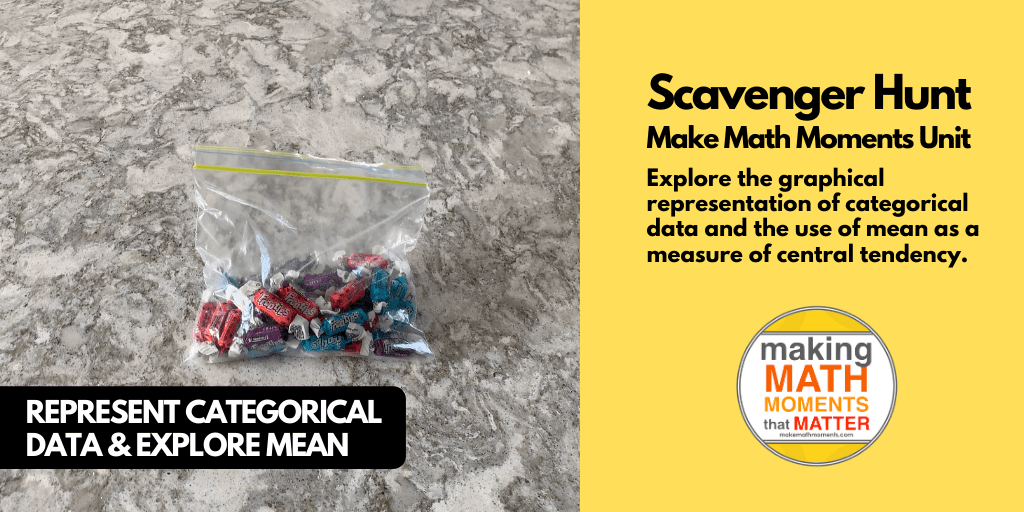
Represent Categorical Data & Explore Mean
Downloadable resources including blackline masters, handouts, printable Tips Sheets, slide shows, and media files do require a Make Math Moments Academy Membership.
ONLINE WORKSHOP REGISTRATION
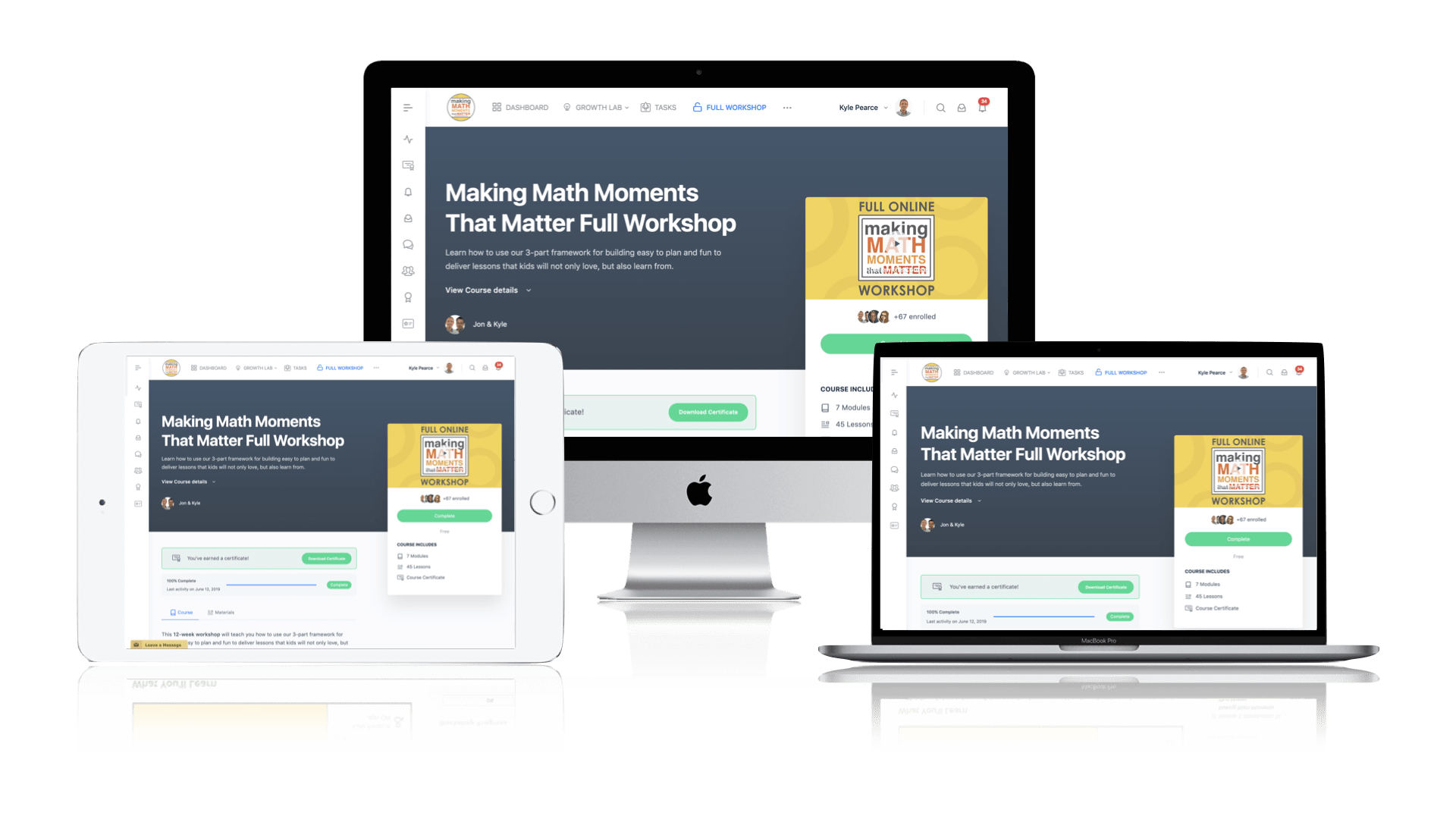
Pedagogically aligned for teachers of K through Grade 12 with content specific examples from Grades 3 through Grade 10.
In our self-paced, 12-week Online Workshop, you'll learn how to craft new and transform your current lessons to Spark Curiosity, Fuel Sense Making, and Ignite Your Teacher Moves to promote resilient problem solvers.
0 Comments