
Episode #440: Tired of Calling on the Same Few Students in Your Math Classroom? Fixing Math Discourse Fatigue
LISTEN NOW HERE…




WATCH NOW…
Why is it so hard to get more students talking in math class? In this episode, the team digs into a common challenge: when just a few confident students dominate math class discussions, while others stay silent. Drawing from personal experience and real classroom coaching, we explore how small, intentional shifts—like silent signals and think time—can completely transform math classroom discourse.
Whether you’re a math teacher seeking practical moves or a coach supporting system-wide change, this episode offers a roadmap from problem-aware to solution-ready. We also unpack how ongoing support—not one-off PD—makes these shifts stick.
You’ll Learn:
- Why traditional hand-raising shuts down thinking
- How small habits like think time and turn-and-talk build inclusion
- The four conditions needed to help any strategy stick
- What math leaders and coaches can do to move from awareness to adoption
If you’re ready to break the cycle of disengagement and build a math classroom where every student has a voice, this conversation is for you.
Attention District Math Leaders:
Not sure what matters most when designing math improvement plans? Take this assessment and get a free customized report: https://makemathmoments.com/grow/
Ready to design your math improvement plan with guidance, support and using structure? Learn how to follow our 4 stage process. https://growyourmathprogram.com
Looking to supplement your curriculum with problem based lessons and units? Make Math Moments Problem Based Lessons & Units
Be Our Next Podcast Guest!
Join as an Interview Guest or on a Mentoring Moment Call
Apply to be a Featured Interview Guest
Book a Mentoring Moment Coaching Call
Are You an Official Math Moment Maker?



FULL TRANSCRIPT
Yvette Lehman: I was trying to shift the dynamic in my classroom away from, know, I ask a question, the same three students put their hand up and answer, and then everybody else is disengaged and sleeping. And like, I knew I was at that problem aware stage. I knew that that was a problem. You know, I didn’t want that to be the dynamic that I had in my room where it was the same three or four voices that were engaged and putting their hand up because they already knew the answer. And everybody else, like Lucy West says, and one of her iconic speeches, it’s sleepy time for everybody else because they know that those three kids are gonna carry this conversation and she’s not gonna call on me because somebody else will put their hand up.
Jon Orr: That’s not my role in my room. I hang back. That’s their role. Keep this moving forward so we all can look at our phones earlier.
Kyle Pearce: So I was at that problem aware stage where I knew that that was not the dynamic I wanted, but I didn’t know what to do to change it because that was my own experience. I was the kid with the hand up, right? You I was the one who the teacher would ask a question to and my hand would fly up and I almost prided myself on being that person who always had the answer, you know? And so,
That was all that I knew from my own classroom experience, but I knew it was not what I wanted and it was not what was best for all learners. So now what?
Jon Orr: This is why we brought the panel today. is, got Kyle, we got Beth, we got you, Yvette, myself, John. Guys, coaches, help. Help Yvette, who’s the classroom teacher not knowing what to do at this stage. How do we help her as a coach, you know, break out of the problem aware stage and know what the solution aware stage looks like?
Kyle Pearce: I vividly remember that shift happening in my classroom, or at least when I became more aware that this was a challenge. And it’s not an easy thing that you can just sort of overnight change. Because what I recognized in in, you know, reviewing kind of what I was doing in my own classroom was I was giving like what we call the lob balls, right? Like, so you’re like tossing up something that you’re hoping one of these other students is gonna like wanna grab and run with, but that same student you had already articulated, Yvette, still grabs those ones as well, right? So they’re throwing their hands up. And ultimately, at the end of the day, what I realized was like, I need to make this more conversational. And that starts with reframing like what a lesson might look like and sound like.
And I know for me, although I do want to, you know, definitely, you know, get us towards a bit of a strategy or a structure. One of the first things that I found was incredibly helpful as a start was getting students to make more estimates and predictions in class, like where it’s like now it’s like no one’s got a right answer. And it’s like very opinion based and it’s very, you know, and they can rationalize, they can do all of these things. Like that was how I started to move out of that zone. However, today we’re going to be talking a little bit more about like what this might look like at the start and how we can sort of systematize this in phases as we move along. But Beth, you know, take us back to your classroom. Like was it always a great conversation, mathematical discourse everywhere?
What was going on in your classroom? Is it similar to what Yvette and I were struggling with? Was it different? And what was sort of your light bulb moment that you had when you started to want to make a shift towards making sure more students were involved?
Beth Curran: Well, to answer your first question, was my classroom the perfect place where all the students were involved in this course? No, absolutely not. ⁓ But, know, as Yvette had kind of said and experienced, ⁓ she knew that she wanted to see something different. So, Yvette, I heard you say that you didn’t know what to do. And I think trying to decide on what to do starts with what do want the classroom to look like? What do you want to see? You’re not happy with those one, two or three students constantly raising their hand and dominating the conversation in math class. So what would you want to see? Is it conversation? Is it engagement? And then finding that high leverage move that you can make in the classroom that’s easy to do. So maybe what you want to see are more students engaged in conversation and thinking.
So a high level leverage, easy move to make would be, let’s be really thoughtful about instead of just asking a question and letting it drop, I’m going to ask a question and then ask students to turn and talk to their partner, just to get that conversation going, to get students comfortable with that. And so I think it’s knowing what you want to see in your classroom and then looking for those.
really, really high leverage moves that you can make that aren’t going to, it’s not a bunch of prep you have to do. It’s not a bunch of any, you you don’t have to go to a course in order to enact a turn and talk, you know, but being intentional about trying those as baby steps and then layering in other moves as, as you see fit. Right.
Yvette Lehman: think it’s great too that so many people have been doing this work over the past, let’s say 10 to 15 years, that there are some research-based best practices that we can all learn from. And I think that one of our district partners, they’ve been leaning into this work and they’ve been leaning into the through the lens of number talks in particular, but wanting more engagement and more, you know, number talk implies that we’re talking about math and that it’s not just teacher, student, teacher, student. And so
some of the strategies that they are supporting the implementation of across their district are some of the ones that worked best actually for me in my own classroom. And it was learning about think time. It was learning about the value of silent signals. That was such a huge game changer for me. And the research behind silent signals is that the second someone puts their hand up, it gives everybody else permission to stop thinking.
Because they think that person’s going to now answer where when you do silent signals and you provide wait time, it tells the community that we’re not just relying on that one person who’s gonna get there quickly, we’re gonna let you all have the time that you need to think. And I’m waiting to see that thumb up. So there’s an expectation that there’s active involvement here, active engagement from everybody. And on top of that, as I move through my levels of implementation, I did, as you mentioned, Beth,
bring in before then taking a response from the class. So it’s like, let’s start with think time. Let’s use silent gestures as an indication that we’re ready to share rather than hands up, which distracts or pulls people away from their own thinking. And before I call on somebody, I’m gonna ask them all to turn and talk so that there is this expectation that it’s the entire community that’s responsible for generating a response to this prompt, even if it’s a partial understanding.
That’s okay, that’s the expectation. And we have a district partner who is doing this work. They’re supporting the implementation of number talks across their district K-5. But when they talk about beginning, you know, the initial conditions that are necessary to support this type of talk in their classroom, they have look-fors. These are indicators. And their coaches, when they’re going out and they’re supporting teachers who are implementing number talks, they look for these so that it’s providing a safe environment. using silent signals, wait time, think time, teacher neutrality.
So not saying yes or that’s right, that’s, you know, but being more curious, longer and asking questions and for sure. And then also leveraging the turn and talk structure. And so when we think about, you know, we made these changes in our own classroom because we were problem aware and we were seeking a solution and we were open to looking to research and best practice. But imagine now you’re a coach and you’re trying to implement this across all classrooms in your school or across your district. And so I asked myself, what was the first step I needed to take as a classroom teacher? What’s the first step I need to take as a coach? And so how do we help others, first of all, become problem aware, and then eventually solution aware that they’re ready to start implementing some of these changes. And that maybe leads us, I’m going to throw this one to John, this idea of the adoption model. It’s like what is necessary for people to believe that silent signals make a difference, that think time matters, that teacher neutrality is important.
Jon Orr: Like what I like about what this team is doing with the, you know, the look for list is, is in a way reminds me of, it reminds me of like atomic habits. you’ve ever read, if you’ve never read atomic habits, atomic habits is kind of like what, what, one of the big ideas, there’s many big ideas about like how to, how to make changes in your life to become more habitual, you know, and make, make, make good habits and make good habits easy, but make bad habits hard, you know, And one of the things I remember specifically was like why it’s called atomic habits is because you there are small things you could do to prime the environment to make it easier for the next leg. Like, like while they know like, like incorporating discourse at a higher level of a solution for their their, you know, classroom experience, we know that that’s going to evolve. We know that it’s like, these things are important down the road, and it’s going to look like this way and that way and that way.
These are small moves that we know matter. They’re atomic. They’re little things that matter a lot because they prime us to do the next step. And that’s a really important part of what this team took as a solution to helping more teachers do more things down the road. wasn’t like we’re just gonna jump into this whole shebang of what this is supposed to look like. It’s like what are the small things we can be doing now knowing that it will lead to big things later.
And that is hard to develop sometimes initially because you want the big thing, but you need to think about what are those small primers that can lead to the bigger thing? having said that, like in a way what they were doing when you think about the levels of adoption or the phases of adoption is there are four components that every learner needs to go through so that they make this part of a regular occurrence.
And so, If we want our teachers to do more strategies like these, then we need to make sure that we’re setting up conditions to do these four things, these four moves. So if I’m a coach, these are the questions I ask myself. Like, are we making use and how do I make use of these four things? So the first thing is, know, does it make sense? Like, does this make sense for where we’re trying to go? Does this make sense for some of the problems we’re trying to solve in our classroom? Does it make sense for what?
you know, I believe is true about learning mathematics. Like sometimes we accomplish that, the coach, the professional development provider accomplishes that through sometimes data, you present data to help you go like, my analytical brain says like, yes, that makes sense. My emotional brain also needs to be like targeted to say like, that makes sense because there’s an emotional side to that. So typically we have to help everyone understand like this makes sense. sometimes that’s the only thing we try to do.
The second component is teachers have to see these things in action. We have to see it. We have to be able to see what this looks like, all the pieces. typically we accomplish that by modeling. This team was saying we’re gonna model this behavior. We’re gonna show what this looks like. We’re gonna make sure that we dedicate time to make sure teachers experience it so that they can then translate that into the classroom. Like typically we have to do that. It’s a part of adoption model. sometimes we skip it.
You know, we think we just show them what this. structure looks like and then we say go forth and do it. You’re gonna miss a big part if you don’t accommodate for that component. Third component is teachers have to believe that they can do this work. It’s not like it’s just important, which is part one. They have to believe that they can do it. So a lot of times it’s like when they don’t see it or they do see it still, they still don’t believe that they can do it because like I don’t have the skill set for that. That’s for a teacher that teaches that way, not the way I teach. doesn’t fit my personality maybe. It doesn’t fit my skill set. Teachers will make up excuses, but they have to believe that they can do that type of work and that that ambitious teaching is doable by them. And then they have to believe that their students can do it.
And sometimes you can only accomplish that by doing the second one, which is like the modeling, and the fourth part, which actually makes up like 90 % of the adoption is the ongoing support required. It’s required. It changes a 10 % success rate into a 90 % success rate. If you schedule time to help teachers just systematically bring this in, they get the support, they get the feedback, they get the constant touch points. Too many teams are kind of dropping ideas on and then saying, here, we’ll provide coaching or we’ll provide this model, but then we never see them again. you’re asking for the 10 % versus the 90%. Whereas this team is saying like, we got these little look-fors, we’re gonna like slowly drip in we’re gonna constantly support our teachers through our coaching model moving forward, because that’s where you can make up that 90%. So that’s the four kind of big components you wanna think about when you’re designing those moves. Because like you said, Yvette, when we ask ourselves, What’s the coaching move or the move that I could make as a coordinator or a person providing support to teachers in terms of mathematics? I usually ask myself a version of one of those four things. Am I doing those four things to help move this along or provide this ⁓ structure so that we have a hope that that shift and that problem, now I know what the solution could look like versus just being problem-aware.
Beth Curran: So to kind of wrap up the big takeaways for me from this session here is that in order to see a change in the classroom, we first have to identify the problem. So if you’re a coach, you’re gonna work with the teacher, you’re gonna listen to the teacher, you’re gonna help them, you’re gonna hear what struggles they’re having in the classroom.
What would that change look like? Like, what would you like to see in the classroom? So then you’re going to ask them, you know, in a perfect world, what would you want to see? And then what makes sense as far as a tool for change in my classroom? What makes sense to me? And how do I know that that will have an impact? So finding those high impact changes that can easily be made in the classroom. And then thinking about what coaching moves or teacher moves could be made that will affect that change in the classroom and supporting your teachers in seeing that change by going through those four stages of that adoption model that John spoke of.
Yvette Lehman: The idea that this change that we’re describing, you the problem we had, which is we have the same few students. I liked when you said, John, these are small moves that are transformational. And I know we all experienced that, right? Which is why we advocate for these really small, you mentioned there’s like atomic habits. just getting rid of hand raising is huge.
Like, and I remember when I was in a coaching role and I, know, Kyle and I would go into classrooms and right away we would always say like, we’re not going to do hands up in here. You know, so, you know, when we ask a question, we like, don’t raise your hand, but give us a quiet gesture so that, you know, and we would explain to students why, you know, like that we’re hand raising is just not going to be part of our culture in this classroom.
We’re gonna do, there’s gonna be a lot of opportunities to turn and talk, a lot of options to share. At some point we may call on somebody in particular to share with the whole group, but there’s no need to put your hand up unless it’s an emergency. And that’s just like a classroom culture shift that has a huge, huge impact on whose voice is going to dominate.
Kyle Pearce: And I wish when we began this process and you and I had done it kind of individually, you in your classroom, I was in my classroom when this sort of shift happened, I wish I had those four stages to kind of reflect on because I think we put a lot of pressure on ourselves. I mean, it made sense for sure that I wanted to change what was going on in my classroom, but I don’t think I spent enough intentional time on focusing on seeing those moves in action, like seeing other people do it and then analyzing like what it what like what are they doing? That’s like getting them the positive result. Like a lot of times we go back, we do experimentation, we might get a poor result. But then we also don’t have anyone observing to kind of give us some feedback as to like, why didn’t it work? Like, where did the breakdown happen? So then we move on, right? We move on to something else.
So Being able to see it in action, working together, whether you’re team teaching like Yvette used to have the opportunity to do on a daily basis or whether it means going into, you know, some of your colleagues classrooms, right? Taking a prep and going in there and observing and team teaching that way, that can be incredibly helpful. And then finally, that fourth stage, John, that you articulated, having the ongoing support and really focusing on how to get better at that move, it eventually becomes a part of what you do.
And then it almost becomes very difficult to unpack in your mind as to why or how it’s working. Right. So these are really important, ⁓ key moves and hopefully this scenario that we’ve used is something that you can use as an example, but then think about that problem in your own classroom that you’re working with the pebble in your own shoe. And then think of how you can apply those four stages so you can slowly make the change that you’re after in your own context. Of course,
If you need any support, we do encourage you to reach out to us over at MakeMathMoments.com and you can do our assessment. Head on over to the report page, MakeMathMoments.com forward slash report and do your classroom inventory assessment.
If you’re looking for any sort of feedback and help on where you are growing in your classroom, what’s working well and where you might want to focus next.
Head on over to makemathmoments.com forward slash grow and you can take our classroom or district level assessment and you’ll receive a report right to your email.
Thanks For Listening
- Book a Math Mentoring Moment
- Apply to be a Featured Interview Guest
- Leave a note in the comment section below.
- Share this show on Twitter, or Facebook.
To help out the show:
- Leave an honest review on iTunes. Your ratings and reviews really help and we read each one.
- Subscribe on iTunes, Google Play, and Spotify.
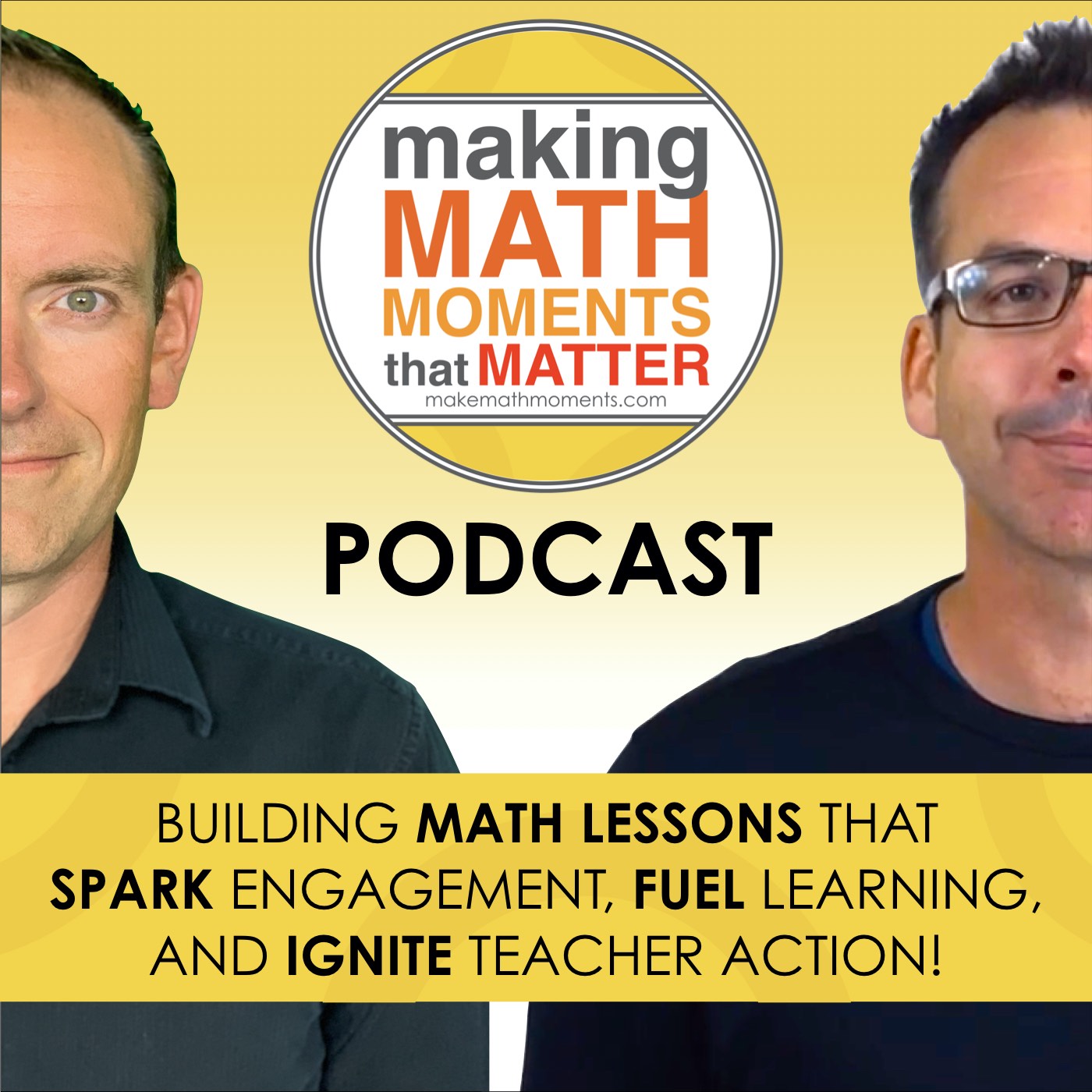
DOWNLOAD THE 3 ACT MATH TASK TIP SHEET SO THEY RUN WITHOUT A HITCH!
Download the 2-page printable 3 Act Math Tip Sheet to ensure that you have the best start to your journey using 3 Act math Tasks to spark curiosity and fuel sense making in your math classroom!
LESSONS TO MAKE MATH MOMENTS
Each lesson consists of:
Each Make Math Moments Problem Based Lesson consists of a Teacher Guide to lead you step-by-step through the planning process to ensure your lesson runs without a hitch!
Each Teacher Guide consists of:
- Intentionality of the lesson;
- A step-by-step walk through of each phase of the lesson;
- Visuals, animations, and videos unpacking big ideas, strategies, and models we intend to emerge during the lesson;
- Sample student approaches to assist in anticipating what your students might do;
- Resources and downloads including Keynote, Powerpoint, Media Files, and Teacher Guide printable PDF; and,
- Much more!
Each Make Math Moments Problem Based Lesson begins with a story, visual, video, or other method to Spark Curiosity through context.
Students will often Notice and Wonder before making an estimate to draw them in and invest in the problem.
After student voice has been heard and acknowledged, we will set students off on a Productive Struggle via a prompt related to the Spark context.
These prompts are given each lesson with the following conditions:
- No calculators are to be used; and,
- Students are to focus on how they can convince their math community that their solution is valid.
Students are left to engage in a productive struggle as the facilitator circulates to observe and engage in conversation as a means of assessing formatively.
The facilitator is instructed through the Teacher Guide on what specific strategies and models could be used to make connections and consolidate the learning from the lesson.
Often times, animations and walk through videos are provided in the Teacher Guide to assist with planning and delivering the consolidation.
A review image, video, or animation is provided as a conclusion to the task from the lesson.
While this might feel like a natural ending to the context students have been exploring, it is just the beginning as we look to leverage this context via extensions and additional lessons to dig deeper.
At the end of each lesson, consolidation prompts and/or extensions are crafted for students to purposefully practice and demonstrate their current understanding.
Facilitators are encouraged to collect these consolidation prompts as a means to engage in the assessment process and inform next moves for instruction.
In multi-day units of study, Math Talks are crafted to help build on the thinking from the previous day and build towards the next step in the developmental progression of the concept(s) we are exploring.
Each Math Talk is constructed as a string of related problems that build with intentionality to emerge specific big ideas, strategies, and mathematical models.
Make Math Moments Problem Based Lessons and Day 1 Teacher Guides are openly available for you to leverage and use with your students without becoming a Make Math Moments Academy Member.
Use our OPEN ACCESS multi-day problem based units!
Make Math Moments Problem Based Lessons and Day 1 Teacher Guides are openly available for you to leverage and use with your students without becoming a Make Math Moments Academy Member.
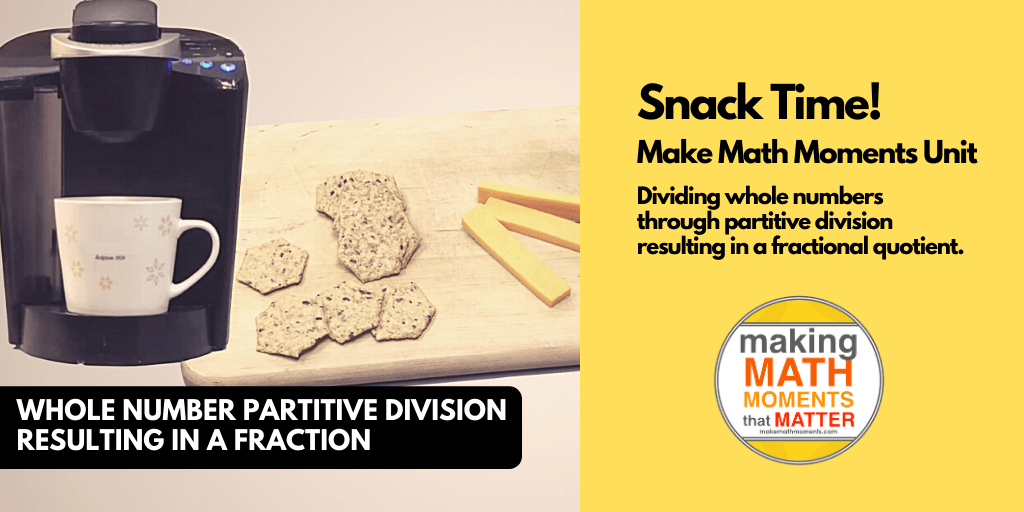
Partitive Division Resulting in a Fraction
Equivalence and Algebraic Substitution

Represent Categorical Data & Explore Mean
Downloadable resources including blackline masters, handouts, printable Tips Sheets, slide shows, and media files do require a Make Math Moments Academy Membership.
ONLINE WORKSHOP REGISTRATION
Pedagogically aligned for teachers of K through Grade 12 with content specific examples from Grades 3 through Grade 10.
In our self-paced, 12-week Online Workshop, you'll learn how to craft new and transform your current lessons to Spark Curiosity, Fuel Sense Making, and Ignite Your Teacher Moves to promote resilient problem solvers.

0 Comments