
Episode #439: How Do I Teach Grade-Level Math When My Students Are All Over the Map?
LISTEN NOW HERE…




WATCH NOW…
Struggling to meet the needs of every math learner in a single classroom?
Many teachers feel overwhelmed when students show up with wildly different entry points—especially when they’re trying to teach to grade-level standards with integrity. This episode dives into a familiar challenge: how to support diverse learners in Tier 1 math instruction without lowering expectations or relying on interventions alone. You’ll hear how one school tackled this barrier head-on by equipping teachers, building systems, and redefining what support looks like in real classrooms.
Listeners Will:
- Understand how the concrete–representational–abstract (CRA) model creates access for all math learners
- See how one coach removed barriers by aligning tools, time, and teacher collaboration
- Learn why committing to “some, not all” can lead to system-wide impact over time
- Hear practical coaching moves that build trust, buy-in, and shared ownership
- Reflect on the leadership structures that allow great teaching to spread
Press play to explore what real Tier 1 math access looks like—and how to start building it in your own school or district.
Attention District Math Leaders:
Not sure what matters most when designing math improvement plans? Take this assessment and get a free customized report: https://makemathmoments.com/grow/
Ready to design your math improvement plan with guidance, support and using structure? Learn how to follow our 4 stage process. https://growyourmathprogram.com
Looking to supplement your curriculum with problem based lessons and units? Make Math Moments Problem Based Lessons & Units
Be Our Next Podcast Guest!
Join as an Interview Guest or on a Mentoring Moment Call
Apply to be a Featured Interview Guest
Book a Mentoring Moment Coaching Call
Are You an Official Math Moment Maker?




FULL TRANSCRIPT
Yvette Lehman:
Today we’re gonna dive into another pebble, know, one that I think we’ve probably all experienced ourselves or we hear from a lot of educators, which is, you know, I’m a fourth grade teacher. I’m trying to teach to the standard or based on the curriculum expectations at my grade level. I’m trying to create, you know, integrity to this tier one instruction, but I have a huge range of entry points around particular concepts. And so I’m trying to make sure that instruction is…
allowing entry for all learners. And when I say all learners, you know, this might be just students who have gaps in understanding. It could be students who have a special education profile or a multi-language learner. It may also be our gifted students who probably could have done the summative assessment the day they walked in the door. And so how do I create a learning environment where all students can see themselves in the grade level standards?
Jon Orr:
right? Because you’re describing is like, you’re in a way you’re kind of like saying, we’ve, you know, here’s how you do that. But what the problem is, is to say, like, we’ve got so such a varying level of, of entry, like, students and where they are, and what they’re bringing into the, the year and from previous, you know, previous learning and lack of learning and all this, it’s like, how do I handle this in my classroom when I have such a varying level of entry points for all topics?
We’re going to talk about that. We’re going to talk about that from the classroom level. You know, what are we doing a teacher? But also we’re to talk about like, how do I help teachers do that? And what do I what can I do to design my system to make this easier for everyone from from the classroom teacher to the say, coach or coordinator or the principal into the system. So we’ll unpack all of that. want to I want to turn it over to Beth. Beth.
I’m probably putting you on the spot, I mean, know, entry level, varying levels, talk to us about that. Like, what have you seen? Like, maybe it’s your own teaching experience, or maybe it’s like a team that maybe you’ve coached before. It’s like, like, what does this look like, you know, in the classroom for folks on experiencing this issue? Because I think we all experience it.
Beth Curran:
Sure. Yeah. So I think Yvette kind of touched on it a little bit in setting up the whole problem here. But if we want to provide access for all students through tier one instruction in the classroom, what does that look like when we have those varying levels? And I think emphasizing and focusing really like leaning into the concrete to pictorial or representational to abstract approach. is going to provide a clear path for all students to be able to access the grade level content. And so what I see in classrooms and when working with teachers as far as implementing this concrete pictorial abstract progression within their lessons, there’s a few things. There’s a few barriers. One is maybe not being familiar with how those concrete materials could be used to demonstrate a concept. One is ⁓ time.
Right? Many teachers will say that, well, I just don’t have time to pull out those concrete materials to allow students to build those models. I think another barrier is management. You know, that’s one that I think we can’t just ignore is that students will play with the materials. And one way to, ⁓ to sort of address that is to have them be a regular part of math class. If we’re only pulling them out once a week or once a month, then it’s a fun, new, exciting toy. so, yeah, they’re going to play with them.
And so really focusing on your management around using those. But I do think that by allowing students the ability to access math by building a model, drawing a picture, or using their abstract understanding is going to help ⁓ more students be able to access those grade level standards during your tier one instruction.
Yvette Lehman:
You’re describing Beth essentially exactly the approach one of our coaches is taking, one of our partner districts out in Spokane, Washington. This coach is a classroom teacher, but also has coaching periods throughout the day. And essentially what she was trying to figure out is what am I doing during those coaching periods? You know, I feel like right now I’m just going in, I’m almost an extra teacher in the room. doesn’t feel very purposeful. But the barrier that the teachers were articulating is
How do I support everybody? How do I make this learning meaningful for everybody? have so many entry points. And so this coach is taking the approach that you described, which is a universal tier one support for all subjects is to make the learning visual. So what does that mean in the math class? Modeling is also a universal tier one support for all subjects. What does that mean in the math classroom? The CRA is a perfect fit.
for that idea of whether it’s my multi-language learners, my special education students, students with gaps in learning, if we can make it more concrete, more visual, we’re going to create greater access for all students. And so exactly to your point, where do you start? So I’m a coach, the teachers have identified that this is their pebble, this is what’s preventing them from feeling confident as a facilitator of math learning in their classroom. We’ve come in with a possible solution.
but now we need to actually get this rolling. And so one of the things that this coach did as a first step was number one, I need to remove the barrier that teachers don’t have the concrete tools they need. Because if I have to run around the building to try to find enough square tiles, enough linking cubes, enough, you know, I’m not going to do it. And so that was actually their first step is they…
The coach actually went to administration. said, if you want us to do this work, we are going to need to put in the classrooms these non-essential high leverage concrete materials at these grade levels based on our scope and sequence. So creating access to the materials that they need was one of the first steps that they took.
Kyle Pearce:
I love it. I love it. And I think right there, what you’re doing is removing. I don’t want to say it’s an easy barrier in that particular case, because it does require, you know, some effort, some work, potentially even some funding, right? If we don’t have enough of these materials, we might have to actually, you know, purchase some additional like and at the end of the day, though, if we at least recognize that that barrier is there. And if we aren’t willing to overcome that barrier,
then we can’t at least be surprised that we’re not seeing any moves in that particular area, right? So I think this really comes down to the whole idea around focusing on what you’re actually doing. What is the one thing that we’re going to focus on? You had mentioned this individual coach was maybe feeling a little bit like their coaching periods were a little aimless, you know, going into the classroom and just trying to be helpful.
I mean, it’s all good intentioned. You want to be relevant. It want, you know, all of those things and important inside the classroom. But if we don’t have that North star, if we don’t have that thing that we’re looking to try to achieve or that thing that we’re going going to try to work towards, then a lot of times we’re going to do the spaghetti at the wall approach, right? We’re going to help a little bit over here. We’re going to help a little over there, and we’re probably not going to see any traction taking place in any one area. So
That sounds like a great initial barrier to deal with. Now, Yvette, tell us a little bit more. After that barrier was removed, what is that coach now doing? And I mean, I know what we don’t have to worry about now is having accessibility to those tools. But what’s the next step if now we’ve removed that first barrier? What’s the next barrier or challenge that you might encounter?
Yvette Lehman:
I wanna make sure too that we highlight the coaching move here, right? So the coach went in and said, what is your pebble? And the teacher said, my pebble is varying entry points. So then the teacher said, well, let’s try this solution together. And they aren’t necessarily going in with all the answers or as the knower, it’s like, here’s a solution, this is research-based. What if every time I am in this room, we commit to helping each other figure out how can we make this concept, this task, today’s learning objective more concrete. And it’s a commitment that they are making to each other. That, you know, every single time it’s the lens through which we will analyze today’s lesson. It’s the lens through which we will debrief and consolidate our time together is were we able to make the learning more visual today? Were we able to…
create more access because we were able to use a manipulative or we were able to use a pictorial representation today. So rather than trying to, as you mentioned, Kyle, tackle everything, their time together is really targeted. But I think that the coaching move of having the teacher identify their pebble is critical because ultimately you both have to commit to this work now.
Kyle Pearce:
Well. Yeah. And I think too, you’ve removed a barrier before it began, which is the buy-in barrier, right? Like everybody says, like getting teacher buy-in is one of those hard challenges that you have. Well, you don’t have to get anyone to buy in because it actually came from their own pebble. It came from their own challenge, their own issue. And together you’re going to try to help to solve it. And therefore they’re a part of that process. there’s, you know, ownership there.
Right. And, and I think that’s, that’s going to be obviously huge and hugely important because if we bring in this idea and we say, listen, we want to represent things concretely, but the teacher doesn’t understand why we’re doing it. They never felt that there was an issue in their class that requires it. That’s going to create ultimately this new barrier or obstacle around teacher buy-in.
Jon Orr:
Well, think of it this way too, is like the fact that you’ve, you know, essentially she’s using effective coaching techniques that made me think about, you know, the coaching habit from Michael Benyestanyer, who was like, keep, you know, what’s the real issue here that we could help you with? know, like getting them to get to the root of like what they really want to work on, because it will create what you’re saying, like that buy-in. But I think the other power of getting, say, that commitment to the one thing, the one thing is really important, because Like if she’s being aimless, she’s focusing on too many things and saying like, this is the commitment we’re gonna make on one move that we’re gonna, we’re not gonna like, I’m not gonna come back next week or tomorrow and it’s gonna be something different. It’s like, this is the thing we’re gonna commit to because removing the barriers for all the things, you can’t. Like you have to commit to like, well, what’s the barrier I can remove to this one thing? And I think that’s the part of the job of the coach is like, how do I make the pathway to go down this easier?
And I can’t make all pathways easy. So I have to help them with, what’s this one pathway we can go down together and let me try to like remove those barriers along the way. But then zoom out a little bit. It’s like, how can I do that with every teacher? If I’m the coach of the district, if I’m the coach for the school and I have all these teachers, how do I do that? How do I make mass improvement, improvement at scale?
when I have to help all the teachers? And basically the answer is you can’t. You can’t when you’re at the district level. You can’t even when at a school level, but what you can do is commit to some. And I think that’s always been our recommendation when we work with teams is that we get bogged down on the greatest good for the greatest number dilemma, which is if I can’t provide coaching and support to everyone, therefore I shouldn’t. I shouldn’t provide it to some because I need to be equitable.
I need to make sure that I’m providing it to everyone. But the problem with that is then you don’t provide it to anyone. Which is, in coaching, is the number one most leveraged move you can make in a school to help you reach goals and help you reach the achievement that you’re looking for, your success criteria. You have to commit to some versus all. And then when you commit to some, you have to be sound with the idea that when you build…
that teacher up because you’re really moving those barriers, you’re helping them to go down this pathway that they chose, that they will be stronger. And when you create bright spots in your buildings, that the it’s the cascading effect will be there, like that teacher is not going to be in isolation, you’re going to be creating that network for that teacher to bump elbows with people at the lunchroom table, like the these things spill over. in these natural ways that when you focus on giving intense support to one, two, three, four teachers in a building, how many you can commit to? You have to look at your schedule. What can you commit to is really what you have to boil down to. It will spill over and therefore you’re building a compounding effect. Because we get too concerned if it’s like, I can’t support everyone, therefore I shouldn’t do it, but you should support some so that down the road, like look back on it three, four years down the road.
Think about the difference between committing to some each year and four years down the road, what that school will look like versus I didn’t coach anyone, I just kind of stayed up here, you know, or I let them come to me and sometimes it worked and sometimes it didn’t. Like commit and then that’s the powerful move that this coach is making. Like they’re not committing to everyone, they’re committing to some.
Beth Curran:
Right. And John, just to build on that, I think that you brought up a good point is that those structures have to be in place though. If we can trust that we can only work, we know that we work with just a limited number of teachers and that that message will then spread. those structures, those PLCs, those, you know, teachers need to be given the opportunity from leadership to get together and put their heads together and to share what they’ve learned from working with the coach, in order to see success.
kind of spread across the board.
Yvette Lehman:
I think what you’re describing Beth is the role of the administrator, how important that is. Because I’ve been in that experience. When I was a classroom teacher, I had so many opportunities and I also had an amazing teaching partner. And someone was gonna have to pry me away from my teaching partner. But imagine the leadership team had said, I’m actually am going to separate you because you are instructional leaders.
And if I take the two of you and I put one of you in fifth and one of you in sixth with a new partner this year, then I know that you’re gonna be positioned to team teach with another person. And now there’s going to be four of you instead of just two of you. And that’s where the administrator needs to really think about, okay, we’ve built capacity in these bright spots. Now, how are we gonna strategically leverage them to build other bright spots? And if we’re not thinking about that, if we haven’t…
created space for networking and capacity building and new partnerships, then probably only your bright spots will benefit. And then you’re going to have, remember Kyle, we always talked in our system about, know, pockets of excellence, although great, don’t have a long-term impact on students.
Kyle Pearce:
Yeah. Yeah. Little bright spots that can inspire you that, you know, might get other people’s wheels turning. But unfortunately, the traction is just not there right to see any sort of systemic change.
Jon Orr:
Hmm. Right, right. And I think what I like about what this coach is doing is that they’re making that commitment to the few, but they’re also making, when they’re working with that teacher, they’re making the commitment of the regularity, the framework of every day going in and going, here’s the lens, we’re going to look at this. And everything is going to come back to that. And that habit that you’re building is again, that whole system approach of saying like, this is how we’re going to get better at things is we’re going to keep.
inching along the way because we keep looking back at this thing and we’re not kind of all over the place. So I love that about this coach and the work that they’re doing inside their school.
Kyle Pearce:
Yeah. And it’s that compound effect as well, right? If we’re working with less people and we can go deeper with them, we as the coach and then they, as the, we’ll call them the new coaches because we’re hoping to see that they’re going to take others under their wing and we’re going to start to see this spread across a school, across a division. And the more we can do and the deeper we can go, the better we can build in the stronger, we can build that framework or that system.
so that it can be implemented across a broader scale, right? Because now we’ve done that work. We’ve gone deep. We’ve seen some of the things that work really well and some of the things that, you know, pose some challenges that maybe we want to sidestep for now based on this or that. And it’s, it can start small, but it’s that intentionality that it comes down to. So, ⁓ you know, as you’re listening to this episode, as you’re envisioning what you might be able to do as a leader,
I want you to reflect on that is that it might not seem like the thing that you’re focusing on is massive or that it’s going to have this great systemic impact yet. But if you can have a greater impact at a smaller scale, that gives you that little Petri dish that you can kind of, you know, look at and build off of so that we can grow this thing much bigger, much wider than we could with much greater traction than throwing the spaghetti against the wall.
Jon Orr:
You know, and I think when you look at this, this episode, we started talking about, you know, what do we do when we have a wide variety and a wide range of, of, of learning and learning skills coming into our school system. And we ended here with like thinking about systems and thinking about like habits and thinking about like dedication of like, by, by making incremental moves to support different things in terms of this thing. But it’s like that in general is for
many different pebbles that are in our shoes, right? Many barriers that are in our place is you want to think about it with that lens and that framework. And so, you know, while we kind of talked about, you know, those learning varieties and we moved here, you know, those elements are really about like math improvement planning and the different pieces of it. And we’ve put together
you know, an assessment that helps leaders, ⁓ school, you know, classroom teachers think about the elements of their math classroom, but also their math improvement planning. There are six big components that you wanna think about when you’re making these plans. can also, you can go to makemathmoments.com forward slash grow, and you can learn about those six pieces and actually get a report on where you are on each of those six pieces by filling out an assessment. So again, that’s makemathmoments.com forward slash grow.
Thanks For Listening
- Book a Math Mentoring Moment
- Apply to be a Featured Interview Guest
- Leave a note in the comment section below.
- Share this show on Twitter, or Facebook.
To help out the show:
- Leave an honest review on iTunes. Your ratings and reviews really help and we read each one.
- Subscribe on iTunes, Google Play, and Spotify.
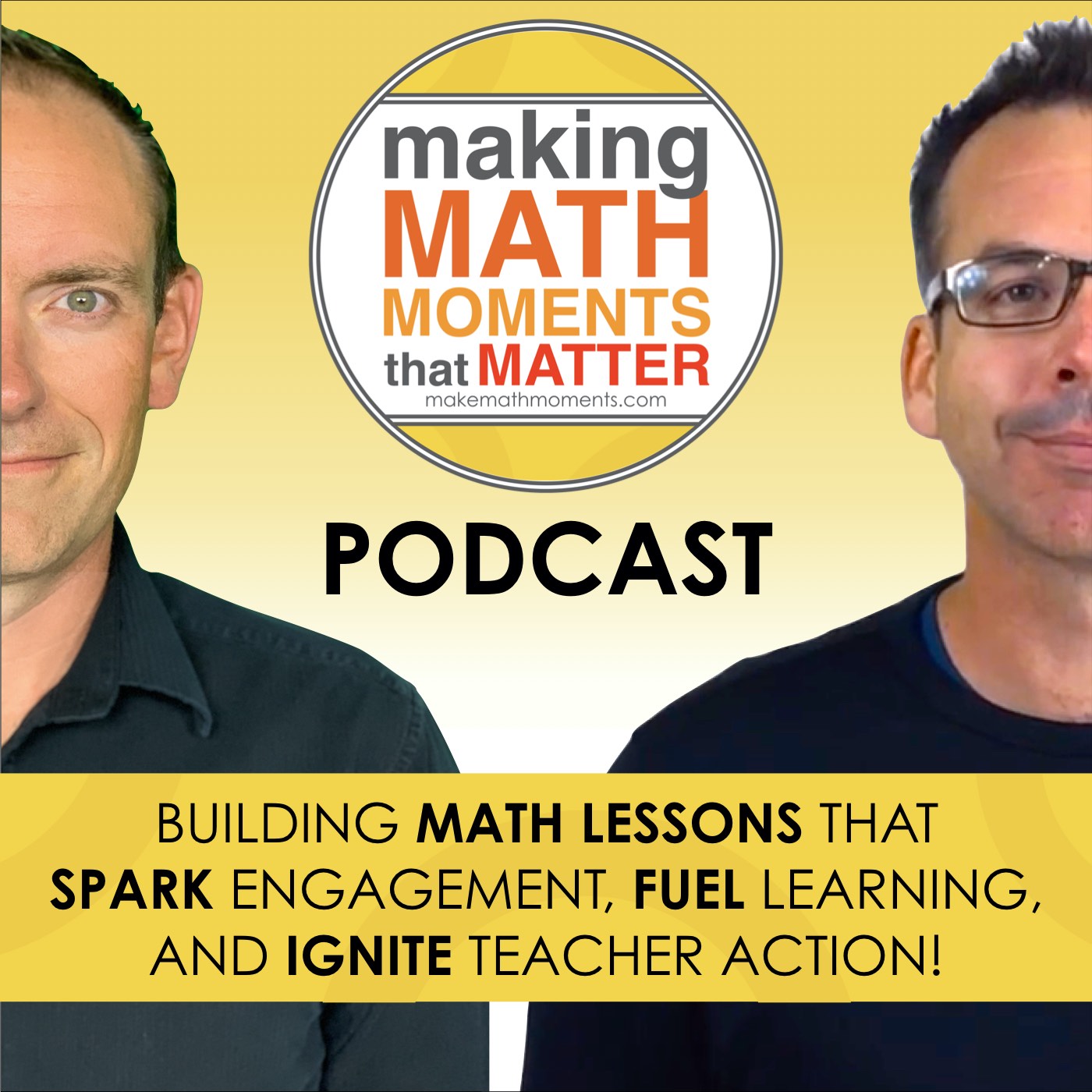
DOWNLOAD THE 3 ACT MATH TASK TIP SHEET SO THEY RUN WITHOUT A HITCH!
Download the 2-page printable 3 Act Math Tip Sheet to ensure that you have the best start to your journey using 3 Act math Tasks to spark curiosity and fuel sense making in your math classroom!
LESSONS TO MAKE MATH MOMENTS
Each lesson consists of:
Each Make Math Moments Problem Based Lesson consists of a Teacher Guide to lead you step-by-step through the planning process to ensure your lesson runs without a hitch!
Each Teacher Guide consists of:
- Intentionality of the lesson;
- A step-by-step walk through of each phase of the lesson;
- Visuals, animations, and videos unpacking big ideas, strategies, and models we intend to emerge during the lesson;
- Sample student approaches to assist in anticipating what your students might do;
- Resources and downloads including Keynote, Powerpoint, Media Files, and Teacher Guide printable PDF; and,
- Much more!
Each Make Math Moments Problem Based Lesson begins with a story, visual, video, or other method to Spark Curiosity through context.
Students will often Notice and Wonder before making an estimate to draw them in and invest in the problem.
After student voice has been heard and acknowledged, we will set students off on a Productive Struggle via a prompt related to the Spark context.
These prompts are given each lesson with the following conditions:
- No calculators are to be used; and,
- Students are to focus on how they can convince their math community that their solution is valid.
Students are left to engage in a productive struggle as the facilitator circulates to observe and engage in conversation as a means of assessing formatively.
The facilitator is instructed through the Teacher Guide on what specific strategies and models could be used to make connections and consolidate the learning from the lesson.
Often times, animations and walk through videos are provided in the Teacher Guide to assist with planning and delivering the consolidation.
A review image, video, or animation is provided as a conclusion to the task from the lesson.
While this might feel like a natural ending to the context students have been exploring, it is just the beginning as we look to leverage this context via extensions and additional lessons to dig deeper.
At the end of each lesson, consolidation prompts and/or extensions are crafted for students to purposefully practice and demonstrate their current understanding.
Facilitators are encouraged to collect these consolidation prompts as a means to engage in the assessment process and inform next moves for instruction.
In multi-day units of study, Math Talks are crafted to help build on the thinking from the previous day and build towards the next step in the developmental progression of the concept(s) we are exploring.
Each Math Talk is constructed as a string of related problems that build with intentionality to emerge specific big ideas, strategies, and mathematical models.
Make Math Moments Problem Based Lessons and Day 1 Teacher Guides are openly available for you to leverage and use with your students without becoming a Make Math Moments Academy Member.
Use our OPEN ACCESS multi-day problem based units!
Make Math Moments Problem Based Lessons and Day 1 Teacher Guides are openly available for you to leverage and use with your students without becoming a Make Math Moments Academy Member.

Partitive Division Resulting in a Fraction

Equivalence and Algebraic Substitution

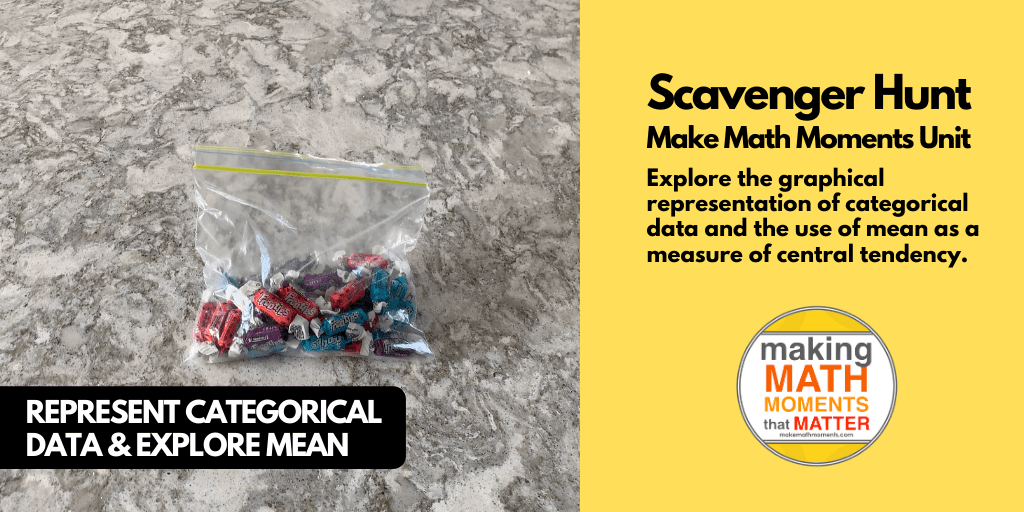
Represent Categorical Data & Explore Mean
Downloadable resources including blackline masters, handouts, printable Tips Sheets, slide shows, and media files do require a Make Math Moments Academy Membership.
ONLINE WORKSHOP REGISTRATION
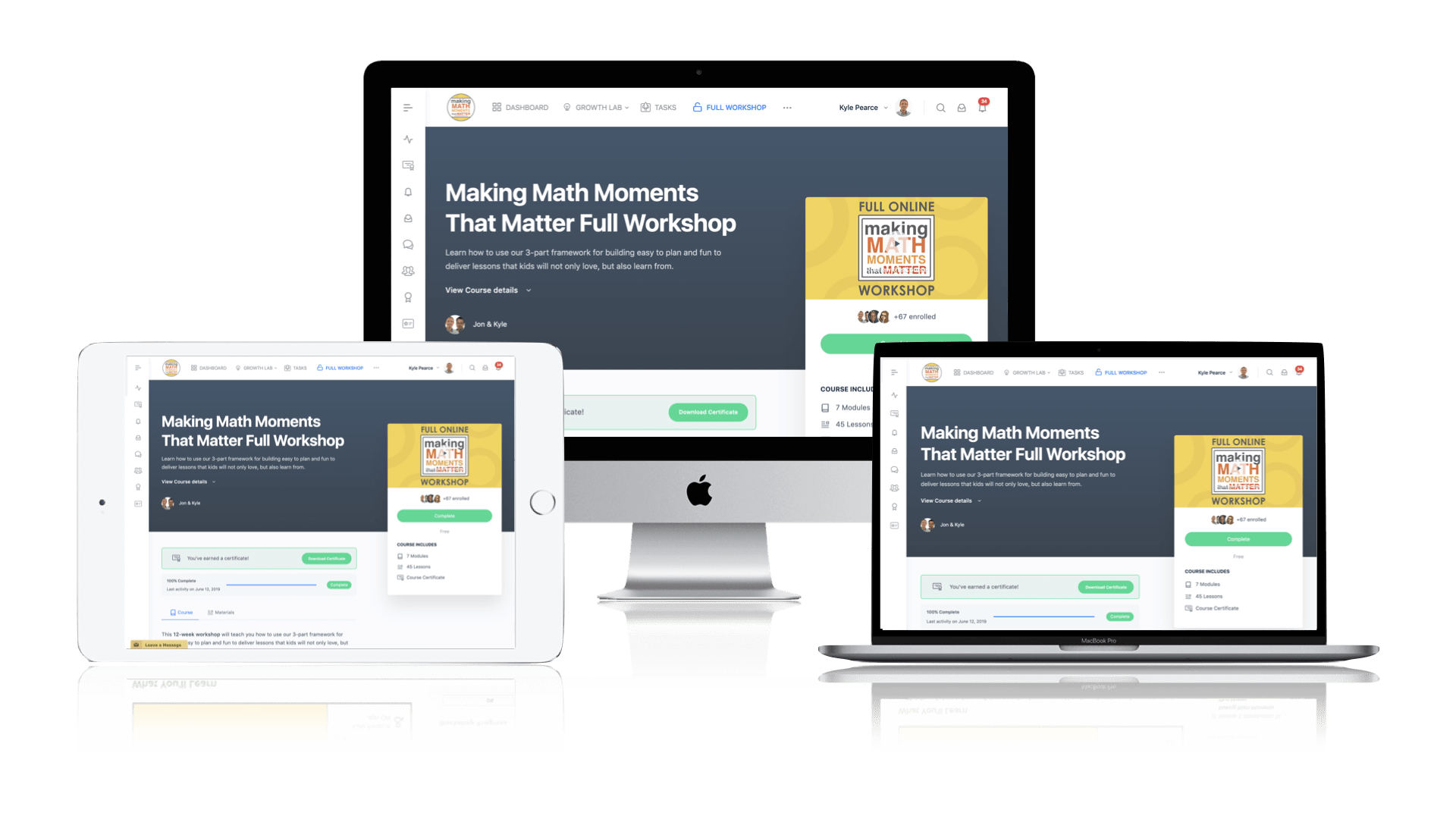
Pedagogically aligned for teachers of K through Grade 12 with content specific examples from Grades 3 through Grade 10.
In our self-paced, 12-week Online Workshop, you'll learn how to craft new and transform your current lessons to Spark Curiosity, Fuel Sense Making, and Ignite Your Teacher Moves to promote resilient problem solvers.

0 Comments