BE A GUEST ON OUR SHOW!
What Is The Making Math Moments That Matter Podcast?
In a nutshell, we want The Making Math Moments That Matter Podcast to be a resource that all educators who teach mathematics can turn to in order to learn from others in the mathematics education space. Each episode typically involves Jon and I conversing about ideas in math teaching and learning, Math Mentoring Moments with teachers who join us on the show for a coaching call, and interviews with influencers in the mathematics education space.
We would love to explore your story in mathematics education, the challenges you may have experienced along the way, and the current projects you are currently working on to raise awareness of all the great things happening with our Math Moment Maker Community of listeners.
If you want to get more of a feel for the style of the show, you can listen to previous episodes right from this webpage or, take them with you by listening in on all common podcast platforms such as iTunes, Google Play, and Spotify.
Interview Structure
Each interview is intended to be a free-flowing conversation.
However, early in the call we like to help listeners get a better sense of your story. This will include these three questions early on in the conversation:
- Tell us a little about yourself. What’s your math teaching story/journey?
- What inspired you to become a math educator / researcher / involved in mathematics education?
- When you think back to your own education experience, what memorable math moment has stuck with you?
Framing how you might respond to each of those three (3) questions ahead of time can be helpful for making things flow into the next section of the chat.
We then typically send you some high-level questions related to your specific work ahead of time. The conversation will dictate which pre-planned questions we discuss in the interview as well as any new questions that might arise.
Share Your Current Work
Consider your work and what might provide value for the Math Moment Maker Community:
- Are you currently promoting a book?
- Releasing a new podcast?
- Publishing a new research paper?
- Launching a new project or tool?
- Something else?
Be ready to share details with our audience (i.e.: website url, social media handle(s), etc.) to ensure they know where they can learn more about you and your work.
If interested, we would be happy to run a contest for a copy of your new book, resource, tool, etc.
Just let us know!
Interview Logistical Details
To ensure you have what you need to connect with us for an interview, we’ve created a list of the most important details:
- The interview will be audio only conducted via a web based tool called Zencastr via a link we would send in a follow-up email.
- The total time commitment would be approximately one hour.
- Secure yourself a microphone that connects to your computer. You don’t need to buy one at all if you have earbuds with a microphone attached. (For example I use the pair of earbuds that came with my iPhone). Note that sometimes bluetooth headsets can cause problems with delay, sound quality, etc. We’d recommend getting “wired in” if you can.
- Try to avoid using a tablet or Chromebook for this call. Our recording software isn’t a big fan of them and does much better with a desktop or laptop as the audio is recorded locally in your own computer web browser.
- Ensure that at the time of the call you are connected to high speed internet and using an updated web browser like Google Chrome or Firefox. Sadly, Internet Explorer and Safari don’t play well with our recording software.
Don’t hesitate to contact us if any of this is unclear or if you have additional questions about compatible technology.
We’d love to help!
NEXT STEPS…
Are you interested in joining us for an interview?
Contact us and we’ll send on our booking calendar to reserve you a date and time that works best for you!
Listen To Our Recent Episodes:
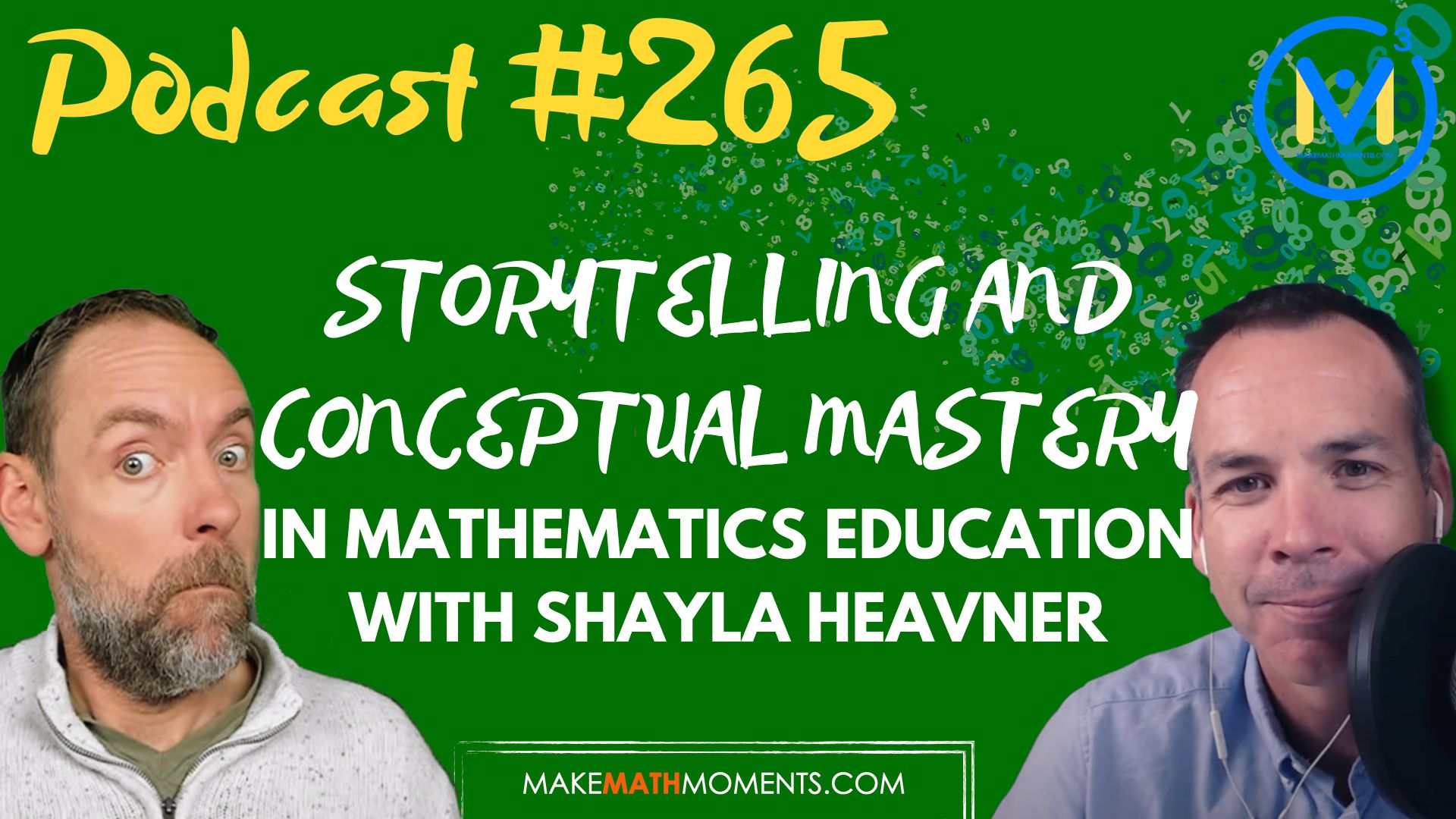
Episode #265: Storytelling and Conceptual Mastery in Mathematics Education with Shayla Heavner
Join us in the latest episode as we dive into the world of mathematics education with Shayla Heavner, the visionary founder of MathBait™. With over a decade of experience and a prestigious Sarah D. Barder Fellowship Award for teaching excellence under her belt, Shayla has been on a mission to revolutionize math education.
As a certified online teacher and master reviewer for Quality Matters, Shayla shares insights on the significance of quality, highly engaging material that is accessible to all students. She explores the power of storytelling as a versatile tool across all levels of math education, shedding light on how it can not only captivate students but also serve as a gateway to deeper conceptual exploration.
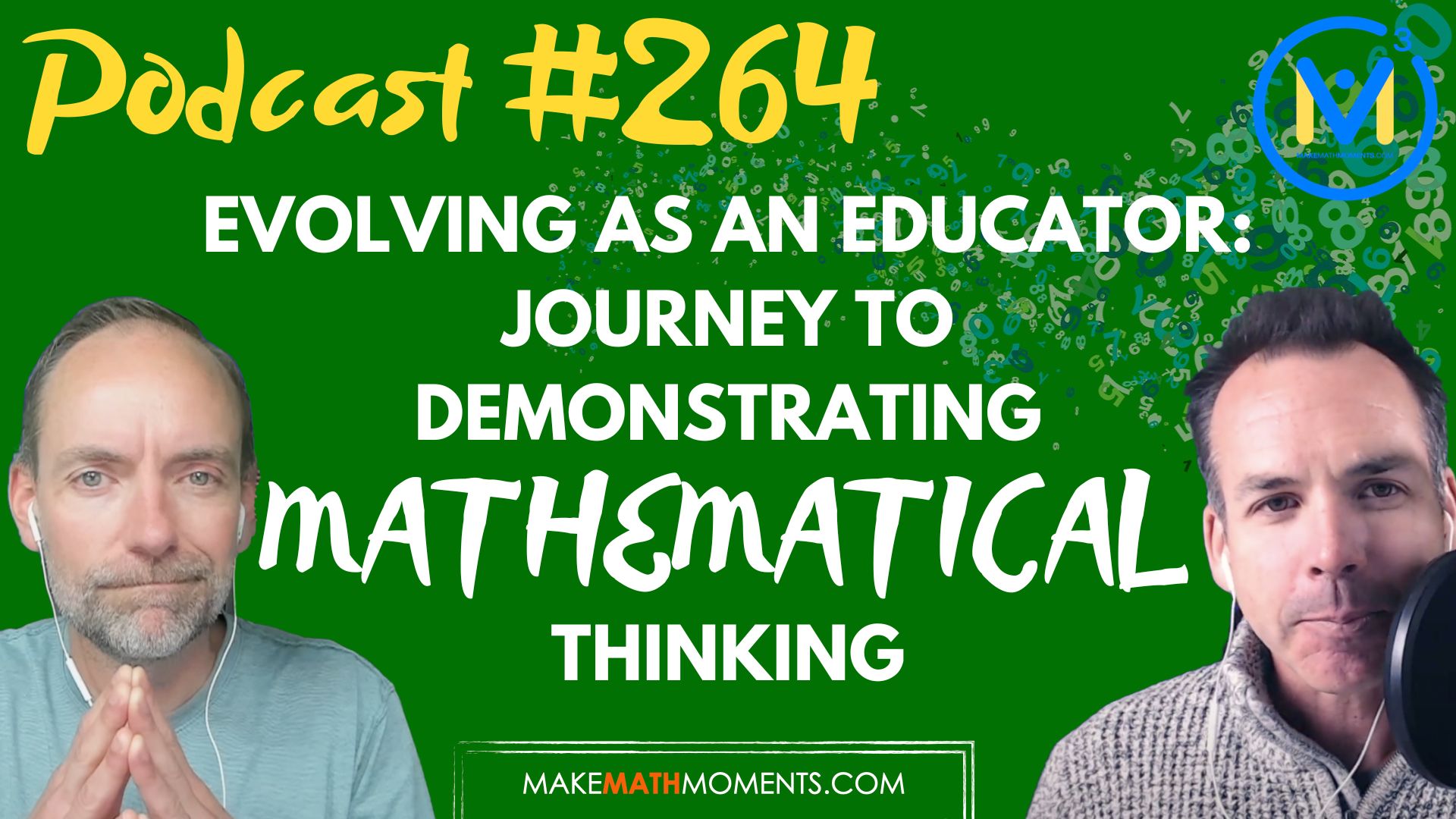
Episode #264: Evolving as an Educator: Journey to Demonstrating Mathematical Thinking – A Math Mentoring Moment
In this where are they now mentoring moment episode we speak again with Adam Love; Adam joined us back on episode 120 when he was as first year teacher from Myrtle Beach South Carolina.
3 years later and a wealth of ideas, teaching strategies, and many lessons learned Adam is here to discuss how to help students show their thinking in multiple ways.
This is another Math Mentoring Moment episode where we chat with a teacher like you who is working through some problems of practice and together we brainstorm ways to overcome them.
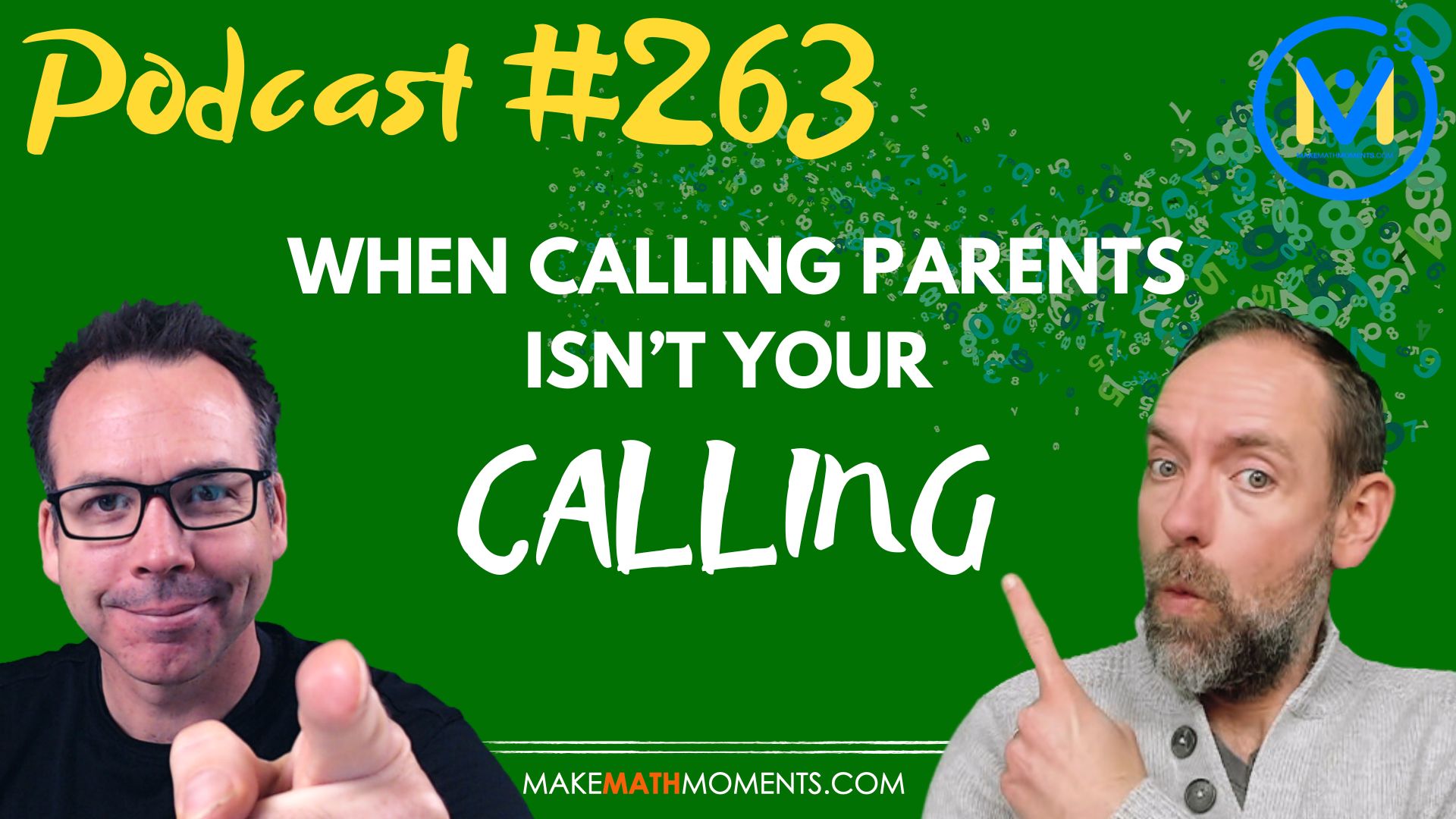
Episode #263: When Calling Parents Isn’t Your Calling – An Interview With Crystal Frommert
Get ready Math Moment Makers for a great “call” with Crystal Frommert, who will be sharing some great tips and strategies that we can put to use to promote productive conversations with parents – especially when the news isn’t necessarily positive.
We’ve all been there before: a student is experiencing struggles in our math class and the time has come where we must make that informative call to ensure parents are in the know. Let’s reframe how we look at conversations with parents by leveraging some of the ideas that Crystal shares in her book, When Calling Parents Isn’t Your Calling.
Episode #262: What Are Your Rocks? Discover What Matters Most!
Are you on track to hit the goals you set out for yourself, your school, your district? It’s December, which often marks the half-way point of the school year and also a great time to check your progress on your program’s action plan.
It’s quite likely that the busy-ness of school has taken you away from your intended focus on what really matters in your school or district’s math program.
In this episode Kyle and Jon share why we need to define our objectives (Rocks) and how to stay focused when there are so many distractions that seem urgent so that when the end of the year comes we can look back to our progress and know that we’re moving toward our targets.
Episode #261: What Is Your Definition of Success In A Math Classroom? – A Math Mentoring Moment
We welcome back Ryan Kinzler, an 8th grade teacher from Pittsburg. Ryan is here to fill us in on the changes he’s made in his classroom since he last spoke with us over two years ago.
He shares how the teacher moves he implemented resulted in his best year ever and then subsequently followed by his worst year ever.
In this episode we dig into the differences between the two years and help Ryan set himself up for another great year.
This is another Math Mentoring Moment episode where we talk with a member of the Math Moment Maker Community who is working through problems of practice and together we brainstorm possible next steps and strategies to overcome them.
Episode #260: The Myth of the Math Brain and the Underdiagnosis of Dyscalculia – An interview with Dr. Sandra Elliot
“I’m not a math person.” I’m sure that is something you two have heard more than once. But have you ever heard someone say, “I am not a reading person?” It seemingly is socially acceptable to be bad at math, but there may be more to it, including the underdiagnosis of dyscalculia.
The research shows…
Dyscalculia is less well known, and there are fewer screening and diagnostic tools (Jaya, 2009), but its prevalence is similar to dyslexia- 5-7% of the population (Menon et al., 2020; Price & Ansari, 2013; Santos et al., 2022).
Add to that an estimated comorbidity of 35-70% with other neurological disabilities, including dyslexia, and suddenly there are a staggering number of students who are at risk of failing math when early identification and intervention can mitigate the problem in many cases (Kisler et al., 2021; Litkowski et al., 2020).
In the last 20 years, there has been a push to address illiteracy through early identification with universal screeners, but the same focus has yet to be there for innumeracy. Even with the increased need for math skills due to technology, there have yet to be national campaigns to address the problem (Bryant, 2008; De Visscher, 2018; National Center for Education Statistics, 2022).
Dr. Sandra Elliot, Ph.D., has spent over four decades working in education as a Special Education teacher, a five-time principal in Florida and Colorado, and a district-level administrator. She is now making it her mission to champion increased awareness of dyscalculia.
Episode #259: Visual Patterns & Practice Standards: A Conversation with Fawn Nguyen
This week we bring on another 2023 Make Math Moments Virtual Summit speaker: Fawn Nguyen!
Fawn is on the Math Advance Team at Amplify Desmos Math. She was a math coach for a K-8 school district for three years. Before that, Fawn was a middle school teacher for 30 years. Fawn was the 2014 Ventura County Teacher of the Year. In 2009, she was awarded the Math Teacher Hero from Raytheon. In 2005, she was awarded the Sarah D. Barder Fellowship from the Johns Hopkins Center for Talented Youth.
Fawn will share why understanding the impact of your past choices in the classroom is necessary for your growth, how learning how to visualize mathematics allows educators to break free from the rush to the algorithm, and how to teach with the website visualpatterns.org the right way!
Episode #258: Integrating Numeracy Beyond the Math Block: An interview with Kendra Jacobs
Join us for a lovely chat with Kendra Jacobs about mathematizing our world around us and bringing it into our classrooms.
Listen in and learn the one simple thing you can do in your classroom to get students to enjoy mathematics instead of despise it.
Kendra is an adjunct professor at the University of British Columbia Okanagan, facilitating ‘Teaching Children Numeracy’ and ‘Numeracy for Diverse Learners’.
She is the founder of Mathematizing 247, where her mission is to inspire and empower elementary teachers to create engaging, joyful, and equitable math opportunities.
She works as a part-time classroom support teacher, alongside educators to support strong numeracy instruction that nurtures the development of joyful, independent learners.
Episode #257: Uplifting Students by Uplifting Mathematics: A Conversation with Sunil Singh
On today’s show, we’re bringing on Sunil Singh, a colleague, friend, and fellow Ontarian from the math education world for a second time.
Sunil, the author of three books (Life of Pi, Math Recess, and Chasing Rabbits) with his fourth on the way (Sonic Seducer), joins us to share his unique insights into effective teaching and learning of mathematics.
In this episode, Sunil highlights the significance of rich, narrative-driven mathematical content in facilitating engaging teaching experiences. He unveils the two essential pillars for becoming an effective math teacher, while also unraveling why the number 70 is weird and its potential to captivate students’ attention.
Sunil guides us through the strategic elements that school districts should prioritize when shaping professional development plans for math educators. He introduces the concept of developing a K-Lifetime mathematics program, emphasizing the importance of cultivating lifelong mathematical curiosity.
Episode #256: Empathy and Effective Math Teaching: Lessons from Rick Wormeli
In today’s episode, we had the privilege of sitting down with author, speaker, educator, Rick Wormeli. Rick is a true trailblazer in the field of education, and he brought a wealth of wisdom and experience to our conversation.
In this engaging discussion, Rick delved into some thought-provoking ideas that challenge conventional teaching practices in mathematics. He passionately emphasized why assigning a large number of problems might not be the most effective way to help students learn and why it’s crucial to understand that the person doing the editing is the one truly engaging with the material.
Rick also shared his insights on the power of intentional purpose in assignments, the importance of cultivating empathy for students new to math, and the interconnectedness of pedagogy and mathematics content.
Furthermore, Rick introduced a bold notion—that teaching the same course year after year may not be the most effective approach for educators or students. His unique perspective on this topic invites us to reconsider the dynamics of teaching and its impact on student outcomes.
Prepare to be inspired and challenged as Rick Wormeli takes us on a journey of rethinking math education. It’s a conversation you won’t want to miss, so let’s dive right in!
STAY IN THE LOOP:
JOIN THE COMMUNITY
KYLE PEARCE & JON ORR