Episode #449: Stop Wasting Teachers’ Time: Making Math PD Practical, Coherent, and Ongoing
LISTEN NOW HERE…



WATCH NOW…
Have you ever left a math PD session thinking, “This all sounds great… but what does it actually mean for my class tomorrow?”
Teachers are hungry for professional learning that respects their time and improves student learning—but too often, math PD stays stuck in big ideas, vague theory, and system messaging. When there’s no clear connection to curriculum, classrooms, or follow‑up support, trust erodes and implementation stalls.
In this episode, we dig into why even well‑intentioned math PD misses the mark—and how leaders can redesign professional learning to actually move instruction forward.
Listeners Will Learn
- Why one‑off, theory‑heavy PD leads to low classroom impact
- How “coverage” and system messaging crowd out meaningful math learning
- What research says about effective professional development in math
- Why ongoing support matters more than a single great session
- How to connect PD to curriculum, PLCs, and coaching cycles
- Ways math leaders can rebuild trust by making PD immediately usable
- How modeling how teachers learn should mirror how students learn
If you’re designing math PD—or sitting through it—this episode offers concrete guidance to turn professional learning into sustained instructional change.
Attention District Math Leaders:
Not sure what matters most when designing math improvement plans? Take this assessment and get a free customized report: https://makemathmoments.com/grow/
Ready to design your math improvement plan with guidance, support and using structure? Learn how to follow our 4 stage process. https://growyourmathprogram.com
Looking to supplement your curriculum with problem based lessons and units? Make Math Moments Problem Based Lessons & Units
Be Our Next Podcast Guest!
Join as an Interview Guest or on a Mentoring Moment Call
Apply to be a Featured Interview Guest
Book a Mentoring Moment Coaching Call
Are You an Official Math Moment Maker?



FULL TRANSCRIPT
Jon Orr:
All right, here’s here’s our question that we’re going to address here today is that I was a teacher. And again, you got more going to position this as a leader as well. But it’s like I have I have PD on Friday. And I’m gonna I’m gonna say it. It was not awesome. And I’m tired of the big theory in the big picture. I need to know how this impacts me tomorrow and next week in my classroom. Like when I go into PD, this is what I’m hoping to get and I never get it. It’s always like this like lofty idea. So then therefore, that’s the question we want to address because really, really what it comes down to is that you’re losing trust of teachers when you’re designing professional development this way. And let’s unpack this here today because this is the utmost priority as a, know, being teachers trying to make them the most out of it, but also as leaders designing professional development.
Yvette Lehman:
feel like I can relate to both sides, right? As the person who’s received PD and the person who’s planning PD. So I have.
Jon Orr:
Because you plan terrible PD.
Kyle Pearce:
Everybody’s done it before, for sure.
Jon Orr:
You do it’s just like a new teaching you plan terrible lessons and you get better and as long as you’re you know and then you plan terrible PD and you learn how to get better.
Yvette Lehman:
I was describing to my husband after his PD on Friday, what it was like being at the central office role and trying to figure out the different topics for different days on the calendar. And really, you where do those topics even come from? And I was saying, you know, here in Ontario, many of those topics that we cover during the full day PD are ministry mandated. So it’s not at the discretion of the district. And I guess the way I should describe this is the ministry tells us what, but the district has full autonomy over the how. And the school has some autonomy as well. So I’ve definitely been in a situation. think I’ve shared on the podcast before. There was one day where I had to plan PD for all six great educators in the entire district around math and Holocaust education in the same half day. You know, because that’s how the calendar fell and it needed to be in person. And so I think sometimes what we don’t recognize as the teacher who’s receiving the professional development are sometimes the constraints for those who are planning it. But that doesn’t mean that there aren’t better ways to go about this work so that it can be optimized and more impactful and more meaningful for because otherwise, what’s the point? We can say that we did it, but if there is absolutely zero impact and participants don’t walk away feeling as though they’ve benefited from that experience. Like you said, John, it actually just builds more distrust in the system.
Beth Curran:
And I would add to that, that I think a lot of teachers find themselves feeling like, another PD. It’s a waste of my time because time is such a valuable resource, especially for a teacher who is not a content area specialist, who’s a generalist. You know, if they’re going to take an hour, three hours, a full day to set aside to sit in a professional development session, they want to walk out with something that they can use in their classroom the next day because their time is such a valuable resource to them. And they often, I think, leave feeling like that was a waste of my day. I could have gotten so many other things done during that time. So I think as a PD provider myself, I’m constantly striving to help the teachers to see how this directly applies to what they will be planning for tomorrow, next week, next month, so that they can walk away feeling like, OK, I took something away from this that I can now implement in my classroom. And I think that that’s something that when planning PD, when seeking, you know, maybe you’ve got an expert from outside coming into your school, that I think that that’s something that we should be asking. You know, how is this going to be relevant to my teachers? What are they going to walk away with? And I think it’s okay to hold those professional development providers to that fire to make sure that they’re providing something for the teachers that’s meaningful.
Kyle Pearce:
Your comment about time being such a valuable resource, I think, is one of the big reasons why we end up in this spot is that there’s so little time in many cases. And what ends up happening, and it sounds like what had happened recently for your husband there, Yvette, is the PD ends up becoming a messaging board for keeping people informed as to the vision. So what ends up happening is everything stays so high level and that it’s like we’ve decided as a district like we are going to do X, Y and Z and we’re going to focus on this and we’re going to focus on that and ends up being really just a big update as to what we at the district office have sort of decided on behalf of the district. And the poor challenge that we have here is that while we want clarity, the problem is, is now we’re taking that very limited amount of time in order to just share some generic messaging, but then there’s no actual time or plan and how we’re going to follow up to dig in on these ideas. And then what we end up with, we talk about it all the time is the spaghetti at the wall. Like it feels like it’s just more spaghetti getting tossed on the wall. We’ve now communicated it. And now we’ve kind of put the burden on the school or on the actual educators in order to sort of like go do the appropriate and required learning and then kind of implement, which in reality we know is a very unrealistic expectation.
Yvette Lehman:
So let’s talk about some recommendations. So if this is a leader listening and they say, well, I have PD coming up and it’s large scale PD and many teachers will be participating. I liked these four recommendations that came from an article called professional learning and the learning profession. was actually published by the national staff development council in 2009. So let’s just kind of, I’m going to read the four recommendations and then we’ll dig in. The first recommendation is professional development should be intensive, ongoing and connected to practice. I liked that idea. Actually, I’m not going to dig into them yet, but I will say I liked the idea of ongoing. Well, it’s like I’ll read them all and then maybe we can jump in after, but I feel like the idea of ongoing implies that it’s not a one-off, right? The second recommendation is professional development should focus on student learning and address the teaching of specific curriculum content. The third recommendation, professional development should align with school improvement priorities and goals. And lastly, professional development should build strong working relationships among teachers. Let’s dig in.
Jon Orr:
Okay, let’s go back to the beginning. So the first recommendation is professional development should be intensive, ongoing, which like you just articulated is like it’s not a one-off, and connected to practice. All right, thoughts, who wants to jump in here on, because obviously you’re like no duh.
Beth Curran:
I can just speak from personal experience. Again, you I have spent the last, I don’t know, six, close to 10 years doing professional learning for schools. And often I find that that ongoing piece is what’s missing. I’ll pop in in the summer, I’ll do my intensive to get them going on the curriculum, and then I pop back in again, maybe in the fall and maybe in the spring, and nothing has progressed since I met with the teachers in the previous session. And so that ongoing piece I think is really important. So the need to have somebody who’s going to continue that work in the absence of the professional development provider, I think is really important. If you want to see anything happen, you know, we can’t just be checking on the box filled my PD days in we’re done. You know, there’s more work than that that has to be done.
Kyle Pearce:
Well, and it makes me think that, OK, so if I’m the leader right now, I’m planning because, you know, I’m I’m I’m sweating right now if I’m listening to the episode and I’m going, shoot, I’ve got PD coming up that I have to plan. And, boy, I don’t want to fall into the same trap here. One thing that I think is really important is that whatever has been decided as the idea, the thing that we are going to really be focusing on and and implementing at that PD day, I want everyone to sort of get that out, get it on the board, on the whiteboard, on the page, whatever it is, but then I want you to actually envision what is the next month? What is the next half a year? What does the next year look like related to that topic? Like what is the plan and what could be done? What recommendations could we offer at the end of the session so that educators have some sort of means in order to put these ideas into practice? really thinking ahead and sort of going like, how are we going to support our school leaders, right? So whether that’s the administrators, the coaches that are in the building, and then how do we actually allow the educators themselves in order to dig in a little bit? Because if we leave that day and sort of just go like, here’s the ideas we’re gonna share today, and there’s actually no sort of looking ahead to sort of say, here’s what could happen. Is it an after school optional PD? Because we know we can’t force educators to join in, but it’s like we’ve got options for you in order to dig in here just so that when people leave that room, they’re not in their mind sort of thinking, hmm, okay, good to know. But you know, we’ll probably be back in this room again sometime to talk about something different five months from now or a year from now.
Jon Orr:
Yeah, like the studies show that, you know, if you have your one off or your, hey, I’m creating awareness to some idea, and then I’m going to leave it to you to figure out the study show that like you’re looking at like 10 % of those to be implemented into the classrooms, like, like, but when you pair it with what you’re suggesting, Kyle is like, where are we planning out the intensive support after the fact? Are we connecting this to the PLCs that are in our schools? Are we connecting this to the coaching that’s happening in classrooms with teachers? We know it’s not every teacher, not every teacher gets that connectivity, but some will. I think what you would look at is if you just keep it the one off, then you’re looking at 10 % of those people will take it and run with it, but then you got 90 % of going like, I’m just gonna go back to do what I was doing. But when you pair it with those other subsystems of support, you’re looking at closer to like 80 to 90 % of actual implementable ideas into classroom practices because you’ve connected and you know, connected this, you’ve made it clear that this is a priority, you’re getting ongoing support for this one idea, you can’t just leave this as a one off, otherwise you’re just saying like next year we’re gonna do something different and then we just keep and then you get that exact phrase for what you know, your partner Yvette was saying is like, I’m just tired of these big ideas because there’s nothing actually translates in the classroom. I view this very much as a connected to the third, the third one, which is like professional development should align with school improvement priorities and goals. Like you got to pair those two together for sure because like what is our goal so that I can connect the one-off PD that the district might say is important for us to do into my PLCs at my school level to support my ongoing goals. to support our coaching if we’re, if we have a coach at our school or if the coach visits once, twice, three times a week or, or, you know, and then they’re on their cycle. these, all of these things have to be supported and connected. That’s when you’re looking at like where a teacher is going to walk out of that PD and not have that, that phrase to say like, like it’s not, you know, it’s not, not for me. It’s not, I don’t even see it because it’s like, we know that they’re going to be supported and they’re connected past that one day.
Yvette Lehman:
John, it’s like we’re sharing a brain today. You stole my idea. I was gonna say the exact same thing. To me, it’s like, how do you make this live at the school level? How is there continued opportunities to dig in and develop collaborative structures to unpack the learning from a pull-out PD? It’s through connection to the school improvement goal, but I’m gonna present it this way. Just as important, the school needs to know what the system priorities are, what the system vision is, and what the big ideas of professional development are going to be this year so that they’re well positioned to bring that to the school level. But the same is also true for anybody working at the district level. I need to be very in tune to what the schools are working on. That way I can take the big idea from the pull-out PD and help them see their school improvement work in it. And so we talk about this idea of it not being top down or bottom up. It’s like, how do we ensure that these two systems, our district level work and our school level work are working in tandem and supporting each other throughout the process? So if I’m a consultant at the district level, director, superintendent, I should be intimately aware of what schools are working on. That way, when I know that we have PD coming up, I can help them see their work in that big idea that’s being presented at system PD and vice versa, right? Schools also need to be aware of what the priorities are at the state or district level.
Beth Curran:
Yeah, and I would say then let’s take it one step further. So looking at recommendation two here, connecting it to specific curricular content. I think that we can say that maybe we want to work on student discourse around mathematics. And so our professional development is all about bringing a problem string into our classrooms. But then if teachers don’t see where that fits into their curricular content, it’s like adding more onto their plate. They’re piling on and piling on and piling on. And so I think that it’s important that educators see where this big idea lives within the curricular materials that they’ve been given.
Jon Orr:
Yeah, yeah, well said. Like I think we have to make it practical. We have to make it so that you can take it and run with it. that might mean you need to go, you know, smaller groups. You might mean to be like, think about like, should I, like I could design professional development into a mass blast, or could I? Is there a world or are there conditions that allow me to be more targeted and specific? Could I get the same message across when we’re working with just grade levels or just individual schools so that it feels more relevant to what we’re doing tomorrow or the next day?
Kyle Pearce:
I think when we, you know, when we think about this as well, it’s like, you know, we, if professional development is going to be building strong relationships amongst our teachers, we need to, we need to be really thinking about every opportunity we have to do, whether it’s full large group PD or not is like, how are we going to use that as a means to strengthen that relationship? And I think that’s one of the areas that, you know, can be a big barrier that once you start to like cross that barrier, like once you start to actually, you know, focus on that area, you start to see some meaningful progress take place. But if you never pass that, you know, cross that bridge, if you never get to this place where there’s actually meaningful work being done in any one area where we haven’t actually built the relationship with educators that we’re trying to help, and we’re trying to, you know, provide this PD and the support for, we’re not going to see any sort of movement here. So really focusing on how can you use every opportunity in order to build that relationship into a true working relationship? Because otherwise, the way I see a lot of large group PD taking place is it’s usually one way, right? It’s someone delivering content and then leaving. And there’s no new relationship or no building on the relationship, the existing relationship. So like, how do we do this in a way where we’re actually strengthening our relationship with the individuals that we’re working with? Because every single opportunity, every time we have with that group is an opportunity for us to either build the relationship or to allow it to sort of dwindle a little bit. Like I won’t even say it’s like maintain the relationship. Like you’re actually, I think you’re losing a little bit of any progress you’ve done if we keep it very one way and very, you know, sort of sage on the stage, right? Again, how many times do we do that? We tell our educators we want them to deliver, you know, their math content in a certain way. But then when we deliver PD, we do it in a very different way. And, you know, how do we do this so that we can use this as a modeling opportunity in order to build relationships, but then also to show how, hey, listen, Here’s some great content and here’s a way that we can actually make some progress, even though we are dealing with a much larger group and maybe at a much higher level in terms of the content that we’re focusing on currently in that large group PD.
Jon Orr:
Yeah, like you said, it’s like what most of you have to decide, you know, what is it that I want the big message and the big takeaways and the learning goals to be when I design professional learning with teachers, because you just hit it, Kyle, is like, if I think like, and this makes me think about, you know, our math coherence compass, which is a tool that we help our teams with when we think about you know, their vision and their objective and their support structures. But the East on the compass is our culture and our beliefs. And like, what are our fundamental beliefs about how students learn? We have to know what that, like we want that to be because we have to share that. But also like, what do we want the fundamental beliefs to be about how teachers are supported and how teachers learn? Like, what is that belief? Because if we truly believe, that teachers, we want teachers to learn just like we want students to learn, then we have to prioritize how we deliver the learning. Like if I wanna just be the sage on the stage, like are we teaching everyone what it is that we want them to take away from that as I deliver professional development? Because you’re completely right, Kyle. It’s like, it’s so easy for me to be like, I’m just gonna show some slides and talk about the big ideas but not make it practical. It’s hard to take time to design professional development to hit all four of these things. It’s hard to let go, could I structure this to be more grade level specific? Could I take time to build relationships? Could we have discourse happening so that teachers are round table discussions and then we’re rotating them and we’re actually putting into thinking practices into our professional development? It is hard to do that. if I had a fundamental belief that we truly believe teachers learn just the way we want students to learn about their teaching practice and their mathematics, then we would take time because we have to say that I, I got a PD day coming up. Does it pass the East on the compass if I just teach it this way or do we actually have to schedule some time to plan to teach the way we want to teach so that they get this big idea because It’s easy. It’s a cop out if you just do it the other way around. If you don’t fundamentally believe what you believe about learning. And I think that’s an important aspect you have to take back as a leader to go like, are we just doing this because it’s quick and easy? Because I could and you were like, I don’t have time to do that. I have to do all these other things. Sure. You have to decide is it a priority or not? Which one is the bigger priority? And these are hard decisions that everyone has to make. And here’s and here’s the kicker. You might decide the other thing is more of a priority. You just have to be okay with what consequences come about of your professional development. You just have to be okay with your 10%.
Kyle Pearce:
Well said.
Beth Curran:
gosh. I think Kyle and John, you both kind of touched on something that had me thinking about just having those systems in place, Knowing who your bridges are. Again, being the person who was probably checked the box for the, I was that box checked for that principal or that administrator by bringing me in, but then there wasn’t a bridge in place to carry that message throughout, to plan those professional learning sessions. to be in the classrooms and support teachers because as that person coming in, and I think in a large district, you’re also running into this, right? You can’t be with every teacher following a PD session. You can’t be in every classroom. So those bridges have to be in place. That system has to be functioning so that that message continues to be supported and heard all the way down to the classroom level because we’re doing PD because we wanna see change in the students, right? We want student improvement. So we can’t just have it live high up in the system. It has to be supported all the way down and having those systems in place and those bridges identified to carry that message on I think is crucial.
Kyle Pearce:
I love it. I love it. That’s some great messaging. I, you know, as we think back and reflect on some of the discussions here first, you know, and we’ve heard a number of us here say it, this is hard work, you know, it’s incredibly hard work. And, you know, I remember being in the planning stages and I know Yvette, you know, and I would do this, these planning sessions and it’s very easy for us to get hyper-focused once we decide on the topic. the thing we’re going to cover. And then it’s about how do we make the day go well? How do we make the session go well? But then oftentimes we’re kind of getting so narrow that we forget to kind of zoom out and see what impact is this going to have on people beyond the day? And this is really important work. So what we’re encouraging you to think about here as you plan your next session, specifically when we’re looking at these larger group sessions, we know that they’re important. We know that you know, a lot of really great things can happen, but hopefully you’ll take some of these ideas from this session in order to make sure that it aligns with your goals and your objectives, right? We wanna give you a tool, if you haven’t grabbed it yet, it is our Coherence Compass Template that you can go grab over at makemathmoments.com forward slash coherence, and you can grab that Compass Template today to make sure. that the next session and all of the sessions that you’re gonna be planning out for the educators you serve is going to align and be coherent so that you can build on each session and we get less of those experiences that we hear so often of when teachers walk away saying, was all big ideas and there wasn’t anything I could implement in my own classroom. Let’s make sure that we build. and get aligned and coherent across our systems. And it really does start with some of these larger group PD sessions. So head on over to makemathmoments.com forward slash coherence or makemathmoments.com forward slash coherence dash compass.
Thanks For Listening
- Book a Math Mentoring Moment
- Apply to be a Featured Interview Guest
- Leave a note in the comment section below.
- Share this show on Twitter, or Facebook.
- Leave an honest review on iTunes. Your ratings and reviews really help and we read each one.
- Subscribe on iTunes, Google Play, and Spotify.
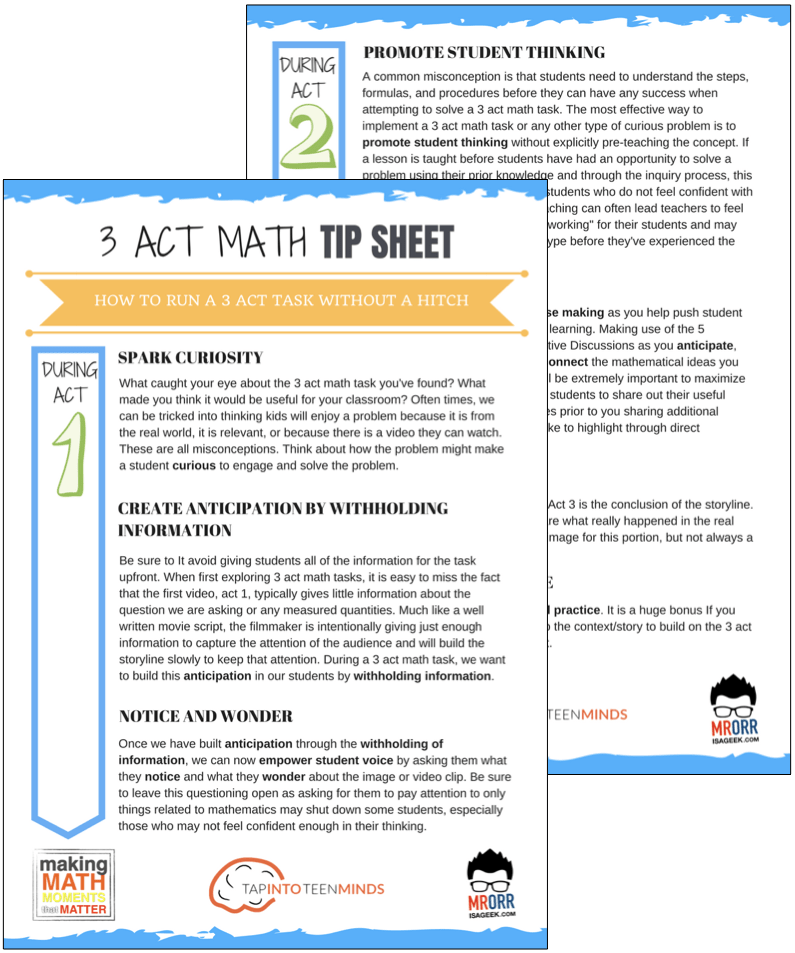
DOWNLOAD THE 3 ACT MATH TASK TIP SHEET SO THEY RUN WITHOUT A HITCH!
Download the 2-page printable 3 Act Math Tip Sheet to ensure that you have the best start to your journey using 3 Act math Tasks to spark curiosity and fuel sense making in your math classroom!
LESSONS TO MAKE MATH MOMENTS
Each lesson consists of:
Each Make Math Moments Problem Based Lesson consists of a Teacher Guide to lead you step-by-step through the planning process to ensure your lesson runs without a hitch!
Each Teacher Guide consists of:
- Intentionality of the lesson;
- A step-by-step walk through of each phase of the lesson;
- Visuals, animations, and videos unpacking big ideas, strategies, and models we intend to emerge during the lesson;
- Sample student approaches to assist in anticipating what your students might do;
- Resources and downloads including Keynote, Powerpoint, Media Files, and Teacher Guide printable PDF; and,
- Much more!
Each Make Math Moments Problem Based Lesson begins with a story, visual, video, or other method to Spark Curiosity through context.
Students will often Notice and Wonder before making an estimate to draw them in and invest in the problem.
After student voice has been heard and acknowledged, we will set students off on a Productive Struggle via a prompt related to the Spark context.
These prompts are given each lesson with the following conditions:
- No calculators are to be used; and,
- Students are to focus on how they can convince their math community that their solution is valid.
Students are left to engage in a productive struggle as the facilitator circulates to observe and engage in conversation as a means of assessing formatively.
The facilitator is instructed through the Teacher Guide on what specific strategies and models could be used to make connections and consolidate the learning from the lesson.
Often times, animations and walk through videos are provided in the Teacher Guide to assist with planning and delivering the consolidation.
A review image, video, or animation is provided as a conclusion to the task from the lesson.
While this might feel like a natural ending to the context students have been exploring, it is just the beginning as we look to leverage this context via extensions and additional lessons to dig deeper.
At the end of each lesson, consolidation prompts and/or extensions are crafted for students to purposefully practice and demonstrate their current understanding.
Facilitators are encouraged to collect these consolidation prompts as a means to engage in the assessment process and inform next moves for instruction.
In multi-day units of study, Math Talks are crafted to help build on the thinking from the previous day and build towards the next step in the developmental progression of the concept(s) we are exploring.
Each Math Talk is constructed as a string of related problems that build with intentionality to emerge specific big ideas, strategies, and mathematical models.
Make Math Moments Problem Based Lessons and Day 1 Teacher Guides are openly available for you to leverage and use with your students without becoming a Make Math Moments Academy Member.
Use our OPEN ACCESS multi-day problem based units!
Make Math Moments Problem Based Lessons and Day 1 Teacher Guides are openly available for you to leverage and use with your students without becoming a Make Math Moments Academy Member.
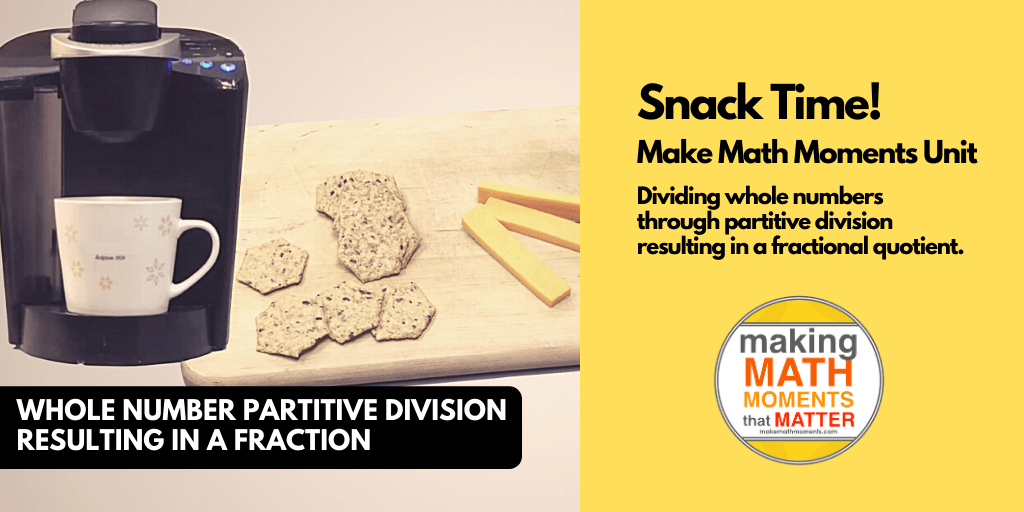
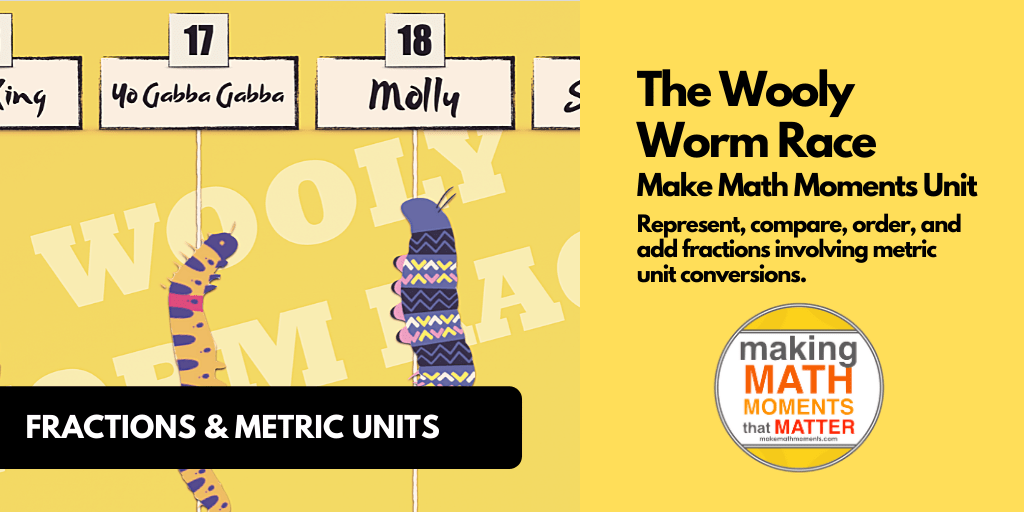
Partitive Division Resulting in a Fraction
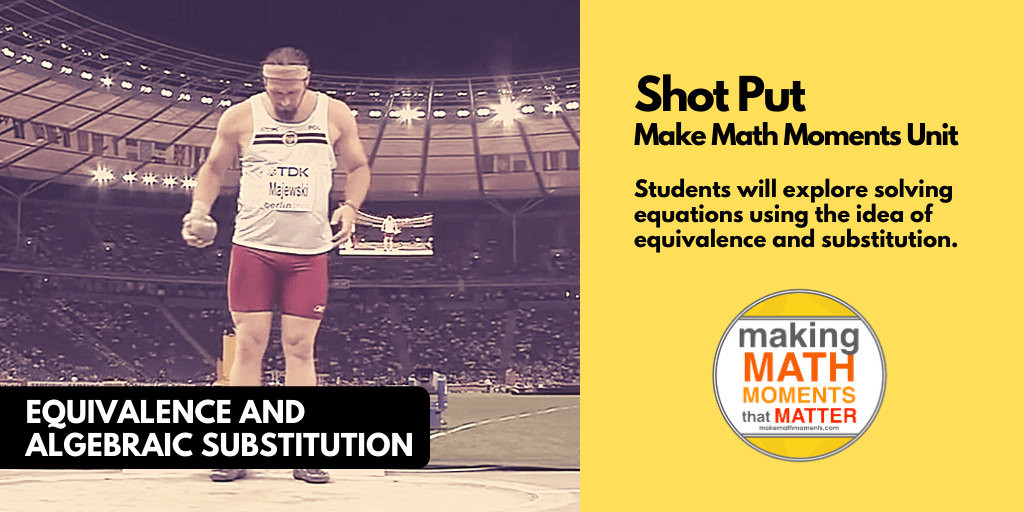
Equivalence and Algebraic Substitution
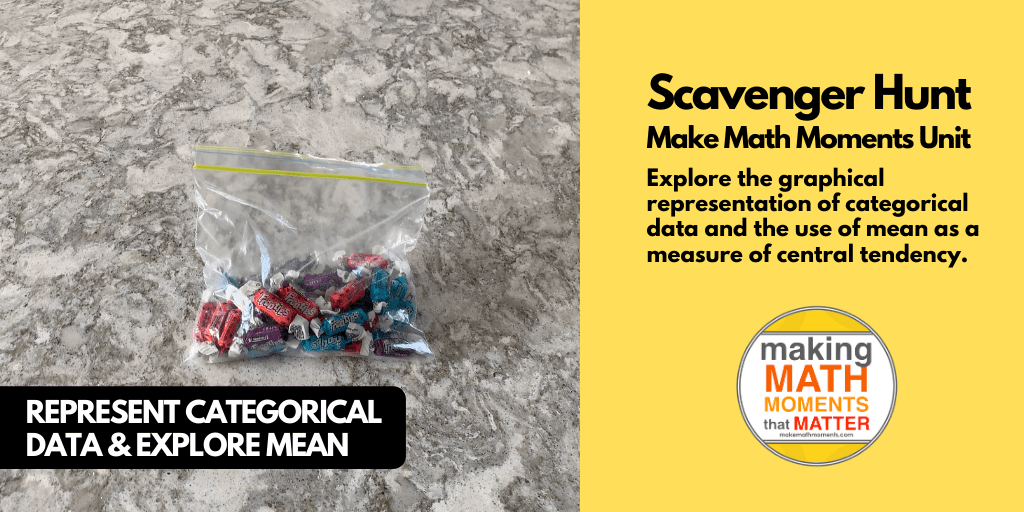
Represent Categorical Data & Explore Mean
Downloadable resources including blackline masters, handouts, printable Tips Sheets, slide shows, and media files do require a Make Math Moments Academy Membership.
ONLINE WORKSHOP REGISTRATION
Pedagogically aligned for teachers of K through Grade 12 with content specific examples from Grades 3 through Grade 10.
In our self-paced, 12-week Online Workshop, you'll learn how to craft new and transform your current lessons to Spark Curiosity, Fuel Sense Making, and Ignite Your Teacher Moves to promote resilient problem solvers.
0 Comments