Episode #458: How to Prepare for Standardized Tests In Math Class Without Test Prep Mode
LISTEN NOW HERE…




WATCH NOW…
Testing is around the corner—and teachers are asking: “Do I stop everything and switch into test prep mode?”
Many teachers spend weeks reviewing, drilling, and assigning packets. But students don’t remember what was “taught” months ago, review feels like pulling teeth, and anxiety spikes. The firehose approach overwhelms students and often leaves teachers feeling like they have no choice but to cram harder.
In This Episode, You’ll Learn
- Why end-of-year review can overwhelm students and raise anxiety
- What Jon Orr changed after a decade of test-prep cycles (and why he stopped doing month-long review)
- How teaching through problem solving builds real math readiness: stamina, strategy use, and resilience
- How cumulative practice and cumulative assessment reduce the need for cramming
- Why daily independent work time can lower testing anxiety
- How formative assessment and progress monitoring help teachers support students without shifting into panic mode
- What to do if it’s already March: why it’s not too late, and what to start tomorrow
Pick one shift you can start now. Keep math instruction steady. Build habits this month that reduce anxiety now—and make next year’s testing season feel like business as usual.
Attention District Math Leaders:
Not sure what matters most when designing math improvement plans? Take this assessment and get a free customized report: https://makemathmoments.com/grow/
Ready to design your math improvement plan with guidance, support and using structure? Learn how to follow our 4 stage process. https://growyourmathprogram.com
Looking to supplement your curriculum with problem based lessons and units? Make Math Moments Problem Based Lessons & Units
Be Our Next Podcast Guest!
Join as an Interview Guest or on a Mentoring Moment Call
Apply to be a Featured Interview Guest
Book a Mentoring Moment Coaching Call
Are You an Official Math Moment Maker?



FULL TRANSCRIPT
Yvette Lehman: This episode is going to be released in March and for many of our listeners coming from the US or here in Ontario, we are right around the corner of state testing or standardized testing for us here at EQAO. I feel like EQAO is starting earlier and earlier. used to think end of May and now I think the reporting period starts end of April. So it is just around the corner.
Yvette Lehman: And I think a common pebble that many teachers face this time of year is do I sacrifice my regular instruction to get into test prep mode? Am I gonna take the next two weeks or the next month to prepare for the test or should I stay the course? And so that’s the topic we’re gonna dive into today.
Jon Orr: It’s a good one because I remember my first few, well, maybe my first 10 years of teaching is I would get to the end of the course, the end of the year, and it would be time. I’d plan for review. So it’s like going in into the, for me, was EQAO or grade nine standardized testing. And it’d be like, okay, this is a really important test for everyone and the school and the kids. And so we would plan. I would plan a lot of time to get ready for that test.
Jon Orr: And you can imagine that it was like, I remember getting into review and going over the review and it was like pulling teeth because you knew you taught it and I’m using air quotes here, you know, but the kids are like, you never taught us this. You know, like, I don’t remember any of this, like, cause it’s like, oh, that was back in September. And it’s like, there’s this long gap.
Jon Orr: And then all that did to me, like structuring and thinking about that I knew that I was giving that much time, like I’m talking at least three weeks of preparing for this standardized test at the end of the year, it just gave me more ammo to be like, okay, I gotta make sure that I plan better for that review. Like you’re planning for the review all year long because you knew the kids, maybe I need more time to plan for the review because they didn’t remember it the first time.
Jon Orr: I better give a little bit more because it’s like all of a sudden we gotta cram it all in at the end of the year hoping and praying that they can perform well on this test. That was the mindset that I had for a long time.
Yvette Lehman: I think that’s probably the mindset that many of our teachers are feeling, right? That we have to shift what we’re doing. That test prep looks different than what I do every day in my tier one instruction. I think the argument that we’re going to make today is it may be too late this year. If you’re listening right now and you’re like, my gosh, that’s my only option at this point. Yeah, and you did this episode in September, but maybe going into next year, we can think about if success on the standardized test at the end of the year is the goal.
Yvette Lehman: You know, one of, and I hope it’s not the only goal. It’s one indicator of okayness. It’s a way to evaluate your curriculum and the strength of your system. What are we doing all throughout the year so that we’re not, and I mentioned this as we jumped on the call, I saw David Costello speak once and he was saying, you know, we don’t want to be spraying and praying.
Yvette Lehman: Which is basically like, imagine you have the fire hose and you’re just like blasting the entire room with this review over the next three weeks. And it’s like, how much is even being absorbed? Like it’s overwhelming. It’s probably creating more anxiety for students because they also, like you were saying, John, they’re like, well, they don’t remember it. They know they don’t remember it. And so now everybody is kind of feeling elevated and anxious. So if that’s maybe not the way.
Yvette Lehman: Right? Like if cramming the last few weeks is maybe not the most effective approach, we’re going to maybe dive into what would we do differently or what would you do differently, John, now, you know, now that you’ve learned what you’ve learned over the past 20 years, how would you approach preparation for a standardized test? Not with a focus on the last three weeks reviewing.
Jon Orr: Well, I’ll tell you what I did for the last 10 years. If you were an avid listener of the podcast you probably know how I shifted my instruction over the years, but one is I taught my lessons, like my tier one instruction, my lessons, as if we were, it’s not as if we were planning for that end of year test, but what I was planning for is almost, I am not going to review.
Jon Orr: Like I am not spending a month of review. And that was a mindset that I think I had, is that I need to make sure that I plan my tier one instruction well enough that I can support these students all year with what they need so that when we get to the end of the year, it’s not like all of a sudden it’s a whole new ball game and then we have to spend a month preparing for this. It’s just, we continue business as usual.
Jon Orr: And there was, I guess, I’ll talk about two. There’s probably a million things. This is one of the things I’ve said here on the podcast a lot of times is that what 10 years, like 20 year teacher John and 10 year teacher John look like are obviously 10 years of learning in between those two pieces, but sometimes when we hear what 20 year John was doing, we think we should be able jump to that in no time.
Jon Orr: But there’s a million pieces that added up to being, to be where I was and where I am. So sometimes that’s an important idea to hear when you hear someone talk about how they taught, or how they teach, or what they’re doing in their classroom, know that there’s a lot of moves that led to that point, not just like one conscious move.
Jon Orr: So I guess I’ll talk about two of those, but one of those moves was I taught through problem solving. So I knew that our standardized tests, especially the EQAO, most of those problems are not naked problems. They were multi-step problems. They are problems with context. There were multiple strategies to solve every single one of those problems.
Jon Orr: And I was teaching in my first 10 years of like the very traditional here’s the naked problem, here’s the easy version, here’s the medium version, here’s the hard version, here’s the word problem, and now let’s practice a bunch of them and then you have to figure out which type it is. And I remember saying to someone when I saw a problem from the standardized test and it was a multi-step problem around I think integers.
Jon Orr: And I was like, if they wanted them to assess whether they knew integers or not, why didn’t they just ask them the point blank naked problem? But that’s not what they’re assessing all the time. So they’re assessing things that I learned to, I think, believe in, which is math is more than just knowing the right answer. We’re knowing about resilience and problem solving and being able to solve multi-step problems and apply your thinking in terms of strategy.
Jon Orr: These were all being assessed that I built into my tier one instruction. Basically, so I taught through problems with context, had students solve problems in class. We tie it up at the end of the class or the middle of the class. We have individual practice. And then we would repeat that practice. You know, day in, day out, we solved unfamiliar problems, but then tied it to the familiar. That was the way I taught for the last 10 years.
Jon Orr: So that was an important move because now when we saw, this was, remember someone said to me, and they said, John, did your kids do better on the standardized tests than they did before? And I said, you know what, I think overall, year to year, I mean, there may have been some improvement, but it wasn’t like massive improvement on that standardized test.
Jon Orr: But what I remember saying is that my kids stuck with the problems a lot longer on the test. Like there wasn’t kids just handing it in anymore. Like they stuck with the problems because they were seeing unfamiliar problems and they were trying to solve them. And that was a big difference than before because it was like the unfamiliar problems blank. Now the unfamiliar problems stuff. And that was a big win for us.
Jon Orr: So that part I think was a major shift. And then when you think about planning for that, we didn’t have to plan, like prepare for that. It was just how we did it. And it was what we did in class. So that’s one. The second piece was around, I think, how we did commutative practice and commutative assessment.
Jon Orr: So we brought in like whatever we did one week, it was still something that we would continually learn week to week to week. So my assessments had previous material on it. We kept rolling material, which allowed me to do a couple of things. Keep the, we’re reviewing all year long. You know, we’re continually saying like what we did in September didn’t just happen in September. It’s actually happening now. And we’re still looking at strengthening your understanding of that, even though it’s March.
Jon Orr: And we wanna make sure that that’s an understanding that we have as a class. And so we’re going to allow you to look at strengthening it now in class. We’re gonna allow you to say, you know, it’s gonna show up on a quiz in a different time period than it should have because it’s out of that unit, which is basically we’re doing commutative practice and we’re doing commutative assessment all year long.
Jon Orr: And so that allowed us to say, we didn’t have to review so much because review was built in all year long. And so those were two of the big changes that I made over those 10 years that allowed me to say I was prepared for our standardized tests and I didn’t stress about it anymore and our kids didn’t stress about it anymore. It was just built into how we did things. All right, what about you guys?
Beth Curran: So, John, I heard you say strengthening your tier one instruction throughout the year, having opportunities to build in some of that cumulative review, focusing on building perseverance and the ability to really stick to a problem for some time. All of those things contributed to your students feeling more prepared to enter into a standardized testing situation. I would also recommend that within our just regular instructional day, try to build in some time daily if you can for students to do independent work with you standing in the classroom in front of them and telling them, I’m not going to help you on this problem. I think you can do it all by yourself.
Beth Curran: Because if the only time that we say to students, I can’t help you, even though you’re standing right there with them, whether or not it’s a summative test or your standardized test in the spring, if the only time we say to them, I can’t help you, you’re going to have to figure this out on your own, is when we put a test in front of them, we might unintentionally be creating situations where students are experiencing testing anxiety.
Beth Curran: So if we just make that a normal part of the day, maybe it’s one problem, maybe it’s an exit ticket, maybe it’s a workbook page, something each day, if you can, to let the students practice this idea that I can do this without the teacher’s help. Just to build up that perseverance and being able to work independently, which is something that I think a lot of students lack in that ability.
Yvette Lehman: I love that recommendation. It’s one that I don’t think I had thought about, this idea of students need opportunities to work independently, but I love the idea of to work independently and I’m not going to answer your question right now. I’m not going to give you advice. Like I want you to show me what you can do independently, do your best and I’ll give you feedback after to build up that norm.
Yvette Lehman: That is actually my own child on his report card this month. The recommendation for his learning skills was like, you are capable of figuring things out without asking. Right? Like he has to trust that he doesn’t need to always seek the teacher’s validation or confirmation that he’s understood. It’s like he needs to trust himself and it’s like she’s trying to build up that skill in him. And he’s an only child, so I totally get this, right? Like he’s constantly seeking confirmation, validation for what he’s doing or thinking from an adult in particular.
Yvette Lehman: So it’s like really good for us to be aware that’s something that he needs to build is like confidence in his own ability. And what she said is usually you can figure it out on your own. You’ve just built up a habit of always asking. So I love that recommendation of like, there’s going to be time built into every single day. And if you’re a homeroom teacher, it doesn’t even need to just be math. It’s like, where is the time in every day where it’s like, no, I trust that you are capable to figure this out to the best of your ability.
Yvette Lehman: And it’s okay, like give me your best for today and then I’ll give you feedback after. I think that my recommendation, and again, this kind of goes back to just what does effective tier one instruction throughout the year look like, is I think that I was never anxious because I feel like one thing I did well was formative assessment all the time. I really felt like I understood where all of my students were in their learning and I also understood where we were trying to go.
Yvette Lehman: I had a really solid understanding of what would be assessed at the end of the year on the standardized assessment and I also had a good understanding of where every student was on their learning journey and how I could provide that tiered support to lift everybody up as close as I could to grade level. So it wasn’t a surprise — there weren’t unexpected events that came up where I felt like we were now cramming in the last month.
Yvette Lehman: Because again, I had a good understanding of where we were trying to go collectively relative to demonstrating proficiency of this curriculum at this grade level. But I also was constantly monitoring progress, monitoring every single student along their learning journey through, like John suggested, those opportunities for mixed assessment and mixed practice.
Yvette Lehman: So if you, maybe this is a call to action for everybody listening. It’s like, what is one thing you’re gonna commit to? Are you gonna commit to building in that independent think time, independent application time for students? Are you gonna build in more opportunities for formative assessment and ongoing progress monitoring of where students are so that you can create those opportunities for tiered instruction and support where needed?
Yvette Lehman: Are you going to think about how are we revisiting curriculum throughout the year so that it doesn’t feel like the review all happens at once? It’s actually built in throughout every unit that you’re teaching. And how are you going to create opportunities for students to routinely interact with cognitively demanding problems that require them to apply their thinking in new situations?
Yvette Lehman: And that’s what happens, right? On a standardized test, it’s like you’re looking at all content coming together on a single assessment, and in interesting and novel ways that are gonna require resilient problem solvers. That shouldn’t be the first time they’re seeing those types of problems. That should be just how we do business in this classroom.
Beth Curran: That’s right.
Jon Orr: There you have it, five easy things. Five strategies, we talked about five strategies to prepare for standardized assessment, standardized testing. So Yvette, I love your call to action. Like I said before, don’t imagine you’re just gonna magically go from point A to point B, but a good call to action here is like, what could you commit to? Is there one thing, like you said, probably you’re imagining this is what it looks like going into next year.
Jon Orr: To do these strategies through the year and stay consistent with them so that this time next year, the standardized testing season is you’re feeling prepared, you’re feeling ready, there’s no anxiety around it, the kids don’t feel anxiety around it. So these are the moves that you wanna make. I would say let’s make sure that we plan moving forward that way. What’s the one thing for you to do?
Yvette Lehman: I think a good question is, is it too late? Right? So maybe it’s March and testing is coming up in April. Would it be realistic to implement one of these things over the next month? You know, and what if you haven’t been doing this cumulative review and you haven’t been teaching through rich tasks or problems, you know, maybe people are listening and feeling like this all sounds great, but now we are weeks out. So what’s our recommendation for a teacher who might be saying those are great recommendations and I’m going to start strong next year, but what about the month that I have ahead of me?
Jon Orr: Actually, I feel like it’s a good time. Like you’re already, think of it like this. Sometimes we don’t wanna make changes to our routines because we’re mid-year. We don’t wanna disturb the flow. But actually, you’re gonna do that anyway going into this testing season. So this could be a good move to say even tomorrow that you’re gonna put one of these actions into place.
Jon Orr: It might be that at the end of the week you’re going to have a kind of revisit an idea from earlier on, which is now just taking a little bit of time to start reviewing without calling it review early because you’re revisiting. Or maybe you’re going to teach through problem solving, you know, one portion of one period each week moving into this way, because you don’t need this because it’s like we’re gonna tackle this unfamiliar problem as we connect it to the familiar and connect it to the curriculum that we’re currently teaching.
Jon Orr: I think there’s a lot of space here starting now to build the habits, now going into this type of season that you’re going to be in, so that next year it’s actually more of a habit. And I don’t think you want to kind of wait until next year. It starts now. So I think yes on all five, but pick one.
Beth Curran: Pick one. And then I would say also just try to keep business as usual going in the classroom, right? Try to stick to using, you know, if you have a curricular resource, just try to stick to that as much as you can. And then just gently weaving in some of these five strategies rather than we’re going to work on this test packet for the next two weeks, right?
Jon Orr: There you have it, some good strategies there moving forward. What strategies have worked for you in the past? If you’re getting our emails, reach out to us. Hit reply on any of those emails and let us know. Hey, I just listened to the episode on preparing for standardized tests. Here’s exactly what I do and we’d love to hear, we’d love to read. Maybe we’ll share them on an upcoming episode.
Jon Orr: If you want to learn more about effective teaching practices and the six key components of a healthy math classroom, then you can learn more and take an assessment over at makemathmoments.com forward slash report. You can fill out an assessment there that helps you understand the six but also gives you a report, a custom report to strengthen each of the six and will pinpoint the first one to work on. So makemathmoments.com forward slash report and we’ll see you next episode.
Thanks For Listening
- Book a Math Mentoring Moment
- Apply to be a Featured Interview Guest
- Leave a note in the comment section below.
- Share this show on Twitter, or Facebook.
To help out the show:
- Leave an honest review on iTunes. Your ratings and reviews really help and we read each one.
- Subscribe on iTunes, Google Play, and Spotify.
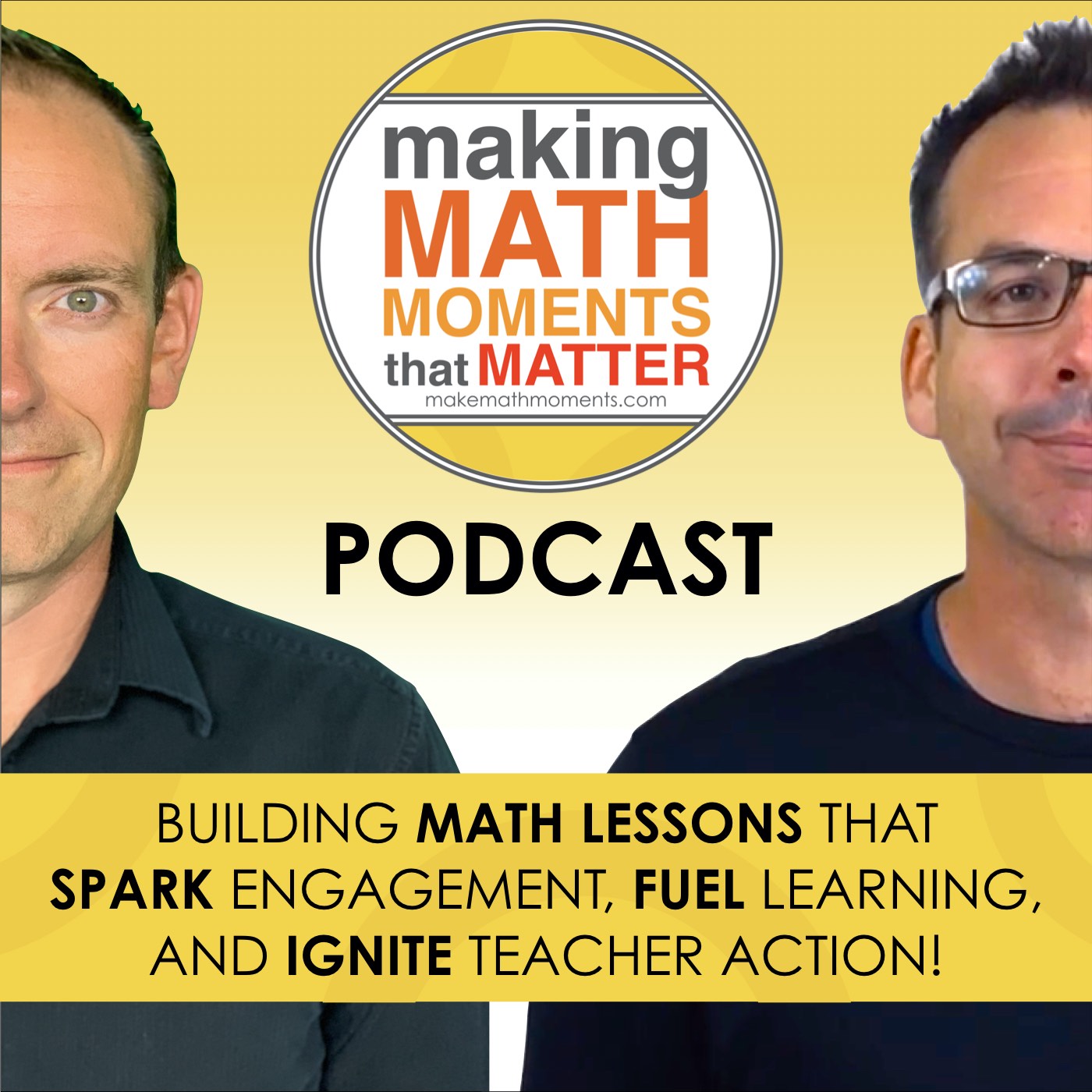
DOWNLOAD THE 3 ACT MATH TASK TIP SHEET SO THEY RUN WITHOUT A HITCH!
Download the 2-page printable 3 Act Math Tip Sheet to ensure that you have the best start to your journey using 3 Act math Tasks to spark curiosity and fuel sense making in your math classroom!
LESSONS TO MAKE MATH MOMENTS
Each lesson consists of:
Each Make Math Moments Problem Based Lesson consists of a Teacher Guide to lead you step-by-step through the planning process to ensure your lesson runs without a hitch!
Each Teacher Guide consists of:
- Intentionality of the lesson;
- A step-by-step walk through of each phase of the lesson;
- Visuals, animations, and videos unpacking big ideas, strategies, and models we intend to emerge during the lesson;
- Sample student approaches to assist in anticipating what your students might do;
- Resources and downloads including Keynote, Powerpoint, Media Files, and Teacher Guide printable PDF; and,
- Much more!
Each Make Math Moments Problem Based Lesson begins with a story, visual, video, or other method to Spark Curiosity through context.
Students will often Notice and Wonder before making an estimate to draw them in and invest in the problem.
After student voice has been heard and acknowledged, we will set students off on a Productive Struggle via a prompt related to the Spark context.
These prompts are given each lesson with the following conditions:
- No calculators are to be used; and,
- Students are to focus on how they can convince their math community that their solution is valid.
Students are left to engage in a productive struggle as the facilitator circulates to observe and engage in conversation as a means of assessing formatively.
The facilitator is instructed through the Teacher Guide on what specific strategies and models could be used to make connections and consolidate the learning from the lesson.
Often times, animations and walk through videos are provided in the Teacher Guide to assist with planning and delivering the consolidation.
A review image, video, or animation is provided as a conclusion to the task from the lesson.
While this might feel like a natural ending to the context students have been exploring, it is just the beginning as we look to leverage this context via extensions and additional lessons to dig deeper.
At the end of each lesson, consolidation prompts and/or extensions are crafted for students to purposefully practice and demonstrate their current understanding.
Facilitators are encouraged to collect these consolidation prompts as a means to engage in the assessment process and inform next moves for instruction.
In multi-day units of study, Math Talks are crafted to help build on the thinking from the previous day and build towards the next step in the developmental progression of the concept(s) we are exploring.
Each Math Talk is constructed as a string of related problems that build with intentionality to emerge specific big ideas, strategies, and mathematical models.
Make Math Moments Problem Based Lessons and Day 1 Teacher Guides are openly available for you to leverage and use with your students without becoming a Make Math Moments Academy Member.
Use our OPEN ACCESS multi-day problem based units!
Make Math Moments Problem Based Lessons and Day 1 Teacher Guides are openly available for you to leverage and use with your students without becoming a Make Math Moments Academy Member.

Partitive Division Resulting in a Fraction

Equivalence and Algebraic Substitution
Represent Categorical Data & Explore Mean
Downloadable resources including blackline masters, handouts, printable Tips Sheets, slide shows, and media files do require a Make Math Moments Academy Membership.
ONLINE WORKSHOP REGISTRATION
Pedagogically aligned for teachers of K through Grade 12 with content specific examples from Grades 3 through Grade 10.
In our self-paced, 12-week Online Workshop, you'll learn how to craft new and transform your current lessons to Spark Curiosity, Fuel Sense Making, and Ignite Your Teacher Moves to promote resilient problem solvers.

0 Comments