Episode #442: When There’s Too Much Math to Cover: Why Teachers Need Permission & Support to Innovate
LISTEN NOW HERE…




WATCH NOW…
Ever feel like you’d love to try a new strategy—but you’re too afraid to fall behind?
You’re not alone. Math teachers often want to innovate but feel stuck between pacing pressure, new resources, and competing priorities. In this episode, the Make Math Moments team talks about what’s really holding math teachers back—and what school and district leaders can do to help.
Listeners will:
- Understand why strong core resources reduce the fear of “getting off track”
- Learn how spiraling supports both coverage and deeper learning
- Explore how to lead with integrity instead of fidelity
- Discover what psychological safety looks like for teachers
- See how math leaders can align priorities and support risk-taking
- Get clear on what “good math instruction” sounds and looks like
If you’re a math leader, coach, or teacher who’s tired of the “there’s too much to cover” conversation, this episode offers real solutions to help you move forward with clarity—and purpose.
Attention District Math Leaders:
Not sure what matters most when designing math improvement plans? Take this assessment and get a free customized report: https://makemathmoments.com/grow/
Ready to design your math improvement plan with guidance, support and using structure? Learn how to follow our 4 stage process. https://growyourmathprogram.com
Looking to supplement your curriculum with problem based lessons and units? Make Math Moments Problem Based Lessons & Units
Be Our Next Podcast Guest!
Join as an Interview Guest or on a Mentoring Moment Call
Apply to be a Featured Interview Guest
Book a Mentoring Moment Coaching Call
Are You an Official Math Moment Maker?



FULL TRANSCRIPT
Yvette Lehman
I feel like we can all relate to wearing both hats here, both the teacher and the coach or leader where you’re trying to incorporate something new or try a new innovation or incorporate a new resource. But you’re feeling that pressure of knowing that if I do this, if I take this pivot, if I deviate from the plan, I may not cover everything. You have this, you know, super tight pacing. You know that there’s already more than 10 months of learning in your grade level.
And so knowing that if you’re gonna take this risk and you’re gonna try something new and it might take longer or might pull me off course, now I may not get to everything. And that I think is really scary for a lot of teachers, when they feel a responsibility to cover their grade level standards or cover the expectations by the end of the year.
Jon Orr
that’s like the valid concern we have as a teacher in teaching students in classrooms, because there’s so many things now. But as a leader, a coach, a coordinator who’s trying to make a difference and shift instruction because they know the research says so, that’s what you’re hearing. You’re hearing like, and you’re saying like, I know they’re right. Like how can I make this work? when they have so many things on their plates. And that’s what we want to talk about here today. So let’s jump in.
Kyle Pearce
I think one of the one of the first things that are on our mind when you’re starting that school year that semester as a teacher is you’re looking at your long range plan. You’ve sort of chunked a certain amount of time for each concept and you’re kind of hoping everything will work out perfectly. And I don’t know. I think I’m all for 20 on it ever working out as I thought it would. But ultimately, at the end of the day, it’s really about kind of zooming out and trying to figure out, okay, first of all, what am I trying to do here? And I think ultimately at the end of the day, when we’re thinking about covering curriculum, it really gets you thinking very robotically. And I think it really promotes us doing the opposite of what we’re really trying to advocate, right? Which is really trying to meet learners where they are and trying to help them build that understanding. So here, I want to chat a little bit about, you know, some of these challenges, but then also maybe some of the things we can do to slowly shift that mindset from covering curriculum to actually uncovering curriculum. And we might, ⁓ we might go back into the old tickle trunk there, John, and talk about some of the things we used to really advocate for on the show. And we haven’t necessarily talked a whole lot about, which is the idea of even spiraling curriculum.
Yvette Lehman
I wonder if our American listeners know what the tickle trunk is. It’s Mr. Dress Up who was on Canadian kids programming. He’s like the Canadian ⁓ Mr. Rogers.
Jon Orr
Beth? She’s like, I don’t even know what you just said and I don’t even know if you should have said it.
Beth Curran
American listener doesn’t.
Kyle Pearce
It’s a part of all of our childhoods, you know?
Jon Orr
I was gonna say, feel like it’s familiar, but it’s not ringing a bell. Mr. Dress Up.
Kyle Pearce
Yeah, you got to do a quick Google search there and you it’ll be you’ll experience all of our childhood memories, you know, coming to life.
Jon Orr
I was gonna say polka dot door, which is also a Canadian reference. Back to you, Yvette, for spiraling. Get us into it.
Yvette Lehman
Well, I guess I was just having this moment reflecting when Kyle was saying, you know, he was 0 for 20. I think that the challenge when I was first teaching was that I was teaching in units and it’s like, well, if I get off pace, I’m not going to get to that entire unit. It’s like I left data management for the end of the semester. And if I derail at all, then I’m going to skip an entire unit of instruction where if we didn’t teach that way. If we didn’t teach concepts in silos as a single unit that we only see at this point in the year, I think that would alleviate some of the teacher pressure because we wouldn’t be missing entire standards or expectations because they’d be woven throughout the learning throughout the year.
Jon Orr
Right, now, but think about that for a sec. What allowed you to move to teach that way?
Yvette Lehman
So I guess that comes back to the question of my own capacity, but also permission, right? Like I did have a textbook and the textbook was presented in a particular order and there was pacing, but I did have the autonomy to work flexibly within my grade level. And I didn’t wait until December to introduce data management. I incorporated data management throughout the semester. So I guess it’s twofold, right? It’s like I was positioned to do that work at that time. And I had support from a teaching partner and support from my math community. And I also had administration and leadership who was allowing me to implement that resource or curriculum with integrity rather than rigidity.
Beth Curran
I’d also like to just add to that event that it sounds like in your situation, you deeply understood your curriculum, your resources, what you were using. I feel like we’ve kind of gotten ourselves into a ⁓ situation over the last, I don’t know, I’m going to say eight years, especially in the United States with the implementation of the Common Core State Standards for mathematics. A lot of the publishing companies were making changes to curriculum that were really unfamiliar to a lot of teachers teaching math, embracing these best practices now in mathematics that weren’t familiar to them. And so I think we’ve gotten ourselves in a situation where a new curriculum maybe is implemented because the school or the school district recognized a need to kind of move forward toward these, embracing these standards a little bit more. And then, that the teachers were just like day at a time. They were treading water. They weren’t seeing the big picture of the scope of the ⁓ curriculum or the resources. They were just going unit by unit or lesson by lesson and feeling like, I run into this a lot with a lot of the clients I work with is that feeling like, I can’t move on because they didn’t master this. And so then they just hang out in this one unit of study rather than recognizing, you know, looking ahead and saying, well, if I continue on, this is actually being applied in the next unit. And so that, that natural spiral review is kind of built in because math does build, right. But I think it’s, you know, it’s positioning teachers to see the big picture in the resources of the curricula that they’re using, I think is maybe, maybe a missing piece. And maybe we can talk about that a little bit.
Kyle Pearce
100%. I would argue, you we talk about it all the time as like our own content knowledge is so critical in order to do any of this well, whether we are just gonna go unit by unit like I did for many years until I started spiraling. You know, if I’m spiraling and I’m not really sure how things connect, then that can be really tricky, right? And it can be scary. The other like, barrier that I want to share here that I think we all, you we know this is, is happening. We see it in a lot of the districts that we work with through our district improvement program. But the reality is, is that if we are say using a pacing guide and that pacing guide says thou shalt do this, this, this, and this, and this order, and for this length of time, that can kind of put you in kind of a tricky spot as well as an educator. So even if you feel prepared or able, to introduce some sort of spiraling, you might feel restricted if the rest of your division or the rest of your school or the leadership team in your school or division aren’t necessarily on the same page here. So some of these barriers can be really challenging. you know, I would argue that assuming you don’t have that barrier and you do have a little bit more freedom to consider some of these things. sometimes by doing the spiraling and by just limiting how deep you go the first time through can really help you at least alleviate that sort of challenge that Yvette was facing where there’s an entire unit that I’m not gonna touch on. Maybe I’m not gonna get to the depth that I would hope, but ultimately I’m gonna at least ensure that everything gets some attention. And then as the year goes on and we determine where we are, as we see that less and less days are left in the school calendar, we can then start, you know, trying to figure out like, where do we want to go back to? Like, where are we going to get the most bang for our math buck here in terms of time? And we can kind of hone in on those pieces. And like you’re saying, Beth, oftentimes when we focus on the important pieces, those essential understandings, Oftentimes the other pieces kind of come into play as well. Like, you know, I don’t want to say it’s just going to happen on its own, but when we’re focusing on the things that really matter, especially as the year goes on, some of those connections start to go and some of those light bulbs start to go off as well. And students start to see it as a much more connected understanding instead of very segmented or siloed. Like we might see in some of the older traditional unit approaches.
Yvette Lehman
What I think I just heard through this conversation is that if we have in place a really high quality instructional material, a really solid core resource or curriculum that we trust, then it shouldn’t be an either or, right? Any of the innovations that you’re trying to support should live in and breathe within that particular resource. And it’s just about supporting teachers and understanding it with integrity and deepening their implementation of that high quality material. Not to be rigid, but to use it with integrity and to follow the pacing because it will be spiraled and it will create opportunities for the incorporation of high impact practices. So that’s kind of what I heard is like one of the ways that we can address this time issue is that if we put a high quality instructional material in place and we just put all of our effort and energy into supporting the implementation with integrity because we know that any innovation that we’re for will live within that particular resource or curriculum. I guess the challenge would be in spaces where that’s not the case. Beth and I just met with the district recently where it’s like they don’t have a curriculum or a resource. Or we have some places where they have one, but it’s not great.
Jon Orr
Right.
Yvette Lehman
And so maybe this is one of our recommendations is if that’s the case, if it’s like if we cannot trust the resource or we can’t trust the curriculum that we’ve put in the hands of our educators to do the things that we want them to do, which is to incorporate the effective teaching practices to spiral, to not teach concepts in isolation, to connect, you know, big ideas across the year. If that’s not true, if we can’t trust the resource we have in place to do that. then that’s probably one area that we want to investigate as a district or a state or a province.
Jon Orr
You’re saying like, go and find one?
Yvette Lehman
I guess it’s like if you don’t have one currently, if you can’t confidently say that if teachers were to implement this curriculum or resource with integrity, which gives them of course professional autonomy to make decisions that are responsive and they aren’t positioned to do that while incorporating the eight effective teaching practices and… strong assessment practices, they don’t have opportunities to revisit concepts. Like I know I was reviewing a curriculum that’s on the approved list here in Ontario recently and I was like, we don’t do division until May. Like we don’t see division the entire year until the month of May. You know, like that’s problematic. So I guess maybe that’s step one, because maybe then these aren’t competing priorities. It’s not like stop what you’re doing or, you know, slow down what you’re doing or, deviate from what you’re doing because we’re going to try this new innovation. It’s like, no, no, this innovation lives within your pacing that you already have in place. We’re just going to do it with more intention. We’re going to investigate it deeper. We’re going to build our capacity around it.
Jon Orr
Like we’ve said this on previous episodes is that what you’re doing is you’re making sure there’s a foundational floor to build from. Because it’s hard to innovate without the foundation. if you’re every day trying to spend time gathering resources for that one lesson to do all the things that you just said, it’s hard to do that every single day. Knowing that foundation can give you tomorrow, I know that that’s going to be good. And two days from now, I’m going to spend time with my colleagues to innovate on top of that. And then therefore you can grow that way. So there’s I like that that recommendation that would be where you might want to spend some time as a leader to like, do we have a foundational floor? How do I know that I have a foundational floor to build from if we don’t because that can free up some time to do the things that you know that are important. The other thing I want to kind of talk about here to around the barrier is here, the things that we’re saying, like we got too many things on our plate. How do we kind of go down that route? And I think what I heard you folks say is that when we’re teaching, if we can spiral, if we can create, know, use the instructional material, that’s the right fit, so that we’re not leaving things to the end, or we’re not teaching in silos, then that can be a place where we’re like, focus on what really matters. So as a teaching suggestion, that’s like, what we would want to do as long as we said this earlier, as long as we’re prioritizing that that’s what we’re wanting to do, like what that’s where we’re trying to go. Because I think we we said this earlier, like the the permission aspect of like, are we are we prioritizing that as a system? As a school that we know that that’s what we’re wanting to do is an important component. We’re not going to take those risks if we don’t have trust in our teachers, if our leaders don’t trust the teachers are going to make appropriate decisions there. Like that’s an issue. The other the other issue here is, is is thinking about the, you know, the plate if we have too many things on our plate. Are we like, how do know what we could take off our plate? And this is, we’ve talked about this in a number of times over the last year with some of our district partners is to say, that’s a, and to me, that’s a, sometimes a measurement issue is that we’ve been putting things on our plates, our teachers plates without knowing the impact that that thing has in their, in what they’re doing on a day-to-day basis. We load the plate without knowing when is it time to take that thing off the plate? Cause it didn’t actually have any impact and we don’t know the answer to that. And when we don’t know the answer, that’s problematic because we don’t know if we should take it off the plate. But what we don’t know really is if I take it off the plate, will that make all the things go down? don’t know, the, will make the whole thing crumble. We don’t know. And that’s, to me, that’s that’s a, we’ve been putting things in place and doing the spaghetti at the wall without knowing the impact of what moves we’re trying to make. And if we start redesigning our moves, with intentionality of like, if I do that, then what impact will we have and how will I know? That can help you decide to take it off the plate at the end of the year or in two years or to put it on the plate. And then that can help free the plate so that there’s not so many priorities competing with a teacher who’s teaching many subjects, many different varieties of learners in the classroom. So we’ve got to consider that for sure. But I think as a leader or as a coach or coordinator, I do want to think about, like, am I making sure that the things I continually add to teachers’ plates, is there like the fail safe that I’ll know that I should take that off the plate?
Beth Curran
John, I would even say, I would add to that that maybe it’s just helping teachers see how the things on the plate are all related. I’m just gonna use the plate example here. So you got your core material, your core curriculum, that’s your mashed potatoes, right? But we want teachers doing number talks. That’s maybe a pat of butter, right? That works with the mashed potatoes really, really well. It’s not sitting on the side of the plate all by itself. We’re putting it on top of those mashed potatoes. So we’re seeing that connection there. You we want teachers working on problem strings, you know, help them understand where those problem strings maybe exist or.
Jon Orr
What you’re saying, Beth, is you’re saying you’re dedicating time to supporting teachers with the moves you’re making. You’re saying, I’m not just saying go do. I’m saying I’m actually going to spend time with a professional development time I have throughout the year to focus on these things and make it clear and work with teachers instead of just saying I’m dumping.
Beth Curran
Absolutely. Absolutely. And we talked a lot about, you know, teaching in isolation. When we, as administrators or coaches, add things in isolation, teachers will see that as just something else to add to the plate. And how do I have the time to do all that within my, my, my, my lesson time? You know, it’s, it’s like, add on, add on, add on. Whereas, you know, I think that just about any good resource, that’s an additional resource that we’re asking, you know, ⁓ teachers to try to implement in their classroom is going to have connections to what they’re currently doing. It’s not a separate thing that they now have to do. And so I think it’s helping the teachers to see the connections in these maybe resources, these extra resources that otherwise would look like we’re just adding on, helping them to see the connection to what they’re currently doing or where it lives within their instructional materials.
Yvette Lehman
I was just thinking about the cognitive load or the capacity of the educator and doing all this new learning as you were describing that Beth and I was thinking about my own journey and it’s like, when was I in a position to add more to my plate? Right, so imagine, you know, it’s my first time teaching that grade. and I’m just learning the core resource for the first time and I don’t even know the grade level expectations by the end of the year for this particular grade level. Is it the role of the coach and the leader to know where teachers are on their own learning journey and when they’re ready for more on their plate? And this, don’t know the answer to this. Like would I throw everything at them at once and say like, this is a comprehensive math block. It has small group instruction. You’re going to use the core resource. You’re going to add many lessons. You’re going to, you know, would you do it all at once? Or is there a place that you would start and then build from? And I’m actually genuinely asking this to the group. Like I’m trying to put myself in a position of I’m working with a new teacher. I understand that it’s all new to them. Where do I start? And do I, do we go out of the gate? with the comprehensive picture or do we build from a foundation and continue to innovate?
Kyle Pearce
I love this question and I think I don’t know if there is an answer. You know that the answer of it depends is probably going to be the one that will prevail here because I think also we also have to like understand who the individual educator is as say a person. You know, like some people get overwhelmed very quickly, you know, and maybe they see they get anxious, you know, thinking about the big picture and I’m so far from where you know that picture needs to be and Now I’m losing sleep at night, whereas you get somebody else on the other side and they’re going like, I need to see that. Like their personality type almost needs to know what the end goal is before they can actually start making these moves. So I think there’s a lot of, and this is what makes us work so incredibly hard. Like it would be so much easier if we were all just machines and we all behaved the exact same way. But in reality, like we’re all so different, just like our students are different. And that’s what makes this so challenging. So I think, you know, as a leader, if I’m a coach, if I’m a consultant, if I’m a coordinator, really trying to get a sense of who you’re working with and differentiating, you know, as we always say, differentiating for them as to where they are and what they’re ready to tackle at that time, I think is one of the most important pieces that we have to have in any stage of education, whether it’s in the classroom working with the teacher or sorry, as a teacher working with students or whether it’s coaches working with teachers, we’re all the same. We’re just different ages, you know, and we’re learning along the way. And I think, you know, as we analyze that and we really try to pay attention to what that individual could benefit from at that time, I think that’s going to help you try to navigate what that might look like and sound like. Now, if we zoom all the way out to the district office, some people are shaking their heads and saying, Kyle, you’re not being very helpful for me here because I’ve got all these teachers or I have all these coaches. Like, what am I supposed to do? And I think that’s where, you know, we often talk about our waterfall approach here. When we’re working with districts, we’re working with the leadership team for a long time to make sure that everybody on that team is clear of what’s going on. so that everybody feels confident so that as we go to the next level, the coaches and the coaches work with teachers that we have a clear vision of what that might look like and sound like. However, there’s gonna be some different little paths, I think, for different individuals in the system in order to get them to the next step and get them closer to that end goal.
Yvette Lehman
So I feel like the teacher challenge that we discussed today, you know, that we’ve all experienced is this pressure of wanting to innovate, wanting to add more, wanting to refine our practice without deviating from the path. It’s like I already know there’s too much to cover in too little time. How am I going to take this risk? And so we talked about, you know, I would say some of our big ideas today here were around high quality instructional materials in the hands of our educators is a really good place to start because then that’s the foundation that we build from. And if everybody has that foundation, then we can start to add in many lessons and we can start to add in better practices around assessments or more formative assessment opportunities. having that foundation is really critical. Another big idea that I think we talked about today is just ensuring that we do have that psychological safety for educators to take a risk. So knowing that if they deviate from that pacing by a day, a week, you know, because they’re trying something new or they’re in this deep cognitive load of learning something that they’re not gonna be reprimanded or there isn’t gonna be pushback from their community or from their leadership. I think that lastly, what we just talked about is being as if you’re a coach, you’re a leader, knowing that this journey is gonna look different for all educators, but having the big picture of what the end result is in mind is really important. It’s just like that idea of backwards design, right? Grant Wiggins, it’s like if we don’t know where we’re all trying to go, if we don’t collectively understand, it goes back to also systems for instructional improvement, where they talk about having this common understanding of high quality, ambitious teaching. So it’s like, need to know what the end result is going to look like, sound like, feel like, and then our coaching can position us to make the right next step for every teacher that we’re supporting. So high quality instructional material was a big one, psychological safety, and then lastly, that differentiated support and ongoing support for educators, knowing what the end result is.
Jon Orr
And if you are in a position of leadership and you’re thinking about making these moves and helping teachers make these moves and you need a little bit of guidance or if you need some structure, that’s what we do in our support programs. We help teams make these types of moves and get clear on creating their flywheel and making that flywheel move inside a school or school district. You can reach out to us over at mcmathpumpits.com, port slash district. and we look forward to seeing you there if you need to. Otherwise, we will see you in the next episode.
Thanks For Listening
- Book a Math Mentoring Moment
- Apply to be a Featured Interview Guest
- Leave a note in the comment section below.
- Share this show on Twitter, or Facebook.
To help out the show:
- Leave an honest review on iTunes. Your ratings and reviews really help and we read each one.
- Subscribe on iTunes, Google Play, and Spotify.
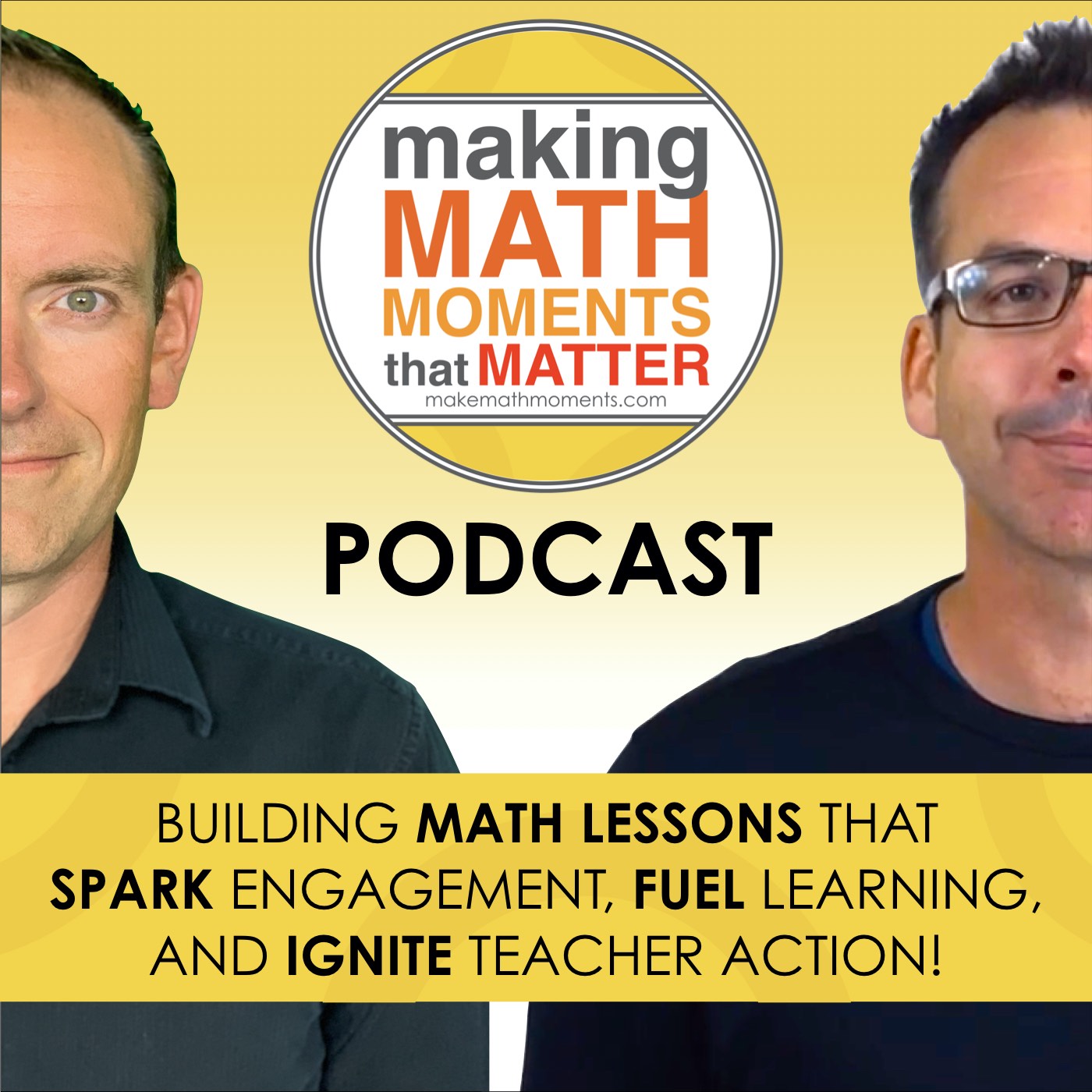
DOWNLOAD THE 3 ACT MATH TASK TIP SHEET SO THEY RUN WITHOUT A HITCH!
Download the 2-page printable 3 Act Math Tip Sheet to ensure that you have the best start to your journey using 3 Act math Tasks to spark curiosity and fuel sense making in your math classroom!
LESSONS TO MAKE MATH MOMENTS
Each lesson consists of:
Each Make Math Moments Problem Based Lesson consists of a Teacher Guide to lead you step-by-step through the planning process to ensure your lesson runs without a hitch!
Each Teacher Guide consists of:
- Intentionality of the lesson;
- A step-by-step walk through of each phase of the lesson;
- Visuals, animations, and videos unpacking big ideas, strategies, and models we intend to emerge during the lesson;
- Sample student approaches to assist in anticipating what your students might do;
- Resources and downloads including Keynote, Powerpoint, Media Files, and Teacher Guide printable PDF; and,
- Much more!
Each Make Math Moments Problem Based Lesson begins with a story, visual, video, or other method to Spark Curiosity through context.
Students will often Notice and Wonder before making an estimate to draw them in and invest in the problem.
After student voice has been heard and acknowledged, we will set students off on a Productive Struggle via a prompt related to the Spark context.
These prompts are given each lesson with the following conditions:
- No calculators are to be used; and,
- Students are to focus on how they can convince their math community that their solution is valid.
Students are left to engage in a productive struggle as the facilitator circulates to observe and engage in conversation as a means of assessing formatively.
The facilitator is instructed through the Teacher Guide on what specific strategies and models could be used to make connections and consolidate the learning from the lesson.
Often times, animations and walk through videos are provided in the Teacher Guide to assist with planning and delivering the consolidation.
A review image, video, or animation is provided as a conclusion to the task from the lesson.
While this might feel like a natural ending to the context students have been exploring, it is just the beginning as we look to leverage this context via extensions and additional lessons to dig deeper.
At the end of each lesson, consolidation prompts and/or extensions are crafted for students to purposefully practice and demonstrate their current understanding.
Facilitators are encouraged to collect these consolidation prompts as a means to engage in the assessment process and inform next moves for instruction.
In multi-day units of study, Math Talks are crafted to help build on the thinking from the previous day and build towards the next step in the developmental progression of the concept(s) we are exploring.
Each Math Talk is constructed as a string of related problems that build with intentionality to emerge specific big ideas, strategies, and mathematical models.
Make Math Moments Problem Based Lessons and Day 1 Teacher Guides are openly available for you to leverage and use with your students without becoming a Make Math Moments Academy Member.
Use our OPEN ACCESS multi-day problem based units!
Make Math Moments Problem Based Lessons and Day 1 Teacher Guides are openly available for you to leverage and use with your students without becoming a Make Math Moments Academy Member.
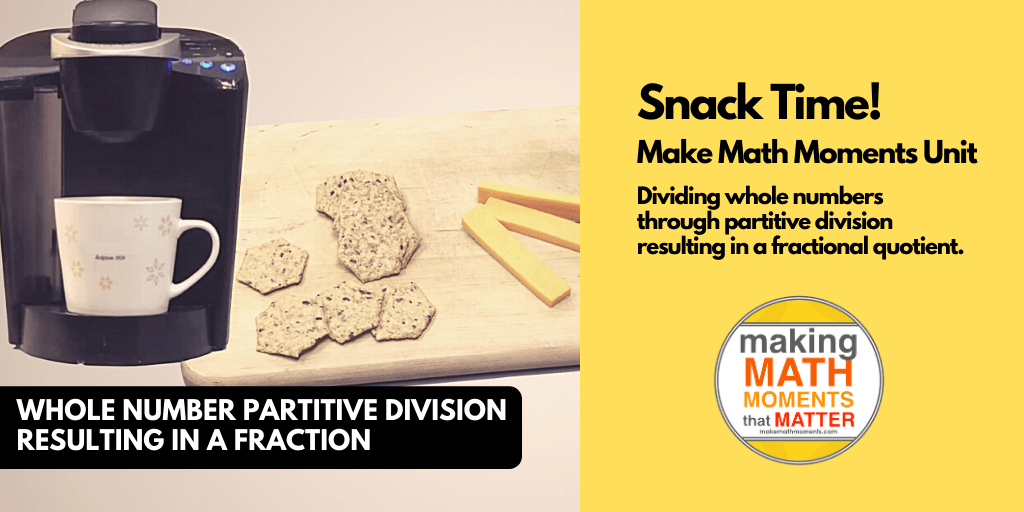
Partitive Division Resulting in a Fraction
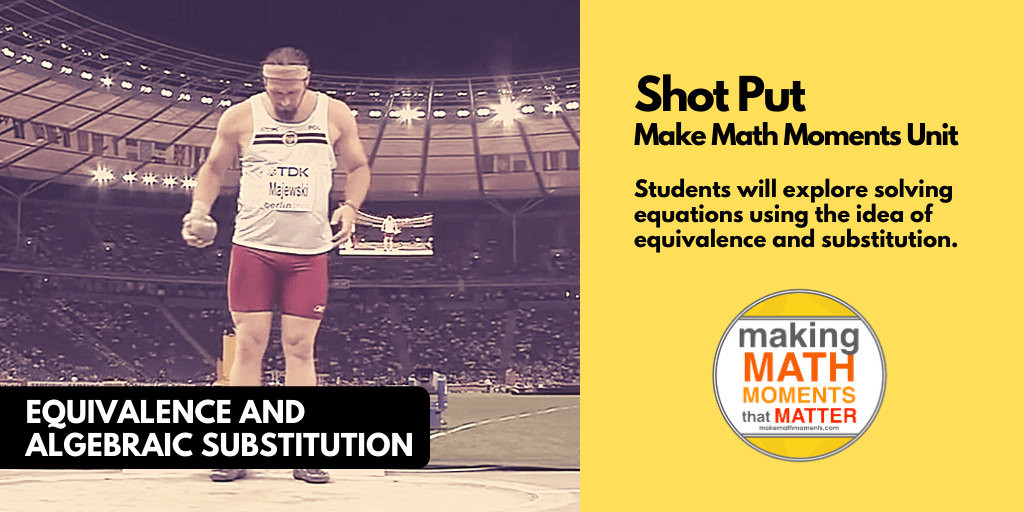
Equivalence and Algebraic Substitution
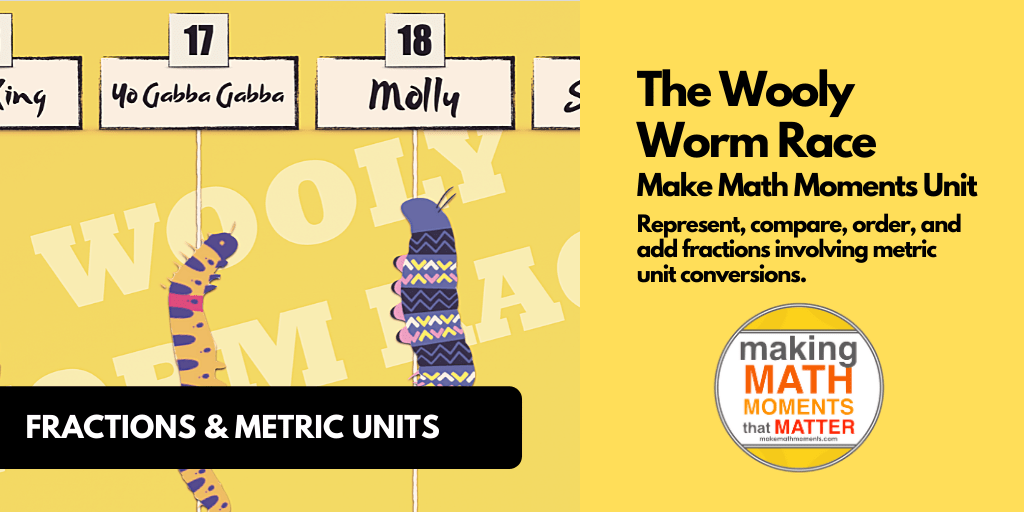
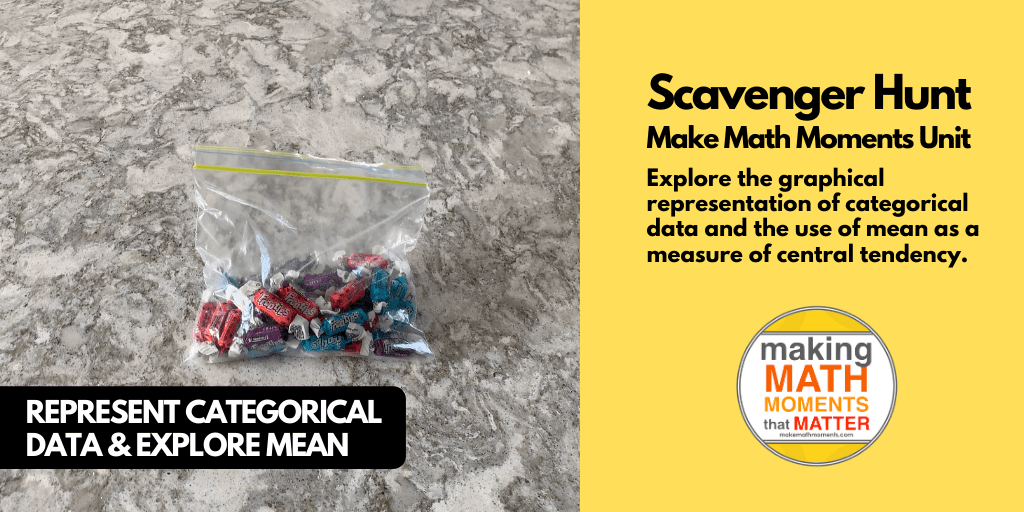
Represent Categorical Data & Explore Mean
Downloadable resources including blackline masters, handouts, printable Tips Sheets, slide shows, and media files do require a Make Math Moments Academy Membership.
ONLINE WORKSHOP REGISTRATION
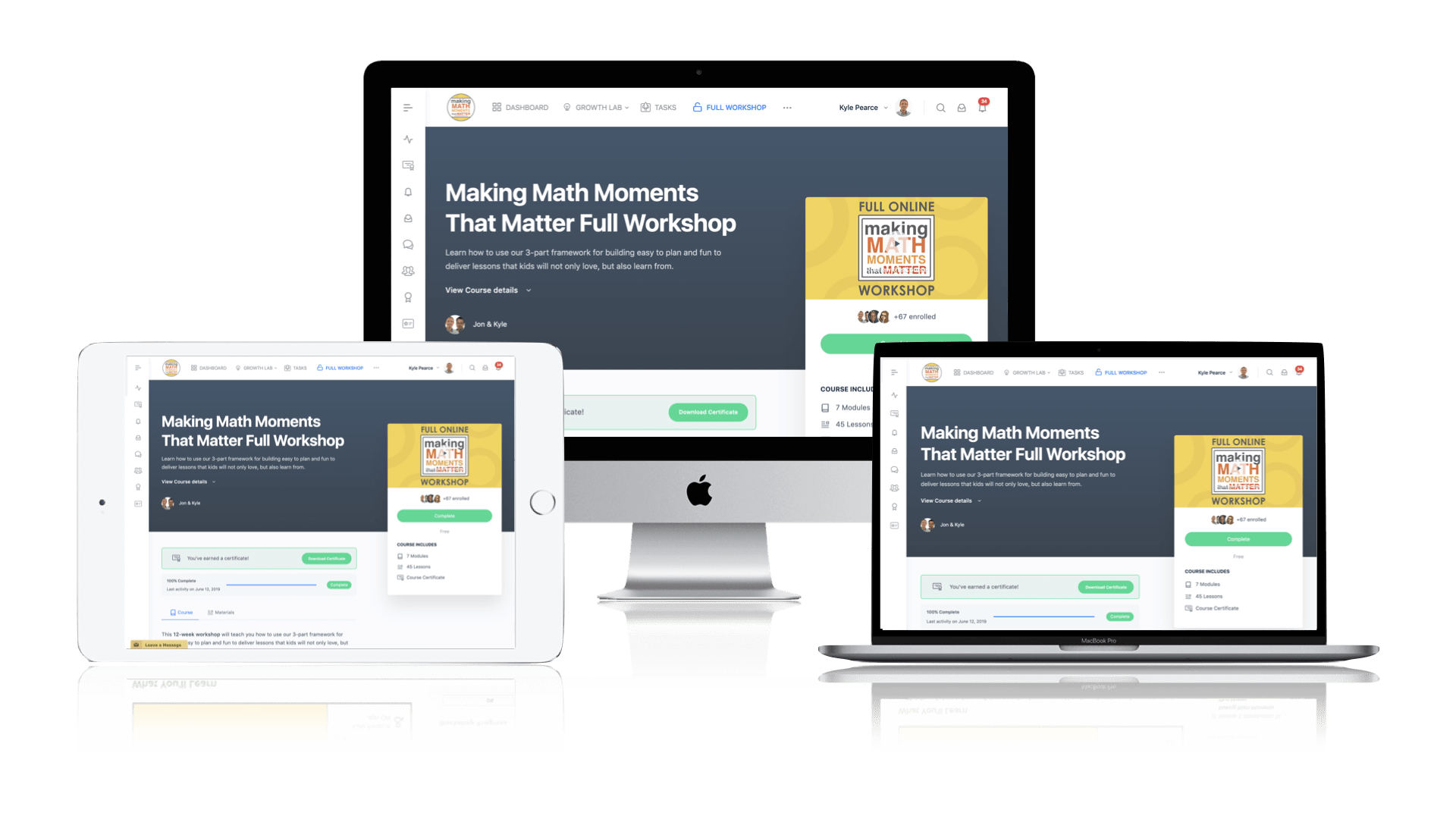
Pedagogically aligned for teachers of K through Grade 12 with content specific examples from Grades 3 through Grade 10.
In our self-paced, 12-week Online Workshop, you'll learn how to craft new and transform your current lessons to Spark Curiosity, Fuel Sense Making, and Ignite Your Teacher Moves to promote resilient problem solvers.
0 Comments