
Episode #460: Should Students Show Their Work in Math? What Teachers Should Actually Assess
LISTEN NOW HERE…




WATCH NOW…
Some math teachers insist students must always show their math thinking. Others argue that if the math answer is correct, that should be enough. When math grading practices don’t align with math learning goals, frustration grows — for math students and parents alike. The real issue isn’t compliance in math. It’s clarity about what we are assessing in math.
In this episode, we explore:
- The difference between assessing math fluency and assessing math understanding
- Why getting the right answer in math doesn’t always prove deep math understanding
- When requiring students to show their math thinking strengthens math learning
- When over-requiring explanation in math can harm math confidence and math identity
- How math leaders can support math teachers in aligning math learning goals, math success criteria, and math grading practices
Before grading the next math assessment, ask:
What was I trying to measure in math — accuracy or reasoning?
Your answer should determine whether students need to show their math thinking.
Attention District Math Leaders:
Not sure what matters most when designing math improvement plans? Take this assessment and get a free customized report: https://makemathmoments.com/grow/
Ready to design your math improvement plan with guidance, support and using structure? Learn how to follow our 4 stage process. https://growyourmathprogram.com
Looking to supplement your curriculum with problem based lessons and units? Make Math Moments Problem Based Lessons & Units
Be Our Next Podcast Guest!
Join as an Interview Guest or on a Mentoring Moment Call
Apply to be a Featured Interview Guest
Book a Mentoring Moment Coaching Call
Are You an Official Math Moment Maker?



FULL TRANSCRIPT
Yvette Lehman: Okay, today this is a debate episode for us and I have no idea where this conversation is going to go.
Jon Orr: So what you’re saying is this could get heated.
Yvette Lehman: It could. I think though that likely we will all come to a space that we can agree, you know, on a definition. But the question really is, do students need to show their work? And when do students need to show their work? And how much work do they need to show?
Yvette Lehman: I was talking to a parent recently who, you know, report cards just went home here in Ontario for elementary schools. Their feeling was my child is a really strong mathematician, has great reasoning skills, great mental math skills, but is getting low marks in math because they don’t show their thinking. That’s kind of the parent’s perception. And so that sparked this idea for me of when should students show their thinking and when is it actually overkill or taking away from the students’ automaticity to have them show their thinking. So that’s our debate today.
Yvette Lehman: Because I think sometimes what happens in education is we kind of go all or nothing.
Jon Orr: Right, right. I get what you’re saying. So maybe when you think about this, should they show their work? I feel like there’s a bigger question here than saying should I show my work? Because I think showing your work is like, why are we doing the all or nothing in this case? So I’m gonna throw this back to you since we’re debating. What do you really gain here? Like, what are you really after when you’re asking kids to show their work? Why would you say you need to show your work if you’re on that side of the debate? Because there’s a lot of teachers that are like, yeah, you got to show your work. That’s why we do math. What’s the real reason?
Beth Curran: I don’t know if any one of us can debate that side that we have to show their work, because I think all of us are pretty deeply invested in this conceptual understanding idea. And also flexible strategies and mental math. Maybe I’m wrong here. I think that the reason — let’s reframe it as not showing your work and more like showing your thinking.
Beth Curran: Why would a teacher occasionally want students to share their thinking? Because we want to make sure they have a conceptual understanding and that they haven’t just memorized something, right? Because we want to make sure students are more than just answer getters, that they’re deep mathematical thinkers.
Jon Orr: Always?
Beth Curran: I think for most concepts. No?
Yvette Lehman: See, and actually I liked when you said Beth, occasionally. Like I feel like if a student has really automatized truly from a place of deep conceptual understanding, I don’t need to see it every time. Because I can trust that when I do ask them occasionally, they’re able to use a model for thinking. But sometimes it actually just slows their thinking down to have to go back and use it because they didn’t use a model for thinking in the first place.
Yvette Lehman: I guess it’s a model of thinking. So if I went to that student and they’ve looked at an algebraic equation and they’ve automatized the answer, like they’re like, I know that X is a certain value, occasionally I might say to that student, could you show me your thinking? Let me inside your brain, unpack this for me. And they might be able to use a model of thinking, but do I need them to use that model every time if they are beyond that stage in their own development?
Beth Curran: Right? I would argue that no, that sometimes a student just writing an answer is okay. We run into this a lot, I think, when we introduce students to flexible strategies for calculating, right? The curriculum I work with calls it mental math. But so occasionally students are just going to look at a problem and apply some flexible strategy. They’re going to use their mental math and they’re just going to be able to come up with an answer. And I think this is something that drives teachers crazy because they say, well, how do I know they know how to do it?
Beth Curran: And I always say, could you just lean over and say, hey, you got that answer really quickly. Tell me how you did it. Right. So a lot of it is communicating. Could you occasionally put a problem on an assessment or an exit ticket and say, on this one, I want you to explain to me how you got your answer. Sure. Right. But I don’t think it has to be always. I think that just like you said, we do have to trust that we did get them to that automaticity, that level of automaticity, being able to calculate or whatever it is that we’re asking them to do. And so they don’t always need to show what they’re thinking.
Jon Orr: I think it just comes down to what are you trying to assess? Like you have to answer that. And sometimes like you’re saying, you’re assessing thinking and sometimes you’re assessing whether they understand the connection that this model is showing. Sometimes you’re not assessing that either because you’ve already learned that the student consistently demonstrates that learning goal or that curriculum expectation or standard, and you’re assessing something else.
Jon Orr: So I think that’s what we really need to ask ourselves. It shouldn’t be like, should they always show their work? That’s not the debate. To me, the debate is we need to decide what are we assessing and then how do I learn that information? And how can I learn that information from this student? Sometimes that’s watching them do work while we’re engaging in a lesson. Sometimes that’s I’m circulating and I’m seeing them play a game because it’s practice time.
Jon Orr: Wherever I can structure my lessons to gain the information I need to know about the student is really the big idea here. And yes, sometimes getting them to put it on paper, showing your work is important because that’s the vehicle that you’re going to learn this information from them. But having a conversation can also give you that information from a student. So it doesn’t have to be about showing your work, but it might be because it reinforces the ideas from the conversation or vice versa.
Jon Orr: So this is really the crux of what we’re discussing — it’s not, it shouldn’t be about whether we always show our work. And so if a teacher is saying that you have to show your work no matter what, and let’s say I’m a coach helping this teacher, then we have to talk about this question about assessment. Like, what are you assessing today in this case? Let’s talk about that so that we can then collect the information. This might be the right move to show your work, but the always — I think with everything, always is never the right answer.
Yvette Lehman: I’m scared of always also. Just because I think about what it does to students. If you have a student who has really strong automaticity and they’re being penalized because they’re not showing the work the way you want it to be shown. That’s another problem. It’s like sometimes when we say show your work, we’re saying show your work the way it was mimicked or modeled to you in the classroom.
Jon Orr: Yeah, what are you teaching them?
Yvette Lehman: And so now you might have a student who is being penalized for actually having automatized and no longer needs those steps. Right. I think about a problem that we did recently with mean, where we had different data points and we were trying to figure out the mean. And like I told all of you, I used no steps. Like I didn’t use a single procedure to solve that problem. I just looked at the three numbers and in my mind, I balanced them.
Yvette Lehman: I didn’t add anything up, I didn’t divide anything. So would I have gotten zero or lost marks on that assessment because I didn’t show the procedure for mean? And I guess, what does that do for a student in your classroom who loves math and is now starting to hate math?
Jon Orr: Well, so that example — let’s say I’m a teacher and I’m asking them to show their work on that example. I think you just have to have the humility and the honest explanation to the students to say, I’m asking you to demonstrate this today, this way, because I’m assessing whether you know it or not, which means I don’t know if you know it. So in this case, we’re damaging the students’ understandings — like I know this really well, but now I have to show it this way.
Jon Orr: We also have to tell the students that right now I don’t know that you know this. So this is the one way I’m looking to see if you have understood this idea here. But that’s really with that, because you’re saying I’m choosing this form of assessment because I don’t know, but I have a huge problem with, like, you already know and you’re still making them do it.
Beth Curran: Right. And I think coming off of that, I’m remembering that conversation too, where that question might need a follow-up question, right? To truly assess, do they know what might be deemed the most efficient strategy? Would you have solved to find the mean if the numbers were messier? I think those numbers lent themselves nicely to you seeing them in that way and being able to just look at them and find the mean.
Beth Curran: But if the numbers were messy, you know, and so I think that gets back to we have to think about our formative assessment, right? We have to think about the questions we’re giving students when we’re asking them to demonstrate this. Because if we give them a problem that’s pretty easy to do in your head or to see in a different way, then we might not be knowing if they know that standard procedure. But then if we give them a higher level one where the numbers are kind of messy, can they then apply that procedure to solve a problem when it’s a little bit messier? Because that’s where that efficiency piece comes in.
Yvette Lehman: This I think obviously hinges on comfort with the content and the teacher’s own flexibility in engaging in dynamic assessment and being able to hear a student’s thinking and make sense of it themselves beyond maybe the one way that they were taught or the one way that they have in their toolkit. So I’m thinking about our coaches and our leaders.
Yvette Lehman: Imagine there’s maybe some pushback from parents in a class or pushback from students. We often talk about disposition towards math in the math classroom. It’s like maybe there’s some frustration around this maybe rigid interpretation of what show your thinking means. How would we as a coach support this teacher?
Jon Orr: Well, let me zoom out from a coach for a sec too, because I think if you imagine your school and you have collaborative time with teachers, let’s say you have grade level teams that meet once a week, every two weeks, there are certain early Fridays or Wednesdays where you have time where the department gets together or the grade level teams to get together. And that school is spending that time taking their curriculum, taking their lessons, and then unpacking those lessons and asking that question. What are we looking to assess by the end of this lesson? What are we really looking to learn from our students across this collection of expectations or standards?
Jon Orr: And coming at the collaboration time with an open discussion of saying, what are we looking for? How are we going to look for that? What are the moves that we’re gonna make to look for that? How are we gonna structure the lesson to look for these things? So that we can then at the end of the lesson, know whether our students individually understand those things that we’re actually looking for.
Jon Orr: And so imagine that the school is using that time in that way — how much professional learning and math is actually being unpacked there so that the team is in alignment with show your work. Like, why are we showing our work here? What does the work look like when we see this or that? That right there is going to create so much professional learning around assessment, around standards, around the mathematics that will propel the grade level forward for the educators to build their own capacity.
Jon Orr: But now all of a sudden think about the cohesion that the team has when a parent does ask, what’s going on here? What the principal can then support. Like this is the reason. Sometimes, especially when you get into these, like we’re always gonna do it this way — you just really haven’t spent the time enough to really unpack the why. You’re sticking to a rule and then you can’t explain the rule. Like every time a parent taps somebody on the shoulder to say, hey, what’s going on here? And you can’t satisfy it, it’s probably because you just don’t know the reasons you’re doing some things and you can’t articulate it well enough to justify the moves you’re making.
Jon Orr: But think about the school who’s doing that type of work during that type of time. And if I’m a coach or I’m a coordinator or an administrator, I should be structuring that type of environment so that this doesn’t become an issue. There’s no question anymore because we’ve built — and this is the way that we learn with the mathematics that we’re teaching — and how we’re creating a collaborative environment for us to learn from each other so that we all, you’re going to learn more together than you are separately, whether you have a coach or not, and that’s the place to do it.
Yvette Lehman: I think you were describing an environment, John, where there might be embedded PLC or time at staff meetings for teachers to come together and do some moderated marking, unpack lessons. So that’s one context, right? Where that’s the structure that’s available. Imagine though a context where that isn’t available, but there is a coach. Right, so every system in every school is different as far as the subsystems they have access to.
Yvette Lehman: So imagine, you know, ongoing opportunities for networking and teacher collaboration isn’t available, but I do have a coach in my classroom and I’m that coach. You know, I’ve been asked to go in and work with this teacher and I’m wondering how would I guide that conversation to help open up the debate of do we always need to show our thinking? When are we showing our thinking? For what purpose? What assessment are we gathering by asking students to do that?
Beth Curran: I mean, I think we’ve kind of touched on a lot of whether or not you’re a coach or in a system in place where you’re getting together as a whole faculty. I think that the same questions apply. What are we assessing? Let’s look at an assessment. Let’s decide which questions we want to maybe tag as, this is one where I want you to show your thinking. I think making sure that the students are aware of what the expectation is upfront is also really important, right?
Beth Curran: So maybe you analyze some of those assessments and you decide which of the questions would be good to demonstrate their conceptual understanding, which ones could we dig into, and which are the others that the students can just, if you can do it in your head, do it in your head and write the answer. And I think the conversations are kind of the same, right. I mean, devil’s advocate here — could they have just guessed and get an answer? Sometimes, right.
Jon Orr: Sure. No, I think you’re obviously right. It’s like you said a key thing about communicating with students. Like what you’re saying is that you’re communicating what is the learning goal of this artifact or this assessment or this experience or this lesson that we’re trying to collect information of. And if we don’t know what the real learning goal is, like that’s the part that we have to have these conversations with our teachers around when I’m coaching them.
Jon Orr: Like what is the learning goal here? What are other learning goals that you’re looking for? Like what are you hoping to gain by asking them this way or structuring it this way? Just honest conversations to say, why do we do what we do and why do we structure it the way we structure it? And then that can open the door to having honest conversations about some of those moves and what we’re really doing.
Jon Orr: So like, for example, structuring and understanding the learning goal is extremely important. And then communicating those learning goals to students throughout or at some point during those lessons is also extremely important so that you can learn what you need to learn to help our students move down that pathway. And so you’re also trying to learn with the teacher, right? Like what is your big learning goal around this? Asking them questions is going to be the move that moves you closer to supporting this educator who’s doing great things in the room, and you’re just trying to create an awareness around why do we do what we do? So it’s not just, we always ask for showing our work. It’s anything. It’s a coaching move.
Beth Curran: Yeah, I think I feel like we always land back on, you got to do the math, right? So as a coach, you’ve got to do the math. You’ve got to anticipate students’ responses. You have to think about different ways outside of maybe just the way the teacher learned math, right? And so anticipating those responses, I think, is important. And that only happens by actually digging in and doing some of that math together.
Yvette Lehman: I was actually thinking something very similar, Beth, of what do we consistently unearth? And maybe even more specifically, one high leverage move — whether that’s in your PLC or between a coach and teacher — is to work through the summative assessment together. Actually answer the questions, solve the problems as if you were a fifth grade student, a fourth grade student, and add maybe that extra layer that we talked about today.
Yvette Lehman: Which is to flag the ones that are where we’re just looking for whether or not they’ve automatized this fact. It’s more of a fluency check, or we’re just looking for accuracy. And where are the ones where it’s like, no, for these ones, we want to make sure we see their thinking. We want them to explain their thinking. And to your point, I think both of you have shared communicating that upfront to students, making sure it’s very clear what we are assessing and why we are assessing it.
Yvette Lehman: So that we’re very transparent with both parents and caregivers so that there isn’t a questioning about, now my student came home with a B because they didn’t show their thinking, but they got every question right. Which is going to impact disposition towards math and also parents’ trust in the system.
Yvette Lehman: Any final takeaways today? I feel like it wasn’t as heated of a debate as I thought it might be. I feel like we all agree. We landed on this idea that, of course, students explaining their thinking, justifying their reasoning, being able to use a model of thinking is really important, particularly to demonstrate their conceptual understanding of a concept. But once we know that they own that understanding and they’ve demonstrated it multiple times, do we need to keep asking for it over and over again?
Yvette Lehman: And knowing that there are times when we’re just looking for automaticity versus other times where we’re really trying to dig and really reveal their understanding and their reasoning skills. I think our pitch to coaches and to leaders is in order to position teachers to do this type of thinking, we need to do the math together, we need to plan for assessments together, we need to moderate student thinking.
Jon Orr: And I think also, like I was saying, it comes down to understanding assessment and what you’re really assessing. So I would say, if you want to take a step further down that pathway, we built a whole course around assessment for mathematics and assessment for growth around mathematics. Understanding some of the key principles there can help you or the teachers you’re supporting think about how we use assessment for growth and what that really means.
Jon Orr: You could learn more about that course over at makemathmoments.com forward slash assessment. That’s makemathmoments.com forward slash assessment. And you could take that roadmap to continue your learning.
Thanks For Listening
- Book a Math Mentoring Moment
- Apply to be a Featured Interview Guest
- Leave a note in the comment section below.
- Share this show on Twitter, or Facebook.
To help out the show:
- Leave an honest review on iTunes. Your ratings and reviews really help and we read each one.
- Subscribe on iTunes, Google Play, and Spotify.
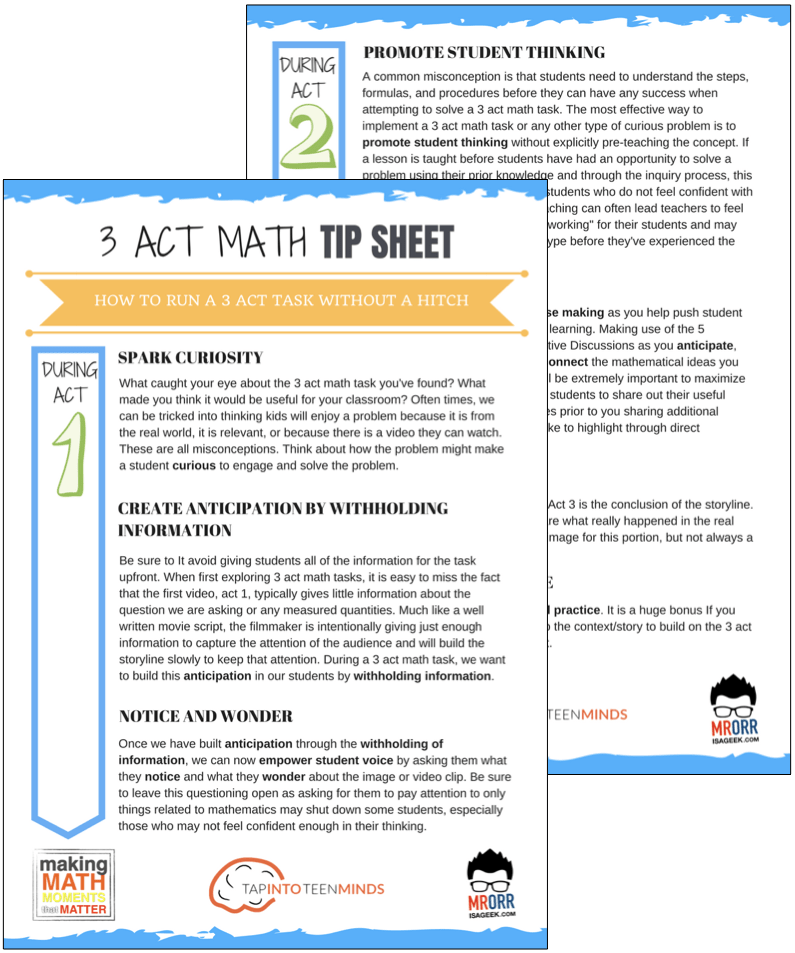
DOWNLOAD THE 3 ACT MATH TASK TIP SHEET SO THEY RUN WITHOUT A HITCH!
Download the 2-page printable 3 Act Math Tip Sheet to ensure that you have the best start to your journey using 3 Act math Tasks to spark curiosity and fuel sense making in your math classroom!
LESSONS TO MAKE MATH MOMENTS
Each lesson consists of:
Each Make Math Moments Problem Based Lesson consists of a Teacher Guide to lead you step-by-step through the planning process to ensure your lesson runs without a hitch!
Each Teacher Guide consists of:
- Intentionality of the lesson;
- A step-by-step walk through of each phase of the lesson;
- Visuals, animations, and videos unpacking big ideas, strategies, and models we intend to emerge during the lesson;
- Sample student approaches to assist in anticipating what your students might do;
- Resources and downloads including Keynote, Powerpoint, Media Files, and Teacher Guide printable PDF; and,
- Much more!
Each Make Math Moments Problem Based Lesson begins with a story, visual, video, or other method to Spark Curiosity through context.
Students will often Notice and Wonder before making an estimate to draw them in and invest in the problem.
After student voice has been heard and acknowledged, we will set students off on a Productive Struggle via a prompt related to the Spark context.
These prompts are given each lesson with the following conditions:
- No calculators are to be used; and,
- Students are to focus on how they can convince their math community that their solution is valid.
Students are left to engage in a productive struggle as the facilitator circulates to observe and engage in conversation as a means of assessing formatively.
The facilitator is instructed through the Teacher Guide on what specific strategies and models could be used to make connections and consolidate the learning from the lesson.
Often times, animations and walk through videos are provided in the Teacher Guide to assist with planning and delivering the consolidation.
A review image, video, or animation is provided as a conclusion to the task from the lesson.
While this might feel like a natural ending to the context students have been exploring, it is just the beginning as we look to leverage this context via extensions and additional lessons to dig deeper.
At the end of each lesson, consolidation prompts and/or extensions are crafted for students to purposefully practice and demonstrate their current understanding.
Facilitators are encouraged to collect these consolidation prompts as a means to engage in the assessment process and inform next moves for instruction.
In multi-day units of study, Math Talks are crafted to help build on the thinking from the previous day and build towards the next step in the developmental progression of the concept(s) we are exploring.
Each Math Talk is constructed as a string of related problems that build with intentionality to emerge specific big ideas, strategies, and mathematical models.
Make Math Moments Problem Based Lessons and Day 1 Teacher Guides are openly available for you to leverage and use with your students without becoming a Make Math Moments Academy Member.
Use our OPEN ACCESS multi-day problem based units!
Make Math Moments Problem Based Lessons and Day 1 Teacher Guides are openly available for you to leverage and use with your students without becoming a Make Math Moments Academy Member.
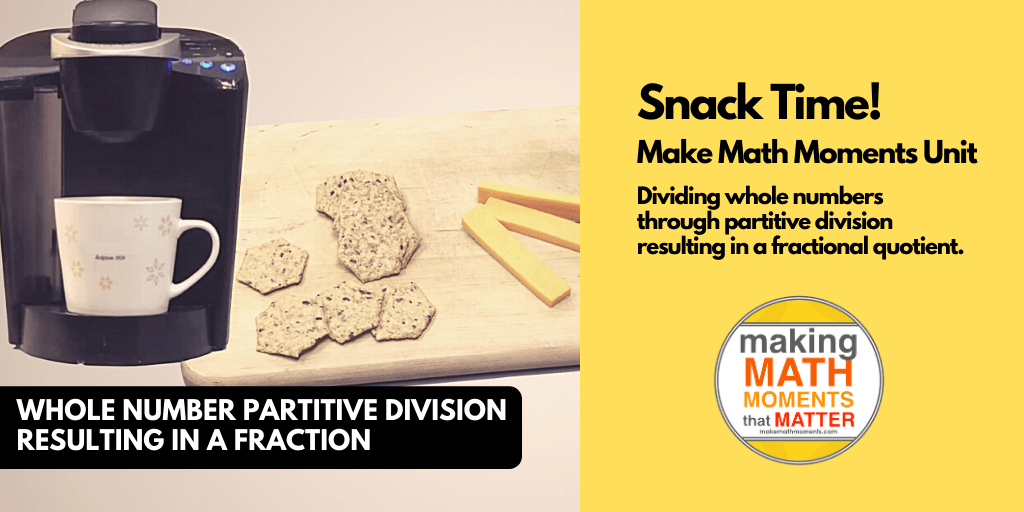
Partitive Division Resulting in a Fraction
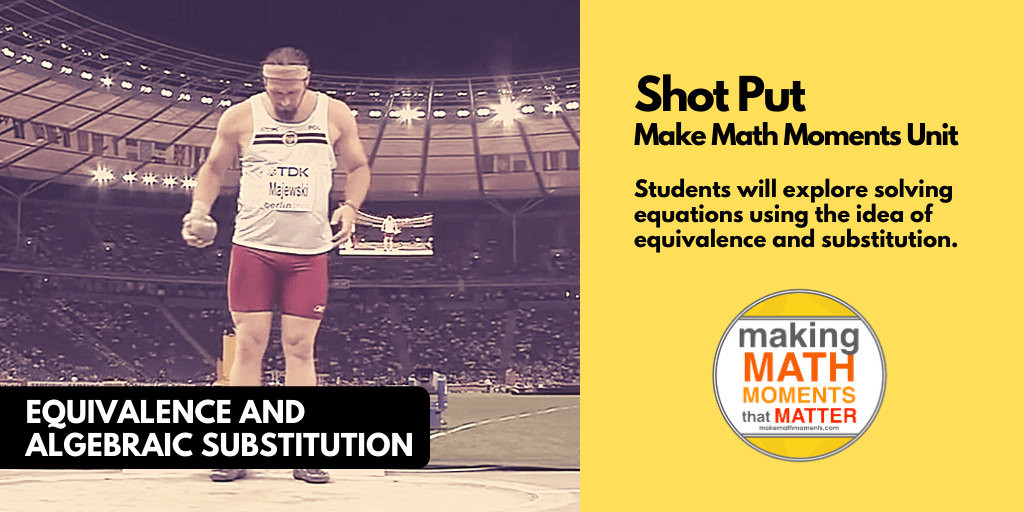
Equivalence and Algebraic Substitution
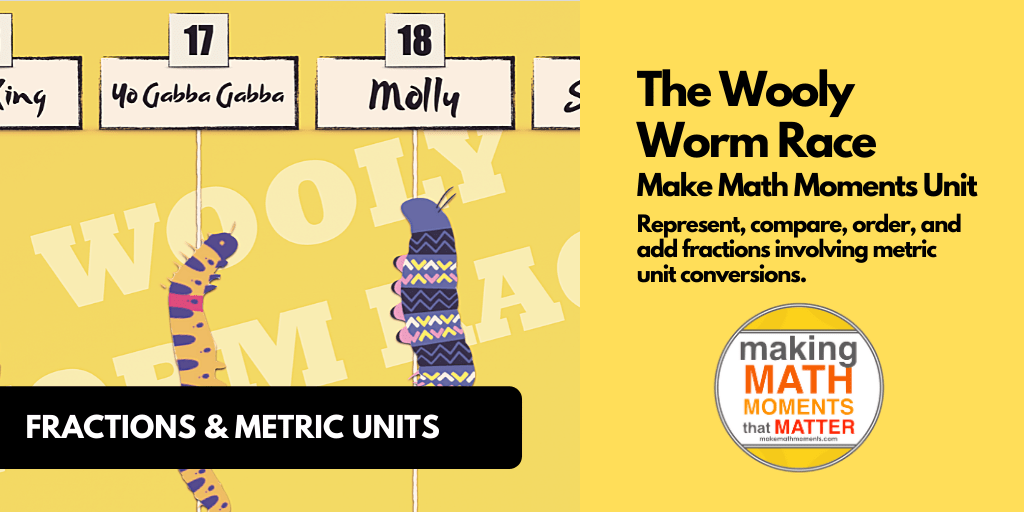
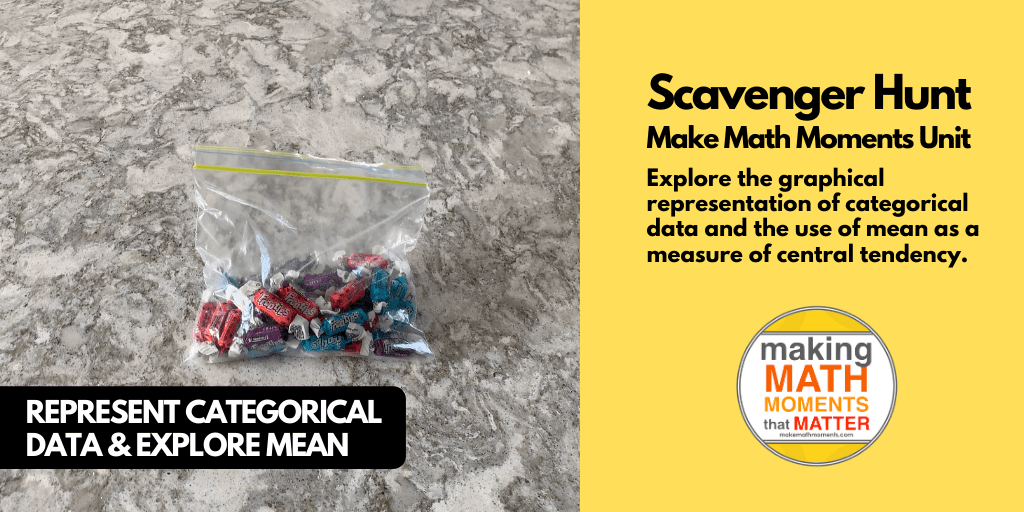
Represent Categorical Data & Explore Mean
Downloadable resources including blackline masters, handouts, printable Tips Sheets, slide shows, and media files do require a Make Math Moments Academy Membership.
ONLINE WORKSHOP REGISTRATION

Pedagogically aligned for teachers of K through Grade 12 with content specific examples from Grades 3 through Grade 10.
In our self-paced, 12-week Online Workshop, you'll learn how to craft new and transform your current lessons to Spark Curiosity, Fuel Sense Making, and Ignite Your Teacher Moves to promote resilient problem solvers.

0 Comments