Episode #462: Should You Teach Standard Algorithms First? A Better Way to Build Math Fluency
LISTEN NOW HERE…
WATCH NOW…
If the standard algorithm is the final goal in math, why not just teach it directly?
This question came up during a recent math leadership summit while discussing fluency and strategy development in math classrooms. One teacher asked a question many educators are quietly wondering: if students ultimately need to use the standard algorithm in math, why spend time exploring other strategies first?
This debate sits at the heart of modern math instruction. Some argue that teaching the standard algorithm early provides a reliable method students can always use. Others argue that focusing too quickly on procedures can limit math reasoning, number sense, and strategy flexibility.
In This Episode, We’ll Unpack:
- Why the standard algorithm in math is a useful tool—but not the only one
- How flexible math reasoning strategies build deeper number sense
- Why students who only learn the standard algorithm often struggle with efficiency and estimation
- How reasoning strategies strengthen understanding of math properties like distributive and associative
- Why math fluency is about strategy choice, not just executing one procedure
- How math teachers can help students move from “What should I do?” to “What could I do?”
- Why the goal of math instruction is helping students choose the right mathematical tool for the problem
If you’re navigating the balance between teaching the standard algorithm and developing deeper math reasoning, this episode will help you rethink how both can work together to build stronger mathematicians.
Attention District Math Leaders:
Not sure what matters most when designing math improvement plans? Take this assessment and get a free customized report: https://makemathmoments.com/grow/
Ready to design your math improvement plan with guidance, support and using structure? Learn how to follow our 4 stage process. https://growyourmathprogram.com
Looking to supplement your curriculum with problem based lessons and units? Make Math Moments Problem Based Lessons & Units
Be Our Next Podcast Guest!
Join as an Interview Guest or on a Mentoring Moment Call
Apply to be a Featured Interview Guest
Book a Mentoring Moment Coaching Call
Are You an Official Math Moment Maker?




FULL TRANSCRIPT
Yvette Lehman: Last week we had our leader summit and Beth and I had an opportunity to attend Jennifer Bay-Williams’ session, which was awesome. And I think we’re going to dig into some of the big ideas from that session here today. We were talking about fluency and what fluency really means and looking at a variety of strategies and models and representations. But somebody in the chat — a teacher from Alberta — said, but what if in my curriculum, the goal is the standard algorithm? That’s ultimately what we’re trying to get students to grasp by the end of this year. Why don’t I just teach it directly, if that is ultimately the outcome we want for students?
Jon Orr: What do you mean by the goal in their curriculum? Tell me more there. Because I get where that’s coming from, but yeah.
Yvette Lehman: I can only tell you what they wrote. So that was just the comment in the chat — basically, if at the end of the day I still have to teach them, and that’s how the expectation is written, you know, solve problems using the standard algorithm to add and subtract numbers up to 100, then why don’t I just teach that and forget the rest? If that’s ultimately the goal here.
Jon Orr: Yeah, so great question, but my first gut reaction is that’s not — and I’m gonna guarantee the Alberta curriculum — that is not the only standard and goal written inside there. Because every set of standards also has the process standards, the math practices. Like these are the other goals of the work we’re doing in our classrooms that are written as legal documents. So it’s like, yeah, I have to teach the standard algorithm, but just teach it to them and move on, this is the way we all learned it? Like, you also have these other things to teach kids about mathematics. And how are you doing that if you’re not trying to lead in towards the standard algorithm, or show here are other approaches on your way towards or away from a standard algorithm? You’re not doing the other things, which I have a problem with.
Beth Curran: Yeah, I would also say that when reading standards — just going to say it because this is how most of us learned math — we learned it procedurally. We learned to focus on the standard algorithms. That’s what we see when we read the standards, as opposed to seeing flexible strategies that involve place value and other ways.
Jon Orr: Well, I guess what this teacher is saying though, right, is to say like it’s literally saying, teach the standard algorithm, and that is the standard written, which means I have to do it. So why don’t I just jump right to it?
Beth Curran: Yeah. Well, I think it’s in our standards too, which is why in the United States, most curricula tends to focus on that standard algorithm again as well, because it’s in the standard. But I think that we tend to focus on the piece that we want to see rather than seeing the whole big picture. And I would also argue that there’s nothing wrong with teaching students a standard traditional algorithm for calculating with the four operations if we’re teaching it with place value understanding. And if we’re teaching it with estimation and we’re teaching it with number sense built around it, right?
Beth Curran: Unfortunately, what tends to happen is we do proceduralize it. We talk about single digit numbers, just add these numbers and add these numbers. And we don’t talk about the value of the numbers we’re adding. And so students lose out on a lot of that deeper number sense and understanding of place value. So I would say it’s not that we shouldn’t teach the standard algorithm. I think we need to think about how we’re teaching the standard algorithm.
Yvette Lehman: This comment that I read during the chat is coupled with a comment I heard on a podcast recently, which was basically arguing, let’s just teach the standard algorithm. Let’s ignore all of these other strategies because it’s reliable. It’s going to work every time. Let’s just teach that algorithm and have students practice it so that they own it and they can use it effectively and accurately because it’s going to work.
Beth Curran: Well, let’s talk about efficiency though, right? Quite often that standard algorithm is going to be a little bit clunkier for students. I mean, imagine for example, subtracting across zeros. So 2000 minus 756, right? There’s a lot that students have to recall and remember. They have to remember how to regroup from higher places to lower places across zeros.
Beth Curran: Whereas if we just teach them to look at the numbers and maybe think of another strategy that might be a little bit more efficient. So students should have that bag of tools that they can draw from. If we only teach one way, then that’s the only way students will ever approach things, which kind of gets back to the number sense. So do you want to talk about a couple of examples?
Yvette Lehman: One of the things I love about what Dr. Bay-Williams shared on Friday is she put six different equations on the screen for us and all of them would have been really tedious using the standard algorithm but actually very efficient and elegant if we used a different strategy. So I’m going to share the first one, but then John I’m going to give you the second one and I want you to talk us through what the standard algorithm would look like for the second one for our listeners.
Yvette Lehman: The first one’s pretty straightforward. It was 4 multiplied by 98. Now I feel like, you know, intuitively — and what she talked about too is that students who have good reasoning skills look at these problems from left to right, whereas if you’re using a standard algorithm, you’re looking at them from right to left and you’re treating them as digits. So I just look at four times 98 and I just think of four times 100 minus four groups of two. So it’s like, can you really kind of quickly see that 98 is really close to 100? Well, I know with my automaticity that four times a hundred is 400 and I just need to adjust by four groups of two. So I’m going to subtract eight and I could arrive there pretty efficiently.
Beth Curran: Might I also add that when you are solving that problem in that way — four times 100 minus two in parentheses — what you are doing, while maybe you’re not at a level sophisticated enough to write it as an expression in that way, but what you are doing and what students are doing when they work through that is they’re practicing the properties of multiplication. When we teach a standard algorithm, if it’s just taught multiply by the eight and then multiply by the nine, we might be missing out on learning those properties.
Beth Curran: And so by allowing students to be flexible in their thinking, they’re demonstrating the distributive property of multiplication so that when we get into algebra, it’s not the first time we’re seeing that.
Yvette Lehman: Which leads us in beautifully to the next example that Dr. Bay-Williams shared. So John, imagine you don’t have your reasoning hat on and you see this equation. It’s three multiplied by, in brackets, X plus five tenths, equals six. Now take off your reasoning brain and talk us through what would the procedure look like?
Jon Orr: Okay, so the procedure if I’m solving this equation — which is three, with a bracket X plus, you said five tenths or a half, close that bracket, equals six — so procedurally, if I’m trying to tell kids the reliable technique here, you’re going to use the distributive property. So you’re gonna say, hey, I’m gonna take three, since it’s outside the bracket, we’re gonna multiply three through that bracket. We’re gonna take three, multiply it by X, we get three X. We’re gonna take three, multiply it by half, we get one and a half. And then now I rewrite my expression: I have three X plus one and a half equals six.
Jon Orr: And now I gotta solve this two-step equation. So because we’ve done lessons on two-step equations in the past, we’re now gonna rely on those steps — we’re going to subtract 1½ from both sides of this equation because we’re trying to isolate the variable term. So if I do that, I’m subtracting the 1½ and the 1½, which is my zero principle, and then I subtract 1½ on the six side of the equation because I’m trying to make sure everything’s balanced. So now I have 3X equals 4½.
Jon Orr: Well, I gotta keep isolating. So I have three of these things equal to four and a half of these things. What’s one of these things? Well, divide both sides by three to isolate and get one X. So one of these things is four and a half divided by three, which is one and a half. So that is the procedural approach, using the distributive property to solve this multi-step equation.
Yvette Lehman: Okay. Couple steps there. Okay, Beth, solve it with reasoning.
Jon Orr: How come you made me go through that and Beth gets the reasoning solution?
Yvette Lehman: Because I know you know the procedure. All right, Beth, solve it with reasoning.
Beth Curran: So here’s the thing. If we teach students to reason through things, we’re going to teach them, like you said Yvette, to go from kind of left to right instead of thinking of a procedure, right? So a student who can reason through problems is going to look for connections. They’re going to look for some sort of number sense or something that tells them maybe there’s another way to solve this. And so three times something equals six. If that bracket were just x, then we would say 3x equals 6. And so then we would just divide by 3, right? And we’d get whatever is in the bracket equals 2.
Beth Curran: So noticing that 3 is outside of the bracket like that and 6 is on the other side, then I can just go ahead and eliminate that first. And so then I end up with x plus a half equals two. So what do I have to add to a half to get two? I would have to add one and a half. So then my x would be one and a half. So by approaching this with some reasoning or some number sense, I would see that there’s a three and a six and my gosh, there’s a connection there.
Jon Orr: Right, yeah. And this is the pushback, right? Like the pushback is saying — and teachers are constantly battling with this — you used the term earlier Yvette, reliability. If I only have so many lessons to teach solving multi-step equations, two-step equations, one-step equations with students, how do I build in flexible strategies? And then, because I think what this teacher is saying in the comment is like, I do want them to solve that equation. How do I create an experience? How do I design a lesson to create clever moves like this?
Jon Orr: To create this, hey, I can see the multiplicative relationship between this side and this side, and therefore I can then flexibly — like how do I help them with that in this safe time period? But then also give them a reliable technique to fall back on. Because I think that’s what a lot of people are battling — don’t we want, if I can’t see the cleverness, don’t I want a fallback strategy that will always work? Which is where all of this ends up coming from — we want kids to have the reliable solution or the strategy or the moves, but I also want them to think cleverly.
Jon Orr: And I want them to have this fluency that we’re all after, but how do I do both of those at the same time? And that is a really hard thing to think about. Because I’ll also go out on a limb and say that probably most curriculums that are in the hands of teachers aren’t helping them with the clever part. Lots of high school teachers or middle school teachers help kids see that move — hey, let’s divide by six here, it’s easier to go right away, that’s a great move. But how do I build that? How do I build towards that? That’s the part I think we all have to kind of decide.
Jon Orr: And I think there’s no easy answer here. Because this is where this actually blows up even bigger — the reliability technique is us trying to go, what is an easy solution to a complex problem? Well, let’s just teach everybody the reliable one way to do this. And this is where our math learning system has really come from. That’s an easy solution to a complex problem, because we’ve got many smart people thinking about how to solve strategic problems and it’s boiled down into this one routine because it’s reliable.
Jon Orr: The complex solution is to teach multiple strategies and have kids try to decide between them all the time. And so you can see why we result to the easier strategy, because it is harder to think about how to build this — I also have to have that understanding myself. Like I have to be strong there myself to see that I could divide by three on both sides first. It’s hard. And I think my big takeaway is just try to always take one small step back and go, am I trying to solve a hard problem with an easy solution, or is it worth it to try to work towards a harder solution because it’s a hard problem?
Beth Curran: So I heard something recently — I was listening to a couple of TED talks, one was Jo Boaler and one was Jennifer Bay-Williams. And I can’t remember who said this, but I think this kind of sums it up. Wouldn’t it be wonderful if, given a problem to solve, students looked at it and thought, what could I do, as opposed to what should I do?
Beth Curran: I think that just right there kind of sums up a lot of it. Yeah, we can teach students what they should do, but wouldn’t it be nice if they approached problems and problem solving with what could I do?
Yvette Lehman: I was using the forefront assessment with my nephew last weekend. I was using the third grade assessment and he was subtracting 200 minus 198. And right away he said, it’s two. He just looked at those two numbers and he said the difference between these two numbers is two. So then my brother and sister-in-law are sitting in the kitchen watching this and they were like, well, we would have stacked them — we would have borrowed across those zeros. And they were saying, should he be using the standard algorithm?
Yvette Lehman: So then I went into showing them how his strategy of looking at the numbers and doing comparison — how it’s going to be so helpful when he gets to subtracting integers. So he’s looking at two integers on a number line, and he can just see that five minus negative seven — he can see the actual physical difference between those two values. And their minds were blown by this. They were like, but we only know the standard algorithm. And same with subtracting fractions, they were like, we would find zero pairs. They only know the one way. And my brother-in-law actually said to me, he was like, why wasn’t math always taught this way? That is so much more clever, so much more sophisticated. It actually makes sense, what you just showed me for subtracting integers.
Yvette Lehman: And so to your point, John, I think that you’re right. There comes a point where the numbers become too ugly, too unfriendly, too complicated to rely on our reasoning and we can no longer look at the problem left to right. And at that point, we are going to have to rely on something that is kind of fail-proof. But I guess I wonder, and this is the debate, right — what comes first?
Yvette Lehman: I think about, let’s say, the standard algorithm for subtraction. When do we need to introduce the standard algorithm for subtraction? Because if we’re subtracting to 20, to 50, to 100 — with the way that I was envisioning it as you were asking that question, John — I was thinking about everything that happens before you get them in ninth grade. Can you imagine — imagine I sent you kids with incredible reasoning skills. Like they could look at friendly numbers and they could do a lot with them. They could reason through them. They understand the relationships. They understand the properties, the four operators. They understand associative, distributive, commutative. They fundamentally grasp these mathematical concepts, and now it’s your job to teach them the procedure for the times when their reasoning fails them.
Jon Orr: In a way, because when you were saying that, I was imagining every ninth grade or algebra teacher or middle school teacher ready for that kid. And what I mean by ready is that you have to now honor the fact that they have way more flexibility, fluency, and efficiency type strategies than your own — and probably yourself, and you’re used to — and then are you just going to teach them the algorithm at that point?
Jon Orr: And I think that’s a part of the system problem right there, because the high school teacher or the other teacher is kind of saying the algorithm is the be all end all. So why don’t we just show them that? And that’s probably mostly true across high school and in algebra classes. And then you’ve got eighth grade teachers, seventh grade teachers, sixth grade teachers, all the way down saying, I gotta get them ready for the next level. And it just trickles.
Jon Orr: And so then you can see that the systemness is really just reliant on what the next grade really wants. And it’s all because we want this — I’m using air quotes — higher thinking, which is not true. It’s just abstract level thinking. I love to think of it in a world where it’s like, if we had that, what I would have to do differently in my class to teach solving equations that way, and what level of understanding I also need to make that happen and keep that thinking going — is also super high. Like I have to have that level of understanding myself.
Jon Orr: And again, what I’m really saying is that sometimes I get on calls with people when they’re asking about math improvement and how to design math improvement for their school system or district. They’re saying, we really wanna focus on building conceptual understanding and influence these strategies with our elementary teachers. And I often say, you need to do it all the way across because of this issue. There’s many — I was a high school teacher for 19 years and I needed that understanding, and I needed to build that up myself. So that when I could help kids be flexible with solving equations and thinking about them and modeling them differently, we could pass them to the next grade knowing that they’re coming, and then educate the next grade.
Jon Orr: The system has to be there and we have to be sharing the strategies and the models all the way up, not just stop because you got to grade six or grade seven or grade nine.
Beth Curran: I have a question for you. Given Yvette’s situation and her conditions, what if we focused on developing their reasoning and their number sense and everything so that by the time they got to you, you could just teach them that standard algorithm or procedure? Would that go faster? Would their fluency — the time it takes them to get fluent using that standard algorithm — do you envision that would be easier, quicker? Because maybe they’ve already reasoned through problems and used the distributive property and the associative property, so they already know how those function.
Jon Orr: I guess you’re right, they would already know the type of numeracy, the operations and the flexibility of the number sense. If they had stronger number sense, for sure. And I think this is the point I was trying to make, Beth, is that I wouldn’t teach it the way that — when you said, when they get to me, I’m just gonna teach the algorithm — that’s not what I’m gonna do. That’s not what we’re going to do anymore.
Jon Orr: Like we are going to work on flexible strategies. Yes, is the algorithm there? Yes, you had to teach the algorithm in sixth grade for multiplication as well. But we also have an army of kids that have stronger number sense skills that we can build upon. Would those things move faster? Great. Could we solve more complex problems? Probably. Could we apply them in different scenarios? Yes. Like these are all for sure.
Beth Curran: Yeah, could we check our answers for reasonableness a little more readily?
Jon Orr: This is what we’re all wanting — we would love to work and build the strength of numeracy in different arenas with our kids.
Yvette Lehman: I don’t know that we came to a definitive answer here today. I think what we talked about is, is the standard algorithm the goal? And I think where we all agree is that there are going to be situations where the standard algorithm is going to be the most reliable approach. Where we are no longer positioned to reason because of the complexity of the numbers or the steps in the equation, and we’re going to have to trust this reliable procedure that’s been proven time and time again.
Yvette Lehman: But that’s not because it’s the most efficient. It’s not because it’s the most elegant necessarily, or because it has a higher place on the ladder than other strategies.
Jon Orr: Yeah, that’s what I was gonna say. It needs to be on equal footing towards different strategies. And it is — like when you say an algorithm, really it is a model of manipulation, right? It’s a procedure, but put it on the same level as the models and the strategies, and using models and strategies at the same time. I would like to see that. I would like to see that we devalue the importance of the algorithms and move them towards equal footing in our classes.
Jon Orr: Because they’re a tool. They’re a tool to help solve the problem, just like any other tool to solve a problem. And I would want the goal of the work that we’re doing in our math classes to create a student who can choose the right tool for the right job. Therefore, you want to show them different tools to solve the problems. Unfortunately, I think we’ve still got many teachers who aren’t seeing math as tool selection, or problem solving as tool selection.
Jon Orr: It’s still fundamentally moving towards a hierarchy from this end to this end, and that end is our algebraic abstractness of mathematics — and that’s the higher order thinking, which is not true in my opinion. But we have to help our teachers every single day develop skills themselves, so they see that and have those same epiphanies. Because that’s the way that we can make these shifts. We can’t just mandate shifts. We have to help everyone have these little mini epiphanies that this is what we’re really doing in mathematics, and this is how we can help kids with what resources we currently have to make that possible. We’ve got a lot of constraints, but I think we first have to start with, what are we really doing here? And are we making those moves towards what we hold as important to mathematics?
Yvette Lehman: So what’s our call to action for maybe leaders or coaches or teachers listening today? They’re thinking to themselves, okay, I’m hearing this debate. I know that the standard algorithm is explicitly stated in my standards or curriculum expectations. I wanna teach the standard algorithm for sure. We understand that it has value and reliability, but we don’t wanna value it over some of these other reasoning strategies. So what’s maybe one first move a listener could take on this journey?
Beth Curran: I like the idea of just thinking about shifting from what should I do to what could I do. If listeners could just walk away with that and bring it into their classroom and how they approach calculating and teaching calculations to students.
Yvette Lehman: Well, we’re going to wrap up here for today with this big idea. If you want to learn more about some of these key concepts, there are lessons in the academy, there are full courses on the fundamentals of math that really go through some of these properties. And maybe you’re feeling like you yourself need to dig into some of the learning, dig into the associative, commutative, distributive property. I want to build my own understanding of strategies and models to support reasoning as opposed to always defaulting to the reliable standard algorithm. Head on over to MakeMathMoments.com. There are opportunities within the academy to really focus on your own professional development if this is something that you are seeking at this point in your mathematical journey.
Thanks For Listening
- Book a Math Mentoring Moment
- Apply to be a Featured Interview Guest
- Leave a note in the comment section below.
- Share this show on Twitter, or Facebook.
To help out the show:
- Leave an honest review on iTunes. Your ratings and reviews really help and we read each one.
- Subscribe on iTunes, Google Play, and Spotify.
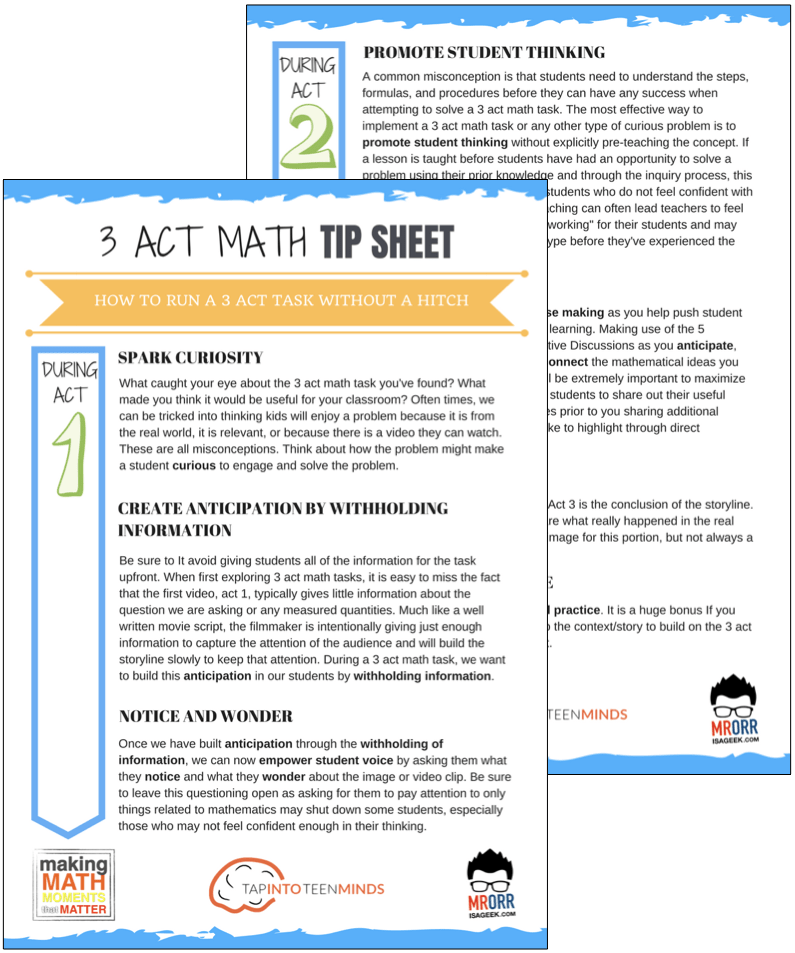
DOWNLOAD THE 3 ACT MATH TASK TIP SHEET SO THEY RUN WITHOUT A HITCH!
Download the 2-page printable 3 Act Math Tip Sheet to ensure that you have the best start to your journey using 3 Act math Tasks to spark curiosity and fuel sense making in your math classroom!
LESSONS TO MAKE MATH MOMENTS
Each lesson consists of:
Each Make Math Moments Problem Based Lesson consists of a Teacher Guide to lead you step-by-step through the planning process to ensure your lesson runs without a hitch!
Each Teacher Guide consists of:
- Intentionality of the lesson;
- A step-by-step walk through of each phase of the lesson;
- Visuals, animations, and videos unpacking big ideas, strategies, and models we intend to emerge during the lesson;
- Sample student approaches to assist in anticipating what your students might do;
- Resources and downloads including Keynote, Powerpoint, Media Files, and Teacher Guide printable PDF; and,
- Much more!
Each Make Math Moments Problem Based Lesson begins with a story, visual, video, or other method to Spark Curiosity through context.
Students will often Notice and Wonder before making an estimate to draw them in and invest in the problem.
After student voice has been heard and acknowledged, we will set students off on a Productive Struggle via a prompt related to the Spark context.
These prompts are given each lesson with the following conditions:
- No calculators are to be used; and,
- Students are to focus on how they can convince their math community that their solution is valid.
Students are left to engage in a productive struggle as the facilitator circulates to observe and engage in conversation as a means of assessing formatively.
The facilitator is instructed through the Teacher Guide on what specific strategies and models could be used to make connections and consolidate the learning from the lesson.
Often times, animations and walk through videos are provided in the Teacher Guide to assist with planning and delivering the consolidation.
A review image, video, or animation is provided as a conclusion to the task from the lesson.
While this might feel like a natural ending to the context students have been exploring, it is just the beginning as we look to leverage this context via extensions and additional lessons to dig deeper.
At the end of each lesson, consolidation prompts and/or extensions are crafted for students to purposefully practice and demonstrate their current understanding.
Facilitators are encouraged to collect these consolidation prompts as a means to engage in the assessment process and inform next moves for instruction.
In multi-day units of study, Math Talks are crafted to help build on the thinking from the previous day and build towards the next step in the developmental progression of the concept(s) we are exploring.
Each Math Talk is constructed as a string of related problems that build with intentionality to emerge specific big ideas, strategies, and mathematical models.
Make Math Moments Problem Based Lessons and Day 1 Teacher Guides are openly available for you to leverage and use with your students without becoming a Make Math Moments Academy Member.
Use our OPEN ACCESS multi-day problem based units!
Make Math Moments Problem Based Lessons and Day 1 Teacher Guides are openly available for you to leverage and use with your students without becoming a Make Math Moments Academy Member.
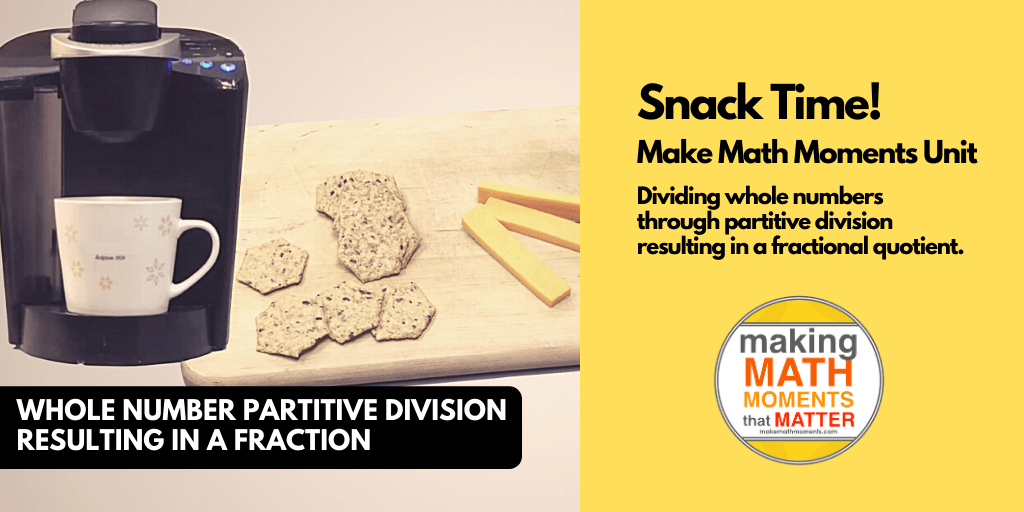
Partitive Division Resulting in a Fraction
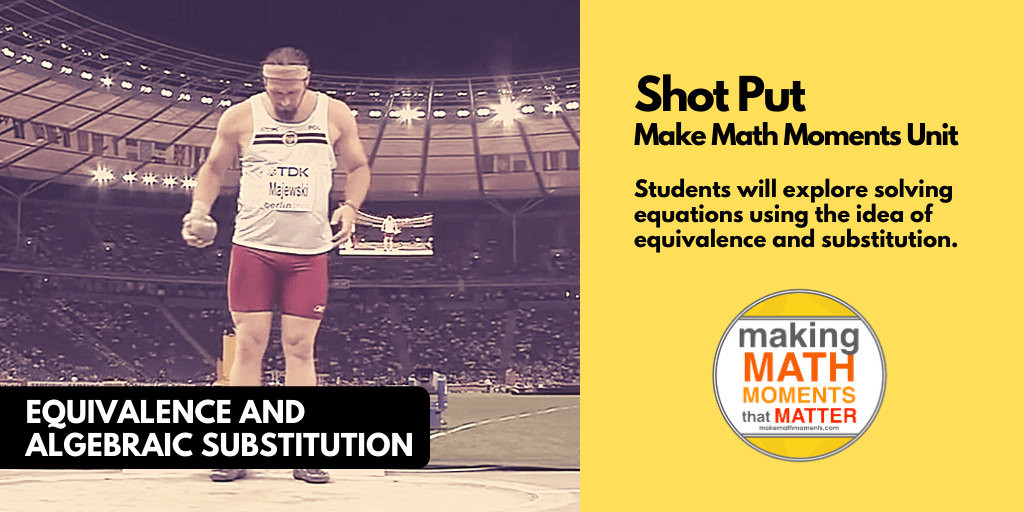
Equivalence and Algebraic Substitution
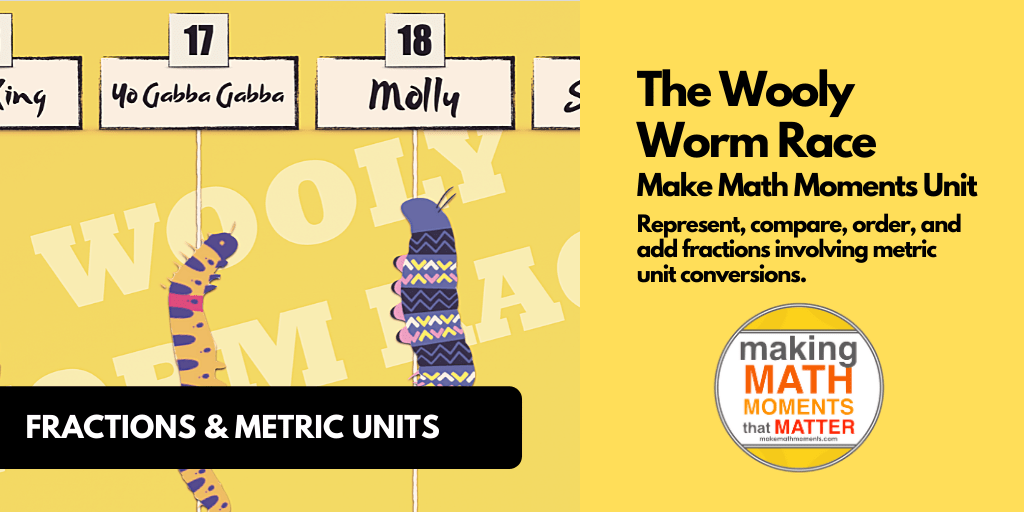
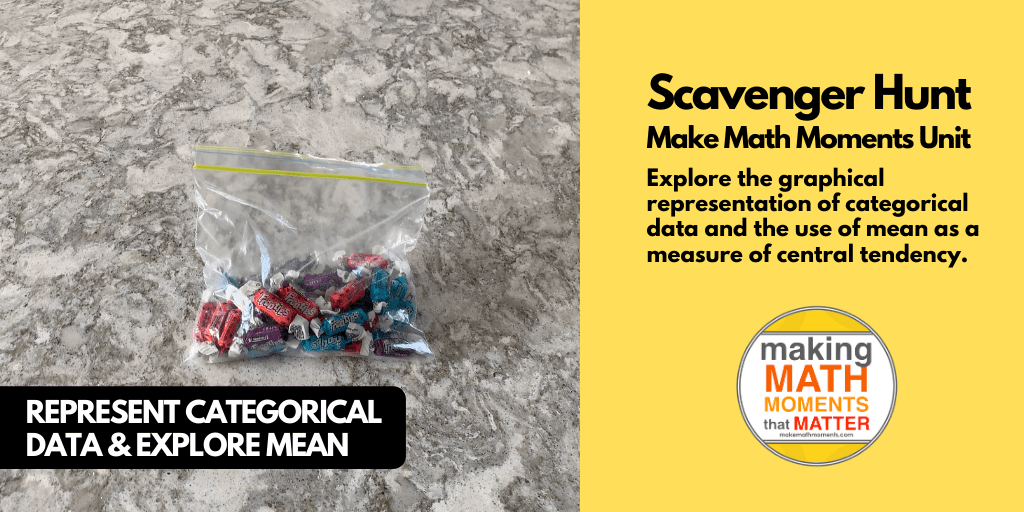
Represent Categorical Data & Explore Mean
Downloadable resources including blackline masters, handouts, printable Tips Sheets, slide shows, and media files do require a Make Math Moments Academy Membership.
ONLINE WORKSHOP REGISTRATION
Pedagogically aligned for teachers of K through Grade 12 with content specific examples from Grades 3 through Grade 10.
In our self-paced, 12-week Online Workshop, you'll learn how to craft new and transform your current lessons to Spark Curiosity, Fuel Sense Making, and Ignite Your Teacher Moves to promote resilient problem solvers.

0 Comments