
Episode #448: What About the Students Who Already Get It? – Supporting Advanced Learners Without Accelerating
LISTEN NOW HERE…




WATCH NOW…
What do you do when students already know the math before you even teach it?
This question came straight from a listener—and it’s one we don’t talk about enough. While so much attention in education focuses on supporting students below grade level, we often miss a critical (and underserved) group: the students who already “get it.”
Without meaningful mathematical thinking and cognitive challenge, these students may disengage, develop surface-level strategies, or come to see math as boring and procedural. In this episode, we explore why traditional unit pacing may actually harm these learners—and what educators can do instead to deepen reasoning, sense-making, and flexibility. If you’ve ever wondered what comes after mastery, this conversation is for you.
Listeners Will Learn:
- Why “early finishers” often get the least instructional support in math
- How adjusting pace can unintentionally limit access to the full landscape of grade-level mathematics
- What it looks like to create math challenge without just assigning more problems
- How “what if?” questions and strategic mathematical constraints deepen understanding
- Why abstract thinkers need to represent their thinking—and how to get their buy-in
- How planning ahead (not improvising) leads to better differentiation in math
- The power of mini-consolidations to target all learners, not just the middle
- Why all students—not just struggling ones—deserve access to rich, high-cognitive-demand math tasks
Whether you’re a teacher trying to meet a wide range of learners or a coach supporting classroom math differentiation, this episode is packed with tools and mindsets to help you stretch mathematically confident learners without sacrificing your core instruction.
Attention District Math Leaders:
Download the Math Coherence Compass here.
Not sure what matters most when designing math improvement plans? Take this assessment and get a free customized report: https://makemathmoments.com/grow/
Ready to design your math improvement plan with guidance, support and using structure? Learn how to follow our 4 stage process. https://growyourmathprogram.com
Looking to supplement your curriculum with problem based lessons and units? Make Math Moments Problem Based Lessons & Units
Be Our Next Podcast Guest!
Join as an Interview Guest or on a Mentoring Moment Call
Apply to be a Featured Interview Guest
Book a Mentoring Moment Coaching Call
Are You an Official Math Moment Maker?



FULL TRANSCRIPT
Yvette Lehman:
few weeks ago, we recorded an episode around how do you create access to rigorous tier one instruction when you have a range of entry points in your classroom. you know, we all recognize that I teach fourth grade. It doesn’t mean that every single student sitting in the classroom is at the exact same point in their development. And so we talked a little bit in that episode about ways that we can create access for more learners. And a teacher reached out to us and said, Thank you so much for those ideas. However, what you didn’t address was what about the students who walk in the room and could already write the end of unit summative assessment and demonstrate, you know, a really good mastery of the grade level standards? How are we engaging those students in our classroom?
Kyle Pearce:
I love it. And I’m actually really excited that a listener did push us on that side because I feel like in this happens, not just in math education, but in education in general, we’re constantly talking about students who are working below grade level, right? So students who are struggling, we’re constantly trying to figure out one, why we’re, you we want those students to be, you know, closer to where they, would be at grade level. And oftentimes we sort of forget to talk about these other students and they’re being underserved if We’re just allowing them to come into our classroom. We know that they’re comfortable, confident with the material. And then as an educator, think the default, you know, switch in our mind is like, well, at least they’re doing well. So I’m gonna let them just sort of do what they’re doing. And in reality, I’ll even call it like in a way it’s like kind of rot. They go over there and they, you know, they oftentimes lose interest in the subject matter because… there is no cognitive demand there, right? Like they’re not able to get to a place of flow. So I’m really excited to dig into this. I wanna flip it right to Beth here. Beth, you have for many years, like John and I have done for quite a few years, and I know Yvette in greater Essex would be doing this, where you’re going into classrooms that sometimes you’re not necessarily aware of who’s working at what level. So I know you’ve got some tricks up your sleeve here. might we go about helping those students who are working at or well above grade level in order to keep them, you know, learning and keep pushing them so that they too can get some benefit from that experience.
Beth Curran:
Yeah, so there are some things that I try to just have in my back pocket as I’m working with groups of students and I’m not aware of their ability levels. One thing that I think just kind of overarching, something that we all need to consider as educators is our pace, our pace in our classroom. I think that we tend to want to teach to maybe the low, middle, lower pace because we don’t want to leave anyone behind. And unfortunately, what happens in that situation, if our pace is not moving along quickly enough, we lose those students who are capable, who may be, as Kyle described as they walked in the classroom and they could have taken an ACE to the summative assessment. And so we have to be mindful of our pace, that we’re providing enough opportunity for students at those higher levels to continue to work through math. that they’re not sitting and listening to the teacher try to remediate a student who might be struggling whole group. So having some things in place to keep your, you know, things that I often rely on so that I can keep my pace going is that I know that I have a safety net for those students who aren’t understanding, meaning that I know that I structure my lesson in a way that I’m going to keep the pace moving and I’m going to recognize through formative assessment opportunities, those students who aren’t quite understanding the mathematics. And I’m not going to leave them behind, but I am going to kind of keep moving through that pacing, knowing that I’m going to reach a point where I can set those students free who are ready to work independently, who are ready to challenge themselves. I’m going to set them free and I’m going to maybe pull a small group. to do my reteaching in that small group, not whole group with everyone else around.
So I do try to monitor my pacing. So that’s one thing. Another thing is to just have some what if questions in your back pocket. So as you’re planning and you’re looking at grade level content and you know that there are some students who are going to grasp those concepts really quickly and be able to fly, you need to be prepared to have some what if situations. Well, what if instead of whatever the combination of numbers might be. Maybe you just tweak the numbers. What if instead of this, it was these numbers? Or what if we just changed this fraction to this? Would it work the same way? So that’s something to have when you’re planning, just to think about how you could tweak those. Because it doesn’t require any extra materials. You don’t have to copy anything. You just have to ask that student a question that’s going to get them thinking a little more deeply about the math. Another thing that I’m a firm believer in is multiple strategies or multiple ways to approach a problem. So quite often our students who we label as those higher level thinkers are really our abstract thinkers. They already understand how the abstract math works together. so asking those students to then model the math or draw a picture of the math or enter into that problem in another way, Oftentimes that will keep them engaged in the mathematics as well. And it might oftentimes be an area that they might be lacking. They see math abstractly in their head, but they don’t quite understand why it works the way that it does. And so engaging them and solving problems using multiple strategies, multiple different. methods of approaching the problem can often keep them engaged in that lesson as well. So those are some things that I try to do and that I also try to encourage the teachers that I work with to do in the classroom.
Kyle Pearce:
Love it. Love it.
Yvette Lehman:
One thing that I heard, Beth, that I’m gonna, I think is worth, well, there’s a few things I think are worth restating. I think you are spot on when you said that sometimes we adjust the pace to like the middle, below middle. I do think that that is very true because it oftentimes it’s more than half the class, right? It’s not one or two or three students, a significant number of students, but to your point, it’s like, there’s a lot of harm in that. One, it’s like we’re gonna create unintentional gaps in learning just because we will never get to all of the standards at our grade level if that is the pace. We’re gonna unintentionally create gaps in learning for those who shouldn’t have had gaps. But also to your point, if everybody has to sit through the remediation, whether they need it or not, think about like disposition towards math. Like how boring is this? Like we’re on the same lesson again. So what I think you’re advocating for is that absolutely we need to remediate and some students may need to hear that lesson multiple times or interact with it in a variety of ways, but that’s where you need your tiered instruction established where you do have your small groups and students are then engaging in choice boards or mass centers or purposeful practice that’s high interest. so that everybody is still engaged in learning that’s relevant for them. So that was a big takeaway that I took from what you shared. I also, when you were talking about how do you change the question slightly, Kyle, you and I used to always talk about this as like, what constraint can we add? We would be like, okay, so this is the task for today that students are gonna interact with, but how could we add a new constraint? that would change the complexity, shift the way that the student approached it. But what I always found is that I had to plan those in advance. I wasn’t good at on the fly coming up with that constraint. And that’s where five practices, right, for orchestrating productive mathematical discussions, where you’re thinking about your assessing and advancing questions before the task, right? Because I have to think about, I have to plan for the student who already knows the answer.
Kyle Pearce:
Well, there’s nothing worse than you do it on the fly. We’ve all been there. We don’t want to do it on the fly. But you’ve been caught before where you go, shoot, I wasn’t anticipating needing a question in this moment. But now that I need to figure one out, you give them a problem. And then within 45 seconds, they’re back. And you’re like, shoot, that didn’t work out as planned. So having that time ahead is going to be really critical so that you kind of know where it’s going. this is going to bring us to how important, again, content knowledge is in order for us to do this work. So if I actually have a pretty strong understanding as to why today’s lesson is important for later, that allows me to try to poke down the road a little bit and try to help that student who might be coming to you and is a little bit ahead of schedule here, but you might be able to give them an opportunity to bump into the new learning that we’re planning to do a little longer. Now, again, this is creating us more of a problem for that lesson when we get there and that students already bumped into it. But what a beautiful situation that would be if we always are able to give, you know, I’m picking as if it’s one student all the time, but whatever that student or that group of students as they’re working, if we’re able to give them the opportunity to inquire a little bit and push. And I also, I wanna go back, I thought Yvette was gonna bring this one up. Beth, you highlighted, and I find it so interesting that with our abstract thinkers, those students who are usually ahead are usually relying on reasoning through logic. And the logic is all connected abstract, usually algebraic principles, right?
So they’re like, I understand that if this, then that. and they just go down this line. And I was that student, I was able to see that piece. But if you asked me to model that, I would get nervous, I would get anxious. And even as an educator, I felt that way for many years as I was learning how to model the mathematics. That type of work can be so powerful for those students so that they can again see the math from a different lens. And you don’t know when that will be helpful for them down the road. Like at some point down the road, when they hit a wall on a problem where suddenly their trust in the algebra or their trust in the abstract math that they’ve been doing is not quite there. They’re not quite confident. If they’re able to model, they have a much better opportunity to kind of work them themselves through a problem than if they had only had the one approach the one strategy in order to get there. So I can’t understate that or overstate that enough. I should say, how important it is for students to be pushed. And I’m going to argue that those are going to be the students who are going to push back the hardest. They’re going to be the ones that are like, I don’t need to model because they’ve had this experience along the way that modeling or manipulatives or any of these things are for students who don’t understand the math, which again is the wrong approach. It’s the wrong mentality or perspective in math class. It’s that we should all be able to model in multiple ways. And if you’re an abstract thinker and you’re only able to model in one way, you are not nearly as flexible as we want you to be. And we want you to be flexible so that you will not get yourself caught in a situation where there’s nowhere for you to turn because somehow your logic or your thinking has sort of fallen apart on you.
Beth Curran:
Right. I want to just briefly go back to the idea of pacing again also, is I think that this, we have to think about how we’re structuring our math lessons. I think that traditionally what math might look like is I ask a question, I give the students some time to try to answer it, students will finish at different times and I maybe just have them kind of waiting until everyone has an answer. I might even during that time be walking around monitoring, seeing if they got it right or wrong, because again, they’re all answering at a different time. And then I bring everyone back together and we, I’m going to say painfully go over that problem again. Or we call on a student to painfully go over that problem again. And we think that we’re supporting our middle low low students because they’re hearing it again. But chances are if they struggled with that problem the first time, they’re probably checking out or feeling anxious because another student is being called on who was able to figure it out quickly and they got through the problem. you know, so I can’t overstate enough the importance of just having that safety net and not feeling like your whole group instruction is the time to remediate those students who might need that, because I really don’t think that it benefits them. And so when I say pacing, I mean more of a, I’m going to call it rapid fire, know, have a bunch of practice problems, have a way to formatively assess whether or not they’re understanding or not. But, you know, I often say to teachers if they’ve already answered it and their answer is correct, what is the value in going over that problem again?
Yvette Lehman:
what you just challenged me to think about and I’ve done this both ways, but I do see the value in what you’re describing. It’s like almost like I’m having mini consolidations with every student or groups of students because it’s like I’ve been monitoring and I’ve been assessing through observation and conversation, the understanding from today’s lesson. So I might do a mini consolidation with this group who got it. just to solidify the big idea or make a connection to another strategy or advance their thinking. But maybe the consolidation I do with another group looks different. And it doesn’t always have to be a whole group consolidation where I’m trying to find the middle. And I’m trying to make it work for everybody and not being mindful of where they are in their learning journey.
Kyle Pearce:
that’s a really important piece. And it brings me back, there is some research that would suggest that as soon as we’re speaking to a group of people that’s beyond what I would call a smaller group, like four, five, six students, all of a sudden you feel anonymous, you feel like you are not who you are or who the teacher is talking to. And you know, so if you imagine a group of 30 students sitting there, and we’re trying to recap this problem for everyone, and it’s like, it’s important for all of you. It’s like all 30 students think this isn’t for me, right? So like the student that you wanted to help the student that maybe it would have been good to see it again, like a lot of these students, they’re not getting the value that we think they’re getting when we’re just speaking to the group anyway. So I like this idea, Yvette of the mini consolidation allows you to be more targeted, more specific. And then of course, if we are doing a larger consolidation for the group, we typically wanna pick something where there’s some learning to be done for everyone, right? So like we don’t necessarily just wanna reiterate what everyone already did. Maybe as the educator, I wanna show you a model that we didn’t see here today, or that only one student had used in the classroom and we want to kind of highlight that strategy so that other students are led into it. Very, what I’m hearing is the importance of being very strategic here. And I think for me, that’s the biggest takeaway, I think, from this conversation and from this teacher problem we all struggle with is like, we need to be strategic ahead of our lesson, right?
Planning for what are we going to do for those students who may be falling behind a little bit? What are we gonna do for those students who are right where we want them to be? And what are we gonna be doing for those students who are ahead of schedule here? We wanna make sure that we’re planning ahead so that we can be more strategic in the moment. And by all means, we understand this is hard work. It’s impossible for you to do this with perfection. But if we’re at least making an attempt to do that type of work, and we do that more often in our lesson planning, you will start to see. things happening in your classroom, you’ll start to see these little improvements. You’ll start to see students having more time and taking things into their own hands. And I think that actually frees you up in your classroom to spend a little bit more time with different groups of students depending on who needs you at what time. So I wanna thank you both for sharing some pretty awesome strategies here. Again, the work we do is incredibly hard, whether you are an educator in the classroom who’s working directly with students, or if you’re a leader who’s trying to assist their educators with handling this very, very tough work. Hopefully you found some key gems or nuggets that you can take away from this episode. And of course, for our district leaders, if you’re looking for a conversation to help shake out that pebble in your district leader shoe, you should head on over to makemathmoments.com forward slash district and book a call with our team so that we can go through your very specific situation and discuss some next steps that you could be taking.
Thanks For Listening
- Book a Math Mentoring Moment
- Apply to be a Featured Interview Guest
- Leave a note in the comment section below.
- Share this show on Twitter, or Facebook.
To help out the show:
- Leave an honest review on iTunes. Your ratings and reviews really help and we read each one.
- Subscribe on iTunes, Google Play, and Spotify.
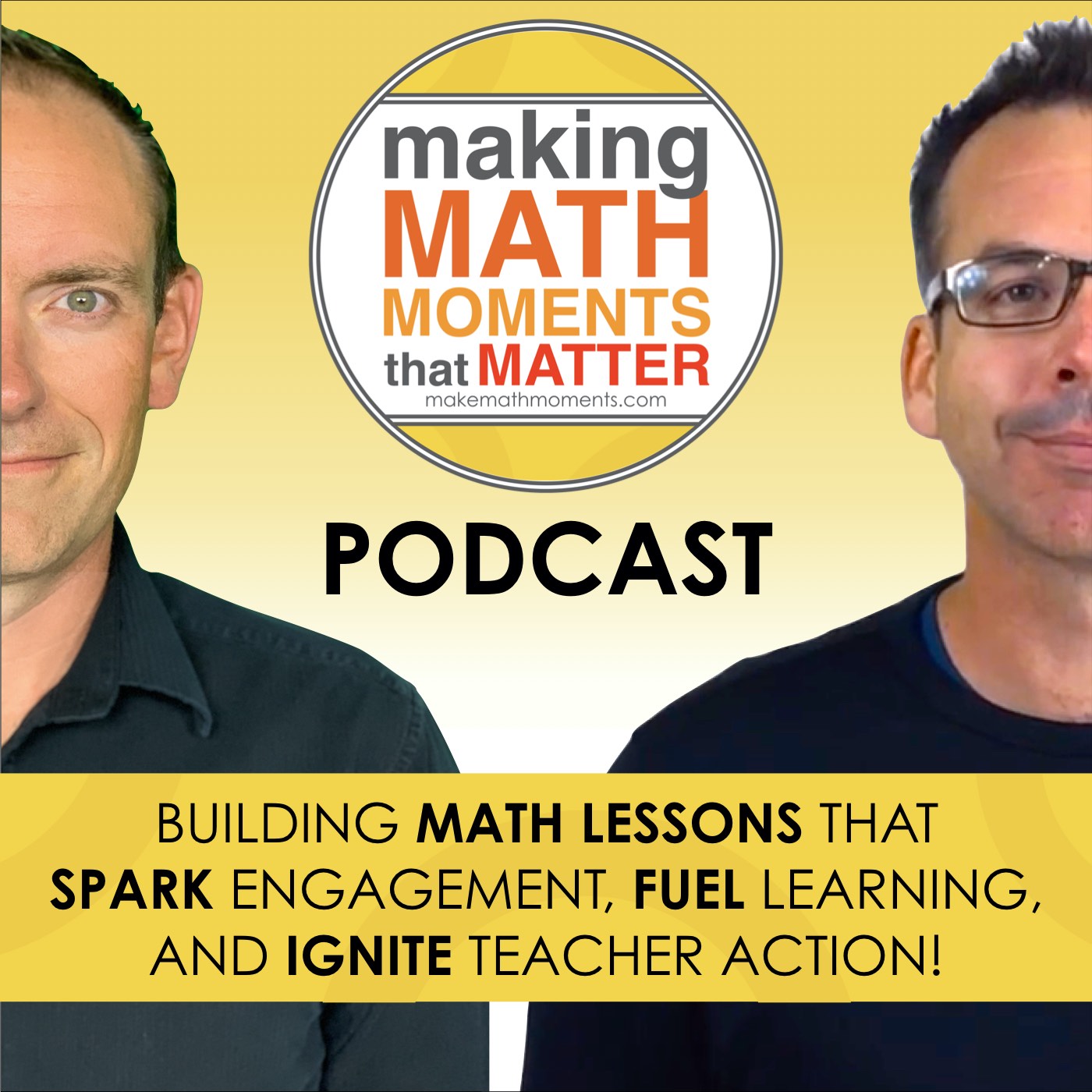
DOWNLOAD THE 3 ACT MATH TASK TIP SHEET SO THEY RUN WITHOUT A HITCH!
Download the 2-page printable 3 Act Math Tip Sheet to ensure that you have the best start to your journey using 3 Act math Tasks to spark curiosity and fuel sense making in your math classroom!
LESSONS TO MAKE MATH MOMENTS
Each lesson consists of:
Each Make Math Moments Problem Based Lesson consists of a Teacher Guide to lead you step-by-step through the planning process to ensure your lesson runs without a hitch!
Each Teacher Guide consists of:
- Intentionality of the lesson;
- A step-by-step walk through of each phase of the lesson;
- Visuals, animations, and videos unpacking big ideas, strategies, and models we intend to emerge during the lesson;
- Sample student approaches to assist in anticipating what your students might do;
- Resources and downloads including Keynote, Powerpoint, Media Files, and Teacher Guide printable PDF; and,
- Much more!
Each Make Math Moments Problem Based Lesson begins with a story, visual, video, or other method to Spark Curiosity through context.
Students will often Notice and Wonder before making an estimate to draw them in and invest in the problem.
After student voice has been heard and acknowledged, we will set students off on a Productive Struggle via a prompt related to the Spark context.
These prompts are given each lesson with the following conditions:
- No calculators are to be used; and,
- Students are to focus on how they can convince their math community that their solution is valid.
Students are left to engage in a productive struggle as the facilitator circulates to observe and engage in conversation as a means of assessing formatively.
The facilitator is instructed through the Teacher Guide on what specific strategies and models could be used to make connections and consolidate the learning from the lesson.
Often times, animations and walk through videos are provided in the Teacher Guide to assist with planning and delivering the consolidation.
A review image, video, or animation is provided as a conclusion to the task from the lesson.
While this might feel like a natural ending to the context students have been exploring, it is just the beginning as we look to leverage this context via extensions and additional lessons to dig deeper.
At the end of each lesson, consolidation prompts and/or extensions are crafted for students to purposefully practice and demonstrate their current understanding.
Facilitators are encouraged to collect these consolidation prompts as a means to engage in the assessment process and inform next moves for instruction.
In multi-day units of study, Math Talks are crafted to help build on the thinking from the previous day and build towards the next step in the developmental progression of the concept(s) we are exploring.
Each Math Talk is constructed as a string of related problems that build with intentionality to emerge specific big ideas, strategies, and mathematical models.
Make Math Moments Problem Based Lessons and Day 1 Teacher Guides are openly available for you to leverage and use with your students without becoming a Make Math Moments Academy Member.
Use our OPEN ACCESS multi-day problem based units!
Make Math Moments Problem Based Lessons and Day 1 Teacher Guides are openly available for you to leverage and use with your students without becoming a Make Math Moments Academy Member.
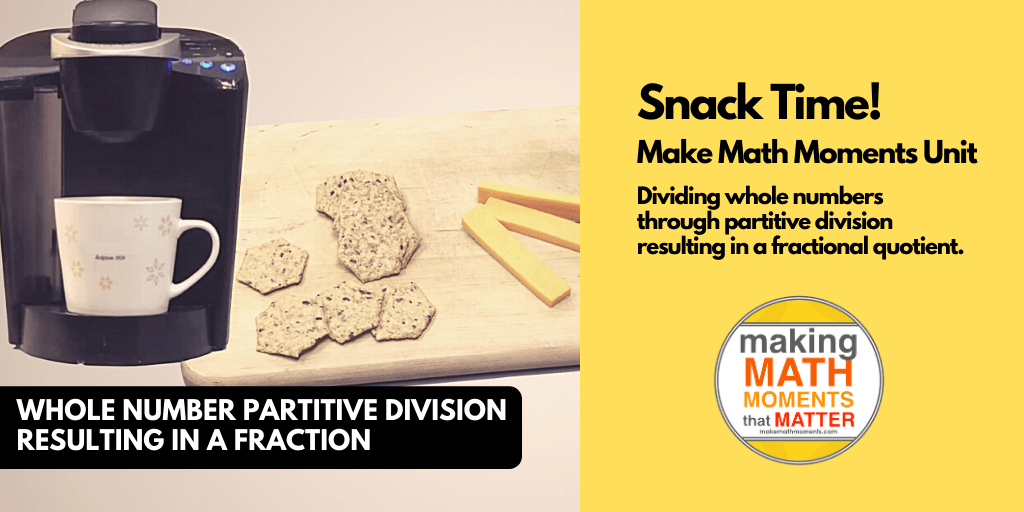
Partitive Division Resulting in a Fraction
Equivalence and Algebraic Substitution
Represent Categorical Data & Explore Mean
Downloadable resources including blackline masters, handouts, printable Tips Sheets, slide shows, and media files do require a Make Math Moments Academy Membership.
ONLINE WORKSHOP REGISTRATION
Pedagogically aligned for teachers of K through Grade 12 with content specific examples from Grades 3 through Grade 10.
In our self-paced, 12-week Online Workshop, you'll learn how to craft new and transform your current lessons to Spark Curiosity, Fuel Sense Making, and Ignite Your Teacher Moves to promote resilient problem solvers.

0 Comments