Episode #465: What Does “Strong Tier 1 Math Instruction” Actually Mean?
LISTEN NOW HERE…
WATCH NOW…
We talk about Tier 1 instruction all the time in math education.
But here’s the question:
Do we actually have a shared understanding of what strong Tier 1 math instruction looks like… or are we all picturing something slightly different?
Because when terms like rigorous, engaging, and grade-level instruction aren’t clearly defined, things start to drift.
In one classroom, students might be working through step-by-step procedures, focused on accuracy and speed. In another, they’re exploring multiple strategies, discussing their thinking, and making connections.
And both are labeled “strong Tier 1.”
That’s where the tension lives—not in effort, but in alignment. If we’re not clear on what we mean, it becomes really difficult to support teachers, measure progress, or build consistency across a school or system.
In This Episode, You’ll Learn
- What Tier 1 instruction actually means within MTSS—and why it’s designed to support most learners
- Why staying at grade-level math matters, even when students are struggling
- What rigor really looks like in a math classroom (and what it’s often mistaken for)
- The difference between students completing math and students thinking mathematically
- How to recognize when students are reasoning, representing, and explaining—not just following steps
- Why access and entry points are essential for engagement
- How teams can reduce “interpretation drift” and build a shared understanding across classrooms
As you reflect on your own classroom—or the classrooms you support—consider this:
If someone walked in during a math lesson, what would they actually see and hear?
Would students be making sense of the math, explaining their thinking, and engaging with the task… or mostly following a set of steps?
That small shift in awareness is where stronger Tier 1 instruction begins.
Attention District Math Leaders:
Not sure what matters most when designing math improvement plans? Take this assessment and get a free customized report: https://makemathmoments.com/grow/
Ready to design your math improvement plan with guidance, support and using structure? Learn how to follow our 4 stage process. https://growyourmathprogram.com
Looking to supplement your curriculum with problem based lessons and units? Make Math Moments Problem Based Lessons & Units
Be Our Next Podcast Guest!
Join as an Interview Guest or on a Mentoring Moment Call
Apply to be a Featured Interview Guest
Book a Mentoring Moment Coaching Call
Are You an Official Math Moment Maker?





FULL TRANSCRIPT
Yvette Lehman: We often talk about these terms that get thrown around in math education and the assumption that we all think we’re saying the same thing. That’s been a theme for us over the last few weeks — really digging into this interpretation drift around terms that are used when it comes to particularly school improvement planning or feedback we’re providing educators. And I was talking to a new teacher recently who was vulnerable enough to say, everyone’s talking about this idea of rigorous tier one, or strong tier one, or that I need to be implementing tier one instruction in my classroom with integrity or fidelity.
Yvette Lehman: But she said to me, I don’t actually know what you mean when you say that. And I don’t know that every principal I work for thinks it’s the same thing. So I’m getting a lot of mixed messages. And so I thought that was what we could tackle today — even just interpretation drift between the three of us. Are we all thinking the same thing when we talk about rigorous tier one instruction happening consistently in classrooms?
Jon Orr: Right, right. And I know that makes a lot of sense because it’s a general term that describes, in a way, what classroom experience and what teaching is looking like or sounding like in our classrooms. But we know as teachers that that radically changes teacher to teacher, person to person. Like I know when you look in the classroom next door, they don’t teach the same way you do. It’s just because sometimes teaching is a very personal move that we put into our classrooms. A lot of our own classrooms have a lot of our own personalities built in.
Jon Orr: And then you’re saying like, well, what is that supposed to look like? What does good teaching look like? This is what everyone’s trying to be after — how do we make sure that we’re teaching effectively, that we have rigorous teaching in our classrooms? And you’re absolutely right that even the word tier is new, you know, even though you’ve been teaching for 25 years, you hear this word and you’re like, tier one, is that what I do? Is that what’s happening in classrooms? So it’s logical that, well, we don’t really know what that means unless we’ve defined it and shared what this looks like and sounds like. I’m going to go on a limb and say most people don’t know what rigorous tier one really means, mostly because we all have different definitions and different personalities in our classrooms.
Beth Curran: So Yvette, maybe you could go into — because you seem pretty well versed in tier one, tier two — where did that even come from? Why are we even talking about it?
Yvette Lehman: Yeah, I think it actually stemmed from the special education world where they started with the RTI model and then moved into the MTSS model. So it’s our effort to meet the needs of all learners through this multi-tiered coordinated system of support.
Beth Curran: Okay. So I heard you say RTI and MTSS. Some listeners might not even know what those mean. Can you break it down further?
Yvette Lehman: Yeah. So RTI is response to intervention. And I think the difference between the multi-tiered support system, which is MTSS, and RTI, was the shift. And again, this is really stemming from the special education world. We’ve now adopted it in what we call tier one because we know that we need a coordinated system of support to meet the needs of all learners. Intervention can’t happen in isolation of what’s happening in the homeroom or the classroom.
Yvette Lehman: So my understanding is that this response to intervention was where we introduced the tiers. And originally in the research, which is of course predominantly around reading, they essentially said the majority of your students should be successful with just tier one, which is your general classroom instruction. I don’t want to give exact percentages because I can’t remember the research exactly, but I want to say it was something like 75 to 80% of students should be able to be successful with strong core instruction in the homeroom.
Yvette Lehman: Then you’re going to have another 15% who are going to require that tier two, which is just that added support, a little bit more time, maybe a more multimodal approach, additional practice — so they’re being pulled for additional support. And the research actually said that only 5% of students should really require that third tier, which is the intensive ongoing support that’s going to be personalized to their student learning profile and often delivered in many contexts by a specialized intervention teacher.
Yvette Lehman: My understanding is that the shift towards the MTSS model is really that they’re taking into account the whole child. So it’s beyond just looking at academic benchmarks and academic achievement, and really trying to understand more holistically the identity of the learner, the confidence of the learner, creating a coordinated approach from all of the stakeholders and service providers that are going to meet the complex needs of all learners beyond just looking at academic scores. But keep in mind everybody, I am not a special education expert. So this is my interpretation of this world that we’re trying to make sense of now in the math classroom context.
Beth Curran: Sure. And I can imagine someone listening is thinking, wow, those percentages sound great. But in the real world right now, maybe I’m looking at 50% of my students actually doing okay with the core instruction in my classroom. And I’m finding that more than 50% are needing what might be considered tier two. So if we’re talking about how do we then strengthen tier one to include those students, I think that’s where the conversation is going to get kind of hot here.
Yvette Lehman: Yeah. And even just to circle back to our original question — John, you shared that it’s hard to define it in a single way because teaching is so personal. But I wonder if there are non-negotiables. If there are certain criteria for rigorous tier one.
Yvette Lehman: We talk about this often — the difference between the what and the how. What is rigorous tier one versus how am I going to achieve it? That’s where the individuality, the personal approach of the teacher is going to come into play. But are there non-negotiable indicators of effective tier one instruction?
Beth Curran: I would say grade level content is high on my list. Strong tier one instruction has to expose students to grade level content. What that might look like, again, gets back to the individual approach or the approach that the school has embraced. So does that look like providing students with different tools so that they can access that grade level content? In my mind, providing access to grade level content to students is top of my list for tier one instruction.
Yvette Lehman: I would agree with that. And I also was thinking about not only grade level content, but here in Ontario — and I’m not sure what other curriculums or standards look like — we have the achievement chart. And basically what it’s telling us is that we have to look at the grade level curriculum expectations or standards, but then through the lens of the achievement chart. So that means it’s not just knowledge questions; we also need to have thinking questions and application questions and communication questions.
Yvette Lehman: It’s really understanding the expectations for that grade level, but then also the DOK level, the depth of knowledge level, or the cognitive demand of the question. So I can’t just look at the expectation that says, you know, add and subtract to a hundred and give them 20 questions where they’re stacking and adding and subtracting. Really understanding that achievement chart is also important, I think, for rigorous or strong tier one.
Jon Orr: Now, I think what we’re trying to say and define here is what does it look like and what does it not look like? And I do wanna go on the record here in saying what we’re doing right now is brainstorming together what we would want to see in tier one instruction and what we don’t — or want to see less of — in tier one instruction. But I think the move you want to think about is, if you’re a department head or a math lead in your building, or a principal or a math coordinator or a math coach, this type of discussion is what you want to do at your school.
Jon Orr: Because you’re trying to create alignment. You’re trying to say, well, when we say tier one, what do we really mean? And what you don’t want to do is say, here’s exactly what tier one looks like, because then you’re discounting what I said at the top of the episode — what instruction looks like in individual classrooms because of personalities, because of experiences. You’re not maybe honoring the experience that teachers are bringing to the table to help define what tier one is for them and what it is for the teacher next door.
Jon Orr: And so our recommendation is, if you are going to try to coordinate alignment around tier one instruction and tier two instruction, you definitely want to be building that into your professional development plans. Are we having sessions? Are we having grade level team meetings to talk about what that looks like in our classrooms and what that sounds like in our classrooms? Let’s bring in some evidence. Like you might, you know, it might be the focus for all your PLCs for the next year to understand what tier one and tier two really mean across your school system.
Jon Orr: So we’re tossing out some different ideas here, like what does grade level content really lean to? Do we know what that means in our school system? For this grade level team, when they’re unpacking this together, that alone — to unpack what grade level means for each topic or strand — is years’ worth of collaborative work. Because you now have to look at student evidence. You have to look at what students are doing. You have to look at what the curriculum is saying to do for this grade level. Spending time unpacking just that one idea about grade level or about tier one instruction is essential.
Yvette Lehman: Another thing I was thinking about as far as the criteria — I really liked this definition, which was strong tier one means designing instruction so that the majority of students can access, engage with, and learn the key ideas. And so I think that access is a big part of core instruction or strong tier one instruction. It means understanding how everybody is going to have entry into this learning today.
Yvette Lehman: Differentiation was kind of a really big buzzword 10 years ago — everyone needs to differentiate, differentiate. And I really liked in one of our summit sessions, somebody shared this idea of creating pathways. Like, how do I create pathways so that everybody or the majority of students can access today’s learning in a meaningful way? So to me, that’s another indicator of quality tier one instruction. If I was to walk into a room, I would look around and say, it looks like the majority of students here are engaging, are thinking, are making sense of the problems, are communicating, and they have access to this learning. Because if they don’t, then that to me would be an indicator that this is not strong tier one.
Jon Orr: Yeah. Right, right. So I think when you say tier one and if you haven’t done the unpacking and the brainstorming and the discussing of what this looks like, your definition might just fall back to saying, well, tier one is just whole group. That’s it. Like whatever whole group is, that’s tier one instruction and therefore it’s quality tier one instruction.
Jon Orr: The questions are like, how do I bring this? Is it just picking the right curriculum? Is that enough? Is it just whole class teaching? Is it just keeping an eye on everyone at the same time? And then like what you’re saying is, it’s not just that. We have to differentiate our learning. We have to create our lessons — whether the curriculum does this or not — so that more students have access and can engage with key learning. And then how do I know that I’ve done that? How do I know that I’ve created access for students to engage? How do I know that students have learned key ideas? These are important elements when you are thinking about tier one instruction and designing your tier one. What is it not, guys?
Beth Curran: Well, when you said whole group versus small group — I think what it’s not is just teaching exactly the same way to every student in the classroom, or expecting all students to come up with the same answer or use the same path to get to the answer. So that’s definitely something that it’s not.
Beth Curran: So it’s not just whole group in the sense of I’ve got all the students together and I’m going to move them all through these steps of solving this problem together. I think tier one instruction goes much deeper than that.
Yvette Lehman: I mean, this again is biased, right? But to me, what tier one instruction is not — or what strong tier one instruction is not — is high disengagement. And disengagement presents in a lot of ways. But it’s like disengagement means that the students aren’t doing the thinking. That might mean that the teacher is doing a lot of the thinking, holding up the cognitive demand because they’re essentially having students mimic every part of the problem.
Yvette Lehman: So that to me would not be an example of rigorous tier one instruction. When I walk into a room, I always say this to coaches with coaching experience — you know when you’re there, and it’s sometimes hard to describe how you know, but there’s almost a feeling in the room. And I would say the biggest feeling is, who owns the learning here? When I walk into a room and it is very evident who owns the learning, that is an indicator to me that there is strong core instruction happening in that room.
Jon Orr: Right, right. So when you’re listening to that definition of who’s owning the learning, I think what you’re getting at is there’s appropriate think time, you’re not seeing the direct sage-on-the-stage approach — here’s my lesson and here’s your note taking. There’s more thinking happening with students and they’re maybe engaging with each other. They’re engaging with the teacher.
Jon Orr: I think when you hear that type of definition, or if you’re supporting teachers who are also going like, what does that really look like — it often brings up the word rigor. And when you say rigorous, I think for me anyway, maybe it’s my high school teacher background, I’m thinking hard. Like, we’re white-knuckling through this. We’ve got to maintain rigor because they’re going to move to the next grade level. And I have to make sure that I do hard problems with them, show them how to solve hard problems. That’s sometimes what you hear when people say the word rigor. And I don’t think that’s exactly what you mean when you’re saying rigorous tier one instruction.
Jon Orr: Because if you just say that, I think a lot of teachers get in the mind of what an algebra two classroom should look like or a calculus classroom should look like — the way that we went through class. You automatically go there when you hear the word rigor. I do at least anyway. And I think a lot of people do still.
Yvette Lehman: So what we’re saying is the way that we’re defining rigor doesn’t necessarily mean more quantity-wise or harder questions or faster pace. I actually ran into a teacher last week at a coffee shop and I feel so grateful I had this experience. She is an excellent intermediate teacher and I had a chance to go in and spend multiple weeks working through Kathy Fosnot’s units with her. We co-taught them. I drove out to her school every day and we worked our way through these units.
Yvette Lehman: And I always think about that experience because I think about the environment I was in in that classroom — where the answers weren’t obvious, the problems were challenging, they were interesting, and students were productively struggling through them. But they were making conjectures and generalizations and having aha moments. And we were able to go around the room and, as you described Beth, individually consolidate with every single group and understand where they were on their learning journey to revealing the big idea behind that lesson.
Yvette Lehman: So I think when I think about rigor, it does also come back to engagement and zones of proximal development and really understanding what students are ready to be asked to engage with relative to the outcomes for that grade or those standards. So it’s like having that understanding of productive struggle. And I guess when I say that, when I go back to what does tier one look like — tier one is the eight effective teaching practices in action. It’s teachers with really strong clarity around the learning goal for that lesson. They’ve selected a task that’s gonna promote reasoning and problem solving. Students are engaged in discourse, they’re connecting representations, all of those things. And it doesn’t necessarily mean that the numbers are more difficult. It might just mean that there’s more constraint in the problem, or it’s a new context that they haven’t explored that relationship with before.
Jon Orr: I think you did. Well, how does assessment fit in? Like how are we using assessment in a rigorous tier one environment?
Yvette Lehman: Okay, so I feel like I have a lot to say on this topic today. When I think back to that experience when I was co-teaching with this teacher and we were working through a context for learning unit that we’d never done before, we really had to anticipate. We really had to think about how are students going to solve? What are we going to do if we see this? How are we going to, what question are we gonna ask? What support are we gonna put into place?
Yvette Lehman: Going back to that idea of access — like how are we gonna make sure everybody has access to this task tomorrow? It was by anticipating what might happen, what strategy students might use, or what misconceptions there might be. That way we were ready to engage in what Cathy Fosnot actually calls dynamic assessment, which is your ability in the moment — while students are reasoning through a task — to get a sense of where everybody is entering into the task and know what the next move is for that student. And I can engage in dynamic assessment if I’ve already engaged in those five practices, which includes anticipating and planning for my advancing and assessing questions.
Jon Orr: Exactly. Connecting it to the advancing and assessing questions. It’s like, you might go, okay, we did the anticipation. But you might have only mapped out what the solutions are. Have you then taken the step to go, well, if a student did this, how does that strategy or solution or the anticipated outcome that they’ve come up with connect to the learning goal down the road? And how do you get them to that learning goal? Like that part is an essential component of implementing the anticipation stage of the five practices for orchestrating productive mathematical discussions.
Jon Orr: I want to ask — you’ve described instances of you working with a teacher on this process and really strengthening what tier one instruction could look like and did look like for that teacher. Talk to us about that. What did that look like before the lesson? Were you working during their prep time, outside their prep time? And what did that look like after the coaching was done and you’d moved on to another teacher? Are you confident that tier one instruction is still there with that teacher?
Yvette Lehman: So I’m gonna say that I believe it was already there because of the environment that I stepped into. Like it was very evident to me that the students were used to engaging and learning in this way. I didn’t have to create the environment when I first got there. And this could be a whole other podcast episode because this came up with one of our district leaders last week about this idea of where does the planning time happen, particularly for elementary teachers who are not only planning for math and in some cases have very limited embedded planning time. So this is a problem for sure across the board of math education because it does require time.
Yvette Lehman: So I’ll tell you what we did. Basically I would show up to her room every morning — she had math during the first block. Then we would take the first part of her nutrition break, which was right after when students were outside for recess, and we would basically talk through what we consolidated that day and plan for the next day. And then we would sometimes have to walk away with some homework that we would do separately, where we would basically talk about, okay, this is what we saw today, this is where we’re going tomorrow, what do we need to do to prepare? And then I would come back the next morning. So this is a problem, and we could probably have a whole other episode about the challenge of finding and carving out the time to engage in planning.
Yvette Lehman: But here’s my belief — I believe that the next time that she or I go to teach the frog jumping unit from Kathy Fosnot’s contexts for learning, we will need to plan less.
Jon Orr: Right. And it’s likely you’ll plan less for others because you’ve done the planning for that one and it’ll be quicker when you go to do a new one, or it’s using the same techniques to do the anticipatory stage. So like we often say, the work you do with one teacher on one strand, on one lesson, it doesn’t just live in isolation. It will spill over not only to that teacher’s practice moving forward in other strands, even in other subjects.
Jon Orr: What would be — it also is gonna spill over into the teachers that that teacher communicates with on a regular basis, has lunch with at the lunchroom table. Like these ideas spill over. Now, do they spill over as quickly? No. But you’re planting seeds, but you’re also making moves. And we have to kind of take that step back and go, my investment as a coach or coordinator with one teacher is more than just that one teacher and that one lesson. Even though you might get that feeling of narrowness, like, ah, I need to cover more ground with teachers. Know that you’re doing bigger and better work by giving more time to help plan or coordinate with one or two teachers, because it will spill over. It doesn’t just act in isolation.
Beth Curran: I would add to that too that I think that once teachers get comfortable with presenting lessons in this way — where they are allowing students to access the mathematics at whatever entry point they have, and then listening to students and listening to how they approached a problem — the more you listen to students, the more you’re anticipating. That whole process of anticipating what they might say is going to get easier and easier because they’re your students and you’ve heard them come up with different ways. Maybe some of them were really surprising to you at first, but now it’s like, okay, I need to prepare for this. I know that a student is going to maybe grab those linking cubes, or someone else is going to draw a picture, or someone’s going to solve it in a way I hadn’t thought of before.
Beth Curran: And so the more that you can take the risk — just jump off that ledge and allow the students to play around with the math and really listen to the way that they respond to things — I think that’s going to actually enhance your planning as well.
Yvette Lehman: When I think about our original question today, I want to summarize some of the big ideas that emerged. I think we talked about this idea that we recognize it’s not going to look exactly the same everywhere. But what are some of the indicators? And John, you also mentioned that we always argue that it’s the conversation happening at the school that’s really important. It’s not about coming up with a single definition that we can all agree on across North America. It’s about within your community, within your district, within your school — are you getting closer to a more coherent picture of what you’re collectively striving for when you say strong core instruction or strong tier one instruction?
Yvette Lehman: I think for us, some of our non-negotiables started with this idea of it’s at grade level. So that would require the teacher is routinely referencing their standards or curriculum expectations at that grade level, and ideally working with others at the same grade level to really unpack them and understand what mastery or proficiency looks like for their students. We also talked about access and engagement as being an indicator of strong core instruction or tier one instruction. If I walk into a room and the learning is very passive and I don’t see a lot of thinking on the part of the students, then I would suggest that’s not an indicator of strong tier one instruction. There should be access for the majority — the majority of students should be engaged deeply in the thinking.
Jon Orr: Yeah, yeah. We talked about rigor being more about depth of thinking than difficulty of numbers and a fast pace. So Yvette said it’s important to bring forth these ideas here today for you to think about the term tier one instruction, and have we made appropriate efforts in our school or school systems or even in my own classroom to define what that really means for me and for us and for the team.
Jon Orr: The work that would need to be done to create the coordination and the alignment around that term, if we’re going to use it in our math improvement plans or our goals for the year — no matter where you are on that timeline in thinking about alignment and coordination across a term like tier one instruction or strengthening tier one instruction or intervention in tier two instruction — consider reaching out to us. We plan with teams on how to design their math improvement plans to support and strengthen these structures that you have or the curriculums you’re using to strengthen tier one instruction and coordinate it with tier two instruction and your line goals.
Jon Orr: This is the work that we do on a regular basis — guiding and supporting and consulting with teams to create this in their schools and create alignment and coherence on these ideas. We do this with teams who are just beginning the work, with teams who have already started the work, and with teams who are multiple years into this type of work. Wherever you are in your journey, we can help provide support and give you maybe some next steps. Even if you’re just looking for, we’re starting this, what could our next step be? Head on over to makemathmoments.com forward slash discovery. You can book a call with our team and we can hop on a quick call just to talk about what you have done and what you’re planning to do and point you in some right directions. That’s what we want to do for you as a listener of this podcast. Head on over to makemathmoments.com forward slash discovery.
Thanks For Listening
- Book a Math Mentoring Moment
- Apply to be a Featured Interview Guest
- Leave a note in the comment section below.
- Share this show on Twitter, or Facebook.
To help out the show:
- Leave an honest review on iTunes. Your ratings and reviews really help and we read each one.
- Subscribe on iTunes, Google Play, and Spotify.
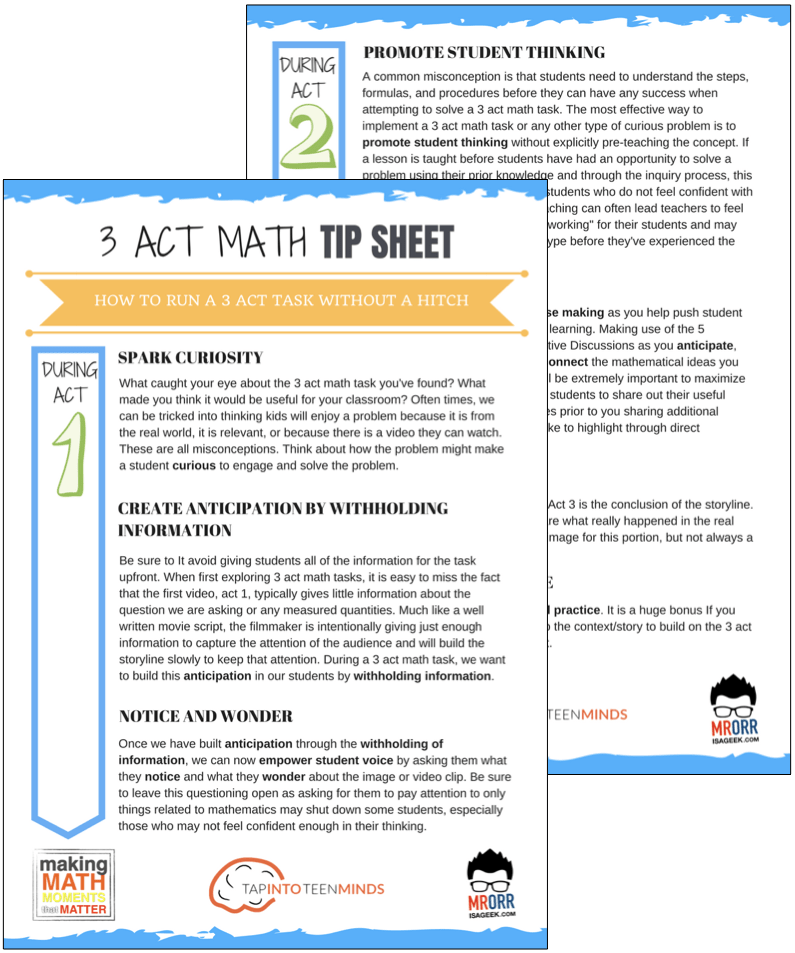
DOWNLOAD THE 3 ACT MATH TASK TIP SHEET SO THEY RUN WITHOUT A HITCH!
Download the 2-page printable 3 Act Math Tip Sheet to ensure that you have the best start to your journey using 3 Act math Tasks to spark curiosity and fuel sense making in your math classroom!
LESSONS TO MAKE MATH MOMENTS
Each lesson consists of:
Each Make Math Moments Problem Based Lesson consists of a Teacher Guide to lead you step-by-step through the planning process to ensure your lesson runs without a hitch!
Each Teacher Guide consists of:
- Intentionality of the lesson;
- A step-by-step walk through of each phase of the lesson;
- Visuals, animations, and videos unpacking big ideas, strategies, and models we intend to emerge during the lesson;
- Sample student approaches to assist in anticipating what your students might do;
- Resources and downloads including Keynote, Powerpoint, Media Files, and Teacher Guide printable PDF; and,
- Much more!
Each Make Math Moments Problem Based Lesson begins with a story, visual, video, or other method to Spark Curiosity through context.
Students will often Notice and Wonder before making an estimate to draw them in and invest in the problem.
After student voice has been heard and acknowledged, we will set students off on a Productive Struggle via a prompt related to the Spark context.
These prompts are given each lesson with the following conditions:
- No calculators are to be used; and,
- Students are to focus on how they can convince their math community that their solution is valid.
Students are left to engage in a productive struggle as the facilitator circulates to observe and engage in conversation as a means of assessing formatively.
The facilitator is instructed through the Teacher Guide on what specific strategies and models could be used to make connections and consolidate the learning from the lesson.
Often times, animations and walk through videos are provided in the Teacher Guide to assist with planning and delivering the consolidation.
A review image, video, or animation is provided as a conclusion to the task from the lesson.
While this might feel like a natural ending to the context students have been exploring, it is just the beginning as we look to leverage this context via extensions and additional lessons to dig deeper.
At the end of each lesson, consolidation prompts and/or extensions are crafted for students to purposefully practice and demonstrate their current understanding.
Facilitators are encouraged to collect these consolidation prompts as a means to engage in the assessment process and inform next moves for instruction.
In multi-day units of study, Math Talks are crafted to help build on the thinking from the previous day and build towards the next step in the developmental progression of the concept(s) we are exploring.
Each Math Talk is constructed as a string of related problems that build with intentionality to emerge specific big ideas, strategies, and mathematical models.
Make Math Moments Problem Based Lessons and Day 1 Teacher Guides are openly available for you to leverage and use with your students without becoming a Make Math Moments Academy Member.
Use our OPEN ACCESS multi-day problem based units!
Make Math Moments Problem Based Lessons and Day 1 Teacher Guides are openly available for you to leverage and use with your students without becoming a Make Math Moments Academy Member.
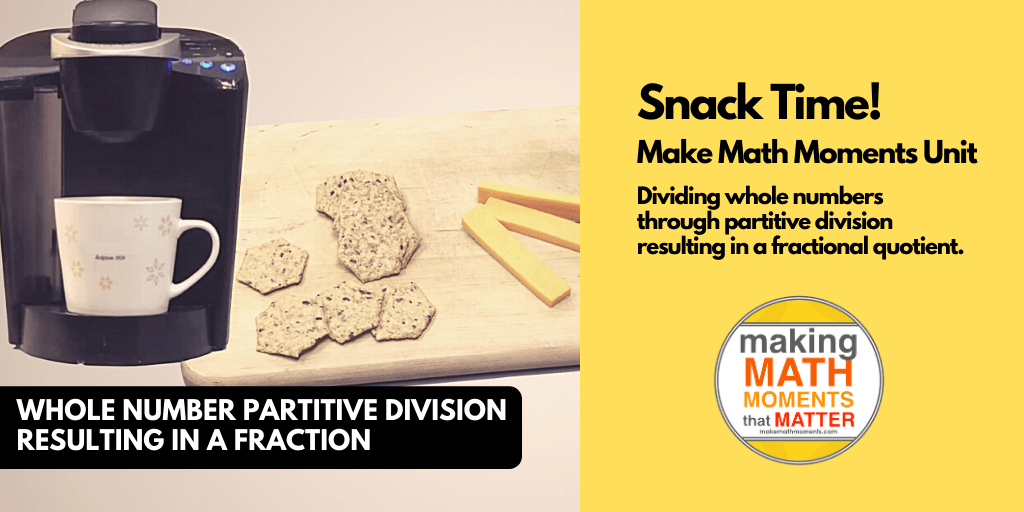
Partitive Division Resulting in a Fraction
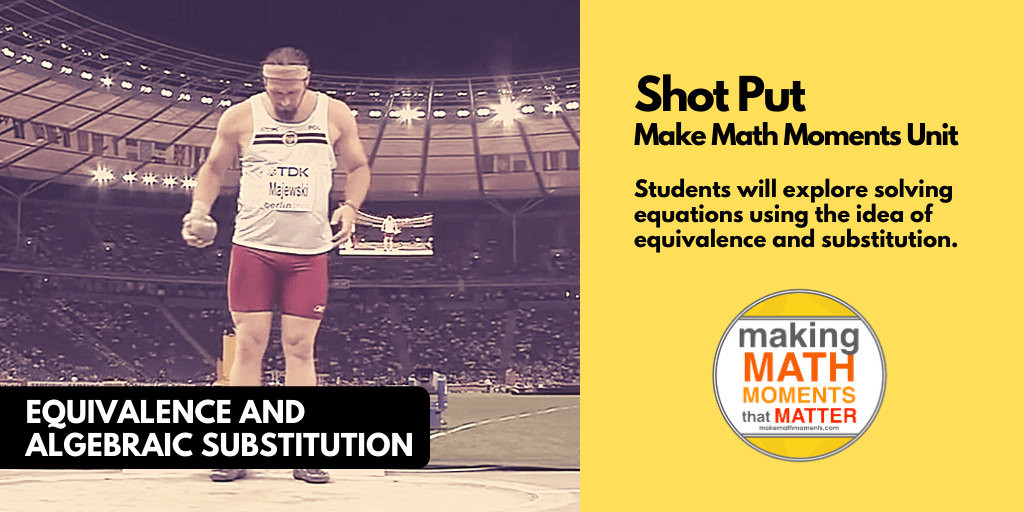
Equivalence and Algebraic Substitution
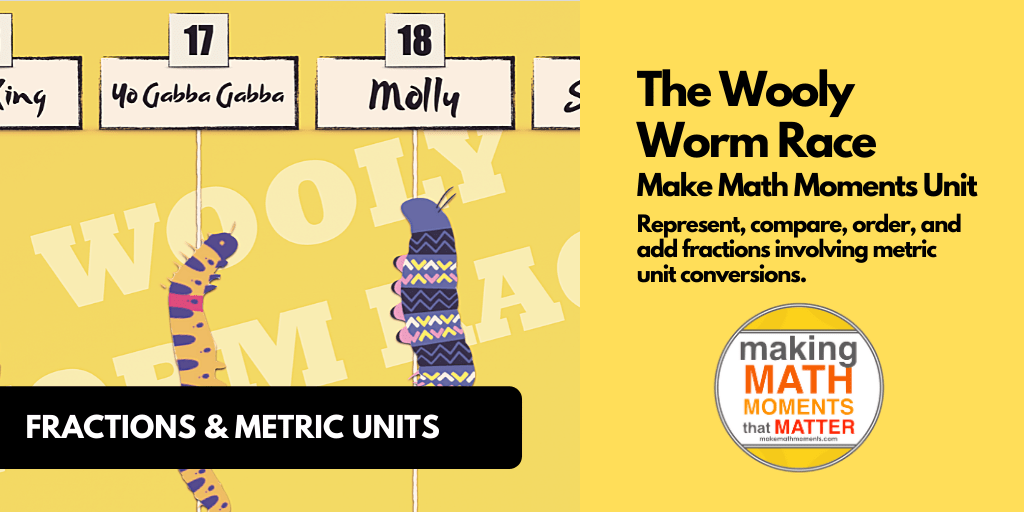
Represent Categorical Data & Explore Mean
Downloadable resources including blackline masters, handouts, printable Tips Sheets, slide shows, and media files do require a Make Math Moments Academy Membership.
ONLINE WORKSHOP REGISTRATION

Pedagogically aligned for teachers of K through Grade 12 with content specific examples from Grades 3 through Grade 10.
In our self-paced, 12-week Online Workshop, you'll learn how to craft new and transform your current lessons to Spark Curiosity, Fuel Sense Making, and Ignite Your Teacher Moves to promote resilient problem solvers.

0 Comments