
Episode #435: Why Students Still Hate Math—Even If They Are Scoring High
LISTEN NOW HERE…




WATCH NOW…
You’re seeing growth in the data. Students are performing well. But something feels… off. Maybe they’re disengaged. Maybe they’re saying they don’t like math. Or maybe, they’re just going through the motions.
In this episode, the team explores a common but often unspoken tension: how do we balance academic achievement with student enjoyment, confidence, and sense of belonging in math? We share a story from a high-achieving school that’s beginning to ask deeper questions—not just about what students know, but how they feel about math.
Listeners Will Reflect On & Learn:
- How student voice can uncover what the data might miss
- What it really means to be “successful” in math
- Ways teachers and leaders can create space for more joyful, confident math experiences
- Why building trust—between students, teachers, and systems—can shift everything
- How to begin these conversations in your own school or district
Whether you’re a teacher, coach, or leader, this episode offers thoughtful entry points to explore student disposition—without judgment, and with a commitment to growing together.
Attention District Math Leaders:
Not sure what matters most when designing math improvement plans? Take this assessment and get a free customized report: https://makemathmoments.com/grow/
Ready to design your math improvement plan with guidance, support and using structure? Learn how to follow our 4 stage process. https://growyourmathprogram.com
Looking to supplement your curriculum with problem based lessons and units? Make Math Moments Problem Based Lessons & Units
Be Our Next Podcast Guest!
Join as an Interview Guest or on a Mentoring Moment Call
Apply to be a Featured Interview Guest
Book a Mentoring Moment Coaching Call
Are You an Official Math Moment Maker?




FULL TRANSCRIPT
Jon Orr: All right, let’s get into this because we hear this, you know, you’ve heard this.
you know how many times have we heard that as educators, as even students? And we wanna talk about that, because we’re talking about the disposition we have and students have towards math and how we can shape that disposition and talk about that from a classroom level, but also a system level and thinking about those things, we’re gonna talk about a story from a team that’s trying to make this shift, to make this improvement.
But let’s get into it. Before we do, do want to ⁓ remind you that we have a new addition to the podcast. Curran is here. She’s joining us. We got the panel here together. Yvette’s here, Kyle’s here, I’m here, Beth’s here. Let’s get into it. Yvette, set the stage. What’s the story here?
Yvette Lehman: was meeting with the school recently and you know they’re working on school improvement planning around math and this is actually a high achieving school. Their state results indicate significant growth and they’re pretty happy with their achievement levels. They use NWA as their benchmarking and the initial benchmark is showing good improvement. And so then I said to them, know, well where’s the opportunity then? You know, it sounds like everything’s going great. Tell me about…
Jon Orr: Yeah, what’s the problem here?
Yvette Lehman: You know, but there’s always opportunity. There’s always opportunity. And the department said, you know, some days I just wish I didn’t teach the subject everybody hates. And I was like, tell me more about that. You know, of course, you know, tell me more. And he’s like, I just, you know, even though our students tend to do well and we’re very proud of our achievement data, students still openly say they don’t want to be there. They hate math class. They don’t see themselves as a math learner. And I mean, I feel like that’s a Problem worth tackling.
Jon Orr: Totally, like I was just gonna say it’s like in a way that what they’ve just told you is that, is that yeah, like we’ve got like there’s this benchmark we’re trying to hit around student data and student achievement, but it’s like, but there’s this other benchmark here that we wish was better, but we, you know, like we don’t know what to do there, but it’s like you’re measuring yourself against these two zones. And sometimes we just don’t even think about how to affect
the one zone versus the other, the achievement goal is the be all end all, where it sounds like this team’s like, we realize that maybe we’ve missed the mark. Is it just as good to have this achievement data when everyone hates it? do we need to have this other goal around student disposition towards the subject is equally important? There’s that balance there and this team’s like, think we should either refocus there or make it a similar priority.
Yvette Lehman: Yeah, it’s definitely interesting. remember supporting another school, an elementary school, who had a similar problem in that they were high achieving. Standardized test scores suggested that they were on a good trajectory. But when they asked their female students if they liked math and they felt they were good at math, over 50 % of them said no. And so this is an indicator of whether or not students are going to continue in math.
higher levels if they’re going to go on to post-secondary education that involves math as a content area and so disposition is important I believe and so with this team the question that we essentially asked was
First of all, what data do you have to suggest apart from anecdotal that students dislike math? You I think it was a feeling, that they had a feeling based on, you know, the body language and overhearing students talk about it. But what data do we have to suggest that students do have a, you know, negative disposition towards the subject? And then ultimately, what are we willing to change to shift that?
Kyle Pearce: If, if we, if we do have the data, if we do collect the data or spend the time to, you know, get to the bottom and really understand where there’s some challenges here with, the, disposition of, of students may keeping it productive. The question then becomes is, what are we going to do? Are we willing to do the work and put the effort in? in order to try to get to the bottom of it. And I think at its core, I think we all want to, but the real question is, are we willing to? Able, I would say we are always able, but sometimes we say we are not due to some time circumstances. But that’s gonna be a big important factor here if we want to actually take this information, what we think anecdotally is taking place is get the real data and then use that to try to figure out what is our next step in order to make a dent in this.
Jon Orr: Yeah. Yeah, when you think about it, what you’re saying is that we need at the school level, at the district level, whatever our system level is, we need to continually remind ourselves that if we’re seeing issues that we want change in, then we need to think about the inquiry process. We need to think about what Yvette’s saying and what you’re saying, Kyle. What data to suggest that we have a problem? What are the steps that we could take to solve the problem?
And how are we gonna know we solved the problem? And do we have the tools, the necessary conditions to solve that problem? And then let’s go ahead and do it. Like think most times it’s like we know these things are there, but we’re not going through that process. We’re not taking that systematized approach to address some of the issues we know are present because I don’t know, it’s someone else’s job. you know, like this is just math. That’s just the way it’s supposed to be and I think what this team is doing and what they are strategizing now to do is to take that approach, but then also, like I was saying before, put on the same level of indicators of success that I have achievement, student achievement in terms of scores as one indicator of success, but we now need to raise up. What are some other quantitative or qualitative indicators that we also want to hold true? Because sometimes, even though we’re talking about like,
student disposition. This is also the same type of reasoning when we talk about buy in from educators is to think about like, because you hear this to at certain levels of education that is like, I’ve been trying to do this, I’ve been trying to shift mindsets around teachers belief and teachers disposition towards the subject around mathematics, because I want them to be lifelong learners, and they want them to go down this pathway.
But Where are we putting the emphasis? Like are we still saying achievement is the be all end all? Or are we creating other qualitative measures to say that yeah, we’re doing okay here, but we’re getting killed over here guys. Like we gotta put something into place to bring this up and that can help, like that refocusing of goals can help change some of the disposition for our educators as well because now we have like a reason.
Jon Orr: to go down this pathway. We now have to like, this is something we’re all striving to go down and it’s really important for our school to do that work. So when you think about that, that can help shift some of these beliefs at the educator level. But that’s kind of big thinking right here. Let’s get more specific. Like what can we be doing to do some of this inquiry approach?
Yvette Lehman: I wanted to share a tangible example, and this is one that I experienced as a teacher. So I was part of a district-wide initiative to unpack student experience in the math classroom. And I remember we had some researchers come in from the district level, and they pulled a panel, a random sampling of students from my class. And I remember this vividly going into the LST office, and there were five students from my class, and I was there with them. But it was these unbiased researchers who were asking them
questions about their math experience, you know, what they did and what was the purpose of it and how they feel. And I thought I knew my students. I pride myself on really knowing my students and I’m going to tell you, I was shocked by their responses. And it really made me realize that I had never asked them. You know, I taught the way that I thought was best for them. And I assumed and some of these were some of my, you know,
most engaged, highest achieving students and to hear their perception of their class experience shook me. It was a transformative, I can literally picture the faces of the children in this room, what was on the walls that day and this was probably eight years ago.
Kyle Pearce: Right? Being I’m telling you, it’s so interesting. A lot of times when we are taking anecdotal, you know, experiential situations and trying to compute what that actually means, when a student’s doing their work, they’re doing well, they’re polite, right? So being polite to you and liking or enjoying math class are actually very different. So they may have like liked me as a person.
And I interpret that as they enjoy math class, when in reality, they might be like, I enjoy having you as a teacher, because you’re a good person, or the way you speak to me, or the way you, you know, build me up or whatever it might be. But mathematics, I’m just going through the motions. And it kind of brings me back, I know, Beth, in the last episode, you had shared your math moment. And, you know, it was comforting to you, you could show up in math class and do you know, just fine. And think a lot of people have that experience. I was one of those people as well. You know, I went to school, I didn’t go home and like excited to do my math homework. You know, it was like I, I did what I had to do. I was confident. And a lot of students in our classes are exactly like this. And even though they aren’t disruptive, or even though they aren’t, you know, voicing these challenges or concerns,
we make these assumptions and assume that everything’s a okay when in reality, if we ask them, maybe there’s an opportunity for us to actually dig in on what’s missing for them and what we might be able to do to actually enhance that experience. And imagine the students already doing well in a math class, and then they actually enjoy the process at the same time. Like think of, you know, how the doors can open for them in terms of what that might mean for them just in
in terms of enjoying it, but then also in terms of what that could lead to from a career path perspective.
Beth Curran: Yeah, I have a story to share too about that, Kyle, because I, similarly to Yvette, thought that I was doing the best that I could in class, teaching my students math the way that I was taught. And then I started sort of branching out and ⁓ trying different things, creating more exploration type activities for students. So less of me telling them what to do and having them model that, but more of them just kind of digging in and building on their prior knowledge and attempting things and persevering through problems on their own. And I specifically remember this one lesson, I had been sort of playing around with this idea of I’m gonna let them work with a partner, I’m gonna let them try to figure this out, we’re gonna consolidate together, we’re gonna have lots of manipulatives and things that they can use to draw, to enter into the mathematics. And at the end of a lesson, this fourth grade student, the girl came up to me and she said, Ms. Curran. I loved today’s lesson. Can we do more of our lessons like that?
Beth Curran: And it was, so I think my point is that, you know, that was straight out of her mouth. She was a great student. She was, you know, I would have said that she absolutely loved math class every day, but it was ⁓ interesting to hear her reflect on that in that moment. But I think what that says to us as educators is we have to be willing to try different things in class. We have to be really willing to try different ways of instruction.
to see what does resonate with our students. Because until, I don’t think she would have, the student would have never said, Ms. Curran, I don’t like math class. But once I tried shifting my instruction in a different way, she came up to me on her own, not prompted, and just said how much she loved math class today. ⁓
Kyle Pearce: And imagine how many other students along the way, whether it’s a positive response or whether it’s maybe something I think a lot of times like we don’t ask because we assume, but then we’re also a little scared too, right? Like, mean, sometimes when you get that feedback, especially if you aren’t exactly sure how to fix it, that can feel very defeating. But at the same time, if we’re not willing to ask, then we’re kind of hoping that a student like the student you had experience there is going to come and actually share that experience with you. So obviously they felt strong enough that there was a big enough difference that it was worth sharing because they wanted to engage in more of that. And you just wonder how many other students are thinking or what are they thinking when we engage in mathematics the way we sort of quote unquote always have.
Beth Curran: Yeah. And I think, go ahead. was going to say that, I think that it also makes me think that, you know, at what point does math become not as enjoyable, right? Cause if you ask kindergarten teachers, do your students enjoy math class? They’ll say yes. First grade? Sure. Second grade? Yeah. It’s usually about third grade. And so I would ask teachers to really reflect on what is the change in instruction starting in about third grade.
Yvette Lehman: This made me think about, ⁓ go ahead.
Beth Curran: And what is it that shifts in our instruction that then makes math class less joyful? You know, is it manipulatives? Is it communication? Is it games? it, is it the focus on memorization that kind of comes up in third grade? That all of a sudden now students aren’t enjoying what they do in math class as much. And so, you know, I think there’s a lot to be said and a lot to be, a lot that we can learn.
from looking at math across all grade levels.
Yvette Lehman: We talked about if we’re going to ask students some of those questions, Beth, that you just shared, the teacher has to be willing to respond. But now I want to talk to the leadership because I want to ask, do they have the freedom and the opportunity to respond? And this goes back to, had a conversation recently on the episode about implementation with fidelity versus implementation with integrity.
And so sometimes when we talk to teachers, they say, I would love to create experiences that are more joyful. I would love to be more responsive, but my district is telling me I have to be lockstep. I have to teach it exactly this way. I don’t have the autonomy or the creativity to adjust anything. And so that’s where I need to talk to leaders now and say, if you’re going to ask the questions of students and you’re going to want your teachers to be responsive,
Are we creating a system that allows us to still remain integrist to the curriculum while also being responsive to the student learning needs and their disposition towards the learning environment?
Jon Orr: Yeah, like you’re bringing up a huge, huge part because I think the, the idea of this is why we get into the pacing guide and follow this and follow that is like, we haven’t built the system around the decision-making frameworks that we want teachers to take. Right? It’s like, if you trusted your teacher to make appropriate instructional decisions based off students, then you wouldn’t try to prescribe everything. You know, you want to be able to like say like, here are the big
Here’s the big picture. Here are, our core values. Here’s where we’re trying to go. And do we understand, like, have we communicated that? And when all of a sudden you start to communicate those things, then it’s all of a sudden teachers can, you can feel the trust come back together to make, make, make these appropriate instructional decisions for students. And I think that kind of goes away. Yvette, talk to us about this team. You know, like what did this team do? Because if like, this was their goal, this was their
next step is like we realize there’s an issue here, what are we now going to do about it?
Yvette Lehman: Well, what I will share is that this group is early in the stages, They’re essentially in the, they’ve identified the pebble, you know, or the, where’s their room for opportunity. But what was exciting is that as we left that call, there was an enthusiasm to go out and seek some answers. You know, they wanted to position students at the center of the decision-making process.
They didn’t want to make assumptions about what was going to improve the student disposition without going to the students and asking them first. And of course, you know, this is also high school. know, students want to have a voice in their education. They want to be seen. They want to feel valued. And so how can they as a department create the opportunities to position students as partners in learning so that they are creating a classroom environment that is responsive to their learning needs and helps them see themselves as more capable and confident in the math class?
So what I loved about this conversation with the school was that one, the principal was there in the meeting and fully supportive of this work and was willing to create space for this work to happen. right away there was conversations about logistics, you who’s going to create, so when can the department come together to co-construct the interview questions?
where is the time for them to, you how are we going to select students to sit on this interview panel and where is that going to take place and when is that going to take place? And so the principal, because they were so supportive of this work, was also willing to create the space and create the structures that this team would require to get this work in motion and to make sure that students were really feeling centered if they were going to be making decisions about how to shift instructional practices to improve student disposition.
Jon Orr: You know, what I think I really admire about this team specifically is that they’re taking, they’re taking that steps on their flywheel approach because it’s like the one of the important parts of the flywheel is understanding the support structures that they have access to and who plays key roles in that support structures. So the fact that you’re saying like the principal is at the table, the principal’s being a skilled facilitator, they’re making use of their content specialist and there’s a team aspect approach to say going down this roadmap of this inquiry process. think that, like one of the indicators that we look at when we support teams is do we have that supportive team in place?
And if not, how do we put them in place? And how do we, how do we kind of create the rallying call to bring those people to that table? Because we know that without the right pressure and support that change doesn’t happen. And that this team is looking to create change and they’re bringing the people together to help create that change. They’re monitoring the change. They’re defining the change that you’re trying to create. And they’re going to capture the evidence to say, is, we have to make a change? And if so, what are we gonna be doing next to create that change and how will we know made that change? Like that right there, they’ve, what I love about this is like, yes, they’re addressing this one particular issue, but because they’re making their system, because they’re starting to put the system in place of like how we make decisions and going to DGEMBA, we’ve used that phrase here before, which is like getting to the, like getting right to it, getting to see the work, getting into the classroom, hearing from the students, then they’re, I feel like this team is going to be strong because they’re putting the right habits in place. Like I heard James Clear speak and he said, James Clear is the author of Atomic Habits. he said basically, he’s like, goals are for like people who are concerned about winning one time. Systems are for people who are about winning consistently. And I think what I’m seeing here is that this team is like,
They’re gonna be winning consistently because they’re taking the right actions to create their flywheel approach. And that’s an important move here that they’re taking. Love seeing that when we work with teams.
Kyle Pearce: Well, and I think an important aspect here as well is that, when you’re doing this type of work, when let’s say student achievement is at a reasonable or, you know, at a strong level, imagine what this can do for a class, a school, a district where maybe student achievement isn’t where you want to see it at. Right. So think about how can we start with getting students to enjoy the process
getting them involved, getting them to invest in the process and build a huge system around that. So let’s continue this work, friends. Reach out to us anytime by booking a discovery call over with us at makemathmoments.com forward slash district. We have resources for you to check out and all kinds of things to help you get started. And of course, we’d love to have a conversation with you about your school, district or team.
Thanks For Listening
- Book a Math Mentoring Moment
- Apply to be a Featured Interview Guest
- Leave a note in the comment section below.
- Share this show on Twitter, or Facebook.
To help out the show:
- Leave an honest review on iTunes. Your ratings and reviews really help and we read each one.
- Subscribe on iTunes, Google Play, and Spotify.
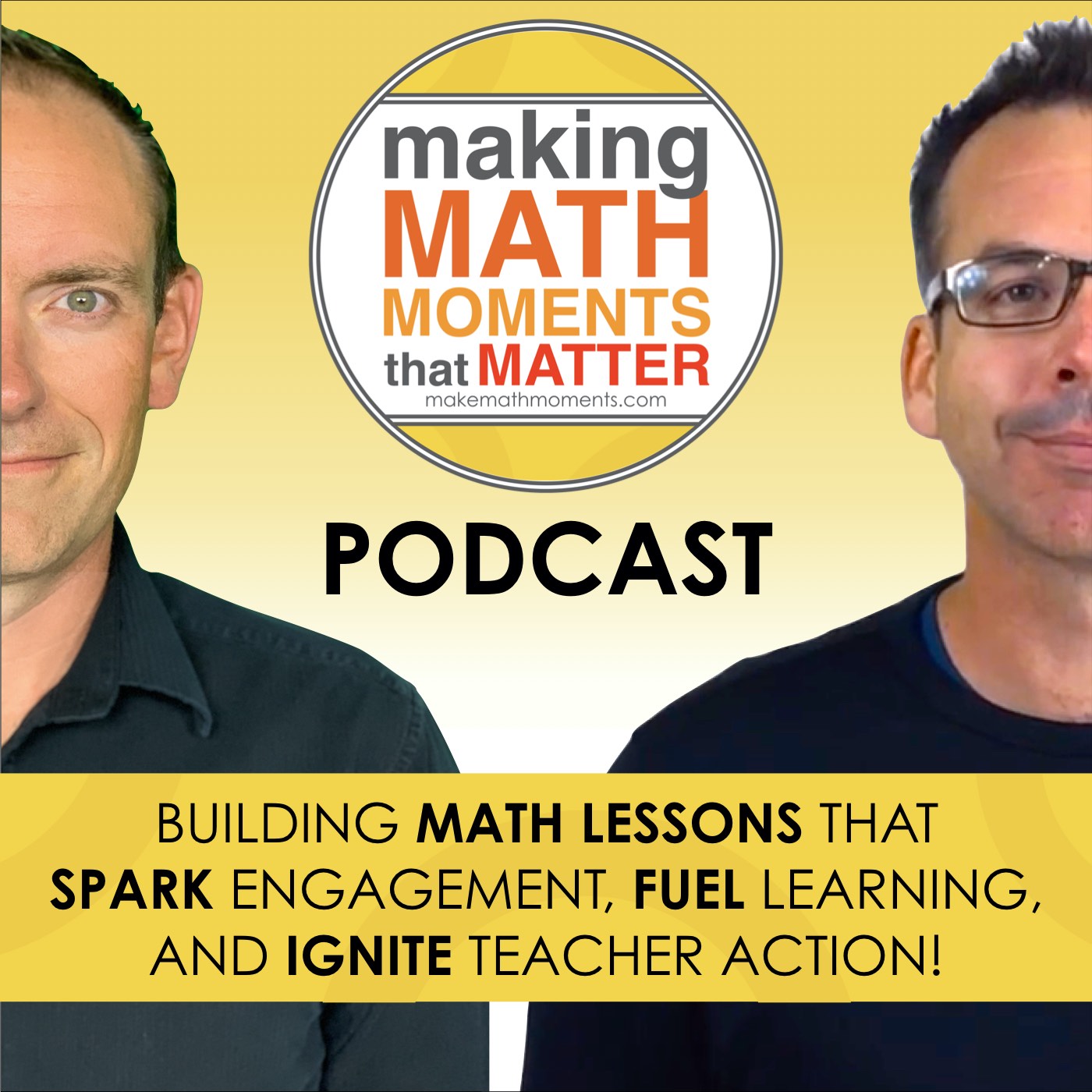
DOWNLOAD THE 3 ACT MATH TASK TIP SHEET SO THEY RUN WITHOUT A HITCH!
Download the 2-page printable 3 Act Math Tip Sheet to ensure that you have the best start to your journey using 3 Act math Tasks to spark curiosity and fuel sense making in your math classroom!
LESSONS TO MAKE MATH MOMENTS
Each lesson consists of:
Each Make Math Moments Problem Based Lesson consists of a Teacher Guide to lead you step-by-step through the planning process to ensure your lesson runs without a hitch!
Each Teacher Guide consists of:
- Intentionality of the lesson;
- A step-by-step walk through of each phase of the lesson;
- Visuals, animations, and videos unpacking big ideas, strategies, and models we intend to emerge during the lesson;
- Sample student approaches to assist in anticipating what your students might do;
- Resources and downloads including Keynote, Powerpoint, Media Files, and Teacher Guide printable PDF; and,
- Much more!
Each Make Math Moments Problem Based Lesson begins with a story, visual, video, or other method to Spark Curiosity through context.
Students will often Notice and Wonder before making an estimate to draw them in and invest in the problem.
After student voice has been heard and acknowledged, we will set students off on a Productive Struggle via a prompt related to the Spark context.
These prompts are given each lesson with the following conditions:
- No calculators are to be used; and,
- Students are to focus on how they can convince their math community that their solution is valid.
Students are left to engage in a productive struggle as the facilitator circulates to observe and engage in conversation as a means of assessing formatively.
The facilitator is instructed through the Teacher Guide on what specific strategies and models could be used to make connections and consolidate the learning from the lesson.
Often times, animations and walk through videos are provided in the Teacher Guide to assist with planning and delivering the consolidation.
A review image, video, or animation is provided as a conclusion to the task from the lesson.
While this might feel like a natural ending to the context students have been exploring, it is just the beginning as we look to leverage this context via extensions and additional lessons to dig deeper.
At the end of each lesson, consolidation prompts and/or extensions are crafted for students to purposefully practice and demonstrate their current understanding.
Facilitators are encouraged to collect these consolidation prompts as a means to engage in the assessment process and inform next moves for instruction.
In multi-day units of study, Math Talks are crafted to help build on the thinking from the previous day and build towards the next step in the developmental progression of the concept(s) we are exploring.
Each Math Talk is constructed as a string of related problems that build with intentionality to emerge specific big ideas, strategies, and mathematical models.
Make Math Moments Problem Based Lessons and Day 1 Teacher Guides are openly available for you to leverage and use with your students without becoming a Make Math Moments Academy Member.
Use our OPEN ACCESS multi-day problem based units!
Make Math Moments Problem Based Lessons and Day 1 Teacher Guides are openly available for you to leverage and use with your students without becoming a Make Math Moments Academy Member.
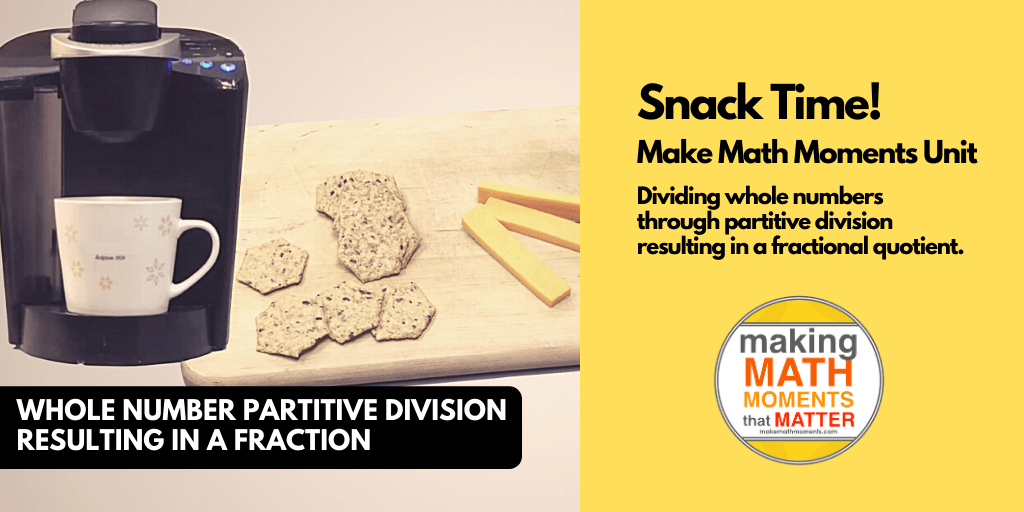
Partitive Division Resulting in a Fraction
Equivalence and Algebraic Substitution

Represent Categorical Data & Explore Mean
Downloadable resources including blackline masters, handouts, printable Tips Sheets, slide shows, and media files do require a Make Math Moments Academy Membership.
ONLINE WORKSHOP REGISTRATION
Pedagogically aligned for teachers of K through Grade 12 with content specific examples from Grades 3 through Grade 10.
In our self-paced, 12-week Online Workshop, you'll learn how to craft new and transform your current lessons to Spark Curiosity, Fuel Sense Making, and Ignite Your Teacher Moves to promote resilient problem solvers.

0 Comments