Episode #432: Helping Teachers Move Beyond the Algorithm in Math Instruction: Resistance to Teaching Multiple Strategies in Math
LISTEN NOW HERE…




WATCH NOW…
Are your teachers reluctant to move beyond the standard algorithm—even when it clearly isn’t working for their students?
In this episode, we explore a real-world example of a school trying to shift toward computational fluency—but getting stuck. The teachers agree that students need more accurate and efficient methods, but many still believe offering multiple strategies only adds confusion. Instead of pushing a solution, the school’s principal is taking a different approach: creating space for math epiphanies, building content knowledge, and shifting belief through structured staff learning.
If you’re a school leader or coach supporting math fluency in your school or district, this episode unpacks what it really takes to create shared commitment—not through mandates, but through deep learning.
Listeners Will:
- Learn how one school is building teacher buy-in for strategy-based fluency
- Understand why resistance to multiple strategies often stems from gaps in math content knowledge
- See how protected staff time is being used to shift beliefs and build instructional confidence
- Discover practical moves (like ICQ protocols and fluency-focused video routines) that create space for reflection and dialogue
- Reflect on the dual role school leaders must play—as both facilitators and math thinkers
If your school or district is working toward stronger fluency and deeper math learning, press play to explore what it really takes to lead that shift.
Attention District Math Leaders:
Not sure what matters most when designing math improvement plans? Take this assessment and get a free customized report: https://makemathmoments.com/grow/
Ready to design your math improvement plan with guidance, support and using structure? Learn how to follow our 4 stage process. https://growyourmathprogram.com
Looking to supplement your curriculum with problem based lessons and units? Make Math Moments Problem Based Lessons & Units
Be Our Next Podcast Guest!
Join as an Interview Guest or on a Mentoring Moment Call
Apply to be a Featured Interview Guest
Book a Mentoring Moment Coaching Call
Are You an Official Math Moment Maker?



FULL TRANSCRIPT
Yvette Lehman: How many times have you heard teachers share their frustration that, you know, my students just are struggling with computation? It’s like, just the four operators, we’re adding, subtracting, multiplying, dividing, and, you know, the algorithm isn’t working for them. A lot of inaccuracies. Students are coming up with answers that are not even reasonable, and then they’re asking themselves, you know, and we look at the solution and we’re like, does this even make sense?
Jon Orr: Yeah.
Yeah.
Yvette Lehman: and the students like, have no idea if it makes sense because I just followed the steps.
Jon Orr: Sure. That’s a main problem. think that here’s the next problem though, right? We want then to say, let’s not focus on the algorithm, let’s focus on strategies and maybe making use of models. But I’ve tried that. I’ve tried the multiple approach, but that’s even… That might be even more confusing and therefore I should just stick to one thing. Like let’s just give one solution. Like you recognize this is the problem, do it this way. Because at least then I’ve given them the one way to solve that. then, cause I feel like giving them too many options is confusing students.
Yvette Lehman: I actually just heard this last week from a teacher. That was exactly their reaction, right? It’s like, well, if the algorithm isn’t working for you and it’s not working for your students and your students are coming up with answers that are unreasonable, maybe there’s another way to approach that computation. And you’re right. The first reaction was like, I’ve tried that. And it just gets messy and it’s confusing. And if they can’t master one approach, how am I going to get them to own more than one?
Jon Orr: Mm-hmm.
Great.
Yvette Lehman: So now imagine you are the instructional leader in this building. And so, you you’ve identified and the staff agrees, know, your teachers are saying, yes, we want our students to have increased computational fluency. We want them to be accurate when they’re working with all four operators. We recognize that maybe for some, the standard algorithm approach is not working, but we’re also reluctant to teach more.
Jon Orr: Yeah, we’re not convinced.
Yvette Lehman: strategies. They’re not convinced.
Jon Orr: Yeah, we’re not convinced that the more is the more is better approach, you know, the optionality isn’t isn’t the better approach. It’s more it’s louder, stronger, you know, and more repetition of the first approach. That might be the ticket because it worked for me, you know, it worked for us, you know, but that’s that’s easier than trying to do, you know, all the other stuff because it’ll just confuse them more.
Yvette Lehman: We’re working with a principal right now. And what was really, I think, amazing about this particular site is this, identifying the problem that they wanted to solve was actually pretty easy for the staff. They came to a pretty quick consensus that, of course, they would all like to see their students increase their mathematical fluency as defined by working flexibly with all four operators based on what’s appropriate for their grade level. Where they’re struggling, is on the solution, agreeing or committing to a strategies-based approach. And so this principal is now in the position where I don’t think she is confident to move forward with the solution until the teachers themselves have some mathematical epiphanies around the value of maybe having more than one way to solve a problem.
Jon Orr: Mm-hmm.
Right.
And that’s, and that’s typically the, you’re saying is, is, typically the, I, the recommended solution that we talk about our teams with is, is when we are seeing resist, you know, I tried that multiple approach or multiple strategies approach, or I think the one way is the best way. How do I get my, how do I help my teachers see that being flexible is, is, is a better skill or a more worthwhile skill? to have as a student, but also as a teacher, then trying to just memorize the one way. Because that’s typically what these barriers are, is that we know that this is better for our kids in long run, but it’s hard to kind of get over the hump, I guess. What does that look like? How do I support? And the supporting, our recommendation is, this is what you’re helping this team with, is to say how many… But we have to help everyone with more access to like have those math epiphanies. Like what are some of those, the strategies that they don’t have? Because if I’m saying I think that one way is the better way, it’s just likely that I just haven’t had the confidence around all the other strategies to create the flexible superpower that I could have. And if I spent time supporting educators to create that,
Yvette Lehman: Mm-hmm.
Mm-hmm.
Jon Orr: and embedded into any sort of collaborative time we have together, then down the road, they’ll have like, it’ll be like through no fault of their own, all of a sudden they’ll have these strategies to rely on. And that is the convincer, right? Like the convincer isn’t like, just do more of it. The convincer is like, you’ve got to build their capacity up.
Yvette Lehman: The advantage that this particular site has is that they are willing and able to commit time every week to this work. So they meet as a staff weekly and a portion of that staff meeting every week is reserved for math because math is a priority at their site. Yeah, it’s awesome. They come together as a full staff. This is a K-5 school. And so where we started with this team is we had to start to shift belief. and shake up a little bit of the resistance. And so we started by engaging in some webinars together, watching some videos, and we used an ICQ protocol, which is that confirms my current belief and something that I’m questioning. So it leaves space for people to say, I don’t believe this, know, or this, I’m not convinced of this. So we’ve created two opportunities so far. The first one was we had them engage with Jennifer Bay Williams session from the summit, you know, where she basically talks about, I wanna say in the first 10 minutes, it’s like, She pretty bluntly says, you know, the ways that sometimes we try to say students are going to build their fluency, you know, through rote practice and memorization is just, the research does not back that. And I think sometimes people need to hear that from somebody other than their instructional leader in their building. You know, somebody that’s respected in the math community and again, with space for them to also push back or challenge. Like this was not a space where it’s like, let’s watch this webinar and everyone needs to agree.
Jon Orr: That’s right.
Yvette Lehman: It’s just an opportunity to begin having some discourse and to maybe start questioning if the way that we were taught or the way that we’re teaching is actually getting us the results we want for students and maybe opening our eyes to the possibility of there being another way that we hadn’t yet considered. I also really love there’s a YouTube clip from Christina Tondevold and we’ll link it in the show notes. The clip itself is actually about the difference between procedural fluency and conceptual understanding. But in this 10 minute clip, she talks about some really great examples of where the standard algorithm fails us, where it’s just super ineffective. And so she does, of course, know, the 1000 minus 999 stacked standard algorithm. And it’s like, wow, if I use the standard algorithm to solve that problem and I can’t just see that it’s one, like.
Jon Orr: Mm-mm.
It’s a lot of carrying. Yeah.
Yvette Lehman: That is such an inefficient way to approach that problem and really shows a deep lack of understanding of the behavior of subtraction. The other example she gives in the video is she talks about going into high school classes and students have to subtract 17 minus nine. And so they write it 17 minus nine stacked, and then they borrow the one and they still have 17 minus nine. It’s like we’re no closer to an answer.
Jon Orr: I’ve seen that, yeah.
Yvette Lehman: Right, of course, because we’re blindly following, right, we’re blind,
Jon Orr: I’m borrow the one again. You just didn’t do it enough.
Yvette Lehman: right, we’re blindly following these procedures that really aren’t helping us get to an answer. And so that’s where we kind of started was we just needed to shake belief a little bit and create a space for dialogue where we have a conversation starter about maybe the standard algorithm isn’t always the best way to approach problems. And wouldn’t it be amazing if students didn’t get stuck in these traps of being very inefficient or coming up with very inaccurate answers because they don’t know what they’re doing.
Jon Orr: ⁓ Yeah, yeah. What I love about what this team has done, you know, because if we think about the high level in terms of math improvement planning, because that’s really what’s happening here, right? Is that we’ve recognized that there needs to be a shift towards making sure that there’s fluency strategies happening in our classrooms and multiple strategies that are priority for where we’re trying to go. Therefore, I need to make that shift in our classrooms or we need it as a collective group need to make that shift in our classrooms. And instead of just saying, is where we’re going, here’s what the, we’re going to choose a curriculum and we’re going to stick, know, that follows this and do this and follow this with the pacing guide and go down this route. It’s, it’s they unpacking and taking into a consideration some really big elements of what you need to include for math improvement planning, which is one is realize that the barrier to most shifts is the content knowledge for our educators in the unfamiliarity of multiple strategies, multiple models, and what, say, models stretch vertically, which ones we need to rely on more than others, which strategies we could be helping with, like our students with, coming at it from the conceptual towards the procedural, like just having that fundamental belief shift happen, but also supporting that shift. in terms of the educators own capacity building around their own mathematical thinking and their own mathematical proficiency. We just don’t have that, you know, we don’t have that familiarity that we need our educators to have. And it’s not their fault. It’s it’s it’s we came through a system that just didn’t, you know, teach math and we still consistently don’t teach math that way. And we need to teach it to our educators or give them experiences. So I love that they’re focused on. But the other thing I really love is as another big picture element, like we got four big problems we solve with our teams. And one of them is obviously building capacity and making sure we’re focusing on that. The second one that they are doing a really great job on is making use of their subsystems for instructional improvement. they’re, you’re saying they’re, the priority here is to create epiphanies for mathematics so that it will translate into instructional practices down the road or even now. But we gotta make use, because we recognize a priority, we gotta find the time. Because it’s like, we don’t have time to do that. But it’s like, find the time. The fact that they’re meeting every week to do this type of work, it means I put the priority here. I’ve decided this is the priority. we’re going to come together to do more math together as a prior. And we’re going to make use of that collaborative time in that way. We’re not going to treat this like, you know, all the, all the logistics that we could be going over in this, all the stuff that could have been an email. We’re actually going to use this time to do this type of work because it, it’s going to lead us down this pathway. And there’s, can see what the future will look like if we stick to these two, really two things, focus on math. make use of the collaborative time to do it.
Yvette Lehman: I remember when I first met with this leader, that was one of her hesitations, I guess, is that she didn’t feel she had support or subsystems. So she’s a single administrator, no coach, no lead teacher, no math con, it’s a single administrator building, and they don’t have any embedded teacher collaboration time or PLCs. And so I think when this journey began, she actually was…
Jon Orr: Right?
Yvette Lehman: concerned about not having the right supports in place or having the subsystems, but the fact that, like you mentioned, she’s committed that, okay, the one system we do have is staff meetings. We have a staff meeting every Wednesday. She’s committed that, like you said, any of the logistical things that would be monopolizing that time are being put to the side, sent in email, addressed very quickly so that they can carve out, and sometimes they actually dedicate the whole hour. to math, you know, it’s a minimum half of the time, but most times it’s actually the full hour that they commit to this learning because it is a priority and their data, their benchmark assessment, their standard state test assessment suggests that there’s a critical need in math. And so this is how they are dedicating their professional development time this year. I also understand too that at the elementary level, math is often not the only priority, right? So it’s challenging, like it certainly is, but I think that they’ve done a really good job of saying, We know we can’t tackle everything at once. We don’t have the capacity. We don’t have the systems. So this is the one we’re going to commit to right now. And we’re going to go all in and we’re going to use all the time that we possibly can. I’m excited for this team’s journey. So I’m picturing, you know, I work with this principle and we come together after every staff meeting. We reflect on what emerged and then we plan. So we always gather some type of exit ticket or she does some anecdotal documentation to get a really good sense of where the room is at. so that we can target the learning for the next session. And so what I obviously would like to get to with this team is that they are doing math, right? So right now we’ve been mostly understanding the why or creating a space for dialogue, but now we need to get into a routine of every time we come together, we are building our own toolkit of strategies that we are better positioned to solve problems that don’t lend themselves to the standard algorithm with efficiency. The advantage this team has though, the principal does have a math background. So I just want to put that out there for everybody, right? That’s also a huge factor when it comes to this work at the school level.
Jon Orr: Yeah. Right. Right. There’s two conditions. She has the two conditions that you really need at a school level to do this type of work consistently. If you’re going to make use of those subsystems for and support, like a staff meeting or PLC is that you’ve got a skill facilitator who can lead individuals and can facilitate sessions and can rally the troops here. But then you also have a math. an understanding of the progressions of mathematics. Like you have a solid understanding of like what is important in mathematics. Like you can decide, like you can have that what’s important in mathematics, like fundamental core beliefs around learning mathematics, but you still need to have, you know, lead these sessions. Like you still need to be able to unpack, like when you’re doing division sessions, like what does this division look like? What are the models? What are the strategies that we could really unpack? Let’s grab our curriculum. Let’s tie it to that. She’s got that because she came with some of that math background prior to being in this role. And it’s not always the case that your instructional leader has that math background. And I’ll probably argue that typically that’s not the case. But you do need, who is that significant other that can do that work with you? Like that’s the duality that other teams have, or we try to encourage if you are gonna create that type of environment in a building or a system. That’s the type of, you know, the dual role you want to strive for. You know, the bigger system you have, the more people are involved, but you do at least need to have, say, at a school site, you know, who is the instructional leader for math? And is that the same person as the facilitator that can keep the wheels turning in the right areas, in the right, in the right piece and use the right pieces to do it? So they’ve got some great things happening here. if you zoom out a little bit too, is that this is one school inside of a larger system where the system also has many schools working on similar goals, similar processes. So when you bet, you said, I’m working with this principal, but really this school system is taking part of our district improvement programs. We’re supporting the entire district on improvement. And right now, the year that we’re on with them is specifically helping instructional leaders at school sites develop appropriate school goals and have, make use of say those support structures in appropriate ways to help them achieve those goals. And that’s some of the specific work we’re doing inside this bigger system. While we’re also meeting with say the system leaders to help design the other areas like vision and goal setting and sustainability and making sure that the you know, the program doesn’t rest on one or two people’s shoulders and how are you making use of distributive leadership. So we solve these types of problems inside this, inside this district, but specifically that is paired with a number of schools inside the district to kind of do that boots on the ground school site support work as well. So that’s the work, you know, we, we, we do on a consistent basis has helped team schools, school systems, design math, planning, and what that looks like. from a high level down into the school level. If you want to get a little bit more insight what this could look like for you, we have some space available. Head on over to mcmathmoments.com forward slash discovery. We can talk about your program soon.
Thanks For Listening
- Book a Math Mentoring Moment
- Apply to be a Featured Interview Guest
- Leave a note in the comment section below.
- Share this show on Twitter, or Facebook.
To help out the show:
- Leave an honest review on iTunes. Your ratings and reviews really help and we read each one.
- Subscribe on iTunes, Google Play, and Spotify.
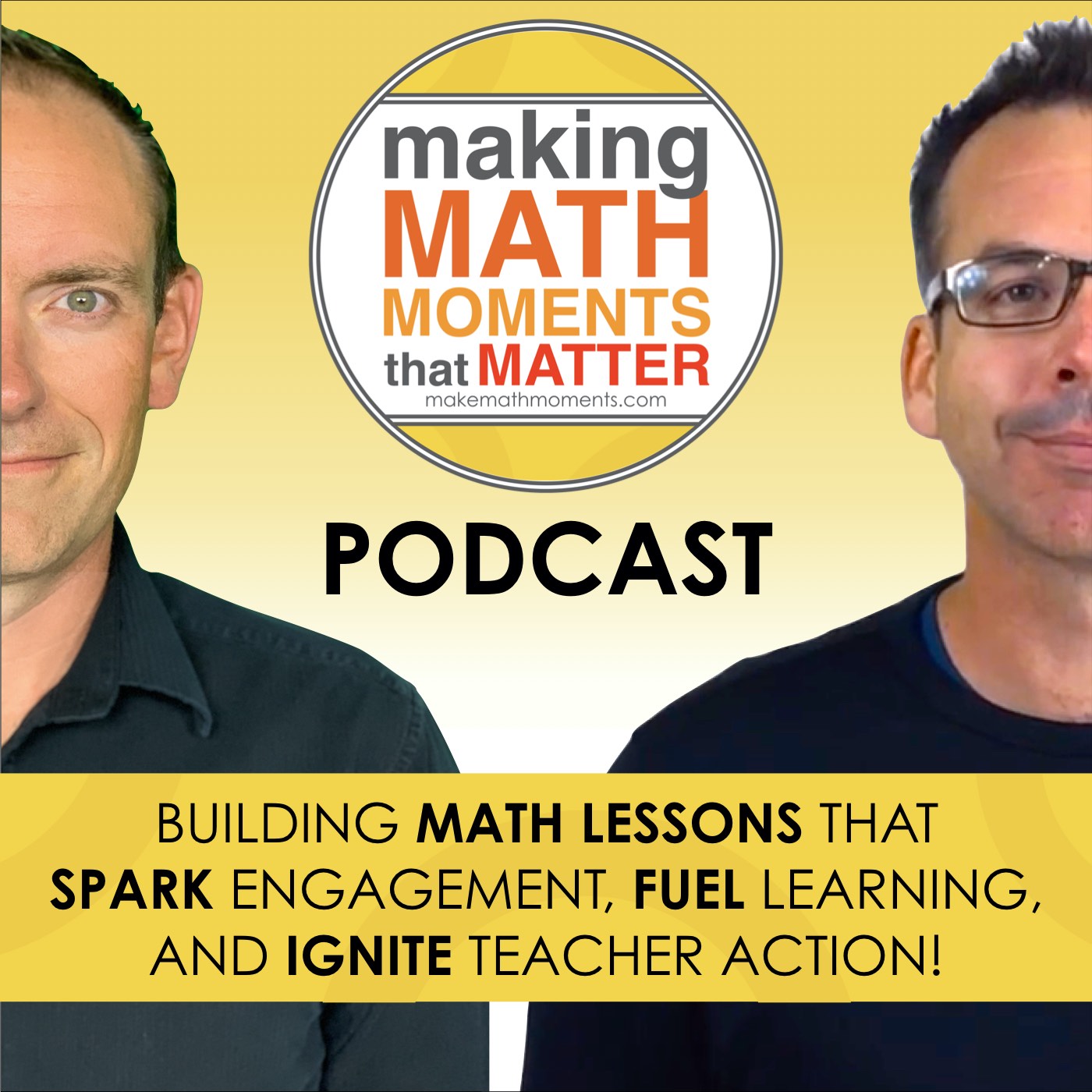
DOWNLOAD THE 3 ACT MATH TASK TIP SHEET SO THEY RUN WITHOUT A HITCH!
Download the 2-page printable 3 Act Math Tip Sheet to ensure that you have the best start to your journey using 3 Act math Tasks to spark curiosity and fuel sense making in your math classroom!
LESSONS TO MAKE MATH MOMENTS
Each lesson consists of:
Each Make Math Moments Problem Based Lesson consists of a Teacher Guide to lead you step-by-step through the planning process to ensure your lesson runs without a hitch!
Each Teacher Guide consists of:
- Intentionality of the lesson;
- A step-by-step walk through of each phase of the lesson;
- Visuals, animations, and videos unpacking big ideas, strategies, and models we intend to emerge during the lesson;
- Sample student approaches to assist in anticipating what your students might do;
- Resources and downloads including Keynote, Powerpoint, Media Files, and Teacher Guide printable PDF; and,
- Much more!
Each Make Math Moments Problem Based Lesson begins with a story, visual, video, or other method to Spark Curiosity through context.
Students will often Notice and Wonder before making an estimate to draw them in and invest in the problem.
After student voice has been heard and acknowledged, we will set students off on a Productive Struggle via a prompt related to the Spark context.
These prompts are given each lesson with the following conditions:
- No calculators are to be used; and,
- Students are to focus on how they can convince their math community that their solution is valid.
Students are left to engage in a productive struggle as the facilitator circulates to observe and engage in conversation as a means of assessing formatively.
The facilitator is instructed through the Teacher Guide on what specific strategies and models could be used to make connections and consolidate the learning from the lesson.
Often times, animations and walk through videos are provided in the Teacher Guide to assist with planning and delivering the consolidation.
A review image, video, or animation is provided as a conclusion to the task from the lesson.
While this might feel like a natural ending to the context students have been exploring, it is just the beginning as we look to leverage this context via extensions and additional lessons to dig deeper.
At the end of each lesson, consolidation prompts and/or extensions are crafted for students to purposefully practice and demonstrate their current understanding.
Facilitators are encouraged to collect these consolidation prompts as a means to engage in the assessment process and inform next moves for instruction.
In multi-day units of study, Math Talks are crafted to help build on the thinking from the previous day and build towards the next step in the developmental progression of the concept(s) we are exploring.
Each Math Talk is constructed as a string of related problems that build with intentionality to emerge specific big ideas, strategies, and mathematical models.
Make Math Moments Problem Based Lessons and Day 1 Teacher Guides are openly available for you to leverage and use with your students without becoming a Make Math Moments Academy Member.
Use our OPEN ACCESS multi-day problem based units!
Make Math Moments Problem Based Lessons and Day 1 Teacher Guides are openly available for you to leverage and use with your students without becoming a Make Math Moments Academy Member.
Partitive Division Resulting in a Fraction
Equivalence and Algebraic Substitution
Represent Categorical Data & Explore Mean
Downloadable resources including blackline masters, handouts, printable Tips Sheets, slide shows, and media files do require a Make Math Moments Academy Membership.
ONLINE WORKSHOP REGISTRATION
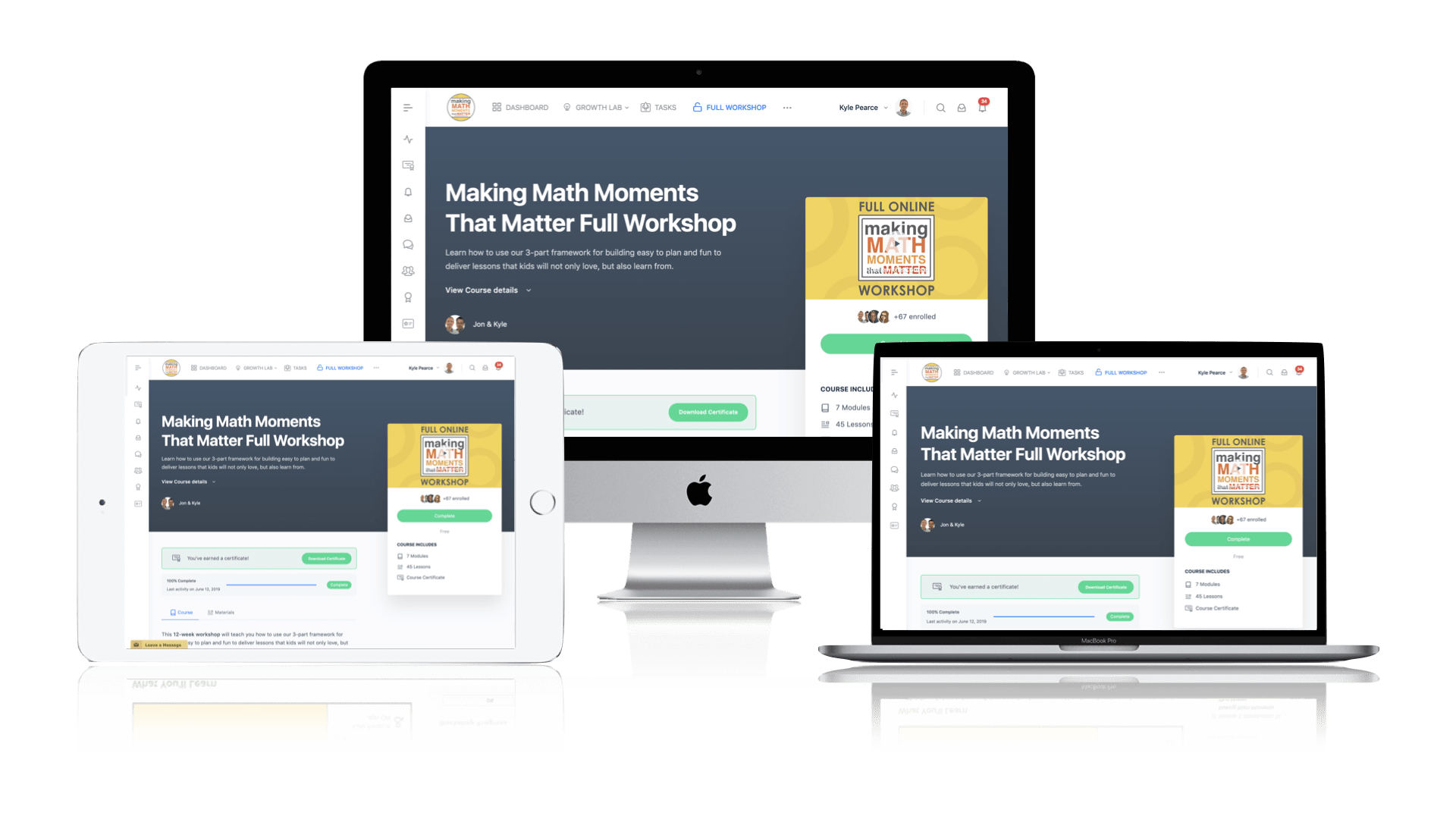
Pedagogically aligned for teachers of K through Grade 12 with content specific examples from Grades 3 through Grade 10.
In our self-paced, 12-week Online Workshop, you'll learn how to craft new and transform your current lessons to Spark Curiosity, Fuel Sense Making, and Ignite Your Teacher Moves to promote resilient problem solvers.

0 Comments