Episode #454: “I Want to Strengthen Math Fact Fluency”—But I Don’t Know Where to Start
LISTEN NOW HERE…



WATCH NOW…
You know math fluency is more than timed tests… but what does that actually look like in your classroom tomorrow?
Many teachers are at the awareness stage: they’ve read, listened, attended PD, and now understand fluency includes flexibility and strategy—not just accuracy and efficiency. But knowing that doesn’t automatically translate into action. Where do you start if you don’t yet know what to assess, what to look for, or what routines to run? In this episode, Jon Orr, Yvette Lehman, and Beth Curran talk through that exact tension and offer realistic first steps that build capacity while you teach.
Listeners Will Learn:
- The difference between basic fact fluency and procedural fluency (and why both matter)
- What “awareness → mechanical → routine → proficient” looks like in math fluency implementation
- Practical first moves: quick assessment, screeners, and number talk-style probes
- How to start building math fluency without pausing grade-level math
- Why teachers often revert to “ones, twos, threes…” memorization—and what to do instead
- Foundational fact clusters that unlock derived facts (not random memorization)
- How leaders and coaches can plan support across implementation stages
If you want a manageable entry point into math fluency—one that builds student fluency and your confidence—this episode will help you take your first step today and plan your next step for next week.
Attention District Math Leaders:
Not sure what matters most when designing math improvement plans? Take this assessment and get a free customized report: https://makemathmoments.com/grow/
Ready to design your math improvement plan with guidance, support and using structure? Learn how to follow our 4 stage process. https://growyourmathprogram.com
Looking to supplement your curriculum with problem based lessons and units? Make Math Moments Problem Based Lessons & Units
Be Our Next Podcast Guest!
Join as an Interview Guest or on a Mentoring Moment Call
Apply to be a Featured Interview Guest
Book a Mentoring Moment Coaching Call
Are You an Official Math Moment Maker?


FULL TRANSCRIPT
Yvette Lehman: I think today’s episode is actually for me, everybody. So I need you to help me answer this question. Because sometimes I’m not sure what recommendations to make when teachers are in this position that I’m about to describe. So imagine you’re a teacher who is at the awareness stage that you want to do something different than what you’ve been doing in the past to strengthen student fluency.
Jon Orr: Way to be selfish.
Yvette Lehman: So whether that’s basic fact automaticity or computational fluency, you’re like, I know that what I’ve been doing isn’t helping all learners. It’s not supporting retention. I’ve been attending webinars, I’ve been reading books. I’ve learned that we can define fluency as more than just accuracy and efficiency, that flexibility is another component of it. But I don’t know what that means for me tomorrow or next week. If I’m aware and I want to move from aware to mechanical towards routine, what is the first step?
Jon Orr: Okay. But let’s make sure we define those three stages you just talked about as well, because it’s like we’re speaking inside baseball. What do you mean awareness? What do you mean mechanical? And what do you mean routine? Before we take that move.
Yvette Lehman: So awareness, I’m using Jim Knight’s definition of the levels of implementation, but awareness means I know about it. I can tell you what it means. I recognize that maybe there’s a change that has to happen, but I haven’t actually put anything into action yet.
Yvette Lehman: Mechanical means I’m willing to start trying and it might be a little clumsy. I might be unsure, but I’m trying things. I’m experimenting. I’m starting to make some changes in my practice, but they probably still feel uncomfortable or I’m still reliant on a script or a lot of support. Whereas we get to routine and it’s like, this is becoming just part of what I do. It’s a habit. It’s starting to feel more comfortable, but at routine, I might still be rigid.
It’s like, imagine you’re implementing Cathy Fosnot’s problem strings and it’s like, I’m still holding the book and reading the script and following it exactly as it’s printed because I don’t own it yet. Whereas if I became proficient with that practice, it’s like I have now internalized it. I understand it with depth. I understand the why so well that I can also adapt it, refine it, innovate it in response to student learning in my classroom.
Jon Orr: So if we rewind then, you’re saying, let’s say I’m aware that fluency is more than just what I thought it was. So I’m aware now, but I don’t know what that looks like in the mechanical and I definitely don’t know what that means for routine or proficient. I’m aware of what it might mean, but I don’t know what that means for me going into my lesson tomorrow.
Because I sat in a PD session or I participated in a PLC where we talked about fluency as an important thing, or maybe someone shared the goal is fluency by the such and such. And I understand the term, but I don’t know what that really means for me tomorrow. That’s the question we’re after here today.
Beth Curran: That’s a big question. So I think that there are things that we need to talk about before we jump into giving recommended solutions for tomorrow in class. One of them is, are we talking about basic fact fluency or are we talking about procedural fluency? Because I think we need to identify the differences between the two just to be really clear. So I think oftentimes when we hear fluency, teachers immediately are thinking basic fact fluency.
The kids don’t know their facts. I can’t do anything with them because they don’t know their facts. Whereas fluency is much deeper. We can talk about procedural fluency. Can they look for an efficient strategy when solving a problem? And that might go beyond just basic facts. So I think we have to start there. I think we also need to make sure that teachers understand what they’re working with.
Jon Orr: Mm-hmm. Great.
Beth Curran: So we have to have some sort of assessment tool. What does that look like? Some sort of a screener to just figure out where are the students? What do I have that I can build on? I think we kind of need to clear up that stuff first. And I’d welcome your thoughts on that.
Yvette Lehman: I think that you did make a recommendation, Beth, which is maybe a first move is to screen. Maybe we need to gather some entry point. But I wonder, does it matter? Because if I want procedural fluency, the really flexible working with all four operators through application of different strands and concepts, I still need basic fact fluency. Basic fact fluency is nested within that bigger umbrella of procedural fluency.
So where do you start? Basic fact fluency is nested within that bigger umbrella of procedural fluency. So maybe in talking about first moves, initial steps for teachers to go down this path of strengthening fluency, I think you’re right. We do need to get clear on what we mean, but I wonder whether we’re talking about the big umbrella of all procedures or computational fluency with less friendly numbers, all four operators, or owning automaticity of our basic facts, we still need to start somewhere. There still needs to be an entry point.
Beth Curran: I do think that I 100 percent agree with you, Yvette, that we have to start with probably the basic facts first, because that’s going to be the foundation from which students build upon for everything else they do in math. And I think that if we surveyed teachers, they would say that that is the biggest thorn in their side right now, is that students don’t have that automaticity with their basic facts.
So we need to start by assessing foundational facts. For addition and subtraction, if students can’t automatically add one, two, and three, then that’s where we need to start. Can they fluently add one, two, and three, or are they still counting on? Are they counting on their fingers? Are they counting all? So we need to start there.
With multiplication and division, can they multiply and divide fluently by ones, twos, fives, and tens? Those are your foundational facts. I think when teachers enter into trying to create their own plan for developing basic fact fluency, they revert back to how we learned it. We’re all going to do our ones, then the whole class is going to do twos, then we’re going to do our threes, then fours, and we’re just going to go in order until everything is memorized.
A lot of research shows that there are some foundational facts, and if we want students moving from counting to deriving to mastery, then we have to build that foundation first. So we have to start with the ones, twos, fives, and tens with multiplication and division and adding and subtracting one, two, and three combos to 10, your doubles, 10 and some more. Those are foundational skills that students need to have in place in order to derive the other facts, which is ultimately where we want them to get.
Jon Orr: What I hear you saying, Beth, is that if I don’t know all that, I’ve got to invest myself in understanding what I’m really looking for if I’m going to do an assessment. I could just put a piece of paper in front of a kid and go like, is this going to tell me what I want to know, but I actually have to know what I’m looking for when I’m engaging with a student to gain this information.
What does it look like when a student is doing this move or this move? What does it look like if they have their doubles and they’re counting this way and that way? We have to invest in ourselves to make sure that we are positioned to make those moves.
Because it’s like, great, fluency tomorrow, let’s go in and assess. The likelihood is that we have to make sure that we put an investment on ourselves to understand these ideas. Is it me taking a course or taking a book or unpacking? Because I could spend 20 years in the classroom dedicated to this practice, or I could make sure that we invested a little bit more into understanding this ourselves while we know that this is important.
Or if I’m a leader, what am I doing to help that teacher see what this is supposed to look like at each stage? If we are going to get narrow on basic fact fluency and then think about procedural fluency, what does it look like if I’m in awareness stage as a teacher? What does it look like when I’m ready for mechanical? When I start to engage students in lessons that are strengthening these ideas, what should it look like for me to know as a teacher what the mechanical stage should look like so I know that I’m still here and I need to get better? We can take the approach of here’s what you could do in your class, but here’s what we need to do to build ourselves up.
Yvette Lehman: I agree with everything everyone’s saying. We have to build our own capacity. We need to understand whether we’re a teacher or a leader. But I also think there’s something to be said for I just need to start taking action. I can’t wait until my own mathematical journey is complete. What is one actionable step? Beth already shared one.
An actionable step is to do a screener, to sit with students interview style. Right now we are in a journey of exploring different screeners, but the one that we would most likely recommend is USNS. The Universal Screener for Number Sense from Forefront would be a really good place to start. Sometimes we don’t do a great job of actually telling people which one. At this point in our journey of exploring screeners, not to say there aren’t others, that is one that we would personally use in our own classrooms.
Beth Curran: I’m going to interrupt quickly though, Yvette, because that’s a big ask to start administering a screener that maybe you’re not familiar with, knowing that you’re going to have to sit down one-on-one with students. So what can they do tomorrow to do a quick assessment just to get a pulse? A number talk. Put one of those basic facts up on the board and ask students all the different ways that they can think about entering into this.
That’s going to give you some information as to where your group is. Is it going to give you individual information? No, but it’s going to give you an idea of where they are. Starting with maybe an addition fact, I always go to the eights and the sevens, eight plus seven. Great addition fact that students can talk through a lot of different ways to add that. You’re going to be able to see, did they use their doubles? Did they use combos to 10? Are they still counting? Are they saying eight and then counting on their fingers seven to add seven to that?
That’s a great one. And eight times seven is a great one for multiplication. Are students connecting their fours facts to the eight facts? Are they decomposing seven into two and five? Or do they have automaticity already? Can they just say eight times seven is 56? So I think just starting even with a number talk and then based on that and the feel that you’re getting from your class, then maybe we move into a formal screener that we can sit down and do.
Yvette Lehman: I’m going to be a devil’s advocate. The move that you’re describing would imply that I know what to ask. I wonder if sometimes we need a tool to tell us what to ask and what to look for. If I was going to go in and do dynamic assessment and I know that this is a powerful fact to assess because I understand that, I think it requires more cognitive lift for teachers than if I was told these are the ones to ask because these are good indicators of fluency at this grade level.
That’s why maybe I would lean toward something that’s already been developed for me, because otherwise I’m the one having to come up with what particular facts to assess for that grade.
Jon Orr: You could argue that if I’m coming up with the prompt to get the information I need to know to make an assessment where these students are on their fluency journey, you’re probably not in the awareness stage. You’re already in the stage of mechanical and probably into routine if you can give the right prompt and then look for the right things.
So that is a good point to bring up here, which is how do I start when I don’t have anything? It’s the chicken or the egg. Do I need to make sure that I start somewhere? The move here could be to rely on a pre-made screener. But then you have to go back and go, is that the best move? If I just have this thing that I have, do I know how to use that?
Beth Curran: The screener is going to give you far more information than just basic fact fluency. If we’re talking about just basic facts, it is the chicken and the egg. Do we invest in ourselves first and get comfortable and flexible with calculating before we try something in the classroom? Or if your question was what can I do tomorrow in my classroom, if I know there’s a fluency problem, what can I do tomorrow? I think that’s the big question.
Yvette Lehman: To share a little bit of my own journey, what worked for me, I was not willing to wait until I had mastery or proficiency for it to impact my students. I’m going to start this tomorrow. I used Marion Small’s Prime Assessment. That was a good place for me to start, to understand developmentally what students should be able to do efficiently and confidently with very little cognitive demand.
I remember doing that assessment and realizing things about students that I had no idea. I had a student who I couldn’t figure out why she was struggling so much with application problems. She seemed to be a strong student. I couldn’t unpack what was falling apart. Every time she got to a multi-step application type problem, she wasn’t having success.
I used Prime with her and I learned through that assessment that she was an additive thinker, not a multiplicative thinker. When she looked at five and 15, she saw plus 10. She hadn’t moved beyond that additive phase to being able to use multiplicative reasoning. Once I was able to unearth that barrier for her, I knew what the intervention was going to look like. I wouldn’t have known that had I not used a research-based tool to understand development.
Another resource that I really liked was Alex Lawson’s book called What to Look For. It gives you quick number talk routines that you can administer, and based on what the student does, here’s your next step. I used that with my son because he got stuck at the counting all phase. He would count four red, count five blue, and then recount them all from the beginning when I asked how many there were. In that book it was like, here’s the prompt, if they do this, then do this. I really needed that. I didn’t have the understanding myself to know how to take them from repeated addition to something more sophisticated. I was reading the book as I did the work.
Beth Curran: Maybe we can tag that resource in the show notes for everyone to look at. And that could be another podcast too, where we could dig into some examples of what teachers could do. I think this is a pretty big question that you’re asking.
Jon Orr: Think about what went into getting you to that space to take those moves yourself. If I’m a leader designing, we started this episode by saying teachers are now in the awareness that fluency is a priority to strengthen in the classroom. Maybe I sat in that PD session or we were at a staff meeting and it was like this is our goal for the year.
How do I design the professional development knowing that my teachers may be in awareness to put them in a position to be like you? Mapping out what does it look like for the teachers I’m supporting at each of these stages. What are the moves I want teachers to take when they’re in awareness? What should that look like? What resources should we put in front of them so they have the moves available and the training available?
Is the staff meeting tied to the PLC or the coaching that’s going to come after? We have to make sure that’s coordinated to support moving through these stages. How do I build the look-fors to help each teacher move through the stages of what does it look like teaching this, so that teachers also know what it looks like in the classroom when students are strengthening their fluency? It’s multi-layered thinking that has to happen. That’s an important move to make as a leader.
Beth Curran: One other thing I would recommend for teachers who just aren’t sure where to start is to think about what your practice looks like in the classroom. Are you providing students an opportunity to practice fact fluency in the classroom? Maybe another what can I do tomorrow would be teach students how to play a game to practice fact fluency and commit to providing time for students to practice by playing those games.
Find a great game. It could be something as simple as addition or subtraction war or multiplication with a deck of cards. Provide that opportunity for students to practice in class. We can’t just be giving them a time test on Monday, again on Wednesday, and then on Friday. We have to be doing some instruction in between.
If you’ve determined that fact fluency is an issue in your classroom, that doesn’t mean that you put the brakes on teaching your curriculum and your content. It’s something that you do while you are moving through that. We are not saying stop work for a month to develop basic fact fluency and then jump back into your curriculum. We’re saying here’s something you can do that’s going to complement what you’re currently doing. You still need to keep moving through grade level content.
Yvette Lehman: To summarize some of the big ideas here today, we’re trying to figure out what’s a first move. I’m at that awareness stage. I know that I want to change. Maybe we start with assessing. Maybe we sit down and get an understanding of where our starting point is from an asset-based lens. What can students do that I can build from?
We talked about leveraging solid research-based resources like Alex Lawson’s What to Look For or Jennifer Bay Williams’ Figuring Out Fluency. Another high-leverage move is to start building in fluency games, redefining what practice looks like away from worksheets with stacked problems to meaningful, engaging games that support retention. That’s a high-leverage move that we could do tomorrow.
Jon Orr: We talked about many aspects of our math class. The leaves of the tree are sometimes the resources that we have to make use of engagement. We talked about the branches of the tree, which are the moves that we make. We talked about the limbs of the tree, which is what our professional development needs to look like in order to engage teachers or engage ourselves to go down a pathway that we know is important.
We believe that there are six key elements of an effective math classroom for ourselves and our students. If you want to learn a little bit more about those six areas and maybe where you stand or what pieces you could strengthen, you can head over to makemathmoments.com forward slash report. You can fill out an assessment there that helps you gain insight on those six areas and get some next steps to support each of those areas. That’s makemathmoments.com forward slash report.
Thanks For Listening
- Book a Math Mentoring Moment
- Apply to be a Featured Interview Guest
- Leave a note in the comment section below.
- Share this show on Twitter, or Facebook.
- Leave an honest review on iTunes. Your ratings and reviews really help and we read each one.
- Subscribe on iTunes, Google Play, and Spotify.
1 Comment
Submit a Comment
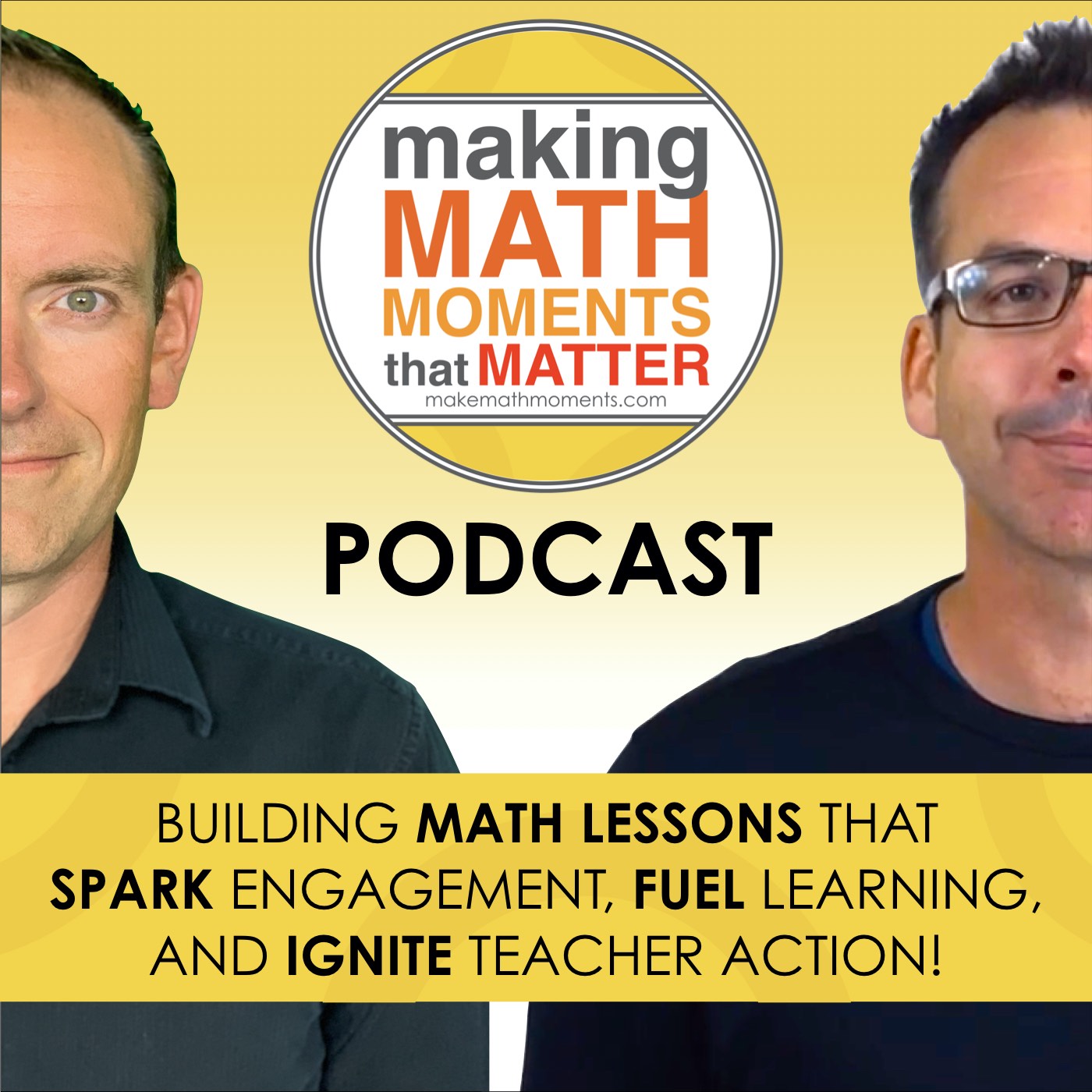
DOWNLOAD THE 3 ACT MATH TASK TIP SHEET SO THEY RUN WITHOUT A HITCH!
Download the 2-page printable 3 Act Math Tip Sheet to ensure that you have the best start to your journey using 3 Act math Tasks to spark curiosity and fuel sense making in your math classroom!
LESSONS TO MAKE MATH MOMENTS
Each lesson consists of:
Each Make Math Moments Problem Based Lesson consists of a Teacher Guide to lead you step-by-step through the planning process to ensure your lesson runs without a hitch!
Each Teacher Guide consists of:
- Intentionality of the lesson;
- A step-by-step walk through of each phase of the lesson;
- Visuals, animations, and videos unpacking big ideas, strategies, and models we intend to emerge during the lesson;
- Sample student approaches to assist in anticipating what your students might do;
- Resources and downloads including Keynote, Powerpoint, Media Files, and Teacher Guide printable PDF; and,
- Much more!
Each Make Math Moments Problem Based Lesson begins with a story, visual, video, or other method to Spark Curiosity through context.
Students will often Notice and Wonder before making an estimate to draw them in and invest in the problem.
After student voice has been heard and acknowledged, we will set students off on a Productive Struggle via a prompt related to the Spark context.
These prompts are given each lesson with the following conditions:
- No calculators are to be used; and,
- Students are to focus on how they can convince their math community that their solution is valid.
Students are left to engage in a productive struggle as the facilitator circulates to observe and engage in conversation as a means of assessing formatively.
The facilitator is instructed through the Teacher Guide on what specific strategies and models could be used to make connections and consolidate the learning from the lesson.
Often times, animations and walk through videos are provided in the Teacher Guide to assist with planning and delivering the consolidation.
A review image, video, or animation is provided as a conclusion to the task from the lesson.
While this might feel like a natural ending to the context students have been exploring, it is just the beginning as we look to leverage this context via extensions and additional lessons to dig deeper.
At the end of each lesson, consolidation prompts and/or extensions are crafted for students to purposefully practice and demonstrate their current understanding.
Facilitators are encouraged to collect these consolidation prompts as a means to engage in the assessment process and inform next moves for instruction.
In multi-day units of study, Math Talks are crafted to help build on the thinking from the previous day and build towards the next step in the developmental progression of the concept(s) we are exploring.
Each Math Talk is constructed as a string of related problems that build with intentionality to emerge specific big ideas, strategies, and mathematical models.
Make Math Moments Problem Based Lessons and Day 1 Teacher Guides are openly available for you to leverage and use with your students without becoming a Make Math Moments Academy Member.
Use our OPEN ACCESS multi-day problem based units!
Make Math Moments Problem Based Lessons and Day 1 Teacher Guides are openly available for you to leverage and use with your students without becoming a Make Math Moments Academy Member.
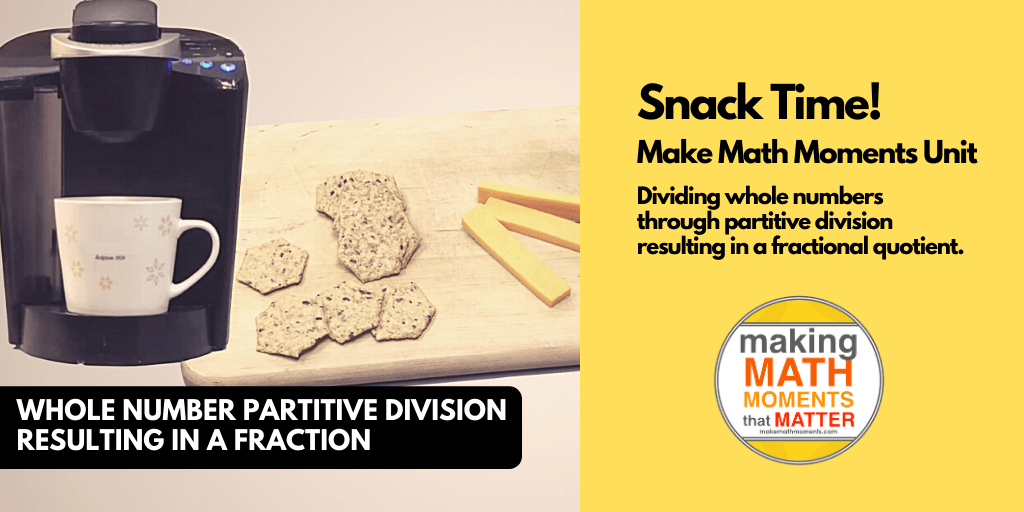
Partitive Division Resulting in a Fraction
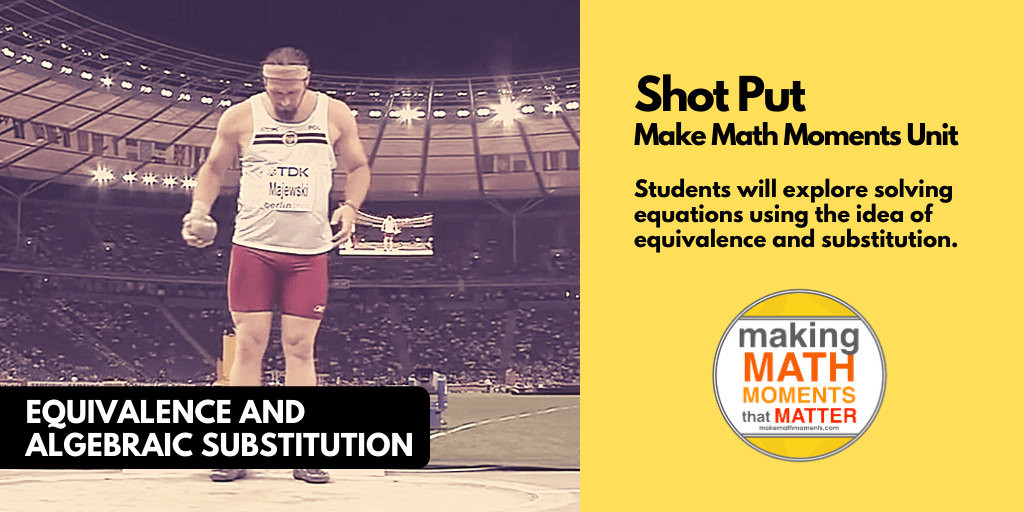
Equivalence and Algebraic Substitution
Represent Categorical Data & Explore Mean
Downloadable resources including blackline masters, handouts, printable Tips Sheets, slide shows, and media files do require a Make Math Moments Academy Membership.
ONLINE WORKSHOP REGISTRATION
Pedagogically aligned for teachers of K through Grade 12 with content specific examples from Grades 3 through Grade 10.
In our self-paced, 12-week Online Workshop, you'll learn how to craft new and transform your current lessons to Spark Curiosity, Fuel Sense Making, and Ignite Your Teacher Moves to promote resilient problem solvers.
The awareness to action gap is the part that quietly stalls a lot of fluency work. What helped me cut through it with my own daughter was picking one small daily diagnostic. We used a three second per fact recall check. Not because speed is the goal, but because it tells you something useful in 30 seconds: which facts she actually retrieved versus which ones she is still reconstructing every time. From there the next step writes itself. The slow ones get short daily review at widening intervals, the fast ones get out of the way. Sessions ended up at three to five minutes, which was the only length she would not push back on. Strategy talk during the lesson, fast retrieval check between lessons. The two halves did not compete the way I expected them to.