Episode #473: How to Unpack Standards for Better Lesson Planning in K-12 Mathematics
LISTEN NOW HERE…



WATCH NOW…
In math education, there are a lot of terms that get used interchangeably—unpacking standards, planning units, designing lessons. But for many teachers, it’s not always clear how these pieces fit together. Are they all the same thing, or is there an important difference that impacts how we teach?
At first glance, it might seem like lesson planning is simply following a resource or turning the page in a curriculum. But without a clear understanding of the standard—the destination we’re aiming for—it becomes difficult to make intentional decisions during instruction. When teachers aren’t clear on what success actually looks like, it limits their ability to question effectively, give meaningful feedback, and gather evidence of student understanding. Whether you’re using a high-quality resource or building lessons from scratch, clarity around the standard is what connects everything together.
In this episode, you’ll explore:
- The difference between unpacking a standard, planning a unit, and designing a lesson
- Why standards should be viewed as the destination for learning
- How teacher clarity impacts student success
- What it really means to “unpack” a standard
- How to define success criteria and identify evidence of learning
- Why collaboration is key to strengthening this work
If you’ve ever wondered whether you’re truly planning with purpose—or just following a resource—this episode will help you rethink your approach and bring more clarity to your math instruction.
Attention District Math Leaders:
Not sure what matters most when designing math improvement plans? Take this assessment and get a free customized report: https://makemathmoments.com/grow/
Ready to design your math improvement plan with guidance, support and using structure? Learn how to follow our 4 stage process. https://growyourmathprogram.com
Looking to supplement your curriculum with problem based lessons and units? Make Math Moments Problem Based Lessons & Units
Be Our Next Podcast Guest!
Join as an Interview Guest or on a Mentoring Moment Call
Apply to be a Featured Interview Guest
Book a Mentoring Moment Coaching Call
Are You an Official Math Moment Maker?


FULL TRANSCRIPT
Yvette Lehman: Today we’re going to try to get some clarity around some of these terms that get thrown out there. A teacher reached out recently saying, I hear a lot about studying standards or curriculum expectations. I hear about studying units or studying lessons. And I’m left wondering — what’s the difference? When one person says study standards versus study your unit versus study your lesson or lesson internalization, is it all the same? Or is there a nuance here?
Jon Orr: Good question. What is the difference between unpacking a standard and lesson planning, and is there one?
Yvette Lehman: I know they’re interconnected — I can’t plan for my lesson without knowing and understanding the standard. I really liked this metaphor that describes it as: the standard is the destination, it’s where you’re trying to go. The curriculum, the textbook, or the unit is the route — the path you’re going to take to get there. And your lesson is the daily steps you’re taking, the distance you’re traveling that day. They’re all connected, and I see them being really connected through the backwards design approach. That’s why you often hear people say, start with the standards.
Jon Orr: I think a lot of us have not looked at lesson planning that way. What we tend to do — and I remember doing this for many years — is rely on the resource to do that part for you. And sometimes the issue there is that you’re letting someone else tell you what the goal of your lesson is. You might not necessarily know what the actual standard from your policy documents is actually referring to, so you can’t make appropriate interpretations of that lesson. You’re saying, hey, someone smarter than me put this lesson together, this resource covers my standards, so all I have to do is turn the page and look at the order of the lesson.
Jon Orr: I’m sharing this as a cautionary tale because I used to do this, and many still do. But why is that a problem? Why should we start with the standard if we know that this is already done for us by the resource?
Yvette Lehman: We can lean on two extensive bodies of research here — Grant Wiggins and John Hattie. Grant Wiggins, the grandfather of backwards design and Understanding by Design, talks about this idea that if we aren’t clear on the destination, I can turn the page, but my questioning, my feedback, the moves I make to take every child from where they are and get them as close to the destination as possible — all of that gets undermined if we don’t have clarity around where we’re going.
Yvette Lehman: That connects to Hattie’s research as well around the effect size of teacher clarity — how clear is the teacher on where we’re going and what the expectation is for achievement at the end of this learning cycle? So really starting with that end goal, that destination in mind — what is the expectation for a third grade student interacting with this particular curriculum expectation or state standard — is where we need to begin.
Jon Orr: And this is where the learning goal on the board comes from — the idea that we’ve got to be clear on where we’re trying to go and students need to be clear as well. I work with a lot of teachers who think that starting with the standard just means writing the learning goal on the board. But is that really what unpacking a standard means, and how it relates to lesson planning?
Yvette Lehman: My mind is going in two directions here, because I’m thinking about the teacher who has a high-quality instructional material that is standards-aligned, as opposed to a teacher who is piecing together different resources. The move might differ slightly in those two scenarios. So let’s talk about the teacher who does have a high-quality instructional material.
Yvette Lehman: For that teacher, the move is not just writing the learning goal and stopping there. The move might be to go to the summative assessment for that unit and look at the performance task related to that standard. So if the standard is around understanding the difference between direct and indirect variation, what are we asking students to do by the end of this learning cycle, and how are we defining success?
Jon Orr: Right. And that’s the key. Unpacking a standard is not just looking at what standard you’re covering. It’s really internalizing for yourself what success looks like when a student at your grade level has actually achieved that standard. Because standards can be written very plainly — and what they look like in practice, from a student actually achieving that expectation, needs to be very clearly defined. A lot of times standards don’t give you that picture.
Jon Orr: Defining what that looks like for a student at your grade level is really important. And it’s really hard to do alone. Your high-quality resource might help you look at exemplars, what grade level looks like, what it doesn’t look like — but still having discussions amongst staff, amongst peers, whether they’re in the same grade band or a different grade — that’s the real power of unpacking standards. It’s important to look at the success criteria at your grade level collaboratively so that you can then effectively follow the path, look at the path, or redesign the path that you’re having with your lessons.
Jon Orr: That’s the lesson planning process — how do you create or experience and witness, or collect evidence on, that success criteria of the standard.
Yvette Lehman: If we leverage Grant Wiggins’ framework, he helps us understand that unpacking a standard is exactly that — having clarity around what students should know, understand, and be able to do, and then your indicators of success. Here in Ontario, our marks on the report card are based on the provincial standard — whether or not students have met or exceeded it. But there isn’t always a lot of clarity around what the provincial standard actually looks like in practice. So coming together with colleagues at the same grade level, above, and below, to really create those exemplars and talk about — by the end of this unit, how will we determine whether a child has met or exceeded the provincial standard? What are the indicators?
Yvette Lehman: And the reason I was distinguishing between teachers with high-quality material versus without is that Grant Wiggins would suggest that part of this work is designing the performance task that is going to elicit the evidence. If you don’t have a high-quality instructional material already doing that for you, part of the unpacking is designing it yourself.
Jon Orr: Exactly. For me, this was a long process of redesigning my lessons because I wanted more opportunities to see student thinking so that I could see where they were in their understanding of the standard. Know, understand, and do were different things. And I was used to just asking a question and seeing whether students could do it — a multiple choice item, for example, where you don’t always get to see the thinking.
Jon Orr: Everything in my lesson planning process became about: how do I create more opportunities to see evidence on a day-to-day basis? Because I’d clearly defined what the success criteria looked like for those standards. And if you don’t have a high-quality resource doing that for you, you have to design your lessons yourself — and you can’t do that if you don’t know what the standard looks like or what student success looks like. That’s an important part of the process.
Yvette Lehman: So what you’re reinforcing, Jon, is that even if I have high-quality instructional material, if I don’t know the destination, I can’t look for evidence of progress toward that outcome throughout the journey. Hattie also has a very high effect size around student-generated assessment, where students are actually assessing themselves relative to the standard — metacognition. How do we create opportunities for students to reflect on their progress toward the intended outcome if nobody knows what it is until we get there?
Yvette Lehman: So I think we’ve proven our point about why we need to start with the standard — we need to define the destination first. And then, as they say, you don’t teach standards directly, you design toward them. We are designing a path to get everybody as close to the destination as possible.
Jon Orr: And I think we’ve also separated the difference between lesson planning and unpacking standards, and the relationship between them. This is the work of strengthening our practice. When we talk about how do we strengthen teacher practice in the classroom, how do we be more consistent across grade levels inside a school or school system, teams are taking time to unpack standards in their PLCs — in the short collaborative times they have, at staff meetings every other month — realizing that’s an important component. We need to understand the standards so that we can understand the lesson design process, whether we design lessons ourselves or we need to understand why a lesson was created the way it was so we can observe the evidence along the way.
Jon Orr: If we’re serious about strengthening our practice using high-quality resources, we have to make sure we’re taking the time — and wherever we can find it. Everyone says time is scarce, but we can always find little pieces or restructure time. It’s about building that collaborative process into your school or school system so that we can share and understand where students are and what success looks like by grade level and by standard.
Jon Orr: This is what the teams we’re supporting are focusing on right now — making sure their PLCs are structured to do this type of work. It’s part of our flywheel approach. The PLC lives in stage two and stage three of our flywheel. Stage one is about vision and goals and ensuring alignment and coherence. Stage two is about aligning the practices and structures — what are the components that can help us get to our goals quicker because we’ve aligned the support structures? PLCs live there. A lot of times the teams we begin working with have PLCs that haven’t been used effectively. We guide them through that process. And it also lives in stage three, which is about building capacity — and you can’t build capacity without understanding your standards and knowing what the grade-level expectations are.
Jon Orr: A team asked me the other day, if we only had to do one thing, what’s the most important thing we could do structurally to support math moving into the next year? I said exactly what we’re talking about here today. Figure out how to create more collaborative time so teachers can unpack standards and link them to the curriculum they’re teaching. If you can do that consistently — not just once, but woven into how you do business in math improvement — two or three years from now, your system is going to be stronger mathematically because of it. And that will turn into student achievement results down the road, just because you have stronger educators focusing on the right things in mathematics.
Yvette Lehman: I think it’s really, as you mentioned, this is the work we’re doing right now — in person, with the district and school teams we’re supporting, strengthening the use of this time. So if anybody is thinking, okay, these are great ideas, but I want to practically understand how I would facilitate a PLC that helps us focus on the destination and plan the route — book a call. We can certainly support you in navigating that conversation and designing a framework that’s going to work within your context.
Jon Orr: And if you’re listening as this goes out, we do have some spots moving into the next school year. Book that call — head on over to makemathmoments.com forward slash discovery. On that call we’ll talk about the moves you’ve made so far and what your practical next steps can look like, so that you walk away just from that one call knowing some moves but also feeling good about the process moving forward. Looking forward to sharing some ideas with you at makemathmoments.com forward slash discovery.
Thanks For Listening
- Book a Math Mentoring Moment
- Apply to be a Featured Interview Guest
- Leave a note in the comment section below.
- Share this show on Twitter, or Facebook.
To help out the show:
- Leave an honest review on iTunes. Your ratings and reviews really help and we read each one.
- Subscribe on iTunes, Google Play, and Spotify.
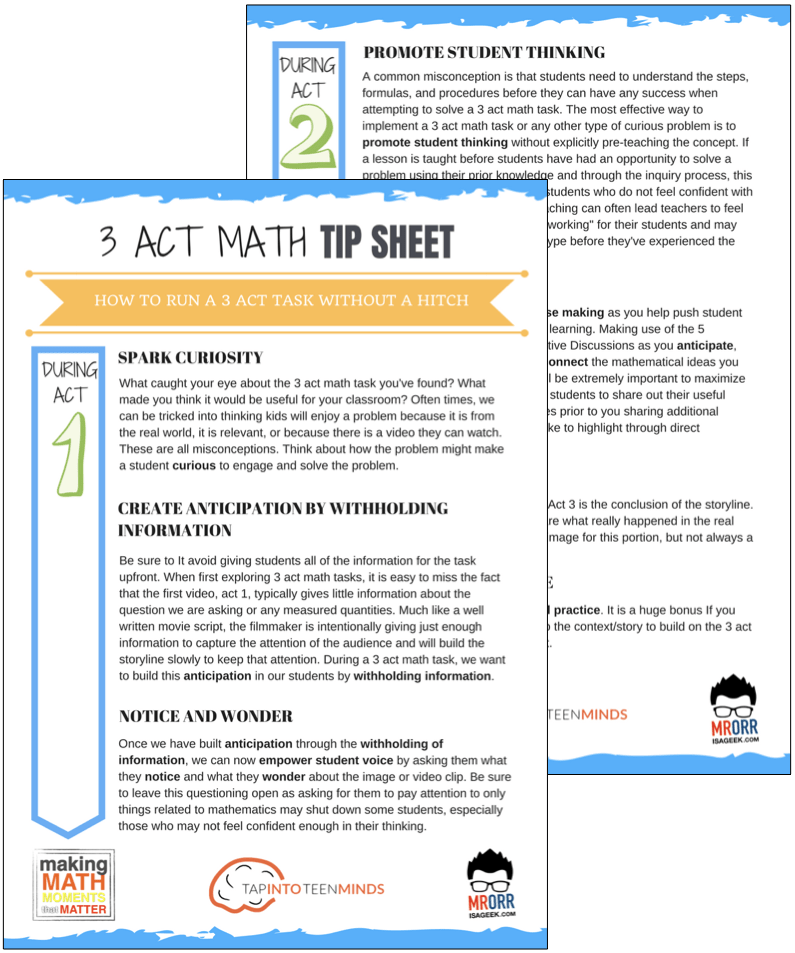
DOWNLOAD THE 3 ACT MATH TASK TIP SHEET SO THEY RUN WITHOUT A HITCH!
Download the 2-page printable 3 Act Math Tip Sheet to ensure that you have the best start to your journey using 3 Act math Tasks to spark curiosity and fuel sense making in your math classroom!
LESSONS TO MAKE MATH MOMENTS
Each lesson consists of:
Each Make Math Moments Problem Based Lesson consists of a Teacher Guide to lead you step-by-step through the planning process to ensure your lesson runs without a hitch!
Each Teacher Guide consists of:
- Intentionality of the lesson;
- A step-by-step walk through of each phase of the lesson;
- Visuals, animations, and videos unpacking big ideas, strategies, and models we intend to emerge during the lesson;
- Sample student approaches to assist in anticipating what your students might do;
- Resources and downloads including Keynote, Powerpoint, Media Files, and Teacher Guide printable PDF; and,
- Much more!
Each Make Math Moments Problem Based Lesson begins with a story, visual, video, or other method to Spark Curiosity through context.
Students will often Notice and Wonder before making an estimate to draw them in and invest in the problem.
After student voice has been heard and acknowledged, we will set students off on a Productive Struggle via a prompt related to the Spark context.
These prompts are given each lesson with the following conditions:
- No calculators are to be used; and,
- Students are to focus on how they can convince their math community that their solution is valid.
Students are left to engage in a productive struggle as the facilitator circulates to observe and engage in conversation as a means of assessing formatively.
The facilitator is instructed through the Teacher Guide on what specific strategies and models could be used to make connections and consolidate the learning from the lesson.
Often times, animations and walk through videos are provided in the Teacher Guide to assist with planning and delivering the consolidation.
A review image, video, or animation is provided as a conclusion to the task from the lesson.
While this might feel like a natural ending to the context students have been exploring, it is just the beginning as we look to leverage this context via extensions and additional lessons to dig deeper.
At the end of each lesson, consolidation prompts and/or extensions are crafted for students to purposefully practice and demonstrate their current understanding.
Facilitators are encouraged to collect these consolidation prompts as a means to engage in the assessment process and inform next moves for instruction.
In multi-day units of study, Math Talks are crafted to help build on the thinking from the previous day and build towards the next step in the developmental progression of the concept(s) we are exploring.
Each Math Talk is constructed as a string of related problems that build with intentionality to emerge specific big ideas, strategies, and mathematical models.
Make Math Moments Problem Based Lessons and Day 1 Teacher Guides are openly available for you to leverage and use with your students without becoming a Make Math Moments Academy Member.
Use our OPEN ACCESS multi-day problem based units!
Make Math Moments Problem Based Lessons and Day 1 Teacher Guides are openly available for you to leverage and use with your students without becoming a Make Math Moments Academy Member.
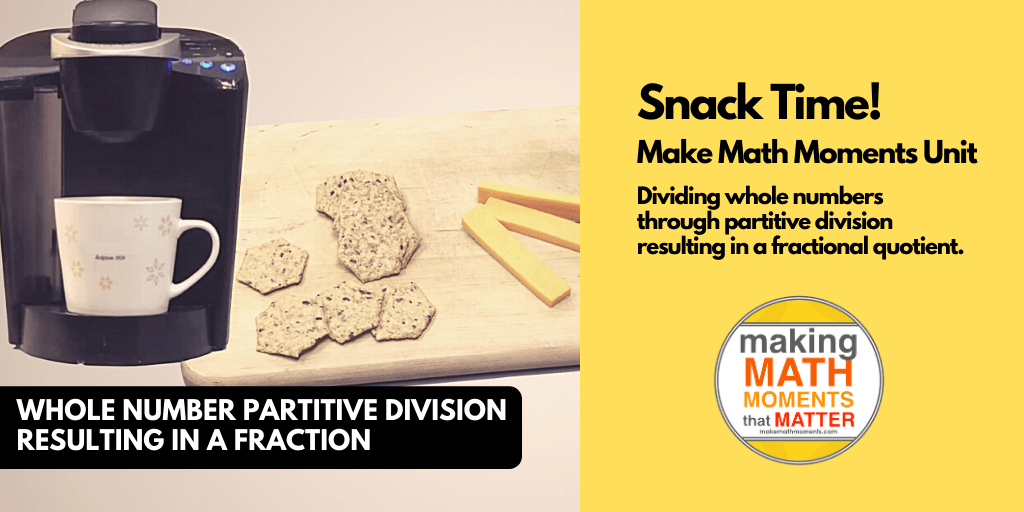
Partitive Division Resulting in a Fraction
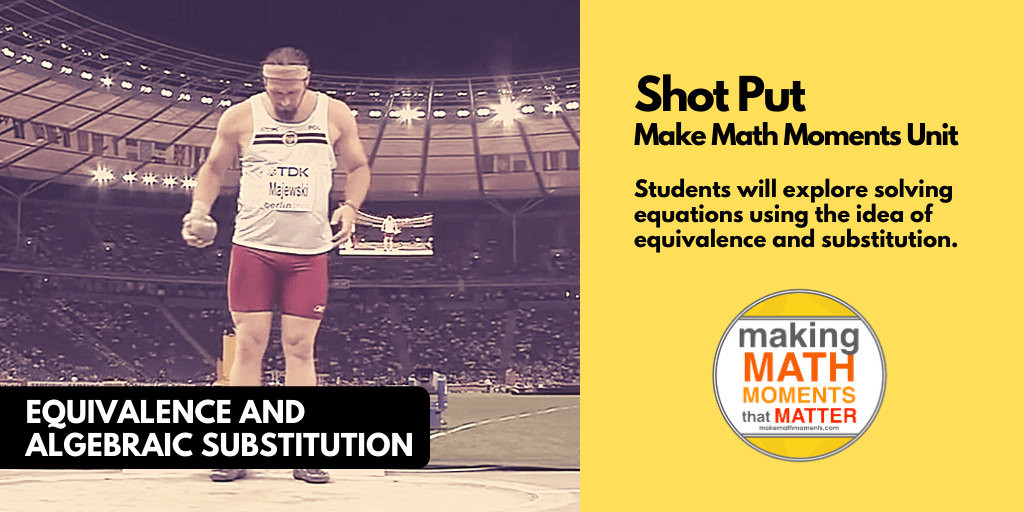
Equivalence and Algebraic Substitution
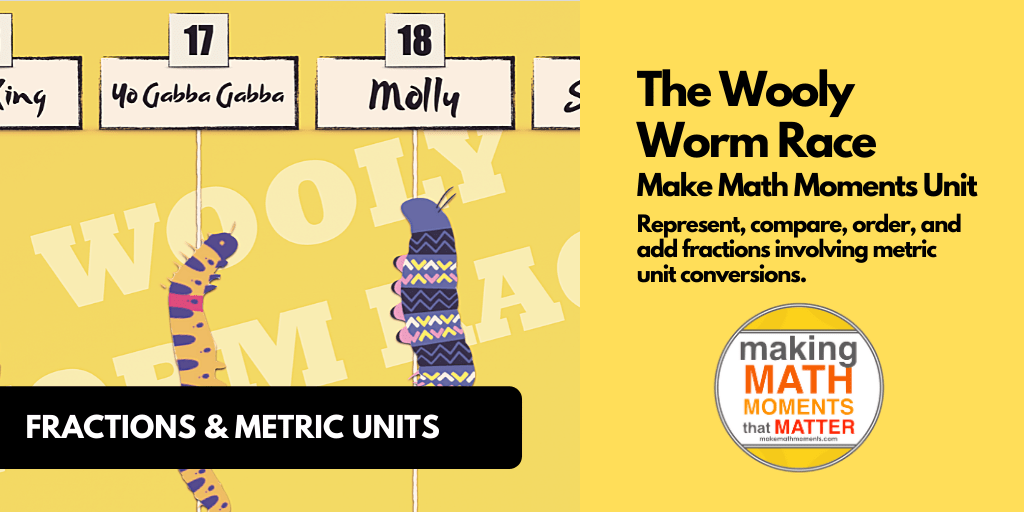
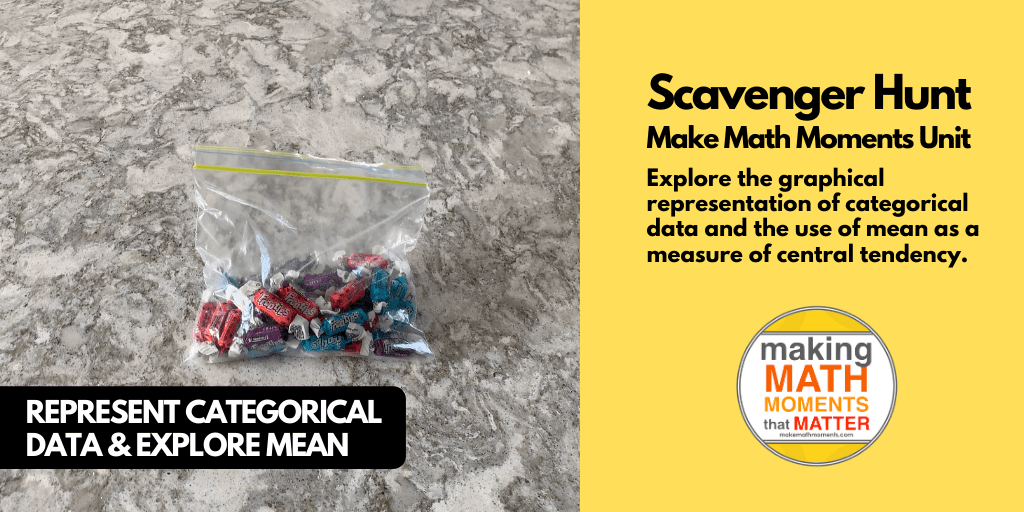
Represent Categorical Data & Explore Mean
Downloadable resources including blackline masters, handouts, printable Tips Sheets, slide shows, and media files do require a Make Math Moments Academy Membership.
ONLINE WORKSHOP REGISTRATION
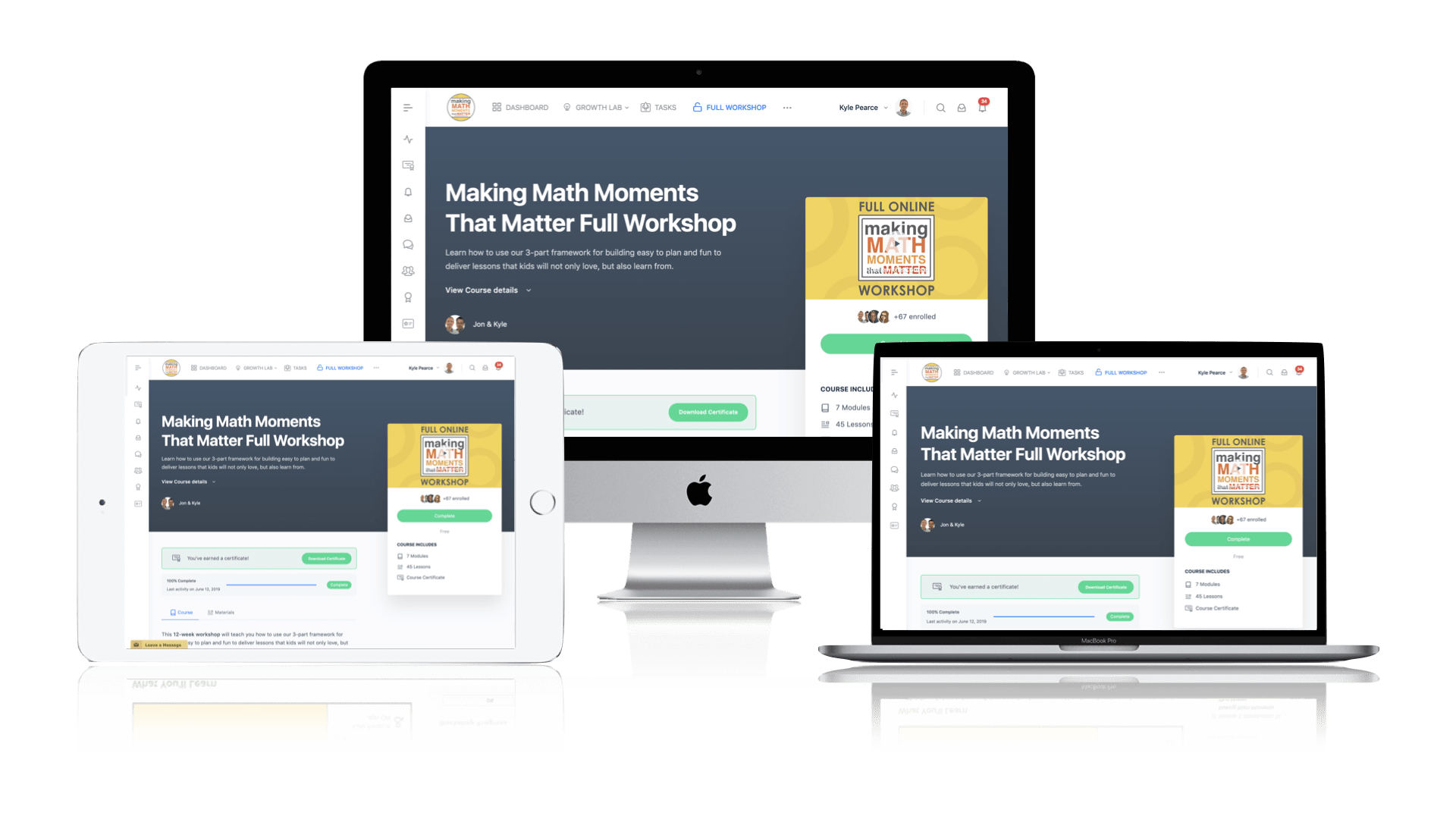
Pedagogically aligned for teachers of K through Grade 12 with content specific examples from Grades 3 through Grade 10.
In our self-paced, 12-week Online Workshop, you'll learn how to craft new and transform your current lessons to Spark Curiosity, Fuel Sense Making, and Ignite Your Teacher Moves to promote resilient problem solvers.
0 Comments