
Episode #472: Initiative Fatigue is Real! Learn How to Avoid it in Math Education
LISTEN NOW HERE...




WATCH NOW...
In schools today, it can feel like there’s always something new being introduced. A new initiative, a new priority, a new expectation. And for many teachers, especially in math classrooms, it raises a familiar question: why this, and why now? After years of seeing initiatives come and go, it’s easy to feel skeptical about whether the next one will actually make a lasting impact.
But what if the issue isn’t the initiative itself—but the number of initiatives being introduced at once? When time, energy, and resources stay the same (or even decrease), every new priority competes for attention. And over time, that leads to what’s known as initiative fatigue. Without clear communication, shared decision-making, and visible evidence of impact, it becomes harder for teachers to invest in new work. The challenge isn’t just choosing the right initiative—it’s knowing what to prioritize, what to let go of, and how to create the conditions for meaningful change.
In this episode, you’ll explore:
- What initiative fatigue is and why it happens in schools
- How competing priorities impact teachers’ time and energy
- Why transparency and teacher involvement matter in decision-making in mathematics
- How to determine when it’s the right time to move on from a math initiative
- The importance of identifying clear success indicators in mathematics
- What teachers and math leaders can do to better manage competing demands
If you’re feeling overwhelmed by constant change—or trying to lead improvement without overloading your team—this episode will help you think more strategically about priorities, capacity, and sustainable progress.
Attention District Math Leaders:
Not sure what matters most when designing math improvement plans? Take this assessment and get a free customized report: https://makemathmoments.com/grow/
Ready to design your math improvement plan with guidance, support and using structure? Learn how to follow our 4 stage process. https://growyourmathprogram.com
Looking to supplement your curriculum with problem based lessons and units? Make Math Moments Problem Based Lessons & Units
Be Our Next Podcast Guest!
Join as an Interview Guest or on a Mentoring Moment Call
Apply to be a Featured Interview Guest
It will take less than two (2) minutes to book your Math Mentoring Moment call.
Book a Mentoring Moment Coaching Call
Take two (2) minutes to book your Math Mentoring Moment call and let's work together to shake that math pebble out of your shoe!
Are You an Official Math Moment Maker?
Ensure that you follow, rate and review on Apple Podcasts, Spotify and other platforms to show your support and ensure other math educators can find the show.



FULL TRANSCRIPT
Yvette Lehman: In today's episode, we're talking about when teachers are feeling like they're questioning — why am I going to do yet this other new thing? It's like all of a sudden a new year starts, a new month starts, and there's yet another initiative or priority being funneled down to the classroom level. And they're sitting there thinking: what makes this move, this innovation, this initiative different from all the other ones I've experienced throughout my career that really didn't go anywhere? They were short-lived. We're constantly moving on to the next. So how do you convince the teacher that this is the one worth committing to?
Jon Orr: You just said something right before we hit record — if you're asking what your initiatives are right now, you don't ask the superintendent if you want the real answer. You don't ask the math coordinator or the district coordinator. You go and ask the teacher. Because the teacher understands that they've got a new math initiative, but they also need to understand new report card software, the new science of reading aspects, the IEP writing process, parent meetings, a new email software, a new attendance reporting structure, a new incident reporting process, and a different protocol for kids getting picked up by parents.
Jon Orr: There's a lot. And the reality is that a superintendent might say they've got one or two priorities, one or two initiatives. But how many superintendents have those, and how many principals then create their own on top of that? That's why you ask. And that's what we want to unpack here today — how do we think about initiatives as a classroom teacher, or as a leader thinking about the level of commitment we're asking people to make? And if I am going to be presented with a new initiative, how do I think about it? How do I help teachers genuinely get on board — not just "buy in" as a buzzword, but truly commit? Let's talk about initiative fatigue, because that's what we're here to discuss today.
Yvette Lehman: I really like Douglas Reeves' definition of the law of initiative fatigue, where he basically states: when the number of initiatives increases while time, resources, and emotional energy either remains constant or in some cases actually decreases, then each new initiative — no matter how well conceived or intentioned — will receive fewer minutes, dollars, and ounces of emotional energy.
Jon Orr: That decreasing comment really hits home. When I think about myself as a new teacher, the only thing I thought about was going to work. I didn't have a family. I was getting paid and I could barely believe it. I lived at school, stayed till six o'clock at night. You could dump anything on me — I was coaching, I was all in. But as you get older, you have more pressures and more responsibilities, and that capacity dwindles. Especially in relation to your job as an educator. And different people have different levels of that. It's likely going to diminish over time, even without adding new initiatives. That available window for the kind of commitment any initiative requires just gets smaller.
Yvette Lehman: This makes me think about Janice Fraser's book Farther, Faster, Far Less Drama. Her first and arguably most important leadership motion is to orient honestly. As a leadership team, if we haven't gone down to the teacher level and really asked — what are all the new changes, the new initiatives, what is your cognitive load and emotional energy being spent on right now — if we aren't getting real about the demands we are funneling down to the classroom, that is the first place we need to start.
Yvette Lehman: I read an article in preparation for today's episode from Language Magazine, 2019, where Douglas Reeves' research was referenced. From there I came across a representation of the job demand-resource model, where on one side of the scale you have all your initiatives — new math curriculum, social-emotional learning, science of reading, new report card software — and on the right-hand side you have your emotional energy resources and time. It's hard to orient honestly if you aren't getting really clear about everything that has been downloaded. So a first step is auditing your initiatives by getting to the school level and asking people what's actually on their shoulders.
Jon Orr: For sure. We call that process going to GEMBA. It's a sticky memory point and an important part of any planning process, whether at the school, district, or higher level. It's really about understanding who's doing the work and what that work actually looks like. The word GEMBA comes from a Japanese term that Toyota used as their mantra — we need to go and see the work if we're going to decide on how to structure the work. It was about getting to the line, drawing a circle, standing in it for two hours, and just watching. You can't make higher-level organizational decisions without seeing what's happening.
Jon Orr: And we've seen this with some of the districts we've supported across the years — some math coordinators are doing GEMBA with principals as well. Saying, look, we've got these initiatives, we're going to download them to the principal to handle at the school level because we believe in autonomy at the school level. We can help dictate the what, but we want the schools to determine the how. That's an important component of establishing local success and honoring local culture and local decision-making. But you also have to go to GEMBA. You have to get to the school level to see what the principal is actually planning around and what their job really looks like with all the competing components. Because initiative fatigue is going to be real unless you're considering that picture so that you can actually plan effectively.
Jon Orr: If you're making math a priority but you've got seven other priorities for that principal, what's the likelihood of impact for the math initiative? Probably low, because you're asking them to do just too much.
Yvette Lehman: In the article we referenced, there were a couple more recommendations beyond orienting honestly. One is to involve teachers in the process, and another is to help them understand the outcomes of previous and current initiatives. I'll share both at the same time because I think they go hand in hand.
Yvette Lehman: I'll give a practical example from one of the districts we support. They are doing incredible work right now with their K-5 teachers across the entire district in supporting the implementation of number talks. They've built a lot of momentum and have really solid indicators of success — clear observable behaviors they're documenting through coaching feedback and other evidence. So the lead said, I think we're ready next year to move on to another innovation, because we really do have our flywheel moving. We feel really good about where our teachers are with number talks. So we're thinking about really prioritizing Building Thinking Classrooms next year in K-5.
Yvette Lehman: My recommendation to them, having now read this article and done some thinking around initiative fatigue, was: but do the teachers know why you're ready to move on? Have they had a part in the decision-making process to say — you're right, we are at a point in our implementation of number talks where we're all at routine or proficient, and we're ready to add another innovation to our plates? Are they part of that decision-making, and have we shared the outcome with them — the indicator that says we're ready for more?
Jon Orr: Transparency is essential, but so is knowing when you're actually ready to move on. The question is — are your success indicators grounded in the five stages of implementation that Jim Knight shares? Because a lot of times we get bogged down in the mechanical stage, where teachers are mechanically implementing number talks but they're not yet at the routine or proficient phase. When you reach routine or proficient, there's less cognitive load, you're not just mechanically figuring this out — you actually believe what you're doing and it's part of how you operate.
Jon Orr: That's part of what ready to move on looks like — you've collected evidence that teachers have moved into that phase. And then, when you think about that balance scale Yvette described, as teachers move towards routine and proficient, the balance starts tipping back toward equalization. Maybe even tipping a little the other way — there's a little more mental and emotional capacity available. They're ready to start talking about the next layer of lesson planning and lesson structure. But you don't know the balance until you know what to look for.
Jon Orr: We all have to ask ourselves: am I moving on because I'm bored? Are we moving on because it's not as flashy anymore? Or are we moving on because we actually have the right indicators to say we're ready as a system? Teachers will be ready to move on at different times. But are we ready to add this next layer without knowing what the evidence looks like and sounds like?
Yvette Lehman: You mentioned the word transparency, and I wonder if it just needs to be a pillar of professional development design. We talk about this all the time — and actually in one of our keynotes right now, we've been using that Hamilton song about being in the room where it happened. If these decisions are being made by a few people in a room with closed doors, I understand why the people at the school level doing the work feel lost. They're like, well, why this new thing? I thought we were doing that thing. And now we've moved on and I have no idea why.
Yvette Lehman: I remember you sharing a story about your experience as a new teacher where it's like, well, we were doing this thing last year and now we're doing something else this year, and I don't see how they're connected. I don't know what the indicator was that suggested we should move on, or whether it was just arbitrary. You can see why people start to lose emotional investment in this type of work if we aren't being transparent about the plan, what the indicators were, and what happened to the previous initiative.
Jon Orr: Right. And we need to be able to articulate what were the indicators of success. What evidence did we gather that helped inform the decision about doing more or doing something new?
Jon Orr: And it's like — the teachers know that we are here and ready as a system, and it makes sense to layer on the next component. I know about it. I feel ready about it. And that transparency is what actually gets you there.
Yvette Lehman: So going back to the teacher — this teacher is thinking, should I even invest in this new thing? Should I put in the effort being asked, knowing it's probably going to change again? If that was me, and I'm part of a larger system and I don't understand why this decision was made or why I should invest my time, what would I recommend?
Yvette Lehman: We can only control what's within our sphere of influence as a teacher. I've been talking to one of our coaches about this who feels the same challenge — sometimes decisions are made outside of their authority. But what we've been working on is just asking the right questions. If I'm unsure about why this move, and what happened to the thing we were doing before, being willing to ask those questions and knowing what to ask is a first step in leading without authority — which we always talk about. How do you gain some authority in the decision-making? By knowing which questions to ask and of whom. If you're trying to understand why this new innovation is falling into your lap, what happened to the last one, should you invest energy — ask those questions. That's my advice to the teacher.
Jon Orr: Good advice. And if you're a leader, the recommendation is to go to GEMBA, make sure you understand the process, be more transparent in the decision-making around initiatives, and collect the right data to indicate whether your initiatives and recommendations to teachers are built upon evidence. You're collecting the right evidence to help you reach the goal, which means you've indicated a goal — why this move, this year, this group, this grade level — instead of just saying, I think this is a great idea, let's push it out to everyone.
Jon Orr: Think about system initiatives like a plate. There's only so much a plate can hold. You keep adding the broccoli, the chicken, the mashed potatoes, then you put a doughnut on top of that. You keep piling it on. But a real big problem with our current level of systemness is that we haven't collected the right data to tell us what we can take off the plate.
Jon Orr: Just like we have success indicators in our math lessons to know when students have achieved the expectation — when they've hit grade-level standard for that learning goal — we have to be able to do that too for our initiatives. If I'm pushing number talks across my K-5 grade levels, how do I define what success looks like, and what am I collecting to confirm we've done it? So that I can say the balance is back to equilibrium and we're ready for the next layer.
Jon Orr: Or, after five years on an initiative, going through training and not seeing the gains — maybe it is time to take a step back. The teachers who have internalized that process will keep running with it. And maybe it's time to say, take that off the plate. The data supports where we are right now. And when a teacher has the guts to ask that question, the answer should be: yeah, let's move along from that. Let's allow you to have that mental energy back. A lot of times the system says no, you're supposed to keep doing that too. But there's no evidence to support keeping it on, and we just don't want to tell you to stop because we're afraid of what might happen. And that's part of the problem — our system keeps adding to plates but rarely removes anything from them.
Yvette Lehman: So what's our call to action today for our listeners? Whether they're a teacher or a leader resonating with this challenge of initiative fatigue and wanting to think strategically about how to reduce its impact within their school, their department, wherever they are.
Jon Orr: I think it's just that. As a leader, go to GEMBA. Take an actual look and make sure you understand the moves you're going to make. As a teacher, prepare to ask those questions. This is a collaborative effort. If we're all looking to get stronger, we need to take ownership of what we're trying to achieve and bring others into the fold. If I'm a teacher, I'm reaching sideways and upward to bring people into what I'm trying to do and understand. And if I'm a leader, I'm reaching across and saying, what are you doing, what am I doing, what does it look like down here — so that I can understand what our next moves are.
Yvette Lehman: This is one of those pebbles we try to get out of our partners' shoes. The districts and schools we work with, the systems we support — we are constantly looking at our pillars of belief around system improvement, and overcoming initiative fatigue is one of the key areas we try to address in building strategic partnerships.
Jon Orr: We do have some spots left moving into the next school year. We support teams in designing math improvement plans that address this as an underlying plate issue — as we develop new initiatives or help teams understand the ones they currently have and strengthen the ones that need to create impact and traction. We do that on a daily basis with our teams. If you're looking for support, guidance, or just a recommendation on what you could be doing to strengthen the moves you're putting into practice in mathematics, head on over to makemathmoments.com forward slash discovery. We'll talk to you there and give you some next steps to take away.
Your Customized Improvement Plan For Your Math Classroom.
Take the 12 minute assessment and you'll get a free, customized plan to shape and grow the 6 parts of any strong mathematics classroom program.
District leader/math coach? Take the District Assessment
Thanks For Listening
- Book a Math Mentoring Moment
- Apply to be a Featured Interview Guest
- Leave a note in the comment section below.
- Share this show on Twitter, or Facebook.
To help out the show:
- Leave an honest review on iTunes. Your ratings and reviews really help and we read each one.
- Subscribe on iTunes, Google Play, and Spotify.
The Making Math Moments That Matter Podcast with Kyle Pearce & Jon Orr
Weekly interviews, strategy, and advice for building a math classroom that you wish you were in.
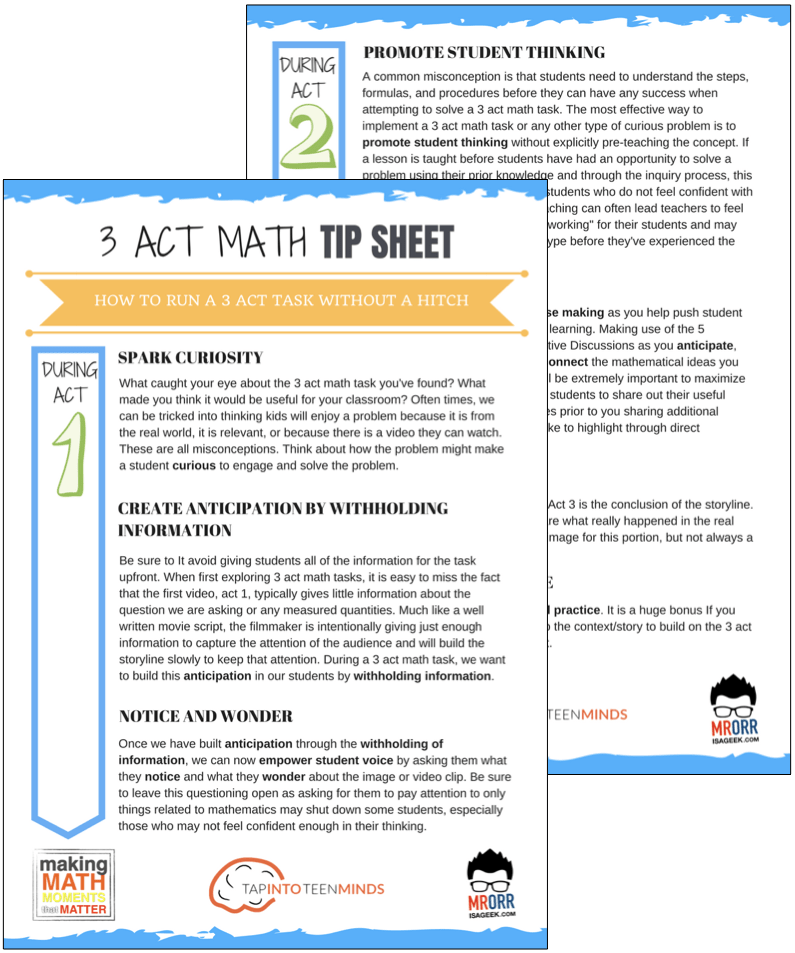
DOWNLOAD THE 3 ACT MATH TASK TIP SHEET SO THEY RUN WITHOUT A HITCH!
Download the 2-page printable 3 Act Math Tip Sheet to ensure that you have the best start to your journey using 3 Act math Tasks to spark curiosity and fuel sense making in your math classroom!
LESSONS TO MAKE MATH MOMENTS
Each lesson consists of:
Each Make Math Moments Problem Based Lesson consists of a Teacher Guide to lead you step-by-step through the planning process to ensure your lesson runs without a hitch!
Each Teacher Guide consists of:
- Intentionality of the lesson;
- A step-by-step walk through of each phase of the lesson;
- Visuals, animations, and videos unpacking big ideas, strategies, and models we intend to emerge during the lesson;
- Sample student approaches to assist in anticipating what your students might do;
- Resources and downloads including Keynote, Powerpoint, Media Files, and Teacher Guide printable PDF; and,
- Much more!
Each Make Math Moments Problem Based Lesson begins with a story, visual, video, or other method to Spark Curiosity through context.
Students will often Notice and Wonder before making an estimate to draw them in and invest in the problem.
After student voice has been heard and acknowledged, we will set students off on a Productive Struggle via a prompt related to the Spark context.
These prompts are given each lesson with the following conditions:
- No calculators are to be used; and,
- Students are to focus on how they can convince their math community that their solution is valid.
Students are left to engage in a productive struggle as the facilitator circulates to observe and engage in conversation as a means of assessing formatively.
The facilitator is instructed through the Teacher Guide on what specific strategies and models could be used to make connections and consolidate the learning from the lesson.
Often times, animations and walk through videos are provided in the Teacher Guide to assist with planning and delivering the consolidation.
A review image, video, or animation is provided as a conclusion to the task from the lesson.
While this might feel like a natural ending to the context students have been exploring, it is just the beginning as we look to leverage this context via extensions and additional lessons to dig deeper.
At the end of each lesson, consolidation prompts and/or extensions are crafted for students to purposefully practice and demonstrate their current understanding.
Facilitators are encouraged to collect these consolidation prompts as a means to engage in the assessment process and inform next moves for instruction.
In multi-day units of study, Math Talks are crafted to help build on the thinking from the previous day and build towards the next step in the developmental progression of the concept(s) we are exploring.
Each Math Talk is constructed as a string of related problems that build with intentionality to emerge specific big ideas, strategies, and mathematical models.
Make Math Moments Problem Based Lessons and Day 1 Teacher Guides are openly available for you to leverage and use with your students without becoming a Make Math Moments Academy Member.
Use our OPEN ACCESS multi-day problem based units!
Make Math Moments Problem Based Lessons and Day 1 Teacher Guides are openly available for you to leverage and use with your students without becoming a Make Math Moments Academy Member.

Partitive Division Resulting in a Fraction
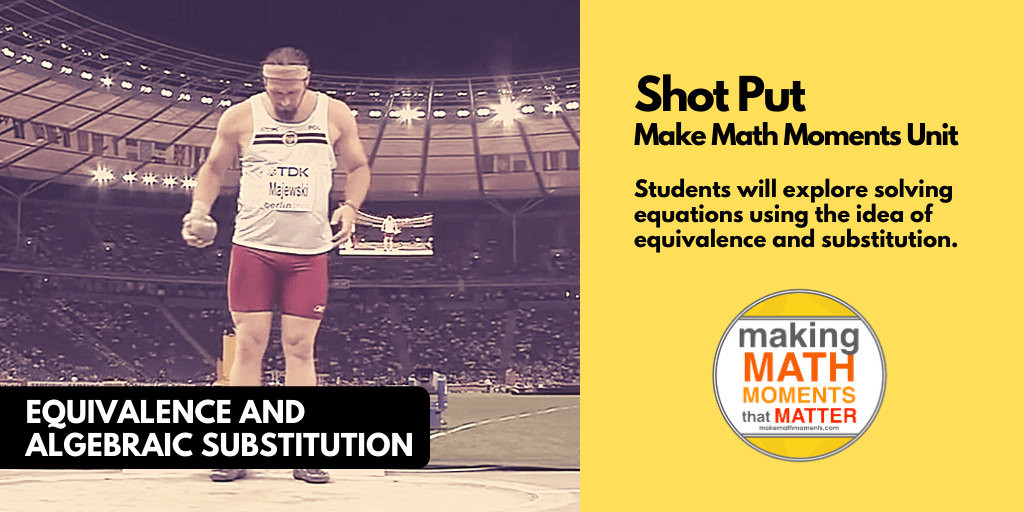
Equivalence and Algebraic Substitution

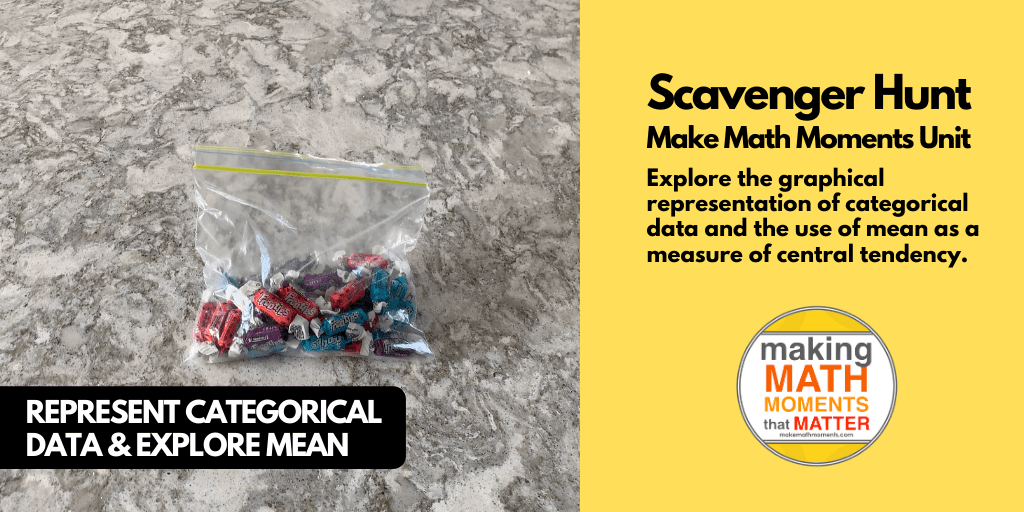
Represent Categorical Data & Explore Mean
Downloadable resources including blackline masters, handouts, printable Tips Sheets, slide shows, and media files do require a Make Math Moments Academy Membership.
ONLINE WORKSHOP REGISTRATION
Pedagogically aligned for teachers of K through Grade 12 with content specific examples from Grades 3 through Grade 10.
In our self-paced, 12-week Online Workshop, you'll learn how to craft new and transform your current lessons to Spark Curiosity, Fuel Sense Making, and Ignite Your Teacher Moves to promote resilient problem solvers.
0 Comments