Episode #481: Atomic Habits For Math Educators & Coordinators: Why Summer Is Your Secret Weapon
LISTEN NOW HERE...




WATCH NOW...
Summer is often seen as a time to step away from school, recharge, and reset. But it can also be an opportunity to strengthen your mathematical thinking, explore new ideas, and build habits that support your growth as an educator—without turning your break into more work.
The key isn't filling your summer with professional development or adding more to your to-do list. It's about being intentional. Whether it's spending a few minutes each week exploring a visual pattern, solving a rich math problem with your family, or exposing yourself to new ideas through reading and diverse experiences, small habits can have a lasting impact. The goal isn't productivity for the sake of productivity—it's creating opportunities to stay curious, build mathematical proficiency, and return to the school year feeling energized and inspired.
In this episode, you'll explore:
- Why doing math regularly strengthens mathematical proficiency
- How visual patterns and rich tasks can spark meaningful math conversations
- Ways to build simple, sustainable summer habits around mathematics
- Why increasing your inputs can broaden your thinking as an educator
- The value of reading beyond math education and learning from other fields
- How to balance growth, curiosity, and rejuvenation during the summer months
If you're looking for ways to make the most of your summer without sacrificing rest and recovery, this episode offers practical ideas for staying connected to mathematics, learning, and personal growth in a joyful and sustainable way.
Attention District Math Leaders:
Not sure what matters most when designing math improvement plans? Take this assessment and get a free customized report: https://makemathmoments.com/grow/
Ready to design your math improvement plan with guidance, support and using structure? Learn how to follow our 4 stage process. https://growyourmathprogram.com
Looking to supplement your curriculum with problem based lessons and units? Make Math Moments Problem Based Lessons & Units
Be Our Next Podcast Guest!
Join as an Interview Guest or on a Mentoring Moment Call
Apply to be a Featured Interview Guest
It will take less than two (2) minutes to book your Math Mentoring Moment call.
Book a Mentoring Moment Coaching Call
Take two (2) minutes to book your Math Mentoring Moment call and let's work together to shake that math pebble out of your shoe!
Are You an Official Math Moment Maker?
Ensure that you follow, rate and review on Apple Podcasts, Spotify and other platforms to show your support and ensure other math educators can find the show.



FULL TRANSCRIPT
Jon Orr: In this episode, we want to unpack your summer homework. And I don't want you to think about homework as — man, why are they giving me homework? It's summer, it's summer break, it's coming. But what we want to do today is unpack what we do and what we are planning to do and what we've have done in the past to think about our summer as a building period, a strengthening period, as a period where we get stronger on things that we want to get stronger on, but also as a period of rejuvenation. So in this episode, we are unpacking what do we do during the summer break or the summer holidays as math teachers, as math leaders. All right, let's get into it. Yvette, where do you want to start on the summer homework?
Yvette Lehman: I'm gonna start by telling you my plan for the summer. This is my summer homework list. One of the things I try to commit to is always carving out time to do math for the sake of math. And I find the summer needs a little more planning, you know, because we're out of our routine. And so I try to think before summer starts. We have nine weeks of summer here in Ontario this year. How am I going to structure in intentional time to do math for the sake of math, just to build my own mathematical proficiency? And, you know, I'm also a math teacher leader, but I'm also a parent. So this is a double benefit, of course. I do it for myself to strengthen my own mathematical proficiency, but of course for my son who's going into grade seven next year. So this is my plan.
Yvette Lehman: And this is what I'm currently working on setting up for myself and my family. Last year we did a visual pattern a week. And I basically just put the visual pattern out on the table. I printed it out. I picked nine — last year I picked eight, but this year I will pick nine. And it's like at the beginning of the week, the pattern goes out on the table.
Jon Orr: Yeah, you printed it off? Like, logistics here — you printed this from visualpatterns.org? Eight different ones.
Yvette Lehman: And the challenge is that everybody by the end of the week represents the tenth term visually and then finds an expression for the nth term. And, you know, you can choose when you do it, but it's like by the end of the week, everybody has to have interacted with the visual pattern and then also defended their expression to the rest of the family.
Jon Orr: Ooh, when does the defend happen?
Yvette Lehman: Once everybody's done. So once everybody has their solution.
Jon Orr: Right. Like is it at dinner, like that night? Like that night everybody's done. All right, let's look.
Yvette Lehman: Yeah, I'm like, I've noticed that everybody has submitted an expression for this particular pattern. Now let's talk about it. Let's talk about defending our expression. And then we look for equivalence. We're like, do we come up with the same expression for this pattern? Are they, you know, can we defend them? Are they all equivalent? Do they all work? We test them and make conjectures. So that's one thing that I'm planning to do. I did it last summer, and honestly, it was super successful because we interact with a lot of math.
Jon Orr: Yeah, for sure.
Yvette Lehman: I highly recommend that move. And again, it's just prioritizing — I call it almost like my math gymnastics in my brain. Just want to use those muscles. I want to, you know, keep it strong in my mind. So that's a move I make.
Jon Orr: Before we go — yeah, before I was gonna say, what are you doing this year? Is that where you're gonna go? You're gonna tell us what's different — like, last year you did visual patterns, but what is the thing this year for the nine weeks?
Yvette Lehman: We're gonna do the same. So I think the visual patterns are gonna stay, but nine new patterns, of course. But I think I'm also going to add in a University of Waterloo problem of the week. So I think I'll introduce it the same way, essentially, where it's like the problem goes out at the beginning of the week, everyone has a chance to interact with it, to come up with a solution. Then we compare our solutions, pull up the solution from the website, and confirm.
Yvette Lehman: And I feel like those two moves will be enough to just keep math conversations happening throughout the summer without feeling like it's a burden as far as like planning or time.
Jon Orr: I want you to send these to me.
Yvette Lehman: Okay. Yeah, you can do them as well. I'll give you our nine weeks.
Jon Orr: If you're listening right now, you might be like, Yvette, I also want you to send that to me. Then let us know. Hit reply on an email and we will send them out to you.
Yvette Lehman: For sure. I can create a Google Drive folder and drop all of the patterns I've selected and all of the problems of the week. I think that for the problems of the week, I'm personally gonna target seventh, eighth grade. So that's where I'm gonna focus.
Jon Orr: That's a good idea. They're not easy problems, right? From the problems of the week from the University of Waterloo. So yeah, a big fan of those for sure. What else? What else?
Yvette Lehman: Those are my moves to strengthen my mathematical proficiency over the summer and to work with Leto, you know, to keep math conversations happening as I mentioned. I also have another bit of summer homework for myself from a math leadership perspective.
Jon Orr: Yeah. But before we do that — why math? Like, I gotta do math. I think if you're listening right now, you're nodding your head like, that makes sense. But let's be clear. Why is this important for you as a teacher of math and also a leader of math?
Yvette Lehman: I just don't know that there's any better way to strengthen our capacity than to be open to deepening our proficiency. And I think that when we talk about even the pedagogy, you know, the eight effective teaching practices, it's like all of those are uplifted by our own ability to reason and interact with the content.
Jon Orr: One hundred percent. I speak with math coordinators, math coaches every single day all year long. And I think when we have discussions about what's shifting in classrooms and what's not shifting in classrooms, we often get to that part where we're like, I've been trying to help teachers understand or see or model the eight effective teaching practices, but here, you, me, the Make Math Moments team — Kyle, Beth — we're all strong believers that you have to have that strong foundational understanding conceptually of math, models, strategies, all of the above, a strong proficiency, if you're going to then teach a topic and try to get more of those eight effective teaching practices. Every single one of them, if you look at them, you do need to be flexible in the classroom.
Jon Orr: And it's hard to be flexible if you're not sure what math is supposed to emerge today, or what possible strategies could come out of a task you put in front of kids. So if you're trying to do a number talk routine or you're trying to do a math talk or you're trying to put a task in front of students and you're not sure exactly what math is going to pop out, then you shy away from those engagements because you're like — that's where the scripts come in. That's where it's like, let's just go and teach this algorithm because I know that, but I don't know that, and that, and that. And I don't know that I don't know it. And so taking ownership of what you don't know is a really important move to strengthen that about your own classroom teaching. And also if you're leading teachers, to strengthen that up about yourself. Because we all know that if we want to strengthen classroom experiences for students, leadership also has to be great facilitators, great modelers of what mathematics learning looks like and sounds like. A great recommendation overall for sure — to do more math amongst yourself and with as many adults and kids as you can.
Yvette Lehman: Actually, that reminded me of just another recommendation. I personally like to try to disengage from social media over the summer. It's like one of my resets. But if you are somebody who stays connected through social media, following math leaders who put math prompts on their pages routinely — Howie Hua is one of the ones that I follow, and Pam Harris. And I like interacting with those quick prompts. I actually just did one this morning from Howie's Facebook page where he had 18/40 equals what percent? And just taking five minutes to reason through, because 40 is not super friendly. So then I was like, I can't think about the relationship between 40 and 100. I have to think about the relationship between 18 and 40.
Jon Orr: I'm curious what you did. Let's do it. Eighteen divided by forty is what percent? Go ahead. I'm curious because I just did it in my head.
Yvette Lehman: So basically, yeah — I was like, well, 20 out of 40 is 50%. And then the difference between 18 and 20 is two. And 2 is 1/20th of 40 because 4 is 1/10th of 40. So because 2 is 1/20th, I know that 1/20th is 5%. So it's 5% less than 50%. So it's 45%. It was like a part-part-whole situation, right? It was like, I know that 20 out of 40 is 50. I'm missing two. Two is 5% because it's 1/20th. So then I had to take away five percent — forty-five percent.
Jon Orr: Okay. So the reason I wanted to go there is because you said 40 is not easy to work with. But then I was like, it is pretty easy to work with because it's a multiple of ten. And that's really nice. So if I scale down, right? If I go down to 10, that's divide by four, which means really I have to divide by two and then divide by two again. And so then if I do that, scale both numerator and denominator down by two, then down by two again, I go from forty to twenty to ten. Therefore I go from eighteen to nine to four and a half. And so now I'm four and a half out of ten.
Yvette Lehman: I love that strategy. That's actually such a good strategy. The one I just thought of now as you were describing that is — I could actually scale up to a hundred because it's double then half. Right. So like I double it. So I double 18 and then do half of 18 more.
Jon Orr: Yep, half more after that. Yep. You could double it. Yep. Thirty six. And then another eighteen after that.
Yvette Lehman: That's interesting. Where right away I was like, I don't want to work with 40 and 100. I just want to look at the ratio, the other relationship, the other multiplicative comparison. So it's like look at how that one prompt this morning — and imagine you shared that with people around you. How much richer it is having this conversation.
Jon Orr: And it just reminds me of things that we talk about with our leaders that we support all the time, thinking about just general big picture things — which is that what you're doing, as you said at the beginning, is that it takes some planning to do because what you're trying to do is build a habit. And habit-forming moves, in our opinions, are really important moves for sustainability.
Jon Orr: It's like, let's not just do that one thing and then plan around it and get it. What you want to do is, in your school systems generally, go — well, what can I commit to forever? Like, what is the move that we would make that we will not unmake? And therefore, that's a habit. It's durable decision making. It's like, well, what is this thing that if we do this thing — can we keep it going? What does that look like if we keep it going? Can I plan around that? Like that's what you're saying about the summer. You're saying, look, I'm not just gonna do this one time, let's put this on the table and then we'll see what happens. It's like, no, I'm planning to do this for the entire summer and I'm not gonna waver from that. But also you probably can plan for it without doing it all at once. It's like I know that every Monday I'm gonna do this. And that's a commitment I'm making to myself. This sounds small, but it's huge.
Jon Orr: It's a huge thing to do, no matter what your role is in education — saying what are the moves that I make that I commit to long term. Those are the most powerful things you can do as an educator, in my opinion.
Yvette Lehman: For another recommendation for my weekly habit — I've been following a woman, a parenting coach on social media, and she talked about putting things out on the table for your older children and teens to interact with. And she basically said, if it's out, they're likely to gravitate toward it. So I made a list of like every week I'm gonna swap out a tabletop activity that I'm hoping we'll all just kind of gravitate toward, and they're really connected to building spatial sense. So it's like every week a new tabletop activity. And if anyone wants that list as well, I can share the list of these recommended tabletop type activities to put out for your older children. Again, it's like we want them off screens, we want them interacting, we want them building their spatial skills. And when it's out and available, people are more likely to interact with it.
Jon Orr: Love it. So I think one of my habits for the summer — and I guess it's more general, it doesn't have to always be the summer, but I feel like I have more time in the summer to do this — is I always try to find myself sinking into reading a little bit more than I usually do during the year. But I also try to read — and I think you might say, look, I want, you know, you're listening to a math podcast, they're gonna give me math books, but in a way, try to think about it like this.
Jon Orr: And we heard this from — I was doing this already, but Morgan Housel kind of said it right. Morgan Housel, who wrote The Psychology of Money and also another book called Same as Ever — in one of those books, and I think on his blog, he articulates something that I think is really impactful. He says, basically, when he's choosing his reading, he says: cast a wide net, but have a strong filter. And what he's meaning by that when he's choosing his books is — look, I start a lot of books, but I finish few of them. And what he's saying generally is, you might be amazed at a genre that you normally might not read. Like if you read mystery books every summer and you never read biographies or science fiction — open up the net a little bit, but don't commit yourself to having to finish that book. If that book doesn't grab you, don't read it. And this is why a library card is really important, right? Because you don't have to read that book. And what he's really saying is that the variety can actually enrich your understanding and your learning.
Jon Orr: And that's the way I've always approached reading, especially in the summer — I actually read a lot of different things, which give me a lot of insight into many different aspects of what we do, of what I was doing in the classroom when I was a classroom teacher for 19 years. So for example, I read Daniel Pink's book one summer — I'd never heard of this guy, Daniel Pink, but it was a book about time. Not time management, but understanding how you think about time and react to time and timing in yourself. I think it was called When. And there was a part of that book that helped me understand when is the best time for me to do my best thinking.
Jon Orr: For me, there's always like — people who are morning people, I'm an afternoon person. It's like understanding when that is for you. It doesn't mean one is right or the other, right? It doesn't mean morning people do it better. But understanding that about yourself can actually help you restructure when you optimize some of the thinking you do or the work you do. So for me, I used to do exercise in the morning, but then when I started to think about that, I'm like, well, my best thinking and creativity time is in the morning. And therefore, maybe I should push my exercise time later in the day when I'm feeling a little sluggish. And therefore use that morning time to do that type of thinking, because that's when my brain is freshest and I can get more done and feel more creative.
Jon Orr: But it was like that was an important learning moment that helped me think about my classroom management and think about how I conduct myself at school and when I get work done and being okay with that. And typically what I do is I have this wide net, and then I try to bring in as much thinking from other aspects or other industries into what I'm doing to see if it influences how I can do my job better, or help my students become better, or help my colleagues become a better version of what they're trying to do. And I think that's one of my moves — just be wide. And then I loved Morgan Housel's idea of: just have a strong filter and you won't feel the pressure that you have to do so much reading. Just abandon it and move on and be okay with that.
Yvette Lehman: I pulled this quote from Morgan Housel's blog. It's titled How to Read. And he says, "Without flooding your brain with inputs, you'll be stuck in the tiny world of what you've personally experienced. But without a strong filter, you'll be overwhelmed with choice and paralyzed by inaction." I love this. I feel like I need to use this mindset. Like you said, it's not just about reading, but about gathering more experiences and more perspectives and just broadening my own worldview. But then to the second point, still having a strong filter so that now I'm not in analysis paralysis and unable to move forward or take any action.
Jon Orr: Totally. Yeah, that quote reminds me of Jordan Peterson. I heard him once say — he wrote The Twelve Rules for Life, by the way, another book I read during the summer — basically that your life will be more enriched the more responsibility you take on. And I think that pairs with what you just said. Because the more responsibility you take on, the more people you meet, the more people you have to impact, the more perspectives you see. Like being a parent is a huge responsibility. It enriches your life. If you're a coach on a team, that enriches your life because of the responsibility you're now taking on. If you're running a charity event, there's responsibility that enriches your life. You're meeting more people, you're seeing more perspectives. Like that's what I feel like I get from that quote you just said. It's like, not just reading — it's putting yourself in these opportunities for responsibility. It opens the door so that you have all these inputs come in. And if you have a strong filter, you might be like, that opportunity is not right for me.
Yvette Lehman: I think to summarize our big ideas here. We talked about building in habits to strengthen our own mathematical proficiency. And more than that, just our joy of learning math. It was funny — when we started this with homework, last night I said to Leto, I was like, Leto, we're gonna do some — I don't know why I called it math homework, but I was like, we're working on dividing fractions. And so he was kind of hemming and hawing about it, but I brought him over to the table and then he afterwards said, That was great. Can we do more tomorrow? And he made himself a video to remind him tomorrow to not push back against it because it's really fun.
Jon Orr: Was he like — hey, future Leto, don't push back on mom's idea?
Yvette Lehman: Yeah. He was like, look at me now. I'm great. I had a good time. I wanted to do more. Future Leto, remember that this was fun. And I think that's another part of it as well — doing math for the joy of math, because it's interesting and it makes us feel good when we have mathematical epiphanies. So that was our one recommendation — how do you create opportunities just to do more math and to do math with others in a joyful way that develops your mathematical proficiency.
Yvette Lehman: And then I think our second recommendation is increase your inputs, but keep a strong filter. And so reading doesn't have to be restricted to the math education world. And even the experiences that you have — oftentimes we attend conferences that are math conferences because it's specific to our role, but maybe we need to be broadening our experiences and looking at them through the lens — like you said — making connections to the work that we do.
Yvette Lehman: Summer's a great time for that. Increase your inputs, everybody.
Jon Orr: Love it. There you go. And I guess just to leave off — we did mention that Yvette's gonna put together some prompts for us in the summer. She's gonna share them with me. If you want a copy of those prompts that she puts together for the summer — those visual patterns and the problems of the week — reach out to us, hit reply on any of the emails you get. Or if you're not on our email list, scroll down to the links below. You can get a copy of our coherence compass down there if you're a math leader — that will get you on the email list. Maybe the classroom assessment, that link is below as well. You can complete that, which helps you understand what the six components of a classroom experience for students look like as a teacher or as a leader. That will also get you on the email list. You can just hit reply and say, hey, you guys in this episode talked about a summer task bank that Yvette was putting together, I'd like a copy, and we will send you that copy. That is your last tidbit of info here today on this episode. We'll talk to you soon.
Your Customized Improvement Plan For Your Math Classroom.
Take the 12 minute assessment and you'll get a free, customized plan to shape and grow the 6 parts of any strong mathematics classroom program.
District leader/math coach? Take the District Assessment
Thanks For Listening
- Book a Math Mentoring Moment
- Apply to be a Featured Interview Guest
- Leave a note in the comment section below.
- Share this show on Twitter, or Facebook.
To help out the show:
- Leave an honest review on iTunes. Your ratings and reviews really help and we read each one.
- Subscribe on iTunes, Google Play, and Spotify.
The Making Math Moments That Matter Podcast with Kyle Pearce & Jon Orr
Weekly interviews, strategy, and advice for building a math classroom that you wish you were in.
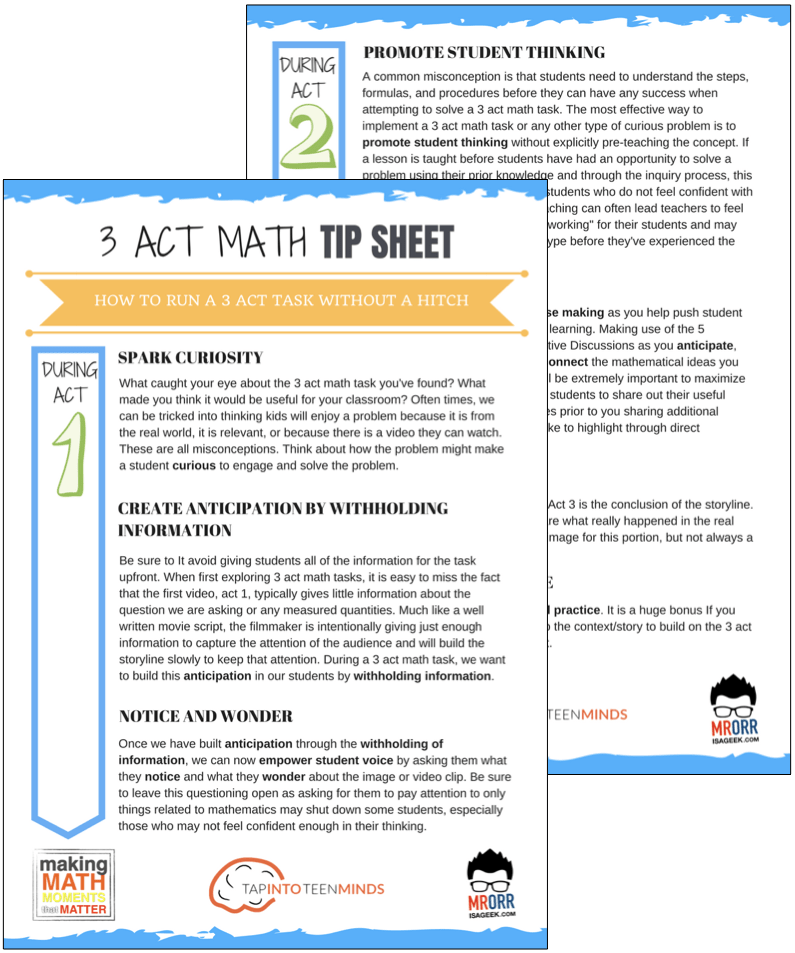
DOWNLOAD THE 3 ACT MATH TASK TIP SHEET SO THEY RUN WITHOUT A HITCH!
Download the 2-page printable 3 Act Math Tip Sheet to ensure that you have the best start to your journey using 3 Act math Tasks to spark curiosity and fuel sense making in your math classroom!
LESSONS TO MAKE MATH MOMENTS
Each lesson consists of:
Each Make Math Moments Problem Based Lesson consists of a Teacher Guide to lead you step-by-step through the planning process to ensure your lesson runs without a hitch!
Each Teacher Guide consists of:
- Intentionality of the lesson;
- A step-by-step walk through of each phase of the lesson;
- Visuals, animations, and videos unpacking big ideas, strategies, and models we intend to emerge during the lesson;
- Sample student approaches to assist in anticipating what your students might do;
- Resources and downloads including Keynote, Powerpoint, Media Files, and Teacher Guide printable PDF; and,
- Much more!
Each Make Math Moments Problem Based Lesson begins with a story, visual, video, or other method to Spark Curiosity through context.
Students will often Notice and Wonder before making an estimate to draw them in and invest in the problem.
After student voice has been heard and acknowledged, we will set students off on a Productive Struggle via a prompt related to the Spark context.
These prompts are given each lesson with the following conditions:
- No calculators are to be used; and,
- Students are to focus on how they can convince their math community that their solution is valid.
Students are left to engage in a productive struggle as the facilitator circulates to observe and engage in conversation as a means of assessing formatively.
The facilitator is instructed through the Teacher Guide on what specific strategies and models could be used to make connections and consolidate the learning from the lesson.
Often times, animations and walk through videos are provided in the Teacher Guide to assist with planning and delivering the consolidation.
A review image, video, or animation is provided as a conclusion to the task from the lesson.
While this might feel like a natural ending to the context students have been exploring, it is just the beginning as we look to leverage this context via extensions and additional lessons to dig deeper.
At the end of each lesson, consolidation prompts and/or extensions are crafted for students to purposefully practice and demonstrate their current understanding.
Facilitators are encouraged to collect these consolidation prompts as a means to engage in the assessment process and inform next moves for instruction.
In multi-day units of study, Math Talks are crafted to help build on the thinking from the previous day and build towards the next step in the developmental progression of the concept(s) we are exploring.
Each Math Talk is constructed as a string of related problems that build with intentionality to emerge specific big ideas, strategies, and mathematical models.
Make Math Moments Problem Based Lessons and Day 1 Teacher Guides are openly available for you to leverage and use with your students without becoming a Make Math Moments Academy Member.
Use our OPEN ACCESS multi-day problem based units!
Make Math Moments Problem Based Lessons and Day 1 Teacher Guides are openly available for you to leverage and use with your students without becoming a Make Math Moments Academy Member.
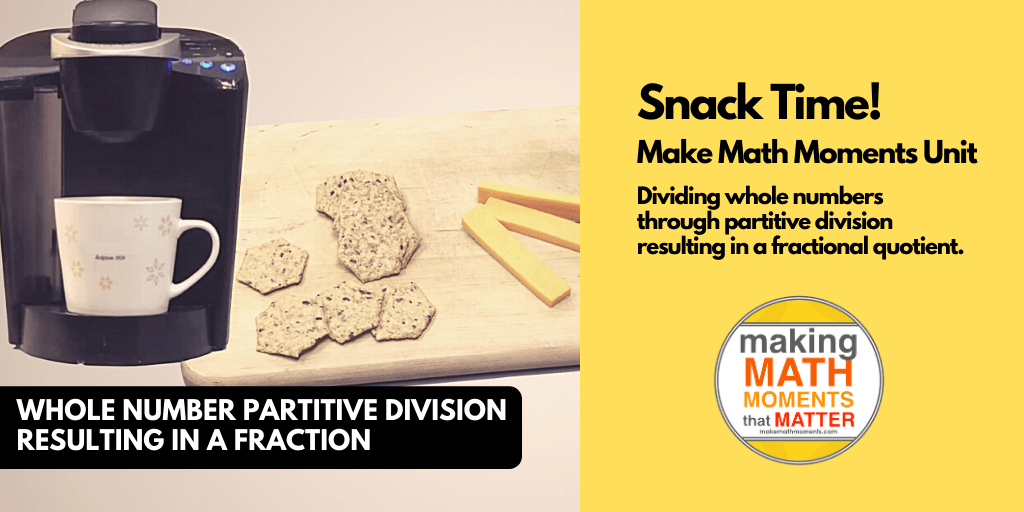
Partitive Division Resulting in a Fraction
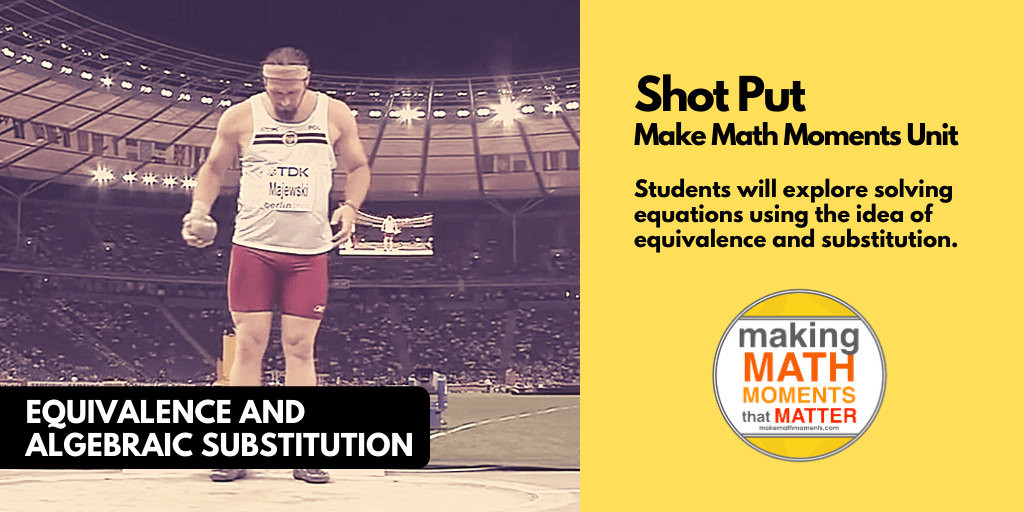
Equivalence and Algebraic Substitution
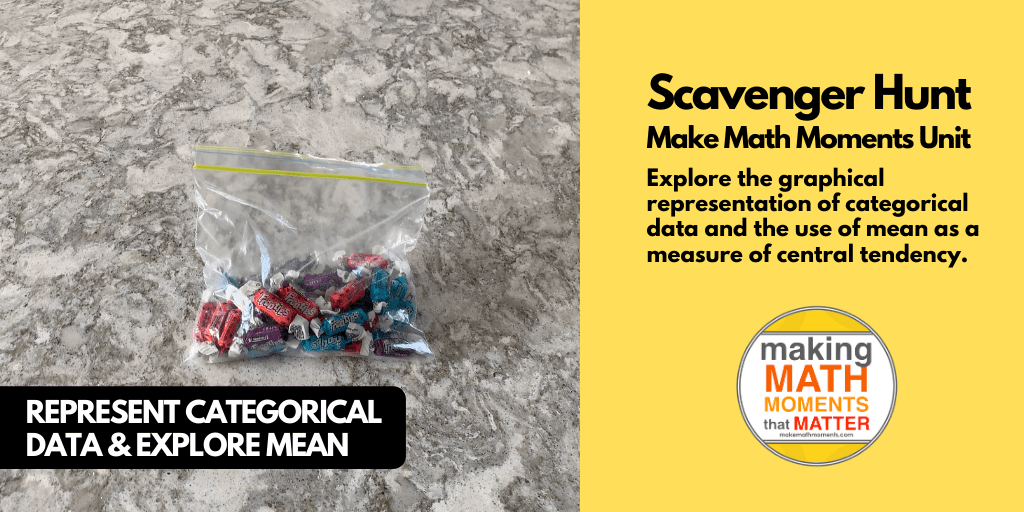
Represent Categorical Data & Explore Mean
Downloadable resources including blackline masters, handouts, printable Tips Sheets, slide shows, and media files do require a Make Math Moments Academy Membership.
ONLINE WORKSHOP REGISTRATION
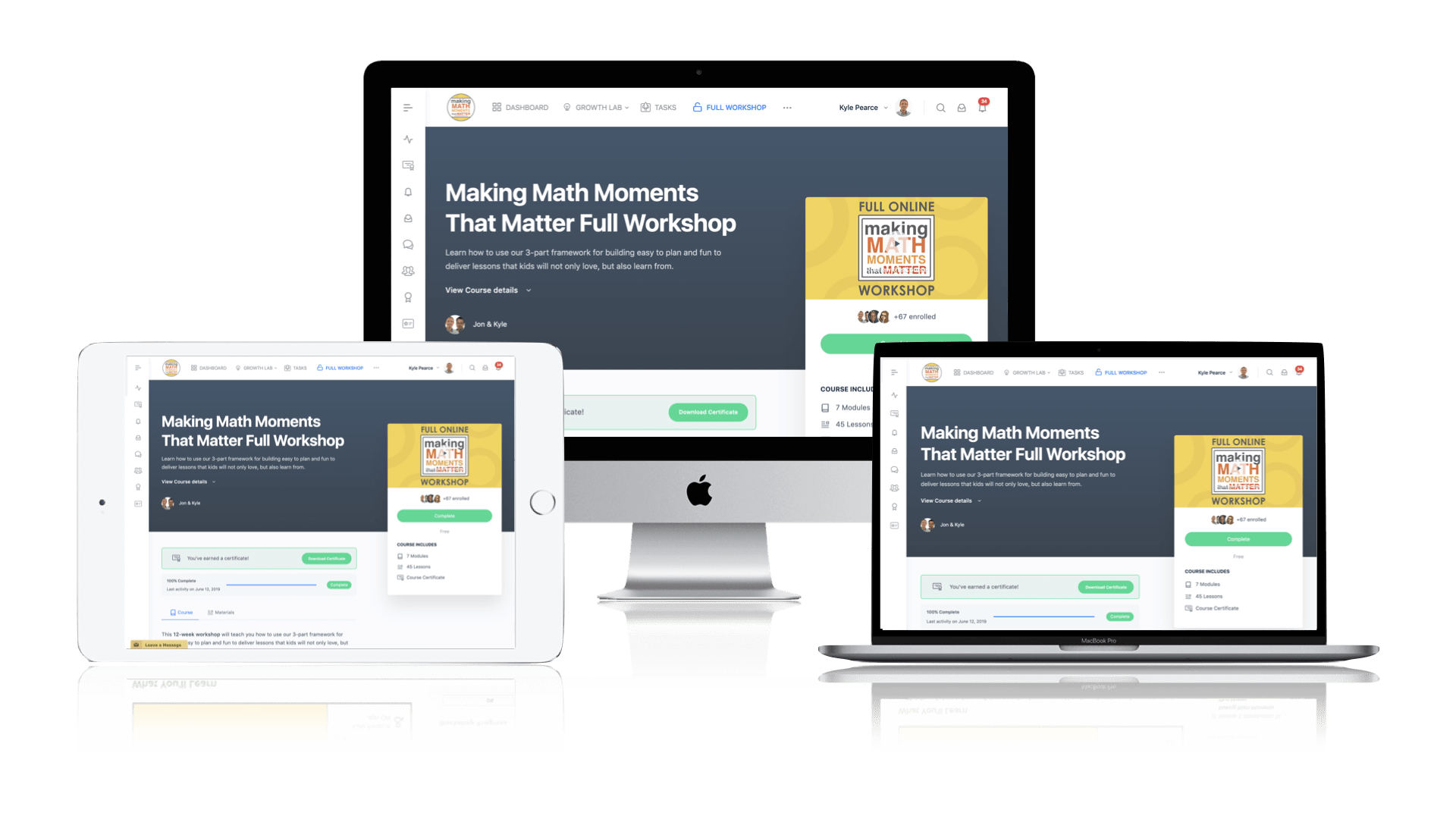
Pedagogically aligned for teachers of K through Grade 12 with content specific examples from Grades 3 through Grade 10.
In our self-paced, 12-week Online Workshop, you'll learn how to craft new and transform your current lessons to Spark Curiosity, Fuel Sense Making, and Ignite Your Teacher Moves to promote resilient problem solvers.
0 Comments