Episode #482: How to Build Deep Fraction Understanding K-12
LISTEN NOW HERE…
WATCH NOW…
Few math concepts seem to create as much anxiety as fractions. For students, parents, and even educators, fractions often carry a reputation for being difficult, confusing, and disconnected from everything else students learn in mathematics.
But what if fractions aren’t inherently difficult? What if the challenge comes from how they’ve traditionally been introduced and taught? Many educators learned fractions through procedures, memorization, and isolated units rather than through reasoning, relationships, and meaningful representations. As a result, important ideas—like fractions as numbers, fractions as measures, benchmark fractions, and multiplicative relationships—often remain hidden. When we begin to see fractions as quantities that live on a number line and connect naturally to measurement, proportional reasoning, and operations, a very different picture emerges.
In this episode, you’ll explore:
- Why fractions should be understood as numbers with magnitude
- The importance of naming and counting unit fractions
- How different fraction representations shape student understanding
- Why benchmark fractions can strengthen number sense and comparison
- The connection between fractions, division, and proportional reasoning
- How fractions can be integrated across the curriculum rather than taught in isolation
- What many educators wish they had known about fractions earlier in their careers
If fractions have ever felt challenging to teach—or if you’re looking to deepen your own understanding of fraction concepts—this episode will help you rethink fractions and build confidence in supporting students’ mathematical reasoning.
Attention District Math Leaders:
Not sure what matters most when designing math improvement plans? Take this assessment and get a free customized report: https://makemathmoments.com/grow/
Ready to design your math improvement plan with guidance, support and using structure? Learn how to follow our 4 stage process. https://growyourmathprogram.com
Looking to supplement your curriculum with problem based lessons and units? Make Math Moments Problem Based Lessons & Units
Be Our Next Podcast Guest!
Join as an Interview Guest or on a Mentoring Moment Call
Apply to be a Featured Interview Guest
Book a Mentoring Moment Coaching Call
Are You an Official Math Moment Maker?




FULL TRANSCRIPT
Yvette Lehman: Today, Beth, we’re gonna dive into a math concept that I think strikes fear in the hearts of many educators, students, and parents. There’s something about this concept that seems to create maybe more anxiety than other concepts, and that is fractions. Yeah, we’re gonna dive into our relationship with fractions, and then maybe some lessons that we’ve learned along the way on our journey as math educators.
Beth Curran: Ooh, fractions. Huh?
Yvette Lehman: Let me kick us off here with a quote from Cathy Fosnot to kind of root our conversation today. I love this quote when I read it. It’s from the book Conferring with Young Mathematicians at Work, which is a book I highly recommend for elementary educators. She says this early on in the book, she says, perhaps it is not that the content is difficult, but that the way we were taught about fractions was not helpful. And I feel like that summarizes my early interactions with fractions as both a student myself and a young educator.
Beth Curran: Absolutely. Yep. Me as well. I would definitely put myself in that category. I think that being a, I don’t know, I’ll say a recovered memorizer — there are so many things about fractions, understanding fractions and teaching fractions that I wish I had known back when I was just starting out and even trying to understand fractions myself as a student. So let’s dig in.
Yvette Lehman: Me too. Let’s do it. So I was just gonna say, for sure. It’s like, if I could go back in time and know what I know now, I feel like my own anxiety would have been lowered. I feel like I remember being in my first years of teaching and knowing that fraction unit was looming. And I vividly remember I was teaching grade two and the textbook that I had at the time was like, you’re gonna introduce fractions as part whole or part part.
Beth Curran: Which seems a little, yeah.
Yvette Lehman: And I was like, what do you mean? Like, what do you mean? And so then I was trying to give them all these scenarios where I’m like, OK, well, you can have one attribute, you know, so a tray of brownies. And this is part whole. But if we have two attributes like blue marbles and green marbles, then it’s part part. But at the time, I had no idea. And I think the big missing piece for me was that I wasn’t just thinking of a fraction as a number. It’s like a quantity that can be plotted on a number line that has magnitude. And I think that was a big piece that was missing for me. Like let’s back up and just talk about the fact that a fraction is a quantity. It’s a measure if we’re looking at something that’s continuous and it lives on a number line. It lives between whole number integers and it has magnitude.
Beth Curran: Yep. So that kind of reminds me of thinking about this idea of naming fractions. I think that that’s something that I definitely wish that I had known when I was introducing fractions to my students. Naming a fraction. So when I talk about that, I’m talking about naming, making sure students understand what the numerator and the denominator are in a fraction. And I have heard a lot of — one of my educators that I look up to is Dr. Yip Banhar and he says that we have to allow students a little bit more time to play around with the nouns of math. And what he means by that is, you know, when we think about numbers, a number is a symbol and, you know, like five, for example, doesn’t exist in the wild unless it has a noun attached to it. So in the same way, when we’re introducing fractions, thinking of the denominator as being our noun.
Beth Curran: So in the same way that we can add four apples and five apples, we can add four fifths and five fifths. The fifths becomes the noun that describes that measurable piece, that unit, right? Out of our whole. And so just slowing down and making sure that students really deeply understand that the denominator is just not the number that’s down, you know, D for down and the numerator’s on the top, but that what do those numbers mean? And so I’ve heard educators describe the naming of a fraction as the denominator being the noun. So we’re going to call it a fifth. That’s the name of the size of the part. And then our numerator being our adjective. So if we think of it as an adjective over a noun, it suddenly starts making a lot more sense and we can visualize that. So that’s a big place that I would say, I wish I had known more about naming fractions when I was a learner myself or when I was a young teacher.
Yvette Lehman: That’s actually echoed in some research here in Ontario from Kathy Bruce, Tara Flynn, and Shelly Yearley. And they really emphasize that idea of counting by unit fractions before introducing the symbolic representation. So it’s like one one-fifth, two one-fifths, three one-fifths, and actually writing one-fifth as a word, you know, as opposed to going right to, you know, the symbolic representation of a unit fraction or a fraction. That would be good. That absolutely. It’s like if I could go back in time, I would focus on naming unit fractions and understanding that it’s a count. It’s a unit. I can count by it. And I might only have one of them, but I might have five of them, I might have seven of them, I might have 12 of them, but that the — exactly, it’s like the denominator defines the size. It tells us how muchness and that one fifth, I can visualize it on the number line living between zero and one. I understand its magnitude because of its relationship to whole numbers, right? There’s a relative size to a one fifth.
Yvette Lehman: It makes me think though about the types of representations we use when we’re introducing fractions. If you ask, I don’t even know, any adult — like truly you go out in the street and you’re like, hey, can you draw me a picture of two thirds? I would say, I don’t know what your guess would be. Like we should try this sometime. Nine out of 10 are gonna draw you a pizza. I’m gonna draw a circle.
Beth Curran: Wish me luck. Easily. Yep, work hard.
Yvette Lehman: And really struggle to equipartition.
Beth Curran: Right. Yep.
Yvette Lehman: And it’s so interesting how so many of us have — and actually in the research, I believe it was actually the research from Kathy Bruce, Tara Flynn, and Shelley Yearley, where they say the first model you’re introduced to is the one that’s going to stick.
Beth Curran: Oof. All right, so if all your…
Yvette Lehman: So there’s a lot of pies, a lot of pizzas happening in K2 world.
Beth Curran: Which might leave some students thinking fractions only are necessary with circles, right? So we’re excluding all the linear measurement all the time that we use fractions to say a fifth of a mile or a 10th of a kilometer. So we’re eliminating a lot of that. So yeah, and I am a big concrete to pictorial to abstract person. And so thinking about the concrete representations that we put in students’ hands. Those tend to be also fraction circles, you know, the tiles, they’re in circular form and we have lots of these and we pass them out for all the students to use. But then when we ask them to move from concrete to the pictorial, they struggle drawing that circle. So I would say something that I wish I had known is get rid of all the fraction circles and get fraction tiles that are linear.
Beth Curran: And put those manipulatives in students’ hands rather than the circles, the foam circles, whatever. Put those, get rid of those and just get those fraction tiles so that students can manipulate those, they can compare. And then when we ask them to draw it, it’s so much easier to represent that in a pictorial form.
Yvette Lehman: That really speaks to, you know, Cathy Fosnot’s work when she talks about when you’re merging a model, it comes from the context. And so I try to be really strategic, right? When I’m writing a unit for fractions, I’m like, what kind of context can I develop that’s rectangular? You know, or a bar-like or linear to avoid the pizzas, the circles, the cakes, you know, the cookies, this like partitioning of this round unit. So that’s really interesting to, you know, everyone who’s listening to think about, you know, for trying to emerge models as tools for thinking — they come from context. You know, students are more likely to draw meaning from those fraction tiles if they’re like, this fraction tile is a tray of brownies. Okay, this tray of brownies needs to be partitioned into eight parts.
Yvette Lehman: And that the ability to partition is going to be so much stronger with something, you know, rectangular bar-like or linear eventually as opposed to the circle. So that’s something I wish I had known as well. And also that idea that whatever model we expose students to early on is likely going to stick.
Beth Curran: Yeah. And I have a funny story to share with you. So teaching fourth grade, first year with a very conceptual curriculum that I was teaching and we were talking about fractions. So, yeah, bringing context, I would say to students, you know, tell me a story about — and in the beginning it was, you know, stories about pies and cookies and pizzas and things that were round. And then by the end of the unit, when I would say, OK, what do we want to talk about today? They started saying things like string cheese and French fries and sticks of gum and candy bars. So because we were representing everything in a bar model, sort of our linear representation, they started connecting things that would make sense to them. They started contextualizing with things that were rectangular shaped. So that made me pause and think.
Beth Curran: So is it me as an educator that’s kind of pushing them toward pies and cookies and round things? Because they could very easily, they automatically just shifted that. So something again that I wish I had known, but that was kind of a funny story.
Yvette Lehman: We’ve been talking a lot about, you know, let’s say representing fractions, like understanding, you know, fundamentally what they represent, that this is a quantity, it’s a quantity that exists between whole numbers. We talked a little bit about, you know, part whole, let’s say, which is this idea that I have a single unit with a single attribute, but I don’t necessarily only have whole number amounts. Like I might have one and a half of it, I might have one and four fifths of it. I may have traveled the distance of one and seven eighths of a kilometer. I also briefly mentioned this idea of part-part. And I wish I had known then that what I was talking about, the fraction itself is a ratio which describes the relative size of two quantities.
Yvette Lehman: And typically it’s like the quantity that you’re comparing is the same, let’s say like unit, like it might be marbles and marbles. It might be, you know, they’re both animals. Like there’s something similar about them, but there’s also something often that distinguishes them. So you’re comparing blue marbles to red marbles, or you’re comparing my height to Beth’s height, right? We’re both people. We’re both being measured in, let’s say inches. There’s something different about us that distinguishes us and when we use a fraction to describe the relationship between two parts, it’s a ratio. It’s a specific type of ratio called a multiplicative comparison and it’s a scale factor. So I could say for example, you know, I’m two-thirds my husband’s height, but he’s also three-halves my height.
Yvette Lehman: And there’s this like inverse relationship that exists between these two quantities that can be described. And sometimes it is a whole number, right? Like where it’s like it’s twice as much, but then you’re still going to have the fraction as the inverse. So if something is, you know, if you have twice as much money as I do, I have half as much. And there’s this natural, you know, inverse relationship that exists when we’re comparing quantities in a multiplicative way.
Yvette Lehman: I had no, I did not know that then, you know, this is the work I’ve done in proportional reasoning, but I always come back to proportional reasoning, fractions, division. They are so interconnected. And I wish I’d known that.
Beth Curran: Right. Yeah, that’s a good one. So we talked about naming fractions, we talked about representing fractions on a number line, we talked about representations, you know, whether or not they’re concrete or pictorial, part to part, part to whole. What’s something else that you wish you’d know about?
Yvette Lehman: Okay, here’s one. So I taught a lot of like junior grades in Ontario, which is like fourth through sixth grade. And there’s a big emphasis on comparing, ordering and comparing fractions. I think that what I used to always do was try to get students to compare them to each other. But what I really wish that I had done was that each of the fractional amounts can be compared to a benchmark.
Yvette Lehman: So what I mean by that is like, rather than asking myself, well, what’s greater, you know, seven eighths or six sevenths, what I would want students to ask themselves is like, well, how far away is six sevenths from one? How far away is seven eighths from one? And this idea of being able to visualize where fractions live relative to zero, a half and one I think is a really powerful way of comparing as opposed to just like going right to common denominator. Can we actually just reason and be like, I actually know that seven eighths is closer to one because an eighth is smaller than a seventh and they can actually visualize — and it kind of goes back to our unit fraction conversation. Like they can visualize the relative size of the unit fraction on a model relative to the benchmarks.
Beth Curran: Yeah. And it helps them to develop their number sense around fractions. It allows them access to comparing fractions with unrelated denominators at an earlier age, because, you know, just like what you said, if I’m comparing two-thirds, one-half, and seven-eighths, you know, I don’t have to find a common denominator between all three of those if I can use my benchmark fractions to think about and how close is it to a half, how close is it to zero, how close is it to one, and using maybe those unit fractions to help me visualize and see that.
Yvette Lehman: I wish I had known that. What’s something else for you, Beth?
Beth Curran: I get back to, you know, again, having a deep understanding of fractions and a deep understanding of the four operations of whole numbers so that we can help students to reason through calculations involving fractions. I think something that I wish I had known is that the power in making sure that students understand properties around the four operations with whole numbers and that those same properties around the four operations apply even if we’re not talking about whole numbers anymore. So if we’re calculating with fractions. And so what we can do to help students see this, and this is something that I wish I had known, is that even when you’re introducing calculating with fractions, start with a whole number example and then work them down to where they’re calculating with fractions so that they see the connection between everything that they’ve learned about, again, the properties of those four operations and how they can then apply that, that language that goes with it.
Beth Curran: Division is a big one that I think about quite often when we’re asking students to divide two fractions. We tend to lose all the language that we’ve come to know around dividing whole numbers, you know, thinking of equal sharing or grouping, what we might call partitive or quotative division, using that language even when we have fractions. So here’s an example I came across recently — Pam Harris does a lot of, she’s been recently doing a lot of work with fractions on her social media. And something that she posted recently was, you know, come up with an interesting strategy for solving nine halves divided by three sixths.
Beth Curran: And so Yvette and I talked through this problem a little bit earlier. And so first thing that popped in your head Yvette was that three sixths is the same as a half.
Yvette Lehman: Right. And then I just asked myself, yeah, like I was like, well, three sixths is a half, how many halves are in nine halves? There’s nine of them. I can count them. One, two, three, four, five, six, seven, eight,
Beth Curran: And so. Right. Yeah, which is getting back to that language around equal grouping, putting division as grouping or that measurement or quotative, what we might call it, but we tend to lose that, right? And so helping students to see that, that if I have an example of like 12 divided by three, I can think of that as how many threes are in 12. So we’re using that quotative language and we can still use that quotative language when we’re working with fractions, you know, how many three-sixths or how many halves are in nine halves. And we want students to see that connection. And that’s something that I wish I had known and would have emphasized a little bit more in my instruction.
Yvette Lehman: I love this conversation because it is kind of a — I feel like I’m in some ways like summarizing my own journey here. When I reflect on where I started and the anxiety that I felt at the time, knowing that my fraction unit was looming. And that comes back to the idea too of even — I had a fraction unit and I would say, I’m going to save that until the end of the year because they’re not going to be ready. You know, they’re not going to be ready for that fraction unit. So I’m going to save that for April.
Yvette Lehman: And we’re going to spend two or three weeks on fractions in April. And that’s something else that I wish I had known and been brave enough to explore — that fractions need to live in every aspect of our curriculum because they are numbers. Just like the whole numbers that we interact with, treating them as though they don’t exist until we get to the fraction unit is probably one of the reasons that we all feel so anxious about them. Is that we know they’re taught in isolation. We only teach them during this time of the year and then we forget they exist, particularly in elementary, of course, right? Up through sixth grade, it’s like we pretend they don’t exist the rest of the time.
Yvette Lehman: And so I think our recommendation to leaders listening today, so coaches, principals, consultants or coordinators — where do fractions live within your current pacing guides? Are they being treated the way I used to teach them, was it a unit taught in isolation, or to your point Beth, when we’re working on addition, do we go from whole number to fractions? We’re working on multiplication, do we go from whole numbers to fractions? Division, whole number to fractions — in our measurement units, measurements are often not friendly.
Yvette Lehman: You know, we don’t — we often have partial measures when we’re talking about linear measurements. And so are we bringing in that idea? It’s a perfect time to introduce number lines and these partial relationships, these quantities that exist between whole numbers and a measurement unit. I mentioned before I jumped on the call — in data, you know, are all of your units always discrete and countable. So on your X and your Y, you only have whole numbers, or sometimes it’s the data that you’re interacting with, something that is continuous. And so maybe your Y axis is a number line that shows the units that exist between whole numbers because you’re describing something like the height of trees. And it’s like every tree isn’t gonna fall exactly on a particular foot. It might be three and a half feet tall. It might be three and a fourth feet tall.
Yvette Lehman: So maybe your y-axis has these fractional amounts on this continuous attribute of your y-axis. And so our call to action really is for people to think about where can fractions live in all aspects of your different strands and content areas.
Beth Curran: It’s interesting. Not taught in isolation. Right? We have to bring that in because that’s going to help students to see those connections. Right? Yeah.
Yvette Lehman: If anybody’s listening today and you’re like, I want to do some of this learning, I’m feeling inspired — these are things that I wish that I knew as well — a resource that I will recommend. I’m going to hold it up in case, you know, if you’re watching on YouTube right now, this is the cover of the book. So it’s a book called Rethinking Fractions, Eight Core Concepts to Support Assessment and Learning. It’s by Kathy Bruce, Tara Flynn, and Shelley Yearley, who I referenced earlier. So this might be a good place to start digging in if you want to explore strengthening your own content knowledge in the area of fractions. Any other recommendations, Beth, for people who are listening who are like, I would also like to deepen my content knowledge and become more confident teaching this concept. Recommendation for them.
Beth Curran: So I did mention Pam Harris. I would highly recommend that if you are a person who engages in social media to seek her out, that’s a great place to start. Get together with your teammates. When you’re doing math together, make sure that you include some fraction, some examples that include fractions. Don’t be afraid of them. If you’re a leader out here, when you get together as a faculty and you’re doing math together, again, don’t be afraid to bring fractions into that and have those discussions around that. So basically doing the math, you know, got to do it to get comfortable with it.
Yvette Lehman: That’s a core belief that we have here at Make Math Moments, something that we engage in routinely with our district and school level partners from across North America. And so if you’re eager to maybe dive in a little bit more, you know, find out what we do here at Make Math Moments and the steps that we’re taking to strengthen our own mathematical proficiency as well as the districts in school that we partner with, you can go over to makemathmoments.com forward slash discovery. And you know, fill out your information there — that’s a great way to get into our network and we’re going to continue to show up for ourselves and each other and continue strengthening our own mathematical proficiency so we’re better positioned to support both educators and students in the classroom. Until next time everybody.
Thanks For Listening
- Book a Math Mentoring Moment
- Apply to be a Featured Interview Guest
- Leave a note in the comment section below.
- Share this show on Twitter, or Facebook.
To help out the show:
- Leave an honest review on iTunes. Your ratings and reviews really help and we read each one.
- Subscribe on iTunes, Google Play, and Spotify.
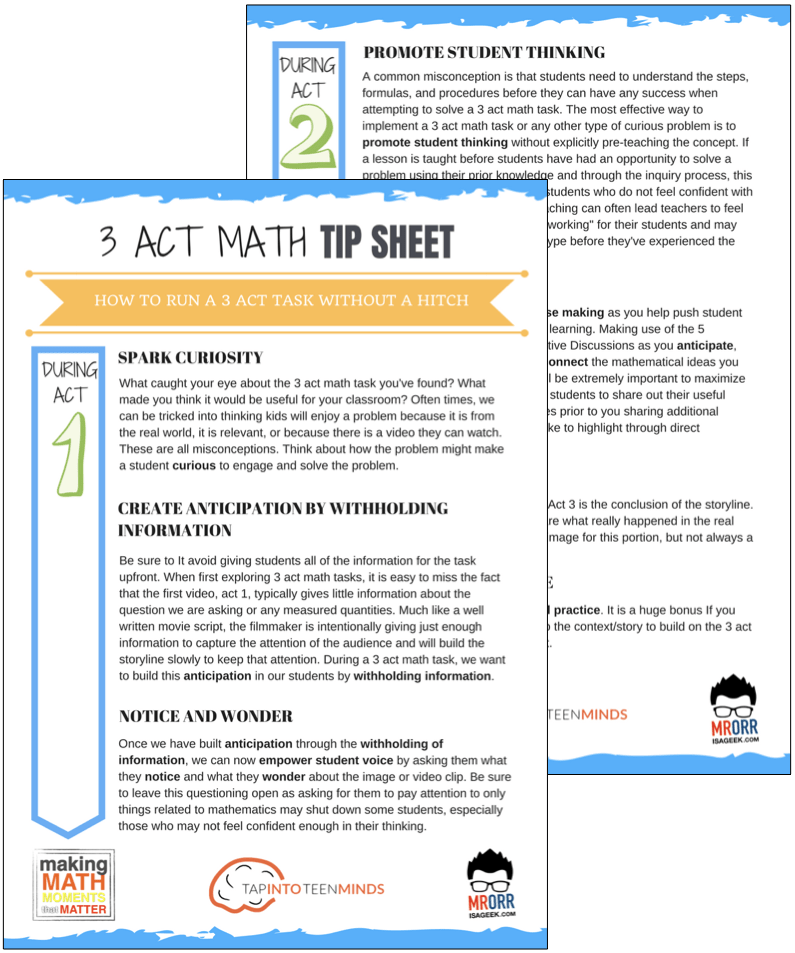
DOWNLOAD THE 3 ACT MATH TASK TIP SHEET SO THEY RUN WITHOUT A HITCH!
Download the 2-page printable 3 Act Math Tip Sheet to ensure that you have the best start to your journey using 3 Act math Tasks to spark curiosity and fuel sense making in your math classroom!
LESSONS TO MAKE MATH MOMENTS
Each lesson consists of:
Each Make Math Moments Problem Based Lesson consists of a Teacher Guide to lead you step-by-step through the planning process to ensure your lesson runs without a hitch!
Each Teacher Guide consists of:
- Intentionality of the lesson;
- A step-by-step walk through of each phase of the lesson;
- Visuals, animations, and videos unpacking big ideas, strategies, and models we intend to emerge during the lesson;
- Sample student approaches to assist in anticipating what your students might do;
- Resources and downloads including Keynote, Powerpoint, Media Files, and Teacher Guide printable PDF; and,
- Much more!
Each Make Math Moments Problem Based Lesson begins with a story, visual, video, or other method to Spark Curiosity through context.
Students will often Notice and Wonder before making an estimate to draw them in and invest in the problem.
After student voice has been heard and acknowledged, we will set students off on a Productive Struggle via a prompt related to the Spark context.
These prompts are given each lesson with the following conditions:
- No calculators are to be used; and,
- Students are to focus on how they can convince their math community that their solution is valid.
Students are left to engage in a productive struggle as the facilitator circulates to observe and engage in conversation as a means of assessing formatively.
The facilitator is instructed through the Teacher Guide on what specific strategies and models could be used to make connections and consolidate the learning from the lesson.
Often times, animations and walk through videos are provided in the Teacher Guide to assist with planning and delivering the consolidation.
A review image, video, or animation is provided as a conclusion to the task from the lesson.
While this might feel like a natural ending to the context students have been exploring, it is just the beginning as we look to leverage this context via extensions and additional lessons to dig deeper.
At the end of each lesson, consolidation prompts and/or extensions are crafted for students to purposefully practice and demonstrate their current understanding.
Facilitators are encouraged to collect these consolidation prompts as a means to engage in the assessment process and inform next moves for instruction.
In multi-day units of study, Math Talks are crafted to help build on the thinking from the previous day and build towards the next step in the developmental progression of the concept(s) we are exploring.
Each Math Talk is constructed as a string of related problems that build with intentionality to emerge specific big ideas, strategies, and mathematical models.
Make Math Moments Problem Based Lessons and Day 1 Teacher Guides are openly available for you to leverage and use with your students without becoming a Make Math Moments Academy Member.
Use our OPEN ACCESS multi-day problem based units!
Make Math Moments Problem Based Lessons and Day 1 Teacher Guides are openly available for you to leverage and use with your students without becoming a Make Math Moments Academy Member.
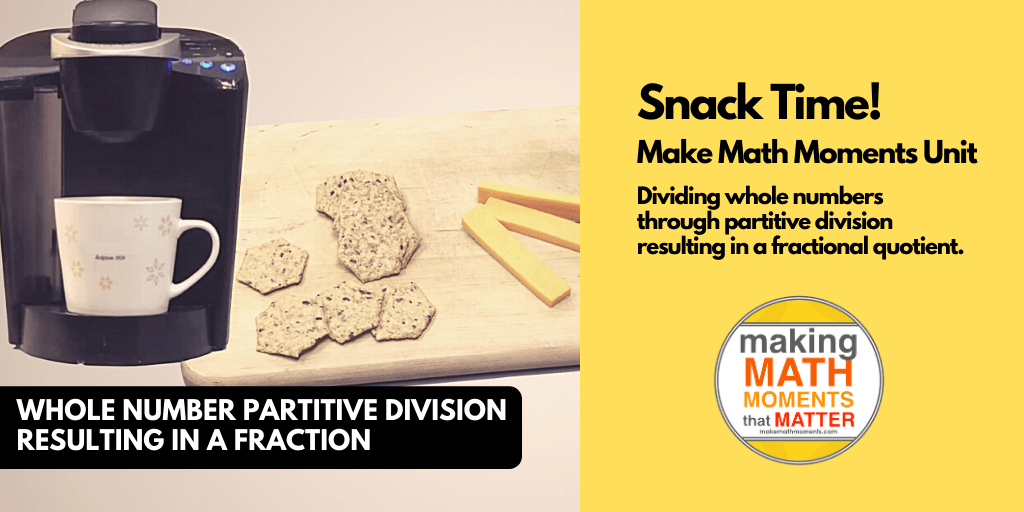
Partitive Division Resulting in a Fraction
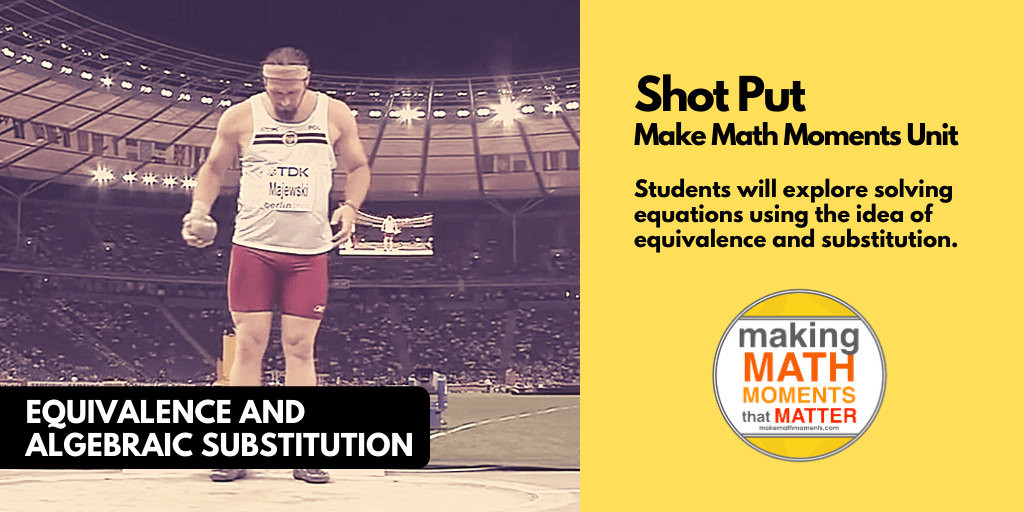
Equivalence and Algebraic Substitution
Represent Categorical Data & Explore Mean
Downloadable resources including blackline masters, handouts, printable Tips Sheets, slide shows, and media files do require a Make Math Moments Academy Membership.
ONLINE WORKSHOP REGISTRATION
Pedagogically aligned for teachers of K through Grade 12 with content specific examples from Grades 3 through Grade 10.
In our self-paced, 12-week Online Workshop, you'll learn how to craft new and transform your current lessons to Spark Curiosity, Fuel Sense Making, and Ignite Your Teacher Moves to promote resilient problem solvers.

0 Comments