Episode #487: Why Teaching Math Is Hard—and Improving Achievement Is Even Harder
LISTEN NOW HERE…



WATCH NOW…
Why do so many mathematics improvement efforts begin with energy and optimism, only to lose momentum months later? Schools invest in professional learning, adopt high-quality instructional materials, launch coaching cycles, and create pacing guides—yet lasting instructional change often remains frustratingly elusive.
In this episode, we revisit Alan Schoenfeld’s influential article, Why Are Learning and Teaching Mathematics So Difficult?, through the lens of school and district leadership. His framework reveals that improving mathematics isn’t simply a classroom challenge—it’s a systems challenge. We explore why teacher understanding, coherent learning environments, and organizational structures must work together to create lasting change. Along the way, we connect Schoenfeld’s ideas to concepts like the Math Improvement Flywheel, leading indicators, distributed leadership, and coherent systems that continue improving even as people move through them.
In this episode, you’ll explore:
- Alan Schoenfeld’s three-circle framework for mathematics education
- Why deep mathematical understanding matters more than instructional moves alone
- How systemic coherence supports stronger classroom practice
- The difference between leading and lagging indicators of improvement
- Why distributed leadership creates more sustainable math improvement
- How the Math Improvement Flywheel helps systems build lasting momentum
- Questions every math leader should ask before launching another initiative
If you’re leading mathematics improvement in a school or district, this episode will help you evaluate your current improvement strategy, identify where momentum is being lost, and build the systems needed for long-term success.
Attention District Math Leaders:
K-12 Math Leaders: Download our free Math Coherence Compass to help your teammates, system leaders, and educators create aligned instructional practices—without adding another initiative.
K-12 Math Leaders: Not sure what matters most when designing math improvement plans? Take this assessment and get a free customized report: https://makemathmoments.com/grow/
K-12 Math Leaders: Ready to design your math improvement plan with guidance, support and using structure? Learn how to partner with us and follow our 4 stage process. https://growyourmathprogram.com
Looking to supplement your curriculum with problem based lessons and units? Make Math Moments Problem Based Lessons & Units
Be Our Next Podcast Guest!
Join as an Interview Guest or on a Mentoring Moment Call
Apply to be a Featured Interview Guest
Book a Mentoring Moment Coaching Call
Are You an Official Math Moment Maker?


FULL TRANSCRIPT
Jon Orr: Let me start this episode with a question. It’s possible you’ve done the workshops as a math leader. You’ve bought your program, you built the pacing guides, you scheduled the coaching cycles, and you launched a new initiative with a strong push in the new year. So when September and October, November roll by, why does it feel like the whole thing is already slipping through your fingers.
Jon Orr: If you lead math across a school or school district, I want you to know something up front here. It’s not because you’re not working hard enough. Let’s be clear there for sure. It’s not because your teachers don’t care. We know teachers care. The reason your hardest improvement efforts keep stalling or failing to stick is actually buried in a research paper from one of the most respected names of math education. And once you see it, you can’t unsee it. And that’s what today’s episode is about.
Jon Orr: We are unpacking Alan Schoenfield’s article, Why Are Learning and Teaching Mathematics So Difficult? But we’ve talked about this before on previous episodes. We’ve written a blog post on it a number of years ago. But we’re reading it here today through a lens of a leader, of a math coordinator, a math coach. And that’s what we want to talk about here today. As leaders, this is an important article. Because when you do that, this paper stops being about why teaching math is just hard. And it starts being an actual blueprint for why improving math across a system, a school system, or a district, or even a state is hard and what you can actually do about it.
Jon Orr: So stick with us because by the end of this episode, you’ll have a way to look at your entire math improvement plan and know exactly which part of it is built to last and which part is going to collapse the second a key person walks out the door.
Jon Orr: So here’s where Schoenfeld starts. He opens with an idea from a mathematician named Hans Freudenthal, who once quoted that the math most kids do here in school systems, and I love this phrase, is the fossilized remains of real mathematical thinking. Think about that. A fossil, a dried-out skeleton of something that used to be alive. We hand students the literal bones of mathematics, the procedures, the definitions, the steps, but we’ve stripped out the living, the breathing, the reasoning that created those bones in the first place.
Jon Orr: Schoenfeld says math is hard to teach and learn for three big reasons. And he pictures them as three circles, one inside the other. The student is in the middle, then the outside circle from there is the classroom around that student, and then the whole society around that classroom. So circle one is — he calls it thinking mathematically, what it actually means to do math in a classroom or just to do math. Circle two is the learning environment around that student, the classroom conditions that let kids think. And circle three is the cultural surround, the systems and equities that shape everything on the inside.
Jon Orr: Now, Schoenfeld wrote those three circles for teachers, researchers, educators, leaders. But our claim here today — every single one of those three difficulties is at its core a system problem. And not just a classroom problem. And that means you can’t solve any of them with one more initiative or one more PD day or one more passionate person caring about the whole thing or carrying that on their back. You solve them, the problems, why it’s hard, by building a flywheel and plan. And we’ll get there. We’ll talk about that. And if you’ve listened to the podcast before, you probably heard us talk about the flywheel. We’re also going to talk about a Ferris wheel. But let’s talk about those circles from the article one at a time.
Jon Orr: Circle one was thinking mathematically. Schoenfeld’s argument here is that real mathematical thinking has four ingredients. There’s the resources — that’s your content knowledge, and the practices of doing math. There’s problem solving strategies, this is like the polya-style moves for an unfamiliar problem. There’s metacognition, monitoring your own thinking. And then there’s belief systems, whether you even believe math is something you’re allowed to make sense of. And his point in the article is brutal. Most school math lives almost entirely in that first bucket. And even there, it’s mostly content coverage with the actual mathematical practices treated like a bonus round, you know — well, if we get to it, we’ll get to the actual thinking and understanding if there’s time.
Jon Orr: So here’s the leadership question. If you walked into any classroom in your system tomorrow, how many of those four ingredients do you actually see? Now here’s the part that matters for you as a leader as well. It’s really easy to hear this and think, okay, my teachers need better content knowledge and they’ll need better pedagogy. This is true. But go one level deeper. Schoenfeld says something a little devastating — that teachers themselves often haven’t had the chance to experience math as a sense-making activity. And the supports to build that, in his words, are few and far between.
Jon Orr: This is where so many improvement plans crack. We talk with leaders every day across North America about what their plans look like and how to strategize around them. Many plans prioritize discourse or problem-based learning and you train teachers on those moves — those visible routines — without ever deepening their own understanding of the math underneath. We call that a pedagogy first fragility. Teachers pick up moves, but because their understanding is shallow, the whole thing falls apart the minute the coach leaves the room or the calendar flips to a new year or we look at a new topic.
Jon Orr: The fix isn’t better workshops. It’s building capacity routinely through real conceptual understanding, practice, deep learning, and that’s not just an event. It’s not just one time. That’s a system where each layer of learning connects to the next and compounds.
Jon Orr: Okay, circle two: the learning environment. Schoenfeld has this line. He says math classrooms are the primary locales in which pupils’ mathematical identities are shaped. That’s a heavy sentence. The classroom isn’t just where kids learn skills, it’s where they decide whether they’re a math person.
Jon Orr: He gives us five dimensions of a classroom that actually builds robust thinkers. Here they are. The richness of the math itself. The cognitive demand, or the productive struggle, is important. Equitable access — every kid is engaged, not just the confident few. Agency and identity, kids making math their own. And finally, formative assessment. Students thinking out in the open with teachers responding in the moment.
Jon Orr: Now, here’s what I want you to catch. Schoenfeld admits doing all five of these at once is, in his words, an extremely demanding task. And then he says it’s demanding even under supporting conditions. And listen to the conditions he lists. Well designed curricula, aligned assessment, effective PD, consistent policy messages. That’s not a list of just good classroom features. That’s a description of actually a coherent system. And he’s admitting most teachers don’t have access to one.
Jon Orr: This is the thing we see in district after district. It is almost never a lack of effort or good ideas. It’s that the good ideas don’t connect. One school is deep into building thinking classrooms and another is all into number talks, a third’s on mid-assessment redesign, everybody’s working hard, nobody’s working in the same direction. We call this systemic misalignment. And here’s the tell: the number one thing you hear from teachers is I don’t have time. But that’s almost never really about the time. What they’re actually saying is I don’t see how this thing helps enough to be worth my time yet. And that’s not resistance. That’s a signal that the system is asking them to spread thinly across ten priorities instead of going deep on one.
Jon Orr: Schoenfeld’s five dimensions cannot be held up by individual teachers being heroic. They need a system where the curriculum, the PD, the coaching, and the walkthroughs all point to the same set of priorities. So growth can compound instead of being scattered.
Jon Orr: Okay, circle three. The cultural surround, the biggest circle, the whole society pressing in on this classroom. Schoenfeld names two forces here. One is resource allocation, and he drops a statistic that should make us step back a little. Teacher turnover rates are ninety percent higher in the schools serving the highest concentrations of students of color than in the schools serving the lowest. 90%. The second force is societal bias, how kids get positioned by their peers, their teachers, as either capable or not, and how that decides who gets access to rich math and who gets sidelined.
Jon Orr: Now, as a leader, that third circle surfaces two barriers that sink improvement plans. And I want to name both. One is the measurement problem. Schoenfeld says assessment too often fails to focus on thinking. And the same thing is true at the system level. How do most districts measure whether their math is improving? Well, they look at year-end standardized tests. But that score shows up late. It’s disconnected. It’s clouded by stuff you don’t actually control. Different kids, different test items, the natural lag between something and seeing it on a test. So even when the scores go up, you can’t actually tell why. Was it the new approach, the coaching, the curriculum? Was it the systemic misalignment? Was it some of the decisions around placement? When it goes down, it’s the same fog. That’s the trap of measuring only lagging indicators. You’re driving the whole system staring into the rear view mirror.
Jon Orr: The shift that we need to change here is measuring leading indicators, the stuff you can actually see week to week, not every spring. Are problem strings actually happening weekly? Are PLCs analyzing real student thinking? Are coaching cycles getting finished? Those predict your outcomes way more reliably than a June test score. And they let you steer during the year instead of doing an autopsy after it’s over.
Jon Orr: All right, here’s barrier two. The sustainability problem. This is the one Schoenfeld circles. He never really quite says out loud, but most improvement plans depend on a person — a passionate educator, a passionate coordinator, a great coach, a principal who finally gets it. And given the turnover he just documented, people move constantly. The second that person changes roles, the work collapses. The wheel resets to zero. No one has ownership here. And if they do, it’s gone.
Jon Orr: The fix is distributed leadership. That’s what we recommend to our teams. A structure where coaches, math leads, and administrators each hold a defined role inside a documented, repeatable system where a new hire can walk in mid-year and figure out where they fit because the supports are written down, they’re embedded, they’re not living in one person’s head. We’ve got a team that runs and supports math instruction and math improvement, not just one person or two people.
Jon Orr: Here’s the metaphor we keep coming back to. There’s a difference between a flywheel and a Ferris wheel, where a Ferris wheel needs constant power, but people are constantly getting on and off. And when we start planning for the Ferris wheel we actually have, but align things like a flywheel, this is where we start to see improvement. And anybody can step up to give it the next push on that flywheel.
Jon Orr: So now step back and look at all three circles for a sec. Because here’s the thing that ties this whole episode up. Circle one told us teacher understanding, not just strategies, is what makes instruction durable. Circle two told us those five dimensions only survive inside a coherent aligned system. Circle three tells us that without the right measures and without distributive leadership, the whole thing stays fragile and resets every single year. And what do all three have in common? Not one of them get solved by working harder. They get solved by building a system where the right work compounds. That’s what we mean by math improvement flywheel.
Jon Orr: The idea comes from — we’ve said before here on the podcast — Jim Collins in the book Good to Great. A flywheel is this massive, heavy wheel. The first push is brutal, almost nothing moves, but you push consistently in the same direction over and over, and each push builds on the last until one day it’s spinning with momentum on its own. No single push could ever explain that momentum.
Jon Orr: We break that flywheel here at Make Math Moments into four parts and let’s watch how each answers a Schoenfeld problem. Design and measure, which is the first stage of the flywheel — we define what great math teaching looks like, we measure with leading indicators, not just test scores. That’s the answer to the measurement problem. The second phase or stage is align and sustain. Build the PD, the coaching, the PLC structures that point everyone in the same direction. So those five dimensions that Schoenfeld talked about can actually take root. That’s your answer to the systemic misalignment.
Jon Orr: Build capacity is the third component. Deepen teachers’ own mathematical proficiency and understanding from the inside, not just their toolkit of moves and their pedagogy. That’s your answer to the pedagogy first fragility. Fourth component of the flywheel is inspire growth. Which is celebrate what works, write it down, distributive leadership so it outlasts any one person. Build your codified Rolodex of activities, strategies. This is where math improvement lives. This is what it looks like. That’s your answer to the sustainability problem.
Jon Orr: And when all four turn together, each rotation makes the next one easier. Focus drives alignment, alignment makes your measurement meaningful, good measurement drives effective PD and the learning deepens focus all over again. The wheel turns itself.
Jon Orr: Schoenfeld ends the paper pretty soberly. He says, the challenges are clear and there is much to be done. And he’s right. The fossilized math, the demanding classroom, the inequitable world around it. None of that is simple. And many people are trying to solve a complex problem with simple ideas. And that’s not how you want to do that.
Jon Orr: But here’s what his research makes clear: the second you read it as a leader, you do not have to solve all three circles at once. And you definitely don’t have to solve them through sheer force of will. You’ve got about a hundred and eighty instructional days a year. That’s it. Without a system, it’s so easy to land next fall in the exact same spot you are now. Tired, unsure, waiting for the test scores that won’t show up until the next year’s already gone.
Jon Orr: So before you pick next year’s initiative, I want to leave you with a question and maybe pause the episode and actually take some time to answer it. If you stepped away tomorrow, which part of your math improvement would keep moving and which would stop? Because whatever would stop, that’s the part of your flywheel you haven’t built yet.
Jon Orr: If you want to figure out exactly where your system is gaining traction and where it still is just spinning, we built a short district math improvement assessment. It’ll give you a free customized plan across six areas that matter most. We use that with the teams. Thousands of leaders have used that across North America. And if you want the simple decision-making tool we use with districts all over North America as well, which actually we use to keep everyone aligned, grab our math coherence compass template. Both links are in the description below — the assessment, and then also the math coherence compass template. Thanks for hanging out with us here today. Keep building that wheel. We’ll see you next time.
Thanks For Listening
- Book a Math Mentoring Moment
- Apply to be a Featured Interview Guest
- Leave a note in the comment section below.
- Share this show on Twitter, or Facebook.
To help out the show:
- Leave an honest review on iTunes. Your ratings and reviews really help and we read each one.
- Subscribe on iTunes, Google Play, and Spotify.
DOWNLOAD THE 3 ACT MATH TASK TIP SHEET SO THEY RUN WITHOUT A HITCH!
Download the 2-page printable 3 Act Math Tip Sheet to ensure that you have the best start to your journey using 3 Act math Tasks to spark curiosity and fuel sense making in your math classroom!

LESSONS TO MAKE MATH MOMENTS
Each lesson consists of:
Each Make Math Moments Problem Based Lesson consists of a Teacher Guide to lead you step-by-step through the planning process to ensure your lesson runs without a hitch!
Each Teacher Guide consists of:
- Intentionality of the lesson;
- A step-by-step walk through of each phase of the lesson;
- Visuals, animations, and videos unpacking big ideas, strategies, and models we intend to emerge during the lesson;
- Sample student approaches to assist in anticipating what your students might do;
- Resources and downloads including Keynote, Powerpoint, Media Files, and Teacher Guide printable PDF; and,
- Much more!
Each Make Math Moments Problem Based Lesson begins with a story, visual, video, or other method to Spark Curiosity through context.
Students will often Notice and Wonder before making an estimate to draw them in and invest in the problem.
After student voice has been heard and acknowledged, we will set students off on a Productive Struggle via a prompt related to the Spark context.
These prompts are given each lesson with the following conditions:
- No calculators are to be used; and,
- Students are to focus on how they can convince their math community that their solution is valid.
Students are left to engage in a productive struggle as the facilitator circulates to observe and engage in conversation as a means of assessing formatively.
The facilitator is instructed through the Teacher Guide on what specific strategies and models could be used to make connections and consolidate the learning from the lesson.
Often times, animations and walk through videos are provided in the Teacher Guide to assist with planning and delivering the consolidation.
A review image, video, or animation is provided as a conclusion to the task from the lesson.
While this might feel like a natural ending to the context students have been exploring, it is just the beginning as we look to leverage this context via extensions and additional lessons to dig deeper.
At the end of each lesson, consolidation prompts and/or extensions are crafted for students to purposefully practice and demonstrate their current understanding.
Facilitators are encouraged to collect these consolidation prompts as a means to engage in the assessment process and inform next moves for instruction.
In multi-day units of study, Math Talks are crafted to help build on the thinking from the previous day and build towards the next step in the developmental progression of the concept(s) we are exploring.
Each Math Talk is constructed as a string of related problems that build with intentionality to emerge specific big ideas, strategies, and mathematical models.
Make Math Moments Problem Based Lessons and Day 1 Teacher Guides are openly available for you to leverage and use with your students without becoming a Make Math Moments Academy Member.
Use our OPEN ACCESS multi-day problem based units!
Make Math Moments Problem Based Lessons and Day 1 Teacher Guides are openly available for you to leverage and use with your students without becoming a Make Math Moments Academy Member.
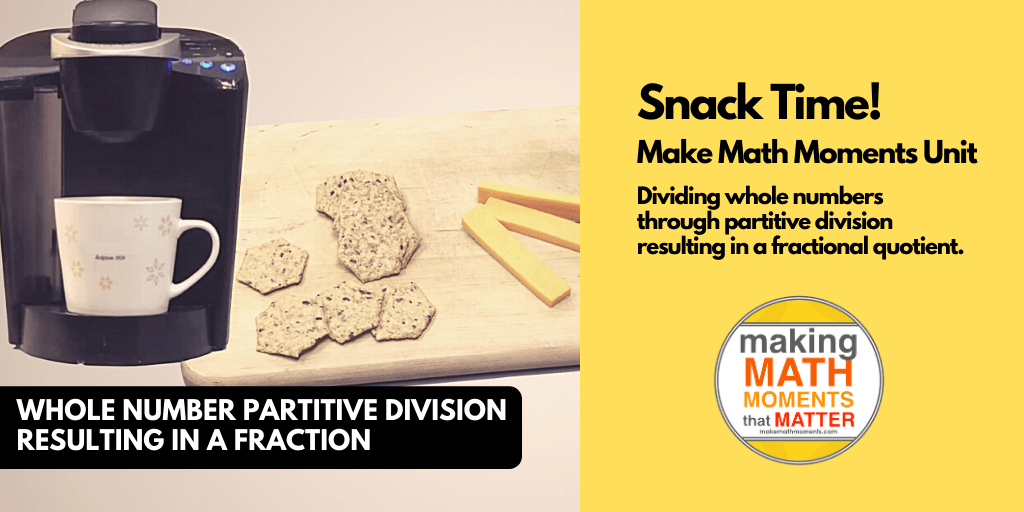
Partitive Division Resulting in a Fraction

Equivalence and Algebraic Substitution
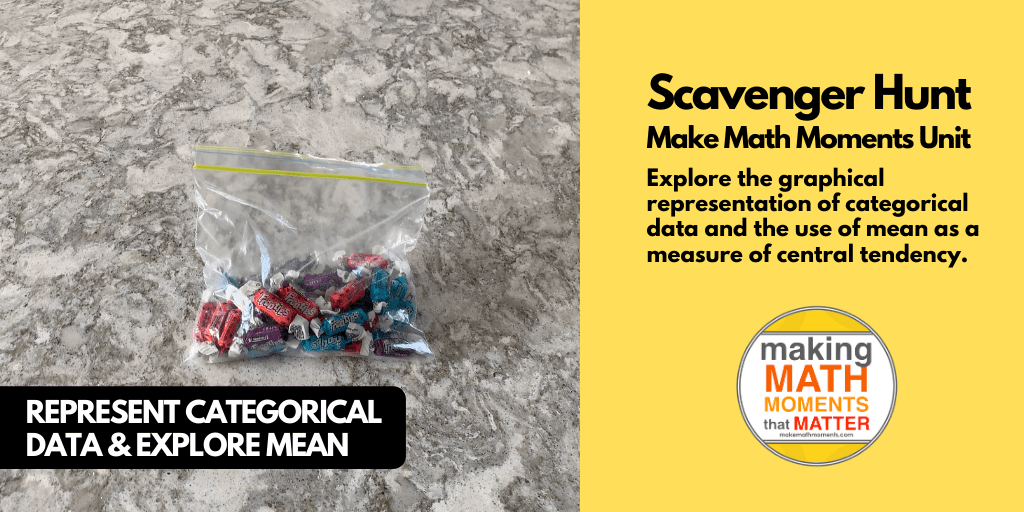
Represent Categorical Data & Explore Mean
Downloadable resources including blackline masters, handouts, printable Tips Sheets, slide shows, and media files do require a Make Math Moments Academy Membership.
ONLINE WORKSHOP REGISTRATION

Pedagogically aligned for teachers of K through Grade 12 with content specific examples from Grades 3 through Grade 10.
In our self-paced, 12-week Online Workshop, you'll learn how to craft new and transform your current lessons to Spark Curiosity, Fuel Sense Making, and Ignite Your Teacher Moves to promote resilient problem solvers.
0 Comments